Showing posts with label 1997. Show all posts

Friday, December 31, 2021

[Ichthyology • 2021] Osteology of Tucanoichthys tucano Géry & Römer, An Enigmatic Miniature Fish (Characiformes: Characidae) from the Amazon Basin, Brazil


Tucanoichthys tucano Géry & Römer, 1997

in Mattox & Conway, 2021.  

Abstract
Miniaturization, the evolution of extremely small adult body size, is a common phenomenon across the lineages of freshwater fishes, especially in the Neotropics where over 200 species are considered miniature (≤26 mm in standard length [SL]). Close to 30% of all miniature Neotropical freshwater fishes belong to the family Characidae, several of which are of uncertain phylogenetic placement within the family. We investigate the skeletal anatomy of Tucanoichthys tucano, a species of uncertain phylogenetic position from the upper Rio Negro basin, reaching a maximum known size of 16.6 mm SL. The skeleton of Tucanoichthys is characterized by the complete absence of ten skeletal elements and marked reduction in size and/or complexity of others, especially those elements associated with the cephalic latero-sensory canal system. Missing elements in the skeleton of Tucanoichthys include those that develop relatively late in the ossification sequence of the non-miniature characiform Salminus brasiliensis, suggesting that their absence in Tucanoichthys can be explained by a simple scenario of developmental truncation. A number of the reductions in the skeleton of Tucanoichthys are shared with other miniature characiforms, most notably species of Priocharax and Tyttobrycon, the latter a putative close relative of Tucanoichthys based on molecular data.

Keywords: developmental truncation, miniaturization, Neotropics, Priocharax, skeleton, Tyttobrycon
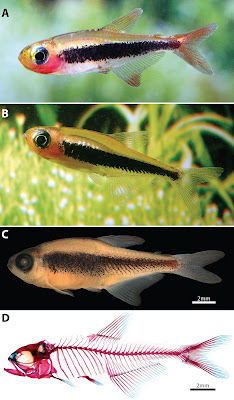

Tucanoichthys tucano.
 A. Male in life, photographed in aquarium, not measured, not preserved (photo by F. Schäfer).
 B. Female in life, photographed in aquarium, not measured, not preserved (photo by F. Schäfer).
C. TCWC 20316.02, 15.2 mm SL, alcohol preserved specimen.
D. TCWC 20316.01, 15.5 mm SL, c&s specimen, lateral view of whole skeleton (hyopalatine arch, opercular series and shoulder girdle of right side, and gill arches removed).


 George M. T. Mattox and Kevin W. Conway. 2021. Osteology of Tucanoichthys tucano Géry and Römer, An Enigmatic Miniature Fish from the Amazon Basin, Brazil (Teleostei: Characiformes: Characidae). Vertebrate Zoology. 71: 645-667. DOI: 10.3897/vz.71.e71886

Thursday, November 25, 2021

[Paleontology • 2021] Kyhytysuka sachicarum • Re-appearance of Hypercarnivore Ichthyosaurs in the Cretaceous with Differentiated Dentition: Revision of ‘Platypterygiussachicarum (Ichthyosauria, Ophthalmosauridae) from Colombia


Kyhytysuka sachicarum (Páramo, 1997) 

in Cortés, Maxwell & Larsson, 2021

Abstract
Early Cretaceous ichthyosaur diversity has markedly increased in recent years with the discovery of new taxa in the field and in museum collections. This has led to new characters, and a better understanding of taxonomically informative anatomy. Here, we re-describe the holotype of the ophthalmosaurid Platypterygius sachicarum from the Barremian–Aptian of Colombia and place these data in a phylogenetic context. The validity of the species is supported by several new characters of the narial region, mandible and dentition. The dentition is unique among ichthyosaurs in that it presents several discrete tooth morphologies that range from piercing to cutting to crushing. In combination, these cranial specializations imply a large vertebrate diet and make this taxon the first Cretaceous hypercarnivorous ichthyosaur. Differences from the type species of Platypterygius, P. platydactylus, include a suite of characters associated with differing feeding ecologies and the complex external nares. The large number of character differences and revised phylogenetic relationships are used to remove the Colombian taxon from Platypterygius and recognize it as a new genus, Kyhytysuka sachicarum comb. nov. A revised set of taxonomic definitions are proposed for Ophthalmosauria to maintain stability at this important node. Kyhytysuka sachicarum opens new questions regarding the diversity and paleobiogeography of Early Cretaceous ichthyosaurs from northern Gondwana and highlights the importance of individually assessing each ‘Platypterygius’ species and, potentially, specimen to better understand the diversity of this broadly distributed taxon.
 
Keywords: Platypterygius sachicarum, Ophthalmosauridae, Early Cretaceous, South America, Colombia, Paja Formation


Dirley Cortés, Erin E. Maxwell and Hans C. E. Larsson. 2021. Re-appearance of Hypercarnivore Ichthyosaurs in the Cretaceous with Differentiated Dentition: Revision of ‘Platypterygiussachicarum (Reptilia: Ichthyosauria, Ophthalmosauridae) from Colombia. Journal of Systematic Palaeontology. DOI: 10.1080/14772019.2021.1989507 


Thursday, February 27, 2020

[PaleoMammalogy • 2020] Lekaneleo, A New Genus of Marsupial Lion (Marsupialia, Thylacoleonidae) from the Oligocene–Miocene of Australia, and the Craniodental Morphology of L. roskellyae, comb. nov.


 Lekaneleo roskellyae Gillespie, 1997

in Gillespie, Archer & Hand, 2020.
Original artwork by Peter Schouten.

ABSTRACT
The domestic cat-sized marsupial lion Priscileo roskellyae (Thylacoleonidae) from the Oligocene–Miocene of Australia was originally allocated to the genus Priscileo Rauscher, 1987, on the basis of its plesiomorphic upper dental formula of three premolars and four molars and its relatively small size. Recent reassignment of the Priscileo type species P. pitikantensis to the genus Wakaleo has now necessitated establishment of a new generic name for the species roskellyae Gillespie, 1997. In contrast to W. pitikantensis, which is only known from a fragmented palate and associated postcranial elements, the skull and lower dentition of P. roskellyae, described here, exhibit features that support its generic distinction within Thylacoleonidae. It is renamed here Lekaneleo roskellyae, comb. nov. Distinctive craniodental features include small sagittal and nuchal crests, lack of a prominent rostral tympanic process on the periotic, lack of alisphenopalatine pterygoid processes, a stylomastoid sulcus that courses through the mastoid, three teeth between i1 and p3, and very broad talonid basins on the lower molars. In contrast to species of Wakaleo, which appear to form a morphocline during the late Oligocene and early Miocene, L. roskellyae is a relatively conservative taxon, exhibiting no discernible change over the same interval of time.

SYSTEMATIC PALEONTOLOGY 
Class MARSUPIALIA Illiger, 1811 
Order DIPROTODONTIA Owen, 1866 
Suborder VOMBATIFORMES Woodburne, 1984 

Family THYLACOLEONIDAE Gill, 1872 

LEKANELEO, gen. nov. 
Type and Only Species— Lekaneleo roskellyaecomb. nov.

Etymology— ‘lekane’ is derived from Greek meaning ‘basin’ and refers to the broad talonid basins present on the lower molars; ‘leo,’ which is Latin for ‘lion,’ is the stem term for all members of the family Thylacoleonidae. The genus is assigned feminine gender.

LEKANELEO ROSKELLYAEcomb. nov. 
Priscileo roskellyae Gillespie, 1997: figs. 1–3.

Reconstruction of  Lekaneleo roskellyae hunting in the early Miocene rainforest at Riversleigh in northwestern Queensland
(Original artwork by Peter Schouten).


Anna K. Gillespie, Michael Archer and Suzanne J. Hand. 2020. Lekaneleo, A New Genus of Marsupial Lion (Marsupialia, Thylacoleonidae) from the Oligocene–Miocene of Australia, and the Craniodental Morphology of L. roskellyae, comb. nov. Journal of Vertebrate Paleontology.  DOI: 10.1080/02724634.2019.1703722


Thursday, October 10, 2019

[Herpetology • 2019] Raorchestes sanctisilvaticus“Endangered or An Artifact of Unsound Taxonomy? Case of the Critically Endangered Bush Frog Philautus sanctisilvaticus Das and Chanda, 1997


 Crigered Bush Frog  Raorchestes sanctisilvaticus (Das & Chanda, 1997)


in Mirza, Warekar, Mohapatra, et al., 2019.

Abstract
We investigated the phylogenetic relationship of the Critically Endangered bush frog Philautus sanctisilvaticus Das and Chanda, 1997 and other species distributed across the fragmented forests of Deccan Peninsula and the northern Eastern Ghats. A short fragment of the mitochondrial 16S rRNA gene was employed to assess phylogenetic relationships across Philautus sanctisilvaticus Das and Chanda, 1997, Raorchestes terebrans (Das and Chanda, 1998) and Philautus similipalensis Dutta, 2003. All sequenced specimens, including material from near the type localities of P. sanctisilvaticus (Amarkantak) and P. similipalensis (Simlipal) were genetically extremely similar, with pairwise uncorrected distances <1% in the 16S gene, and were phylogenetically placed within the genus Raorchestes. The results based on morphology are ambiguous and do not go hand in hand with molecular data, which however do not provide support for a three species hypothesis either. our findings advocate the need for making nomenclatural amendments. Philautus sanctisilvaticus Das and Chanda, 1997, is the first available nomen for this taxon, and we propose to include this species in Raorchestes as Raorchestes sanctisilvaticus (Das and Chanda, 1997), and to consider the nomina Philautus terebrans Das and Chanda, 1998 syn. nov. and Philautus similipalensis Dutta, 2003 syn. nov. as junior subjective synonyms for this nomen following the Principle of Priority in article 23.1 of the ICZN. The findings are notable from the point of conservation of the species and present a novel case with remarkable genetic homogeneity across the fragmented forests of Deccan Peninsula and Eastern Ghats.

Keywords: Amphibia, IUCN, Critically Endangered, conservation, Amphibia, Anura, taxonomy, 16S, phylogeny, Philautus terebrans syn. nov., Philautus similipalensis syn. nov.


FIGURE 3. Map of eastern India showing collection localities of three species of the genus Raorchestes.


FIGURE 5. Maximum likelihood phylogeny of members of the “Bombayensis” clade of Raorchestes base on 16S rRNA gene reconstructed through 1000 non-parametric bootstrap replicates. Numbers at nodes represent bootstrap support and Bayesian posterior probability.
Inset image of Raorchestes sanctisilvaticus from Kanger Valley National Park, Chhattisgarh.

Conclusion:
The bush frogs studied herein, distributed in the northern part of the Eastern Ghats and the Deccan Peninsula, probably represent a single species, to be allocated to Raorchestes sanctisilvaticus. The species, according to the taxonomic hypothesis herein, is locally abundant and can be met within forests across eastern Madhya Pradesh, Chhattisgarh, Odisha, eastern Telangana and northern Andhra Pradesh along an altitudinal gradient of 500–1700 m asl. The current distribution hints on its possible presence in Jharkhand and maybe West Bengal.


Zeeshan A. Mirza , Priya Warekar, Pratyush P. Mohapatra, David Raju, Pranad Patil, Sushil K. Dutta and Saunak Pal. 2019. “Endangered or An Artifact of Unsound Taxonomy? Case of the Critically Endangered Bush Frog Philautus sanctisilvaticus Das and Chanda, 1997”. Zootaxa. 4683(4); 563–576. DOI: 10.11646/zootaxa.4683.4.6 

Monday, January 14, 2013

[Paleontology • 2004] Rinchenia mongoliensis | originally Oviraptor mongoliensis Barsbold, 1986 • Mongolian oviraptorid dinosaur from the late Cretaceous Period


Genus: Rinchenia Osmólska, Currie & Barsbold, 2004 

Species: Rinchenia mongoliensis (Barsbold, 1986) 
Synonyms Oviraptor mongoliensis Barsbold, 1986

Rinchenia is a genus of Mongolian oviraptorid dinosaur from the late Cretaceous Period. The type (and only known) species, Rinchenia mongoliensis, was originally classified as a species within the genus Oviraptor (named Oviraptor mongoliensis by Rinchen Barsbold in 1986), but a re-examination by Barsbold in 1997 found differences significant enough to warrant a separate genus. 

The name Rinchenia was coined for this new genus by Barsbold in 1997, though he did not describe it in detail, and the name remained a nomen nudum until used by Osmólska et al. in 2004.


Osmólska, H., Currie, P. J., and Barsbold, R. 2004. "Oviraptorosauria." In: Weishampel, D.B., Dodson, P., and Osmólska, H. (eds.), The Dinosauria, Second Edition. California University Press, 165-183.

Friday, August 31, 2012

[Ornithology • 1997] New birds in Africa: the last 50 years


CHRONOLOGY OF BIRD DISCOVERIES 
IN AFRICA 1946–1995

The dates refer to the years in which the species were described to science, not to the years in which they were first found or collected.

1946   Roberts’ Prinia Prinia robertsi, Zimbabwe
1947 Fox’s Weaver Ploceus spekeoides, Uganda
1949 White-throated Mountain Babbler Kupeornis gilberti, Cameroon

1951 Mount Kupé Bush ShrikeTelephorus kupeensis, Cameroon
1952 Djibouti Francolin Francolinus ochropectus, Djibouti 
Congo Bay Owl Phodilus prigoginei, Zaïre
1955 Kabobo Apalis Apalis kaboboensis, Zaïre  
Short-billed Crombec Sylvietta philippae, Somalia  
White-headed Robin-Chat Cossypha heinrichi, Angola
1956 Williams’ Lark Mirafra williamsi, Kenya
1957 Angola Helmetshrike Prionops gabela, Angola 
Gabela Akalat Sheppardia gabela, Angola
1958 Dwarf Honeyguide Indicator pumilio, Zaïre 
Ibadan Malimbe Malimbus ibadanensis, Nigeria

1960 Lemon-breasted Canary Serinus citrinipectus, Mozambique
Schouteden’s Swift Schoutedenapus schoutedenapus, Zaïre
1965 White-chested Tinkerbird Pogoniulus makawai, Zambia
1966 Sokoke Scops Owl Otus ireneae, Kenya
1967 Prigogine’s Greenbul Chlorocichla prigoginei, Zaïre 
Tana River Cisticola Cisticola restrictus, Kenya

1970 Nimba Flycatcher Melaenornis annamarulae, Liberia
1974 River Prinia Prinia fluviatilis, Chad 
Gola Malimbe Malimbus ballmani, Ivory Coast
1975 Sidamo Lark Mirafra sidamoensis, Ethiopia 
Degodi Lark Mirafra degodiensis, Ethiopia
1976 Algerian Nuthatch Sitta ledanti, Algeria
1978 Kibale Ground Thrush Zoothera kibalensis, Uganda
1979 Ankober Serin Serinus ankoberensis, Ethiopia

1981 Yellow-footed Honeyguide Melignomon eisentrauti, Liberia
1982 Ash’s Lark Mirafra ashi, Somalia 
Lake Lufira Weaver Ploceus ruweti, Zaïre 
Jambandu Widowfinch Vidua raricola, Cameroon
Baka Widowfinch Vidua larvaticola, Nigeria
1983 Albertine Owlet Glaucidium albertinum, Zaïre 
Rufous-winged Sunbird Nectarinia rufipennis, Tanzania
1984 West African Batis Batis occulta, Liberia
1985 Red Sea Cliff Swallow Hirundo perdita, Sudan 
Liberian Greenbul Phyllastrephus leucolepis, Liberia
1986 Entebbe Weaver Ploceus victoriae, Uganda

1990 Prigogine’s Nightjar Caprimulgus prigoginei, Zaïre 
Kilombero Weaver Ploceus burnieri, Tanzania
1991 Dorst’s Cisticola Cisticola dorsti, Cameroon
Udzungwa Forest Partridge Xenoperdix udzungwensis, Tanzania 
Bulo Burti Boubou Laniarius liberatus, Somalia
1995 Mascarene Shearwater Puffinus atrodorsalis, South Africa 
Nechisar Nightjar Caprimulgus solala, Ethiopia


Hockey, P.A.R. 1997. New birds in Africa: the last 50 years. Africa - Birds & Birding. 2(1):39-44.

Friday, August 17, 2012

[Ornithology • 1997] Species limits and natural history of Scytalopus Tapaculos (Rhinocryptidae), with descriptions of the Ecuadorian taxa, including three new species; Scytalopus parkeri, S. chocoensis & S. robbinsi


Ecuadorian Tapaculo or El Oro Tapaculo • Endangered
|  Scytalopus robbinsi Krabbe & Schulenberg, 1997

Chusquea Tapaculo | Scytalopus parkeri 

Chusquea Tapaculo | Scytalopus parkeri Krabbe & Schulenberg, 1997
Chocó Tapaculo |  Scytalopus chocoensis Krabbe & Schulenberg, 1997
El Oro Tapaculo |  Scytalopus robbinsi Krabbe & Schulenberg, 1997


Krabbe, N.K., and T.S. Schulenberg. 1997. Species limits and natural history of Scytalopus tapaculos (Rhinocryptidae), with descriptions of the Ecuadorian taxa, including three new species. Studies in Neotropical Ornithology Honoring Ted Parker, Ornithol. Monogr. 48: 47-88.

Friday, July 27, 2012

[Paleontology • 1994] Zhejiangopterus linhaiensis • a new pterosaur from Upper Cretaceous in Linhai, Zhejiang, China


Abstract
The text describes a new genus and species of pterosaur from Late Cretaceous sediments around the municipality of Linhai, Zhejiang Province: Zhejiangopterus linhaiensis gen. et sp. nov. which morphologically approaches Nyctosaurus from the Upper Cretaceous Santonian Stage of Kansas, in the U.S. The new taxon is thereby assigned to the family Nyctosauridae.

via ~eurwentala @ DeviantArt

Cai, Z., and Wei, F. 1994. On a new pterosaur (Zhejiangopterus linhaiensis gen. et sp. nov.) from Upper Cretaceous in Linhai, Zhejiang, China. Vertebrata Palasiatica, 32: 181-194.

Unwin, D. & Lü J. 1997. On Zhejiangopterus and the relationships of Pterodactyloid Pterosaurs. Historical Biology, 12, p. 200 DOI:10.1080/08912969709386563

A summary of recent studies on the interrelationships of pterodactyloid pterosaurs is used as a framework for reassessing the taxonomic status of Zhejiangopterus, a new, long‐necked, Late Cretaceous pterosaur from China that has been assigned to the Nyctosauridae. Characters cited in support of this decision include: a notarium, edentulous jaws, and lack of a cranial crest. However, none of these is diagnostic of the Nyctosauridae. Zhejiangopterus exhibits a number of derived characters (orbit relatively small and located in a low position, posteroventrally facing occiput, features of the humerus and ‘T‐shaped’ cross‐section of wing phalanges two and three) only otherwise found in azhdarchids, thus we propose that Zhejiangopterus be reassigned to the Azhdarchidae.

Key words: Pterosaur, Zhejiangopterus, Taxonomy, Phylogeny, Cretaceous, China

Monday, March 5, 2012

[Paleontology • 1997] Zhangheotherium quinquecuspidens • A new symmetrodont mammal from China and its implications for mammalian evolution


The fossil remains of this small animal from the age of the dinosaurs show that it shares features of both modern mammals and their reptilian relatives, and that it lived near a lake with a rich diversity of vertebrates, insects, and plants.

Figure 1: Zhangheotherium quinquecuspidens (IVPP V7466, holotype).

Zhangheotherium quinquecuspidens Hu, Wang, Luo & Li, 1997

Etymology. Zhanghe, in honour of Zhang He, who collected and donated the holotype specimen to the Institute of Vertebrate Paleontology and Paleoanthropology; therium, beast (Greek); quinque, five (Latin); cuspis, point (Latin); dens, tooth (Latin), 
for the three main cusps plus two large accessory cuspules on the lower molars.

Locality. Jianshangou Valley (approximately 41° 41' 01" N, 120° 59' 30" E), about 32 km east of Chaoyang City, Liaoning Province, northeastern China1.

Horizon. The Jianshangou Beds, consisting primarily of shales, are the lowest lacustrine intercalation in the neutro-basic volcanic beds of the Yixian Formation.

Associated fauna. The Jianshangou Beds have yielded diverse fossil fish4, the birds Confuciusornis, Liaoningornis and Protarchaeopteryx, the theropod Sinosauropteryx, and diverse gastropods, bivalves, ostracods, conchostracans and insects.

Age. The age of the Yixian Formation is equivocal. Vertebrate faunal correlation and previous radiometric dates4 suggest that the Jianshangou Beds are either of the latest Jurassic age, or near the Jurassic–Cretaceous transition. An Early Cretaceous age was also suggested by invertebrate faunal correlation, and supported by a recent radiometric date. According to our most recent field investigation, this date should be regarded as an upper age limit for the Jianshangou Beds.


Conclusions
The nearly complete skeleton of Zhangheotherium quinquecuspidens has yielded new and more comprehensive anatomical information about the early therian mammals. New evidence on basicranial and postcranial anatomy from Zhangheotherium corroborates the hypothesis that symmetrodonts are a part of the basal therian radiation. Postcranial features of this new therian mammal support a sister-group relationship between multitubercualtes and therian mammals. A mobile clavicle–interclavicle joint that allows a wide range of movement of the forelimb has an ancient origin in the mammalian phylogeny. The abducted forelimb inferred for Zhangheotherium and other archaic therians suggests that early therian mammals lacked the more parasagittal forelimb posture of most living therians. The presence of a finger-like promontorium in Zhangheotherium indicates, albeit indirectly, that an uncoiled cochlea was present in symmetrodonts and that the coiled cochlea was a development later in therian evolution.


FIGURE 5. Phylogenetic relationships of Zhangheotherium quinquecuspidens.

Hu, Y., Wang, Y., Luo, Z., and Li, C. 1997. A new symmetrodont mammal from China and its implications for mammalian evolution. Nature 390: 137–142.

Hu, Y., Wang, Y., Li, C., and Luo, Z. 1998. Morphology of dentition and forelimb of ZhangheotheriumVertebrata PalAsiatica 36 (2): 102–125.


Friday, February 10, 2012

[Herpetology • 1997] Rediscovery of Lipinia macrotympanum (Stoliczka, 1873) from the Nicobar Islands, India


Abstract
 Stoliczka's (1873) Mocoa macrotympanum, known from the holotype collected over 120 years ago from the Andaman Islands, India, is redescrihed on the basis of two specimens from Little and Great Nicobar Islands. India. The species is diagnosed by: small body size (SVL up to 38.1 mm); tympanum exposed; disk on lower eyelid translucent; prefrontals separate; the failure of the adpressed hind limbs to meet the fore limbs; 21- 23 smooth midbody scale rows; 15-17 subdigital scansors under toe IV; three pairs of nuchals; four supraoculars; seven supralabials (supralabial V in midorbit position); six infralabials; and lateral bands starting from the nostrils.

Key words.- Lipinia macrotympanum, Sauria. Scincidae. Great Nicobar. Little Nicobar, India.


Das, I. 1997 Rediscovery of Lipinia macrotympanum (Stoliczka, 1873) from the Nicobar Islands, India. Asiatic Herpetological Research 7:23-26. http://www.asiatic-herpetological.org/Archive/Volume%2007/07_04.pdf
Stoliczka,F. 1873 Notes on some Andamese and Nicobarese Reptiles, with the descriptions of three new species of lizards. J. Asiat. Soc. Bengal 42: 162-169

Friday, December 23, 2011

[Herpetology • 1997] กบชะง่อนผาอินทนนท์ | Odorrana (Rana) archotaphus | Doi Inthanon Rock Frog • ranid frog from Northern Thailand


Odorrana archotaphus from Species Index by Siamensis.org

กบชะง่อนผาอินทนนท์ | Doi Inthanon Rock Frog
Odorrana archotaphus (Inger and Chan-ard, 1997)
Synonym : Rana archotaphus Inger and Chan-ard, 1997

Abstract (1997)
A New species of Rana, superficially resembling Rana livida, has been found in northern Thailand. The new species is like R. livida in having grooves around the discs of the fingers and green color dorsally, and in lacking humeral glands. It is smaller than R. livida and further differs from the latter in having an outer metatarsal tubercle and in lacking sexual dimorphism in the size of the tympanum. It is compared with other species from Southeast Asia that share expanded finger tips, green dorsal coloration, and other characters.


Etymology.- Species name from archon (Gr), meaning ruler, and taphus (Gr), meaning grave. Doi Inthanon is the mountain where the ashes of a former King of Chiang Mai were buried.

Inger, R. F. and T. Chan-ard. 1997. A new species of ranid frog from Thailand, with comments on Rana livida (Blyth). Natural History Bulletin of the Siam Society 45:65–70. : http://archive.fieldmuseum.org/research_collections/zoology/pdf/Inger_Chanard_1997.pdf

Monday, December 19, 2011

[Herpetology • 1997] Calumma glawi • A new Chameleon in Calumma gastrotaenia-group from Ranomafana, southeastern Madagascar


Glaw's Chameleon
Calumma glawi Böhme, 1997
Type locality: Vohiparara, Ranomafana, w. of Ifanadiana, SO Madagascar.


Böhme, Wolfgang 1997. Eine neue Chamäleonart aus der Calumma gastrotaenia-Verwandtschaft Ost-Madagaskars (A new species of chameleon from the Calumma gastrotaenia-group from eastern Madagascar). Herpetofauna. 19 (107): 5-10. http://www.cites.org/common/docs/Res/12_11/Reptilia_B%C3%B6hme_1.pdf

Photo by

Tuesday, August 23, 2011

[Botany • 1997] สกุล ก้ามกุ้ง | new Phyllagathis (Melastomataceae) from Thailand • P. tuberosa comb. nov. & P. siamensis nom. nov.


Phyllagathis siamensis Cellinese & S. S. Renner, nom. nov.
Basionym: Tylanthera cordata Hansen, Nordic J. Bot. 9: 634. 1990.
TYPE: Thailand. Central: Sarika Falls at Nakhon Nayok, 300 m alt., 1968, Larsen et al. 3402 (holotype, AAU; isotypes, BK1R, C). The new name is necessary because the epithet is occupied by Phyllagathis cordata Ridley. Figure 2.


ABSTRACT
While revising the Melastomataceae for the Flora of Thailand, we discovered two new species of Sonerila, as well as the need for transferring two species of Tylanthera endemic to Thailand into Phyllagathis. Sonerila urceolata and S. loeiensis are endemic to the southeast and the northeast of Thailand, respectively. The first is allied to the widespread S. erecta Jack, from which it differs mainly in the strongly urceolate capsule and the sessile fruit placenta; the second is distinguished from other acaulescent species of Sonerila by its extremely longetiolate large leaves and long-pedunculate inflorescence. The new combinations, Phyllagathis tuberosa (Hansen) Cellinese & Renner and P. siamensis Cellinese & Renner nom. nov., are made because both taxa lie inside the morphologic and phylogenetic bounds of Phyllagathis


Phyllagathis tuberosa (Hansen) Cellinese & S. S. Renner, comb. nov.
Basionym: Tylanthera tuberosa Hansen, Nordic J. Bot. 9: 632. 1990.
TYPE: Thailand. Northern: Phitsanulok: Phu Mieng mountain, 700 m alt., July-Aug. 1966, Larsen et al. 1105 (holotype, AAU; isotypes, BKF, C). Figure 1.


Cellinese, N. and Renner, S. S. 1997. New Species and New Combinations in Sonerila and Phyllagathis (Melastomataceae) from Thailand

[Botany • 1997] สกุล สาวสนม Sonerila urceolata & S. loeiensis • new Sonerila (Melastomataceae) from Thailand


Sonerila urceolata from the southeast of Thailand
and S. loeiensis from the northeast of Thailand


ABSTRACT
While revising the Melastomataceae for the Flora of Thailand, we discovered two new species of Sonerila, as well as the need for transferring two species of Tylanthera endemic to Thailand into Phyllagathis. Sonerila urceolata and S. loeiensis are endemic to the southeast and the northeast of Thailand, respectively. The first is allied to the widespread S. erecta Jack, from which it differs mainly in the strongly urceolate capsule and the sessile fruit placenta; the second is distinguished from other acaulescent species of Sonerila by its extremely longetiolate large leaves and long-pedunculate inflorescence. The new combinations, Phyllagathis tuberosa (Hansen) Cellinese & Renner and P. siamensis Cellinese & Renner nom. nov., are made because both taxa lie inside the morphologic and phylogenetic bounds of Phyllagathis


Sonerila urceolata

Sonerila loeiensis

Cellinese, N. and Renner, S. S. 1997. New Species and New Combinations in Sonerila and Phyllagathis (Melastomataceae) from Thailand

[Botany • 1997] Sonerila nagyana • new Sonerila (Melastomataceae) from Central Kalimantan, Borneo


ABSTRACT
Sonerila is a genus of ca. 100-175 species distributed from Sri Lanka and southern India to the Indo-Pacific region. It is the only trimerous genus (except for the monotypic Stussenia C. Hansen and Lithobium Bongard) in the Melastomataceae, with the flowers having one or rarely two whorls of stamens. Sonerila nagyana, described and illustrated here, has one staminal whorl and is unusual in its rosette habit with succulent and lanceolate leaves. It was discovered in heath forest in the Upper Barito Ulu region in Central Kalimantan, Borneo.


Cellinese N. 1997 A new Sonerila (Melastomataceae) from central Kalimantan, Borneo. Novon.7. (2): 103-105: http://www.jstor.org/stable/3392180