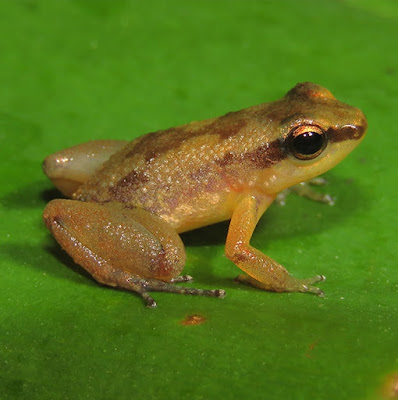
Showing posts with label Aromobatidae. Show all posts

Sunday, July 12, 2026

[Herpetology • 2026] Allobates tanaruThe First Chlorotic Species of the Superfamily Dendrobatoidea: A New Nurse Frog of the Allobates albiventris Complex (Anura: Aromobatidae) with remarkably greenish hatchlings from Brazilian Amazonia


 Allobates tanaru 
Dantas, Ferrão, Cunha-Machado & Lima, 2026


 Abstract -
While many frogs around the world have blue-green tissues because of the accumulation of a pigment called biliverdin, this had never been observed in nurse or poison frogs until now. In this study, we describe a new species of nurse frog from southwestern Amazonia that breaks new ground in Neotropical amphibian taxonomy: It is the first chlorotic species—with greenish hatchlings—ever recorded in the large superfamily Dendrobatoidea. Previously lumped within Allobates albiventris, integrative taxonomy reveals it as a distinct species, supported by a set of morphological and bioacoustic traits. It differs from most of its congeners by a call consisting of a pair of notes emitted in a single exhalation; males with lateral expansions on fingers II and III, and a white vocal sac covered with melanophores; dark brown oocytes, hatchlings with greenish yolk, and tadpoles with two or three short, pyramidal papillae distributed in a single row on each lateral margin of the anterior lip. Beyond its diagnostic features, this discovery is notable because chlorotic tissues were previously unknown in Dendrobatoidea, a superfamily with more than 350 species known for its terrestrial habitat, territoriality, carrying behavior, and nonchlorotic adults. The distinctive greenish hue seen in embryos of certain species, particularly in the new Allobates, may serve as an adaptation for predator avoidance, and it also highlights the ecological plasticity and morphological diversity within the genus. This opens fresh avenues to study the ecological, evolutionary, and developmental significance of biliverdin in frogs using a lineage wherein the biology contrasts with classic model species.

KEYWORDS: biodiversity, chlorosis, Integrative taxonomy, Madeira River, new species, species delimitation

Color in life of adults of Allobates tanaru sp. nov.
(A–C) Female, INPA-H 45548, SVL 17.4 mm. (D–F) Female, MPEG 45484, SVL 17.5 mm.
(G, I) Male, INPA-H 45552, SVL 17.0 mm. (H) Female, INPA-H 45549, SVL 16.9 mm.
(J–L) Male, INPA-H 45554, SVL 15.8 mm.

Allobates tanaru sp. nov. Dantas, Ferrão & Lima
  
Etymology: The specific epithet tanaru is a noun in apposition and honors the indigenous Tanaru, known in Portuguese as Índio Tanaru and Índio do Buraco (Indigenous Tanaru and Indigenous of the Hole, respectively). Tanaru died on 23 August 2022; he was the last representative individual of a poorly known ethnic group that lived in Rondônia, Brazil. His people were exterminated by gunmen at the behest of illegal loggers in 1995. After that, Tanaru lived isolated for almost 30 years in the Tanaru Indigenous Land, located in the southeast Rondônia, approximately 700 km from Rondônia's capital. Because the Tanaru Indigenous Land does not have a consolidated land demarcation and is surrounded by agricultural farms, the land suffers continuous threats and attacks, some of which started just some days after Tanaru's death. The indigenous Txai Suruí, from the Suruí ethnic group, said: “Known for his solitude, Tanaru resisted the contact with non-indigenous people until his last days after so much trauma and violence. His territory must continue to represent resistance and must be preserved and cared for, becoming a permanent conservation area.”

Vernacular names: Tanaru's nurse frog (English),
Rana Cuidadora de Tanaru (Spanish),
Rãzinha Cuidadora do Tanaru (Portuguese).

Diagnosis: A nurse frog Allobates characterized by the following combination of characters. Small-bodied species, SVL 14.1–17.0 mm (n = 18) in males and 16.9–18.2 mm (n = 9) in females; granular dorsal skin; one subarticular tubercle on finger IV; tip of finger IV reaches the distal phalanx of finger III; cream dorsum with contrasting brown marks; dorsolateral stripe present; conspicuous ventrolateral line absent; translucent-white vocal sac; white ventral surface in males; white chest and belly in females; and dorsal surface of fingers brown. Advertisement calls characterized by the emission of two notes in a single exhalation; with a call duration of 64 ± 4 ms (57–69 ms); first note (18 ± 2 ms; 16–22 ms) shorter than the second (27 ± 2 ms; 24–32 ms); an intercall interval of 275 ± 24 ms (220–309 ms); an intercall-series interval 854 ± 123 ms (645–1,118 ms); and a dominant frequency of 5,518 ± 200 Hz (5,168–5,879 Hz). Hatchlings with greenish yolk. Exotrophic tadpoles with an oral disc; labial keratodont row formula 2(2)/3(1); 13–15 pyramidal and cylindrical papillae on posterior labium; three pyramidal papillae at each end of the posterior labium; cylindrical papillae on the central portion of posterior labium; posterior labium length formulae P-I = P-II > P-III; and light-brown melanophores on tail and fins not forming blotches or spots.

Coloration of freshly laid eggs (A), embryos (B), and hatchlings (C) of  Allobates tanaru sp. nov.


Silionamã Pereira Dantas, Miquéias Ferrão, Antônio Saulo Cunha-Machado and Albertina Pimentel Lima. 2026. The First Chlorotic Species of the Superfamily Dendrobatoidea: A New Nurse Frog of the Allobates albiventris Complex (Anura, Aromobatidae) with remarkably greenish hatchlings from Brazilian Amazonia. Breviora. 579 (1), 1-35. DOI: doi.org/10.3099/0006-9698-579.1.1 (8 July 2026) 


Friday, November 21, 2025

[Herpetology • 2025] Dryadobates gen. nov., Dryadobates bokermanni, D. lutzi ... • Museomics and the Systematics of the Atlantic Forest Nurse Frogs (Dendrobatoidea: Aromobatidae: Allobatinae)


Dryadobates lutzi
Dryadobates bokermanni

Grant, Lyra, Hofreiter, Preick, Barlow, Verdade & Rodrigues, 2025
 
Abstract
For four decades after 1967, four species of nurse frogs were recognized in the Atlantic Forest, namely Allobates alagoanus (Bokermann, 1967), A. capixaba (Bokermann, 1967), A. carioca (Bokermann, 1967), and A. olfersioides (A. Lutz, 1925), but in 2007 they were synonymized due to a lack of morphological differences. Although growing evidence from DNA and bioacoustics suggests that multiple species of nurse frogs inhabit the Atlantic Forest, their taxonomy has not been updated because populations at the four type localities had all vanished by the 1990s, making it impossible to collect tissues for DNA analysis and other data (e.g., vocalizations) from topotypic material. To overcome the lack of modern tissues, we employed museomics to obtain historical DNA from topotypic material of the four nominal species, which we analyzed together with data from extant populations from throughout the Atlantic Forest and Atlantic Forest enclaves within the Caatinga. We found that the Atlantic Forest nurse frogs comprise a well-supported clade of no fewer than 12 species that arrived in the Atlantic Forest via a single invasion from the Guiana Shield. We propose Dryadobates, gen. nov., for this clade, which is the sister group of all other allobatines. We consider the four nominal species to be valid, redescribe them as D. alagoanuscomb. nov.D. capixabacomb. nov., D. carioca, comb. nov., and D. olfersioidescomb. nov., describe two sister species (D. bokermanni, sp. nov., and D. lutzi, sp. nov.) from southern Bahia, and summarize available information for the remaining six undescribed species. The type series of D. olfersioides comprises two species, so we designate a lectotype to clarify the application of the name. Dryadobates alagoanus is extant and broadly distributed, but D. capixaba, D. carioca, and D. olfersioides are presumed extinct, representing 50% of the nominal species of Dryadobates. These results provide a clear and consequential example of the essential role museomics and taxonomy play in understanding diversity loss and setting conservation priorities.
 
Keywords: Dendrobatidae, Mata Atlântica, Classification, Frogs, Genetics, Dryadobates, Museomics.


Dryadobates bokermanni, sp. nov., adult in life.
Adult male holotype (MZUSP 160849, 16.7 mm SVL): A, dorsal view; B, ventral view.
C, adult female topoparatype (MZUSP 160848, 17.8 mm SVL), ventral view. Photographs: T.G.

Dryadobates lutzi, sp. nov., adult male paratypes in life.
 A, dorsal view (MZUSP 160544, 14.7 mm SVL; photograph: M.T.R.);
B, ventral view (MZUESC 20074, 15.5 mm SVL; photograph: Omar Rojas Padilla).

Dryadobates gen. nov.
Dryadobates bokermanni sp. nov.
Dryadobates lutzi sp. nov.

Dryadobates olfersioides comb. nov.
Dryadobates alagoanus , D. capixaba , D. carioca (removed from the synonymy of Dryadobates olfersioides)

Dryadobates alagoanus adult male in life (an individual in the series CHUFPE 1817–1823):
A, dorsal view; B, ventral view.
Photographs: Marcos Dubeux.
 

Taran Grant, Mariana L. Lyra, Michael Hofreiter, Michaela Preick, Axel Barlow, Vanessa K. Verdade, Miguel Trefaut Rodrigues. 2025. Museomics and the Systematics of the Atlantic Forest Nurse Frogs (Dendrobatoidea: Aromobatidae: Allobatinae). Bulletin of the American Museum of Natural History. 2025(472); 1-76. DOI: doi.org/10.1206/0003-0090.472.1.1  [6 May 2025]
https://hdl.handle.net/2246/7504


[Herpetology • 2025] Dryadobates erythropus • A recently extinct New Species of Dryadobates (Anura: Aromobatidae) from South Brazil: Species Description and Implications for the historical distribution and Recent Extinction History of the Clade


Dryadobates erythropus Grant & Pinheiro, 2025
Dryadobates bokermanni Grant et al., 2025, from southern Bahia, Brazil 

photos: Taran Grant/IB-USP
 
Abstract
We describe a new species of Dryadobates on the basis of a single adult male collected in 1963 in Tarumã, Curitiba, Paraná, Brazil. Although the specimen is badly desiccated and extremely fragile, it can be readily assigned to Dendrobatoidea on the basis of its posterodorsally concealed tympanum, phalangeal swelling on finger IV, and tarsal keel. The new species shares with other species of Dryadobates the same morphology of finger discs II, IV, and V, absence of a metatarsal fold, presence of a complete pale oblique lateral stripe, absence of a pale dorsolateral stripe, presence of basal webbing between toes III–IV (absent between all other toes), presence of pale paracloacal marks, and small size. It is diagnosed from all nominal congeners by possessing a conspicuous pale oblique lateral stripe that is discrete and well defined along its entire length (i.e., not anteriorly indistinct). The type locality lies ca. 550 km south of the nearest congener in Angra dos Reis, Rio de Janeiro, suggesting the existence of additional Dryadobates populations between these localities. However, despite extensive surveys in suitable habitats at multiple localities in São Paulo and Paraná over the past 50 years, no other specimens of Dryadobates have been collected. Further, the region of the type locality—once characterized by forests, streams, and expansive fields and wetlands—has been transformed into a highly developed residential and commercial area lacking suitable habitat for Dryadobates, leading us to presume this species to be extinct. With the current species, Dryadobates now comprises seven described species, four of which disappeared within a 15–20-year window between the mid-1960s and mid-1980s. The drivers of these recent extinctions remain unclear, underscoring the urgent need to gather data on the natural history, distribution, and population status of extant Dryadobates species to inform effective conservation strategies.

Amphibia, Dendrobatoidea, Neotropics, Nurse frogs, Rocket frogs, Systematics, Taxonomy
 
Despite being quite dried out, the only known specimen of Dryadobates erythropus allowed it to be identified as a new species to science. 
photo: Taran Grant/IB-USP

Dryadobates erythropus sp. nov. 
 
Etymology. Like the specific epithets alagoanus, capixaba, and carioca, erythropus refers to inhabitants of the region of the type locality. Specifically, it is derived from the Greek erythros (red) and pous (foot), Latinized as pus, from the Portuguese term pé-vermelho (red-foot), a colloquial nickname for people in rural areas of Paraná, originating from the farmers who often worked barefoot on the characteristic red soil of the northern part of the state. 


Taran GRANT and Paulo Durães Pereira PINHEIRO. 2025. A recently extinct New Species of Dryadobates (Anura: Aromobatidae) from South Brazil: Species Description and Implications for the historical distribution and Recent Extinction History of the Clade. Zootaxa. 5693(4); 583-595. DOI: doi.org/10.11646/zootaxa.5693.4.9 [2025-09-19]

Monday, July 31, 2023

[Herpetology • 2023] Allobates albiventris • A New Pale-ventered Nurse Frog (Anura: Aromobatidae) from southwestern Brazilian Amazonia


 Allobates albiventris  
Souza, Ferrão, Kaefer, Cunha-Machado, Melo-Sampaio, Hanken & Lima. 2023


Abstract
We use integrative taxonomy to formally describe a candidate species of nurse frog of the genus Allobates from southwestern Brazilian Amazonia. The new species nests within a clade that has been defined historically as A. gasconi, but it has an 8.8–11.0% genetic distance for 16S to samples from the type locality of A. gasconi. The new species differs from congeners mainly by males having a translucent white throat and vocal sac; advertisement calls with a duration of 42–60 ms, two notes separated by an inter-note interval of 8–23 ms, and a dominant frequency of 4,953–6,331 Hz; and exotrophic tadpoles with 2 pyramidal papillae on each end of the upper lip and 10–13 pyramidal and cylindrical papillae surrounding the lower lip. Phylogenetic analyses based on mitochondrial DNA suggest that A. gasconi sensu lato as defined previously represents a complex of as many as seven species, corroborating studies that have shown high levels of cryptic diversity within Allobates.

Keywords: Advertisement call, biodiversity, integrative taxonomy, morphology, phylogeny, reproductive behavior, State of Acre, tadpole

Coloration of the vocal sac and throat of Allobates albiventris sp. nov. (A, B) and A. gasconi sensu stricto (C, D).
Photographs by J.R.D. Souza (A, B) and A.P. Lima (C, D).

Coloration in life of  Allobates albiventris sp. nov. from Manoel Urbano and Rio Branco, State of Acre, Brazil.
 A–C Male holotype, SVL 14.6 mm; D–F Female, INPAH45051, SVL 16.8 mm; G–I Male, MNRJ 91679, SVL 16.0 mm; J–L Female, MPEG44613, SVL 16.0 mm; M Male, uncollected; N Male, INPAH45044, SVL 15.3 mm; O Male, uncollected.
Photographs by J.R.D. Souza (A–F, J–O) and P.R. Melo-Sampaio (G–I).

Allobates albiventris sp. nov.

Diagnosis: Allobates albiventris sp. nov. differs from other Allobates by the following combination of characters: males in life with a throat and vocal sac translucent white with melanophores uniformly distributed and a white belly; females in life with throat white centrally and posteriorly, translucent laterally and anteriorly, chest and belly white; small adult size, SVL 14.3–16.4 mm (n = 22) in males and 15.6–17.8 mm (n = 16) in females; one subarticular tubercle on finger IV; finger III of adult males weakly swollen; disc of finger II approximately the same width as the distal phalanx; interdigital membranes present between toes II, III and IV; paired digital scutes white; advertisement call with a duration of 42–60 ms and comprising two notes (the first note is smaller than the second), with an inter-note interval of 8–23 ms and dominant frequency of 4,953–6,331 Hz; exotrophic tadpoles with 2 pyramidal papillae on each end of the anterior labium, 10–13 pyramidal and cylindrical papillae on the posterior labium, LTRF = 2(2)/3(1), gap in row A-2 ≈ 40% of A-1, relative length P-1 > P-2 > P-3, and P-3 ≈ 65% of P-1.

Etymology: The specific epithet albiventris is a combination of two Latin words, albus (white) and ventris (venter), in reference to the pale ventral coloration of the new species. Vernacular names: pale-ventered nurse frog (English), rana cuidadora de vientre blanco (Spanish), and rãzinha cuidadora de ventre branco (Portuguese).

Habitat and natural history of Allobates albiventris sp. nov.
 A Typical understory of open ombrophilous forest at the type locality in Manoel Urbano, State of Acre, Brazil. B Beginning of courtship behavior, in which a male is leading a female to an oviposition site. C Female (unvouchered) positioning herself to jump to the adaxial surface of the leaf, where the male is vocalizing. D Mating pair (unvouchered) in cephalic amplexus. E Mating pair (unvouchered) on the leaf, with the female in oviposition and the male silent. F Recently deposited clutch, with the smallest clutch recorded (17 eggs). G The largest clutch recorded (31 eggs). H Mating pair on a leaf, where a male vocalizes while a female deposits a second clutch on the same leaf. I Male INPAH45045 carrying 10 tadpoles on his back.
Photographs by J.R.D. Souza.


 Jesus R. D. Souza, Miquéias Ferrão, Igor Luis Kaefer, Antonio Saulo Cunha-Machado, Paulo Roberto Melo-Sampaio, James Hanken and Albertina Pimentel Lima. 2023. A New Pale-ventered Nurse Frog (Aromobatidae: Allobates) from southwestern Brazilian Amazonia. Vertebrate Zoology. 73: 647-675. DOI: 10.3897/vz.73.e103534

Saturday, June 24, 2023

[Herpetology • 2023] Allobates ripicolus & A. vicinus • Two New Species of Allobates of the trilineatus clade (Anura: Aromobatidae) from the Eastern Guiana Shield


Allobates ripicolus 
Fouquet, Ferrão & Jairam, 2023

 
Abstract
The actual diversity of anurans occurring in Amazonia remains only partly described. This is notably the case of the species of the genus Allobates despite a fast rate of species description in this genus during the last decade. This increasing taxonomic effort has been particularly facilitated by the availability of DNA sequences throughout the region. These data suggest for instance the existence of three lineages in the Guiana Shield that may correspond to unnamed species. We examined morphology and calls of these putative species and compared them to related nominal species, which confirmed that two of these lineages not only differ genetically but also morphologically and bioacoustically. These two species are thus named and described herein. Allobates vicinus sp. nov. from northern Suriname forms a clade with another candidate species from southern Suriname and Northern Pará, (Brazil) and with A. granti that occurs in French Guiana. Allobates ripicolus sp. nov. occurs throughout the eastern Guiana Shield and is nested within the A. tapajos complex which otherwise occurs in southeastern Amazonia and comprises A. tapajos and A. kamilae, along with three additional candidate species.

Keywords:  Amphibia, acoustics, Amazonia, morphology, Neotropics, taxonomy  


Allobates vicinus sp. nov. 


Allobates ripicolus sp. nov.
 

Antoine Fouquet, Miquéias Ferrão, Rawien Jairam. 2023. Two New Species of Allobates of the trilineatus clade (Anura: Aromobatidae) from the Eastern Guiana Shield.  Zootaxa. 5297(4); 533-561. DOI: 10.11646/zootaxa.5297.4.4  

Thursday, August 4, 2022

[Herpetology • 2022] Allobates kamilae • A New Nurse Frog of the Allobates tapajos Species Complex (Anura: Aromobatidae) from the upper Madeira River, Brazilian Amazonia


Allobates kamilae 
Ferrão​, Hanken & Lima, 2022
 

Abstract 
Cryptic diversity is extremely common in widespread Amazonian anurans, but especially in nurse frogs of the genus Allobates. There is an urgent need to formally describe the many distinct but unnamed species, both to enable studies of their basic biology but especially to facilitate conservation of threatened environments in which many are found. Here, we describe through integrative taxonomy a new species of the Allobates tapajos species complex from the upper Madeira River, southwestern Amazonia. Species delimitation analyses based on molecular data are congruent and delimit five candidate species in addition to A. tapajos sensu stricto. The new species is recovered as sister to A. tapajos clade F, a candidate species from Teles-Pires River, southeastern Amazonia. The new species differs from nominal congeners in adult and larval morphology and in male advertisement call. Egg deposition sites differ between east and west banks of the upper Madeira River, but there is no evidence of corresponding morphologic or bioacoustic differentiation. The new species appears to be restricted to riparian forests; its known geographic range falls entirely within the influence zone of reservoirs of two large dams, which underscores the urgent need of a conservation assessment through long-term monitoring. This region harbors the richest assemblage of Allobates reported for Brazilian Amazonia, with six nominal species and four additional candidate species awaiting formal description.

Color in life of adult Allobates kamilae sp. nov.
(A, B) Female from the Abunã Direito sampling module, INPAH 42958, SVL = 16.1 mm.
 (C, D) Male from the Abunã Direito sampling module, INPAH 42932, SVL = 15.8 mm.
 (E, F) Male from the Abunã Esquerdo sampling module, INPAH 42881, SVL = 16.4 mm.

 Live tadpoles (lot INPAH 42851) of Allobates kamilae sp. nov., Gosner stages 39–40,
from the Jirau Direito sampling module.

Allobates kamilae sp. nov. 

Allobates sp. 1: Dias-Terceiro et al. (2015), Dayrell et al. (2021).
Allobates tapajos “Allobates_63”: Vacher et al. (2020), SupInfo 4.
Allobates aff. tapajos: Moraes & Lima (2021), Silva et al. (2022).
Allobates aff. tapajos “3”: Réjaud et al. (2020), Fig. 1 and Figs. S1–S3.

Generic placement: The new species is assigned unambiguously to the genus Allobates because the tip of finger IV does not reach the distal subarticular tubercle of finger III, toe IV with basal webbing and lateral fringe on its preaxial side, pale paracloacal marks (characters 5, 43 and 50 of Grant et al., 2017), respectively) and its phylogenetic relationship as assessed by molecular data.

Diagnosis: A small-bodied species of Allobates characterized by the following combination of characters: SVL 14.5–17.4 mm in males (n = 49) and 15.2–17.8 mm in females (n = 26); finger III not swollen in males; one subarticular tubercle on finger IV; basal webbing between toes II and III absent; EN/WFD = 2.67–3.67 in females; WFD/WTD = 0.67–1.00 and HANDIV/WFD = 3.58–5.60 in males; dorsal surface of thigh lacks red or yellow marks; pale dorsolateral stripe absent in preservative; white ventrolateral stripe absent in life; belly without dark and white marbling; throat in males bright yellow with scattered melanophores; throat in females with scattered melanophores; dorsal surface of fingers brown to orange-brown; advertisement calls predominantly arranged in groups of 2–5 unpulsed notes; first (135 ms ± 24) and last (142 ms ± 31) inter-note intervals are of similar duration and longer than note duration; dominant frequency 5,211–6,201 Hz; tadpoles have an oral disc and spiracle; five short papillae on each side of the lateral margin of the anterior labium; long papillae on the posterior labium; a “V”-shaped lower jaw sheath; and labial tooth rows P-3 and P-1 of similar length.

Etymology: The specific epithet kamilae honors Kamila Xavier Amaral, a very young and enthusiastic biologist who passed away prematurely after battling cancer. While an undergraduate student, Kamila was being trained in Allobates taxonomy by A. P. Lima. She was the first person to study the new species described in this study.


Allobates kamilae sp. nov. mating in the Abunã Esquerdo sampling module.
(A) Female climbing over a previously deposited clutch to approach the male. (B) Male approaching the female to embrace her in a lateral cephalic amplexus (C). (D) Female depositing eggs. (E) Female moments before she left the egg deposition site. (F) The freshly deposited clutch has merged with a previously deposited clutch one day after deposition. Male (♂), INPAH 42944, SVL 16.9 mm; female (♀), uncollected. Numbers denote the temporal sequence of clutch deposition from newest (1) to oldest (3).

Conclusions: 
The Allobates tapajos species complex comprises six species distributed in southwestern, southeastern, eastern and northeastern Amazonia. Yet, sampling remote and poorly explored areas will likely reveal additional candidate species (e.g., Silva et al., 2022). Although A. kamilae resembles A. tapajos sensu stricto in morphology, these species nevertheless are easily diagnosed. Acoustic differentiation between these species, however, is achieved mainly through detailed comparisons of temporal traits within the same call arrangement. Recognition of additional candidate species in the A. tapajos species complex—as well as other species complexes in the genus—will likely require such fine-scale analyses. Allobates kamilae is known only from riparian forests in the impact zone of two large dams in the upper Madeira River, underscoring the urgent need for comprehensive assessments of its geographic distribution and conservation status.


Miquéias Ferrão​, James Hanken and Albertina P. Lima. 2022. A New Nurse Frog of the Allobates tapajos Species Complex (Anura: Aromobatidae) from the upper Madeira River, Brazilian Amazonia. PeerJ. 10:e13751 DOI: 10.7717/peerj.13751


Tuesday, March 8, 2022

[Herpetology • 2022] Allobates paleci • A New Amazonian Species of Allobates Zimmermann & Zimmermann, 1988 (Anura: Aromobatidae) with A Trilled Advertisement Call


 Allobates paleci
Silva,  Marques, Folly & Santana, 2022

sapinho-foguete-dos-paleci | DOI: 10.7717/peerj.13026

Abstract
 
Background: 
Currently, 58 species are assigned to the genus Allobates, with 70% of its diversity described just in the last two decades, with many additional species likely unnamed. The continuous description of these new species represents a fundamental step for resolving the taxonomy and ensuring the future conservation of the genus.

Methods: 
Using molecular, acoustic, and morphological evidences, we describe a new species of Allobates from Teles Pires River region, southern Amazonia, and provide accounts on the population of A. tapajos found sympatrically with the new species.

Results: 
The new species is distinguished from its congeners by the coloration of thighs, venter, dorsum, and dark lateral stripe. It has four types of calls, with advertisement calls formed by relatively long trills with a mean duration of 2.29 s ± 0.65, mean of 39.93 notes ± 11.18 emitted at a mean rate of 17.49 ± 0.68 notes per second, and mean dominant frequency of 5,717 Hz ± 220.81. The genetic distance between the new species and its congeners in a fragment of the 16S mitochondrial fragment ranged between 13.2% (A. carajas) to 21.3% (A. niputidea). The sympatric Allobates population fits its morphology and acoustic with the nominal A. tapajos, but presents a relatively high genetic distance of nearly 6.5%, raising questions on the current taxonomy of this species.


 Allobates paleci sp. nov. in life (CHUFPB 30252), Jacareacanga municipality, Pará state, Brazil.

Allobates paleci sp. nov.

Diagnosis. Allobates paleci sp. nov. can be distinguished from the other species of the genus by the following combination of characters: (1) small size (males SVL 13.4–16.2 mm (15.1 ± 1.0), female SVL 16.07 mm); (2) dorsal surface of thighs light brown lacking dark brown transversal bars, abdomen immaculate yellowish in life; (3) dorsum light brown with dark brown hourglass mark ranging from the interorbital level to the urostyle region; (4) gular region of males yellowish in life, lacking obvious melanophores; (5) interrupted dark lateral stripe, more conspicuous anteriorly; (6) advertisement calls formed by trills with a duration of 0.97–3.57 s (2.29 ± 0.65), 17–61 notes (39.93 ± 11.18) emitted at a rate of 16.32–19.10 notes per second (17.49 ± 0.68), and dominant frequency ranging between 5,168 and 6,202 Hz (5,717 ± 220.81).

Etymology. Indigenous populations of the Apiaká ethnic group historically inhabited areas along the major tributaries of the Tapajós, Juruena, Teles Pires, and Arinos rivers. Different familial groups of the Apiaká are called according to their residence regions, and families inhabiting the middle Teles Pires River are known as Paleci. The specific epithet “paleci” is a noun in apposition referring to these families, who live on the vicinities of the new species’ type locality. We also suggest the following Portuguese vernacular name for the new species: “sapinho-foguete-dos-paleci”.

Geographic distribution and natural history. Allobates paleci sp. nov. is known only from the type locality, in the right bank of the Teles Pires River, Jacareacanga municipality, southern Pará state, Brazil. In this locality, the new species was only recorded inside dense ombrophilous forests. During the rainy season (specially between November and February), several males of the new species were found calling from the moist leaf litter. The calling behavior was mainly concentrated in rainy days between 06:00–10:00 am and 04:00–06:00 pm. Despite being recorded in very close sites and after a considerable sampling effort, Allobates paleci sp. nov. and A. tapajos were never found calling syntopically. Furthermore, A. paleci sp. nov. was less abundant at the type locality when compared to the sympatric A. tapajos. More details on reproductive behavior, oviposition, and tadpoles of Allobates paleci sp. nov. remain unknown.


Leandro A. Silva, Ricardo Marques, Henrique Folly and Diego J. Santana. 2022. A New Amazonian Species of Allobates Zimmermann & Zimmermann, 1988 (Aromobatidae) with A Trilled Advertisement Call.  PeerJ. 10:e13026. DOI: 10.7717/peerj.13026


Monday, September 6, 2021

[Herpetology • 2021] Allobates sieggreenae • A New Species of Nurse-Frog (Anura: Aromobatidae) from the Amazonian Forest of Loreto, Peru


Allobates sieggreenae
 Gagliardi-Urrutia, Castroviejo-Fisher, Rojas-Runjaic, Jaramillo, Solís & Simões, 2021. 

 facebook.com/FernandoRojasRunjaic
 
Abstract
We describe a new species of nurse-frog (Aromobatidae, Allobates) from the Amazonian forest of Loreto, Peru using morphological, acoustic and genetic data. Our phylogenetic analysis placed Allobates sieggreenae sp. nov. as the sister species of A. trilineatus, the most similar-looking species and with which it was previously confused. However, the new species has a brown dorsum, solid dark brown lateral dark stripe not fading towards groin, adult males with few and sparse melanophores over a cream background on chin, chest, and belly, dark transverse bars absent on thighs, and an advertisement call formed by a trill of single notes (in A. trilineatus dorsum dark brown, blackish brown lateral dark stripe, paler from mid-body to groin, adult males with a dark background color on chin, chest, and belly due to a dense layer of melanophores, dark transverse bar present on dorsal surface of thighs, and trills of paired notes). Allobates sieggreenae is known from two localities of Amazonian white-sand forest ecosystems east of the Ucayali River.

Keywords: Amphibia, Advertisement calls, Amazonia, Allobates trilineatus, Allobatinae, external morphology, mtDNA, systematics


Figure 1. (A) Map of western Amazonia and neighboring areas (inset map indicates its location within South America) showing rivers (blue lines), country borders (black contours), and known localities of Allobates sieggreenae sp. nov. and A. trilineatus sensu lato.
 (B) Satellite image of the Ucayali-Tapiche-Yavarí interfluve and neighboring regions with main rivers, cities, and conservation areas labeled (the area of the latter shaded with light green). Centro de Investigaciones Jenaro-Herrera (CIJH) and Río Blanco (RB).

Figure 7. Comparative oscillograms and power spectra (top and bottom graphs of each figure, respectively) of the advertisement call of the holotype of Allobates sieggreenae sp. nov. (A, B)
and a topotypic A. trilineatus (C). (A) Call trill formed by irregularly spaced single notes. (B) Detailed view of three notes of the same call. (D, E) dorsolateral and ventral views of the recorded specimen (MCP 14309).

Figure 3. (A) Lateral view of the holotype (CRBIIAP 1754) of Allobates sieggreenae sp. nov. (B, C) Ventral view of the left hand of the preserved holotype and paratype (MCP 14534, adult female), respectively. (D, E) Ventral view of the left foot of the same aforementioned preserved specimens.
Scale bar = 5 mm (A) and 1 mm (B–E).

Figure 6. Color in life of type specimens, information of specific vouchers not recorded, of Allobates sieggreenae sp. nov.
 (A) Dorsolateral and (B) ventral views of an adult male. (C) Dorsolateral and (D) ventral views of an adult female. (E) An adult male vocalizing with its vocal sac inflated. (F) Dorsolateral and (G) ventral views of a juvenile specimen.


Allobates sieggreenae sp. nov. 


Giussepe Gagliardi-Urrutia, Santiago Castroviejo-Fisher, Fernando J. M. Rojas-Runjaic, Andrés F. Jaramillo, Samantha Solís and  Pedro Ivo Simões. 2021. A New Species of Nurse-Frog (Aromobatidae, Allobates) from the Amazonian Forest of Loreto, Peru. Zootaxa. 5026(3); 375-404. DOI: 10.11646/zootaxa.5026.3.3

New species of nurse frog honours amphibian conservationist Marcy Sieggreen

Thursday, September 2, 2021

[Herpetology • 2021] Allobates grillicantus • A New Nurse Frog (Anura: Aromobatidae) with a Cricket-Like Advertisement Call from Eastern Amazonia


Allobates grillicantus
 Moraes & Lima, 2021

 
Abstract
Integrative analyses, long-term studies, and access to remote areas in Amazonia have led to new hypotheses and increased resolution of the systematics and taxonomy of the small nurse frog genus Allobates (family Aromobatidae). During anuran sampling in the Middle Tapajós River region, state of Pará, Brazil, we collected data on a new cryptically colored species of Allobates with a cricket-like advertisement call. Here, we name and describe this new species, following an integration of phenotypic, ecological, and molecular analyses. The results of a phylogenetic analysis based on mitochondrial and nuclear DNA placed the new species as the sister taxon of Allobates grillisimilis. Genetic pdistances between the two sister taxa at the 16S region of the mitochondrial DNA ranged from 7% to 9%. A sister-species relationship between the new species and A. grillisimilis is also supported by phenotypic evidence. Adults of the new species are small (snout–vent length 15.2–16.8 mm in males and 16.5–17.7 mm in females), with a dorsum uniformly tan to reddish brown, a dark brown lateral stripe and a white ventrolateral stripe, arms pale tan brown and legs greyish-brown, and venter yellowish colored, with variable extension and shades of yellow, paler on the throat. The advertisement call is a trill with a mean peak frequency of 5830.2 Hz, arranged in series of short, closely spaced, pulses (mean of 24.3 pulses/s), and followed by silent intervals of variable duration. We discuss the putative drivers generating and maintaining the distinctiveness between the new species and the allopatrically distributed sister taxon, and on threats to the persistence of the new species. With this species description, the Middle Tapajós River region is consolidated as having one of the highest alpha diversities for the genus Allobates in Amazonia.

Key words: Anura; Bioacoustics; Biogeography; Brazil; Conservation; Cryptic diversity; DNA; Integrative taxonomy; Para


FIG. 5. Variation in color in life and external morphology of some adult specimens from the type series of Allobates grillicantus in dorsal, lateral, and ventral views (from left to right).
 (A) MPEG 43038, male, 15.7 mm snout-vent length (SVL);
(B) INPA-H 41352, male, 15.8 mm SVL;
(C) MPEG 43042, female, 17.7 mm SVL;
(D) MPEG 43043, female, 17.7 mm SVL.
 Not to scale. Photographs by A.P. Lima.


Allobates grillicantus sp. nov.

Etymology.— The specific epithet grillicantus means ‘‘cricket song’’ and refers to the cricket-like advertisement call emitted by this species. It is a compound Latin noun in the nominative case used in apposition, derived from gryllus ,meaning ‘‘cricket’’ and cantus, meaning ‘‘song.’’ The name is purposely similar to the sister taxon A. grillisimilis to refer to common ancestry.

FIG. 1. Bayesian phylogenetic tree of Allobates inferred from a concatenated data set of eight genes (four mitochondrial and four nuclear), highlighting the position of the new species from the Middle Tapajós River region, state of Pará, Brazil as the sister taxon of Allobates grillisimilis. Outgroups were omitted, and the informal clade names to right of the tree follow the subdivision of Réjaud et al. (2020). Support values are shown above branches: asterisks represent posterior probability 1.00-0.99, black circles 0.98-0.95, open circles 0.94-0.85, and support below this level were omitted. (H) Holotype; (T) Tadpole. Photographs by A.P. Lima.  

FIG. 9. Geographic distribution of  Allobates grillicantus (squares) and its sister taxon Allobates grillisimilis (dots) relative to the lower-middle courses of the Madeira River and the Tapajós River. Inset (lower left) shows the area within South America and Brazil. Dotted symbols indicate species' type localities.  

 
Leandro J.C.L. Moraes and Albertina P. Lima. 2021. A New Nurse Frog (Allobates, Aromobatidae) with a Cricket-Like Advertisement Call from Eastern Amazonia. Herpetologica. 77(2); 146-163. DOI: 10.1655/Herpetologica-D-20-00010.1