Showing posts with label Paleoanthropology. Show all posts

Friday, October 29, 2021

[PaleoAnthropology • 2021] Homo bodoensis • Resolving the “Muddle in the Middle”


Homo bodoensis 
Roksandic, Radović, Wu & Bae, 2021


Abstract
Recent developments in the field of palaeoanthropology necessitate the suppression of two hominin taxa and the introduction of a new species of hominins to help resolve the current nebulous state of Middle Pleistocene (Chibanian) hominin taxonomy. In particular, the poorly defined and variably understood hominin taxa Homo heidelbergensis (both sensu stricto and sensu lato) and Homo rhodesiensis need to be abandoned as they fail to reflect the full range of hominin variability in the Middle Pleistocene. Instead, we propose: (1) introduction of a new taxon, Homo bodoensis sp. nov., as an early Middle Pleistocene ancestor of the Homo sapiens lineage, with a pan-African distribution that extends into the eastern Mediterranean (Southeast Europe and the Levant); (2) that many of the fossils from Western Europe (e.g. Sima de los Huesos) currently assigned to H. heidelbergensis s.s. be reassigned to Homo neanderthalensis to reflect the early appearance of Neanderthal derived traits in the Middle Pleistocene in the region; and (3) that the Middle Pleistocene Asian fossils, particularly from China, likely represent a different lineage altogether.

Keywords: hominin taxonomy, Homo bodoensisHomo heidelbergensisHomo rhodesiensis, Middle Pleistocene

Homo bodoensis sp. nov. holotype partial cranium Bodo 1 (Middle Awash, Ethiopia). Frontal (a), left lateral (b), superior (c) inferior (d) views. Scale bar: 5 cm.

Order Primates Linnaeus 1758.
Suborder Anthropoidea Mivart 1864.

Superfamily Hominoidea Gray 1825.
Family Hominidae Gray 1825.

Tribe Hominini Gray 1825.

Genus Homo Linnaeus 1758.

Homo bodoensis sp. nov.

Etymology: The name bodoensis refers to the site of Bodo D'ar where the fossil specimen Bodo 1 was discovered.

Holotype: Bodo 1, a partial cranium of an adult (presumably male) individual, preserving the face and the anterior braincase, found in autumn 1976 by Alemayehu Asfaw, Paul Whitehead and other members of the Rift Valley Research Mission in Ethiopia headed by Jon Kalb.123, 124 The specimen is currently curated in the National Museum of Ethiopia in Addis Ababa, Ethiopia.  

Type locality: Bodo D'ar, the Middle Awash research area, Afar Depression, the northwestern part of the former Hararghe Province, Ethiopia.

Geological age and stratigraphic position: Upper Bodo Sand Unit.123 Dated to ca. 600 ka by laser-fusion 40Ar/39Ar technique (0.64 ± 0.03 Ma), biostratigraphy and tephrochronology.127

Archaeological context: The specimen is associated with an Acheulean stone tool assemblage.

Species diagnosis: The species is diagnosed by a unique combination of cranial traits. The Bodo specimen has already been described as showing a mix of H. erectus-like and H. sapiens-like features. The species is similar to H. erectus in having: a robustly built midface; total facial prognathism128; projecting tori and a flattened low frontal squama; sagittal keeling; a low vault profile; a prominent parietal angular torus; thick vault bones; no foramen lacerum is observable—it is presented as a narrow crevice.20, 128 These traits can be linked to the retention of the general cranial structure from H. erectus. Traits similar to other Middle Pleistocene and later hominin taxa include: increased cranial capacity and associated traits (broader frontal and mid-vault, reduced postorbital constriction, signs of parietal bossing, high and arched temporal squama), a vertical (rather than forward sloping) nasal margin, and the position of the incisive canal in front of the hard palate. Excessively thick and projecting, but segmented brow ridges, with the incipient division of the brow at mid-orbit and attenuated laterally may be considered a distinctive trait of the species.

A simplified model for the evolution of the genus Homo over the last 2 million years, with Homo bodoensis sp. nov. positioned as the ancestral (mostly African) form of Homo sapiens


Mirjana Roksandic, Predrag Radović, Xiu-Jie Wu and Christopher J. Bae. 2021. Resolving the “Muddle in the Middle”: The Case for Homo bodoensis sp. nov. Evolutionary Anthropology: Issues, News, and Reviews. DOI: 10.1002/evan.21929

Saturday, October 26, 2019

[Mammalogy • 2019] The Evolutionary Radiation of Hominids: A Phylogenetic Comparative Study


Geographical distribution of the sampled extant (circles) and fossil (triangles) Hominoid species.
Distinct colors were used for Hominidae (orange) and Hylobatidae (dark cyan) families.

in Rocatti & Perez, 2019. 

Abstract
Over the last 150 years the diversity and phylogenetic relationships of the hominoids have been one of the main focuses in biological and anthropological research. Despite this, the study of factors involved in their evolutionary radiation and the origin of the hominin clade, a key subject for the further understanding of human evolution, remained mostly unexplored. Here we quantitatively approach these events using phylogenetic comparative methods and craniofacial morphometric data from extant and fossil hominoid species. Specifically, we explore alternative evolutionary models that allow us to gain new insights into this clade diversification process. Our results show a complex and variable scenario involving different evolutionary regimes through the hominid evolutionary radiation –modeled by Ornstein-Uhlenbeck multi-selective regime and Brownian motion multi-rate scenarios–. These different evolutionary regimes might relate to distinct ecological and cultural factors previously suggested to explain hominid evolution at different evolutionary scales along the last 10 million years.

Figure 4: Geographical distribution of the sampled extant (circles) and fossil (triangles) Hominoid species. Distinct colors were used for Hominidae (orange) and Hylobatidae (dark cyan) families. Extant species distribution was obtained from IUCN redlist (www.iucnredlist.org) database, while fossil locations were extracted from bibliographical sources.


Guido Rocatti and S. Ivan Perez. 2019. The Evolutionary Radiation of Hominids: A Phylogenetic Comparative Study. Scientific Reports. 9: 15267. nature.com/articles/s41598-019-51685-w


Thursday, April 11, 2019

[PaleoAnthropology • 2019] Evidence for Increased Hominid Diversity in the Early to Middle Pleistocene of Indonesia


Meganthropus palaeojavanicus 

in Zanolli, Kullmer, Kelley, et al., 2019.

Abstract
Since the first discovery of Pithecanthropus (Homoerectus by E. Dubois at Trinil in 1891, over 200 hominid dentognathic remains have been collected from the Early to Middle Pleistocene deposits of Java, Indonesia, forming the largest palaeoanthropological collection in South East Asia. Most of these fossils are currently attributed to H. erectus. However, because of the substantial morphological and metric variation in the Indonesian assemblage, some robust specimens, such as the partial mandibles Sangiran 5 and Sangiran 6a, were formerly variably allocated to other taxa (Meganthropus palaeojavanicusPithecanthropus dubiusPongo sp.). To resolve the taxonomic uncertainty surrounding these and other contentious Indonesian hominid specimens, we used occlusal fingerprint analysis (OFA) to reconstruct their chewing kinematics; we also used various morphometric approaches based on microtomography to examine the internal dental structures. Our results confirm the presence of Meganthropus as a Pleistocene Indonesian hominid distinct from Pongo, Gigantopithecus and Homo, and further reveal that Dubois’s H. erectus paratype molars from 1891 are not hominin (human lineage), but instead are more likely to belong to Meganthropus.


Clément Zanolli, Ottmar Kullmer, Jay Kelley, Anne-Marie Bacon, Fabrice Demeter, Jean Dumoncel, Luca Fiorenza, Frederick E. Grine, Jean-Jacques Hublin, Anh Tuan Nguyen, Thi Mai Huong Nguyen, Lei Pan, Burkhard Schillinger, Friedemann Schrenk, Matthew M. Skinner, Xueping Ji and Roberto Macchiarelli. 2019. Evidence for Increased Hominid Diversity in the Early to Middle Pleistocene of Indonesia. Nature Ecology & Evolution. DOI: 10.1038/s41559-019-0860-z

Reassessing the Early to Middle Pleistocene hominid diversity in Java


[PaleoAnthropology • 2019] Homo luzonensis • A New Species of Homo from the Late Pleistocene of the Philippines


Homo luzonensis 
Détroit, Mijares, Corny, Daver, Zanolli, Dizon, Robles, Grün & Piper, 2019


Abstract
A hominin third metatarsal discovered in 2007 in Callao Cave (Northern Luzon, the Philippines) and dated to 67 thousand years ago provided the earliest direct evidence of a human presence in the Philippines. Analysis of this foot bone suggested that it belonged to the genus Homo, but to which species was unclear. Here we report the discovery of twelve additional hominin elements that represent at least three individuals that were found in the same stratigraphic layer of Callao Cave as the previously discovered metatarsal. These specimens display a combination of primitive and derived morphological features that is different from the combination of features found in other species in the genus Homo (including Homo floresiensis and Homo sapiens) and warrants their attribution to a new species, which we name Homo luzonensis. The presence of another and previously unknown hominin species east of the Wallace Line during the Late Pleistocene epoch underscores the importance of island Southeast Asia in the evolution of the genus Homo.


Fig. 2: Fossil remains of Homo luzonensis from Late Pleistocene sediments at Callao Cave.

Fig. 1: Geographical location of Callao Cave.

Order Primates Linnaeus, 1758
Suborder Anthropoidea Mivart, 1864

Superfamily Hominoidea Gray, 1825
Family Hominidae Gray, 1825

Tribe Hominini Gray, 1825
Genus Homo Linnaeus, 1758

Homo luzonensis sp. nov.

Etymology. The species name is derived from the island of Luzon, where the specimens were discovered.

Locality. The type locality is Callao Cave, in the Callao Limestone formation in the Peñablanca region of northern Luzon, the Philippines.


Florent Détroit, Armand Salvador Mijares, Julien Corny, Guillaume Daver, Clément Zanolli, Eusebio Dizon, Emil Robles, Rainer Grün and Philip J. Piper. 2019. A New Species of Homo from the Late Pleistocene of the Philippines. Nature. 568; 181–186. DOI: 10.1038/s41586-019-1067-9

Previously unknown human species found in Asia raises questions about early hominin dispersals from Africa nature.com/articles/d41586-019-01019-7 

UP researchers co-discover new human species in Luzon

New species of early human found in the Philippines https://phys.org/news/2019-04-species-early-human-philippines.html via @physorg_com


Tuesday, May 24, 2016

[PaleoAnthropology • 2016] Pleistocene Footprints Show Intensive Use of Lake Margin Habitats by Homo erectus groups


Clockwise from upper right: White rhinoceros (Ceratotherium simum), pelican (Pelecanus), hominin (putative Homo erectus), large wading bird (Ciconiidae or Gruidae), elephant (Elephas or Loxodonta) and medium sized bovid.
Photos: N. Roach/K. Hatala. Silhouettes: phylopic.org,
elephant by T. Michael Keesey (creativecommons.org).

Abstract
Reconstructing hominin paleoecology is critical for understanding our ancestors’ diets, social organizations and interactions with other animals. Most paleoecological models lack fine-scale resolution due to fossil hominin scarcity and the time-averaged accumulation of faunal assemblages. Here we present data from 481 fossil tracks from northwestern Kenya, including 97 hominin footprints attributed to Homo erectus. These tracks are found in multiple sedimentary layers spanning approximately 20 thousand years. Taphonomic experiments show that each of these trackways represents minutes to no more than a few days in the lives of the individuals moving across these paleolandscapes. The geology and associated vertebrate fauna place these tracks in a deltaic setting, near a lakeshore bordered by open grasslands. Hominin footprints are disproportionately abundant in this lake margin environment, relative to hominin skeletal fossil frequency in the same deposits. Accounting for preservation bias, this abundance of hominin footprints indicates repeated use of lakeshore habitats by Homo erectus. Clusters of very large prints moving in the same direction further suggest these hominins traversed this lakeshore in multi-male groups. Such reliance on near water environments, and possibly aquatic-linked foods, may have influenced hominin foraging behavior and migratory routes across and out of Africa.


Geology and Depositional Context
We report here on 481 identifiable fossil tracks (Fig. 1), including 97 hominin footprints, found near the town of Ileret in northwestern Kenya. A small assemblage of hominin and other animal tracks was initially discovered in 200621. The excavation of this site has continued over the past 9 years, and new excavations were conducted in 2013–2014 at three additional targeted localities where hominin prints were also found. Twenty randomly selected test squares also were excavated, totaling 114 m2 of uncovered track surface. These surfaces are located within the Okote Member of the Koobi Fora Formation and are tightly time bracketed between fluvially reworked volcanic tuffs. The Northern Ileret Tuff caps the sequence and is radiometrically dated to 1.51–1.52 Ma, while the underlying Lower Ileret Tuff is dated to 1.53 Ma22,23. Between these tuffs is ~8.5 m of massive and laminated silts interspersed with fine grained, stratified and cross-stratified sands (Fig. 2). This complex is divided near the middle by the Ileret Tuff, dated to 1.52 Ma21.


Neil T. Roach, Kevin G. Hatala, Kelly R. Ostrofsky, Brian Villmoare, Jonathan S. Reeves, Andrew Du, David R. Braun, John W. K. Harris, Anna K. Behrensmeyer and Brian G. Richmond. 2016. Pleistocene Footprints Show Intensive Use of Lake Margin Habitats by Homo erectus groups. Scientific Reports. 6, Article number: 26374. DOI: 10.1038/srep26374

Saturday, October 31, 2015

[PaleoAnthropology • 2015] Pliobates cataloniae • Miocene Small-bodied Ape from Eurasia sheds light on Hominoid Evolution


A team of researchers from the George Washington University and the Institut Català de Paleontologia Miquel Crusafont identified a new genus and species of small ape that existed before the evolutionary split of humans/great apes (hominids) and gibbons (the 'lesser apes' or hylobatids).
Illustration: Marta Palmero / Institut Català de Paleontologia Miquel Crusafont 


ABSTRACT
Miocene small-bodied anthropoid primates from Africa and Eurasia are generally considered to precede the divergence between the two groups of extant catarrhines—hominoids (apes and humans) and Old World monkeys—and are thus viewed as more primitive than the stem ape Proconsul. Here we describe Pliobates cataloniae gen. et sp. nov., a small-bodied (4 to 5 kilograms) primate from the Iberian Miocene (11.6 million years ago) that displays a mosaic of primitive characteristics coupled with multiple cranial and postcranial shared derived features of extant hominoids. Our cladistic analyses show that Pliobates is a stem hominoid that is more derived than previously described small catarrhines and Proconsul. This forces us to reevaluate the role played by small-bodied catarrhines in ape evolution and provides key insight into the last common ancestor of hylobatids (gibbons) and hominids (great apes and humans).


 STRUCTURED ABSTRACT

INTRODUCTION
Reconstructing the ancestral morphotype from which extant hominoids (apes and humans) evolved is complicated by the mosaic nature of ape evolution, the confounding effects of independently evolved features (homoplasy), and the virtual lack of hylobatids (gibbons and siamangs) in the Miocene fossil record. For several decades, small-bodied anthropoid primates from Africa and Eurasia have not played an important role in this debate, because they generally lack the shared derived features of extant catarrhines (hominoids and Old World monkeys) and are thus considered to precede their divergence. Even some small-bodied catarrhines from Africa (dendropithecids), considered to be stem hominoids by some authors, are viewed as more primitive than the larger-bodied stem ape Proconsul. This has led to the assumption that hylobatids are a dwarfed lineage that evolved from a larger-bodied and more great ape–like common ancestor with hominids (great apes and humans).

RATIONALE
Here we describe a new genus of small-bodied (4 to 5 kg) ape from the Miocene (11.6 Ma), discovered in the Abocador de Can Mata stratigraphic series (Vallès-Penedès Basin, northeast Iberian Peninsula), that challenges current views on the last common ancestor of extant hominoids. This genus is based on a partial skeleton that enables a reliable reconstruction of cranial morphology and a detailed assessment of elbow and wrist anatomy. It exhibits a mosaic of primitive (stem catarrhine–like) and derived (extant hominoid–like) features that forces us to reevaluate the role played by small-bodied catarrhines in ape evolution.


Order: Primates
Suborder: Haplorhini
Superfamily: Hominoidea

Family: Pliobatidae Alba et al. 2015

Genus: Pliobates Alba et al. 2015

Species: Pliobates cataloniae Alba et al. 2015


Reconstruction of the skull (front and side view) and representation of life appearance of Pliobates cataloniae are shown.
Credit: Marta Palmero / Institut Català de Paleontologia Miquel Crusafont 

Long bones from the left arm of Pliobates cataloniae. Humerus (A), radius (B) and ulna (C).
photos: Institut Català de Paleontologia Miquel Crusafont (ICP) 


RESULTS
The new genus retains some features that are suggestive of generalized above-branch quadrupedalism, but it possesses more extensive hominoid-like postcranial features (mostly related to enhanced forearm rotation and ulnar deviation capabilities) than those convergently displayed by atelids. Its overall body plan is more compatible with an emphasis on cautious and eclectic climbing, combined with some degree of below-branch forelimb-dominated suspension (although less acrobatic than in extant gibbons). Its relative brain size implies a monkey-like degree of encephalization (similar to that of hylobatids but below that of great apes), and dental microwear indicates a frugivorous diet. From a phylogenetic viewpoint, the new genus combines craniodental and postcranial primitive features (similar to those of dendropithecids) with multiple derived cranial and postcranial features shared with extant hominoids. Some cranial similarities with gibbons would support a closer phylogenetic link between the new genus and hylobatids. However, this possibility is not supported by the total evidence. A cladistic analysis based on more than 300 craniodental and postcranial features reveals that the new genus is a stem hominoid (preceding the divergence between hylobatids and hominids), although more derived than previously known small catarrhines and Proconsul.

CONCLUSION
As the first known Miocene small-bodied catarrhine to share abundant derived features with extant hominoids, the new genus indicates a greater morphological diversity than previously recognized among this heterogeneous group, and it provides key insight into the last common ancestor of hylobatids and hominids. Our cladistic results, coupled with the chronology and location of the new genus, suggest that it represents a late-surviving offshoot of a small African stem hominoid that is more closely related to crown hominoids than Proconsul is. These results suggest that, at least in size and cranial morphology, the last common ancestor of extant hominoids might have been more gibbon-like (less great ape–like) than generally assumed.

Representation of the environment and some of the species that inhabited the area of Els Hostalets de Pierola about 12 million years ago.
Illustration: Oscar Sanisidro / Institut Català de Paleontologia Miquel Crusafont (ICP) 


D. M. Alba, S. Almecija, D. DeMiguel, J. Fortuny, M. P. de los Rios, M. Pina, J. M. Robles, S. Moya-Sola. 2015. Miocene Small-bodied Ape from Eurasia sheds light on Hominoid Evolution. Science. 350 (6260): aab2625. DOI: 10.1126/science.aab2625

 Meet your gibbon cousin
Apes are divided into two groups: larger-bodied apes, or hominoids, such as humans, chimps, and gorillas; and smaller-bodied hylobatids, such as gibbons. These two lineages are thought to have diverged rather cleanly, sharing few similarities after the emergence of crown hominoids. Alba et al. describe a new ape from the Miocene era that contains characteristics from both hominoids and small-bodied apes (see the Perspective by Benefit and McCrossin). Thus, early small-bodied apes may have contributed more to the evolution of the hominoid lineage than previously assumed.


New Fossil Suggests We Had A Gibbon-Like Early Ancestor | IFLScience http://www.iflscience.com/plants-and-animals/new-fossil-suggests-we-had-gibbon-early-ancestor
A new primate species at the root of the tree of extant hominoids http://phy.so/365332715 via  @physorg_com


Thursday, September 10, 2015

[PaleoAnthropology • 2015] Homo naledi • A New Species of the Genus Homo from the Dinaledi Chamber, South Africa


While primitive in some respects, the face, skull, and teeth show enough modern features to justify Homo naledi's placement in the genus Homo.
Artist John Gurche spent some 700 hours reconstructing the head from bone scans, using bear fur for hair.


Homo naledi
Berger, Hawks, de Ruiter, Churchill, Schmid, Delezene, Kivell, Garvin, Williams, DeSilva, Skinner, Musiba, Cameron, Holliday, Harcourt-Smith, Ackermann, Bastir, Bogin, Bolter, Brophy, Cofran, Congdon, Deane, Dembo, Drapeau, Elliott, Feuerriegel, Garcia-Martinez, Green, Gurtov, Irish, Kruger,  Laird, Marchi, Meyer, Nalla, Negash, Orr, Radovcic, Schroeder, Scott, Throckmorton, Tocheri, VanSickle, Walker, Wei & Zipfel, 2015

The braincase of this composite male skull of H. naledi measures a mere 560 cubic centimeters in volume—less than half that of the modern human skull behind it.

Abstract

Homo naledi is a previously-unknown species of extinct hominin discovered within the Dinaledi Chamber of the Rising Star cave system, Cradle of Humankind, South Africa. This species is characterized by body mass and stature similar to small-bodied human populations but a small endocranial volume similar to australopiths. Cranial morphology of H. naledi is unique, but most similar to early Homo species including Homo erectus, Homo habilis or Homo rudolfensis. While primitive, the dentition is generally small and simple in occlusal morphology. H. naledi has humanlike manipulatory adaptations of the hand and wrist. It also exhibits a humanlike foot and lower limb. These humanlike aspects are contrasted in the postcrania with a more primitive or australopith-like trunk, shoulder, pelvis and proximal femur. Representing at least 15 individuals with most skeletal elements repeated multiple times, this is the largest assemblage of a single species of hominins yet discovered in Africa.


Order Primates LINNAEUS 1758
Suborder Anthropoidea MIVART 1864

Superfamily Hominoidea GRAY 1825
Family Hominidae GRAY 1825
Tribe Hominini GRAY 1825

Genus Homo LINNAEUS 1758

Homo naledi sp. nov.
urn:lsid:zoobank.org:pub:00D1E81A-6E08-4A01-BD98-79A2CEAE2411


Etymology: The word naledi means ‘star’ in the Sotho language and refers to the Dinaledi Chamber's location within the Rising Star cave system.

Locality: The Dinaledi chamber is located approximately 30 meters underground, within the Rising Star cave system at about 26°1′13′′ S; 27°42′43′′ E. The system lies within the Malmani dolomites, approximately 800 meters southwest of the well-known site of Swartkrans in the Cradle of Humankind World Heritage Site, Gauteng Province, South Africa.

Horizon and associations: 
The present sample of skeletal material from the Dinaledi Chamber was recovered during two field expeditions, in November 2013 and March 2014.

Six specimens from an ex situ context can be identified as bird bones, and few fragmentary rodent remains have been recovered within the excavation area. Neither of these faunal constituents can presently be associated with the hominin fossil collection (Dirks et al., 2015).

Aside from these limited faunal materials, the Dinaledi collection is entirely composed of hominin skeletal and dental remains. The collection so far comprises 1550 fossil hominin specimens, this number includes 1413 bone specimens and 137 isolated dental specimens; an additional 53 teeth are present in mandibular or maxillary bone specimens. Aside from the fragmentary rodent teeth, all dental crowns (n = 179) are hominin, recovered both from surface collection and excavation. Likewise, aside from the few bird elements, all morphologically informative bone specimens are clearly hominin. In all cases where elements are repeated in the sample, they are morphologically homogeneous, with variation consistent with body size and sex differences within a single population. These remains represent a minimum of 15 hominin individuals, as indicated by the repetition and presence of deciduous and adult dental elements.

The geological age of the fossils is not yet known. Excavations have thus far recovered hominin material from Unit 2 and Unit 3 in the chamber (Dirks et al., 2015). Surface-collected hominin material from the present top of Unit 3, which includes material derived from both Unit 2 and Unit 3, represents a minority of the assemblage, and is morphologically indistinguishable from material excavated from in situ within Unit 3. In addition to general morphological homogeneity including cranial shape, distinctive morphological configurations of all the recovered first metacarpals, femora, molars, lower premolars and lower canines, are identical in both surface-collected and excavated specimens (see Figure 14 later in the text). These include traits not found in any other hominin species yet described. These considerations strongly indicate that this material represents a single species, and not a commingled assemblage.

..........


Figure 2. Holotype specimen of Homo naledi,
Dinaledi Hominin 1 (DH1). U.W. 101-1473 cranium in (A) posterior and (B) frontal views (frontal view minus the frontal fragment to show calvaria interior). U.W. 101-1277 maxilla in (C) medial, (D) frontal, (E) superior, and (F) occlusal views. (G) U.W. 101-1473 cranium in anatomical alignment with occluded U.W. 101-1277 maxilla and U.W. 101-1261 mandible in left lateral view. U.W. 101-1277 mandible in (H) occlusal, (I) basal, (J) right lateral, and (K) anterior views. Scale bar = 10 cm.

Sunlight falls through the entrance of Rising Star cave, near Johannesburg. A remote chamber has yielded hundreds of fossil bones—so far. Says anthropologist Marina Elliott, seated, “We have literally just scratched the surface.”


A composite skeleton reveals H. naledi’s overall body plan. Its shoulders, hips, and torso hark back to earlier ancestors, while its lower body shows more humanlike adaptations. The skull and teeth show a mix of traits.

Figure 1. Dinaledi skeletal specimens.
The figure includes approximately all of the material incorporated in this diagnosis, including the holotype specimen, paratypes and referred material. These make up 737 partial or complete anatomical elements, many of which consist of several refitted specimens. Specimens not identified to element, such as non-diagnostic long bone or cranial fragments, and a subset of fragile specimens are not shown here. The ‘skeleton’ layout in the center of the photo is a composite of elements that represent multiple individuals. This view is foreshortened; the table upon which the bones are arranged is 120-cm wide for scale.


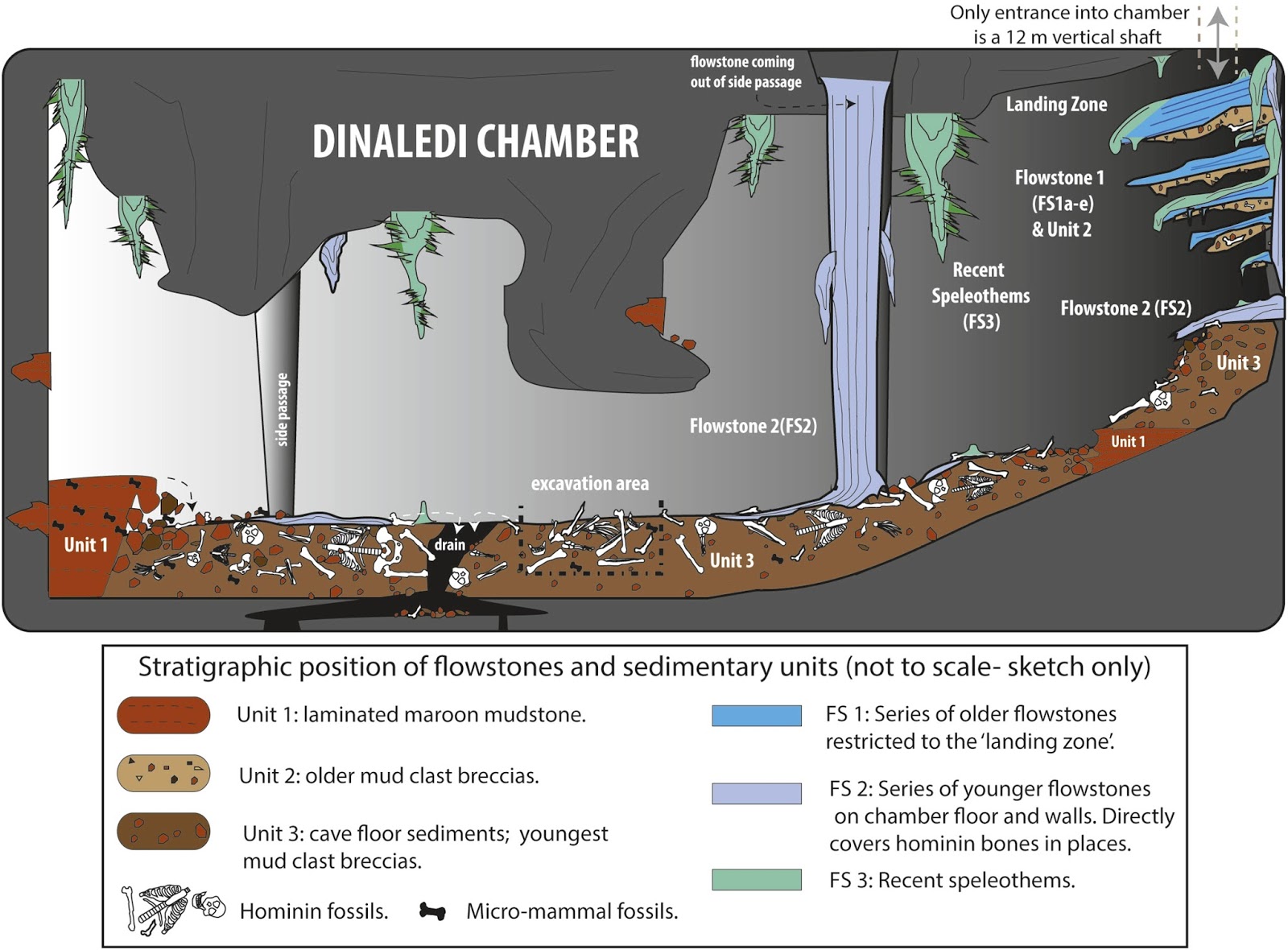
Figure 3. Cartoon illustrating the geological and taphonomic context and distribution of fossils, sediments and flowstones within the Dinaledi Chamber.
The distribution of the different geological units and flowstones is shown together with the inferred distribution of fossil material.

Figure 1. Geological setting of Cradle of Humankind and Rising Star cave system.
(A) Geology of Johannesburg Dome and surroundings, showing the Cradle of Humankind world heritage site in bold black outline. (B) surface geology of the immediate surroundings of the Rising Star cave system, showing the fault sets and variable chert content in the dolomite that controlled cave formation. The cave system is confined to a chert-poor stromatolitic dolomite horizon.


Lee R Berger, John Hawks, Darryl J de Ruiter, Steven E Churchill, Peter Schmid, Lucas K Delezene, Tracy L Kivell, Heather M Garvin, Scott A Williams, Jeremy M DeSilva, Matthew M Skinner, Charles M Musiba, Noel Cameron, Trenton W Holliday, William Harcourt-Smith, Rebecca R Ackermann, Markus Bastir, Barry Bogin, Debra Bolter, Juliet Brophy, Zachary D Cofran, Kimberly A Congdon, Andrew S Deane, Mana Dembo, Michelle Drapeau, Marina C Elliott, Elen M Feuerriegel, Daniel Garcia-Martinez, David J Green, Alia Gurtov, Joel D Irish, Ashley Kruger, Myra F Laird, Damiano Marchi, Marc R Meyer, Shahed Nalla, Enquye W Negash, Caley M Orr, Davorka Radovcic, Lauren Schroeder, Jill E Scott, Zachary Throckmorton, Matthew W Tocheri, Caroline VanSickle, Christopher S Walker, Pianpian Wei and Bernhard Zipfel. 2015. Homo naledi, A New Species of the Genus Homo from the Dinaledi Chamber, South Africa. eLife. 4. DOI: 10.7554/eLife.09560


This Face Changes the Human Story. But How? on.NatGeo.com/1ig3kot via @NatGeo
Homo naledi: New species of ancient human discovered, claim scientists http://gu.com/p/4c8jb
  New human-like species discovered in S Africa bbc.com/news/science-environment-34192447


Abstract
We describe the physical context of the Dinaledi Chamber within the Rising Star cave, South Africa, which contains the fossils of Homo naledi. Approximately 1550 specimens of hominin remains have been recovered from at least 15 individuals, representing a small portion of the total fossil content. Macro-vertebrate fossils are exclusively H. naledi, and occur within clay-rich sediments derived from in situ weathering, and exogenous clay and silt, which entered the chamber through fractures that prevented passage of coarser-grained material. The chamber was always in the dark zone, and not accessible to non-hominins. Bone taphonomy indicates that hominin individuals reached the chamber complete, with disarticulation occurring during/after deposition. Hominins accumulated over time as older laminated mudstone units and sediment along the cave floor were eroded. Preliminary evidence is consistent with deliberate body disposal in a single location, by a hominin species other than Homo sapiens, at an as-yet unknown date.


Paul HGM Dirks, Lee R Berger, Eric M Roberts, Jan D Kramers, John Hawks, Patrick S Randolph-Quinney, Marina Elliott, Charles M Musiba, Steven E Churchill, Darryl J de Ruiter, Peter Schmid, Lucinda R Backwell, Georgy A Belyanin, Pedro Boshoff, K Lindsay Hunter, Elen M Feuerriegel, Alia Gurtov, James du G Harrison, Rick Hunter, Ashley Kruger, Hannah Morris, Tebogo V Makhubela, Becca Peixotto, Steven Tucker. 2015. Geological and Taphonomic Context for the New Hominin Species Homo naledi from the Dinaledi Chamber, South Africa. eLife. 4. DOI: 10.7554/eLife.09561


eLife digest
Modern humans, or Homo sapiens, are now the only living species in their genus. But as recently as 20,000 years ago there were other species that belonged to the genus Homo. Together with modern humans, these extinct human species, our immediate ancestors and their close relatives are collectively referred to as ‘hominins’.

Now, Dirks et al. describe an unusual collection of hominin fossils that were found within the Dinaledi Chamber in the Rising Star cave system in South Africa. The fossils all belong to a newly discovered hominin species called Homo naledi, which is described in a related study by Berger et al. The unearthed fossils are the largest collection of hominin fossils from a single species ever to be discovered in Africa, and include the remains of at least 15 individuals and multiple examples of most of the bones in the skeleton.

Dirks et al. explain that the assemblage from the Dinaledi Chamber is unusual because of the large number of fossils discovered so close together in a single chamber deep within the cave system. It is also unusual that no other large animal remains were found in the chamber, and that the bodies had not been damaged by scavengers or predators. The fossils were excavated from soft clay-rich sediments that had accumulated in the chamber over time; it also appears that the bodies were intact when they arrived in the chamber, and then started to decompose.

Dirks et al. discuss a number of explanations as to how the remains came to rest in the Dinaledi Chamber, which range from whether Homo naledi lived in the caves to whether they were brought in by predators. Most of the evidence obtained so far is largely consistent with these bodies being deliberately disposed of in this single location by the same extinct hominin species. However, a number of other explanations cannot be completely ruled out and further investigation is now needed to uncover the series of events that resulted in this unique collection of hominin fossils.