|
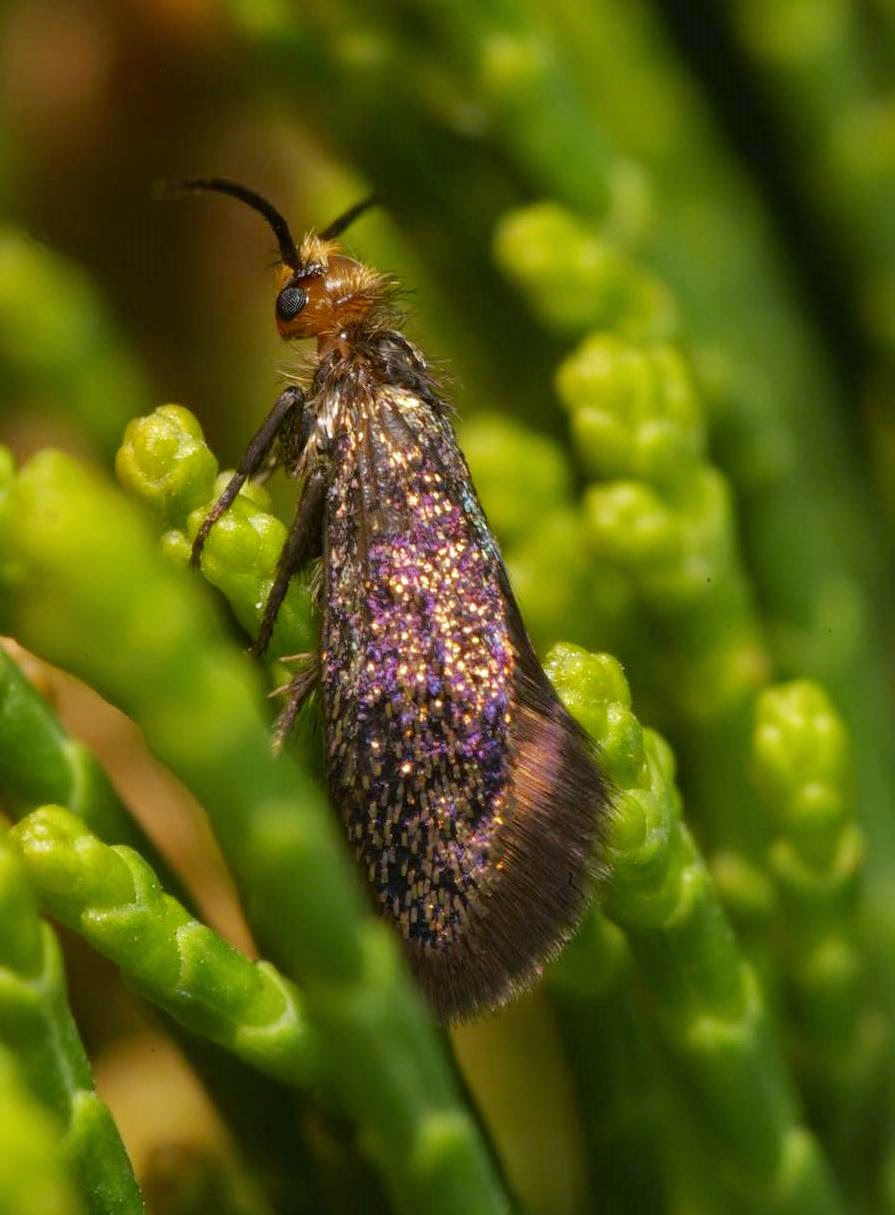
| [A, C-F]Vietomartyria wuyunjiena, [B] Vietomartyria maoershana Liao, Hirowatari & Huang, 2020 DOI: 10.5852/ejt.2020.610 |
Abstract
Micropterigidae is a family of Lepidoptera characterized by plesiomorphic morphological characters. Presently, this family consists of more than 22 genera and is distributed throughout all biogeographic realms. Vietomartyria Hashimoto & Mey, 2000 presently consists of six species mainly from South China. Two new species of the genus, V. wuyunjiena sp. nov. and V. maoershana sp. nov., are described herein from China; adult genitalia and wing venation are illustrated. Some biological accounts of the new species are also provided. A key to all described Vietomartyria species is given.
Keywords. Micropterigidae, Vietomartyria, new species, morphology, taxonomy.
Class Insecta Linnaeus, 1758
Order Lepidoptera Linnaeus, 1758
Superfamily Micropterigoidea Herrich-Schäffer, 1855
Family Micropterigidae Herrich-Schäffer, 1855
 |
| Adults and habitat of Vietomartyria spp. A. Vietomartyria wuyunjiena sp. nov., holotype, ♂. B. Vietomartyria maoershana sp. nov., holotype, ♂. C. One adult of V. wuyunjiena sp. nov. perching on fern. D. Habitat of V. wuyunjiena sp. nov. E. Specimen collection of V. wuyunjiena sp. nov. by sweep net. F. One adult of V. wuyunjiena sp. nov. perching on the white curtain of a light trap. |
Micropterigidae
Vietomartyria wuyunjiena sp. nov.
Diagnosis: The adults of this species are very similar to Vietomartyria nankunshana Hirowatari & Hashimoto, 2009 and V. nanlingana Hirowatari & Jinbo, 2009 because of their same ground color, but are separable from these two species by the dorsal process of the valva slightly curved inwardly (but almost right-angularly curved inwardly in V. wuyunjiena sp. nov.), and by tergite X slightly emarginate at the middle (but broadly emarginate in V. nankunshana and narrowly in V. nanlingana).
Etymology The specific epithet is derived from the name of the type locality, Wuyunjie National Nature Reserve.
Distribution This species is known from Wuyunjie National Nature Reserve (Taoyuan, Changde, Hunan, China).
Vietomartyria maoershana sp. nov.
Diagnosis This species is very similar to V. wuyunjiena sp. nov. and V. expeditionis, but can easily be distinguished by the following characters: paired X tergal lobes slender and digitate (slightly emarginate in V. wuyunjiena sp. nov. and broadly emarginate at the middle in V. expeditionis); basal process of valva long and pointed (absent in V. wuyunjiena sp. nov. and short obtuse in V. expeditionis); slightly curved dorsal process of gonopod (strongly curved in V. expeditionis).
Etymology This specific epithet is derived from the name of the type locality, Mao’ershan National Nature Reserve.
Distribution This species is known from Mao’ershan National Nature Reserve (Xin’an, Guilin, China). Remarks Adults of V. maoershana sp. nov. were collected along a paved road at 1500 m a.s.l., half way up Mt Mao’ershan. Similar to V. wuyunjiena sp. nov., the adults were observed flying or perching on low shrubs and ferns in cloudy conditions and even in weak rainfall.
Liao C.Q., Hirowatari T. and Huang G.H. 2020. Descriptions of Two New Vietomartyria species (Lepidoptera, Micropterigidae) from China. European Journal of Taxonomy. 610: 1–14. DOI: 10.5852/ejt.2020.610
Distribution This species is known from Mao’ershan National Nature Reserve (Xin’an, Guilin, China). Remarks Adults of V. maoershana sp. nov. were collected along a paved road at 1500 m a.s.l., half way up Mt Mao’ershan. Similar to V. wuyunjiena sp. nov., the adults were observed flying or perching on low shrubs and ferns in cloudy conditions and even in weak rainfall.
Liao C.Q., Hirowatari T. and Huang G.H. 2020. Descriptions of Two New Vietomartyria species (Lepidoptera, Micropterigidae) from China. European Journal of Taxonomy. 610: 1–14. DOI: 10.5852/ejt.2020.610