Showing posts with label Terrarana. Show all posts

Thursday, December 18, 2025

[Herpetology • 2025] Cryptomantis subgenus nov. & Pristimantis paganus • Vast Cryptic Diversity in Direct-developing Frogs Pristimantis (Anura: Strabomantidae): A New Subgenus and the Description of A New Species from the eastern Andes of Ecuador

 
Pristimantis paganus  
Loza-Carvajal, Yánez-Muñoz, Quilumbaquin & Ortega-Andrade, 2025
 
Amazonian pagan rainfrog| Cutín pagano Amazónico  ||  DOI: doi.org/10.7717/peerj.20512

Abstract 
Pristimantis, a genus of direct-developing frogs within the family Strabomantidae, comprises 617 recognized species, making it the most species-rich genus of vertebrates worldwide. This group include 264 described (43% of the world) species in Ecuador, being one of the countries in the region with the highest rate of species description, greatest diversity and endemism. In this study, we analyze the phylogenetic position and describe a new Pristimantis species from the Colonso Chalupas Biological Reserve and Llanganates National Park in northeastern Ecuador, using phylogenetic, genetic, morphological, and geographic evidence. Additionally, we propose a new subgenus within Pristimantis that includes the Pristimantis prolatus and Pristimantis bicantus species groups. Our results indicate that the new species and related species form a well-supported group with significant genetic divergence based on the 16S rRNA gene (average uncorrected p-distance = 2.8–7.5%), within the Pristimantis bicantus species group. Morphologically, the new species is characterized by a black to dark-gray dorsum and marbled venter (less intense or brown in males), being endemic to the Guacamayos mountain range and the Llanganates region in the northeastern Andean foothills of Ecuador. We emphasize the importance of including topotypic specimens to analyze and compare species groups to delimiting species, like Pristimantis.
 
Keywords: Integrative taxonomy, Cryptic diversity, Pristimantis paganus sp. nov., Pristimantis prolatus group, Pristimantis bicantus group, Cryptomantis gen. nov.


Pristimantis paganus sp. nov. 
Holotype in life DHMECN 16810, adult female, SVL = 27.2 mm.
(A) Dorsal view; (B) frontal view; (C) lateral view; (D) ventral view. Photographs by Mario H. Yánez Muñoz.

Pristimantis paganus sp. nov.
Suggested common English name: Amazonian pagan rainfrog
Common name in Spanish: Cutín pagano Amazónico.

Diagnosis. Pristimantis paganus sp. nov. (Figs. 2–7) is a member of the subgenus Cryptomantis and P. bicantus species group, characterized by the following combination of characters: (1) dorsal skin finely granular with dorso-laterally aligned flattened warts, areolate venter, discoidal fold present and visible posteriorly, dorsolateral folds weak and discontinuous in females, continuous in males; scapular W-shaped fold in males; (2) tympanic membrane and tympanic annulus present, round, horizontal diameter of tympanum equal to 38% of eye diameter, antero-dorsal margin with a supratympanic fold and large subconical postrictal tubercles; (3) snout short, subacuminate in dorsal view, rounded in profile with slightly flared lips; (4) upper eyelid with at least three to four large rounded tubercles surrounded by several small rounded tubercles, two subconical tubercles behind each eye; no cranial crest; (5) dentigerous processes of vomers, oblique in outline each process with 3–8 teeth; (6) vocal slits absent; no nuptial pad and no vocal sac; (7) Finger I shorter than Finger II; broad, expanded disks dilated with circummarginal grooves; (8) fingers with thin lateral cutaneous fringes; (9) subarticular tubercles, present, prominent; hyperdistal subarticular tubercle, present; ulnar tubercles absent; (10) heel with one subconical tubercle; outer edge with two flattened tubercles, tarsal fold absent; (11) inner metatarsal tubercle oval in females 3 times larger than rounded outer metatarsal tubercle; supernumerary tubercles absent; (12) toes with thin lateral fringes present, interdigital membrane absent, Toe V longer than Toe III; (13) The distinctive coloration of females, characterized by a uniformly black dorsum and black markings on a cream to pinkish-cream background on the flanks, belly, and throat, distinguishes this species from its congeners and other Pristimantis species inhabiting the eastern montane forests of Ecuador; (14) adult males, SVL = 17.20–21.5 mm (mean = 19.6, n = 13), females SVL= 24.8–29.8 mm (mean = 29.6 mm, n = 6), (Tables 2, 3, S3).

Etymology. The specific epithet is from the Latin word “paganus”, an adjective derived from “pagus”, which refers to the inhabitants of the forest or village, far from civilization and towns, referring to the remote and unexplored sites where this species inhabits, in the montane cloud forests at the Colonso Chalupas Biological Reserve and Llanganates National Park, northeastern flanks of the Andes in Ecuador.

Habitat and specimens of Pristimantis paganus sp. nov.
(A) Cloud forest with epiphytic plants, type locality, Colonso Chalupas Biological Reserve; (B) female, DHMECN 19962;
(C) paratype, male, DHMECN 15602; (D) paratype, adult female, DHMECN 17222.
Photographs: Jorge Brito (A), Keyko D. Loza-Carvajal (B), H. Mauricio Ortega-Andrade (C), Zane Libke (D).

Representative species of the subgenus Cryptomantis.
Subclade A-Pristimantis prolatus species group:
(A) Pristimantis ganonotus DHMECN 16961, Colonso Chalupas Reserve, Napo; (B) P. burtoniorum DHMECN 14479, Paratype, Mayordomo Reserve, Tungurahua; (C) P. prolatus DHMECN 11564, Topotype, Río El Reventador, Sucumbíos;
(D) P. c.sp. 1, DHMECN 15674, Colonso Chalupas Reserve, Napo.
Subclade B-Pristimantis bicantus species group: (E) P. c.sp. 2, QCAZ 70020, Llanganates National Park, Napo; (F) P. marcoreyesi, DHMECN 13833, Tungurahua volcano, Tungurahua; (G) P. paganus sp. nov. DHMECN 15606, Colonso Chalupas Reserve, Napo;
(H) P. tungurahua, DHMECN 14428, Vizcaya Reserve, Tungurahua; (I) P. sacharuna, QCAZ 52496, Zúñag Reserve, Tungurahua; (J) P. c.sp. 3, QCAZ 51553, San Antonio de Juval, Cañar;
(K) P. nelsongalloi, DHMECN 5223, Zúñag Reserve, Tungurahua; (L) P. bicantus, DHMECN 12359, El Reventador, Sucumbíos; (M) P. c.sp. 5, QCAZ 52489, Sangay National Park, Morona Santiago.
Photo credit: Gustavo Pazmiño, Bioweb (E); Santiago Ron, Bioweb (I), Bioweb (J, M); Keyko D. Loza, Carvajal (A); Mario H. Yánez Muñoz (B, C, F, H, K, L); H. Mauricio Ortega-Andrade (D, G).

Conclusions: 
We described a new species, Pristimantis paganus, from the Colonso Chalupas Biological Reserve and Llanganates National Park, northeastern Ecuador. Furthermore, we define a new subgenus, Cryptomantis, within Pristimantis that includes the Pristimantis prolatus and Pristimantis bicantus species groups. Our results indicate at least five Candidate species within Cryptomantis. We emphasize the importance of including topotypic specimens to analyze and compare specios groups to delimiting species, like Pristimantis.

 
Keyko D. Loza-Carvajal, Mario H. Yánez-Muñoz, Walter Quilumbaquin and H. Mauricio Ortega-Andrade​. 2025. Vast Cryptic Diversity in Direct-developing Frogs Pristimantis (Anura: Strabomantidae): A New Subgenus and the Description of A New Species from the eastern Andes of Ecuador. PeerJ. 13:e20512. DOI: doi.org/10.7717/peerj.20512 [December 17, 2025]
 

Sunday, November 9, 2025

[Herpetology • 2020] Pristimantis afrox, P. cisnerosi & P. chocoensis • Phylogenetic Relationships of the Subgenus Hypodictyon (Anura: Strabomantidae: Pristimantis) with the description of Three New Species from the Chocó Region


Pristimantis afrox
Pristimantis cisnerosi
Pristimantis chocoensis
Reyes-Puig, Yánez-Muñoz, Ortega & Ron, 2020


Abstract
We describe 3 new species of frogs Pristimantis, subgenus Hypodictyon from the Chocó of Colombia and Ecuador. Additionally, we present an updated phylogeny of the subgenus Hypodictyon on which we report, for the first time, the phylogenetic position of P. calcaratus, P. colomai, P. illotus, P. kuri, P. rosadoi, P. tenebrionis, and P. variabilis. We review the species content of Hypodictyon and its 2 species groups. Pristimantis afrox sp. nov. is characterized by  bearing  an  ×-shaped  scapular  fold;  an  interocular  fold  and  a  longitudinal  tubercle  in  the  interorbital  region,  toes  with  conspicuous  lateral  fringes  on  fingers  II-V;  distinctive  coloration  on  groin  and  hidden  surfaces  of  thighs  red.  Pristimantis chocoensis sp. nov. is characterized by having finger I equal or slightly shorter than II; venter and throat homogenously cream to slightly stained with brown, and black marks towards the insertion of the arm. Pristimantis cisnerosi  sp.  nov.  exhibits  strongly  convex  and  flared  nasal  bones;  protruding  nostrils  anteriorly;  dorsal  coloration  dark brown and venter scarlet; bearing conical tubercles on the upper eyelid and reduced tympanum.

Keywords: Bioregion; Terrarana; Phylogeny; Pristimantis afrox sp. nov.; Pristimantis chocoensis sp. nov.; Pristimantis cisnerosi sp. nov.

Pristimantis afrox sp.  nov. (DHMECN 6578)
 
Pristimantis cisnerosi sp. nov. (DHMECN 6683)

Pristimantis chocoensis sp. nov. (QCAZ 65560)


Carolina Reyes-Puig, Mario H. Yánez-Muñoz, Jhael A. Ortega and Santiago R. Ron. 2020. Relaciones filogenéticas del subgénero Hypodictyon (Anura: Strabomantidae: Pristimantis) con la descripción de tres especies nuevas de la región del Chocó [Phylogenetic relationships of the subgenus Hypodictyon (Anura: Strabomantidae: Pristimantis) with the description of three new species from the Chocó región]. Revista Mexicana de Biodiversidad. 91: e913013. DOI: doi.org/10.22201/ib.20078706e.2020.91.3013

Resumen: Describimos 3 nuevas especies de cutines Pristimantis del subgénero Hypodictyon de la bioregión del Chocó de Colombia y Ecuador. Además, presentamos una filogenia actualizada del subgénero Hypodictyon en la que reportamos por primera vez la posición filogenética de P. calcaratus, P. colomai, P. illotus, P. kuri, P. rosadoi, P. tenebrionis y P. variabilis. Se revisó el contenido de Hypodictyon y sus 2 grupos de especies. Pristimantis afrox sp. nov. se caracteriza por la presencia de un pliegue escapular en forma de ×; pliegue interocular y tubérculo longitudinal en la región interorbital; dedos del pie con pronunciados rebordes cutáneos basales en los dedos II-V; distintiva coloración inguinal y superficies ocultas de los muslos rojas. Pristimantis chocoensis sp. nov. posee dedo I de la mano igual o ligeramente más corto que el II; vientre y garganta homogéneamente crema a ligeramente manchados de café, pliegue interorbital, rebordes cutáneos laterales presentes, pliegue metatarsal interno y manchas negras hacia la inserción posterior del brazo. Pristimantis cisnerosi sp. nov. presenta distintivos huesos nasales fuertemente convexos y acampanados; narinas protuberantes proyectadas anteriormente; coloración dorsal café oscura y vientre café escarlata; tubérculos cónicos sobre el párpado y tímpano reducido.
Palabras clave: bioregión; terrarana; filogenia; Pristimantis afrox sp. nov.; Pristimantis chocoensis sp. nov.; Pristimantis cisnerosi sp. nov.

Thursday, January 23, 2025

[Herpetology • 2025] Deep Cryptic Diversity in the Craugastor podiciferus Species Group (Anura: Craugastoridae) of Isthmian Central America revealed by mitochondrial and nuclear data


 (A) Craugastor aenigmaticus (UCR 22961) from Cerro Arbolado, Puntarenas, CR, (B) C. blairi (SMF 104032) from Fortuna, PA, (C) C. sagui (SMF 104018) from La Nevera, PA,
 (D) C. zunigai (UCR 20389) from Potrero Grande, Puntarenas, CR, (E-F) C. podiciferus (UCR 23155, 23159) from Caribbean slopes of Cerro Kamuk, Limón, CR,
 (J) Craugastor sp. Pico Blanco (UCR 24466) from Escazú, San José, CR, (K) Craugastor sp. Chumacera (UCR 23011) from Chumacera, San José, CR, (L) Craugastor sp. Siola (UCR 23169) from Siola, Limón, CR, 
(M) C. bransfordii from Siquirres, Limón, CR, (O) C. underwoodi from Cascajal, San José, CR, (V) C. rearki from Siquirres, Limón, CR.

in Arias, Crawford, Hertz et Olea,. 2025. 

Abstract 
The Craugastor podiciferus Species Group contains eleven species of terraranan frogs distributed from eastern Honduras to eastern Panama. All species have remarkable color pattern polymorphisms, which may contribute to potential taxonomic problems. We performed exhaustive sampling throughout the geographic distribution of the group to evaluate the phylogenetic relationships and biogeographic history of all named species based on two mitochondrial markers and nuclear ddRAD loci. We also implemented various species delimitation methods to test for the presence of unconfirmed candidate species within the group. Molecular phylogenetic analyses showed that the group contains four major clades. All currently named species are supported by molecular data, yet species richness within the group is clearly underestimated. Species delimitation was discordant between the mitochondrial and nuclear datasets and among analytical methods. Adopting a conservative approach, we propose that the C. podiciferus species group contains at least 12 unconfirmed candidate species. Ancestral area reconstruction showed that the group originated and diversified in the highlands of the Talamancan montane forest ecoregion of Costa Rica and western Panama.

Photographs in life of Craugastor podiciferus species complex.
 (A) Craugastor aenigmaticus (UCR 22961) from Cerro Arbolado, Puntarenas, CR, (B) C. blairi (SMF 104032) from Fortuna, PA, (C) C. sagui (SMF 104018) from La Nevera, PA, (D) C. zunigai (UCR 20389) from Potrero Grande, Puntarenas, CR, 
(E-F) C. podiciferus (UCR 23155, 23159) from Caribbean slopes of Cerro Kamuk, Limón, CR, (G) Craugastor sp. Monte Verde (UCR 24613) from Monte Verde, Puntarenas, CR, (H) Craugastor sp. San Gerardo (CRARC 0247) from San Gerardo, Guanacaste, CR,
(I) Craugastor sp. Fila Costeña (UCR 23028) from Quebradas, San José, CR, (J) Craugastor sp. Pico Blanco (UCR 24466) from Escazú, San José, CR, (K) Craugastor sp. Chumacera (UCR 23011) from Chumacera, San José, CR, (L) Craugastor sp. Siola (UCR 23169) from Siola, Limón, CR, 
 (M) C. bransfordii from Siquirres, Limón, CR, (N) Craugastor sp. Fila Carbon (UCR 23127) from Amubri, Limón, CR, (O) C. underwoodi from Cascajal, San José, CR, (P) Craugastor sp. Quebradas from Fila Costeña, Puntarenas, CR,
(Q) Craugastor sp. Vereh (UCR 23040) from Vereh, Cartago, CR, (R) Craugastor sp. Panama (SMF 104010) from Rambala. PA, (S) C. stejnegerianus (UCR 22976) from Palmar Norte, Puntarenas, CR, (T) C. gabbi (UCR 22998) from San Vito, Puntarenas, CR,
(U) C. persimilis from Siquirres, Limón, CR, (V) C. rearki from Siquirres, Limón, CR, (W) Craugastor sp. Neilly (UCR 22985) from Río Claro, Puntarenas, CR, and (X) Craugastor sp. Quepos (UCR 24612) from Montes de Oca, San José CR.
Photos by E. Arias (A, E, F, G, I, J, K, L, N, Q, S, T, W, and X), Andreas Hertz (B,C, and R), Eduardo Boza-Oviedo (D and O), Brian Kubicki (H, M, U, and V), and Raby Nuñez (P).


Conclusions: 
The diversity within the Craugastor podiciferus Species Group is vastly underestimated, as revealed by the presence of several undescribed species recovered from the phylogenetic and species delimitation analyses. An exhaustive morphological review of the genetic lineages may show morphological characteristics that would allow for the differentiation of the molecular lineages. Comprehensive studies are needed on habitat use, acoustics, behavior, and other data to corroborate and better understand the taxonomy of all lineages revealed here.

Based on our mitochondrial and nuclear analyses, morphological evidence, and previous information we recovered 23 lineages, 11 with names and 12 unconfirmed candidate species. Based on our results, we propose the following changes:

• We restrict C. podiciferus to populations of Cordillera Volcánica Central from Costa Rica and the Cordillera de Talamanca of Costa Rica and western Panama. In the Cordillera de Talamanca, C. podiciferus is restricted to the Caribbean slopes.
 •Craugastor polyptychus is referred to as a junior synonym of C. bransfordii.
 • Craugastor rearki is resurrected to include wide-ranging populations from the Caribbean versant of Costa Rica, Nicaragua, and Honduras.
 • Craugastor lauraster is referred to as a junior synonym of the older name, C. rearki.

Finally, we want to highlight the need to continue exploring remote areas in the ICA, especially in the Talamanca Mountain Range. The fieldwork performed in this area has resulted in the discovery of several new species or new records for the region. Therefore, more fieldwork and laboratory work are necessary to improve the knowledge of biodiversity in this region to perform informed strategies of conservation.


Erick Arias, Andrew J. Crawford, Andreas Hertz and Gabriela Parra Olea​. 2025. Deep Cryptic Diversity in the Craugastor podiciferus Species Group (Anura: Craugastoridae) of Isthmian Central America revealed by mitochondrial and nuclear data. PeerJ. 13:e18212. DOI: doi.org/10.7717/peerj.18212

Friday, August 16, 2024

[Herpetology • 2024] One hundred years of solitude: The Rediscovery of Pristimantis ruidus (Anura: Strabomantidae) in the southern Andes, Ecuador and its phylogenetic relationships


Pristimantis ruidus  Lynch, 1979

in Sánchez-Nivicela, Székely, Salagaje, Astudillo-Abad, Culebras, Ortiz et Székely. 2024.
 
Abstract
We report the rediscovery, a century after its last record, of two specimens of Pristimantis ruidus from approximately 6 km northeast of its type locality, in a montane forest from the western Andes of southern Ecuador. This species, described by John D. Lynch in 1979, based on specimens collected in 1922 by George H. Tate, was previously known only from the type series, all specimens originating from a single locality (Molleturo, Provincia Azuay, Ecuador, 2317 m elev.). The rediscovery occurred in November 2022 in the Reserva de Conservación Quitahuaycu, Molleturo Parish, Azuay Province. The two specimens, both females, are characterised by rough skin with numerous rounded low warts and tubercles on their dorsum, a W-shaped occipital fold, tympanum and tympanic ring not externally visible and by the lack of cranial crests, characters that correspond with the description of the holotype. We evaluate the phylogenetic relationships, based on two mitochondrial genes (12S and 16S rRNA) and one nuclear gene (RAG-1). These analyses reveal Pristimantis ruidus as a member of the subgenus Huicundomantis, being most closely related to P. philipi, a species with a distribution restricted to the paramo of the same mountain region (Macizo del Cajas). Pristimantis ruidus co-exists with Pristimantis jimenezi, three additional species of Pristimantis and one Noblella with uncertain taxonomic status. This rediscovery underscores the urgency of implementing effective conservation and monitoring measures for the few remnants of the original ecosystems from western Ecuador, which face ongoing anthropogenic threats and harbour a diversity that remains insufficiently studied.

Key Words: Amphibia, biodiversity, conservation, Huicundomantis, molecular genetics, morphology, new record, phylogeny, systematics, taxonomy

Pristimantis ruidus in life.
Female DHMECN 19106: A. Dorso-lateral view; B. Dorsal view; C. Ventral view; SVL = 30.0 mm.
Female MUTPL 1613; D. Dorso-lateral view; E. Dorsal view; SVL = 20.1 mm.
Photographs: Jaime Culebras, Juan Sánchez.


 Juan C. Sánchez-Nivicela, Diana Székely, Luis A. Salagaje M., Nicolás Astudillo-Abad, Jaime Culebras, Ernesto Arbeláez Ortiz and Paul Székely. 2024. One hundred years of solitude: The Rediscovery of Pristimantis ruidus (Anura, Strabomantidae) in the southern Andes, Ecuador and its phylogenetic relationships. Zoosystematics and Evolution. 100(3): 1107-1120. DOI: doi.org/10.3897/zse.100.119662

Monday, June 24, 2024

[Herpetology • 2024] Eleutherodactylus coelum • A New Species of Direct-developing Frog of the Genus Eleutherodactylus (Anura: Eleutherodactylidae) from Tamaulipas, Mexico


Eleutherodactylus (Syrrhophuscoelum
Hernández-Austria, García-Castillo & Parra-Olea, 2024

 
Abstract
The number of species of the subgenus Syrrhophus, genus Eleutherodactylus has increased rapidly in the last eight years, due to recent taxonomic studies. This subgenus of direct-developing frogs is well represented in Mexico, which harbors more than 90% of the species richness reported for the subgenus. In this study, we describe one new speciesEleutherodactylus (Syrrhophuscoelum sp. nov. from the El Cielo Biosphere Reserve in Tamaulipas, Mexico, based on morphological and molecular data. The new species, which was previously assigned to E. cystignathoides, differs from its congeners mainly by its small size and by having the tips of Finger III and IV expanded to twice the width of the narrowest part of these fingers. Phylogenetic analyses recovered a well-supported relationship of the new species as the sister group to an undescribed taxon from San Luis Potosí. This analysis also indicates there are more lineages wating for description.

Amphibia, Terraranas, eastern Mexico, taxonomy, diversity, phylogenetics, conservation


Eleutherodactylus (Syrrhophuscoelum


Raquel Hernández-Austria, Mirna G. García-Castillo and Gabriela Parra-Olea. 2024. A New Species of Direct-developing Frog of the Genus Eleutherodactylus (Anura: Eleutherodactylidae) from Tamaulipas, Mexico.  Zootaxa. 5471(4); 433-450. DOI: 10.11646/zootaxa.5471.4.3
facebook.com/RaquelHAustria/posts/pfbid0msrcjLJhMfW3U4GLsAAHoPgtj8Mjr5zdt9H1azQ2eQm6kYx3RHbuehLeMcLDv1Ucl

Wednesday, June 5, 2024

[Herpetology • 2024] Pristimantis normaewingae • Phylogenetic Diversity of the Pristimantis anaiae species group, with A Description of A New Species of Pristimantis (Anura: Strabomantidae) from Cerro Candelaria, Tungurahua, Ecuador


Pristimantis normaewingae 
Reyes-Puig, Yánez-Muñoz, Libke, Vinueza & Carrión-Olmedo, 2024
 
Norma Ewing Rain Frog  ||  DOI: 10.3897/evolsyst.8.118855

Abstract
Continuous field work on mountains in the upper Pastaza watershed, showed an unexpected cryptic diversity in the recently described Pristimantis anaiae species group. Based on molecular and morphological characters we describe a new frog species from the central region of the eastern Ecuadorian Andes. We present an updated phylogeny for the Pristimantis anaiae species group, based on widely used, ubiquitous, and available genes, three mitochondrial genes (12S rRNA, 16S rRNA, ND1) and RAG1 nuclear gene. Our phylogenetic hypothesis increases genetic diversity of the species group and shows two well-supported subclades. We show the relationships of the new species and include for the first time Pristimantis maryanneae, belonging to a clade related to P. resistencia + P. glendae. Our phylogeny shows that new species, from Cerro Candelaria, is more closely related to P. kunam from Sangay National Park and differs from it by having a less conspicuous dorsolateral row of enlarged tubercles, and sacral oval marks surrounded by thin white pale lines. The new species and two additional undescribed species occur on the south side of the Rio Pastaza Valley, at Cerro Candelaria within the Llanganates – Sangay Ecological Corridor, reflecting the high importance of this area for conservation and understanding of evolution processes in the area, suggesting a probably adaptive radiation zone for the P. anaiae species group.

Key Words: Andes, amphibia, nanopore sequencing, upper Rio Pastaza watershed, Pristimantis normaewingae sp. nov.


Life coloration variation of the type series of Pristimantis normaewingae sp. nov.
 A1–A3. DHMECN 18863, adult female; B1–B3. DHMECN 18404, adult male; C1–C3. DHMECN 17191, juvenile; D1–D3. DHMECN 18996 male juvenile. Photographs JPRP and ZL.

Life comparison between members of Pristimantis anaiae species group.
 A. Pristimantis normaewingae sp. nov. (DHMECN 18400, male paratype); B. P. normaewingae sp. nov. (DHMECN 18409, female holotype);
C. P. kunam (QCAZ 56438, male holotype,); D. P. resistencia (QCAZ 66519, female holotype); E. P. anaiae (DHMECN 16859, male); F. P. maryanneae (DHMECN 18227, male); G. P. glendae (QCAZ 56437, adult male); H. P. venegasi, (MZUTI6571, female). Arrows show area of the oval marks in sacrum, proposed diagnostic of the group by Ortega et al. 2022.
Photographs JPRP, MYM, JCC, Jorge Brito, and Bioweb.

Pristimantis normaewingae sp. nov. in its habitat at Cerro Candelaria.
 A. DHMECN 18868, female; B. DHMECN 18401, male on Neurolepis aristata (Poaceae) at night; C. DHMECN 17188, juvenile on bromeliad at night.; D. DHMECN 18400, male on leave of shrub; E. habitat at the type locality of the new species in Cerro Candelaria. Photographs JPRP and ZL.


 Pristimantis normaewingae sp. nov.
 English Common name: Norma Ewing Rain Frog. 
Spanish Common name: Cutín de Norma Ewing.

Etymology: The specific epithet normaewingae is a noun in the genitive case and is a patronym in honor of Norma Ewing, a passionate conservationist and animal rescue volunteer from United States. Her belief that all species, and especially frogs, are interconnected, is rooted in her early childhood surrounded by nature living and working on a farm. She has always cared for animals of all shapes and sizes. As a volunteer with animal rescues, she was admired for her ability to nurture orphaned and injured animals.


 Juan Pablo Reyes-Puig, Mario H. Yánez-Muñoz, Zane Libke, Patricio Vinueza and Julio C. Carrión-Olmedo. 2024. Phylogenetic Diversity of the Pristimantis anaiae species group, with A Description of A New Species of Pristimantis (Anura, Strabomantidae) from Cerro Candelaria, Tungurahua, Ecuador. Evolutionary Systematics. 8(1): 101-118. DOI: 10.3897/evolsyst.8.118855

Wednesday, February 14, 2024

[Herpetology • 2023] Pristimantis paulogabrieli • A New Species of Pristimantis (Anura: Strabomantidae) from the State of Acre, Brazil


Pristimantis paulogabrieli
Melo-Sampaio, 2023

 
Abstract
Pristimantis is the amphibian genus with the largest number of described species yet harbouring many species still to be named, notably in Amazonia. Here, I describe a member of the P. diadematus species complex from southwestern Amazonia in Brazil based on external morphology. The species is most similar to P. divnae, a species from southern Peru, but diagnosable from it by the combination of the following characters: presence of nuptial pads and tympanum, smaller body size (SVL 19.5-23.5 mm in males, 27.8-30.6 mm in females), and absence of yellow marks in both the inguinal region and shanks. The new species occupies the same habitats as the syntopic P. altamazonicus, another member of the P. diadematus species complex. Based on an extensive literature review, a new composition of the P. diadematus species complex is proposed and discussed.


Pristimantis paulogabrieli sp. nov. in life.
Daytime photos (A-D) male paratype UFAC-RB 9668 (field series UFAC-RB 4423) (A), female holotype UFAC-RB 9669 (field series UFAC-RB 4424) (B-D).
Night colouration: female paratype UFAC-RB 5737 (E) and unvouchered (F).
Red arrows indicate tympanum and yellow arrow indicates discoidal fold.

Pristimantis paulogabrieli sp. nov. 

Diagnosis: The new species, P. paulogabrieli, is diagnosed by the following combination of characters: 1) skin on dorsum shagreen with scattered minute tubercles; dorsolateral fold absent; skin on venter areolate; discoidal fold present; 2) tympanic annulus visible, tympanic membrane present; 3) snout subacuminate in dorsal view, rounded in lateral view; 4) upper eyelid with minute tubercles, upper eyelid smaller than IOD, cranial crests absent; 5) dentigerous processes of vomers oblique low; 6) males with nuptial pads, but lacking vocal sac and vocal slits; 7) postrictal tubercles present; 8) finger I shorter than finger II, discs on fingers III and IV broad, rounded; 9) fingers with narrow lateral fringes; 10) ulnar tubercles present; 11) outer surfaces of tarsus without tubercles; 12) heel without minute tubercle; 13) short, inner tarsal fold present; 14) inner metatarsal tubercle ovoid, four and half times the size of ovoid outer metatarsal tubercle; 15) few supernumerary plantar tubercles present; 16) toes with narrow lateral fringes; 17) basal toe webbing present between toes III and IV; 18) toe V much longer than toe III, toe discs broad, rounded, slightly smaller than discs on fingers; 19) in ethanol, dorsum brown with dark brown W-shaped mark on scapula and a dark brown chevron; 20) chest and belly cream with dark brown blotches, throat cream with few dark brown blotches and many minute dark brown spots; 21) SVL in adult males 19.5-23.5 mm (n = 8), females 27.8-30.6 mm (n = 2).

Etymology: The specific epithet is a patronymic name for my beloved son, Paulo Gabriel Silva Melo Sampaio.


Paulo R. Melo-Sampaio. 2023. A New Species of Pristimantis (Anura, Strabomantidae) from the State of Acre, Brazil. J. of Vertebrate Biology. 72(23044): 1-19.DOI: 10.25225/jvb.23044

Monday, January 1, 2024

[Herpetology • 2023] Pristimantis koki, P. kopinangae & P. kalamandeenae • Exceptional Diversity of Pristimantis Landfrogs (Anura: Terraranae) on the Wokomung Massif, Guyana, with Descriptions of Three New Species


 a) Pristimantis koki, b) P. kopinangae,
c) P. kalamandeenae, d) P. dendrobatoides,
g) P. marmoratus, h) P. pulvinatus 
  
Means, Heinicke, Blair Hedges, Macculloch & Lathrop, 2023

 Abstract
We describe three new species of landfrogs, genus Pristimantis, from near the summit of Mt. Kopinang, one of the several high points of the Wokomung Massif, a large horseshoe-shaped tepui (= mesa) in west-central Guyana. Pristimantis koki n. sp. is known from 1,067 to 1,525 m elevation. It is characterized by small-sized adults averaging 12.4 mm SVL (snout-vent length) in males and 18.4 mm in females; a pointed, depressed, elongated snout; lack of an obvious tympanum, vocal slit, or sac; and diagnostically black pigment prominently arranged around the anus fringed by light pigment. When handled, P. koki seems to emit volatile organic compounds and leaves a slightly numbing taste at the base of the human tongue. Pristimantis kopinangae n. sp. is known from three specimens collected at approx. 1,385 m elevation on the Wokomung Massif and two specimens from slightly higher in elevation on Mt. Ayanganna. About the size of most Pristimantis inhabiting the Guyana uplands and highlands (20-30 mm SVL), it is characterized by 2-3 light yellow inguinal flash-mark blotches, short broadly round snout, large eye with a blue iris, white skin of chin and areolate belly with dark brown vermiculations; and absence of a tympanum. Pristimantis kalamandeenae n. sp. is known from three specimens collected on the Wokomung Massif including an amplexing pair at approx. 1,550 m elevation. Similar in size to P. kopinangae, it is characterized by an acuminate snout, black iris, obvious tympanum, and uniform tan pigmentation dorsally after dark that becomes uniformly dark brown in daytime. Phylogenetic results show that P. koki and P. kopinangae are sister species and are members of a larger assemblage of related species endemic to the Pantepui Region within the P. unistrigatus species group. Pristimantis kalamandeenae is not closely related to these species, instead forming a clade with the P. lacrimosus species group. The three new species occur in sympatry with at least five other Pristimantis species on the Wokomung Massif, the greatest known Pristimantis species richness on a single tepui of the Guiana Shield.  

KEYWORDS: Brachycephaloidea, Craugastoridae, Pantepui, South America, Strabomantidae, systematics, tepui, volatile skin secretions


Exceptional diversity of Pristimantis (family Strabomantidae) on a single tepui;
 a) Pristimantis koki, b) Pristimantis kopinangae, c) Pristimantis kalamandeenae,
d) Pristimantis dendrobatoides, e) Pristimantis jester, f) Pristimantis saltissimus, g) Pristimantis marmoratus, h) Pristimantis pulvinatus, i) Ceuthomantis smaragdinus (family Ceuthomantidae) sympatric with all the above and similar in size and general appearance.


D. Bruce Means, Matthew P. Heinicke, S. Blair Hedges, Ross D. Macculloch and Amy Lathrop. 2023. Exceptional Diversity of Pristimantis Landfrogs (Anura: Terraranae) on the Wokomung Massif, Guyana, with Descriptions of Three New Species. Journal of Vertebrate Biology. 72(23026), 23026.1-26. DOI: 10.25225/jvb.23026  

Wednesday, December 27, 2023

[Herpetology • 2023] Pristimantis similaris • A New Cryptic Species of Terrestrial Breeding frog of the Pristimantis danae Group (Anura: Strabomantidae) from montane forests in Ayacucho, Peru


Pristimantis similaris 
Herrera-Alva, Catenazzi & Aguilar-Puntriano, 2023

Photos by V. Diaz-Vargas and E. Castillo-Urbina.

Abstract
Based on morphological and molecular characters, we describe a new species of terrestrial breeding frog of the Pristimantis danae Group from montane forests of La Mar Province, Ayacucho Department in southern Peru, at elevations from 1200 to 2000 m a.s.l. The phylogenetic analysis, based on concatenated sequences of gene fragments of 16S rRNA, RAG1, COI and TYR suggests that the new species is a sister taxon of a clade that includes one undescribed species of Pristimantis from Cusco, Pristimantis pharangobates and Pristimantis rhabdolaemus. The new species is most similar to P. rhabdolaemus, which differs by lacking scapular tubercules and by its smaller size (17.0–18.6 mm in males [n = 5], 20.8–25.2 mm in females [n = 5] in the new species vs. 22.8–26.3 mm in males [n = 19], 26.0–31.9 mm in females [n = 30] of P. rhabdolaemus). Additionally, we report the prevalence of Batrachochytrium dendrobatidis (Bd) in this species.
Key words: Chytridiomycosis, cryptic species, montane forests, morphology, phylogeny

Pristimantis similaris sp. nov. (A–D) male. SVL: 17.0 mm. Holotype. MUSM 41030.
Photos by Vladimir Diaz-Vargas.

A–H colour and pattern variation of Pristimantis similaris sp. nov. 
 Specimen from A–F collected in Cajadela:
A, B male MUSM 41029 C, D female MUSM 41031
E, F female MUSM 41032. Specimen G, H male MUSM 41326 collected in Machente.
Photos by V. Diaz-Vargas and E. Castillo-Urbina.

 Pristimantis similaris sp. nov.
 
Common name: English: Similar Rubber Frog.
 Spanish: Rana cutín similar.

Diagnosis: A new species of Pristimantis assigned to the P. danae species Group having the following combination of characters: (1) Skin on dorsum shagreen, skin on venter areolate; discoidal and dorsolateral folds present, weak; thoracic fold present; (2) tympanic membrane and tympanic annulus present, distinct, visible externally; (3) snout subaccuminated in dorsal view, round in lateral view; (4) upper eyelid lacking tubercles; EW smaller than IOD; cranial crest absent; two small and flat tubercles above the snout near the eyes; (5) dentigerous processes of vomers low, oblique in five of the paratypes, absent in four paratypes and the holotype; (6) males with vocal slits, subgular vocal sac large extending on to chest and without nuptial pads; (7) Finger I slightly shorter than Finger II; discs of digits expanded, flat and truncated; (8) fingers without lateral fringes; (9) ulnar tubercles present, but diffuse; (10) heel with two to three small and flat tubercles; inner tarsal fold present, small; (11) inner metatarsal tubercle ovoid, 2–3 times larger ...

Etymology: The specific name corresponds to the Latin word “similar”. This refers to the similarity of the new species and its close phylogenetic relationship with P. rhabdolaemus and P. pharangobates.


 Valia Herrera-Alva, Alessandro Catenazzi and César Aguilar-Puntriano. 2023. A New Cryptic Species of Terrestrial Breeding frog of the Pristimantis danae Group (Anura, Strabomantidae) from montane forests in Ayacucho, Peru. ZooKeys. 1187: 1-29.  DOI: 10.3897/zookeys.1187.104536

Resumen: Describimos una nueva especie de rana terrestre de desarrollo directo del grupo Pristimantis danae de bosques montanos procedentes de la provincia de La Mar, departamento de Ayacucho al sur de Perú con rango de distribución altitudinal entre los 1200–2000 msnm, en base a caracteres morfológicos y moleculares. El análisis filogenético basado en las secuencias concatenadas de los fragmentos de genes ARNr 16S, COI, RAG1 y TYR sugiere que la nueva especie es un taxón hermano del clado que incluye a una especie de Pristimantis no descrita de Cusco, Pristimantis pharangobates y Pristimantis rhabdolaemus. La nueva especie se asemeja más a P. rhabdolaemus; de la cual difiere por la ausencia de tubérculos escapulares y su menor tamaño corporal (17.0–18.6 mm en machos [n=5], 20.8–25.2 mm en hembras [n=5] en la nueva especie vs 22.8–26.3 mm en machos [n=19], 26.0–31.9 mm en hembras [n=30] de P. rhabdolaemus). Adicionalmente, reportamos la prevalencia de Batrachochytrium dendrobatidis (Bd) en esta especie de Terrarana.
Palabras clave: Bosques montanos, especies crípticas, filogenia, morfología, quitridiomicosis

Monday, November 20, 2023

[Herpetology • 2023] Pristimantis loeslein Contributing to the Taxonomic Inventory of Green-colored Rain Frogs: A New Species of the Pristimantis lacrimosus group (Anura: Strabomantidae) from the southern Cordillera Azul, central Peru


Pristimantis loeslein 
 Castillo-Urbina, Vences, Aguilar-Puntriano, Glaw & Köhler, 2023


Abstract
We studied the taxonomic status of a population of Pristimantis from the southern Cordillera Azul, Departamento Huánuco, central Peru. A phylogenetic analysis based on the mitochondrial 16S rRNA gene revealed that it represents a lineage within the Pristimantis lacrimosus species group, being the closest relative of a species of uncertain taxonomic status from a lowland rainforest in central Peru (Panguana), and P. pulchridormientes from the Tingo Maria National Park. However, the focal lineage is divergent from all nominal species in the P. lacrimosus group for which respective data are available by >7.9% uncorrected pairwise distance in the 16S rRNA gene fragment. An integrative taxonomic approach, including morphological and bioacoustic analyses, provided multiple lines of evidence for the focal specimens belonging to an unnamed evolutionary lineage at the species level that we describe and name herein. The systematics of Peruvian populations associated with the P. lacrimosus group are discussed, particularly highlighting problematic taxa with uncertain taxonomic status and unknown relationships. We point to scientific challenges and actions needed to achieve a better taxonomic resolution of this species-rich clade of frogs.

Keywords: Amphibia, bioacoustics, integrative taxonomy, molecular genetics, morphology, systematics

Living male holotype of Pristimantis loeslein sp. nov. (MUSM 40302, FGZC 6257) from Abra La Divisoria, Cordillera Azul, Departamento Huánuco, Peru, 1650 m a.s.l.,
in (a) dorsolateral, (b) frontal, and (c) ventral views (SVL 21.0 mm).

 Pristimantis loeslein sp. nov.
  
Definition: A species assigned to the genus Pristimantis and in particular to the P. lacrimosus species group based on molecular phylogenetic relationships and overall morphological similarities. Pristimantis loeslein sp. nov. is characterized by the following combination of characters: (1) Skin on dorsum smooth; skin on flanks with small scattered low subconical tubercles; skin of venter coarsely areolate; discoidal fold present, weakly defined; dorsolateral folds absent; (2) tympanic membrane and tympanic annulus present, round, its length about 2/5 of eye diameter; its upper edge slightly concealed by inconspicuous supratympanic fold; (3) snout acuminate in dorsal view, slightly rounded to almost truncate in profile, lacking distinct rostral papilla; (4) interorbital region flat, broader than upper eyelid; upper eyelid with 1–3 distinct small subconical tubercles; cranial crests absent; (5) dentigerous processes of vomers low, widely separated, ....

Etymology: The species is named after the German family Löslein (from Erlangen and Munich) in recognition of supporting taxonomic research and species conservation in Peru through the BIOPAT initiative. The name is treated as a noun in apposition.

Topotypic male paratypes of Pristimantis loeslein sp. nov. in life:
MUSM 40301 (FGZC 6256) in (a) dorsolateral and (b) ventral views (SVL 20.5 mm);
MUSM 40303 (FGZC 6258) in (c) dorsolateral and (d) ventral views (SVL 22.3 mm).
 

 Ernesto Castillo-Urbina, Miguel Vences, César Aguilar-Puntriano, Frank Glaw and Jörn Köhler. 2023. Contributing to the Taxonomic Inventory of Green-colored Rain Frogs: A New Species of the Pristimantis lacrimosus group (Anura: Strabomantidae) from the southern Cordillera Azul, central Peru.  Vertebrate Zoology. 73: 1047-1061. DOI: 10.3897/vz.73.e109309

Sunday, November 12, 2023

[Herpetology • 2020] Pristimantis chamezensis • A New Terrarana Frog (Anura: Strabomantidae) from An unexplored Cloud Forest from the eastern Andes, Colombia


Pristimantis chamezensis  
Acosta-Galvis, Saldarriaga-Gómez, Ramírez & Vargas-Ramírez, 2020
 

Abstract
A new species of Pristimantis (Craugastoridae, subgenus Pristimantis) is described from a relict and unexplored cloud forest in the western slope from Cordillera Oriental of the Colombian Andes. The specific name was chosen by consensus expert scientists and local people. Pristimantis chamezensis sp. nov. is easily distinguished from congeneric species by having a gray iris with black reticulations in life, subconical tubercles on the upper eyelid, the chin edged with irregular, dark-brown blotches, and conical heel tubercles. The phylogenetic analyses suggest that the origin and radiation of its clade may have occurred in the highlands. With the description of P. chamezensis sp. nov., we identify 14 species distributed throughout the eastern slope of the Andes that are associated with the Orinoco Basin.

Keywords: Casanare, Cis-Andean, Cordillera Oriental, diversity, phylogeny, South America, taxonomy


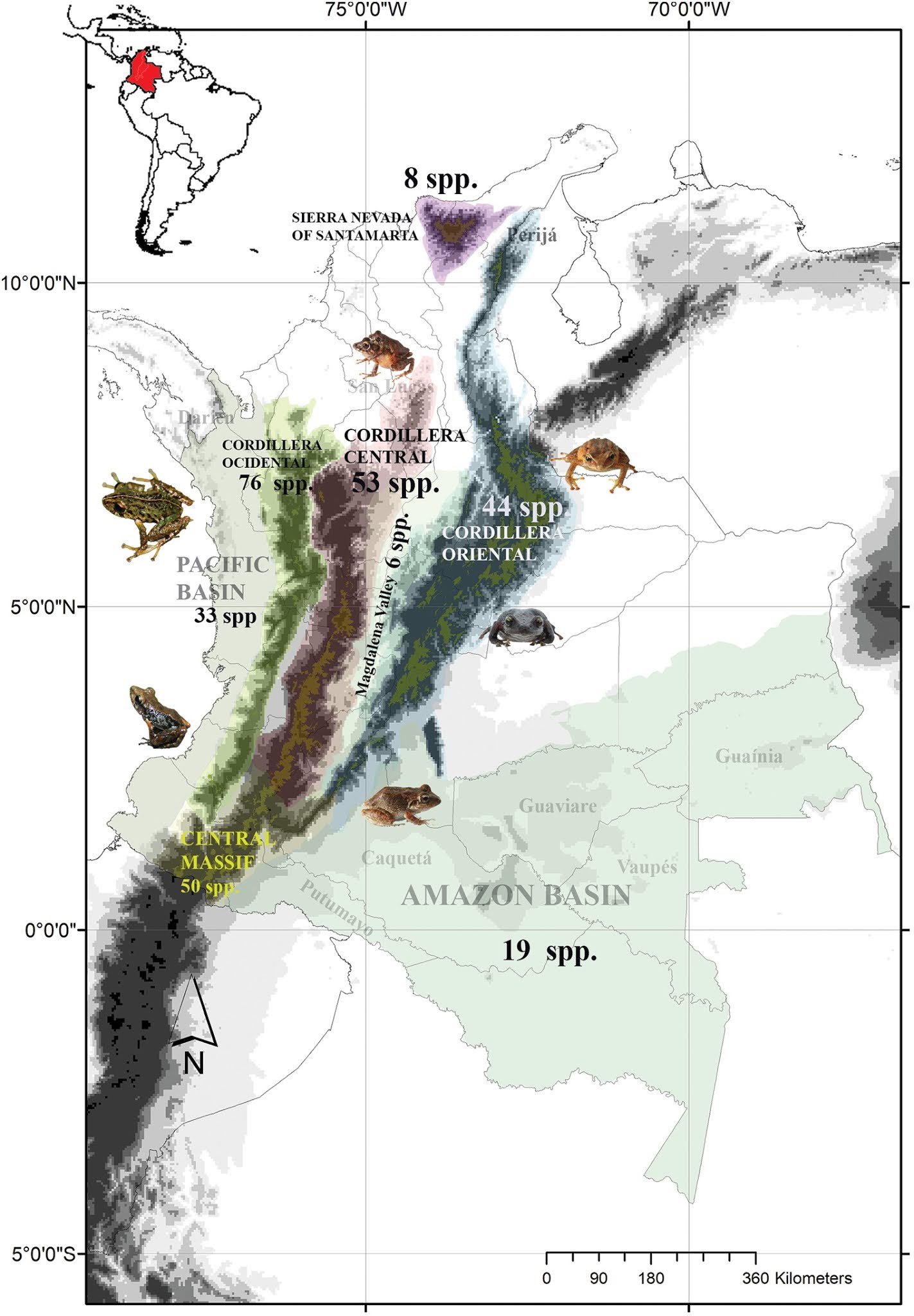
 Andrés R. Acosta-Galvis, Ana M. Saldarriaga-Gómez, Beatriz Ramírez and Mario Vargas-Ramírez. 2020. A New Terrarana Frog of Genus Pristimantis from An Unexplored Cloud Forest from the eastern Andes, Colombia.  ZooKeys. 961: 129-156. DOI: 10.3897/zookeys.961.51971