Showing posts with label 2001. Show all posts

Wednesday, March 12, 2014

[Herpetology • 2001] First Record of the Smooth-Backed Parachute Gecko Ptychozoon lionotum Annandale 1905 from the Indian Mainland


Abstract
 The smooth-backed parachute gecko, Ptychozoon lionotum is reported from the mainland India for the first time. The nearest known previous record was from Pegu, Myanmar, about 700 km southeast of the previous location. The species was collected in Langtlai and seen in the Ngengpui Wildlife Sanctuary, both in south Mizoram. The collected individual was kept in captivity for four and a half months. during this time, opportunistic observations on activity pattern, food habits, escape and parachuting behavior were made. Both individuals showed slow, deliberate pre-escape movement previously unrecorded for Ptychozoon. Information on morphological characters and morphometric measurements is presented. Explanations for the disjunct distribution are discussed.

Key words: Reptilia, Gekkonidae, Ptychozoon, parachute gecko, Northeast India, Myanmar, distribution, biogeography, behavior


Pawar, Samraat S. and Sayantan Biswas. 2001. First Record of the Smooth-Backed Parachute Gecko Ptychozoon lionotum Annandale 1905 from the Indian Mainland. Asiatic Herpetological Research. 9; 101–106. 

Tuesday, March 11, 2014

[Ichthyology • 2001] A Revision of the akysid Catfish genus Acrochordonichthys Bleeker (Teleostei: Siluriformes) of the South-east Asia


The taxonomy of the South-east Asian catfish genus Acrochordonichthys (Akysidae) is revised.The shapes of the snout, humeral process and adipose fins are diagnostic species characters. Only four out of 11 species and one sub-species described prior to this study are considered valid, namely A. rugosus (Bleeker, 1847), A. ischnosoma Bleeker, 1858, A. chamaeleon (Vaillant, 1902), and A. pachyderma Vaillant, 1902. An additional five new species (A. guttatus, A. septentrionalis, A. mahakamensis, A. strigosus and A. falcifer) are described.

Keywords: Akysidae; Acrochordonichthys; South-east Asia; taxonomy


 Ng, H. H.; Ng, P. K. L. 2001. A Revision of the akysid Catfish genus Acrochordonichthys Bleeker. Journal of Fish Biology 58 (2): 386–418. doi: dx.doi.org/10.1111/j.1095-8649.2001.tb02260.x

Tuesday, November 19, 2013

[Paleontology • 2001] Liaoningosaurus paradoxus • A juvenile ankylosaur from Yixian Formation of Liaoning, China


Liaoningosaurus paradoxus

Abstract
Juvenile ankylosaur specimens are very rare. A new ankylosaur, Liaoningosaurus paradoxus gen. et sp. nov., is described based on a beautifully preserved juvenile ankylosaur specimen from the famous Yixian Formation of Liaoning, China. Liaoningosaurus has a large bony plate (somewhat shell-like) shielding the abdomen. This discovery represents the first record of such a structure among dinosaurs. Although it has a number of distinct features seen in the family Ankylosauridae, a cladistic analysis placed Liaoningosaurus in the sister-family Nodosauridae. The 'intermediate' status of this taxon between the two ankylosaur families further supports the monophyly of Ankylosauria. This finding also documents the smallest known ankylosaur specimen and first complete nodosaurid specimen from Asia.

Liaoningosaurus paradoxus

Xu, X., Wang, X.-L., and You, H.-L. 2001. A juvenile ankylosaur from China. Naturwissenschaften. 88(7): 297-300.

[Paleontology • 2001] Gobisaurus domoculus • A new ankylosaurid (Dinosauria: Ankylosauria) from the Lower Cretaceous of China, with comments on ankylosaurian relationships


Gobisaurus domoculus 
 Vickaryous, Russell, Currie & Zhao 2001
illustration: Andrey Atuchin | nhm.ac.uk

Abstract
 Amongst the fossil material collected by the Sino-Soviet Expeditions (1959–1960) to the Alshan Desert, China, was a large, virtually complete ankylosaur skeleton. Gobisaurus domoculus gen. et sp. nov. closely resembles Shamosaurus scutatus, but is distinct in having an unfused basipterygoid–pterygoid contact and elongate premaxillary processes of the vomers. Although it is difficult to make a definitive taxonomic assignment without considering postcranial material, a preliminary phylogenetic analysis places Gobisaurus as the sister taxon of Shamosaurus, clustered as one of several successive outgroups of the Ankylosaurinae.


Systematic palaeontology
Dinosauria Owen 1842 | Ornithischia Seeley 1888
Ankylosauria Osborn 1923 | Ankylosauridae Brown 1908

Gobisaurus gen. nov.
Type species: Gobisaurus domoculus.

Etymology: Gobi, refers to the geographic locale.

Gobisaurus domoculus sp. nov.
Type locality: IVPP V12563 (Holotype) is believed to have been collected from the same general locality as the large theropod Chilantaisaurus maortuensis, approximately 60 km north of Chilantai (Jilantai; 39 45 N, 105 45E), on the east side of Chilantai Salt Lake (Chilantaiyen Chih), Maortu, Alashan Desert, Nei Mongol Zizhique (Inner Mongolia), China.

Formation: Ulanhushao (Suhongtu) Formation, Lower Cretaceous (Aptian–?Albian).

Etymology: domo to subjugate; and oculus, the eye


Matthew K. Vickaryous, Anthony P. Russell, Philip J. Currie, and Xi-Jin Zhao. 2001. A new ankylosaurid (Dinosauria: Ankylosauria) from the Lower Cretaceous of China, with comments on ankylosaurian relationships. Canadian Journal of Earth Sciences/Rev. can. sci. Terre 38(12):1767-1780.


[Paleontology • 2001] Aletopelta coombsi • an ankylosaurian ornithischian dinosaur from Southern California


Aletopelta and Lambeosaurus in prehistoric California
illustration by Ken Kirkland
Aletopelta coombsi Kirkland & Ford, 2001
an ankylosaurian ornithischian dinosaur from Southern California

 Generic name is composed of the Greek terms aletes and pelte, meaning, respectively "wandering" and "shield". This genus name was suggested by Ben Creisler because the fossil location, at the time the dinosaur died, being located on the tectonic plate containing the Peninsular Ranges Terrane, was somewhere opposite the middle of Mexico. This plate had thus been wandering northward, carrying the specimen with it. The specific epithet honors the vertebrate paleontologist Walter P. Coombs, Jr., for his ground-breaking work on ankylosaurs and his years of research, which have inspired many an enthusiast as well as professional paleontologist.

Ford, T. L. & Kirkland, J. I. 2001. Carlsbad Ankylosaur (Ornithischia, Ankylosauria): An Ankylosaurid and Not a Nodosaurid, Chapter 12 of Carpenter, ed., The Armored Dinosaurs, Indiana University Press, Bloomington & Indianapolis, Indiana 239-260.

[Paleontology • 2001] Cedarpelta bilbeyhallorum • Disarticulated Skull of a New Primitive ankylosaurid from the Lower Cretaceous of Utah


Cedarpelta bilbeyhallorum
Carpenter, Kirkland & Bird 2001


Cedarpelta is an genus of basal ankylosaurid ankylosaur, based on material recovered from the Lower Cretaceous of North America. The skull lacks extensive cranial ornamentation, a trait which has been interpreted as plesiomorphic for ankylosaurs.


Carpenter, K., Kirkland, J. I., Birge, D., and Bird, J. 2001. Disarticulated Skull of a New Primitive ankylosaurid from the Lower Cretaceous of Utah. in Carpenter, K. (editor) 2001. The Armored Dinosaurs. Indiana University Press

Wednesday, March 20, 2013

[Ichthyology • 2001] Aspidoparia ukhrulensis • A new freshwater cyprinid fish Aspidoparia from the Chatrickong River, Manipur, northeastern India


Aspidoparia ukhrulensis Selim & Vishwanath, 2001

Aspidoparia ukhrulensis is known only from Manipur, northeastern India.  It is inferred to have a restricted distribution in the hill streams, but more research is needed to determine its current distribution and population structure. 

Range: reported from two localities of the Ukhrul River in the Chindwin drainage of Myanmar. The type locality is given as "Rivers at foot of Sikkim Mountains, India".
_______________________

Aspidoparia is a small genus of cyprinid fishes that are found in Asia. There are currently three recognized species in this genus.
Aspidoparia jaya (F. Hamilton, 1822) (Jaya)
Aspidoparia morar (F. Hamilton, 1822)
Aspidoparia ukhrulensis Selim & Vishwanath, 2001 

Selim, K. i W. Vishwanath, 2001. A new freshwater cyprinid fish Aspidoparia from the Chatrickong River, Manipur, India. J. Bombay Nat. Hist. Soc. 98(2): 254-257.

Monday, February 25, 2013

[Paleontology • 2001] Hesperosaurus mjosi • New Primitive Stegosaur from the Morrison Formation, Wyoming, northern America


Hesperosaurus 
(meaning "western lizard", from Classical Greek, ἕσπερο-/hespero- "western" and σαυρος/saurus "lizard") 

a herbivorous dinosaur from the Kimmeridgian to Tithonian epochs of the Jurassic period (approximately 150 million years ago), whose fossils are found in the state of Wyoming in the United States of America. It is from an older part of the Morrison Formation, and so a little older than other Morrison Stegosaurs.


Carpenter K, Miles CA, Cloward K 2001. New Primitive Stegosaur from the Morrison Formation, Wyoming. In Carpenter, Kenneth(ed). The Armored Dinosaurs. Indiana University Press. pp. 55–75.

Monday, January 14, 2013

[Paleontology • 2001] Khaan mckennai • A new oviraptorids (Theropoda: Oviraptorosauria), upper Cretaceous Djadokhta Formation, Ukhaa Tolgod, Mongolia


Khaan mckennai Clark, Norell, & Barsbold, 2001

oviraptorid dinosaur that was found in the Djadochta Formation of Mongolia and lived in the Late Cretaceous Period (Campanian), 75 million years ago.

The genus name is derived from Mongol khaan, "lord" or "ruler". The specific name honours the paleontologist Malcolm Carnegie McKenna.


Clark, J.M., Norell, M.A., & Barsbold, R. 2001. Two new oviraptorids (Theropoda: Oviraptorosauria), upper Cretaceous Djadokhta Formation, Ukhaa Tolgod, Mongolia. Journal of Vertebrate Paleontology 21(2): 209-213.

[Paleontology • 2001] Citipati osmolskae | 'Lord of the Funeral Pyre' • A new oviraptorids (Theropoda: Oviraptorosauria), upper Cretaceous Djadokhta Formation, Ukhaa Tolgod, Mongolia

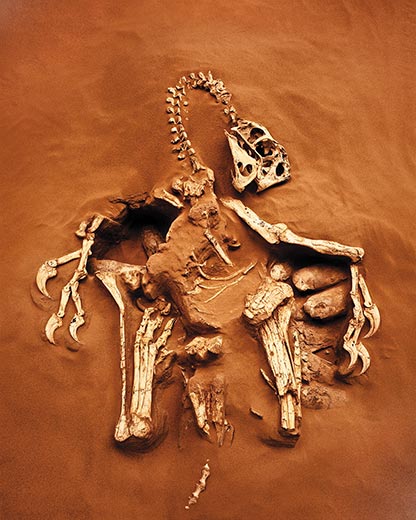
reconstructed Citipati fossil from Mongolia with 20 eggs


 the skeleton of the Dinosaur Citipati preserved on a nest of eggs.
The eggs are arrayed in a circle under the skeleton and are about 18cm long.
Credit: Nature (December 1995) http://dx.doi.org/10.1038/378774a0

Egg Cetera #2: The answer to the riddle of which came first

Citipati osmolskae with chicks 


Citipati (Hindi, meaning 'funeral pyre lord') is a genus of oviraptorid theropod dinosaur from the Late Cretaceous Period of what is now Mongolia (specifically, the Djadokhta Formation of Ukhaa Tolgod, in the Gobi Desert). It is one of the best-known oviraptorids, thanks to a number of well-preserved skeletons, including several specimens found in brooding positions atop nests of eggs. These nesting specimens have helped to solidify the link between non-avian dinosaurs and birds.

Citipati osmolskae


Clark, J.M., Norell, M.A., & Barsbold, R. 2001. Two new oviraptorids (Theropoda: Oviraptorosauria), upper Cretaceous Djadokhta Formation, Ukhaa Tolgod, Mongolia. Journal of Vertebrate Paleontology 21(2): 209-213.

Monday, November 26, 2012

[Herpetology • 2001] Batrachoseps luciae, B. minor, B. incognitus & B. gavilanensis | Molecular phylogenetic analysis of slender salamanders, genus Batrachoseps (Amphibia: Plethodontidae), from central coastal California with descriptions of four new species


Figure 2. Examples of nonadaptive radiations (i.e. collections of related ecologically similar species that are allopatric or parapatric replacements of one another, also known as allospecies). (a) Batrachoseps salamanders (Plethodontidae) of western North America (from top: Batrachoseps gavilanensis, B. luciae, B. incognitus, B. minor). Species are genetically different, and some of the illustrated taxa might be separated by >10 million years. Species recognition is possibly based on pheromones.

Plethodontid salamanders  of  the genus  Batrachoseps comprise  a clade  of  morphologically  similar, elongate  species  whose  great genetic  diversity is being  revealed  through molecular studies. We used  allozymes  and mtDNA  sequences  to study variation in 62 populations  from central coastal  California,  treated  most  recently  as  members  of  the  B.  pacificus  complex.  Analyses  of mtDNA  data identify  four lineages  that  are well  differentiated  from  each  other  and do  not form a monophyletic  group.  Instead,  the  central  coastal lineages  are multiply  paraphyletic  with  respect  to the  southern  California  members  of  the  pacificus  group.  Marked  allozymic  differences  show  that these  four lineages  are  strongly  differentiated,  although  some  limited gene  exchange  may  have occurred  in the  past.  Each lineage is  also morphologically  distinctive,  but  the  differences  between them  are subtle.  Because  these lineages  appear to  be  evolving  independently,  we  describe  them  as new  species:  B. luciae,  B. incognitus  and B. minor, distributed parapatrically from north to south in the  Santa Lucia Mountains  of coastal Monterey  and San Luis Obispo  Counties,  and B. gavilanensis, occurring  mainly inland  from  the  range  of B.  luciae,  centered  on  the  Gabilan  Mountains,  but  also extending  to  the  Pacific  coast  at  the  north  end  of  the  range  of  the  complex,  along  the  northern border  of  Monterey  Bay. Although  no sympatry is known  among  any of  the  new  species,  B. luciae and B.  gavilanensis  are narrowly parapatric. Furthermore,  all but  B.  luciae  occur  in sympatry with other  members  of the  genus in at least  a part of their  geographic  ranges. The  new species  may have arisen  vicariantly  with  respect  both  to  each  other  and  to  related  forms  in  southern  California,  in part as a result  of the  dramatic tectonic  movements  that have  characterized  the  last 15 million years of  geological  history in western  North  America.
Key words:  Batrachoseps;  Plethodontidae;  Systematics;  Allozymes;  Cytochrome  b;  California biogeography;  New  species


Batrachoseps minor Jockusch, Yanev & Wake, 2001 Lesser slender salamander
Batrachoseps gavilanensis Jockusch, Yanev & Wake, 2001 Gabilan Mountains slender salamander
Batrachoseps incognitus Jockusch, Yanev & Wake, 2001 San Simeon slender salamander
Batrachoseps luciae Jockusch, Yanev & Wake, 2001 San Lucia Mountains slender salamander


Jockusch, E.L., Yanev, K.P. and Wake, D.B. 2001. Molecular phylogenetic analysis of slender salamanders, genus Batrachoseps (Amphibia: Plethodontidae), from central coastal California with descriptions of four new species. Herpetological Monographs. 54-99.

Rebecca J. Rundell and Trevor D. Price. 2009. Adaptive radiation, nonadaptive radiation, ecological speciation and nonecological speciation 

Sunday, September 30, 2012

[Botany • 2001] ประทัดสุเทพ | Agapetes thailandica • A new species of Agapetes (Ericaceae) from nerthern Thailand


ประทัดสุเทพ 
Agapetes thailandica Watthana

Abstract
A new species of Agapetes (Ericaceae) from Thailand is described and illustrated.
Keywords. Agapetes, Ericaceae, Thailand


Watthana, S. 2001. A new species of Agapetes (Ericaceae) from Thailand. Edinburgh J. Bot. 58(3): 423 http://www.aseanbiodiversity.info/Abstract/53005865.pdf


Sunday, September 9, 2012

[Paleontology • 2001] 'Sinornithosaurus' Dave NGMC-91 • The distribution of integumentary structures in a feathered dinosaur


Non-avian theropod dinosaurs with preserved integumentary coverings are becoming more common, but apart from the multiple specimens of Caudipteryx, which have true feathers, animals that are reasonably complete and entirely articulated that show these structures in relation to the body have not been reported. Here we report on an enigmatic small theropod dinosaur that is covered with filamentous feather-like structures over its entire body.


unamed specimen NGMC-91. From Ji, Norell et al., 2001.

Qiang, Ji, Norell, Mark A., Gao, Ke-Qin, Ji, Shu-An, Ren, Dong. 2001. The distribution of integumentary structures in a feathered dinosaur. Nature. 410:1084-1087 doi:10.1038/35074079

[Paleontology • 2001] Branched integumental structures in Sinornithosaurus and the origin of feathers

Figure 1 Sinornithosaurus millenii, holotype (IVPP 12811). Carbonized, filamentous, integumental appendages, 30–45 mm long, are attached to the skull, forelimbs, tail and other skeletal elements. 

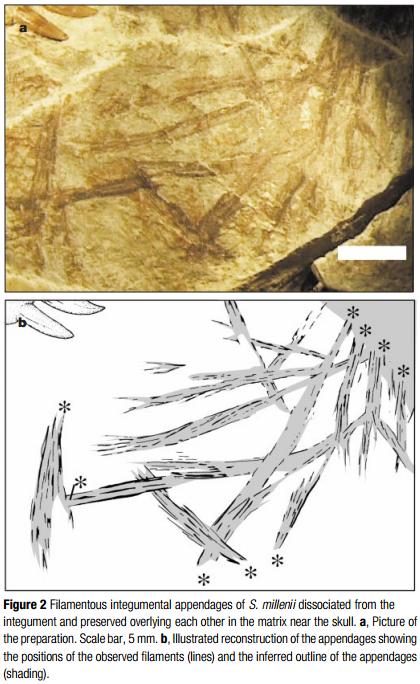
Figure 2 Filamentous integumental appendages of S. millenii dissociated from the integument and preserved overlying each other in the matrix near the skull. a, Picture of the preparation. Scale bar, 5 mm. b, Illustrated reconstruction


Xu, X., Zhou, Z. and Prum, R.O. 2001. Branched integumental structures in Sinornithosaurus and the origin of feathers. Nature. 410: 200-204.

Xu, Xing, Wu, Xiao-Chun. 2001. Cranial morphology of Sinornithosaurus millenii Xu et al. 1999 (Dinosauria: Theropoda: Dromaeosauridae) from the Yixian Formation of Liaoning, China. Canadian Journal of Earth Sciences. 38:1739-1752.

Friday, August 31, 2012

[Botany • 2001] Kaisupeea • a new genus of Gesneriaceae centred in Thailand


Kaisupeea orthocarpa B.L.Burtt


Kaisupeea (C.B.Clarke) B.L.Burtt
Type species: Kaisupeea herbacea (C.B.Clarke) B.L.Burtt


The genus Kaisupeea is established for Boea herbacea, a species long recognised as being out of place in Boea, and two new species closely allied to it. These plants produce annual flowering stems whose basal leaves may be represented by broad foliaceous cataphylls. Kaisupeea herbacea and K. cyanea have spirally twisted fruit-valves, but those of K. orthocarpa are straight. Kaisupeea ranges from Moulmein in Burma [Mawlamyne in Myanmnar] eastwards across Thailand to Bassac on the Mekong river in lower Laos and south to the neighbourhood of Satun on the south coast of Thailand just north of the Malaysian border.


Etymology: The name is an amalgamation of the forenames of the Danish/Thailand botanists Kai and Supee Larsen.


Species number: 3 [Kaisupeea herbacea (C.B.Clarke) B.L.Burtt, 
Kaisupeea cyanea B.L.Burtt, 
Kaisupeea orthocarpa B.L.Burtt].

Distribution: Myanmar, Thailand, S Laos.

Notes: The genus is remarkable for the perennial habit with annual stems. Kaisupeea herbacea dies down to the ground in the unfavourable season, and no new leaves appear above ground until favourable conditions return. Then there appear, not normal foliage leaves, but light green expanded leaf-bases, that have presumably been covering the new bud underground; this soon bursts through and produces a flowering stem whose leaves diminish quickly upwards as do the axillary inflorescences so that the whole forms a terminal thyrse about 0.5 m high. Details of this regime deserve study in the field.“ (Burtt 1998: 3).

Burtt, B. L. 2001. Kaisupeea: a new genus of Gesneriaceae centred in Thailand. Nord. J. Bot. 21: 115-1 19.   DOI: 10.1111/j.1756-1051.2001.tb01345.x

Milica Stankovic, Sahut Chantanaorrapint and Kitichate Sridith. 2013. Notes on the Vegetation of the Fast-flowing Streams in Peninsular Thailand, the Tropical Mainland of South East Asia. Taiwania. 58(4): 275‒290.

Boea hygroscopica F.Muell.


[Ornithology • 2001] Extreme endemic radiation of the Malagasy Vangas (Aves: Passeriformes: Vangidae)


Tylas Vanga | Tylas eduardi Hartlaub, 1862

Abstract
Phylogenetic relationships of the family Vangidae and representatives of several other passeriform families were inferred from 882 base positions of mitochondrial DNA sequences of 12S and 16S rRNA genes. Results indicated the monophyly of the Vangidae, which includes the genus Tylas, hitherto often placed in the family Pycnonotidae. Our results also revealed the Malagasy endemic Newtonia, a genus never previously assigned to the Vangidae, to be a member of this family. These results suggest the occurrence of an extensive in situ radiation of this family within Madagascar, and that the extant high diversity of this family is not the result of multiple colonizations from outside. The extremely high morphological and ecological diversification of the family seems to have been enhanced through the use and ultimate occupancy of vacant niches in this island.
Key words: 12S rRNA — 16S rRNA — Phylogeny — Passeriformes — Oscines — Vangidae —  Madagascar


Yamagishi, S.; Honda, M.; Eguchi, K. & Thorstrom, R. 2001. Extreme endemic radiation of the Malagasy Vangas (Aves: Passeriformes). J. Mol. Evol. 53(1): 39-46. http://www.springerlink.com/content/yt0q7rycg5gr9ha5/

Saturday, June 9, 2012

[Ichthyology • 2001] Fonchiiichthys • Diagnosis of fourteen new genera of the family Loricariidae Rafinesque, 1815


 Fonchiiichthys uracanthus (Kner, 1863)

Fonchiiichthys Isbrücker & Michels, 2001


Isbrücker, I. J. H. , I. Seidel, J. P. Michels, E. Schraml and A. Werner  2001. Diagnose vierzehn neuer Gattungen der Familie Loricariidae Rafinesque, 1815 (Teleostei, Ostariophysi) [Diagnosis of fourteen new genera of the family Loricariidae Rafinesque, 1815]. Datz-Sonderheft "Harnischwelse 2' [Special issue no. 2]: 17-24. [In German.]

Thursday, May 31, 2012

[Mammalogy • 2000] Nesolagus timminsi | Annamite Striped Rabbit • A new species of Nesolagus (Lagomorpha, Leporidae) from Vietnam with osteological description


Nesolagus timminsi sp. n., based on a partial skeleton from Vietnam, differs from N. netscheri (Schlegel, 1880) from Sumatra by skull length larger, foramen lacertum smaller, P2 larger and having two folds on anterior face, m3 with two columns joined by a lingual dentine bridge. Detailed osteological description of  Nesolagus timminsi sp. n. is presented.

Distribution. – Annamite Mountains, Vietnam and Laos.
Etymology. – In honour of Mr. Robert J. Timmins, discoverer of the Annamiterabbit in Laos.


Surridge A. K., Timmins R. J., Hewitt G. M. and Bell D. J. 1999. Striped rabbit in Southeast Asia.


Averianov A. O., Abramov A. V. and Tikhonov A. N. 2000. A new species of Nesolagus (Lagomorpha, Leporidae) from Vietnam with osteological description. Contributions from the Zoological Institute, St. Petersburg. 3: 1–22.

Can D. N., Abramov A. V., Tikhonov A. N. and Averianov A. O. 2001. Annamite striped rabbit Nesolagus timminsi in Vietnam. Acta Theriologica 46: 437–440.

Abstract
The distribution of a new species of striped rabbit Nesolagus timminsi Averianov, Abramov et Tikhonov, 2000 is restricted to the central part of the Annamite Mountains, along the border between Vietnam and Laos. A low density of separated populations and hunting pressure in Vietnam already makes this species critically endangered.

Key words: striped rabbit, Nesolagus timminsi, Vietnam

Sunday, February 26, 2012

[Herpetology • 2007] Sabahphrynus | new genus from Borneo • Taxonomic relationshiops of Ansonia anotis and Pedostibes maculatus with a description of a new genus (Amphibia, Bufonidae)


Fig. 3. Views of living (A) Ansonia anotis (SP 26033 from Riou Hutan Simpan, Kiau, Mt. Kinabalu) and
(B) Pedostibes maculatus (KUHE 38505 [formerly BORNEENSIS 08681], from Trail 5 of Ulu Kimanis, Crocker Range). 

Genus Sabahphrynus 


Abstract
Examination of types and recently collected specimens revealed that Ansonia anotis Inger, Tan, and Yambun, 2001 and Pedostibes maculatus (Mocquard, 1890), both described from Kinabalu, Sabah, Malaysia, are hardly differentiated morphologically. Analyses of a total of 2,427 bp of the 12S rRNA, tRNAval, and 16S mitochondrial rRNA genes revealed that the two species are very close genetically. Thus A. anotis is regarded as conspecific and is synonymized with P. maculatus. Genetically, this species proved to form a lineage distinct from other bufonids from Southeast Asia, including species of Ansonia and Pedostibes. Because the species has also some unique morphological traits different from known bufonid genera, we propose to establish a new genus for Nectophryne maculata Mocquard, 1890.

Keywords: Malaysia, molecular phylogeny, new genus, Sabah, synonymy


Matsui, M., Yambun, P., and Sudin, A. 2007. Taxonomic relationshiops of Ansonia anotis Inger, Tan, and Yambun, 2001, and Pedostibes maculatus (Mocquard, 1890), with a description of a new genus (Amphibia, Bufonidae). Zoological Science, 24, 1159-1166. DOI: 10.2108/zsj.24.1159


Inger, R.F., Tan, F.L. and Yambun, P. 2001. A new species of toad of the genus Ansonia (Anura: Bufonidae) from Borneo. Raffles. Bull. Zool. 49: 35–37