Showing posts with label Central Thailand. Show all posts

Monday, January 26, 2026

[Invertebrate • 2026] Alloscopus ramanai • A New Collembola Species (Orchesellidae: Heteromurinae) from central Thailand, with complete mitochondrial genome and phylogenetic placement


Alloscopus ramanai  Nilsai, Jantarit & Jaitrong, 

in Nilsai, Jantarit, Jeenthong, Detcharoen et Jaitrong, 2026.

Abstract
Background: Alloscopus is one of the genera within the subfamily Heteromurinae, recently recorded in Thailand and is currently represented by six species from two regions of the country. In the northern part, A. tetracanthus Börner, 1906 and A. thailandensis Mari Mutt, 1985 have been recorded from forested habitats. In the southern part, A. whitteni Jantarit & Sangsiri, 2020, A. namtip Jantarit & Sangsiri, 2020 and A. jantapasoae Jantarit, Nilsai & Manee, 2025 have been reported from a cave habitat, while A. sago Jantarit & Manee, 2025 was recently described from a sago palm forest.

New information: A new species, Alloscopus ramanai sp. nov., is described from central Thailand, based on an integrative taxonomic approach combining morphological and molecular data. The new species closely resembles A. tetracanthus Börner, 1906, sharing several diagnostic characters including a dark red ocular patch and PAO shape and the number of M and S series chaetae on the dorsal head. Additional similarities include the number of spiniform labral papillae, labial basis chaetae, the number of pseudopores on the manubrium, the number of central and lateral macrochaetae on Th.II, the number of central macrochaetae on Th.III and Abd.IV. However, A. ramanai sp. nov. can be clearly distinguished from A. tetracanthus by a unique combination of traits, including the number of lateral macrochaetae on Abd. III and Abd. IV and the number of chaetae on the anterior side of the ventral tube. A detailed diagnosis and illustrations of the new species are provided herein. A key for species of Alloscopus in Thailand is also included. The complete mitochondrial genome of A. ramanai sp. nov. is 14,757 bp in length and comprises 13 concatenated protein-coding genes (PCGs), 22 transfer RNA (tRNA) genes and two ribosomal RNA (rRNA) genes. Phylogenetic analysis, based on mitochondrial genome data, indicates that A. ramanai sp. nov. forms a sister lineage to Alloscopus bannaensis Zhang, 2020. The description of this new species contributes to a more comprehensive understanding of Heteromurinae diversity in Thailand and underscores the need for expanded mitogenomic sampling across Collembola.

Keywords: Entomobryoidea, mitogenome, new species, taxonomy, phylogeny

A Habitus of Alloscopus ramanai sp. nov. (SEM image, upper; wet specimen, lower). Scale bars = 0.5 mm;
B–C The type locality of the new species, a forest plantation of the Natural History Museum of the National Science Museum Thailand (THNHM);
D The localities of Alloscopus recorded in Thailand. 1, A. tetracanthus Börner, 1906 and A. thailandensis Mari Mutt, 1985. 2, A. whitteni Jantarit & Sangsiri, 2020. 3, A. namtip Jantarit & Sangsiri, 2020. 4, A. jantapasoae Jantarit, Nilsai & Manee, 2025. 5, A. sago Jantarit & Manee, 2025.

Alloscopus ramanai Nilsai, Jantarit & Jaitrong, sp. nov.

Diagnosis: Alloscopus ramanai sp. nov. exhibits the morphological similarity to A. tetracanthus Börner 1906, a species reported from Australia, Indonesia, Malaysia, Singapore, Papua New Guinea, India, New Britain, Micronesia and Thailand (Chiang Mai Province). Both species share several morphological characters, including a dark red eye patch with reddish to dark dot pigmentation, a semi-divided PAO, labial basis M1(m)m2rel1l2, four spiniform labral papillae, 4–5 central and 4–5 posterior mac on Th. II, six central mac on Th. III, two central mac on Abd. IV, 0–2 inner unpaired ungual teeth, the presence of teeth on the unguiculus, smooth chaetae on the tibiotarsi, a similar number of chaetae on the manubrium and 4–7 spines on the dens. However, Alloscopus ramanai sp. nov. can be distinguished from A. tetracanthus by the absence of eyes (vs. 1+1), orange dot pigmentation (vs. lack of pigmentation) and the presence of five macrochaetae on the “A” series of the dorsal head chaetotaxy (vs. four). Furthermore, A. ramanai sp. nov. can ...

Etymology: The new species was collected in the vicinity of the Rama 9 Museum, part of the National Science Museum, Thailand, which serves as the locality. The specific epithet ramanai is derived from the name of the Museum and is used as a noun in apposition, honouring the institution.


 Areeruk Nilsai, Sopark Jantarit, Tadsanai Jeenthong, Matsapume Detcharoen and Weeyawat Jaitrong. 2026. Alloscopus ramanai sp. nov. (Orchesellidae, Heteromurinae), A New Collembola Species from central Thailand, with complete mitochondrial genome and phylogenetic placement. Biodiversity Data Journal. 14: e173157. DOI: doi.org/10.3897/BDJ.14.e173157

Saturday, July 26, 2025

[Botany • 2024] Dorcoceras uthongensis (Gesneriaceae) • A New Species from the Limestone Karst of Suphan Buri, Thailand


Dorcoceras uthongensis Prajanban, Patumchartpat & Panvilai, 

in Prajanban, Patumchartpat, Akkarawongsapat, Napaswad et Panvilai, 2024. 
จอกหินอู่ทอง  ||  DOI: doi.org/10.25081/jp.2024.v16.9037

Abstract
Dorcoceras uthongensis, a new species of the genus Dorcoceras Bunge, is described. This new species is endemic to Uthong district, Suphan Buri province, Thailand, and differs from the other species by exhibiting capitate glandular hairs with globose unicellular head on the abaxial surface of the leaf. Additionally, it is classified as an endangered species (EN) according to IUCN criteria. The phylogenetic analysis based on nuclear ITS1-5.8S-ITS2 confirmed its placement within Dorcoceras. Moreover, we sought to explore the potential biological activities of the crude extract of this new species. We evaluated the aqueous extract of leaves which revealed antioxidant activity and no cytotoxicity indicating potential safety for further research and utilization. To examine the phytochemical composition, we performed an analysis using LC-MS/MS-QTOF. The result revealed the presence of flavonoids, alkaloids, phenolic compounds, and terpenes.

Keywords: Dorcoceras, New species, Trichome, Biological activity, Phytochemical composition, LC-MS/MS-QTOF

Dorcoceras uthongensis Prajanban, Patumchartpat & Panvilai, sp. nov.
 a) Habitat on the boulder of limestone karst, b) Lateral side of the flower is shown, c) Oblong unicellular head outside the corolla, d) Pale pink stigma, e) Detail of the reproductive organs, f) Pistil, g) Twisted capsule, h) Flower bud with pale purple petals, dorsally white, i) Glandular multicellular hairs on pedicel, j) Three staminodes are shown and k) Gland-tipped and eglandular multicellular hairs on calyx

Dorcoceras uthongensis Prajanban, Patumchartpat & Panvilai, sp. nov.

DIAGNOSIS: Dorcoceras uthongensis is similar to D. geoffrayi and D. wallichii in colorless indumentum on the abaxial leaf surface but consisting of capitate glandular hairs with globose unicellular head (absent in D. geoffrayi and D. wallichii), as shown in Figure 5. Moreover, the sessile glandular trichomes observed in D. wallichii are absent in D. uthongensis. Also similar to D. brunneum in the leaf shape (Figure 4) but differing in the colorless indumentum abaxially (rusty brown in D. brunneum). The stigma of D. uthongensis is pale pink bilabiate, which is only found in this new species (Figure 3).


Jaran Prajanban, Wichai Patumchartpat, Radeekorn Akkarawongsapat, Chanita Napaswad, Sathit Panvilai. 2024. Phytochemical Composition and Biological Activities of Dorcoceras uthongensis (Gesneriaceae) - A New Species from the Limestone Karst of Suphan Buri, Thailand. Journal of Phytology. 16, 231–238. DOI: doi.org/10.25081/jp.2024.v16.9037

Thursday, September 12, 2024

[Botany • 2024] Kaempferia chaveerachiae (Zingiberaceae) • A New Species from central Thailand


 Kaempferia chaveerachiae Saensouk, P.Saensouk & Boonma, 

in Boonma, S. Saensouk et P. Saensouk. 2024. 
 
Abstract
 This research investigates the Zingiberaceae family in Saraburi Province, Thailand, aiming to understand its biodiversity, distribution, ecology, conservation status, and traditional uses. Through systematic exploration, 103 species are identified, including a novel species, Kaempferia chaveerachiae Saensouk, P.Saensouk, and Boonma. Additionally, 23 species are newly reported for distribution in Saraburi Province. Methodologically, a district-wise analysis and the unweighted pair group method with arithmetic mean (UPGMA) cluster analysis were employed to discern species prevalence and geographical patterns. Findings reveal varied species distribution aligned with diverse ecological conditions, informing targeted conservation strategies. Fourteen endemic species and the District Endemism Index emphasize localized conservation significance. Assessment of conservation status highlights critical and vulnerable species, prompting focused conservation initiatives. Phenological analysis underscores adaptability through flowering peaks tied to environmental cues. Ethnobotanical insights highlight the multifunctionality of Zingiberaceae, emphasizing its cultural significance and traditional applications. This study offers valuable insights into Zingiberaceae diversity, advocating for tailored conservation strategies and sustainable practices in Saraburi Province to safeguard its unique flora, habitats, and indigenous knowledge.

Keywords: diversity; endemic; new species; taxonomy; Zingiberales

 Kaempferia chaveerachiae Saensouk, P.Saensouk & Boonma:
 (A) natural habitat, (B) front view of flower, (C) semi side view of inflorescence with flower, (D) plants with leaves displaying varying degrees of dark green to almost black patterns on the adaxial surface.
Photographs by Thawatphong Boonma.

 Kaempferia chaveerachiae Saensouk, P.Saensouk & Boonma:
(A) side view of flower, (B) semi side view and front view of anther, (C) dorsal corolla lobe, (D) lateral corolla lobes, (E) bracteole, (F) bract, (G) habit, (H) seed with aril, (I) ovary with epigynous glands, (J) fruit with calyx:
Drawn by Thawatphong Boonma.


 Thawatphong Boonma, Surapon Saensouk and Piyaporn Saensouk. 2024. Biogeography, Conservation Status, and Traditional Uses of Zingiberaceae in Saraburi Province, Thailand, with Kaempferia chaveerachiae sp. nov. Horticulturae. 10(9), 934. DOI: doi.org/10.3390/horticulturae10090934  


Wednesday, November 30, 2022

[Botany • 2022] Kaempferia napavarniae & K. sakonensis (Zingiberaceae: Zingibereae) • Two New Species from Thailand


Kaempferia sakonensis Saensouk, P. Saensouk & Boonma 
 
in Saensouk, Saensouk & Boonma, 2022.
(Drawn by Thawatphong Boonma)

Abstract
Two new species of Kaempferia L., namely Kaempferia napavarniae Saensouk, P. Saensouk & Boonma, and Kaempferia sakonensis Saensouk, P. Saensouk & Boonma, are discribed here. The production of terminal inflorescences, covered by leaf sheaths, makes both species fall into the subgenus Kaempferia. The first species were found only in Nakhon Sawan Province, Northern Thailand, and the second species were found only in Sakon Nakhon Province, Northeastern Thailand. Living specimens and spirit specimens of both new species were compared to the existing allied species, but they differed and were never reported in taxonomic treatment before. Thus, we claimed both of them as new species to science .... The descriptions with their illustrations, ecology, etymology, distributions, and a revised key to species of Kaempferia subgenus Kaempferia in Thailand for facilitating identification are also prepared.

Keywords: Kaempferia roscoeanaKaempferia larseniiKaempferia maculifolia, Nakhon Sawan, Kaempferia pardi, Sakon Nakhon, taxonomy, Zingiberales

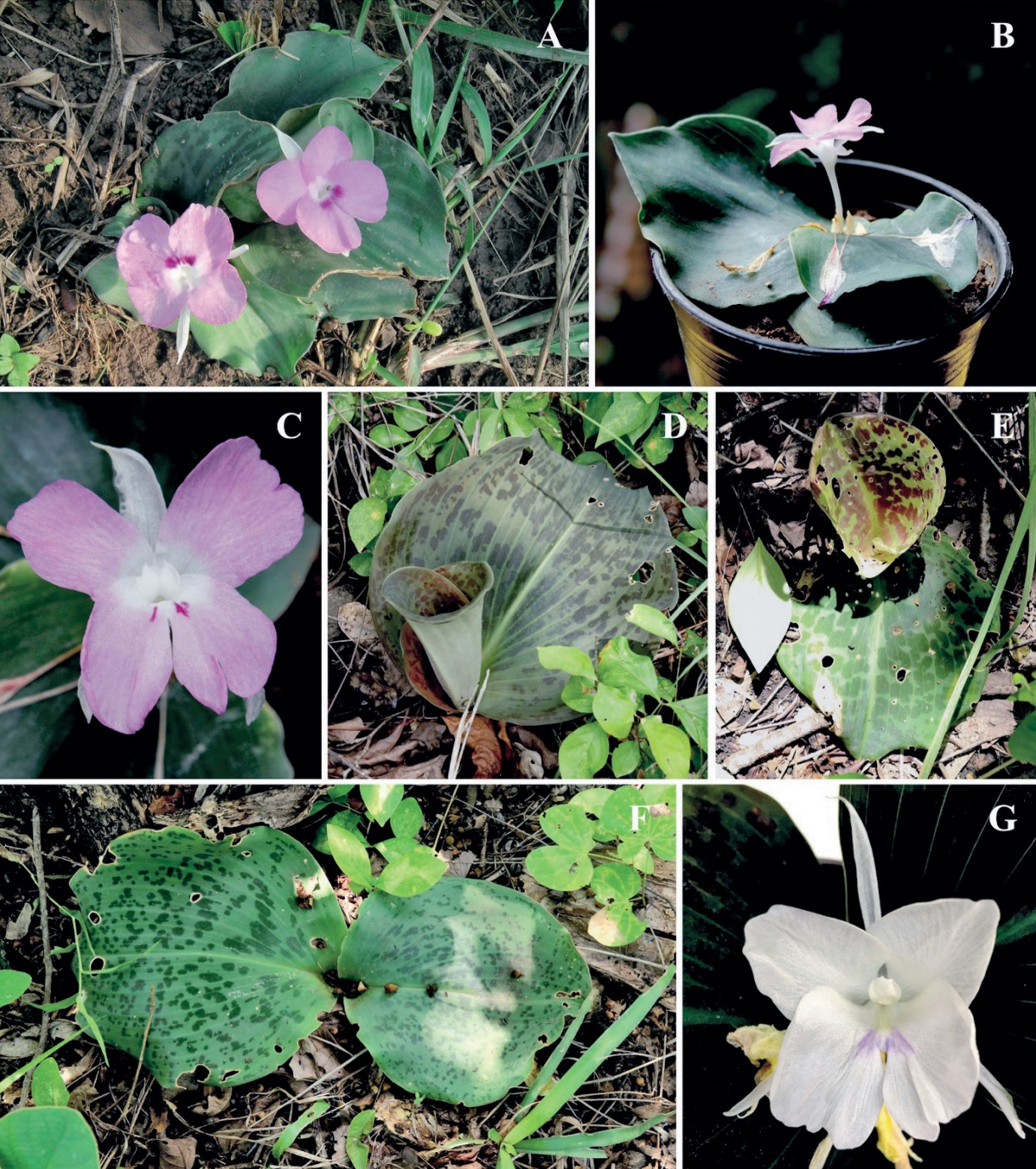
Kaempferia napavarniae Saensouk, P. Saensouk & Boonma sp. nov. (A) Top view of flowers and leaves, (B) Oblique-side view of flowers and leaves, (C) top view,
 (D) K. roscoeana Wall.– top view, (E) K. koratensis Picheans. – top view, (F) K. pardi Larsen K. & Jenjitt. – oblique view, (G) K. maculifolia Boonma & Saensouk – top view.
(Photographs A–B by Surapon Saensouk; C–G and Design by Thawatphong Boonma)


Kaempferia napavarniae Saensouk, P. Saensouk & Boonma, sp. nov. 
– subgenus Kaempferia

Diagnosis: The new species is similar to K. roscoeana Wall. but differs in having pubescent leaf sheaths (vs. glabrous leaf sheath); leaf adaxially green with several deep dark green spots, pubescent on both surfaces (vs. leaf adaxially green with mottled dark green, glabrous on both surfaces); bracts triangular and pubescent (vs. oblong and glabrous); calyx 2.5–2.9 cm long, apex mucronate, sparsely hairy (vs. c. 2 cm long, apex bifid, glabrous); anther crest broadly ovate, c. 5.5 × 5 mm(vs. ovate, c. 1.5 × 1.5 mm); epigynous glands c. 10 mm long (vs. c. 3 mm long).

Ecology: It grows in sandy loam soil, well-drained, in the mixed-deciduous forest, at an elevation 200–300 m above sea level.

Etymology: The specific epithet “napavarniae” is chosen to honor Associate Professor Dr. Napavarn Noparatnaraporn, who is a specialist in Biodiversity in Thailand.


Kaempferia sakonensis Saensouk, P. Saensouk & Boonma sp. nov. (A) – top view of flower and leaves, (B) – top view of flowers,
K. larsenii Sirirugsa (C) – oblique view of flower, (D) – oblique view of leaves with red along the veins variant, (E) – top view of flower,
K. albomaculata Jenjitt. & K.Larsen (nomnud.) (F) – oblique view of flowers and leaves, (G) – top view.
(Photographs A–E by Surapon Saensouk; F–G and design by Thawatphong Boonma)

Kaempferia sakonensis Saensouk, P. Saensouk & Boonma sp. nov. 
(A) Bract, (B) Bracteole (C) Side view of habit, (D) Calyx, (E) Anthercrest (each lobe rounded and truncate), side and front view of the anther, (F) Ovary and epigynous glands, (G) Labellum, (H) Staminodes, (I) Corolla lobes.
(Drawn by Thawatphong Boonma)

Kaempferia sakonensis Saensouk, P. Saensouk & Boonma, sp. nov. 
 – subgenus Kaempferia

 Diagnosis: The new species is similar to K. larsenii Sirirugsain having leafless sheaths sparsely hairy (vs. glabrous); leaf sheaths pubescent (vs. glabrous); petiole sessile (vs. 1 cm long); ligule emarginate, 2.5–3.2 mm long, each lobe apex rounded to truncate, pubescent (vs. broadly triangular, c. 1 mm long, each lobe apex acute, glabrous); number of leaves 2 (vs. 2–4 leaves); lamina ovate, elliptic, or obovate, 12–17 × 4.5–8cm, apex mucronate, base attenuate, upper surface dark red, midrib dark red, lower surface dark red, upper surface glabrous, lower surface pubescent (vs. elliptic-linear to linear, 6–9 × 0.5–1 cm, apex acute, base cuneate, upper surface green or green with various shade of reddish tinged along the veins, midrib green or red, lower surface paler green, both surfaces glabrous); peduncle c. 1 cm long (vs. sessile); bracts lanceolate, 3.5–5 × 0.8–1.5 cm, apex mucronate, mucro c. 1–1.4 mm long, pubescent (vs. linear, c. 3 cm × 0.3 cm, apex acute, glabrous); bracteoles 2.3–3.4 cm long (vs. c. 1.5 cm long); calyx 3.5–3.7 cm long, apex mucronate, white with reddish tinge at apex (vs. c. 3 cm long, apex bifid, white); corolla lobe 2.1–2.4 × 0.38–0.5 cm (vs. c. 1.4 cm × 0.25 cm); dorsal corolla lobe apex mucronate (vs. apex blunt); lateral staminodes 1.67–1.75 × 1.1–1.2 cm (vs. c. 1.4 × 0.7 cm); labellum bilobed, deeply divided about 3/5 of the length, each lobe asymmetrical obcordate or broadly obovate, 2.1–2.2 × 1.55–1.76 cm, pale purple with white at the base, dark purple at sinus to base (vs. bilobed, divided to the base, each lobe obovate, c. 1.7 × 0.7 cm, purplish pink with white at base); filament subsessile, c. 1 mm long (vs. sessile); anther c. 5 mm long (vs. c.2 mm long); anther thecae c. 3 mm long (vs. c.1 mm long); anther crest suborbicular c. 5 × 5 mm, apex emarginate (vs. obovate, c. 3.7 × 2.7 mm, apex rounded); ovary 3.5–4 × 2.5–3 mm (c. 3 × 1 mm); epigynous glands c. 4 mm long (c. 2.5 mm long).

Ecology: It grows in sandy loam soil, well-drained, in the deciduous forest, at an elevation 200–400 m above sea level.

Etymology: The specific epithet is named according to the province name of their natural habitat in Akat Amnuay District, Sakon Nakhon Province, Northeastern Thailand.


 Piyaporn Saensouk, Surapon Saensouk and Thawatphong Boonma. 2022. Two New Species of Kaempferia Subgenus Kaempferia (Zingiberaceae: Zingibereae) from Thailand. Biodiversitas. 23: 4343-4354. 


Thursday, September 29, 2022

[Botany • 2022] Curcuma suphanensis & C. rosea (Curcuma subg. Ecomata, Zingiberaceae: Zingibereae) • Two New Species from Central and Southwestern Thailand


 Curcuma suphanensis P. Saensouk, Boonma, Rakarcha, Maknoi, Wongnak & S. Saensouk,  

in Saensouk, Boonma, Rakarcha, et al., 2022.
กระเจียวสุพรรณ || smujo.id/biodiv 

Abstract
Two new species of Curcuma L. are described. The first species, Curcuma suphanensis P. Saensouk, Boonma, Rakarcha, Maknoi, Wongnak & S. Saensouk sp. nov. was found in Suphan Buri province, Central Thailand, and the second species namely C. rosea P. Saensouk, S. Saensouk & Boonma sp. nov. was found in Uthai Thani province, Southwestern Thailand. Both species fall into the subgenus Ecomata because of the lack of conspicuous coma bract, and the presence of epigynous glands. This brings the number of species in this subgenus worldwide to 37 species. Living specimens and spirit specimens of both new species were collected from their natural habitats, morphological attributes measured, and compared to all existing species. Neither species match any previously-described species, therefore, both of them are new species to science. The first was named Curcuma suphanensis based on its province of origin (Suphan Buri Province), and the second species was named Curcuma rosea, on account of its pinkish bracts. Morphological descriptions along with their illustrations, notes on their ecology, etymology, and distributions, are presented along with a revised key to species of Curcuma subgenus Ecomata worldwide to facilitate identification.

Keywords: Curcuma eburnea, Curcuma pitukii, Suphan Buri, Uthai Thani, taxonomy, Zingiberales


 Curcuma suphanensis P. Saensouk, Boonma, Rakarcha, Maknoi, Wongnak & S. Saensouk sp. nov. 
กระเจียวสุพรรณ


Curcuma rosea P. Saensouk, S. Saensouk & Boonma sp. nov.
 กระเจียวอุทัย

Piyaporn Saensouk, Thawatphong Boonma, Sarayut Rakarcha, Charan Maknoi, Mathee Wongnak and Surapon Saensouk. 2022. Two New Species of Curcuma Subgenus Ecomata (Zingiberaceae: Zingibereae), from Central and Southwestern Thailand. Biodiversitas. 23: 4578-4588.  https://smujo.id/biodiv/article/view/11872


Thursday, June 30, 2022

[Botany • 2020] Kaempferia minuta & K. pardi • Two New Species of Kaempferia (Zingiberaceae) from Thailand


(A–C)  เปราะน้อย Kaempferia minuta Jenjitt. & K. Larsen; 
 (D–G) เปราะเสือแต้ม Kaempferia pardi K. Larsen & Jenjitt. 

in Jenjittikul & Larsen, 2020. 
 Nat. Hist. Bull. Siam Soc. 64(1) thesiamsociety.org 
 Photographs by Nattapon Nopporncharoenkul.
 
ABSTRACT
 Two new species of Kaempferia section KaempferiaK. minuta Jenjitt. & K. Larsen and K. pardi K. Larsen & Jenjitt. are described and illustrated. 

Keywords: Kaempferia minuta, Kaempferia pardi, new taxa, taxonomy

(A–C) Kaempferia minuta Jenjitt. & K. Larsen: A, Habit; B, Plant in side view; C, Flower.
 (D–G) Kaempferia pardi K. Larsen & Jenjitt.: D–F, Habit; G, Flower.
Photographs by Nattapon Nopporncharoenkul.


  Kaempferia minuta, a new species from Ubon Ratchathani Province, Thailand
(photograph by Nattapon Nopporncharoenkul)

Kaempferia minuta Jenjitt. & K. Larsen, sp. nov.

Diagnosis.—Similar to Kaempferia attapeuensis Picheans. & Koonterm in its flower, but distinct in its orbicular to suborbicular laminae (vs. oblong-elliptic to ovate laminae in K. attapeuensis). 

Distribution.—Thailand (Eastern: Ubon Ratchathani Province) and Laos

Etymology.—The specific epithet “minuta” refers to the tiny size.
Vernacular name.—Proh noi (เปราะน้อย), Proh laolek (เปราะลาวเล็ก) 

(A–C) Kaempferia minuta Jenjitt. & K. Larsen: A, Habit; B, Plant in side view; C, Flower.
(D–G) Kaempferia pardi K. Larsen & Jenjitt.: D–F, Habit; G, Flower.
Photographs by Nattapon Nopporncharoenkul.


Kaempferia pardi K. Larsen & Jenjitt., sp. nov. 

Diagnosis.—Similar to Kaempferia koratensis Picheans. in leaf shape, but differs in having larger laminae with numerous dark spots on upper surfaces (vs. dark green, sometimes with white variegated pattern in K. koratensis), a larger flower, white with two dull purple blotches at the sinus (vs. white with a pale yellow patch at the base of labellum in K. koratensis) and strikingly larger anther thecae. 

Distribution.—Endemic to Thailand. This species is currently only known in Phetchabun, Lopburi, Phitsanulok and Nakhon Sawan provinces.

Etymology.—The specific epithet “pardi” refers to leopard-like spotted pattern on its upper surface of leaves.
Vernacular name.—Proh sua tam (เปราะเสือแต้ม) 


Thaya Jenjittikul and Kai Larsen. 2020. Two New Species of Kaempferia (Zingiberaceae) from Thailand. Nat. Hist. Bull. Siam Soc. 64(1): 17–23.


Saturday, May 21, 2022

[Botany • 2022] Curcuma achrae (Zingiberaceae, sect. Ecomata) • A New Species from Central Thailand


Curcuma achrae Saensouk & Boonma, 

 in Saensouk, Boonma & Saensouk, 2022. 
ขมิ้นทอง ||  Rheedea. 32(1) rheedea.in
photos by Thawatphong Boonma

Abstract
Curcuma achrae Saensouk & Boonma, a new species of Curcuma subgenus Ecomata (Zingiberaceae) from Nakhon Nayok province, Central Thailand is described and illustrated along with photographs, notes on its distribution and habitat. A revised identification key to 68 species of the genus Curcuma in Thailand is also presented.

Keywords: Curcuma flaviflora, C. xanthella, Nakhon Nayok province, Taxonomy.

Curcuma achrae Saensouk & Boonma:
a. Habit–oblique top view; b. Flower–side view; c. Lateral staminodes; d. Labellum; e. Flower– front view; f. Stamen–side view; g. Dorsal corolla lobe; h. Lateral corolla lobes; i. Floral tube with ovary, calyx, and front view of stamen; j. Bract; k. Bracteole; l. Calyx; m. Ovary with epigynous glands; n. Inflorescence with flowers, rhizome, and tuberous roots
(from T. Boonma 24; drawn by Thawatphong Boonma).

Curcuma achrae Saensouk & Boonma:
a. Plants in natural habitat; b. Pseudostem–top view; c. Pseudostem–side view; d. Distal part of sheathing bract–side view; e. Young inflorescence–side view; f. Anthesis in natural habitat
(a–c in September 2019; d in late April 2020; f. e & f in late March 2020, 2021 respectively; 
photos by Thawatphong Boonma).

Curcuma achrae Saensouk & Boonma:
 a. Flower, (upper row) dorsal corolla lobe and lateral corolla lobes, (lower row) two lateral staminodes, labellum, calyx, cross-section of flower, ovary with epigynous glands, bracteole, flower bud, and bract; b. Reddish V-shaped patch at base of staminode; c. Stamen–side, oblique side, front and back view; d. Inflorescence with rhizome, spike varied in sizes and colours–side view; e. Inflorescence–oblique top view; f. Close up flower–front view
 (photos by Thawatphong Boonma).

Curcuma achrae Saensouk & Boonma, sp. nov. 

Similar to Curcuma xanthella Škornik. but differs. C. achrae having pubescent petioles (vs. glabrous), green with a reddish tinge (vs. green); adaxially sparsely hairy leaves with fine hairs along the midrib (vs. glabrous on both surfaces); fertile bracts connate in the lower 1/7 (vs. connate in the lower 1/4), apex mucronate (vs. narrowly acute); base of labellum white, middle and apical part golden yellow, with embossed two golden yellow median band running along the midrib from tip to base and divided into two Y-shaped patches at base (vs. base of labellum white to light yellow, middle and apical part warm yellow, with two yellow-orange swollen bars running across the center); staminodes irregularly ovate, apex acute, golden yellow gradually fades to pale yellow at base, with reddish V-shaped or triangle patch at base of staminodes (vs. staminodes irregularly oblong, apex obtuse, bright warm yellow without red patch); anther appear almost straight (vs. anther appear as L-shaped), spurs c. 3 mm long (vs. spurs c. 6 mm long), crest 3–4 mm long with apex acute to rounded or slightly truncate (vs. crest not obvious).

Habitat: Occurring at elevations of 60–152 m, growing in sandy loam soil at the boundary, close to the watercourse, in semi-open area in a deciduous forest.

 Distribution: Curcuma achrae is known from the southwestern part of the Sankamphaeng mountain range in Mueang Nakhon Nayok district, Nakhon Nayok province, Central Thailand (Fig. 4). 

Etymology: The specific epithet “achrae” is chosen to honour Assistant Professor Dr. Achra Thammathaworn (botanist of Khonkaen University), who is a specialist in botany and teacher of many Thai botanists.
Vernacular name: Khamin Thong -- ขมิ้นทอง. 


Surapon Saensouk, Thawatphong Boonma and Piyaporn Surapon Saensouk. 2022. Curcuma achrae (Zingiberaceae), A New Species from Central Thailand.  Rheedea. 32(1); 30-45. DOI: 10.22244/rheedea.2022.32.01.03


Tuesday, May 10, 2022

[Paleontology • 2022] Peruvispira kanchanaburiensis • A Low-diversity Peruvispira-dominated Gastropod Assemblage from the Permian Ratburi Group of Central Thailand


 Peruvispira kanchanaburiensis
 Karapunar, Nützel & Ketwetsuriya, 2022


Abstract
Permian gastropods from Thailand have been extensively studied over the last few years. The earliest known fossil collection was recovered in 1967 but has never been figured or described. Here, we document this historically important gastropod assemblage excavated from the upper-Lower to Middle Permian Ratburi Group of Khao Mang Lat in the Ban Kao District of Kanchanaburi Province, Central Thailand. The material comprises approximately 200 specimens, almost all of which represent a new species, Peruvispira kanchanaburiensis sp. nov. (Goniasmatidae), together with a single individual of Orthonychia sp. (Orthonychiidae = Platyceratidae). This exceptionally low-diversity community is unusual in comparison to Permian gastropod faunas reported from elsewhere, and could reflect either a low temperature palaeoenvironmental setting or priority effects resulting from early establishment of planktotrophic larvae within the local habitat.
 
Keywords: Gastropoda, Platyceratidae, diversity, Kanchanaburi, Sibumasu Terrane


 Peruvispira kanchanaburiensis


Baran Karapunar, Alexander Nützel and Chatchalerm Ketwetsuriya. 2022. A Low-diversity Peruvispira-dominated Gastropod Assemblage from the Permian Ratburi Group of Central Thailand. Alcheringa: An Australasian Journal of Palaeontology. DOI: 10.1080/03115518.2022.2050814

Saturday, April 9, 2022

[Herpetology • 2022] Gehyra wongchan • A New Four-clawed Gecko (Gekkonidae: Gehyra) from Limestone Hills in Lopburi Province, central Thailand


Gehyra wongchan 
 Pauwels, Meesook, Kunya, Donbundit & Sumontha, 2022

จิ้งจกหินวงจันทร์ | Lunulate Four-clawed Gecko || DOI: 10.11646/zootaxa.5115.4.3

Abstract 
We describe Gehyra wongchan sp. nov. from Tham Khao Chan (Khao Chan Cave), Tha Luang District, and Wat Khao Wong, Kok Samrong District, in Lopburi Province, central Thailand. The new species differs from all currently recognized Gehyra by the following combination of morphological characters and dorsal color pattern: maximal known snout–vent length of 52.4 mm, 8–10 supralabials, 76–80 dorsal and 48–50 ventral scale rows around midbody, absence of skin folds on limbs, 17 or 18 preanofemoral pores in males in a continuous series extending to mid-length of femur (pores absent in females), tail not- to moderately widened behind vent in adults, a single row of widened subcaudals, digits and toes unwebbed, 7 or 8 divided subdigital lamellae on 4th toe, and a dorsal pattern with white spots as large or larger than adjacent crescentic black markings on a beige to light-brown background.

Keywords: Reptilia, Gehyra wongchan sp. nov., taxonomy, morphology, karst, cave, Saraburi Group Limestones

 Live adult male holotype (CUMZ-R-2598) of Gehyra wongchan sp. nov. in situ before capture.
Photograph by M. Sumontha.

Gehyra wongchan sp. nov.
 
Gehyra cf. angusticaudata –– Meesook et al. 2021: 322.

Etymology. The specific epithet wongchan is a name in apposition, invariable, based on the contraction of the localities of the paratypes (Wat Khao Wong) and of the holotype (Tham Khao Chan). In Thai wongchan also means the Moon, in reference to the typical crescent-shaped marks on the nape and dorsum of the new species. 
We suggest the following common names: จิ้งจกหินวงจันทร์ (Djing-djok-hin wongchan ; Thai); Lunulate Four-clawed Gecko (English) , and Gehyra lunulée (French) .


 Olivier S. G. Pauwels, Worawitoo Meesook, Kirati Kunya, Nattasuda Donbundit and Montri Sumontha. 2022. A New Four-clawed Gecko from Limestone Hills in Lopburi Province, central Thailand (Squamata, Gekkonidae: Gehyra). Zootaxa. 5115(1); 511-531. DOI: 10.11646/zootaxa.5115.4.3

Tuesday, September 28, 2021

[Mollusca • 2021] Aenigmatoconcha eunetis • Systematic Revision of the Limestone Karst-restricted Land Snail Genus Aenigmatoconcha (Eupulmonata: Helicarionidae), with Description of A New Species


[F, G, H] Aenigmatoconcha eunetis Pholyotha & Panha  

in Pholyotha, Sutcharit, Tongkerd & Panha, 2021.

ABSTRACT
Thai limestone karsts are known to contain a rich biodiversity of animals, especially terrestrial snails, but still require further intensive exploration to evaluate their biodiversity. To date, only a few studies on the limestone karst-inhabiting land snail genera have been published. The present work focuses on the species diversity and phylogenetic relationships of the limestone karst-restricted land snail genus Aenigmatoconcha from Thailand, based on comparative morphology and molecular evidence. The results yielded three known species (A. clivicola Tumpeesuwan & Tumpeesuwan, 2017, A. sumonthai Tumpeesuwan & Tumpeesuwan, 2018, and A. mitis (Pfeiffer, 1863) comb. nov.), plus a new species (A. eunetis Pholyotha & Panha sp. nov.). The phylogenetic analyses of partial fragments of the mitochondrial cytochrome oxidase c subunit I (COI) gene confirmed the monophyly of all recognized species and congruence with the traditional morphology-based species designations. Average uncorrected p-distances of COI sequences between species were 9.7–12.0% and within species were 0.2–4.2%. This study also provides the re-description of penial sculpture, penial sheath, flagellum, penial caecum, and mantle lobe morphology that were neglected from the type species description. The present discovery of a new species increases the known diversity of Thai land snails and will support the conservation planning to protect karst biodiversity.

Keywords: Endemic, Indochina, limestones, COI gene, DNA barcoding


 Arthit Pholyotha, Chirasak Sutcharit, Piyoros Tongkerd and Somsak Panha. 2021. Systematic Revision of the Limestone Karst-restricted Land Snail Genus Aenigmatoconcha (Eupulmonata: Helicarionidae), with Description of A New Species. European Journal of Taxonomy. 767(1), 55-82. DOI: 10.5852/ejt.2021.767.1487


Wednesday, July 7, 2021

[Entomology • 2021] Ephoron ookaewae • A New Species of Ephoron Williamson, 1802 (Ephemeroptera: Polymitarcyidae) from Thailand


Ephoron ookaewae Techakijvej & Phalaraksh, 2021

in Techakijvej, Sareein, ... et Phalaraksh, 2021. 

Abstract
The genus Ephoron Williamson, 1802 is widely distributed around the world. In Thailand, only Ephoron indicus Pictet, 1843 was reported in 1961. In this study, a new Ephoron mayfly is described as Ephoron ookaewae sp. nov. In this new species description, the morphological characteristics of larvae and eggs in addition to adults are also shown in detail. Number of tubercles on mandibular tusks, and a median frontal process in larvae, distinguish Ephoron ookaewae sp. nov. from other Ephoron species. Their polar cap shape and a concave indentation in their eggs are also unusual. In addition, the mitochondrial DNA COI sequence data of the newly described Ephoron ookaewae sp. nov. is registered in GenBank. Registration of sequence data for the DNA barcode region of Ephoron mayflies inhabiting the Oriental region remains limited, however it will be useful for future research.

Keywords: Aquatic insects, Mayflies, Asia, Oriental region, DNA barcoding, Ephemeroptera


Ephoron ookaewae sp. nov. 

𝐸𝑝ℎ𝑜𝑟𝑜𝑛 𝑜𝑜𝑘𝑎𝑒𝑤𝑎𝑒 Techakijvej & Phalaraksh, 2021


Chotiwut Techakijvej, Nattawut Sareein, Jeong Mi Hwang, Yeon Jae Bae and Chitchol Phalaraksh. 2021. A New Species of Ephoron Williamson, 1802 (Ephemeroptera: Polymitarcyidae) from Thailand. Zootaxa. 4985(3); 392–402. DOI: 10.11646/zootaxa.4985.3.6