Showing posts with label Non-Passeriformes. Show all posts

Sunday, August 4, 2024

[Ornithology • 2024] Oceanites barrosi • Resolving the Conflictive Phylogenetic Relationships of Oceanites (Procellariiformes: Oceanitidae) with the Description of A New Species


Oceanites barrosi 
 Norambuena, Barros, Jaramillo, Medrano, Gaskin, King, Baird & Hernádez, 2024

 
Abstract
The family Oceanitidae, formerly considered a subfamily of Hydrobatidae, includes all the small storm-petrels of the southern hemisphere. The ancestor-descendent relationships and evolutionary history of one of its genera, Oceanites, have been partially studied, yielding contrasting results. We revised the phylogenetic relationships of this group using Bayesian inference (BI) based on new sequence data of the mitochondrial gene Cytb and linear morphological measurements of all species and five subspecies-level taxa in Oceanites, including a new taxon from the Chilean Andes. Our BI results show that the Oceanites genus is monophyletic and composed of four well-supported clades (posterior probability > 0.95): (1) chilensis; (2) exasperatus; (3) gracilispincoyae, and barrosi sp. nov.; and (4) oceanicus and galapagoensis. The species O. chilensis is a basal clade within Oceanites. According to our time-calibrated tree, the split between Oceanites and the other genera in Family Oceanitidae is estimated to be ~35.9 Mya, and the oldest divergence within Oceanites (the split between O. chilensis and other Oceanites) was dated to the early Miocene, around c. 21.3 Mya. The most probable geographic origin of Oceanites is the Southern Ocean. The morphological data suggest continuous size variation between Oceanites taxa, ranging from smallest in gracilis to largest in exasperatus. Based on our phylogenetic hypothesis, and morphological analyses, we suggest elevating to species status the taxa galapagoensischilensis, and exasperatus, and we describe a new taxon barrosi sp. nov., thus recognizing a total of seven species within the genus Oceanites.

Aves, evolution, storm-petrels, systematics, taxonomy

Phylogenetic hypothesis of the genus Oceanites based on BeAST from Cytb gene. Numbers on nodes are posterior probability values from the Bayesian analysis. outgroups are not shown. Inset illustration Oceanites pincoyae from Handbook of the Birds of the World.

Type specimen of Oceanites barrosi sp. nov., specimen no. LACM 25182, Natural History Museum of los Angeles County uSA, preserved as a study skin: adult female, collected by Rafael Barros Valenzuela in río Blanco, los Andes province, Valparaíso region, Chile (latitude 32°54’32.06”S, longitude 70°18’15.30”W, elevation 1,402 m), on 7 April 1924.


Live individual of Oceanites barrosi sp. nov. captured by Rodrigo Barros in río Blanco, Los Andes province, Valparaíso region, Chile (latitude 32°54’S, longitude 70°18’W, elevation 1,400 m), on 9 January 2022.


Oceanites barrosi sp. nov. 
Andean Storm-Petrel
golondrina de mar andina (Chilean name)
 
Diagnosis: Typical Oceanites structure with (1) small size (Table S3) with short rounded wings, notably short inner wing, and broadly rounded “hand” compared to Hydrobatidae. Oceanites barrosi sp. nov. wing is, on average, larger than in O. chilensis but smaller than in O. pincoyae. At the same time, its tail and tarsus measurements are smaller than in O. chilensis and larger than in O. pincoyae (Table S3). Noticeably smaller than O. exasperatus and somewhat smaller than O. oceanicus mainly in wing and tail length (Table S3). (2) restricted white tips on the belly, never as extensive as in O. galapagoensis, O. gracilis, or O. pincoyae, but typically not dark-bellied like O. chilensis, O. oceanites, and O. exasperatus. (3) Bold double pale line on underwing due to pale tipping on...


Etymology: The chosen scientific name barrosi refers to Rafael Barros Valenzuela (1890–1972) a Chilean ornithologist who first recorded specimens of Oceanites around the Andean mountains of Aconcagua, Chile. rafael Barros was one of the most prolific ornithologists in Chile during the 20th century, and we name this species in recognition of his work. The holotype specimen was collected by him (lACM 25182) on 7 April 1924.

English name: We propose the name Andean Storm-Petrel due to its unique breeding area. Although a nest has not yet been found, the Andean Storm-Petrel is seen going in and out of high elevation areas during the breeding season, and many recently fledged juveniles have been found in elevations above the city of Santiago (Barros 2017).

Wing views of live individuals of Oceanites barrosi sp. nov. captured by rodrigo Barros in río Blanco, los Andes province, Valparaíso region, Chile (latitude 32°54’S, longitude 70°18’W, elevation 1,400 m), on 9 January 2022. The number in the photo identifies the captured specimen.


Heraldo V. Norambuena, Rodrigo Barros, Álvaro Jaramillo, Fernando Medrano, Chris Gaskin, Tania King, Karen Baird, Cristián E. Hernádez. 2024. Resolving the Conflictive Phylogenetic Relationships of Oceanites (Oceanitidae: Procellariiformes) with the Description of A New Species.  Zootaxa. 5486(4); 451-475. DOI: doi.org/10.11646/zootaxa.5486.4.1


Friday, June 28, 2024

[Ornithology • 2024] Caprimulgus ritae • A New Species of Nightjar (Caprimulgiformes: Caprimulgidae) from Timor and Wetar, Lesser Sunda Islands, Wallacea


Caprimulgus ritae
King, Sangster, Trainor, Irestedt, Prawiradilaga & Ericson, 2024
 
Timor Nightjar  |  Cabak Timor  ||  DOI: 10.1111/ibi.13340  
photo by James Eaton

Abstract
The nightjars of the Caprimulgus macrurus complex are distributed from Pakistan to Australia and comprise six morphologically similar but vocally distinct species. Fieldwork on Timor and Wetar, Lesser Sunda Islands, has resulted in the discovery of a seventh species in the complex, which we describe as a new species. This species has previously been confused with Caprimulgus macrurus, Caprimulgus celebensis and Caprimulgus manillensis but it differs from these and all other species in the complex by at least 13 vocal characters. Discriminant function analysis correctly classified all recordings in the complex to species. Caprimulgus ritae is known from five adult museum specimens, which are the smallest in the complex and which differ from other species in the complex in several morphological characters. A molecular phylogenetic analysis indicated that C. ritae is sister to C. meesi from Flores and Sumba, and that these species together are sister to C. macrurus. C. ritae is a tropical forest specialist occurring from sea level to at least 1500 m (probably mostly below 1000 m). Lowland and montane forests on Timor are threatened. Wetar is one of the least developed islands in Indonesia, and retains >95% natural vegetation, dominated by Eucalyptus woodlands, with tropical forests in river gorges and slopes in upland areas. Pressure for development is accelerating throughout the range of C. ritae, and a detailed assessment of its conservation status is urgently needed.
 
Male Caprimulgus ritae, Wetar, 13 October 2014 (James Eaton).
This bird was sound recorded (XC204788 and XC204789).

Caprimulgus ritae sp. nov.
Timor Nightjar | Cabak Timor

 
Ben F. King, George Sangster, Colin R. Trainor, Martin Irestedt, Dewi M. Prawiradilaga and Per G. P. Ericson. 2024. A New Species of Nightjar (Caprimulgus) from Timor and Wetar, Lesser Sunda Islands, Wallacea. Ibis. DOI: 10.1111/ibi.13340 
 

Friday, February 2, 2024

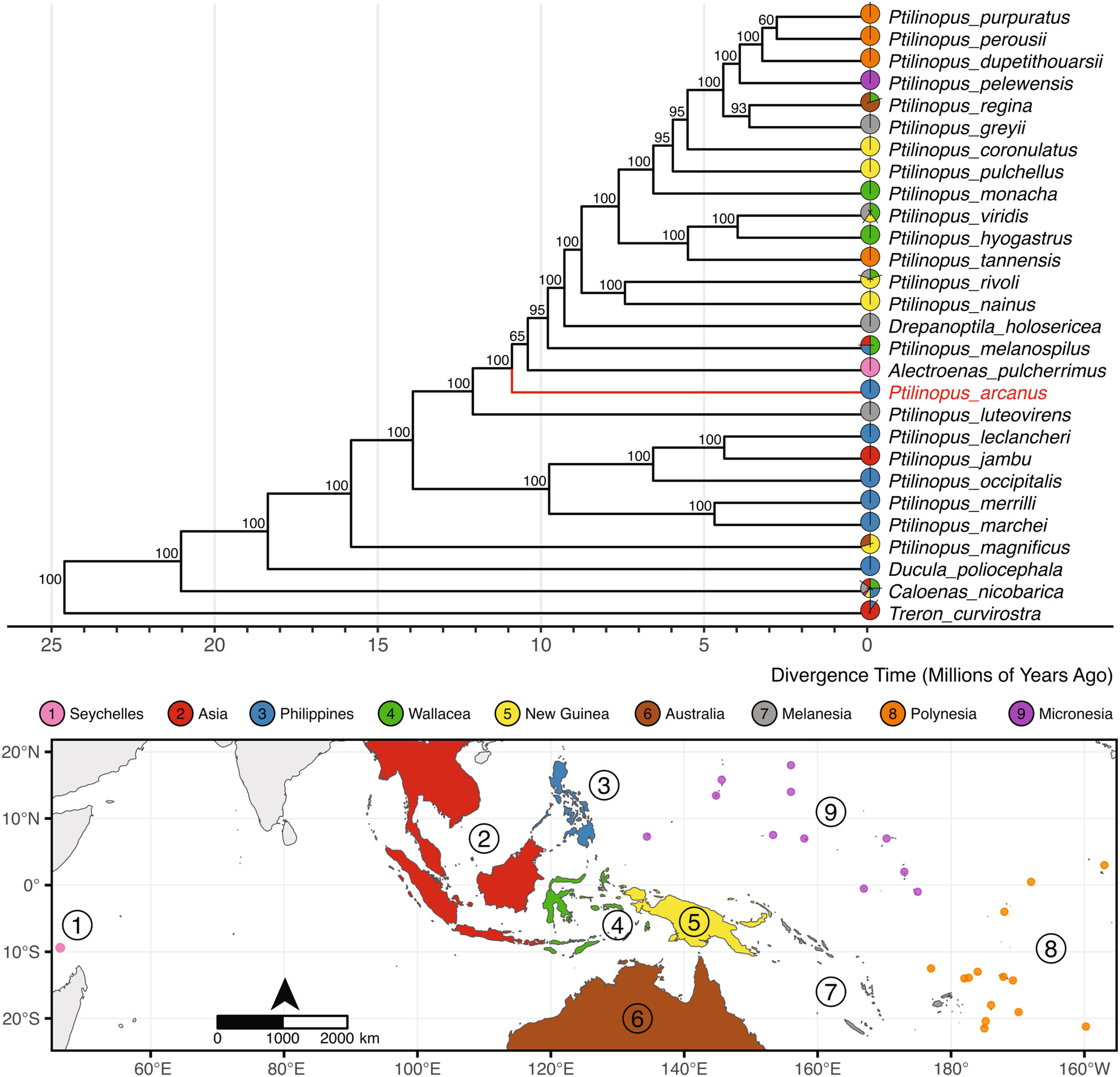
[Ornithology • 2024] Species Status and Phylogenetic Relationships of the enigmatic Negros Fruit Dove Ptilinopus arcanus (Aves: Columbidae)


Negros Fruit Dove  Ptilinopus arcanus  

in Nash, Harrington, Zyskowski, Near & Prum, 2024. 

Abstract
The Negros Fruit Dove Ptilinopus arcanus is an enigmatic bird known only from a single specimen collected on Negros Island, Philippines, in 1953. We extracted and sequenced ultra-conserved elements from historical toe-pad samples of the type specimen of P. arcanus and 27 other species of ptilinopine doves to investigate the species status and phylogenetic relationships of this taxon. We establish that P. arcanus represents a valid species, resolve its phylogenetic position at the base of the radiation of ‘core’ Ptilinopus fruit doves, and estimate that P. arcanus diverged from its most recent common ancestor several million years before Negros Island emerged from the seafloor. We also perform an ancestral range reconstruction to evaluate the effect of different altitudinal preferences on the putative historical range of this species, and we discuss how these findings can inform future efforts to relocate and potentially conserve this species.

Keywords: ancestral range reconstruction, historical DNA, Negros Fruit Dove, Philippines, phylogeny, Ptilinopus arcanus, ultra-conserved elements


John A. Nash, Richard C. Harrington, Kristof Zyskowski, Thomas J. Near and Richard O. Prum. 2024. Species Status and Phylogenetic Relationships of the enigmatic Negros Fruit Dove (Ptilinopus arcanus). Ibis. DOI: 10.1111/ibi.13305

Tuesday, March 15, 2022

[Ornithology • 2022] Fregetta lineata (Peale, 1848) is A Valid Extant Species Endemic to New Caledonia


Fregetta lineata (Peale, 1848)

 in Bretagnolle, Flood, Gaba & Shirihai, 2022.  

Abstract
We present evidence that confirms the streaked Fregetta lineata is a valid extant species that breeds on New Caledonia and endorse the vernacular name New Caledonian Storm Petrel. We review taxonomic deliberations over the historic five ‘Pealea’ streaked storm petrel specimens. Three belong to the recently rediscovered New Zealand Storm Petrel F. maoriana. We study six biometrics of the other two identical-looking specimens, one from Samoa, the other from the Marquesas Islands, a third ‘new’ specimen collected off Brisbane, and other Fregetta taxa. Results of Principal Component Analyses, Discriminant Analyses, and a review of phylogenetic relationships between Fregetta storm petrels, F. lineata and F. maoriana, lead us to conclude that the three specimens represent a single taxon, F. lineata. Furthermore, F. lineata is clearly separated from F. maoriana, White-bellied Storm Petrel F. grallaria and Black-bellied Storm Petrel F. tropica. We further conclude that storm petrels photographed at sea, off New Caledonia and in the Coral Sea, are F. lineata. We then redescribe F. lineata from at-sea observations, photographs taken at sea, and study of the three museum specimens. Criteria for in-hand and at-sea identification are presented. We report the first breeding record, from New Caledonia, a grounded fledgling presumably disoriented by onshore artificial lights. We explore likely breeding locations and conservation issues.

Comparison of ‘streaked’ White-bellied Storm Petrel Fregetta g. grallaria with New Zealand Storm Petrel F. maoriana and New Caledonian Storm Petrel F. lineata.
(A) White-bellied Storm Petrel, Lord Howe Island, Australia, April 2019 (David Newell, birdlifephotography.org.au). (B) White-bellied Storm Petrel, Lord Howe Island, February 2017 (Mark Lethlean, birdlifephotography.org.au). (C) White-bellied Storm Petrel, Lord Howe Island, date unknown (Jack Shick, lhirodenteradicationproject.org/plants-animals/birds).
 (D) New Zealand Storm Petrel, Hauraki Gulf, North Island, New Zealand, November 2018 (Hadoram Shirihai, © Tubenoses Project).
(E) New Caledonian Storm Petrel, off Nouméa, New Caledonia, January 2020 (Hadoram Shirihai, © Tubenoses Project). (F) New Caledonian Storm Petrel, off Nouméa, New Caledonia, January 2020 (Hadoram Shirihai, © Tubenoses Project).
Rarely, individuals of all populations of F. grallaria have limited fine streaking, for example (A) and (B), narrow and close to feather shafts, never in rows of oval dapples characteristic of F. lineata, for example (E) and (F), or forming straighter lines characteristic of F. maoriana (D). A few extreme examples of F. g. grallaria from Lord Howe possess broader flanks streaking, e.g. (C), but never covering the whole belly.

Comparison of underparts and underwing patterns of New Caledonian Storm Petrel Fregetta lineata (n = 30), off Nouméa, New Caledonia, January 2020 (top row)
and New Zealand Storm Petrel F. maoriana (n = 43), Hauraki Gulf, North Island, New Zealand, November 2018 (bottom row).

New Caledonian Storm Petrel Fregetta lineata, off Nouméa, New Caledonia, January 2020
 (Hadoram Shirihai, © Tubenoses Project)

New Caledonian Storm Petrel Fregetta lineata

New Caledonian Storm Petrel Fregetta lineata, Port Bouraké, New Caledonia, 26 September 2014; the first documented fledgling; note traces of down on head, stripes on belly diagnostic of F. lineata, narrow white fringes on dorsal feathers and upperwing (the latter most typical of F. grallaria)
(photographer unknown, images supplied by L. Renaudet)


Vincent Bretagnolle, Robert L. Flood, Sabrina Gaba and Hadoram Shirihai. 2022. Fregetta lineata (Peale, 1848) is A Valid Extant Species Endemic to New Caledonia. Bulletin of the British Ornithologists’ Club, 142(1):111-130. DOI: 10.25226/bboc.v142i1.2022.a6


Tuesday, November 30, 2021

[Ornithology • 2022] Population Connectivity Across A highly Fragmented Distribution: Phylogeography of the Chalcophaps Doves (Aves, Columbidae)


Phylogeography of the Chalcophaps Doves

in DeRaad, Manthey, Ostrow, ... et Moyle, 2021.

Highlights: 
• Phylogenetic reconstruction supports current taxonomy.
• Discordant nuclear and mitochondrial ancestry near contact zone.
• Isolation by distance and hierarchical population structure within clades.
• Low overall diversity despite a large and fragmented geographic distribution.

Abstract
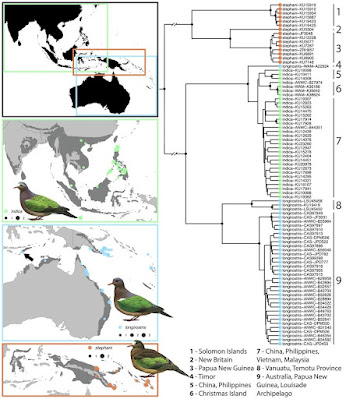
Chalcophaps is a morphologically conserved genus of ground-walking doves distributed from India to mainland China, south to Australia, and across the western Pacific to Vanuatu. Here, we reconstruct the evolutionary history of this genus using DNA sequence data from two nuclear genes and one mitochondrial gene, sampled from throughout the geographic range of Chalcophaps. We find support for three major evolutionary lineages in our phylogenetic reconstruction, each corresponding to the three currently recognized Chalcophaps species. Despite this general concordance, we identify discordant mitochondrial and nuclear ancestries in the subspecies C. longirostris timorensis, raising further questions about the evolutionary history of this Timor endemic population. Within each of the three species, we find evidence for isolation by distance or hierarchical population structure, indicating an important role for geography in the diversification of this genus. Despite being distributed broadly across a highly fragmented geographic region known as a hotspot for avian diversification, the Chalcophaps doves show modest levels of phenotypic and genetic diversity, a pattern potentially explained by strong population connectivity owing to high overwater dispersal capability.
  
 Keywords: Phylogeography, Evolution, Isolation by distance, Mitonuclear discordance, Phylogenetics, Chalcophaps


 Devon A. DeRaad, Joseph D. Manthey, Emily N. Ostrow, Lucas H. DeCicco, Michael J. Andersen, Peter A. Hosner, Hannah T. Shult, Leo Joseph, John P. Dumbacher and Robert G.. Moyle. 2021. Population Connectivity Across A highly Fragmented Distribution: Phylogeography of the Chalcophaps Doves.  Molecular Phylogenetics and Evolution. 166; 107333. DOI: 10.1016/j.ympev.2021.107333 
Emerald Dove

Monday, February 15, 2021

[Ornithology • 2020] The Status and Distribution of the Masked Finfoot Heliopais personatus—Asia’s Next Avian Extinction?


 Masked Finfoot Heliopais personatus

in Chowdhury, Yong, Round, ... et Eames, 2020
 Forktail. 36
 image taken by Sayam U. Chowdhurybirdguides.com
 
Abstract  
The Masked Finfoot Heliopais personatus is among Asia’s most threatened waterbirds. The species formerly ranged widely across north-east India, Bangladesh and South-East Asia, but recent records are few. In this review, we aim to address the gaps in knowledge on the conservation status and ecology of the Masked Finfoot by (1) synthesizing recent information on its occurrence in all range states, (2) re-estimating the global population based on best guesses of national populations, and (3) identifying priority conservation actions. Based on a combination of our survey data (Bangladesh) and best-guess estimates from key sites, we estimate the current population at 108–304 individuals, far lower than the last estimate of 600–1,700 individuals in 2009. Our estimate of population size and rate of decline indicates that Masked Finfoot should be uplisted to Critically Endangered. Masked Finfoot may now breed only in Bangladesh and Cambodia, and there have been no records within the past five years in Malaysia and Thailand, where it once occurred regularly, despite a marked increase in observer effort. Habitat loss and disturbance is the single most important threat to the Masked Finfoot (and many riverine waterbird species), given that low-lying, forested wetlands across South-East Asia are increasingly encroached upon by human activities, or are cleared. There is an urgent need to re-survey areas where it was formerly known, especially in Myanmar. All remaining known breeding populations must be adequately protected or it may become Asia’s next avian extinction.

Global distribution and present population status of Masked Finfoot Heliopais personatus based on best-guess estimates at sites where it has been recently recorded (post-2000). Green circles represent sites with recent breeding records (post-2010). Blue circles represent sites that may hold breeding populations. Red dots represent isolated, likely non-breeding records (post-2005).


Individual differences in facial markings of four adult Masked Finfoots Heliopais personatus (a-c: male; d: female). Apart from the varying width and length of the white stripe on the side of the neck, the shape and size of the yellow horn at the base of the bill are also different in different individuals. The fleshy knob above the base of the bill may be present throughout the year (not only during breeding season) and occurs in both males and females, but is visibly shorter in the female.
 All images taken by Sayam U. Chowdhury
 

Sayam U. Chowdhury, Ding Li Yong, Philip David Round,  Robert Tizard, Simon P. Mahood and Jonathan Charles Eames. 2020. The Status and Distribution of the Masked Finfoot Heliopais personatus—Asia’s Next Avian Extinction? Forktail. 36; 16-24. 


Masked Finfoot sliding towards extinction
A new study published in Forktail, the journal of the Oriental Bird Club, has concluded that Masked Finfoot could become Asia's next avian extinction if its remaining populations are not afforded adequate protection.
Masked Finfoot is a secretive and poorly known waterbird, thinly distributed from north-east India and Bangladesh east to Vietnam, and south to Sumatra and Java, Indonesia. It was formerly found widely across its range, yet recent records are few and far between.
...


Gertrud Neumann-Denzau, E. Fahrni Mansur and R. Mansur. 2008. Nests, Eggs, Hatchlings and Behaviour of the Masked Finfoot Heliopais personatus from the Sundarbans in Bangladesh, with First Nesting Observations. FORKTAIL. 24; 92–99. orientalbirdclub.org/forktail24

Wednesday, July 17, 2019

[PaleoOrnithology • 2019] Aldiomedes angustirostris • A Small, Narrow‐beaked Albatross from the Pliocene of New Zealand demonstrates A Higher Past Diversity in the Feeding Ecology of the Diomedeidae


[upper]  Aldiomedes angustirostris Mayr & Tennyson, 2019


[lower] extant Black‐footed Albatross Phoebastria nigripes 

  DOI: 10.1111/ibi.12757 

Abstract
We describe a nearly complete, three‐dimensionally preserved skull of a new albatross species from the late Pliocene (3.0–3.4 million years ago) Tangahoe Formation of New Zealand. Aldiomedes angustirostris, n. gen. et sp. has only about 90% of the length of the skull of the smallest extant albatross and is the geologically youngest record of a small‐sized albatross known to date. The new species is characterized by a mediolaterally compressed beak, which is not found in any living albatross. The small size and some cranial features of A. angustirostris indicate that, in spite of its comparatively young geological age, the new species was not part of crown group Diomedeidae. We hypothesize that A. angustirostris was more piscivorous than extant albatrosses, which predominantly feed on squid. The reasons for the extinction of smaller‐sized albatrosses are elusive but may be related to changes in seabird fauna during the Pliocene epoch, which witnessed the radiation of various non‐procellariiform seabird groups.

Keywords: Aldiomedes angustirostris, n. gen. et sp., Aves, evolution, palaeoecology


 Skull of Aldiomedes angustirostrisn. gen. et sp. from the late Pliocene of South Taranaki, New Zealand (holotype, NMNZ S.046313)

 Skull of Aldiomedes angustirostrisn. gen. et sp. [upper] from the late Pliocene of South Taranaki, New Zealand (holotype, NMNZ S.046313), in comparison with extant Black‐footed Albatross Phoebastria nigripes [lower].
Scale bars: 1 cm.

Figure 2: Skull of  Aldiomedes angustirostrisn. gen. et sp. from the late Pliocene of South Taranaki, New Zealand (holotype, NMNZ S.046313), in comparison with extant Diomedeidae (a, c, e, g: dorsal view; b, d, f, h: lateral view).
 (a, b, d) A. angustirostris; in (d), the neurocranium was digitally brought into its presumed natural position.
 (c, h) Black‐browed Albatross Thalassarche melanophris. (e) Laysan Albatross Phoebastria immutabilis. (f,g) Black‐footed Albatross Phoebastria nigripes. Scale bars: 10 mm.

Systematic Palaeontology
Aves Linnaeus, 1758
Procellariiformes Fürbringer, 1888
Diomedeidae Gray, 1840

Aldiomedes, n. gen.

Aldiomedes angustirostris, n. sp.

Differential diagnosis: Small‐sized albatross, which differs from all extant Diomedeidae (Phoebetria, Phoebastria, Thalassarche and Diomedea) in: smaller size (Table 1), beak mediolaterally narrower and culmen more ridge‐like, nostrils proportionally larger and with slit‐like caudal margin, fossae glandularum nasales narrower, processus paroccipitales more caudally directed, fossae temporales deeper, and crista nuchalis transversa more sharply defined.

Etymology: The taxon is named in honour of Alastair (‘Al’) Johnson, who found the holotype of the new species; the second part of the name refers to Diomedes, the Greek mythological figure, after which the albatross family was named.

Skull of  Aldiomedes angustirostrisn. gen. et sp. from the late Pliocene of South Taranaki, New Zealand (holotype, NMNZ S.046313)

Aldiomedes angustirostris, n. sp.

Etymology :The species epithet is derived from angustus (Lat.): narrow and rostrum (Lat.): beak and refers to the unusually narrow beak of the new species.


 Gerald Mayr and Alan J. D. Tennyson. 2019. A Small, Narrow‐beaked Albatross from the Pliocene of New Zealand demonstrates A Higher Past Diversity in the Feeding Ecology of the Diomedeidae. Ibis. DOI: 10.1111/ibi.12757

Wednesday, July 4, 2018

[Ornithology • 2018] Pelecanoides whenuahouensis • Analyses of Phenotypic Differentiations Among South Georgian Diving Petrel (Pelecanoides georgicus) Populations Reveal An Undescribed and Highly Endangered Species from New Zealand


Pelecanoides whenuahouensis 
Fischer, Debski, Miskelly, Bost, Fromant, Tennyson, Tessler, Cole, Hiscock, Taylor & Wittmer, 2018

Whenua Hou Diving Petrel  ||   DOI:  10.1371/journal.pone.0197766 

Abstract
Unresolved taxonomy of threatened species is problematic for conservation as the field relies on species being distinct taxonomic units. Differences in breeding habitat and results from a preliminary molecular analysis indicated that the New Zealand population of the South Georgian Diving Petrel (Pelecanoides georgicus) was a distinct, yet undescribed, species. We measured 11 biometric characters and scored eight plumage characters in 143 live birds and 64 study skins originating from most populations of P. georgicus, to assess their taxonomic relationships. We analysed differences with principal component analyses (PCA), factorial ANOVAs, and Kruskal-Wallis rank sum tests. Results show that individuals from New Zealand differ significantly from P. georgicus from all other populations as following: 1) longer wings, 2) longer outer tail feathers, 3) deeper bills, 4) longer heads, 5) longer tarsi, 6) limited collar extent, 7) greater extent of contrasting scapulars, 8) larger contrasting markings on the secondaries, 9) paler ear coverts, 10) paler collars, and 11) paler flanks. Furthermore, we used a species delimitation test with quantitative phenotypic criteria; results reveal that the New Zealand population of P. georgicus indeed merits species status. We hereby name this new species Pelecanoides whenuahouensis sp. nov. Due to severe reductions in its range and the very low number of remaining birds (~150 individuals limited to a single breeding colony on Codfish Island/Whenua Hou) the species warrants listing as ‘Critically Endangered’. 

S1 Fig. Lateral view of the holotype of Pelecanoides whenuahouensis  (NMNZ OR.21058) (Johannes H. Fischer).

The new species of diving petrel, named Whenua Hou Pelecanoides whenuahouensis, is already marked as critically endangered. File size: 13.5 MB Attribution: Jake Osborne

Pelecanoides whenuahouensis sp. nov.  

Etymology: P. whenuahouensis is named after the name of Codfish Island in the Māori language/Te Reo Māori: Whenua Hou (pronounced 'fɛnua 'hou, meaning ‘new land’). This island hosts the only extant colony of this species. This name was selected by the Ngāi Tahu, the Māori people who still hold a genealogical, cultural, and spiritual connection to both the island and this species, which they consider a taonga (treasure).

Common name: We propose the English common name ‘Whenua Hou Diving Petrel’.

Generic placement: P. whenuahouensis clearly belongs in Pelecanoides (family: Pelecanoididae, order: Procellariiformes) based on a combination of black and white plumage, short, paddle-like wings, short tail, small and compact build, and bill morphology (short, broad based bill with hooked tip, a paraseptal process in nostrils, and gular pouch).

Diagnosis: P. whenuahouensis differs from P. garnottii, through bill morphology/coloration (a shorter, slimmer bill, with much smaller nostrils, the presence of lavender blue on the lower mandible, and a less well-defined paraseptal process (but both species have the paraseptal process placed at approximately 50%) and a smaller overall size (resulting in shorter wings, tarsi, and a much lower bodyweight). P. whenuahouensis, however, does appear to have a longer tail than P. garnottii. Furthermore, P. whenuahouensis exhibits 1) a much larger extent of contrasting ear coverts, 2) continuous and pure white scapulars, 3) a limited (light grey) collar, 4) much paler (light grey) flanks and axillaries, and 5) white underwings including primaries. In addition, P. whenuahouensis can also be readily distinguished from P. garnottii based on vocalisations.
......


Distribution: All known study skins of P. whenuahouensis originate from either Dundas Island, Enderby Island (both Auckland Islands, New Zealand), or Codfish Island, New Zealand. P. whenuahouensis remains extant only on Codfish Island, where it breeds in a minute (0.018 km2) strip of coastal, sandy foredunes in Sealers Bay. The historic distribution of P. whenuahouensis in New Zealand likely encompassed the Otago Peninsula on the South Island, Mason’s Bay on Stewart Island, Enderby and Dundas Islands on the Auckland Islands and the Chatham Islands.

The offshore distribution of P. whenuahouensis remains unknown. Prey species found in two specimens indicate that P. whenuahouensis forages on the edge of the continental shelf during the breeding season. The only documented P. georgicus record for Australia (Bellambi Beach, New South Wales) likely pertained to P. whenuahouensis, based on the reported biometrics (most notably a tail length of 41 mm), indicating at least considerable vagrancy potential, and perhaps a larger offshore distribution than previously assumed, as recently demonstrated in P. u. urinatrix.


Fig 6. Study skins of Pelecanoides georgicus from different populations (Johannes H. Fischer). (A) Dorsal view. (B) Ventral view. (C) Lateral view. SAO = NMNZ OR.18421; origin: South Georgia, U.K., South Atlantic Ocean. SIO = NMNZ OR.24768; origin: Heard Island, Australia, South Indian Ocean. NZ = NMNZ OR.21631; origin: Dundas Island, Auckland Islands, New Zealand. Note differences in bill depth (NZ having the highest/deepest), collar extent (SIO having the largest), extent of contrasting scapulars (NZ having the largest), and contrasting white markings on secondaries (NZ having the largest) among others.

Conclusion: 
Here, we provide evidence of the distinctiveness of the Whenua Hou Diving Petrel (Pelecanoides whenuahouensis sp. nov.; previously part of the South Georgian Diving Petrel P. georgicus complex), which is a ‘Critically Endangered’ species. The conservation status of this species has remained “hidden” to global conservation interests due to its inclusion in a polytypic “species”. New Zealand, however, maintains a national threat classification system and therefore, the dire situation of P. whenuahouensis has been acknowledged within New Zealand. Consequently, we advocate the continuing use of national threat classification systems, as in cases like this, it has complemented the global threat classification system, by protecting taxa for which the taxonomy is still unclear. In addition, we urge taxonomists to focus new research on polytypic species that are likely to include threatened taxa, for conservation efforts depend on species being a clear and single ecological unit.


Johannes H. Fischer, Igor Debski, Colin M. Miskelly, Charles A. Bost, Aymeric Fromant, Alan J. D. Tennyson, Jake Tessler, Rosalind Cole, Johanna H. Hiscock, Graeme A. Taylor and Heiko U. Wittmer. 2018. Analyses of Phenotypic Differentiations Among South Georgian Diving Petrel (Pelecanoides georgicus) Populations Reveal An Undescribed and Highly Endangered Species from New Zealand. PLoS ONE. 13(6): e0197766.  DOI:  10.1371/journal.pone.0197766

New diving petrel critically endangered  scimex.org/newsfeed/new-diving-petrel-critically-endangered

Saturday, March 10, 2018

[Ornithology • 2018] Macroevolutionary Patterning of Woodpecker Drums reveals How Sexual Selection Elaborates Signals Under Constraint


in Miles, Schuppe, Ligon & Fuxjager, 2018.


Abstract
Sexual selection drives elaboration in animal displays used for competition and courtship, but this process is opposed by morphological constraints on signal design. How do interactions between selection and constraint shape display evolution? One possibility is that sexual selection continues exaggeration under constraint by operating differentially on each signal component in complex, modular displays. This is seldom studied on a phylogenetic scale, but we address the issue herein by studying macroevolutionary patterning of woodpecker drum displays. These territorial displays are produced when an individual rapidly hits its bill on a hard surface, and drums vary across species in the number of beats included (length) and the rate of drumbeat production (speed). We report that species body size limits drum speed, but not drum length. As a result of this biomechanical constraint, there is less standing variation in speed than length. We also uncover a positive relationship between sexual size dimorphism and the unconstrained trait (length), but with no effect on speed. This suggests that when morphology limits the exaggeration of one component, sexual selection instead exaggerates the unconstrained trait. Modular displays therefore provide the basis for selection to find novel routes to phenotypic elaboration after previous ones are closed.

KEYWORDS: sexual selection, animal behaviour, signal design, constraint 


Figure 1. Cladogram of the woodpeckers (family: Picidae) from Dufort et al. [2016]. At the tips, longer bars indicate species with longer drums. Bars are coloured by drum speed (beats s–1), with warm colours (green to red) indicating progressively faster drums than cool colours (blue-green to blue). Edge colors indicate the evolution of drumming determined from ER Mk1 ancestral state reconstruction (black, drum; orange, drum-like signal; blue, no drum or drum-like signal). Silhouettes are aligned near their corresponding tips, and drawn to-scale based on phylogenetic PCA of body size.


Meredith C. Miles, Eric R. Schuppe, R. Miller Ligon IV and Matthew J. Fuxjager. 2018. Macroevolutionary Patterning of Woodpecker Drums reveals How Sexual Selection Elaborates Signals Under Constraint. Proc. R. Soc. B. 285; 20172628. DOI:  10.1098/rspb.2017.2628
M. J. Dufort. 2016. An augmented supermatrix phylogeny of the avian family Picidae reveals uncertainty deep in the family tree. Mol. Phylogenet. Evol. 94, 313–326.   DOI:  10.1016/j.ympev.2015.08.025

The evolution of woodpecker drums @meredithcmiles @fuxjagerlab  ow.ly/Tbic30iCa6d  #openaccess #ProcB