Showing posts with label Rhinocerotidae - Rhinoceros. Show all posts

Wednesday, October 29, 2025

[PaleoMammalogy • 2025] Epiaceratherium itjilik • Mid-Cenozoic rhinocerotid dispersal via the North Atlantic


  Epiaceratherium itjilik  
Fraser, Rybczynski, Gilbert & Dawson, 2025 
 
Artwork: Julius Csotonyi  facebook.com/JuliusCsotonyi

Abstract
The North Atlantic Land Bridge (NALB), which connected Europe to North America, enabled high-latitude dispersal, particularly during globally warm periods such as the Palaeocene–Eocene Thermal Maximum, a period of dramatic faunal reorganization. It has been generally accepted by palaeontologists, based on faunal comparisons between Europe and North America, that terrestrial vertebrates did not disperse via the NALB more recently than the early Eocene. Here we describe a new Early Miocene rhinocerotid species from the Canadian High Arctic with proximity to the NALB and present novel phylogenetic hypotheses for rhinocerotids. The new species, Epiaceratherium itjilik sp. nov., is differentiated from the four other members of the genus by characteristics of the P3, M1-2, mandible and lower premolars. E. itjilik also possesses an enlarged fifth metacarpal and reduced third trochanter of the femur. Global-scale biogeographic analyses reveal a high number of dispersals between Europe and North America, in both directions; cumulatively, they near the number of dispersals within Eurasia. Notably, multiple dispersals occurred in the Oligo-Miocene, suggesting that the NALB may have been crossable for mammals for at least 20 million years longer than previously considered, consistent with emerging geological and palaeoclimatological models. In combination with a NALB that was interrupted by only narrow, shallow waterways until the Miocene, we suggest that the formation of seasonal ice as early as the mid to late Eocene may have facilitated movement of terrestrial organisms between Europe and North America. We thus provide insight into the importance of the NALB as a persistent high-latitude connector of geographically disparate terrestrial faunas, underscoring the pivotal role of the Arctic in mammalian evolution.


  Epiaceratherium itjilik sp. nov.

Artist's recreation of Epiaceratherium itjilik in its forested lake habitat, Devon Island, Early Miocene, 23 million years ago. The plants and animals shown, including a leporid, rabbit and the transitional seal Puijila darwini, are all based on fossilized remains found at the site.
Artwork: Julius Csotonyi


Danielle Fraser, Natalia Rybczynski, Marisa Gilbert and Mary R. Dawson. 2025. Mid-Cenozoic rhinocerotid dispersal via the North Atlantic. Nature Ecology & Evolution. DOI: doi.org/10.1038/s41559-025-02872-8 [28 October 2025]

Saturday, November 2, 2024

[PaleoMammalogy • 2024] Prosantorhinus yei • The First record of the Genus Prosantorhinus (Perissodactyla: Rhinocerotidae) of East Asia


Prosantorhinus yei
Sun, Deng & Wang, 2024

 
Abstract
Prosantorhinus is a genus of small extinct teleoceratine rhinoceroses with shortened limb bones, widely distributed in Europe. However, the Asian evolution of the teleoceratine Prosantorhinus has remained unclear because of a scarcity of fossil records of the genus. Here, we report the first record of Prosantorhinus in East Asia from the Middle Miocene of Tongxin, Ningxia. The new specimen is characterized by a concave dorsal skull profile and elevated nasals; short and stout nasal bones with drooping margins on both sides; the thickened, enlarged, and roughened nasal extremity supporting a small horn; the semi-molarized upper premolars with a lingual bridge between the protocone and hypocone; the metaloph constriction present on P2–4; the protocone equal to the hypocone on P2; the crista present on P3; and the cement on the cheek teeth developed. With all the morphological evidence considered, we establish a new species, Prosantorhinus yei sp. nov.. A phylogenetic analysis based on 282 morphological characters scored for 36 taxa reveals that Prosantorhinus yei sp. nov. is a relatively derived taxon in the genus. We hypothesize that Prosantorhinus yei sp. nov. lived in relatively moist environments.

Prosantorhinus, Middle Miocene, phylogeny, palaeoecology, China


Prosantorhinus yei sp. nov.


Danhui Sun, Tao Deng and Shiqi Wang. 2024. The First record of the Genus Prosantorhinus (Perissodactyla: Rhinocerotidae) of East Asia. Zoological Journal of the Linnean Society. 202(2); zlad183, DOI: doi.org/10.1093/zoolinnean/zlad183

Friday, December 22, 2023

[PaleoMammalogy • 2023] Tongxinotherium latirhinum • A New elasmothere Genus and Species from the middle Miocene of Tongxin, Ningxia, China, and its phylogenetic relationship


Tongxinotherium latirhinum
Sun, Tao Deng, Xiaokang Lu and Shiqi Wang. 2023
  

Abstract
The elasmotheres were well diversified and widespread throughout the Neogene in Eurasia and East Africa. Here we report a new elasmothere genus and species, Tongxinotherium latirhinum gen. et sp. nov., from the Zhang’enbao Formation (middle Miocene) of Tongxin, Ningxia, China. The new genus is characterized by a broad and thick nasal bone, the ‘U’-shaped nasal notch located at the level of P3, the anterior margin of the orbit situated at the level of M2, subhypsodont teeth covered and filled by plentiful cement, slightly developed enamel foldings, expanded protocone with anterior and posterior constrictions, the middle valley and posterior valley closed on the premolars, protoloph separated from the ectoloph on P2, and buccal and lingual cingula present on premolars, but absent on molars. A phylogenetic analysis reveals that Tongxinotherium latirhinum gen. et sp. nov. is more derived than the early elasmotheres, and more primitive than Iranotherium and Ningxiatherium, bridging a morphological and stratigraphical gap between them. The discovery of new material improves the morphological characteristics of the early elasmotheres’ horns and increases the diversity of the middle Miocene elasmotheres.
 
Keywords: elasmotheres, middle Miocene, phylogeny, Tongxin, China


Danhui Sun, Tao Deng, Xiaokang Lu and Shiqi Wang. 2023. A New elasmothere Genus and Species from the middle Miocene of Tongxin, Ningxia, China, and its phylogenetic relationship. Journal of Systematic Palaeontology. 21(1); 2236619. DOI: 10.1080/14772019.2023.2236619    twitter.com/JournalSystPal/status/1698686806160539899
  www.cnfossil.com/viewnews-14716.html

Monday, November 6, 2023

[PaleoMammalogy • 2023] Chilotherium schlosseri & Eochilotherium samium • Revision of the Late Miocene hornless rhinocerotids from Samos Island (Greece) with the Designation of Neotypes and Implications for the European chilotheres


Chilotherium schlosseri (Weber, 1905) and
 Eochilotherium samium (Weber, 1905)

in Kampouridis, Svorligkou, Kargopoulos, Spassov et Böhme, 2023. 
 
ABSTRACT
Extant rhinoceroses are represented only by five species and are characterized by the presence of a nasal horn. In the past, they were much more diverse, with one of the best-known groups being the aceratheriines, i.e., hornless rhinoceroses. Chilotheres are a group of hornless rhinos that inhabited Eurasia during the Late Miocene. Their westernmost geographic range reached Eastern Europe, where overall eight species have been erected. Four of these were described based on material from the Upper Miocene of Samos Island (Greece), two of which are not considered valid anymore. Unfortunately, the type skulls of all four species are lost and there are several issues concerning their taxonomy. Therefore, we herein designate two skulls housed in historical collections from Samos as neotypes for the first two species, Chilotherium schlosseri (Weber, 1905) and Eochilotherium samium (Weber, 1905), and provide detailed comparisons for the separation of the species from each other and from any other chilotheres. Our results prove that the two species are valid and justify their separation on a generic level. Chilotherium schlosseri seems to be more closely affiliated with the other European Chilotherium species, whereas E. samium is more similar to the Chinese ‘Chilotherium’ wimani and ‘Chilotherium’ primigenium, based on their more plesiomorphic characters.


SYSTEMATIC PALEONTOLOGY
Class MAMMALIA Linnaeus, 1758

Order PERISSODACTYLA Owen, 1848

Family RHINOCEROTIDAE Gray, 1821
Subfamily ACERATHERIINAE Dollo, 1885 (sensu Lu, Deng, & Pandolfi, 2023)

Tribe ACERATHERIINI Dollo, 1885 (sensu Lu, Deng, & Pandolfi, 2023)

Subtribe CHILOTHERIINA Qiu, Xie, and Yan, 1987

Included Genera—Chilotherium Ringström, 1924, 
Shansirhinus Kretzoi, 1942, and 
Eochilotherium Geraads and Spassov, 2009.


CONCLUSIONS: 
The European chilotheres have a very complicated taxonomic history, with the erection of over eight species. Herein, we attempt to solve some of the issues involving this group by designating neotypes for the first two described chilothere species from Europe, Chilotherium schlosseri and Eochilotherium samium, both from the Upper Miocene deposits of Samos Island (Greece). The revision showed that they represent two distinct taxa, with E. samium being placed in a distinct genus, based on some cranial features such as the missing depression in the frontal bones and its less complex dental morphology, such as the less pronounced protocone constriction. Chilotherium schlosseri represents one of the most derived species of the genus, based on its very widely separated parietal crests and its very complex tooth morphology, which frequently includes enamel plications. This species is closely allied with other Eastern European Chilotherium species, Chilotherium kowalevskii, Chilotherium sarmaticum from Ukraine and the Asian species Chilotherium orlovi from Kazakhstan. Eochilotherium samium on the other hand, seems to be more similar to the Chinese ‘Chilotheriumwimani and ‘Chilotheriumprimigenium.


Panagiotis Kampouridis, Georgia Svorligkou, Nikolaos Kargopoulos, Nikolai Spassov and Madelaine Böhme. 2023. Revision of the Late Miocene hornless rhinocerotids from Samos Island (Greece) with the Designation of Neotypes and Implications for the European chilotheres. Journal of Vertebrate Paleontology.  e2254360. DOI: 10.1080/02724634.2023.2254360
phys.org/news/2023-11-fossilized-skulls-reveal-today-rhinos.html

Sunday, May 23, 2021

[PaleoMammalogy • 2021] Nesorhinus gen. nov. • A New Rhinoceros Clade from the Pleistocene of Asia sheds light on Mammal Dispersals to the Philippines


in Antoine, Reyes, Amano, ... et Ingicco, 2021. 
 
 
Abstract
Rhinoceroses are among the most endangered mammalian species today. Their past diversity is well documented from the Eocene onward, although their evolutionary history is far from being fully understood. Here, we elucidate the systematic affinities of a Pleistocene rhinoceros species represented by a partial skeleton from 709 ± 68 kya archaeological deposits in Luzon Island, Philippines. We perform a comprehensive phylogenetic analysis, including all living species and a wide array of extinct rhinocerotid species. We confirm the early split between Elasmotheriinae and Rhinocerotinae at c. 35.5 Mya and constrain the divergence between recent Asian and African rhinoceroses at c. 24 Mya, with contrasting phenotypic evolutionary rates in Diceroti and Rhinoceroti. Dental features reveal the existence of an unsuspected Asian Pleistocene clade, referred to as Nesorhinus gen. nov.. It includes the rhinoceros from the Philippines and another extinct species from Taiwan, N. hayasakai. Nesorhinus is the sister-group to a cluster comprising Dicerorhinus and Rhinoceros. Our phylogenetic results strongly suggest an island-hopping dispersal for Nesorhinus, from the Asian mainland towards Luzon via Taiwan by the Late Miocene or later, and Pleistocene dispersals for representatives of Rhinoceros. Nesorhinus philippinensis would be the first perissodactyl species supporting the island-rule hypothesis, with decreased body weight and limb-bone robustness.

Keywords: evolutionary trends, island biogeography, island fauna, Mammalia, megafauna, morphological phylogenetics, morphological systematic


Pierre-Olivier Antoine, Marian C. Reyes, Noel Amano, Angel P. Bautista, Chun-Hsiang Chang, Julien Claude, John De Vos and Thomas Ingicco. 2021. A New Rhinoceros Clade from the Pleistocene of Asia sheds light on Mammal Dispersals to the Philippines. Zoological Journal of the Linnean Society. zlab009.  DOI: 10.1093/zoolinnean/zlab009


Friday, November 1, 2019

[Paleontology • 2019] The First Tertiary Fossils of Mammals, Turtles, and Fish from Canada's Yukon


Tertiary Paleoenvironment in Yukon, Canada.
Rhinocerotidae, Chrysemys pond turtleHesperotestudo tortoise, and Esox pike

in Eberle, Hutchison, Kennedy, et al., 2019. 
Illustration: Julius Csotonyi digitallibrary.amnh.org

Abstract
Despite over a century of prospecting and field research, fossil vertebrates are exceedingly rare in Paleogene and Neogene rocks in northern Canada's Yukon Territory. Here, we describe the first records of probable Neogene vertebrate fossils from the territory, including tooth fragments of a rhinocerotid, a partial calcaneum of an artiodactyl, shell fragments of the pond turtle Chrysemys s.l. and tortoise Hesperotestudo, and a fragment of a palatine of Esox (pike). Although the tooth fragments cannot be identified solely by traditional paleontological means, we use tooth enamel microstructure, and primarily the presence of vertical Hunter-Schreger bands, to refer them to the Rhinocerotidae. As the only known record of the Rhinocerotidae in North America's western Arctic, the tooth fragments from the Wolf Creek site support the hypothesis that the clade dispersed between Asia and North America across Beringia. The fossils are consistent with a Miocene age for the Wolf Creek site that is inferred from radiometric dates of the Miles Canyon basalt flows in the vicinity of the fossil locality. Further, the tortoise and pond turtle fossils indicate a mild climate in the Yukon at the time, consistent with the vegetation reconstructions of others that indicate a warmer, wetter world in the Miocene than today.

FIGURE 9. A–B. Tangential section of YG514.12 (uncoated) viewed under a light microscope showing the bifurcating vertical HSB. A. Light source from top. B. Light source from bottom. C. SEM image of tangential section. D. Magnified bifurcation in region encompassed by white square in C, showing the steeply angled prisms comprising the HSB; transitional zones are the light-colored edges of the bifurcation. E. Magnified SEM image showing narrow transitional zone of horizontal prisms flanked by the steeply angled prisms that make up the vertical HSB. F. Vertical section of outer enamel showing the radial enamel wherein the prisms rise at a shallow angle toward the OES. Abbreviation: OES, outer enamel surface.


an ancient relative of today's rhinoceroses splashing through a stream next to turtles and fish in the Yukon.
Illustration: Julius Csotonyi


Jaelyn Eberle, J. Howard Hutchison, Kristen Kennedy, Wighart Von Koenigswald, Ross D.E. MacPhee and Grant Zazula. 2019. The First Tertiary Fossils of Mammals, Turtles, and Fish from Canada's Yukon. American Museum Novitates. (3943); 1-28. DOI: 10.1206/3943.1 

Ancient rhinos roamed the Yukon phys.org/news/2019-10-ancient-rhinos-roamed-yukon.html via @physorg_com

Wednesday, July 31, 2013

[PaleoMammalogy • 2013] Aceratherium porpani • A new species of Aceratherium (Rhinocerotidae, Perissodactyla) from the late Miocene of Nakhon Ratchasima, northeastern Thailand


Reconstruction of the Late Miocene habitat of Aceratherium porpani from Tha Chang area in Nakhon Ratchasima Province, northwestern Thailand


Photo : Institute of Vertebrate Paleontology and Paleoanthropology,
Chinese Academy of Sciences -- illustrated by Chen Yu


Holotype skull of Aceratherium porpani Deng, Hanta & Jintasakul 2013

Abstract
A new species of the genus Aceratherium, A. porpani sp. nov., from the Tha Chang sand pits in Nakhon Ratchasima Province, northwestern Thailand, is described. It is a mid-sized rhinocerotid in the subfamily Aceratheriinae, and represents the first discovery of Aceratherium in Thailand. The material includes a well-preserved skull and mandible. A. porpani has broadly separated parietal crests, slightly expanded zygomatic arches, a straight nuchal crest, moderate supraorbital tuberosities, a flat skull roof, a deep nasal notch above the P4/M1 boundary, a moderately wide mandibular symphysis with a posterior border at the p3/p4 boundary, a short diastema between i2 and p2, absence of DP1 and dp1, strong crochets, constricted molar protocones, and long metalophs. This new species has a mixture of primitive and derived characters that differ from the known species of Aceratherium, A. incisivum, and A. depereti. The evolutionary stage of A. porpani is consistent with the latest Miocene age of the associated fauna and flora in the Tha Chang sand pits.

Etymology: In honor of Porpan Vachajitpan, who donated the studied holotype and paratype specimens of this new species


Princess Maha Chakri Sirindhorn was listening to the introduction of Dr. Deng about the holotype skull 


Tao Deng, Rattanaphorn Hanta and Pratueng Jintasakul. 2013. A new species of Aceratherium (Rhinocerotidae, Perissodactyla) from the late Miocene of Nakhon Ratchasima, northeastern Thailand. Journal of Vertebrate Paleontology. 33 (4): 977–975. doi: dx.doi.org/10.1080/02724634.2013.748058.

Aceratherium porpani: New Late Miocene Species of Hornless Rhino from Thailand

Paleontologists have identified a new species of hornless rhino from fossil skull and mandible found in the Tha Chang area, Nakhon Ratchasima Province, Thailand.

In the Tha Chang area, Nakhon Ratchasima Province, Thailand, several sand pits previously have yielded fossils. The area is 220 km northeast of Bangkok, and the sand pits are located next to the Mun River. The sedimentary sequence of these sand pits consists of unconsolidated mudstone, sandstone, and conglomerate, deposited by the ancient Mun River. Almost all the fossils have been found and collected by local villagers working in these sand pits, and they have been brought to public institutions such as Nakhon Ratchasima Rajabhat University. Consequently, precise field information is unavailable for most of the fossils from the Tha Chang area, including the type mandible of the recently described new hominoid Khoratpithecus piriyai

Dr. DENG Tao from Institute of Vertebrate Paleontology and Paleoanthropology (IVPP), Chinese Academy of Sciences, and his Thai colleagues from Nakhon Ratchasima Rajabhat University studied the rhino fossils collected from the Tha Chang sand pits and described them as a new species of the subfamily Aceratheriinae, Aceratherium porpani sp. nov. Its holotype is an adult skull without premaxillae and the anterior portion of nasals, and its paratype is an almost complete mandible. Her Royal Highness Princess Sirindhorn of Thailand was interested in this study and watched the holotype of A. porpani when Dr. Deng and his Thai colleagues studied these fossils in Nakhon Ratchasima. The study is published online June 26, 2013 in Journal of Vertebrate Paleontology.

.............................


Thursday, May 16, 2013

[Mammalogy / Conservation • 2013] Genetics and the last stand of the Sumatran rhinoceros Dicerorhinus sumatrensis | Rhino populations in Sumatra, Borneo should be combined to save Sumatran rhino from extinction


Puntung, a female Sumatran rhinoceros, in forest stockade in Sabah, Malaysian Borneo a day after her capture in December 2011.

Abstract
The Sumatran rhinoceros Dicerorhinus sumatrensis is on the brink of extinction. Although habitat loss and poaching were the reasons of the decline, today's reproductive isolation is the main threat to the survival of the species. Genetic studies have played an important role in identifying conservation priorities, including for rhinoceroses. However, for a species such as the Sumatran rhinoceros, where time is of the essence in preventing extinction, to what extent should genetic and geographical distances be taken into account in deciding the most urgently needed conservation interventions? We propose that the populations of Sumatra and Borneo be considered as a single management unit. 

Keywords: Dicerorhinus sumatrensis ; extinction; genetics; genome resource banking; Sumatran rhinoceros; threatened


Rhino populations in Sumatra, Borneo should be combined
to save Sumatran rhino from extinction

A new study argues for treating endangered Sumatran populations in Borneo and Sumatra as "a single conservation unit", lending academic support to a controversial proposal to move wild rhinos from Malaysia to Indonesia.

The paper, authored by an international team of rhino experts and published in the journal Oryx, says that genetic differences between the island populations are minimal. Given the dire straights of the species — the wild population is estimated at less than 100 individuals — the researchers argue that ensuring the Sumatran rhino's survival takes precedence over preserving what little genetic diversity remains between populations.

"In our paper, we discuss the pros and cons of considering the populations of Sumatran rhinoceros from Sumatra and Borneo as a single management unit," said study lead author Benoit Goossens, Director of the Danau Girang Field Centre in Malaysia, in a statement. "For a species such as the Sumatran rhinoceros, where time is of the essence in preventing extinction, we must ask to what extent should genetic and geographical distances be taken into account in deciding the most urgently needed conservation interventions."


Benoît Goossens et al, 2013. Genetics and the last stand of the Sumatran rhinoceros Dicerorhinus sumatrensis. Oryx. DOI: http://dx.doi.org/10.1017/S0030605313000045

Friday, May 3, 2013

[PaleoMammalogy • 2013] Origin of an Assemblage Massively Dominated by Carnivorans from the Miocene of Spain | Killer Cave Lured Ancient Carnivores to Their Death


Two sabertooth cats circle a rhinoceros carcass in an underground cave
illustration: Mauricio Antón

Abstract
Carnivoran-dominated fossil sites provide precious insights into the diversity and ecology of species rarely recovered in the fossil record. The lower level assemblage of Batallones-1 fossil site (Late Miocene; Madrid Basin, Spain) has yielded one of the most abundant and diversified carnivoran assemblage ever known from the Cenozoic record of mammals. A comprehensive taphonomic study is carried out here in order to constrain the concentration mode of this remarkable assemblage. Another distinctive feature of Batallones-1 is that the accumulation of carnivoran remains took place in the context of a geomorphological landform (cavity formation through a piping process) practically unknown in the generation of fossil sites. Two characteristics of the assemblage highly restrict the probable causes for the accumulation of the remains: (1) the overwhelming number of carnivorans individuals; and (2) the mortality profiles estimated for the four most abundant taxa do not correspond to the classic mortality types but rather were the consequence of the behavior of the taxa. This evidence together with other taphonomic data supports the hypothesis that carnivoran individuals actively entered the cavity searching for resources (food or water) and were unable to exit. The scarcity of herbivores implies that the shaft was well visible and avoided by these taxa. Fossil bones exhibit a very good preservation state as a consequence of their deposition in the restricted and protective environment of the chamber. Batallones-1 had another assemblage (upper level assemblage) that was dominated by herbivore remains and that potentially corresponded to the final stages of the cavity filling.

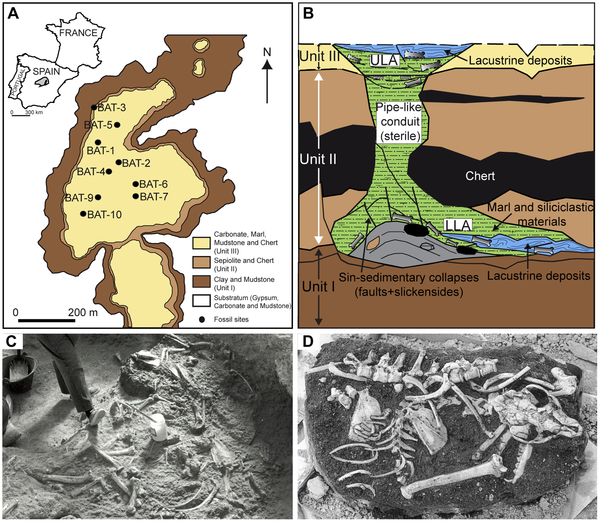
Figure 1. BAT-1 geographic, geologic and taphonomic context. A, Distribution of the three sedimentological units and fossil sites of Cerro de los Batallones in aerial view. BAT-1 = Batallones-1, BAT-2 = Batallones-2 and so on. The Madrid Basin is highlighted in grey in the map of Spain;
B, Geological sketch (vertical section) of BAT-1 showing the lower level assemblage (LLA) and upper level assemblage (ULA) (Modified from Pozo et al. [17]). Because the ULA was mostly eliminated during the sepiolite quarrying, we provide a reconstruction (dotted lines) based on observations from other localities of Cerro de los Batallones. The sketch is not to scale;
C, BAT-1 LLA bone concentration. In some areas of the excavation, bones appeared tightly packed and in contact with one another;
D, Partial skeleton of the hyaena Protictitherium crassum. Mean skull length of Protictitherium crassum from BAT-1 LLA is 13.5 cm.

Killer Cave Lured Ancient Carnivores to Their Death
A cavern in Spain may have lured ancient carnivores to their deaths by offering the promise of food and water, new research suggests.

The new study, published in the journal PLOS ONE, may explain how the carcasses of several carnivore species, including saber-toothed cats and "bear dogs," wound up in an underground cavern millions of years ago.

"Only the carnivores were daring enough to enter," said study co-author M. Soledad Domingo, a paleontologist at the University of Michigan. "But they were unable to make their way out." 

Surprise discovery
In 1991, miners drilling about 18.7 miles (30 kilometers) outside Madrid, Spain, uncovered animal bones and called in local paleontologists to excavate. They uncovered a series of underground caverns full of animal fossils — including the remains of red pandas, bear dogs and saber-toothed cats, as well as ancient animals related to modern elephants, giraffes, rhinoceroses and horses. To date, nearly 18,000 fossils have been recovered from the area.

The so-called Cerro de los Batallones caves formed between 9 million and 10 million years ago in a process known as piping, where sediment falls into cracks or fissures in the surface, carving out hollow spaces in the soft, claylike Earth. Unlike other "pipes" formed in clay that quickly disappear, however, the holes stayed open longer because the area also contained a harder type of rock to buttress the burgeoning caves.

Exactly what happened to the animals, however, remained a mystery.

Cave of death
To solve the mystery, Domingo and her colleagues systematically analyzed all the bones discovered in the bottom level of the site, called Batallones-1. The cave contained an unusually high proportion of carnivores, some of which were completely unknown before the cave's discovery, Domingo told LiveScience.

The researchers found that nearly 98 percent of the large-mammal fossils were of carnivores, many of them healthy young adults. They also studied the orientation of the skeletons in the cave and the lack of trample marks.

Based on these findings, the team concluded that the cave probably had a visible opening in the ground, into which the herbivores may have occasionally fallen. (For instance, the cave contains a complete rhinoceros skeleton.) However, most of the herbivores were smart enough to avoid the trap.

But young-adult carnivores willingly entered the cave, possibly lured by the scent of food or water. The unlucky animals became trapped and died (likely from starvation), and the scent of their rotting carcasses lured other carnivores into the caves, and to their deaths.

"We think that the carnivores were getting trapped, and then they became additional food for another coming carnivore," Domingo said.

The researchers still don't know how long the cave was open before flooding brought fresh material to cover it up. And the findings only apply to one cavern at the site — scientists still need to do further studies to determine how herbivores wound up in the upper levels of the cave complex.


Killer Cave Lured Ancient Carnivores to Their Death

Citation: Domingo MS, Alberdi MT, Azanza B, Silva PG, Morales J. 2013. Origin of an Assemblage Massively Dominated by Carnivorans from the Miocene of Spain. PLoS ONE. 8(5): e63046. DOI: http://dx.plos.org/10.1371/journal.pone.0063046

Friday, March 29, 2013

[Mammalogy • Extinct] Africa's Western Black Rhinoceros Diceros bicornis longipes declared Extinct


Africa's Western Black Rhinoceros Diceros bicornis longipes declared extinct
| Quarter of all mammals at risk of extinction, group says; Northern White Rhino of central Africa also now 'possibly extinct' in the wild
— The Western Black Rhino of Africa was declared officially extinct Thursday by a leading conservation group.

The International Union for Conservation of Nature said that two other subspecies of rhinoceros were close to meeting the same fate. The Northern White Rhino of central Africa is now "possibly extinct" in the wild and the Javan Rhino "probably extinct" in Vietnam, after poachers killed the last animal there in 2010. A small but declining population survives on the Indonesian island of Java.

IUCN said Thursday that a quarter of all mammals are at risk of extinction, according to its updated Red List of endangered species.

....................


Saturday, March 16, 2013

[Conservation / News • 2013] Global Trade Regulation Group Extends Reach | CITES CoP16


Global Trade Regulation Group Extends Reach 

Threatened species of sharks, manta rays, elephants, and rhinoceroses will get some relief thanks to precedent-setting decisions taken at a meeting of the Convention on International Trade in Endangered Species of Wild Fauna and Flora (CITES) that concluded yesterday in Bangkok.

Rising demand for shark fins, shark meat, and manta ray gills is on an unsustainable trajectory according to the International Union for Conservation of Nature (IUCN). Earlier this week, a CITES committee approved what is called an Appendix II listing for five shark species and two species of rays, all of which are considered endangered or vulnerable by IUCN. Appendix II covers species that might face extinction if current trends continue, and CITES allows international trading of these species only if there are controls ensuring their survival in the wild. (An Appendix I listing—intended for species threatened with extinction—outlaws international commercial trading.)

The committee's decision survived a challenge during the closing plenary session on 14 March. Both IUCN and the World Wildlife Fund called the decision "historic."


"There has been an impasse for a number of years over whether or not CITES could further move into the listing of commercially valuable marine species that all the evidence suggests are being harvested unsustainably," says Simon Stuart, who chairs the IUCN's Species Survival Commission.

Those opposed to the changes argued that regional fisheries management organizations should address the threats to sharks and rays. But the stocks "have not been managed sustainably," Stuart says. He acknowledges that enforcement will be a challenge. He thinks that CITES should work in concert with regional organizations to manage the fisheries in a sustainable way based on scientific input.

Enforcement was the key issue in the decisions on ivory and rhino horns. Parties to the convention, as participating countries are called, decided to initiate a process requiring China, Kenya, Malaysia, the Philippines, Thailand, Uganda, Tanzania, and Vietnam to develop plans to crack down on illegal ivory and rhino horn trading. "CITES is ready to get tough on the countries that are the focus of the illegal [ivory] trade," Stuart says.

Over the course of the 12-day meeting, delegates agreed on tighter controls over the trading of tropical timber and on some species of tortoise and freshwater turtles. They also decided to ban international commercial trade in the critically endangered freshwater sawfish. But a call to tighten restrictions on trading in polar bear hides, claws, and teeth put forward by the United States and supported by Russia was defeated after opposition from Canada, Denmark (Greenland), and Norway.

The final score at the 12-day meeting was 55 proposals accepted, nine rejected, and six withdrawn. "Overall, we are pretty pleased," Stuart says. One concern is that "the science isn't being followed as closely as it should be," he says.

The next CITES meeting will be held in South Africa in 2016.


Sunday, January 27, 2013

[PaleoMammalogy • 2012] A Bizarre tandem-horned elasmothere rhino from the Late Miocene of northwestern China and origin of the true elasmothere


Figure 3 A series of six elasmotheres species from the Middle Miocene to the Late Pleistocene. They display an increase in skull size and development from a nasal horn to a frontal horn.
These skulls are reconstructed based on
AMNH 26531 (Tunggur in Inner Mongolia, Middle Miocene) for Hispanotherium tungurense,
HMV 0979 (Houshan in Guanghe, Gansu, Late Miocene) for Iranotherium morgani,
HMV 1411 (Guonigou in Dongxiang, Gansu, Late Miocene) for Parelasmotherium linxiaense,
HMV 1449 (Guonigou in Dongxiang, Gansu, Late Miocene) for Ningxiatherium euryrhinus,
V 18539 (Huaigou in Guanghe, Gansu, Late Miocene) for Sinotherium lagrelii, and
NHM 12429 (Sarepta in Russia, Late Pleistocene) for Elasmotherium sibiricum.

Although the modern Indian and Javan rhinos have a single horn on their noses, the extinct one-horned rhino Elasmotherium was a source for the legendary unicorn, because the latter had a very long horn on its forehead and lived with the prehistoric human beings who drew its images on cave paintings. Elasmothere rhinos first appeared in South Asia in the Early Miocene, but the origin of Elasmotherium has been unclear. All other elasmotheres have a weak or strong nasal horn, whereas Elasmotherium seems to lose the nasal horn of its ancestors and to get a huge frontal horn apparently abruptly. Here we report the first discovered skull of Sinotherium lagrelii from the Late Miocene red clays in the Linxia Basin, northwestern China. This skull has an enormous nasofrontal horn boss shifted posteriorly and a smaller frontal horn boss, which are connected to each other, indicating an intermediate stage for the single frontal horn of Elasmotherium. Morphological and phylogenetic analyses confirm that Sinotherium is a transitional taxon between Elasmotherium and other elasmotheres, positioned near the root of the giant unicorn clade and originated in a subarid steppe. The posteriorly shifted nasal horn has a more substantial support and the arched structure of the nasofrontal area is an adaptation for a huge horn. 

Keywords: Rhinocerotidae, elasmothere, Sinotherium, Late Miocene, Linxia Basin 


Habitat reconstruction the Linxia Basin during the Late Miocene.
Art: ~sinammonite on http://sinammonite.deviantart.com 
under guidance of IVPP scholar Deng Tao

Deng T, Wang S Q, Hou S K. A bizarre tandem-horned elasmothere rhino from the Late Miocene of northwestern China and origin of the true elasmothere. Chin Sci Bull. 

[PaleoMammalogy • 2010] Linxia Basin: An Ancient Paradise for Late Cenozoic Rhinoceroses in North China


Habitat reconstruction the Linxia Basin during the Late Miocene.
Art: ~sinammonite on http://sinammonite.deviantart.com 
under guidance of IVPP scholar Deng Tao

The Linxia Basin is located on the triple-junction of the northeastern Tibetan Plateau, western Qinling Mountains and the Loess Plateau. The basin is filled with 700−2000 m of late Cenozoic deposits, mainly red in color and dominated by lacustrine siltstones and mudstones, and the Linxia sequence represents the most complete and successive late Cenozoic section in China. The localities in the Linxia Basin are notable for abundant, relatively complete, well-preserved, and sometimes partially articulated bones of large mammals, which often occur in dense concentrations. Many new species of the Late Oligocene Dzungariotherium fauna, the Middle Miocene Platybelodon fauna, the Late Miocene Hipparion fauna, and the Early Pleistocene Equus fauna have been described from the Linxia Basin since 2000, including rodents, lagomorphs, primates, carnivores, proboscideans, perissodactyls and artiodactyls.

Among these mammalian fossils, several hundred skulls of the late Cenozoic rhinoceroses are known from the Linxia Basin. In addition, more abundant limb bones and isolated teeth of rhinoceroses are found in this basin, especially from the Late Miocene red clay deposits. Rhinoceroses were over 70% in diversity during the Late Oligocene, and they were dominant in population during the Late Miocene. In the Middle Miocene and Early Pleistocene faunas, rhinoceroses were important members. 


DENG Tao. 2010. Linxia Basin: An Ancient Paradise for Late Cenozoic Rhinoceroses in North China. Bulletin of the Chinese Academy of Sciences24(2). 103-106. http://english.ivpp.cas.cn/rh/as/201012/P020101207396128597065.pdf

Saturday, January 5, 2013

[Mammalogy • Extinct] Integrated and novel survey methods for rhinoceros populations confirm the extinction of Rhinoceros sondaicus annamiticus from Vietnam | Javan Rhino Officially Extinct In Vietnam


A Javan rhino in Vietnam captured in a camera-trap photo.
 ©WWF-Greater Mekong

Abstract 

Javan rhinoceros (Rhinoceros sondaicus) is among the most threatened large mammal species in the world. Development of rigorous, non-invasive survey techniques is a high priority, to monitor populations and develop informed conservation management strategies. The critically endangered javan rhinoceros until recently survived in two separate populations, one in Vietnam and one in Indonesia, representing distinct subspecies. The range of the annamiticus subspecies around Cat Tien National Park (CTNP) has declined significantly since its re-discovery in 1989, and no accurate estimate of population size had ever been obtained. We employed integrated survey techniques and analyses to determine the population status of the javan rhinoceros in Vietnam. We conducted a comprehensive field survey of the Cat Loc sector of CTNP using scat detection dogs to detect javan rhinoceros dung between October 2009 and April 2010. Twenty-two dung samples were collected for microsatellite DNA analysis, seventeen of which were of sufficient quality to be analysed. The genotyping work confirmed that only a single rhinoceros was present at the start of the survey in 2009 and that this was the same individual that was found dead in April 2010. Although far less definitive than host genotyping, stool bacterial diversity assays also supported the hypothesis that all samples collected by the survey were from one individual. This empirical data combined with field survey data indicate the extinction of the javan rhinoceros in Vietnam. We conclude by discussing the developmental progress of these non-invasive survey techniques to monitor other endangered rhinoceros populations. 

Highlights ► We conduct a comprehensive survey of the javan rhinoceros population in Vietnam. ► Genetic and faecal bacterial diversity analysis of faecal samples is employed. ► Rhinoceros sondaicus is confirmed extinct in Vietnam. ► We evaluate these survey and analytical techniques for monitoring rhino populations. 

Keywords: Bacterial diversity assay; Extinction; Genetic analysis; Javan rhinoceros; Rhinoceros population monitoring; Scat detection dogs


A camera trap photograph of a Javan rhino in Cat Tien Nationak Parl.
 (Photo: WWF / Cat Tien National Park)

It’s Official: Vietnam’s Javan Rhino Is Extinct. Which Species Is Next? 
Poachers and lack of territory have killed off these amazing rhinos in Vietnam. Can we save the 35 left in Indonesia?

DNA analysis of rhino dung in Vietnam's Cat Tien National Park in 2009 found that only one rhino remained at that time — the same one that was shot a year later, according to a study published recently in the journal Biological Conservation

The conservation group the World Wildlife Fund declared the rhino extinct in 2011, but it wasn't until late 2012 that the aforementioned study was published in a peer-reviewed journal with data showing that the animal is extinct in Vietnam.


Javan Rhino Officially Extinct In Vietnam http://www.livescience.com/25967-vietnam-rhino-extinct.html via @LiveScience


S.M. Brook, P. van Coeverden de Groot, Scottb, P. Boag, B. Long, R.E. Ley, G.H. Reischer, A.C. Williams, S.P. Mahood, Tran Minh Hien, G. Polet, N. Cox, Bach Thanh Hai. 2012. Integrated and novel survey methods for rhinoceros populations confirm the extinction of Rhinoceros sondaicus annamiticus from Vietnam. Biological Conservation.155, October 2012. 59–67.