Showing posts with label Oligodon. Show all posts

Thursday, December 26, 2024

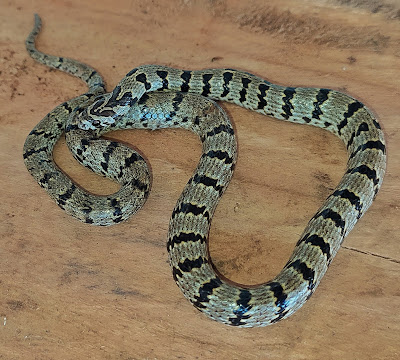
[Herpetology • 2024] Oligodon zhangfujii • A New Species of Kukri Snake Genus Oligodon Fitzinger, 1826 (Serpentes: Colubridae) from Xizang, China


 Oligodon zhangfujii 
 Jiang, Wu, Huang, Ren, Gao, Lyu & L, 2024  


Abstract
A new species of the Kukri snake genus Oligodon is described from Mêdog County in the eastern Himalayas of China. The species, named Oligodon zhangfujii sp. nov., can be distinguished from all known congeners by a combination of the following morphological characteristics: (1) 17-17-15 dorsal scale rows; (2) six supralabials, third and fourth entering orbit; (3) one loreal present; (4) seven infralabials, first to fourth in contact with anterior chin shields; (5) 173 ventral scales and 47 pairs of subcaudal scales; (6) cloacal plate divided; (7) hemipenis single, shallowly bilobed, with large calcareous spines and a calyx area, sulcus spermaticus single; and (8) eight maxillary teeth. Phylogenetic analyses based on two mitochondrial genes revealed that this species occupies an independent phylogenetic position, distinct from the eight recognized species groups within the genus, and represents a sister taxon to the clade comprising the O. theobaldi and O. cinereus groups. The description is based on a single road-killed individual. As such, ecological data for the species remain sparse, underscoring the need for additional field surveys across the eastern Himalayan region.

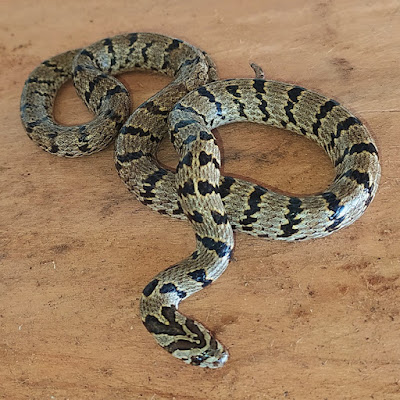
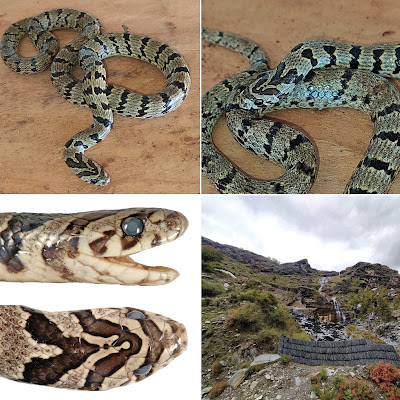
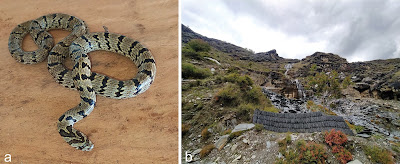
Morphological features of adult male holotype CIB 121710 of  Oligodon zhangfujii sp. nov. as a fresh carcass.
Photos by Jun-Jie Huang.

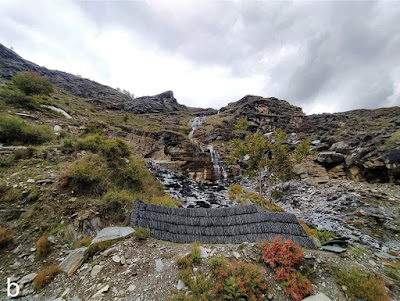
Habitat of Oligodon zhangfujii sp. nov. in Beibeng Township, Mêdog County, Xizang, China. Photo by Ru-Xue Li. Inset on bottom right shows first observation of fresh road-killed specimen CIB 121710.
Photo by Di-Hao Wu.

Oligodon zhangfujii sp. nov.


Ke Jiang, Di-Hao Wu, Jun-Jie Huang, Jin-Long Ren, Zong-Yuan Gao, Zhi-Tong Lyu and Jia-tang Li. 2024. Description of A New Species of Kukri Snake (Serpentes: Colubridae: Oligodon) from Xizang, China. Asian Herpetological Research. DOI: doi.org/10.3724/ahr.2095-0357.2024.0058


Friday, October 25, 2024

[Herpetology • 2024] A multi-gene Phylogeny of the Asian Kukri Snakes (Oligodon Fitzinger, 1826): Sharpening the Blade of the second largest Serpent Radiation (Squamata: Colubridae)


  Phylogeny of the Asian kukri snakes Oligodon Fitzinger, 1826 
 
in Lee, Yushchenko, Suwannapoom, Pawangkhanant, Grismer, Nguyen, Deepak, Narayanan, Das, Neang, Lalremsanga, Yang, Jablonski, Erkaya, Vogel, Bauer et Poyarkov, 2024.

Highlights
• We present the most comprehensive phylogeny of Oligodon assembled to date.
• Molecular phylogeny comprises nearly two-thirds of all currently recognized Oligodon species, with data from three mitochondrial and three nuclear genes.
• We propose an updated intrageneric classification of Oligodon, recognizing eight phylogenetically defined species groups.
• Oligodon likely originated in mainland Southeast Asia during the late Oligocene, with most species-level diversification starting in the Miocene.

Abstract
With 90 recognized species, kukri snakes in the genus Oligodon Fitzinger constitute the second largest snake radiation in the world. Oligodon species are collectively distributed across the Asian continent and possess several ecological and morphological attributes that are unique amongst other snakes. Despite their high levels of species richness, evolutionary relationships within Oligodon are poorly understood due to a limited number of samples and genetic markers available in earlier phylogenies. In this study, we assembled the largest molecular dataset of Oligodon to date, which we use to assess the systematics and biogeography of the entire genus. Based on a combination of maximum likelihood and Bayesian phylogenies using fragments of three mitochondrial genes (12 s, 16 s, CytB) and three nuclear genes (Rag1, C-mos, BDNF), we identify eight deeply divergent clades within Oligodon, of which only two correspond with species groupings that were recognized by previous morphological classifications. Four species delimitation methods employed on the mitochondrial portion of the dataset resulted in dramatically divergent estimations of molecular operational taxonomic units (mOTUs). When combined, all four methods support the existence of unrecognized species-level lineages, but also indicate that several other Oligodon species are poorly differentiated genetically and require additional integrative taxonomic research to properly resolve. Based on divergence dating, we demonstrate that Oligodon began to diversify during the early Neogene and hypothesize that the most recent common ancestor of the genus originated in mainland Southeast Asia. We conclude by recognizing eight phylogenetically defined species groups and identify sampling gaps that require further investigation once new data becomes available. This study contributes to a greater understanding of snake evolution on the Asian continent and acts as a baseline for future studies of this speciose genus.


Justin L. Lee, Platon V. Yushchenko, Chatmongkon Suwannapoom, Parinya Pawangkhanant, L. Lee Grismer, Tan Van Nguyen, V. Deepak, Surya Narayanan, Sandeep Das, Thy Neang, H.T. Lalremsanga, Jian-Huan Yang, Daniel Jablonski, Mustafa Erkaya, Gernot Vogel, Aaron M. Bauer and Nikolay A. Poyarkov. 2025. A multi-gene Phylogeny of the Asian Kukri Snakes (Oligodon Fitzinger, 1826): Sharpening the Blade of the second largest Serpent Radiation (Reptilia: Squamata: Colubridae). Molecular Phylogenetics and Evolution. In Press, 108215. DOI: doi.org/10.1016/j.ympev.2024.108215  

Monday, December 26, 2022

[Herpetology • 2022] First Record of the Annam Kukri Snake Oligodon annamensis Leviton, 1953 (Squamata: Colubridae) From Thailand


Oligodon annamensis Leviton, 1953

in Lee, 2022.

Abstract
I report the first documentation of the rare Kukri Snake species Oligodon annamensis Leviton, 1953 from Thailand based on a previously unidentified specimen collected in 1987 from the tropical rain forests of Chanthaburi Province, southeastern Thailand. This species was previously known from only four specimens collected at three localities in the Langbian Plateau of southern Vietnam and the Cardamom Mountains of western Cambodia. This new specimen extends the distribution of O. annamensis approximately 90.4 kilometers northwest from the nearest location in Phnom Samkos Wildlife Sanctuary, Pursat Province, Cambodia.

  Keywords: Reptilia, Cardamom mountains, biodiversity, Southeast Asia, taxonomy

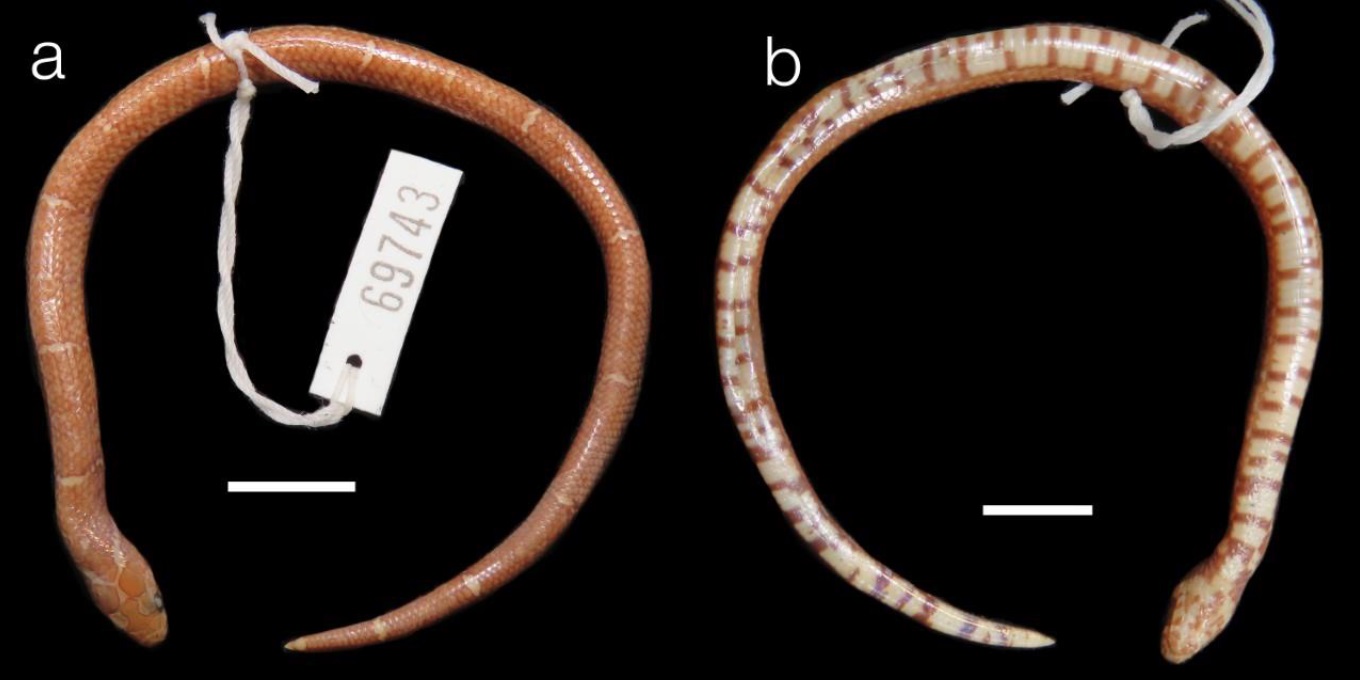
The new specimen of Oligodon annamensis from Chanthaburi Province, Thailand (UF 69743). Detail of the head in dorsal (A), ventral (B) and lateral (left, C; right, D) views. 
Scale bars equal 5 mm. Photos by Justin L. Lee.

The new specimen of Oligodon annamensis from Chanthaburi Province, Thailand (UF 69743) in dorsal (A) and ventral (B) views.
Scale bars equal 10 mm. Photos by Justin L. Lee.

Oligodon annamensis Leviton, 1953


Justin L. Lee. 2022. First Record of the Annam Kukri Snake Oligodon annamensis Leviton, 1953 (Squamata: Colubridae) From Thailand. Tropical Natural History. 22(1); 100-107. li01.tci-thaijo.org/index.php/TNH/article/view/257277

Wednesday, October 5, 2022

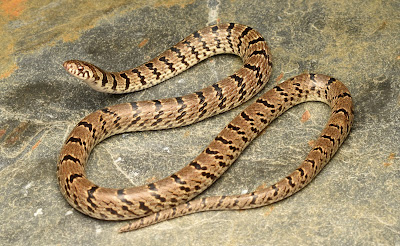
[Herpetology • 2016] Oligodon condaoensis • A New Species of Kukri Snake Genus Oligodon Fitzinger, 1826 (Serpentes: Colubridae) from Con Dao Islands, southern Vietnam


Oligodon condaoensis
Nguyen, Nguyen, Le & Murphy, 2016

Rắn khiếm Côn Đảo  ||  DOI: 10.11646/zootaxa.4139.2.9 

Abstract
We describe a new kukri snakeOligodon condaoensis sp. nov., from Con Dao Islands, southern Vietnam based on the morphological characters of four specimens. It differs from other congeners by a combination of the following characters: medium size in adults (total length up to 552 mm); 17–17–15 dorsal scale rows; deeply forked hemipenes without spines and papillae, extending to subcaudal 13 or 14; 11–13 maxillary teeth, the posterior three being enlarged; cloacal plate undivided; head scalation complete; nasal divided; presubocular absent; 168–176 ventrals; 33–37 subcaudals; overall dorsal coloration dark gray, faint body stripes present or absent; and ventral coloration cream to dark gray without rectangular blotches. We also provide a list of 43 species of amphibians and terrestrial reptiles recorded from Con Dao Islands.

Keywords: Reptilia, Hon Ba, hemipenis, Indochina, maxillary teeth, Oligodon condaoensis sp. nov.

Oligodon condaoensis sp. nov.
 paratype ITBCZ 2597 in life, showing faint dorsal stripes.

Oligodon condaoensis sp. nov.

Diagnosis. Oligodon condaoensis sp. nov. is distinguished from all of its congeners by a combination of the following morphological characters: (1) medium size in adults (total length up to 552 mm); (2) dorsal scale rows 17–17–15; (3) deeply forked hemipenes without papillae and spines, extending to SC 13 or 14; (4) maxillary teeth 11–13, the posterior three being enlarged; (5) cloacal plate undivided; (6) head scalation complete; (7) nasal divided; (8) presubocular absent; (9) ventrals 168–176; (10) subcaudals 33–37; (11) overall dorsal coloration dark gray, faint body stripes present or absent; (12) venter cream to dark gray without rectangular blotches. 

Distribution. The new species is currently known only from Hon Ba Island, Con Dao District, Ba Ria–Vung Tau Prov., Vietnam.

 Etymology. The specific epithet condaoensis is derived from Con Dao Islands, where the new species was discovered.


 Sang N. Nguyen, Vu D. H. Nguyen, Son H. Le and Robert W. Murphy. 2016. A New Species of Kukri Snake (Squamata: Colubridae: Oligodon Fitzinger, 1826) from Con Dao Islands, southern Vietnam. 4139(2); 261–273.  DOI: 10.11646/zootaxa.4139.2.9
http://www.condaopark.com.vn/vnt_upload/news/08_2016/2016_Nguyen_et_al_Oligodon_condaoensis.pdf

Monday, July 4, 2022

[Herpetology • 2022] Oligodon teyniei • A New Species of the Genus Oligodon Fitzinger, 1826 (Serpentes: Colubridae) from southern Laos


Oligodon teyniei 
David, Hauser & Vogel, 2022


Abstract
A new species of the genus Oligodon Fitzinger, 1826, is described based on two specimens originating from Champasak Province in southern Lao PDR. This species differs from congeners occurring in the Indochinese Region by possessing 15 dorsal scale rows at midbody, an unforked hemipenis, an entire cloacal plate, a relatively low number of ventral plates (150–159), and a dorsal pattern made of 29–30 pale (cream in life or pale yellowish-brown in preservative) crossbands on the body that are narrowly edged with blackish-brown. We compare the new species with other species of the Indochinese Peninsula and China that also have 15 dorsal scale rows, especially O. inornatus (Boulenger, 1914) and O. kampucheaensis Neang, Grismer & Daltry, 2012. Finally, we provide an updated list of the Oligodon species of Laos and an identification key to these species.

Key words: Distribution, Indochinese Region, Kukri, Oligodon inornatus, Southeast Asia, taxonomy


Oligodon teyniei sp. nov.

Etymology. The specific nomen is the Latin genitive noun of the last name of Alexandre Teynié, a French herpetologist, to whom we are glad to dedicate this new species for his immense contribution to the herpetology of Laos since 2003. We suggest the following common names: Teynié’s Kukri Snake (English), Oligodon de Teynié (French) and Teynié’s Kukri Natter (German). 


Patrick David, Sjon Hauser and Gernot Vogel. 2022. A New Species of the Genus Oligodon Fitzinger, 1826 (Reptilia: Colubridae) from southern Laos. TAPROBANICA. 11(1); 12–24. DOI: 10.47605/tapro.v11i1.273

Thursday, May 19, 2022

[Herpetology • 2022] Rediscovery and Systematics of the rarely encountered Blue-bellied Kukri Snake Oligodon melaneus Wall, 1909 (Serpentes: Colubridae) from Assam, India


Oligodon melaneus Wall, 1909 

in Das, Gower, Narayanan, Pal, ... et Deepak, 2022. 
 
Abstract
We report the rediscovery of Oligodon melaneus 112 years after its original description and document the third, and only non-type, specimen for the species. The new specimen was found 267 km east of the type locality (Tindharia, West Bengal state) from Assam state, India. We designate a lectotype for the species, and provide an extended description of a freshly collected male specimen. Phylogenetic analyses of 16s and cytb mitochondrial genes provide support for O. melaneus being closely related to the widespread South Asian endemic O. arnensis.

Keywords: Reptilia, Colubridae, Northeast India, phylogeny, rediscovery, Reptilia Serpentes, systematics, taxonomy

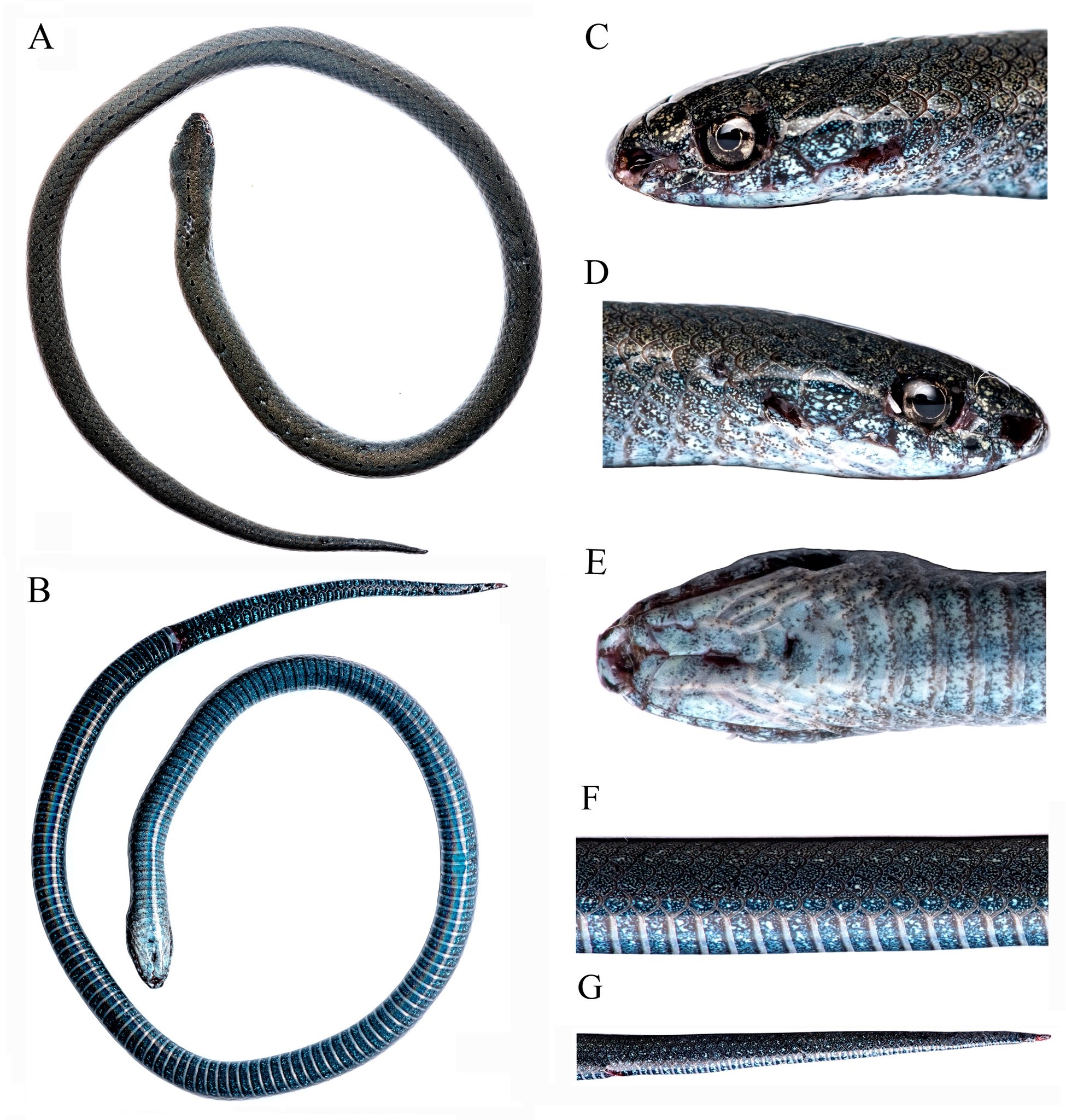
Newly reported, roadkill specimen of Oligodon melaneus (WII-ADR980) photographed soon after collection.
(A)dorsal view, (B) ventral view, (C) left lateral view of head, (D) ventrolateral aspect of midbody and (E) ventrolateral aspect of subcaudals.
 Images not to scale.  

Oligodon melaneus Wall, 1909 


Abhijit Das, David J. Gower, Surya Narayanan, Saunak Pal, Bitupan Boruah, Sanjay Magar, Sanjib Das, Soumabrata Moulick and V. Deepak. 2022. Rediscovery and Systematics of the rarely encountered Blue-bellied Kukri Snake (Oligodon melaneus Wall, 1909) from Assam, India. Zootaxa. 5138(4); 417-430. DOI: 10.11646/zootaxa.5138.4.4

Wednesday, November 3, 2021

[Herpetology • 2021] Oligodon churahensis • A New Species of Snake of the Genus Oligodon Boie in Fitzinger, 1826 (Serpentes: Colubridae) from the Western Himalayas


Oligodon churahensis  
Mirza, Bhardwaj & Patel, 2021


Abstract
A new species of Oligodon Fitzinger, 1826 is described based on specimens collected from Churah Valley of Himachal Pradesh. The new species is related to O. arnensis based on molecular as well as morphological data, however differs from it in several aspects. The new species shows a pairwise sequence divergence of 6–20% from congeners for mitochondrial cytochrome b gene. Lack of pterygoid and palatine teeth of the new species suggests that the diet may largely comprise of eggs. Discovery of the new species is not surprising, as the Western Himalayas has been poorly explored in terms of its herpetofaunal diversity. Considerable genetic divergence in the sampled sequence suggests Oligodon arnensis is a species complex, likely represents multiple species and a revision of the group would be desirable.

Key Words: Colubridae, cytochrome b, Himachal Pradesh, Kukri snake, taxonomy


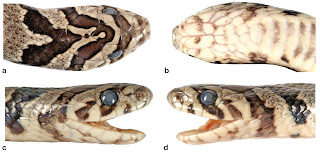
Oligodon churahensis sp. nov. holotype female NCBS NRC-AA-019,
view of the head, (a) dorsal, (b) ventral, (c) lateral right, (d) lateral left.

Oligodon churahensis sp. nov.
holotype female NCBS NRC-AA-019 in life(a);
a general view of the habitat at the type locality (b)
 Photos by Virender Kumar.

Oligodon churahensis sp. nov.
 
Diagnosis: A medium sized Oligodon (SVL 275 mm) with 17 dorsal scale rows at midbody. Seven supralabials, 3rd and 4th in contact with the eye. Loreal present. 170–175 ventrals, 46–47 subcaudals. Palatine and pterygoid teeth absent. Dorsal patterns consist of 1–2 dorsal scales wide black bands edged with yellow. Ventral scales white with brown smear along the width of each scale, the smear is darker on the lateral edges forming a blotch on each side. 48 to 54 bands in total on the body. Hemipenis forked and spinose throughout.

Etymology: The specific epithet refers to the Churah Valley where the new species was collected.

Suggested common name: Churah Valley Kukri

Natural history notes: 
The holotype and the paratype were found actively moving along a mud road around 20:00 hours (Fig. 6b). Additionally, five more individuals (uncollected) of the species were encountered at the same locality between the last weeks of May to late June 2020. All the individuals were found near the village after dusk. Sympatric reptile species recorded at the locality include Cyrtodactylus chamba Agarwal, Khandekar & Bauer, 2018, Asymblepharus sp., Lycodon mackinnoni Wall, 1906, Gloydius himalayanus (Günther, 1864), Orthriophis hodgsonii (Günther, 1864), Laudakia sp. and Liopeltis sp. None of the observed individuals showed any sign of aggression nor did they try to bite except for the male paratype, which bit one of us upon capture.


 Zeeshan A. Mirza, Virender Kumar Bhardwaj and Harshil Patel. 2021. A New Species of Snake of the Genus Oligodon Boie in Fitzinger, 1826 (Reptilia, Serpentes) from the Western Himalayas. Evolutionary Systematics. 5(2): 335-345. DOI: 10.3897/evolsyst.5.72564

Wednesday, July 19, 2017

[Herpetology • 2017] Oligodon saiyok | งูงอดไทรโยค • A New Limestone-dwelling Kukri Snake (Serpentes: Colubridae) from Kanchanaburi Province, western Thailand


Oligodon saiyok 
 Sumontha, Kunya, Dangsri & Pauwels, 2017

  งูงอดไทรโยค | Sai Yok Kukri Snake ||  DOI: 10.11646/zootaxa.4294.3.2 

Abstract

We describe Oligodon saiyok sp. nov. from Benjarat Nakhon Cave Temple, Sai Yok District, Kanchanaburi Province, western Thailand. It is characterized by a maximal known SVL of 626.1 mm; 13 maxillary teeth, the posterior two enlarged; 8 supralabials; 17-17-15 dorsal scale rows; 181–187 ventrals and 38–43 subcaudals; a single anal; hemipenes extending in situ to the 18th subcaudal; dorsum with 21–22 dark blotches or white rings without vertebral or lateral stripes; and venter with a dense network of subrectangular dark blotches. It is the 7th squamate species believed to be endemic to Sai Yok District.

Keywords: Reptilia, Thailand, Oligodon saiyok sp. nov., new species, taxonomy, limestone cave, Buddhist temple


FIGURE 1. Live holotype of Oligodon saiyok sp. nov. Photograph by K. Kunya.


Etymology. The specific epithet is an invariable noun in honor of the administrative district where the type locality lies. We suggest the following common names: Ngu Ngod Sai Yok - งูงอดไทรโยค (Thai), Sai Yok Kukri Snake (English), Oligodon de Saï Yok (French), and Sai Yok Kukrinatter (German).

....
Oligodon saiyok sp. nov. increases the already exceptionally high number of squamates endemic to Sai Yok District, still unexplained to date: Cnemaspis huaseesom Grismer, Sumontha, Cota, Grismer, Wood, Pauwels & Kunya, 2010, Cyrtodactylus saiyok Panitvong, Sumontha, Tunprasert & Pauwels, 2014 and C. tigroides Bauer, Sumontha & Pauwels, 2003, Dixonius hangseesom Bauer, Sumontha, Grossmann, Pauwels & Vogel, 2004, Gekko nutaphandi Bauer, Sumontha & Pauwels, 2008, and Trimeresurus kanburiensis Smith, 1943 (see David et al. 2004). ....


Montri Sumontha, Kirati Kunya, Siriwat Dangsri and Olivier S. G. Pauwels. 2017.  Oligodon saiyok, A New Limestone-dwelling Kukri Snake (Serpentes: Colubridae) from Kanchanaburi Province, western Thailand. Zootaxa. 4294(3); 316–328. DOI: 10.11646/zootaxa.4294.3.2
ResearchGate.net/publication/318529308_Oligodon_saiyok_a_new_limestone-dwelling_kukri_snake_Serpentes_Colubridae_from_Kanchanaburi_Province_western_Thailand


Saturday, July 15, 2017

[Herpetology • 2017] Oligodon huahin | งูงอดหัวหิน • A New Kukri Snake (Colubridae: Oligodon) from Hua Hin District, and the First record of O. deuvei from Thailand


Oligodon huahin
Pauwels, Larsen, Suthanthangjai, David & Sumontha, 2017

งูงอดหัวหิน หรือ งูปี่แก้วลายหัวหิน || DOI:  10.11646/zootaxa.4291.3.6 

 Abstract

We describe Oligodon huahin sp. nov. from a bamboo forest locality on the road to Pala-U waterfall, Hua Hin District, Prachuap Khiri Khan Province, peninsular Thailand. It is characterized by a maximal known SVL of 553.7 mm; 6 maxillary teeth, the posterior two enlarged; 17-17-15 or 17-15-15 dorsal scale rows; 166–173 ventrals and 35–41 subcaudals in males; a single anal; deeply forked hemipenes lacking spines and papillae, extending in situ to the 14th subcaudal; faint to nearly indistinct vertebral, paravertebral and lateral stripes; no dorsal or supracaudal blotches or crossbars; and an uniformly ivory venter lacking subrectangular or squarish blotches. We also report the first finding of Oligodon deuvei in Thailand based on a specimen from Loei Province.

Keywords: Reptilia, Thai-Malay Peninsula, Thailand, Oligodon huahin sp. nov., Oligodon deuvei, taxonomy


 Live Oligodon huahin sp. nov. (QSMI 1502) in situ at the type locality.  

Photograph by Henning Larsen

Etymology: The specific epithet is an invariable noun in honor of the administrative district where the type locality lies and of its charming main city Hua Hin. The following common names are given "Hua Hin Kukri Snake" (English), "Ngu Ngod Hua Hin" งูงอดหัวหิน or "Ngu Peekeaw Lai Hua Hin" งูปี่แก้วลายหัวหิน (Thai), "Oligodon de Hua Hin" (French) and "Hua Hin Kukrinatter" (German).

Habitat, behaviour and ecology: The habitat, behaviour and ecology of this species is poorly known, even though all specimens used for the species description were found in mixed bamboo forest area, the species is likely to inhabit several other types of habitats and elevations as well. Based on data for other members of the genus Oligodon, O. huahin is thought to be a oviparous (egg-laying) species. This species is nocturnal.

Oligodon huahin sp. nov. is added to a list of endemic reptile species we have recently described from the northern part of the Thai Peninsula, in Phetchaburi and Prachuap Khiri Khan provinces: Cnemaspis punctatonuchalis Grismer, Sumontha, Cota, Grismer, Wood, Pauwels & Kunya, 2010, Cyrtodactylus phetchaburiensis and C. samroiyot Pauwels & Sumontha, 2014 and Ptychozoon kaengkrachanense Sumontha, Pauwels, Kunya, Limlikhitaksorn, Ruksue, Taokratok, Ansermet & Chanhome, 2012. Far from being remote, their type-localities are within about four hours or less of easy drive from Bangkok metropolis, and illustrate how much still remains to be done to fully inventory the herpetofauna of Thailand. ....


 Olivier S. G. Pauwels, Henning Larsen, Winai Suthanthangjai, Patrick David and Montri Sumontha. 2017. A New Kukri Snake (Colubridae: Oligodon) from Hua Hin District, and the First record of O. deuvei from Thailand. Zootaxa. 4291(3); 531–548. DOI:  10.11646/zootaxa.4291.3.6
ResearchGate.net/publication/318393445_A_new_kukri_snake_Colubridae_Oligodon_from_Hua_Hin_District_and_the_first_record_of_O_deuvei_from_Thailand
 en.wikipedia.org/wiki/Oligodon_huahin


Friday, July 7, 2017

[Herpetology • 2017] Oligodon culaochamensis • A New Species of the Genus Oligodon Fitzinger, 1826 (Squamata: Colubridae) from Cu Lao Cham Islands, central Vietnam


Oligodon culaochamensis 
Nguyen, Nguyen, Nguyen, Phan, Jiang & Murphy, 2017


Abstract

A new kukri snake, Oligodon culaochamensis sp. nov., is described from Cu Lao Cham Islands, central Vietnam, based on the morphology of six specimens, including two males, three females and one juvenile. The new species belongs to the O. cyclurus group and differs from other congeners in this group by a combination of the following characters: medium size in adults (total length up to 582 mm); 17–19 dorsal scale rows at neck and midbody and 15 or 17 rows before vent; tail length/total length ratio 0.218–0.219 in males and 0.166–0.169 in females; ventrals 167–169 in males and 179–182 in females; subcaudals 63–66 in males and 51–52 in females; head scalation complete with a presubocular; 9–10 maxillary teeth, the posterior three being enlarged; nasal divided; temporal streak absent; long and deeply forked hemipenes extending to 20th subcaudal and without spines and papillae but with prominent diagonal ridge, oblique flounces and distal calyces; cloacal plate undivided; 10–11+3–4 dorsal blotches; and a vertebral stripe on tail and anterior part of body. This is the second species of Oligodon described on islands of Vietnam.

Keywords: Reptilia, Quang Nam Province, hemipenis, maxillary teeth, Oligodon chinensisOligodon culaochamensis sp. nov.


Paratype of Oligodon culaochamensis sp. nov., ITBCZ 5631, male. 

Natural history. All specimens were collected .. on the ground in dry primary forests or plantations, usually near the bank of small streams. The stomach of the holotype contained two soft shell eggs (size 15 mm x 7 mm). These eggs probably belong to a snake or lizard.

Distribution. The new species is currently known only from Cu Lao Cham Islands, Quang Nam Province, Vietnam. 

Etymology. The specific epithet culaochamensis is derived from Cu Lao Cham Islands, where the new species was discovered.


Sang Ngoc Nguyen, Luan Thanh Nguyen, Vu Dang Hoang Nguyen, Hoa Thi Phan, Ke Jiang and Robert W Murphy. 2017. A New Species of the Genus Oligodon Fitzinger, 1826 (Squamata: Colubridae) from Cu Lao Cham Islands, central Vietnam.
Zootaxa. 4286(3); 333-346.  DOI: 10.11646/zootaxa.4286.3.2