Showing posts with label Shrew - Soricidae. Show all posts

Wednesday, December 10, 2025

[Mammalogy • 2025] Soriculus dexingensis • A New Species of the Genus Soriculus (Eulipotyphla: Soricidae) from Medog, Tibet, China, based on morphological and molecular data


Soriculus dexingensis
Tao Zhang, Yang, Jiang, Gu, Zou, Fu, Guo, Tong Zhang, Liu & Chen, 2025
  

Abstract
The genus Soriculus (Soricidae, Eulipotyphla) currently comprises five recognized species, predominantly distributed in the Himalayas and the Gaoligong Mountains. During our survey of small mammals in Medog County, Tibet, China, 11 Soriculus specimens were collected. In this study, we conducted phylogenetic analyses of the genus using one mitochondrial gene (Cytb) and three nuclear genes (BRCA1, APOB, and RAG2) to assess the phylogenetic relationships of these specimens. The morphology of the 11 specimens was compared with other species within the genus. Our results demonstrate that these specimens represent a new species, Soriculus dexingensis sp. nov. Phylogenetic analyses revealed that S. dexingensis sp. nov. forms a distinct sister clade to S. medogensis, and the Kimura 2-Parameter (K2P) distances between all known species of Soriculus ranged from 0.111 to 0.187, indicating interspecific divergence. Morphologically, the new species is distinguished by a relatively longer tail and a significantly higher TL/HB ratio. The discovery of S. dexingensis sp. nov. in Medog County suggests that the diversity of Soriculus species remains underestimated. Further biodiversity surveys of small mammals across the Himalayan region are warranted.

Key words: Morphology, new species, phylogeny, shrew, small mammals, Soriculus, taxonomy

Left: Dorsal, ventral and lateral views of the skull and mandibles of Soriculus dexingensis sp. nov. (SAF11216).
 Right: dorsal, ventral, and lateral views of S. dexingensis sp. nov. (SAF11216).

Soriculus dexingensis sp. nov.


 Tao Zhang, Siyu Yang, Haijun Jiang, Lin Gu, Qingfang Zou, Changkun Fu, Keji Guo, Tong Zhang, Shaoying Liu and Shunde Chen. 2025. A New Species of the Genus Soriculus (Soricidae, Eulipotyphla, Mammalia) from Medog, Tibet, China, based on morphological and molecular data. ZooKeys. 1262: 175-189. DOI: doi.org/10.3897/zookeys.1262.164459

Monday, September 22, 2025

[Mammalogy • 2025] Crocidura stanleyi • Integrative Taxonomic Revision of endemic Dwarf Shrews Genus Crocidura (Soricidae) from the Ethiopian Highlands


Crocidura stanleyi
Craig, Bryjová, Bryja, Meheretu, Lavrenchenko & Peterhans, 2025
  

 Abstract  
The biodiversity of the Ethiopian Highlands features a significant level of endemism. Among its diverse fauna, the genus Crocidura (Soricidae), with many cryptic species, remains poorly documented, particularly for species of minute size. This study describes a newly discovered minute shrew – one of the smallest mammals worldwide – and addresses the taxonomy of the so-called ‘Afromontane clade’ of Crocidura in Ethiopia. We combined extensive field sampling of recent and historical specimens with advanced genetic analyses (genome skimming, Illumina sequencing, and cytb phylogenetics) and morphological examination (external and craniodental) to delineate the new species and address taxonomic affinities among other minute Crocidura from Ethiopia. One of our newly collected forms represents a distinct genetic lineage, corresponding with unique physical characteristics such as tail length and cranial features. Its discovery highlights the rich, yet still incompletely understood, mammalian diversity in the Ethiopian Highlands and underscores the importance of integrating morphological and molecular data in taxonomic studies.

 KEYWORDS: cryptic species, minute shrews, biodiversity, taxonomy, museomics, Morphometrics


Crocidura stanleyi, sp. nov.


Evan W. Craig, Anna Bryjová, Josef Bryja, Yonas Meheretu, Leonid A. Lavrenchenko and Julian C. Kerbis Peterhans. 2025. Integrative Taxonomic Revision of endemic Dwarf Shrews from the Ethiopian Highlands. Journal of Vertebrate Biology. 74 (25060), 25060.1-18. DOI: doi.org/10.25225/jvb.25060 (20 August 2025) 


Wednesday, June 25, 2025

[Mammalogy • 2025] Nagasorex albidensThe Shrew of Nagaland: A Remarkable New Genus and Species from Northeast India, With A Discussion of The Phylogeny and Classification of The Soricidae (Mammalia)


Nagasorex albidens 
Hutterer, Swanson, Esselstyn & Heaney, 2025


Abstract
A new genus and species of extant shrew, Nagasorex albidens, is described based on a single specimen obtained in Nagaland, northeastern India, in 1950. The new species shows novel characters, such as a total tooth number of 34, not found in any extant genus though they are found in extinct genera such as †Miosorex, †Lartetium, †Pseudotrimylus, and †Domnina. To determine the phylogenetic relationships of the new species, we first analyzed craniodental characters from all extant and many extinct genera of Soricidae. Although statistical support for most nodes was low, the nearest relatives of the new taxon appear to be certain Miocene and Pliocene taxa from Europe and Asia—†Dobenflorinia (new name), †Clapasorex, †Miosorex, and †Crocidosorex—followed by the extant African genera Congosorex, Myosorex, and Surdisorex, all of which we treat as members of the Myosoricinae. We then conducted a molecular phylogenetic study of extant genera using mitochondrial and nuclear genes. Although the genetic data we obtained from the new shrew are limited, our results place Nagasorex as the sister taxon of Crocidurinae (mitochondrial genes), or sister to Myosoricinae + Crocidurinae (nuclear genes). We tentatively place the new genus in the Myosoricinae. Additionally, we replace the preoccupied generic name Soricella with a new name, Dobenflorinia. Based on these results, we present a new systematic arrangement of the Soricidae.

Keywords: Shrews, India, Nāgāland, Classification, Phylogeny, Nagasorex albidens

Order Eulipotyphla Waddel et al. (1999) Family Soricidae Fischer, 1814
Nagasorex, new genus

Type Species: Nagasorex albidens, new species.
Included Species: The type species only.
Etymology: The generic name combines the place of origin (Naga Hills) with the Latin sorex (shrew); the gender is masculine. The specific epithet combines the Latin albus (white) and dens (tooth).

A, Dorsal; B, ventral; and C, lateral aspects of the holotype skin of Nagasorex albidens (FMNH 76197). Total length of specimen is 97 mm. Also shown are photographs of the original field label and subsequent FMNH label.


Nagasorex albidens, new species Diagnosis: A small dark shrew with narrow tail covered by very short hairs (fig. 8); cross section of guard hairs with H-profile (fig. 13); ear conch small, round and almost naked (fig. 8); skull roof with traces of the foramina vascularia (fig. 9); 34 nonpigmented teeth, tooth formula I 3/1 C 1/1 P 3/2 M 3/3 (figs. 10, 11); p4 with a distinct “myosoricine” Y-pattern (fig. 12B); mandibular articulation with upper and lower facets (fig. 11); plus the unique combination of characters described in the following section.


Rainer Hutterer, Mark T. Swanson, Jacob A. Esselstyn and Lawrence R. Heaney. 2025. The Shrew of Nagaland: A Remarkable New Genus and Species from Northeast India, With A Discussion of The Phylogeny and Classification of The Soricidae (Mammalia). Bulletin of the American Museum of Natural History. (474); 1-72. DOI: doi.org/10.1206/0003-0090.474.1.1 [18 June 2025]


Thursday, December 26, 2024

[PaleoMammalogy • 2024] Anourosorex andabata • A New Species of Anourosorex (Lipotyphla: Soricidae) from the Pleistocene of Vietnam


 Anourosorex andabata Lopatin, 2024
 

Abstract
Jaw fragments and isolated teeth of the mole shrew Anourosorex andabata sp. nov. are described from the Middle Pleistocene deposits of Tham Hai cave (Lang Son Province, northern Vietnam). This is the first fossil record of Anourosorex in Vietnam. The new species is characterized by medium size (as in Recent A. squamipes Milne-Edwards, 1872), a narrow apex of the coronoid process of the mandible and a weakly reduced (relatively long and wide) talonid of M1.

Jaw fragments of Anourosorex andabata Lopatin, 2024; Vietnam, Lang Son Province, Tam Hai Cave; Middle Pleistocene

Order Lipotyphla

Family Soricidae Fischer von Waldheim, 1817
Subfamily Soricinae Fischer von Waldheim, 1817

Tribe Anourosoricini Anderson, 1879

Genus Anourosorex Milne-Edwards, 1872

Anourosorex andabata Lopatin, sp. nov.

Etymology. Latin andabata, a gladiator who fought blind, blindfolded or wearing a closed helmet with no eye slits. The name is associated with the strong reduction of eyes in mole shrews and fights between males during the mating season (see Liao et al., 2013).


A. V. Lopatin. 2024. A New Species of Anourosorex (Soricidae, Lipotyphla) from the Pleistocene of Vietnam.  Paleontological Journal. 58; 363–370. DOI: doi.org/10.1134/S0031030124700060

Из среднеплейстоценовых отложений пещеры Там-Хай в провинции Лангшон на севере Вьетнама описаны остатки нового вида кротовых землероек Anourosorex andabata. Это первая ископаемая находка рода Anourosorex во Вьетнаме.


Thursday, October 12, 2023

[Mammalogy • 2023] Soriculus nivatus & S. medogensis • Multilocus Phylogeny and Morphological Analyses illuminate Overlooked Diversity of Soriculus (Eulipotyphla: Soricidae), with Descriptions of Two New endemic Species from the eastern Himalayas


Soriculus nivatus
in Chen, Pei, Hu, Song, Khanal, Li et Jiang, 2023. 


Abstract
The genus Soriculus is currently recognized as monotypic, containing only one species, Soriculus nigrescens, which is distributed mainly in the Himalayas and the southern Hengduan Mountains. The taxonomy of Soriculus is ambiguous due to insufficient taxonomic sampling. We conducted extensive surveys of Soriculus across the Himalayas and Hengduan Mountains. We sequenced two mitochondrial and three nuclear genes, and the complete mitochondrial genomes of several selected specimens to infer the phylogenetic relationships of Soriculus and also analysed their morphological and morphometric variations. Our results indicate monophyly of Soriculus, and the diversity of the genus is greatly underestimated. We described two new species, Soriculus nivatus sp. nov. and Soriculus medogensis sp. nov., and elevated S. minor as a distinct species. Additionally, we found another putative new species of Soriculus in Medog County; however, we did not formally describe it because only one specimen was collected. Divergence time estimates suggest that the global cooling and desiccating events around the Miocene/Pliocene and Pliocene/Pleistocene boundaries and the Pleistocene climatic oscillations may have played major roles in the diversification of Soriculus. Our results highlight the overlooked diversity of small mammals in the eastern Himalayas, which warrants further surveys and taxonomic studies.

Keywords: China, Mammalia, new species, taxonomy


Zhongzheng Chen, Xiaoxin Pei, Jiangxiao Hu, Wenyu Song, Laxman Khanal, Quan Li and Xuelong Jiang. 2023. Multilocus Phylogeny and Morphological Analyses illuminate Overlooked Diversity of Soriculus (Mammalia: Eulipotyphla: Soricidae), with Descriptions of Two New endemic Species from the eastern Himalayas. Zoological Journal of the Linnean Society. zlad131. DOI: 10.1093/zoolinnean/zlad131

Chinese researchers discover two new mammal species in SW China’s Xizang
www.globaltimes.cn/page/202310/1299494.shtml

Wednesday, February 8, 2023

[Mammalogy • 2023] Cryptic Diversity of Crocidura Shrews (Eulipotyphla: Soricidae) in the Savannahs of Eastern and Southern Africa


Crocidura hirta-flavescens group

in Dianat, Voet, Ortiz, de Bellocq, Cuypers, ... et Konečný, 2023. 

Highlights: 
• The hirta-flavescens group of Crocidura is a monophylum sister to the olivieri group.
• Previously unidentified lineages of Crocidura of the African savannah were identified.
• Crocidura bloyeti is revalidated.

Abstract
Crocidura (Eulipotyphla, Soricidae) is the most species-rich genus among mammals, with high cryptic diversity and complicated taxonomy. The hirta-flavescens group of Crocidura represents the most abundant and widespread shrews in savannahs of eastern and southern Africa, making them a suitable phylogeographical model for assessing the role of paleoclimatic changes on current biodiversity in open African habitats. We present the first comprehensive study on the phylogeography, evolutionary history, geographical distribution, systematics, and taxonomy of the group, using the integration of mitochondrial, genome-wide (ddRAD sequencing), morphological and morphometrical data collected from specimens over most of the known geographic distribution. Our genomic data confirmed the monophyly of this group and its sister relationship with the olivieri group of Crocidura. There is a substantial genetic variation within the hirta-flavescens group, with three highly supported clades showing parapatric distribution and which can be distinguished morphologically: C. hirta, distributed in both the Zambezian and Somali-Masai bioregions, C. flavescens, known from South Africa and south-western Zambia, and C. cf. flavescens, which is known to occur only in central and western Tanzania. Morphometric data revealed relatively minor differences between C. hirta and C. cf. flavescens, but they differ in the colouration of the pelage. Diversification of the hirta-flavescens group has most likely happened during phases of grassland expansion and contraction during Plio-Pleistocene climatic cycles. Eastern African Rift system, rivers, and the distinctiveness of Zambezian and Somali-Masai bioregions seem to have also shaped the pattern of their diversity, which is very similar to sympatric rodent species living in open habitats. Finally, we review the group's taxonomy and propose to revalidate C. bloyeti, currently a synonym of C. hirta, including the specimens treated as C. cf. flavescens.
 
Keywords: White-toothed Shrews, Phylogeny, Taxonomy, East Africa, Morphometry, ddRADseq


A) Geographic distribution of the samples used in the morphometric study.
Schematic depiction of the hirta-flavescens group skull in B) dorsal, C) ventral and D) mandible lingual view with landmark positioning.

 
Malahat Dianat, Inessa Voet, David Ortiz, Joëlle Goüy de Bellocq, Laura N. Cuypers, Boris Kryštufek, Michal Bureš, Dagmar Čížková, Anna Bryjová, Josef Bryja, Violaine Nicolas and Adam Konečný. 2023. Cryptic Diversity of Crocidura Shrews in the Savannahs of Eastern and Southern Africa. Molecular Phylogenetics and Evolution. 180, 107708. DOI: 10.1016/j.ympev.2023.107708

Monday, January 31, 2022

[Mammalogy • 2022] Chodsigoa dabieshanensis • A New Species of Asiatic Shrew of the Genus Chodsigoa (Eulipotyphla: Soricidae) from the Dabie Mountains, Anhui Province, eastern China


Chodsigoa dabieshanensis 
Chen, Hu, Pei, Yang, Yong, Xu, Qu, Onditi & Zhang, 2022

and Chodsigoa hypsibia de Winton, 1899 (skull lower right) 

Dabieshan long-tailed shrew | 大别山缺齿鼩  ||  DOI: 10.3897/zookeys.1083.78233

Abstract
Asiatic shrews of the genus Chodsigoa (Soricidae, Eulipotyphla) currently comprise nine species, mostly occurring in southwest China. From May 2017 to August 2020, 11 specimens of Chodsigoa were collected from the Dabie Mountains in Anhui Province, eastern China. Their morphology was compared with other species within the genus and one mitochondrial (cytochrome b) and two nuclear (apolipoprotein B and breast cancer 1) genes were sequenced to estimate the phylogenetic relationships of these specimens. Based on morphological and molecular evidence, these specimens are recognized as a distinct speciesChodsigoa dabieshanensis sp. nov., which is formally described here. Morphologically, the new species is most similar to Chodsigoa hypsibia, but it is distinguishable from all known congeners by the combination of dark brownish pelage, small size, and relatively short tail. Phylogenetic analyses revealed that C. dabieshanensis sp. nov. forms a phylogenetic lineage sister to the clade containing C. parva + C. hypsibia. The-Kimura 2-parameter genetic distances of the cytochrome b (CYT B) gene between the new species and other nominal Chodsigoa species ranged between 8.6 and 17.6%. The new species is distributed at elevations from 750 to 1250 m in the Dabie Mountains and is geographically distant from other species in the genus.

Keywords: Chodsigoa dabieshanensis, molecular analysis, morphology, new species, taxonomy


Dorsal, ventral, and lateral views of the skull and lateral views of the mandible of the holotype of Chodsigoa dabieshanensis sp. nov. (AHU2008FZL004; left) and Chodsigoa hypsibia (KIZ 016077; right).
Scale bar: 10 mm.

Dorsal and ventral view of Chodsigoa dabieshanensis sp. nov. 

 Chodsigoa dabieshanensis sp. nov.
 
Suggested common name: Dabieshan long-tailed shrew; 
大别山缺齿鼩 (Dabieshan Quechiqu)

Diagnosis: The new species is assigned to the genus Chodsigoa for having three upper unicuspid teeth, with the tips of the teeth lightly pigmented (Fig. 4). Chodsigoa dabieshanensis sp. nov. can be distinguished from the other known species of Chodsigoa by the following combination of characters: small to medium in size (HB = 67.22 mm; CIL = 19.08 mm), dark brownish pelage; tail shorter than the HB, nearly similar ventral and dorsal pelage color, a small tuft of longer hairs at the tip of the tail (Fig. 5); markedly flattened braincase; and the foramen magnum is relatively wider than C. hypsibia. Phylogenetic analyses show that the new species is monotypic, sister to C. hypsibia and C. parva (Fig. 3).
 
Etymology: The specific name dabieshanensis is derived from the Dabie Mountains, the type locality of the new species: -shan means mountain in Chinese, and the Latin adjectival suffix -ensis means “belonging to".

Distribution and habits: Chodsigoa dabieshanensis sp. nov. is currently known from Yaoleping National Nature Reserve, Bancang Natural Reserve, and Foziling Natural Reserve, all located in the Dabie Mountains, Anhui province, eastern China. Most specimens were collected from deciduous broad-leaf forests at 750–1250 m a.s.l.


 Zhongzheng Chen, Tingli Hu, Xiaoxin Pei, Guangdao Yang, Fan Yong, Zhen Xu, Weiying Qu, Kenneth O. Onditi and Baowei Zhang. 2022. A New Species of Asiatic Shrew of the Genus Chodsigoa (Soricidae, Eulipotyphla, Mammalia) from the Dabie Mountains, Anhui Province, eastern China. ZooKeys. 1083: 129-146. DOI: 10.3897/zookeys.1083.78233

Friday, December 31, 2021

[Mammalogy • 2021] Shrews (Eulipotyphla: Soricidae) from A Biodiversity Hotspot, Mount Nimba (West Africa), with A Field Identification Key to Species


in Denys, Jacquet, Kadjo, ... et Monadjem, 2021. 

In this study, we collected 226 shrew specimens originating from 16 localities on the Guinean and Liberian sides of Mount Nimba. We surveyed all major vegetation zones from 400 to 1600 m above sea level (asl), including forest and savannah habitats. We recorded 11 species, whose identifications were confirmed by genetic analyses and classical morphometrics. Furthermore, we provide cytogenetic data for five of these species. The shrew community at Mount Nimba is composed of a mix of both savannah- and forest-dependent species, which is related to the peculiar position of Mount Nimba situated at the transition between lowland rainforest to the south and Guinean woodlands to the north. We recorded 11 species of shrews in syntopy in lowland rainforest, seven in edaphic savannah and mountain forest, and five in high-altitude savannah at 1600 m asl. Based on morphometric analyses, we show that these syntopic species separate along a size axis, allowing species to occupy different ecological niches, which we speculate allows them to access different food resources. We also highlight that Crocidura theresae Heim de Balsac, 1968 from Mount Nimba has a different karyotype from that described in Côte d’Ivoire. Finally, we develop a novel identification key for shrews from Mount Nimba using external characters and standard body measurements, allowing it to be used in the field on live specimens. In total 12 shrew species are now known from Mount Nimba, which highlights its exceptional position as a tropical African biodiversity hotspot.

KEYWORDS: Soricidae, CrociduraSuncus, community, cytogenetics, barcoding, morphometrics, morphology, Africa, Guinea, Liberia, biosphere reserve


Examples of habitats where pitfall traps were placed on the Guinean and Liberian Nimba:
A, gallery forest and swamp, camp 4 (Liberia); B, pitfall, altitude savannah with Loudetia kagerensis, Mare d’hivernage site (1642m) (Guinea);
C, pitfall, Selingbala (Guinea): mesophyllous secondary forest; D, pitfall, Gbie (Guinea): gallery forest with Parinari excelsa Sabine,1824, Carapa procera DC., 1824 and Pseudospondias microcarpa (A. Rich.) Engl., 1883, Maranthochloa purpurea (Ridl.) Milne-Redh.

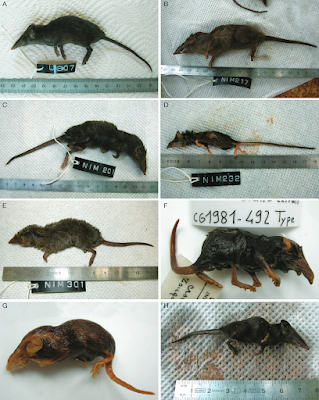
Nimba shrews skins with field numbers:
A, MNHN-ZM-2014-900 (LB07) C. buettikoferi Jentink, 1888 Camp 4;
B, MNHN-ZM-2012-1079 (NIM217) C. grandiceps Hutterer, 1983 Gouan;
C, MNHN-ZM-2012-1158 (NIM201) C. olivieri (Lesson, 1827) Gbié;
D, MNHN-ZM-2012-1111 (NIM232) C. muricauda (Miller, 1900) Gouan;
E, MNHN-ZM-2012-1180 (NIM 301) C. theresae Heim de Balsac, 1968 Gouan;
F, MNHN-ZM-MO-1981-492 C. nimbae Heim de Balsac, 1956 Holotype Zouguepo;
G, MNHN-ZM-MO-1981-483 C. eburnea Heim de Balsac, 1958 Mt Tonkui;
H, MNHN-ZM-2012-1123 (NIM 219) C. obscurior Heim de Balsac, 1958 Gouan. 

 
Christiane Denys, François Jacquet, Blaise Kadjo, Alain Didier Missoup, Vladimir Aniskine, Joelle Goüy de Bellocq, Barré Soropogui, Mory Douno, Morlaye Sylla, Violaine Nicolas, Aude Lalis and Ara Monadjem. 2021. Shrews (Mammalia, Eulipotyphla) from A Biodiversity Hotspot, Mount Nimba (West Africa), with A Field Identification Key to Species.   ZOOSYSTEMA. 43(30); 729-757. 


Thursday, December 16, 2021

[Mammalogy • 2021] Fourteen New, Endemic Species of Shrew (Genus Crocidura: Soricidae) from Sulawesi Reveal a Spectacular Island Radiation


in Esselstyn,  Achmadi, Handika, ... et Rowe, 2021.

Abstract
After nearly a decade of field inventories in which we preserved voucher specimens of the small terrestrial mammals of Sulawesi, we combined qualitative and quantitative analyses of morphological traits with molecular phylogenetics to better understand the diversity of shrews (Soricidae: Crocidura) on the island. We examined the morphology of 1368 specimens and obtained extensive molecular data from many of them, including mitochondrial DNA sequences from 851 specimens, up to five nuclear exons from 657 specimens, and thousands of ultraconserved elements from 90 specimens. By iteratively testing species limits using distinct character datasets and appropriate taxon sampling, we found clear, mostly consistent evidence for the existence of 21 species of shrews on Sulawesi, only seven of which were previously recognized. We divide these 21 species into five morphogroups, provide emended diagnoses of the seven previously named species, and describe 14 new species. The Long-Tailed Group contains Crocidura caudipilosa, C. elongata, C. microelongata, new species, and C. quasielongata, new species; the Rhoditis Group contains C. rhoditis, C. pseudorhoditis, new species, C. australis, new species, and C. pallida, new species; the Small-Bodied Group contains C. lea, C. levicula, C. baletei, new species, C. mediocris, new species, C. parva, new species, and C. tenebrosa, new species; the Thick-Tailed Group contains C. brevicauda, new species and C. caudicrassa, new species; and the Ordinary Group contains C. musseri, C. nigripes, C. normalis, new species, C. ordinaria, new species, and C. solita, new species. Documenting these endemic species reveals a local radiation (20 of the 21 species are members of an endemic clade) in which elevational gradients played a prominent role in either promoting speciation, or at a minimum, fostering the cooccurrence of phenotypically similar species. As now understood, the species-level diversity of Crocidura on Sulawesi is nearly three times the known diversity of any other insular shrew fauna. This study highlights the fact that if we wish to understand the true extent of biodiversity on Earth, large-scale, vouchered organismal inventories followed up with thorough examinations of genetic, morphological, and geographic traits are sorely needed in montane tropical regions, even for purportedly well-studied groups such as mammals.


We divide these 21 species into five morphogroups, provide emended diagnoses of the seven previously named species, and describe 14 new species

The Long-Tailed Group contains Crocidura caudipilosa, C. elongataC. microelongata, new species, and C. quasielongata, new species;
 the Rhoditis Group contains C. rhoditisC. pseudorhoditis, new speciesC. australis, new species, and C. pallida, new species; 
the Small-Bodied Group contains CleaC. levicula, C. baletei, new species, C. mediocris, new species, C. parva, new species, and Ctenebrosa, new species;
 the Thick-Tailed Group contains C. brevicauda, new species and C. caudicrassa, new species
the Ordinary Group contains C. musseri, C. nigripesC. normalis, new species, C. ordinaria, new species, and C. solita, new species.
 
Jacob A. Esselstyn, Anang S. Achmadi, Heru Handika, Mark T. Swanson, Thomas C. Giarla and Kevin C. Rowe. 2021. Fourteen New, Endemic Species of Shrew (Genus Crocidura) from Sulawesi Reveal a Spectacular Island Radiation. Bulletin of the American Museum of Natural History. 454(1); 1-108.  DOI: 10.1206/0003-0090.454.1.1


Monday, May 3, 2021

[Mammalogy • 2021] Crocidura narcondamica • A New Mammal Species (Eulipotyphla: Soricidae) from Narcondam Volcanic Island, India


Crocidura narcondamica 
Kamalakannan, Sivaperuman, Kundu, Gokulakrishnan, Venkatraman & Chandra, 2021

Narcondam Shrew || DOI: 10.1038/s41598-021-88859-4

Abstract
We discovered a new Crocidura species of shrew (Soricidae: Eulipotyphla) from Narcondam Island, India by using both morphological and molecular approaches. The new species, Crocidura narcondamica sp. nov. is of medium size (head and body lengths) and has a distinct external morphology (darker grey dense fur with a thick, darker tail) and craniodental characters (braincase is rounded and elevated with weak lambdoidal ridges) in comparison to other close congeners. This is the first discovery of a shrew from this volcanic island and increases the total number of Crocidura species catalogued in the Indian checklist of mammals to 12. The newly discovered species shows substantial genetic distances (12.02% to 16.61%) to other Crocidura species known from the Indian mainland, the Andaman and Nicobar Archipelago, Myanmar, and from Sumatra. Both Maximum-Likelihood and Bayesian phylogenetic inferences, based on mitochondrial (cytochrome b) gene sequences showed distinct clustering of all included soricid species and exhibit congruence with the previous evolutionary hypothesis on this mammalian group. The present phylogenetic analyses also furnished the evolutionary placement of the newly discovered species within the genus Crocidura.


Mammalia Linnaeus, 1758
Eulipotyphla Waddell et al., 1999

Soricidae G. Fischer, 1814
Crocidurinae Milne-Edwards, 1872

Crocidura Wagler 1832


Crocidura narcondamica sp. nov. (holotype ZSI-29313, female). 
(a) Dorso-lateral view of female (adult alive). Views of the cranium (b) dorsal, (c) ventral, and (d) lateral. Views of the mandible (e) lateral and (f) occlusal (BC braincase, I1 first incisor/first unicuspid).
The photographs were captured by Manokaran Kamalakannan (b–f) and Govindarasu Gokulakrishnan (a) using a Nikon D7000 camera and edited manually in Adobe Photoshop CS 8.0.

Crocidura narcondamica sp. nov.

Diagnosis and description: 
The new species C. narcondamica sp. nov. (Fig. 1) is assigned to the genus Crocidura by the presence of three upper unicuspids and clearly distinguished from all other AN Archipelago shrews by its body size and tail length, which are considerably shorter (Supplementary Table S2). The new species possesses a darker-grey dense fur dorsally and a thick and darker tail (Fig. 1a), whereas the species known from the AN Archipelago possesses a different dorsal pelage and tail; C. jenkinsi (Supplementary Fig. S3a) and C. hispida have a spiny dorsal fur with a slender tail, C. andamanensis has a bluish-grey dorsal fur washed with brown and a darker brown tail, C. nicobarica has a bristly sooty brown dorsal fur with a slender tail, and C. attenuata has a soft brownish-grey dorsal fur with a slender tail2,51 (Supplementary Fig. S2a).
...
 
Etymology: The new species is named for the type locality, Narcondam Island, where the type specimens were collected. The specific epithet is feminine latinized adjective. 
 Suggested common name: Narcondam Shrew.


Map showing the Narcondam Island (marked by a blue colour box) in the Andaman group of Island, India (marked by a blue colour box) along with the habitat where the new species was encountered.
Map prepared using QGIS 2.6.1 (http://www.qgis.org) and edited manually in Adobe Photoshop CS 8.0. The habitat photographs were captured by the fourth author using a Nikon D7000 camera and edited manually in Adobe Photoshop CS 8.0.


Distribution and habitat: The new species is presently known only from its type locality, Narcondam Island, Andaman and Nicobar Archipelago, in the Bay of Bengal, India. It was collected from a littoral forest along the coastline at 11 m elevation. No anthropogenic disturbances were observed in the habitat except for a security post (Fig. 2).


Manokaran Kamalakannan, Chandrakasan Sivaperuman, Shantanu Kundu, Govindarasu Gokulakrishnan, Chinnadurai Venkatraman and Kailash Chandra. 2021. Discovery of A New Mammal Species (Soricidae: Eulipotyphla) from Narcondam volcanic island, India. Scientific Reports. 11: 9416. DOI: 10.1038/s41598-021-88859-4

Subjects: Classification and taxonomy, DNA, Molecular evolution, Phylogenetics, Phylogeny, Sequence annotation, Sequencing, Speciation, Taxonomy, Zoology


Thursday, May 10, 2018

[Mammalogy • 2018] Palawanosorex muscorum • A New Genus and Species of Shrew (Mammalia: Soricidae) from Palawan Island, Philippines


 Palawanosorex muscorum
Hutterer, Balete, Giarla, Heaney & Esselstyn, 2018

Illustration: Velizar Simeonovski ||  photo by Danilo Balete

Abstract
A 2007 survey of small mammals on Mt. Mantalingahan (2,086 m elevation), southern Palawan Island, Philippines, obtained specimens of a distinctive, previously unknown shrew (Soricidae). We describe these specimens as representing a new, monotypic genus and species, Palawanosorex muscorum. The new species was common on Mt. Mantalingahan from 1,550 to 1,950 m (near the peak) but was not detected from 700 to 1,300 m elevation. The previously known native, syntopic shrew, Crocidura palawanensis, has a slender body, slender fore and hind feet, and a long, thin tail with a few long bristles. In contrast, the new species has a stout body, broad fore feet, long claws, and a short tail covered by short, dense fur but no bristles. The dental formula traditionally used would result in assignment of the new species to Suncus, but several distinctive external and cranial features are present, and phylogenetic analyses of thousands of ultraconserved elements suggest P. muscorum is sister to most other Crocidurinae, a clade represented throughout Southeast Asia but numerically dominated by African species. The new species is a distant relative of Suncus murinus (the type species of Suncus) and all other known Southeast Asian species, including the only other shrew known to occur on Palawan (Crocidura batakorum). A time-calibrated phylogenetic analysis estimates divergence between Palawanosorex and its closest known relatives at approximately 10 Ma.

Key words: endemism, Palawanosorex new genus, P. muscorum new species, Philippines, phylogeny, Soricidae, Southeast Asia, taxonomy, ultraconserved elements


Palawanosorex muscorum
Illustration: Velizar Simeonovski 

Palawan moss shrew Palawanosorex muscorum lives only on Mount Mantalingahan in the Philippines.
photo: Danilo Balete


Family Soricidae G. Fischer, 1814 
Subfamily Crocidurinae Milne-Edwards, 1872 

Palawanosorex, new genus

Etymology.— Named for the island of Palawan in combination with Latin sorex, shrew. Gender of genus is masculine.


Palawanosorex muscorum, new species

Etymology.— The species name was derived from muscorum, genitive of Latin musci, mosses, meaning “of the mosses,” referring to the mossy habitat of the shrew. As an English vernacular name, we propose “Palawan Moss Shrew.”


Palawanosorex muscorum was found on Mt. Mantalingahan, a mountain on Palawan Island in the Philippines. Mt. Mantalingahan is what some scientists call a 'sky island.'
photo by Danilo Balete

Palawanosorex muscorum was found on Mt. Mantalingahan, a mountain on Palawan Island in the Philippines. Mt. Mantalingahan is what some scientists call a 'sky island.'
photo by Danilo Balete


Rainer Hutterer, Danilo S. Balete, Thomas C. Giarla, Lawrence R. Heaney and Jacob A. Esselstyn. 2018. A New Genus and Species of Shrew (Mammalia: Soricidae) from Palawan Island, Philippines. Journal of Mammalogy. gyy041  DOI:  10.1093/jmammal/gyy041 
New shrew species discovered on 'sky island' in Philippines  phys.org/news/2018-05-shrew-species-sky-island-philippines.html via @physorg_com