Showing posts with label Author: Leerat.. Show all posts

Wednesday, October 30, 2024

[Botany • 2024] Alysicarpus littoralis (Fabaceae: Desmodieae) • A New Species from southern Thailand


Alysicarpus littoralis Satthaphorn & Leerat., 

in Satthaphorn et Leeratiwong. 2024. 
ถั่วลิสงนาสมุย  ||  www.QSBG.or.th/journal
 
Abstract
Alysicarpus littoralis Satthaphorn & Leerat. (Fabaceae, Desmodieae), a species confined to Samui Island, Surat Thani province, southern Thailand, is described and illustrated as a species new to science. Initially identified as A. vaginalis (L.) DC., the re-examination of morphological characters revealed distinctions of A. littoralis such as the length of inflorescence internode, length of calyx lobes, the colour of corolla and the type of pods at maturity. The newly proposed species is sometimes similar to A. monilifer (L.) DC. And A. ovalifolius (Schumach.) J. Léonard as it exhibits moniliform pods and lax inflorescence, respectively. The conservation status of the new species is assessed as Critically Endangered (CR, B2(bii+ciii)) following IUCN conservation guidelines since populations are surrounded by human disturbances. A morphological description, line drawing and updated key to species of Alysicarpus in Thailand are presented.

Keywords: coastal area, Desmodieae, Papilionoideae, Samui Island, Surat Thani

Line drawings of Alysicarpus littoralis:
 A. habit with inflorescences and infructescences; B. flowers; C. calyx; D. standard; E. wing petal; F. keel petal; G. diadelphous stamens; H. pistil; I. moniliform pod; J. article with reticulation (side view of an article); K. septum between articles (top view of an article); L. seed.
Drawn by J. Satthaphorn from the dried specimen, Leeratiwong 21-1634.

Alysicarpus littoralis:
 A. habit; B. inflorescence with two-tone-coloured corolla; C. close-up flowers; D. moniliform pods.
Photos by C. Leeratiwong.

 Alysicarpus littoralis Satthaphorn & Leerat., sp. nov.

 Type: Thailand, Surat Thani, Ko Samui, Bo Phut, Ban Bo Phut, 20 m alt., 3 Jan. 2021, Leeratiwong 21-1634 (holotype PSU!; isotypes BKF!, KKU!). Figs. 1–2. 

Diagnosis.— Alysicarpus littoralis superficially resembles A. vaginalis in its herbaceous habit, unifoliolate leaves, pseudoracemose inflorescence, valvate calyx and erect loment pods (Fig. 3). However, A. littoralis is distinguishable by longer petiolules (1–1.5 mm long vs ca. 0.3 mm long in A. vaginalis), longer inflorescence internodes (8–12 mm long and lax-flowered vs 2–5 mm long and compact-flowered), longer calyx lobes (3–5 mm long vs 2.3–3 mm long), two-tone-coloured corolla (orangish-yellow standard but pink wings vs monotone-coloured-pink to purple in all petals) and moniliform pods with barrel shaped articles at maturity (vs terete pods with cylindrical articles).

Etymology.— The specific epithet refers to its habitat which can be found in coastal areas.
Vernacular.— Thua lisong na samui (ถั่วลิสงนาสมุย). 


Jiratthi Satthaphorn and Charan Leeratiwong. 2024. Alysicarpus littoralis, A New Species of Alysicarpus (Fabaceae) from Thailand. THAI JOURNAL OF BOTANY. 16 (1): 41–52.  

Wednesday, January 31, 2024

[Botany • 2024] Friesodielsia parvimitra (Annonaceae) • A New Species from Peninsular Thailand and A Note on F. argentea


Friesodielsia parvimitra  Satthaphorn & Leerat.,

in Satthaphorn, Johnson et Leeratiwong, 2024. 
บุหงากลีบเล็ก  ||  DOI: 10.3390/plants13020189  

Abstract
During botanical expeditions focused on the study of Annonaceae in Thailand, specimens resembling Friesodielsia glauca were collected from the lower part of peninsular Thailand but were believed to differ from that species in vegetative, flower, and fruit characters. A morphological investigation of the new specimens and species complex was conducted. Specimens (including types of F. glauca and similar species collected from Thailand and adjacent regions) were examined in the following herbaria: A, BK, BM, BKF, E, K, KEP, KKU, L, PSU, QBG, SING, and US. As a consequence, the new species Friesodielsia parvimitra, endemic to peninsular Thailand, is described and illustrated. The conservation status of the new species was provisionally assessed as Critically Endangered (CR, B2ab(iii)) following the IUCN’s guidelines. In addition, F. argentea, previously regarded F. glauca, is reinstated here as a distinct species based on several morphological differences and is reported as a new record from Thailand. Photographs, line drawings, and a revised key to F. glauca and similar species are presented.

Keywords: endemic; Flora of Thailand; ultramafic soil; Uvarieae; Yala
 
 Line drawing of Friesodielsia parvimitra.
 (A): flowering branch, (B): close-up of flowering branch, (C): flower, (D): sepal (outside), (E): sepal (inside), (F): outer petal (outside), (G): outer petal (inside), (H): inner petal (outside), (I): inner petal (inside), (J): stamen (front), (K): stamen (back), (L,M): pistil, and (N): monocarps.
All drawn by J. Satthaphorn.


 Photographs of Friesodielsia parvimitra. 
 (A): habit, (B): flowering branch, (C): close-up of flowering branch with non-anthesis flowers, (D): flower at anthesis, and (E): fruits.
Photos (A–D) by C. Leeratiwong, (E) by J. Satthaphorn.

Friesodielsia parvimitra Satthaphorn & Leerat., sp. nov.

Diagnosis: Friesodielsia parvimitra superficially resembles F. glauca in having inner petals shorter than half of the length of its outer petals, but differs in its non-glaucous lower leaf surface, much shorter flower pedicels (12–16 mm long vs. 20–40 mm long in F. glauca), shorter bracts (0.5–0.8 vs. 0.9–1.7 mm long), reduplicate sepals 2–3 mm long (vs. non-reduplicate sepals 4.0–5.5 mm long), and inner petals 4–5 mm long with puberulous appressed hairs on the outside surface (vs. 7–10 mm long with a glabrous outside surface).
 
Etymology: The specific epithet pertains to the inner petals that are connivent and short (less than 5 mm long), resembling a headdress.
Vernacular: Bu-nga klip lek (บุหงากลีบเล็ก).

 
 Jiratthi Satthaphorn , David M. Johnson and Charan Leeratiwong. 2024. Friesodielsia parvimitra (Annonaceae), A New Species from Peninsular Thailand and a Note on F. argentea. 
Plants. 13(2); 189. DOI: 10.3390/plants13020189
 (This article belongs to the Topic Plant Systematics and Taxonomy)

[Botany • 2024] Derris rubricosta (Fabaceae: Millettieae) • From Morphology to Molecules: A Comprehensive Study of A novel Derris Species with a rare flowering habit and reddish leaflet midribs, discovered in Peninsular Thailand


Derris rubricosta  Boonprajan & Sirich., 

in Boonprajan, Leeratiwong et Sirichamorn, 2024.
เครือไหลลีรติวงศ์  ||  DOI: 10.3897/phytokeys.237.112860
 
Abstract
Derris rubricosta Boonprajan & Sirich., sp. nov., a new species of the genus Derris Lour. (Fabaceae) was discovered in Peninsular Thailand. The overall morphology demonstrates that the species most resembles D. pubipetala. Nevertheless, the species has several autapomorphies differentiating it from other Derris species, e.g., the presence of reddish midribs of the mature leaflets, sparsely hairy stamen filaments, prominent hairs at the base of the anthers, and presence of glandular trichomes along the leaflet midrib. Additionally, HPLC fingerprints of this species showed a distinction from D. pubipetala by the absence of phytochemical compound peaks after 13 min. Retention Time (RT). Results from molecular phylogenetic analyses also strongly supported the taxonomic status as a new species.

Key words: Anatomy, Derris, HPLC fingerprint, molecular phylogeny, morphology, phytochemical

Derris rubricosta, sp. nov.
A habit and habitat B leaves C stem D young reddish leaflets E reddish midribs of mature leaflets F, G close-up of midrib on adaxial and abaxial surface respectively H inflorescences and foliage I, J close-up of inflorescence, showing flower buds and brachyblasts K close-up of flower and buds. All photos were taken at Pha Dam Forest Ranger Unit in Songkhla province.
Photos by Punvarit Boonprajan (A, B, D–G) and Charan Leeratiwong (C, H–K).

Comparative macro- and micro-morphological characters of leaflets and flowers of Derris rubricosta, sp. nov. (A, A1–A10) and D. pubipetala (B, B1–B10) A, B a branch with leaves and inflorescences

 Derris rubricosta Boonprajan & Sirich., sp. nov.
 
Diagnosis: The species has several autapomorphies distinguishing it from other Derris species. It is the only species that has reddish midribs on the lower surface of mature leaflets. Its style is sericeous at the base and gradually becomes glabrous apically (vs. thinly hairy at the base and mostly glabrous throughout in other Derris species). Derris rubricosta has prominent hairs below the anthers (vs. glabrous anthers in all other Derris species). It is morphologically similar to D. pubipetala Miq., but differs by its leaflet midrib colour (reddish vs. green), number of leaflets or leaf (9–11 vs. 5–9), colour of its corolla (pale pink to pink vs. white), wing petal margin (straight vs. revolute), stamen filament indumentum (sparsely hairy vs. glabrous), indumentum presence below the anthers (present vs. absent), floral disc shape (indistinct to more-or-less 10-lobed vs. annular).

Etymology: The specific epithet refers to the striking reddish colour of the midrib of the mature leaflets which has never been found in other species of Derris.

Vernacular names: “Khruea lai leeratiwong” (เครือไหลลีรติวงศ์) means “Leeratiwong’s Derris”, in Thai, in honor of Associate Professor Dr. Charan Leeratiwong, who discovered and collected the type specimens.

Distribution: Peninsular Thailand: Songkhla (Rattaphum district, Sadao district) (Fig. 4). Estimated population of more than 2,500 mature individuals were found during field survey between 2019 and 2022 in its type locality and nearby areas.


Punvarit Boonprajan, Charan Leeratiwong, Yotsawate Sirichamorn. 2024. From Morphology to Molecules: A Comprehensive Study of A novel Derris Species (Fabaceae) with a rare flowering habit and reddish leaflet midribs, discovered in Peninsular Thailand. PhytoKeys. 237: 51-77. DOI: 10.3897/phytokeys.237.112860


Thursday, August 3, 2023

[Botany • 2023] Friesodielsia betongensis & F. chalermgliniana (Annonaceae) • Two New Species from Peninsular Thailand


Friesodielsia betongensis Leerat., 

in Leeratiwong, Karapan, Satthaphorn et Johnson,2023. 

Abstract
Two new Friesodielsia species (Annonaceae) from Peninsular Thailand, F. betongensis and F. chalermgliniana, are described and illustrated. The addition of these raises the total number of Friesodielsia species in Thailand to 18. A conservation assessment for each new species and an identification key for all Thai species are provided.
 
Keywords: Magnoliids, Annonoideae, conservation assessments, flora of Thailand, keys to Thai species, Magnoliales, Uvarieae


Friesodielsia betongensis Leerat. 

บุหงาเซิงเบตง: Friesodielsia betongensis Leerat. [Annonaceae]....พืชชนิดใหม่ของโลกจากอำเภอเบตง จังหวัดยะลา เป็นหนึ่งในสองชนิดของพืชสกุลนี้ที่พบที่ระดับความสูงมากกว่า 1000 เมตรเหนือระดับทะเลปานกลาง ...


Friesodielsia chalermgliniana Leerat. 

พืชชนิดใหม่ของโลกอีกชนิดพบที่ป่าฮาลา อำเภอเบตง จังหวัดยะลา บนเส้นทางขึ้นยอด 1490 ระดับความสูงเหนือทะเลประมาณ 500 เมตร บุหงาเซิงฮาลา (Friesodielsia chalermgliniana Leerat. [Annonaceae]) 
ชื่อระบุชนิดตั้งชื่อให้เป็นเกียรติแด่ ดร.ปิยะ เฉลิมกลิ่น ผู้เชียวชาญพิเศษ จากสถาบันวิจัยวิทยาศาสตร์และเทคโนโลยีแห่งประเทศไทย (วว.) ผู้ซึ่งมีความเชี่ยวชาญในการศึกษาและวิจัยพืชวงศ์กระดังงาของประเทศไทย และเป็นผู้ให้ความรู้ นำออกภาคสนามในการสำรวจ และสนับสนุนให้ผู้แต่งท่านแรกในการศึกษาพืชวงศ์กระดังงาของประเทศไทย


Charan Leeratiwong, Sunate Karapan, Jiratthi Satthaphorn and David M. Johnson. 2023. Two New Species of Friesodielsia (Annonaceae) from Peninsular Thailand. Phytotaxa. 589(1); 73-82. DOI: 10.11646/phytotaxa.589.1.7  

Sunday, January 15, 2023

[Botany • 2023] Mitrephora langsuanensis, M. sirindhorniae & M. sukhothaiensis (Annonaceae) • Three New Species of Mitrephora from Thailand


Mitrephora sirindhorniae Chalermglin, Leerat. & R.M.K.Saunders,

in Leeratiwong, Chalermglin & Saunders, 2023. 
มหาพรหมสิรินธร  ||  DOI: 10.3897/phytokeys.218.91582

Abstract
Three new Mitrephora species (Annonaceae), M. langsuanensis sp. nov., M. sirindhorniae sp. nov. and M. sukhothaiensis sp. nov., are described from Thailand. Mitrephora langsuanensis resembles M. macclurei, but its leaves have more secondary veins, and its flowers have more carpels, with yellow-and-pink striped outer petals with a margin that becomes undulate with age. Mitrephora sirindhorniae resembles M. tomentosa, but has larger sepals and petals, longer flowering pedicels, and shorter monocarp stipes, with monocarps that have a longitudinal ridge. Mitrephora sukhothaiensis is distinct from its Thai congeners in having outer petals that reflex at maturity and inner petals with a pair of appendages on the margin adaxially. The addition of these three new taxa raises the total number of Mitrephora species in Thailand to 14. An identification key for Thai species is provided. 

Keywords: Annonaceae, Mitrephora langsuanensis, Mitrephora sirindhorniae, Mitrephora sukhothaiensis, new species, Thailand

Mitrephora langsuanensis sp. nov.
A flower buds B flower C flowering branch D, E fruits (slightly immature).
 Photos by P. Chalermglin.

 Mitrephora langsuanensis Leerat., Chalermglin & R.M.K.Saunders, sp. nov.
 
Diagnosis: Mitrephora langsuanensis is similar to M. macclurei Weerasooriya & R.M.K.Saunders, but differs in having: leaves with more secondary veins (7–14 pairs), sometimes with domatia abaxially; yellow outer petals with pink stripes, densely hairy abaxially, and with a margin that becomes undulate with age; more carpels per flower (10–12); and longer fruiting pedicels (20–25 mm).

Etymology: From the name Lang Suan district, Chumphon Province.
Local name: Phrom lang suan (พรหมหลังสวน) (Chumphon).


Mitrephora sirindhorniae sp. nov.
 A vegetative branch B, C flowers D, E sepals (ab- and adaxial) F, G outer petals (ab- and adaxial) H, I inner petals (ab- and adaxial) J, K stamens (ab- and adaxial) L carpel M fruit, composed of separate monocarp N seeds.
Drawn by A. Somphrom, 
A–L from P. Chalermglin 640430 (PSU), M–N from P. Chalermglin 630723 (PSU).

Mitrephora sirindhorniae sp. nov.
A flowering branch B, C flowers D flower, showing calyx E flower, showing indument on adaxial surface of inner petals F fruit (slightly immature) G fruit (mature).
Photos by P. Chalermglin.


 Mitrephora sirindhorniae Chalermglin, Leerat. & R.M.K.Saunders, sp. nov.
 
Diagnosis: Mitrephora sirindhorniae resembles M. tomentosa Hook.f. & Thomson, but is distinguished by its leaves that are sparsely hairy abaxially, larger sepals (8–10 by 10–12 mm), larger outer petals (40–60 by 22–35 mm), larger inner petals (14–16 by 14.5–15 mm), longer flowering pedicels (25–27 mm), shorter monocarp stipes (2.5–8 mm) and monocarps with a longitudinal ridge.

Etymology: Named after HRH Princess Maha Chakri Sirindhorn, in honour of her project on plant germplasm conservation in Thailand.
Local name: Maha phrom sirinthon (มหาพรหมสิรินธร) (general).


Mitrephora sukhothaiensis sp. nov.
A, B leaves (ad- and abaxial) C flower buds D flower (slightly immature) E–G flowers, F, G showing the outer petals reflexed when mature, with insert in F showing adaxial surface of inner petal with inwardly folded marginal protrusions H fruit (mature).
 Photos by P. Chalermglin.

 Mitrephora sukhothaiensis Leerat., Chalermglin & R.M.K.Saunders, sp. nov.
 
Diagnosis: Mitrephora sukhothaiensis is distinct from all other species in having a combination of outer petals that reflex at maturity as well as inner petals that have inwardly folded marginal protrusions at the midpoint adaxially.

Etymology: From the name Sukhothai province.
Local name: Phrom sukho (พรหมสุโข) (general).

 
 Charan Leeratiwong, Piya Chalermglin and Richard M. K. Saunders. 2023. Three New Species of Mitrephora (Annonaceae) from Thailand. PhytoKeys. 218: 93-107.  DOI: 10.3897/phytokeys.218.91582

Wednesday, October 27, 2021

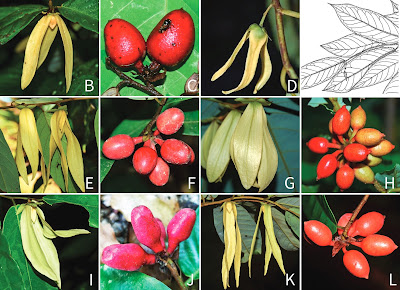
[Botany • 2021] Friesodielsia brevistipitata, F. khaoluangensis, F. songkhlaensis, et al. (Annonaceae) • New Species and New Records for the Climber Genus Friesodielsia in the Flora of Thailand


A–C. ส่าเหล้า Friesodielsia brevistipitata Leerat. 
D. บุหงาเขาหลวง F. khaoluangensis Leerat. & Aongyong.
 E–F. บุหงาแต่งงาน F. longipetala Leerat. & Chalermglin.
G–H. บุหงาสาวิตรี F. macrosepala Leerat. & Aongyong.
  I–J. บุหงาเซิงพะงัน F. phanganensis Leerat. 
K–L. บุหงาเซิงสงขลา F. songkhlaensis Leerat. 

in Leeratiwong, Chalermglin, ... et Johnson, 2021. 

Abstract
Six new species of Friesodielsia (Annonaceae) are described and illustrated, seven species are documented for Thailand for the first time, and Oxymitra fornicata var. glabra is raised to species rank as Friesodielsia andamanica. These additions bring the species diversity of Friesodielsia in Thailand to 16 species. A key to the Thai species is provided.

Keywords: Plant diversity, Southeast Asia, taxonomy


Photographs of new Friesodielsia species.
A–C. Friesodielsia brevistipitata Leerat. A. leaf base showing marginal glands. B. flower. C. monocarps. D. flower of F. khaoluangensis Leerat. & Aongyong. E–F. F. longipetala Leerat. & Chalermglin. E. flowers, F. monocarps.
G–H. F. macrosepala Leerat. & Aongyong. G. flowers. H. monocarps. I–J. F. phanganensis Leerat. I. flower. J. monocarps. K–L. F. songkhlaensis Leerat. K. flowers. L. monocarps.
Photographs by C. Leeratiwong (A–C, E–F, I &K–L), K. Aongyong (G & H) and P. Khiriwong (J).


Friesodielsia brevistipitata Leerat., sp. nov.

Friesodielsia brevistipitata is most similar to F. desmoides (Craib) Steenis and F. songkhlaensis Leerat. It differs from F. desmoides in having appressed rather than erect hairs on the abaxial leaf surface, sepals 5–10 mm versus 4–5 mm long, outer petals 35–60 mm versus (19–)27–31 mm long and obtuse versus acute at the apex, and monocarp stipes 3–5 mm versus 7–10.5 mm long. From F.   songkhlaensis it may be distinguished by the shorter sepals that are rounded to an obtuse or slightly acute apex and again by the short monocarp stipes.

Etymology.— Named for the short stipes of the monocarps, among the shortest in the entire genus.
Vernacular.— Sa lao (ส่าเหล้า)(Krabi).


Friesodielsia khaoluangensis Leerat. & Aongyong, sp. nov.

Friesodielsia khaoluangensis resembles F. alpina (J.Sinclair) Steenis and F. borneensis (Miq.) Steenis in its narrow flowers and narrow leaves. From F. alpina it differs in the twigs and leaves appressed-pubescent rather than glabrous, larger leaves (13–22 × 3.8–7.5 cm versus 8.5–13 × 3–4 cm) but with only 9–12 secondary veins per side versus 12–14 per side, the pedicels ca 10 mm long versus 25–27 mm long, and the outer petals linear-lanceolate, 23–25 mm long, and appressed-pubescent versus lanceolate, ca 15 mm long, and glabrous. From F. borneensis it differs in the leaves not glaucous abaxially and with petioles 8–17 mm long instead of glaucous abaxially with petioles 4.5–8 mm long, the pedicellar bract lanceolate rather than linear, and petals 23–25 mm long rather than 52–59 mm long.

Etymology.— The species is named for the type locality.
Vernacular.— Bu nga khao luang (บุหงาเขาหลวง) (General), 
sao yut (สาวหยุด) (Nakhon Si Thammarat).


Friesodielsia  longipetala Leerat. & Chalermglin, sp. nov.

Friesodielsia longipetala is distinguished from F.  phanganensis  and F.  songkhlaensis  by its sub-coriaceous to coriaceous leaves, outer petals (50–)80–140 mm long, inner petals (11–)15–25 mm long, generally longer pedicels (up to 12 mm long), and monocarps only sparsely pubescent.

Etymology.— Named for the greater length of both the outer and inner petals compared with those of its congeners.
Vernacular.— Bu nga taeng ngan (บุหงาแต่งงาน)(General), 
sao yut (สาวหยุด)(Satun).


Friesodielsia  macrosepala Leerat. & Aongyong, sp. nov.

Friesodielsia macrosepala is similar to F. unonifolia but differs in having twigs covered by persistent mixed spreading and appressed hairs, sepals (7–)11–17 × (5–)9–11 mm, and outer petals 50–80 × 11–22 (–32) mm, with a length:width ratio ofca 4:1. Friesodielsia unonifolia, in contrast, has twigs initially covered with appressed hairs but soon glabrate, sepals 7–9 × 5.5–7 mm long, and outer petals 18–35 (–40) × 9.5–12 mm with a length:width ratio of ca 2.5:1.

Etymology.— The sepals are among the largest in the entire genus. 
Vernacular.— Bu nga sawitri (บุหงาสาวิตรี)(Nakhon Si Thammarat), 
sao yut (สาวหยุด)(Nakhon Si Thammarat)


Friesodielsia phanganensis Leerat., sp. nov.

Friesodielsia phanganensis is distinguished from F. longipetala by the chartaceous leaves, oblanceolate to elliptic-oblanceolate outer petals 50–70 mm long, inner petals 11–15 mm long, and monocarps densely pubescent with shorter stipes 3–5 mm long. 

Etymology.— The species is named for the type locality.
Vernacular.— Bu nga soeang phangan (บุหงาเซิงพะงัน)(General).


Friesodielsia songkhlaensis Leerat., sp. nov.

Friesodielsia songkhlaensis is distinguished from F. longipetala by the chartaceous leaves, pedicels 3–5 mm long with the bract exceeding the pedicel inlength, sepals tapering to a blunt-acuminate apex, outerpetals 6–12 mm wide, inner petals 8–10 mm long, and more densely pubescent monocarps.

Etymology.— Named for the Thai province in which it occurs.
Vernacular.— Bu nga soeng songkhla (บุหงาเซิงสงขลา)(General).


A–B. Friesodielsia affinis (Hook.f. & Thomson) D.Das. A. flowers. B. monocarps.
 C. immature fruit of F. glabra (Ridl.) D.M.Johnson.
D–E. F. calycina (King) Steenis. D. open flower and bud. E. monocarps.
F. flower of F. discolor (Craib) D.Das.
G–H. F. glauca (Hook.f. & Thomson) Steenis. G. flower. H. monocarps.
I–J. F. kingii (J.Sinclair) Steenis. I. flower. J. monocarps.
 K. flower of F. latifolia (Hook.f. & Thomson) Steenis.
 L. flower of F. unonifolia (A.DC.) Steenis.
Photographs by C. Leeratiwong (A–C, E, H & K), A. Baka (D, G, I & J), P. Chalermglin (F) and A. Rungrueng (L).

Friesodielsia species newly reported for the Flora of Thailand.
รายงานพบใหม่ในประเทศไทย
1. Friesodielsia affinis (Hook.f. & Thomson) D.Das (เครือเหนียว)
2. Friesodielsia calycina (King) Steenis (บุหงาดาริกา)
3. Friesodielsia filipes (Hook.f. & Thomson) Steenis (บุหงาก้านดอกยาว)
4. Friesodielsia glauca (Hook.f. & Thomson) Steenis (บุหงานวลแป้ง)
5. Friesodielsia kingii (J.Sinclair) Steenis (บุหงากลีบใหญ่)
6. Friesodielsia latifolia (Hook.f. & Thomson) Steenis (บุหงาใบกว้าง)
7. Friesodielsia unonifolia (A.DC.) Steenis (บุหงากลีบหนา)

ปรับปรุงชื่อ ตามข้อมูลทางอนุกรมวิธาน 
*Friesodielsia glabra (Ridl.) D.M.Johnson (บุหงาตะรุเตา)

 
Charan Leeratiwong, Piya Chalermglin, Jiratthi Satthaporn, Kithisak Aongyong and David M Johnson. 2021. New Species and New Records for the Climber Genus Friesodielsia (Annonaceae) in the Flora of Thailand. Thai Forest Bulletin (Botany). 49(2); 212-230.  DOI:  10.20531/tfb.2021.49.2.09

ชนิดใหม่ในประเทศไทย
1. Friesodielsia brevistipitata Leerat., sp. nov. (ส่าเหล้า)
2. Friesodielsia khaoluangensis Leerat. & Aongyong, sp. nov. (บุหงาเขาหลวง)
3. Friesodielsia longipetala Leerat. & Chalermglin, sp. nov. (บุหงาแต่งงาน)
4. Friesodielsia macrosepala Leerat. & Aongyong, sp. nov. (บุหงาสาวิตรี)
5. Friesodielsia phanganensis Leerat., sp. nov. (บุหงาเซิงพะงัน)
6. Friesodielsia songkhlaensis Leerat., sp. nov. (บุหงาเซิงสงขลา)

Monday, July 12, 2021

[Botany • 2021] Polyalthia heliopetala & P. taweensis (Annonaceae) • Two New Species and A New Record of the Genus Polyalthia from Peninsular Thailand


Polyalthia heliopetala Leerat. & Bunchalee 
 
in Bunchalee, Leeratiwong et Johnson, 2021. 
 เหลืองสุริยา || DOI: 10.11646/phytotaxa.510.3.4 
 
Abstract
Two new species of Polyalthia from Peninsular Thailand, Polyalthia heliopetala and P. taweensis, are described and illustrated. Polyalthia heliopetala most closely resembles P. oblonga and P. motleyana. Polyalthia taweensis most closely resembles P. obliqua. Polyalthia pumila is newly reported for Thailand from a single locality; the species was previously known only from two localities in Peninsular Malaysia and has not been re-collected in over 100 years.

Keywords: Magnoliids, Annonaceae, Polyalthia, new species, new record, Peninsular, Thailand


 เหลืองสุริยา 
Polyalthia heliopetala Leerat. & Bunchalee


นรามรกต 
Polyalthia taweensis Bunchalee & Leerat.


  แสดศรีนรา
  Polyalthia pumila Ridl. 
 

Pasakorn Bunchalee, Charan Leeratiwong and David M. Johnson. 2021. Two New Species and A New Record of the Genus Polyalthia (Annonaceae) from Peninsular Thailand. Phytotaxa. 510(3); 239–250. DOI: 10.11646/phytotaxa.510.3.4

ตัวอย่างพืชสกุล Polyalthia ของพืชวงศ์กระดังงา (Annonaceae) จากอำเภอจะแนะและอำเภอระแงะ จังหวัดนราธิวาส ก็ได้รับการตีพิมพ์ในวารสาร Phytotaxa ซึ่งเป็นวารสารระดับนานาชาติ โดยมีพืชที่จัดเป็นพืชชนิดใหม่ของโลกจำนวน 2 ชนิด และพืชที่รายงานครั้งแรกในประเทศไทยอีก 1 ชนิด ได้แก่

1. พืชชนิดใหม่ของโลก คือ เหลืองสุริยา (Polyalthia heliopetala Leerat. & Bunchalee, ดอกสีเหลืองแกมส้ม) และ นรามรกต (Polyalthia taweensis Bunchalee & Leerat., ดอกสีเขียว)
2. พืชรายงานพบครั้งแรกในประเทศไทย คือ แสดศรีนรา (Polyalthia pumila Ridl., ดอกสีแดง)

ซึ่งมี ผศ.ดร.ภาสกร บุญชาลี เป็นผู้เขียนหลัก โดยมี Prof. Dr. David Johnson และ ผศ.ดร.จรัล ลีรติวงศ์ ร่วมเขียนรายงานการค้นพบ 

Friday, June 4, 2021

[Botany • 2021] Alphonsea annulata (Annonaceae) ตำหยาวสี่ขีด • A New Species from peninsular Thailand


 Alphonsea annulata  Leerat. & Chalermglin,  

in Leeratiwong, Chalermglin & Johnson, 2021.
ตำหยาวสี่ขีด || DOI: 10.1007/s12225-021-09937-4
Photos: C. Leeratiwong.

Summary
A new species of the genus Alphonsea, A. annulata from peninsular Thailand is described and illustrated. A conservation assessment for A. annulata and a key to Alphonsea species in southern Thailand and Peninsular Malaysia are provided.

Key Words: conservation, Miliuseae, taxonomy


 Alphonsea annulata  Leerat. & Chalermglin. 
A fruiting branch; B flowers; C young monocarps; D dried monocarps showing 2 – 7 raised rings of transverse ridges
(from Leeratiwong & Chalermglin 19-1433 (PSU). 
Photos: C. Leeratiwong.

Alphonsea annulata Leerat. & Chalermglin, sp. nov.


ETYMOLOGY. This species is named for its monocarps, which, when dried, are marked by 2 – 7 raised transverse rings.

VERNACULAR NAME. [Thailand] Tam yao si khit ตำหยาวสี่ขีด.

 
Charan Leeratiwong, Piya Chalermglin and David M. Johnson. 2021. Alphonsea annulata (Annonaceae), A New Species from Thailand. Kew Bulletin. DOI: 10.1007/s12225-021-09937-4