Showing posts with label Ornithomimosaur. Show all posts

Tuesday, March 25, 2025

[Paleontology • 2025] Duonychus tsogtbaatari • Didactyl therizinosaur (Coelurosauria: Therizinosauridae) with a preserved keratinous claw from the Late Cretaceous of Mongolia


Duonychus tsogtbaatari
Kobayashi, Zelenitsky, Fiorillo & Chinzorig, 2025
 
illustration by Masato Hattori

Highlights: 
• Duonychus tsogtbaatari is described as another therizinosaur from Mongolia
• It is a didactyl therizinosaur, possessing only two manual digits
• A keratinous sheath on digit I provides rare insight into theropod claw structure
• Duonychus reveals convergent digit III loss in at least five theropod clades

Summary
Therizinosaurs were a group of herbivorous/omnivorous theropod dinosaurs that lived in Asia and North America during the Cretaceous Period. These theropods are notable for their three-fingered hands sporting large claw-like unguals. Here, we describe a new and unusual species of the therizinosaurid Duonychus tsogtbaatari, recovered from the lower Upper Cretaceous Bayanshiree Formation of the Gobi Desert of Mongolia. This species is different from other therizinosaurs in that the hand possesses only two fingers, rather than three fingers, the typical condition for Avetheropoda, providing further insight into forelimb/hand reduction among theropods. Phylogenetically, Duonychus reveals a broader but still limited appearance of didactyly among avetheropodans. The manual ungual of Duonychus tsogtbaatari also preserves a nearly complete three-dimensional structure covering the ungual of the left manual digit I, which represents a keratinous manual claw. The strong curvature of this large claw and high ungual flexion indicate that Duonychus was likely amplectorial (grasping) and an effective grasper of vegetation, despite having only two functional fingers.

Systematic Paleontology
Theropoda  
Coelurosauria  
Therizinosauria  
Therizinosauridae 


Duonychus tsogtbaatari gen. et sp. nov.
 
Horizon and locality: The holotype specimen was collected from the Urlibe Khudak Locality (N43°27.092′, E107°23.476′) within the Bayanshiree Formation (Figure 1), which primarily consists of conglomerates, sandstones, and mudstones deposited in alluvial and fluvial settings, in the eastern Gobi Desert, Mongolia. This formation, dated to the Late Cretaceous, spans the Cenomanian to Santonian stages, as indicated by radiometric dating and biostratigraphic data. ...

Diagnosis: A derived therizinosaur exhibiting the following unique combination of characters: dorsal vertebrae with a long neural spine; a thick centrodiapophyseal lamina without additional laminae; dorsal vertebrae lacking pleurocoels; sacral vertebrae (2–4) with flat ventral surfaces; dorsal vertebrae possessing a weak ventral keel; pneumatic dorsal ribs; fused distal carpals 1 and 2; distal carpals 1 and 2 semilunate-shaped with a mediodorsal process; a small angle between the articular surfaces of the radiale for the semilunate carpal and the radius; a reduced metacarpal III forming a splint; absence of digit III; equally sized manual unguals I-2 and II-3; absence or reduction of the flexor fossa in manual phalanges; and a reduced dorsal process at the proximal end of manual phalanges. Duonychus can be distinguished from other therizinosaurs of the Bayanshiree Formation by several features. Its humerus has a more proximally positioned deltopectoral crest compared to Erlikosaurus, and in Duonychus, the entepicondyle is reduced with a markedly narrow groove separating it from the ulnar condyle. Unlike Enigmosaurus, which has a fused pubic boot and coalesced sacral vertebrae, Duonychus has an unfused pubic boot and ventrally flat sacral vertebrae with a shorter second sacral. Duonychus has an anteriorly deflected humeral shaft and a nearly straight ventral border of the pubic boot, distinguishing it from the convex shape seen in Segnosaurus.


Etymology: The generic epithet is derived from duo for two in Greek in reference to the presence of a didactyl hand which is unusual in therizinosaurs, and from onyx for claw in Greek. The species epithet honors Khishigjav Tsogtbaatar, a paleontologist and former director of the Institute of Paleontology, Mongolian Academy of Sciences in Ulaanbaatar, Mongolia.


Yoshitsugu Kobayashi, Darla K. Zelenitsky, Anthony R. Fiorillo and Tsogtbaatar Chinzorig. 2025. Didactyl therizinosaur with a preserved keratinous claw from the Late Cretaceous of Mongolia.  iScience. www.cell.com/iscience/fulltext/S2589-0042(25)00401-8  
DOI: 10.1016/j.isci.2025.112141 [March 25, 2025]

Thursday, May 9, 2024

[Paleontology • 2024] Phylogenetic Position of Kinnareemimus khonkaenensis (Dinosauria: Theropoda: Ornithomimosauria) from the Lower Cretaceous of Thailand


Kinnareemimus khonkaenensis  Buffetaut, Suteethorn & Tong, 2009

in Samathi, 2024. 

Abstract
A small-bodied ornithomimosaur, Kinnareemimus khonkaenensis Buffetaut, Suteethorn, and Tong 2009, from the Lower Cretaceous Sao Khua Formation of northeastern Thailand was first reported in 1995, then named in 2009. It is the only report of this group in Southeast Asia and was concluded to be a member of Ornithomimosauria, more derived than Harpymimus and Garudimimus but more basal than Archaeornithomimus. Since then, a few published studies have analyzed the phylogenetic position of Kinnareemimus but failed to find it within the clade Ornithomimosauria. Here, the phylogenetic analyses for assessing the relationships of Kinnareemimus within Ornithomimosauria were performed. The results suggested it might be a basal ornithomimosaur or belongs to the subclade Deinocheiridae. Kinnareemimus shares with deinocheirids the proximally projected cnemial crest and the shape of the fibula in proximal view. Its metatarsal III shows subarctometatarsalian condition with metatarsal III pinched between II and IV but visible in anterior view proximally, which might have evolved independently from other ornithomimids. However, the basal position of Kinnareemimus could also be due to the immaturity and the incomplete nature of this animal.

Reptilia, Ornithomimosauria, Southeast Asia, subarctometatarsalian metatarsus, Early Cretaceous Sao Khua Formation, Paleobiogeography


Adun SAMATHI. 2024. Phylogenetic Position of Kinnareemimus khonkaenensis (Dinosauria: Theropoda: Ornithomimosauria) from the Lower Cretaceous of Thailand. Zootaxa. 5448(1); 67-84. DOI: 10.11646/zootaxa.5448.1.4 
 

Friday, September 8, 2023

[Paleontology • 2023] Tyrannomimus fukuiensis • A New Theropod Dinosaur (Coelurosauria: Ornithomimosauria) from the Lower Cretaceous of Japan provides critical implications for the early Evolution of Ornithomimosaurs


Tyrannomimus fukuiensis
Hattori, Shibata, Kawabe, Imai, Nishi & Azuma, 2023


Abstract
Ornithomimosauria consists of the ostrich-mimic dinosaurs, most of which showing cursorial adaptations, that often exhibit features indicative of herbivory. Recent discoveries have greatly improved our knowledge of their evolutionary history, including the divergence into Ornithomimidae and Deinocheiridae in the Early Cretaceous, but the early part of their history remains obscured because their fossil remains are scarce in the Aptian–Albian sediments. In recent years, many isolated ornithomimosaur remains have been recovered from the Aptian Kitadani Formation of Fukui, central Japan. These remains represent multiple individuals that share some morphological features common to them but unknown in other ornithomimosaurs, suggesting a monospecific accumulation of a new taxon. As a result of the description and phylogenetic analysis, the Kitadani ornithomimosaur is recovered as a new genus and species Tyrannomimus fukuiensis, the earliest definitive deinocheirid that complements our knowledge to understand the early evolutionary history of Ornithomimosauria. Due to its osteological similarity to Tyrannomimus, a taxon previously considered an early tyrannosauroid based on fragmentary specimens, namely Aviatyrannis jurassica, may represent the earliest ornithomimosaur from the Upper Jurassic of Europe, significantly expanding the temporal and biogeographic range of Ornithomimosauria. This finding fills a 20-million-year ghost lineage of Ornithomimosauria implied by the presence of the oldest fossil record of Maniraptora from the Middle Jurassic and is consistent with the hypothesis that their biogeographic range was widespread before the Pangaean breakup in the Kimmeridgian.
 
Locality, horizon, and overview of ornithomimosaur materials. Regional map for the location of Fukui in Japan, and the Kitadani Dinosaur Quarry in Fukui (a), stratigraphic section of the part of the Kitadani Formation in the Kitadani Dinosaur Quarry (b), photograph of the Kitadani Dinosaur Quarry in 2019 with an arrowhead indicating where the studied specimens were yielded (c), and overview of the ornithomimosaur materials (d). The map in (a) is modified from the one available at www.freemap.jp. Fossil specimens shown in (d) are not in the same scale while the bar is scaled for the paratype (FPDM-V-10295). The holotype (FPDM-V-11333) and paratype in (d) are colored in red anb blue, respectively. Right femur in (d) is mirrored from the left one (FPDM-V-11338).

Systematic paleontology

Dinosauria Owen, 1842.
Theropoda Marsh, 1881.
Tetanurae Gauthier, 1986.
Coelurosauria von Huene, 1920.

Ornithomimosauria Barsbold, 1976.

Tyrannomimus fukuiensis gen. et sp. nov.

Etymology: The genus name is derived from its morphological resemblance with tyrannosauroids, in which the vertical ridge on the ilium has been regarded as a synapomorphy; the specific name is derived from Fukui, the prefecture where the type and referred specimens were found.

Diagnosis: 
Based on the holotype, theropod dinosaur with following autapomorphies among ornithomimosaurs: deep dorsal tympanic recess with its bottom subdivided by an anteroposteriorly-oriented lamina; expanded spherical cavities within prezygocentrodiapophyseal, centrodiapophyseal and postzygocentrodiapophyseal fossae.

Based on the referred specimens, deep anterolateral pit on proximal part of humerus can be another autapomorphy among ornithomimosaurs. However, this feature should be confirmed by additional specimens including humeri and some elements shared by the holotype.

Tyrannomimus can be distinguished from penecontemporary Asian ornithomimosaurs by having the following features: from Harpymimus by having the deltopectoral crest shorter than the quarter of the humeral length, the muscle scar on the anterolateral margin of the deltopectoral crest, low and elongated ilium, and concave ventral margin of the postacetabular process; from Shenzhousaurus by having ventral grooves on anterior caudal centra, straighter manual unguals, and the lateral distal condyle of the femur extended further distally than the medial condyle that is flattened distally.

Holotype: FPDM-V-11311, a disarticulated but associated skeleton including two parts of the braincase, several dorsal, sacral and caudal vertebrae, and fragments of ilium.


Soki Hattori, Masateru Shibata, Soichiro Kawabe, Takuya Imai, Hiroshi Nishi and Yoichi Azuma. 2023. New Theropod Dinosaur from the Lower Cretaceous of Japan provides critical implications for the early Evolution of Ornithomimosaurs. Scientific Reports. 13: 13842. DOI: 10.1038/s41598-023-40804-3

Tuesday, March 20, 2018

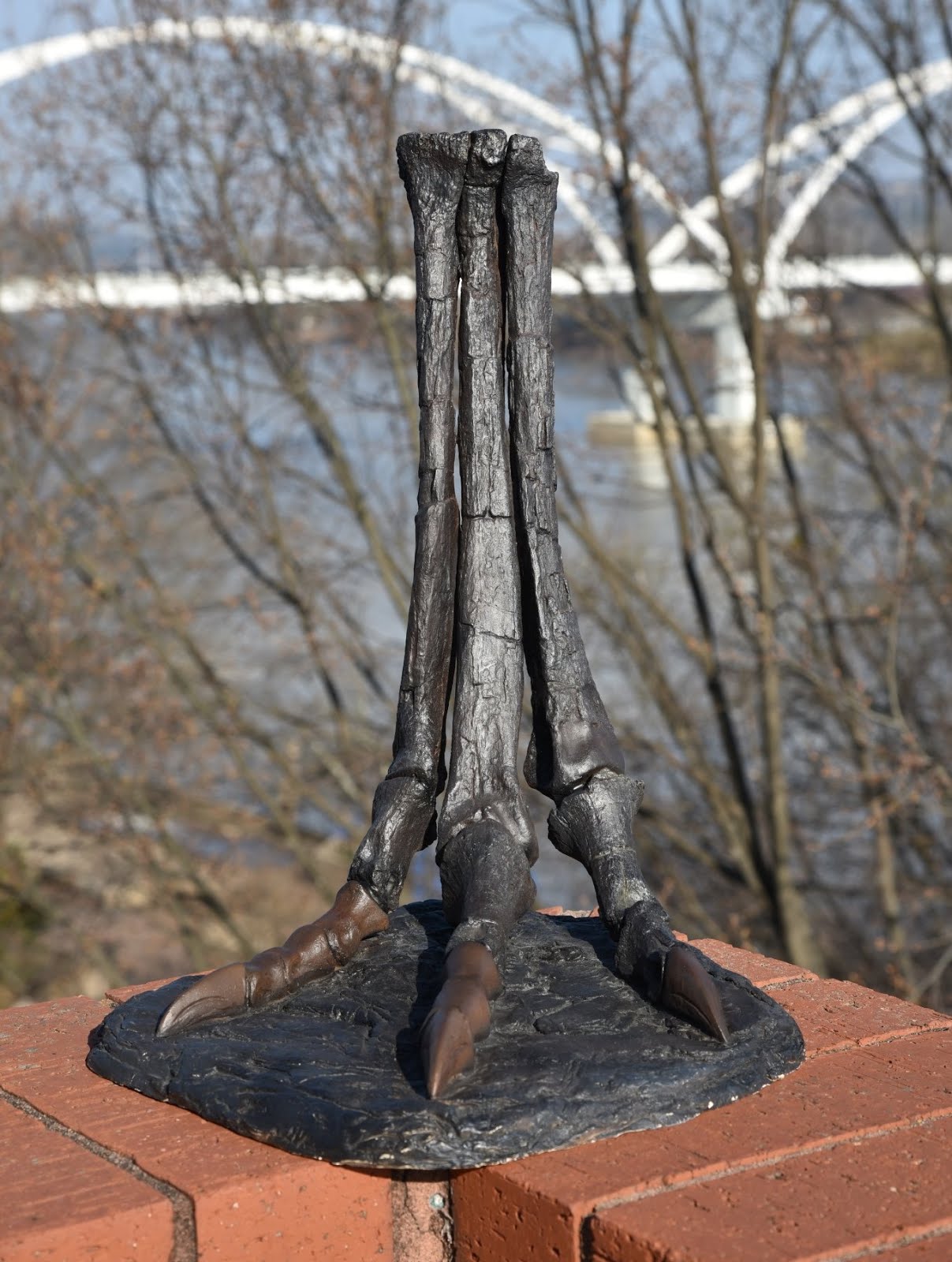
[Paleontology • 2018] Arkansaurus fridayi • A New Ornithomimosaur from the Lower Cretaceous Trinity Group of Arkansas


Arkansaurus fridayi  Hunt & Quinn, 2018


Illustration by Brian Engh   twitter.com/GreyGriffon 

ABSTRACT
Whereas ornithomimosaurs (ostrich-mimic dinosaurs) are well known from Asia during the Early Cretaceous, they are less well known from this time in North America. Represented by a single specimen consisting of pedal elements, a new North American taxonArkansaurus fridayi, gen. et sp. nov., consists of a nearly complete right foot, recovered from the Lower Cretaceous (Albian–Aptian) Trinity Group of Arkansas. Arkansaurus fridayi can be distinguished from other ornithomimosaurs based on differentiated pedal unguals, a laterally compressed third metatarsal that is ovoid in proximal view, and a distal ungual with a very weak flexor tubercle, lacking spurs. The condition of this third metatarsal suggests that Arkansaurus fridayi is more basal than Asiatic ornithomimosaurs of similar age, but consistent with older North American forms. This specimen provides knowledge of a poorly understood radiation of ornithomimosaurs in Appalachia and is the only known saurischian dinosaurian fossil from the state of Arkansas.


FIGURE 3. Arkansaurus fridayi, UAM-74–16-1 to UAM-74–16-3, holotype,
articulated right metatarsals, in A, proximal and B, anterior views. Scale bar equals 10 cm. 

FIGURE 4. Arkansaurus fridayi, holotype, digital surface scans of pedal phalanges.
 UAM-74–16-5, phalanx II-1, in A, proximal, B, distal, C, extensor, D, flexor, E, lateral, and F, medial views.
UAM-74–16-4, phalanx III-1, in G, proximal, H, distal, I, extensor, J, flexor, K, lateral, and L, medial views.
UAM74–16-6, phalanx IV-1, in M, proximal, N, distal, O, extensor, P, flexor, Q, lateral, and R, medial views.
UAM-74–16-7, phalanx III-2, in S, proximal, T, distal, U, extensor, V, flexor, W, lateral, and X, medial views.
 UAM-74–16-8, large ungual, in Y, extensor, Z, lateral, AA, flexor, BB, medial, and CC, proximal views.
UAM-74–16-8, ungual, in DD, proximal, EE, extensor, FF, lateral, GG, flexor, and HH, medial views.
UAM-74–16-8, small ungual, in II, extensor, JJ, lateral, KK, flexor, and LL, medial views.
Scale bar equals 10 cm.

SYSTEMATIC PALEONTOLOGY 
DINOSAURIA Owen, 1842 
SAURISCHIA Seeley, 1887 
THEROPODA Marsh, 1881; Gauthier, 1986 
ORNITHOMIMOSAURIA Barsbold, 1976; Lee et al., 2014 

ARKANSAURUS FRIDAYI, gen. et sp. nov.

Etymology—The genus is named for the state of Arkansas, where the specimen was discovered. The species name is in honor of Joe B. Friday, who discovered the remains in 1972.

....


 twitter.com/GreyGriffon 


CONCLUSION:
Arkansaurus fridayi currently is one of the oldest basal ornithomimosaurs known from North America. Its occurrence in the southeastern portion of the North American continent is significant biogeographically, because most of the Early Cretaceous basal ornithomimosaurs were flourishing in Asia at the time, but are otherwise not well represented in North America. Further discoveries of similar ornithomimosaur taxa in North America will provide better understanding of additional, currently unknown, characters.


 ReBecca K. Hunt and James H. Quinn. 2018. A New Ornithomimosaur from the Lower Cretaceous Trinity Group of Arkansas. Journal of Vertebrate Paleontology. DOI:  10.1080/02724634.2017.1421209


Friday, July 21, 2017

[Paleontology • 2017] Aepyornithomimus tugrikinensis • First Ornithomimid (Theropoda, Ornithomimosauria) from the Upper Cretaceous Djadokhta Formation of Tögrögiin Shiree, Mongolia


Aepyornithomimus tugrikinensis
Tsogtbaatar, Kobayashi, Khishigjav, Currie, Watabe & Rinchen, 2017

Illustration by Masato Hattori

Abstract
The Upper Cretaceous Djadokhta Formation has been intensively surveyed for its fossil vertebrate fauna for nearly a century. Amongst other theropods, dromaeosaurids and parvicursorines are common in the formation, but ornithomimosaurs are extremely rare. A new ornithomimosaur material was discovered from the Djadokhta Formation, represented by eolian deposits, of the Tögrögiin Shiree locality, Mongolia. This is only the third ornithomimosaur specimen reported from this formation, and includes the astragalus, the calcaneum, the third distal tarsal, and a complete pes. The new material is clearly belonged to Ornithomimidae by its arctometatarsalian foot condition and has the following unique characters; unevenly developed pair of concavities of the third distal tarsal, curved contacts between the proximal ends of second and fourth metatarsals, the elongate fourth digit, and a laterally inclined medial condyle on phalanx IV-1. These diagnostic characters of the Djadokhtan ornithomimosaur indicate that this is a new taxon. Our phylogenetic analysis supports three clades within derived ornithomimosaurs, and the new taxon is placed a member of the derived ornithomimosaurs. The present specimen is the first ornithomimid record from eolian Tögrögiin Shiree locality, and is indicative of their capability to adapt to arid environments.


Systematic paleontology
Dinosauria Owen, 184224.
Theropoda Marsh, 188125.

Ornithomimosauria Barsbold, 197626.
Ornithomimidae Marsh, 189027.

Aepyornithomimus tugrikinensis gen. et sp. nov.

Etymology: The generic name refers to the largest ratite bird Aepyornis~, which has similar pes structure; in Latin, ~mimus = ‘as’ or ‘like’; the species name tugrikinensis refers to the locality where the specimen was found.

Holotype: MPC-D 100/130, articulated left pes preserved with an astragalus that is missing the ascending process, a complete calcaneum, and distal tarsal III (DT-III) (Figs 2, 3 and 4). The original specimen is now housed in the Institute of Paleontology and Geology of the Mongolian Academy of Sciences (IPG-MAS).


Type locality and horizon: Central Sayr of Tögrögiin Shiree locality, Upper Cretaceous Djadokhta Formation (Campanian) (Fig. 1). This locality is interpreted as semi-arid eolian sediments28 with up to 52 m of light gray, cross-bedded, structureless sands and sandstones17.

Diagnosis: An ornithomimid dinosaur with the following unique characters; unevenly developed pair concavities on the posterior margin of the DT-III; robust distal articular caput of second metatarsal (Mt II) in dorsal view; proximoventrally rounded ridge of phalanx II-1 (II-1); the elongate fourth digit; laterally inclined medial condyle of phalanx IV-1 (IV-1); elongated pedal unguals.

Illustration by Masato Hattori 

Figure 8: Comparative graph and restoration drawing of Aepyornithomimus tugrikinensis.
 (a), Different proportions of the three metatarsals is represented by ternary diagram, (b), Illustration is drawn by Mr. Masato Hattori.
Abbreviations: (Mt II), the metatarsal II, (Mt III), the metatarsal III, and (Mt III), the metatarsal III, (Ω), Aepyornithomimus tugrikinensis, (Δ), basal ornithomimosaurs, (Π), deinocheirids, (†), ornithomimids. 

Chinzorig Tsogtbaatar, Yoshitsugu Kobayashi, Tsogtbaatar Khishigjav, Philip J. Currie, Mahito Watabe and Barsbold Rinchen. 2017. First Ornithomimid (Theropoda, Ornithomimosauria) from the Upper Cretaceous Djadokhta Formation of Tögrögiin Shiree, Mongolia.  Scientific Reports. 7, Article number: 5835. DOI:  10.1038/s41598-017-05272-6
  

Thursday, September 22, 2016

[Paleontology • 2016] Rativates evadens • A New Ornithomimid Theropod from the Dinosaur Park Formation of Alberta, Canada


Rativates evadens 
McFeeters, Ryan, Schröder-Adams & Cullen, 2016 

ABSTRACT
A partial ornithomimid skeleton, ROM 1790, from the lower Dinosaur Park Formation (upper Campanian) of Alberta was previously referred to Struthiomimus altus, but lacks diagnostic characters of that species. It is here described as the holotype of a new species, Rativates evadens, gen. et sp. nov., diagnosed by the form of the maxilla-jugal contact, the reduction of the mid-caudal neural spines, the convex fusion of the left and right ischial shafts, the straight-edged distal end of the third metatarsal, and possibly the relatively enlarged medial condyle of the tibia. A histological section of the femur confirms that the type specimen is not a juvenile, despite its relatively small size (approximately 50% the size of large individuals of Struthiomimus altus). Phylogenetic analysis recovers Rativates as a member of a derived ornithomimid clade that includes Ornithomimus, Struthiomimus, and the Asian taxa Anserimimus and Qiupalong. Fusion of the proximal tarsals to the tibia in some ornithomimid specimens was observed to be more complete than previously recognized, increasing the suite of features that these non-avian dinosaurs share homoplastically with birds.


Rativates evadens  
Illustration: Andrey Atuchin 

SYSTEMATIC PALEONTOLOGY

THEROPODA Marsh, 1881
ORNITHOMIMOSAURIA Barsbold, 1976

ORNITHOMIMIDAE Marsh, 1890

RATIVATES, gen. nov.

Etymology—Latin ‘ratis’ meaning raft, in reference to the ratite birds; and Latin ‘vates’ meaning seer or foreteller. The name Rativates (‘ræt-aɪ-veɪ-tiz’) alludes to the paradox of an ‘ostrich mimic’ that existed before ostriches.

Diagnosis—As for the type species, R. evadens.

RATIVATES EVADENS, sp. nov.

Etymology— Latin ‘evadere’ meaning to evade, in reference to this swift-footed dinosaur’s ability to evade predators in the Late Cretaceous, as well as recognition as a new species in the 80 years following the discovery of the holotype.

Holotype— ROM 1790, incomplete skull and postcranial skeleton.

Type Locality— Quarry no. Q028 (Currie and Koppelhus, 2005) in the lower Dinosaur Park Formation (upper Campanian) near Dinosaur Provincial Park, Alberta, Canada.

.....


CONCLUSIONS : 
A new ornithomimid, Rativates evadens, is described on the basis of a partial skull and skeleton collected in 1934 from the lower Dinosaur Park Formation of Alberta. Previous referrals of the type specimen ROM 1790 to Struthiomimus altus are unjustified. Rativates evadens is diagnosed by a suite of derived cranial, axial, and appendicular characters, despite regions of the skeleton (primarily the posterior skull, forelimbs, and distal caudals) critical to taxonomic and phylogenetic placement of other ornithomimids being unknown. The phylogenetic relationships of R. evadens, S. altus, and O. edmontonicus remain unresolved, but the consensus tree is consistent with the hypothesis of these species representing a single radiation of derived ornithomimids that entered Laramidia during the Campanian. Rativates evadens is among the oldest named ornithomimid species in North America and increases the diversity of approximately contemporaneous ornithomimid taxa in the lower part of the Dinosaur Park Formation. Reevaluation of previously collected material from other Upper Cretaceous formations in North America may identify additional overlooked ornithomimid species.


Bradley McFeeters, Michael J. Ryan, Claudia Schröder-Adams and Thomas M. Cullen. 2016. A New Ornithomimid Theropod from the Dinosaur Park Formation of Alberta, Canada. Journal of Vertebrate Paleontology. DOI: 10.1080/02724634.2016.1221415 


An international group of researchers led by Bradley McFeeters, currently a Ph.D. student at Carleton University in Ottawa, Canada, has announced the discovery of a new ostrich-mimic dinosaur, Rativates evadens, from the lower Dinosaur Park Formation near Dinosaur Provincial Park, Alberta. The new species lived about 76 million years ago during the Late Cretaceous Period. Research describing the new species is published online in the Journal of Vertebrate Paleontology.

Congratulations to Brad McPheeters & Curator Dr. Michael Ryan on co-describing a new dinosaur! Welcome, #Rativates!  ‏@CMNHVertPaleo  cmnh.org/announcements/rativates-evadens

New Ostrich-Mimic Dinosaur From Alberta Named for Its Ability to Evade Predators

Thursday, August 11, 2016

[Paleontology | Ichnotaxa • 2016] Crouching Theropod at The Seaside. Matching Footprints with Metatarsal Impressions and Theropod Authopods: A Morphometric Approach


Figure 7.  Main phases of the movement made by the Riomartino trackmaker.
(a) Resting phase in ‘crouched’ position; (b) the trackmaker walks in a ‘crouched position’, while the right footprint is being definitively impressed; (c) initial rising up and defin-itive impression of the second left footprint; (d) final kick-off.
Artwork created by Davide Bonadonna DavideBonadonna.it

Romano & Citton, 2016.  DOI: 10.1017/S0016756816000546

Abstract
We compare theropod footprints with elongate metatarsal prints from central Italy with known autopod structures in major theropod groups, in order to more accurately define the trackmaker attribution. Our work, using morphometric analysis, shows the considerable potential of explorative methods such as PCA (principal component analysis) and cluster analysis when describing important characters for a given taxonomic group (body and ichnofossils) and identifying important anatomical regions. Moreover, the results of the analysis suggest that the putative trackmaker is likely a member of Ornithomimosauria, with significant affinities in the posterior autopod structure with the genus Struthiomimus. The fundamental importance of integrating both osteological and ichnological data, when investigating locomotor and behavioural hypotheses, is highlighted. This approach could also contribute positively to the complex cognitive process of trackmaker identification and be favourable for the attainment of a more natural definition of ichnotaxa.

Keywords:  dinosaurs; footprints; Cretaceous; Ornithomimosauria; Italy; palaeobiogeography


Struthiomimus altus
by Davide Bonadonna.

Preparatory illustration for the crouching theropod in Romano and Citton (2016). facebook.com/PalaeoWorks 

Conclusions
Our work highlights the great potential of morphometric methods to describe specific characters of a given taxonomic group (both in body fossils and in footprints) more objectively, as already convincingly pointed out recently in the literature (Castanera et al. 2015).These approaches integrate morphometric analysis with footprint morphology and differential impression depth (‘footprint holomorphy’ sensu Romano, Citton & Nicosia,2016), and may shed light on taxonomically relevant characters but also on the biomechanical properties and importance of selected anatomical regions.The latter, cross-checked and plotted on a phylogenetic analysis, can be pivotal for understanding in which particular node and branch a specific morphology, or  even a particular behavioural trait, has been acquired.Such integrative approaches also shed light on the dispersal of different clades and different palaeobiogeographical models. In this study, we consider it likely that dinosaurs could reach the Apenninic Carbonate Platform only through migration routes from Gond-wana through the Adria region. The identification of a struthiomimid-like theropod as the putative trackmaker of the new Italian material further supports that putative Ornithomimosauria were present in Gondwana, as pre-viously suggested by other Italian tracks and skeletal material from South Africa. Ichnological data proved to be once again a crucial source of evidence, especially in cases where the body-fossil record results are virtually absent. As we have experienced in recentyears, ichnology has passed, in all respects, from a mere curiosity or corollary of vertebrate palaeontology, to acritical mass of ‘pawing’ often unique evidences and inferences.


 Marco Romano and Paolo Citton. 2016. Crouching Theropod at The Seaside. Matching Footprints with Metatarsal Impressions and Theropod Authopods: A Morphometric Approach. Geological Magazine. FirstView; 1-17. DOI: 10.1017/S0016756816000546


Wednesday, February 3, 2016

[Paleontology • 2009] Kinnareemimus khonkaenensis | กินรีไมมัส ขอนแก่นเอนซิส • An Early 'Ostrich Dinosaur' (Theropoda: Ornithomimosauria) from the Early Cretaceous Sao Khua Formation of NE Thailand


Kinnareemimus khonkaenensis
Buffetaut, Suteethorn & Tong, 2009
Illustration: N. Puttapipat himmapaan.wordpress.com

Abstract
Postcranial remains of a small theropod dinosaur, including vertebrae, incomplete pubes, tibiae, an incomplete fibula, metatarsals and phalanges, from the Early Cretaceous Sao Khua Formation of Phu Wiang, Khon Kaen Province, NE Thailand, are described as a new taxon of ornithomimosaur, Kinnareemimus khonkaenensis, gen. et sp. nov. This early ‘ostrich dinosaur’ is characterized by a fairly advanced metatarsus, in which metatarsal III, although still visible proximally between metatarsals II and IV in cranial view, is markedly ‘pinched’ more distally and becomes triangular in cross-section. The condition of its metatarsus shows that Kinnareemimus khonkaenensis is more derived than the geologically younger primitive ornithomimosaurs Harpymimus and Garudimimus, but less derived than Archaeornithomimus. Its occurrence in the Early Cretaceous of Thailand suggests that advanced ornithomimosaurs may have originated in Asia.


Buffetaut, E., Suteethorn, V. and Tong, H. 2009. An Early 'Ostrich Dinosaur' (Theropoda: Ornithomimosauria) from the Early Cretaceous Sao Khua Formation of NE Thailand. 229-243, IN E. Buffetaut, G. Cuny, J. Le Loeuff & V. Suteethorn (eds.), Late Palaeozoic and Mesozoic Ecosystems in SE Asia. Geological Society, London, Special Publications 315: 229-243. doi:  10.1144/SP315.16


Thursday, October 29, 2015

[Paleontology • 2016] A Densely Feathered Ornithomimid (Dinosauria: Theropoda) from the Upper Cretaceous Dinosaur Park Formation, Alberta, Canada


Reconstruction of Ornithomimus showing a plumage pattern that is consistent with both UALVP 52531 and previously described feathered specimens from Alberta ( Zelenitsky et al., 2012), as well as with modern ratite birds, collectively suggesting a thermoregulatory role in all cases.
Artwork: Julius Csotonyi.  DOI: 10.1016/j.cretres.2015.10.004

Abstract
A recently discovered articulated partial skeleton of Ornithomimus from the Upper Cretaceous Dinosaur Park Formation of Alberta, Canada is remarkable in the extent and quality of preservation of integumentary structures including feathers. It is the first ornithomimid to preserve a tail bearing extensive plumaceous feathers that are slightly more elongate in comparison to those present on the remainder of the body. However, the underside of the tail and the hind limb distal to the middle of the femur appear devoid of plumage. Overall, the plumage pattern in Ornithomimus is similar to that of Struthio camelus (ostrich) and other large palaeognaths, indicating a probable function in thermoregulation. The specimen also preserves the body outline around the legs, including a skin contour anterior to the femur, analogous to skin webs in extant birds. Whereas the knee web of birds bridges the knee to the abdomen, in Ornithomimus it spans from the mid-femoral shaft to the abdomen, and is herein referred to as an anterior femoral web. This is the first report of such soft tissue structures in non-avian theropods. It may indicate that the resting position of the femur was positioned more anteroventrally in ornithomimids than in most theropods, and in that sense may have been transitional to the situation in modern birds.

 Keywords: Feathered dinosaur; Ornithomimidae; Ornithomimus; Late Cretaceous; Alberta

Reconstruction of Ornithomimus showing a plumage pattern that is consistent with both UALVP 52531 and previously described feathered specimens from Alberta ( Zelenitsky et al., 2012), as well as with modern ratite birds, collectively suggesting a thermoregulatory role in all cases.
Artwork: Julius Csotonyi.  DOI: 10.1016/j.cretres.2015.10.004

 Concluding remarks
In conclusion, while UALVP 52531 is not the first feathered ornithomimid dinosaur from the Late Cretaceous of western North America, the quality and extent of feather preservation in this specimen is unparalleled. As such, it provides a much stronger basis for interpreting the most likely function of feathers in non-avian theropods, and a much-refined perspective of the biology and ecology of ornithomimids.


Aaron J. van der Reest, Alexander P. Wolfe and Philip J. Currie. 2016. A Densely Feathered Ornithomimid (Dinosauria: Theropoda) from the Upper Cretaceous Dinosaur Park Formation, Alberta, Canada. Cretaceous Research. 58; 108–117. DOI:  10.1016/j.cretres.2015.10.004

Ornithomimus dinosaur with preserved tail feathers and skin tightens linkages between dinosaurs and birds http://phy.so/365249627 via @physorg_com

Thursday, October 23, 2014

[Paleontology • 2014] Resolving the Long-standing Enigmas of A Giant Ornithomimosaur Deinocheirus mirificus


 Deinocheirus mirificus
reconstruction: Michael Skrepnick

The holotype of Deinocheirus mirificus was collected by the 1965 Polish–Mongolian Palaeontological Expedition at Altan Uul III in the southern Gobi of Mongolia. Because the holotype consists mostly of giant forelimbs (2.4 m in length) with scapulocoracoids, for almost 50 years Deinocheirus has remained one of the most mysterious dinosaurs. The mosaic of ornithomimosaur and non-ornithomimosaur characters in the holotype has made it difficult to resolve the phylogenetic status of Deinocheirus. Here we describe two new specimens of Deinocheirus that were discovered in the Nemegt Formation of Altan Uul IV in 2006 and Bugiin Tsav in 2009. The Bugiin Tsav specimen (MPC-D 100/127) includes a left forelimb clearly identifiable as Deinocheirus and is 6% longer than the holotype. The Altan Uul IV specimen (MPC-D 100/128) is approximately 74% the size of MPC-D 100/127. Cladistic analysis indicates that Deinocheirus is the largest member of the Ornithomimosauria; however, it has many unique skeletal features unknown in other ornithomimosaurs, indicating that Deinocheirus was a heavily built, non-cursorial animal with an elongate snout, a deep jaw, tall neural spines, a pygostyle, a U-shaped furcula, an expanded pelvis for strong muscle attachments, a relatively short hind limb and broad-tipped pedal unguals. Ecomorphological features in the skull, more than a thousand gastroliths, and stomach contents (fish remains) suggest that Deinocheirus was a megaomnivore that lived in mesic environments.


Altangerel Perle, a Mongolian paleontologist, with the arms of Deinocheirus in Ulaanbaatar State Museum
 Photographer: Louie Psihoyos


Deinocheirus mirificus
,
from the Greek for “terrible hand, which is unusual”.


Figure 1: Deinocheirus mirificus.
a, MPC-D 100/127. b, MPC-D 100/128. c, Composite reconstruction of MPC-D 100/127 with a simple proportional enlargement of MPC-D 100/128. Scale bar, 1 m. The human outline is 1.7 m tall.
The holotype and the two new specimens provide almost all skeletal information of Deinocheirus.

Figure 2: Skull of Deinocheirus mirificus (MPC-D 100/127).


Figure 3: Postcranial skeletons of Deinocheirus mirificus (MPC-D 100/127, MPC-D 100/128).

Figure 4: Phylogenetic relationships of Deinocheirus mirificus within Ornithomimosauria.
a, Hypothetical fleshed-out reconstruction of Deinocheirus mirificus (by Michael Skrepnick). b, Time-scaled strict consensus tree of the six most-parsimonious trees from our analysis (tree length = 2,927, consistency index = 0.22, retention index = 0.59; Supplementary Information). In this hypothesis Deinocheirus is a derived taxon of the Deinocheiridae, which is the sister-group of the Ornithomimidae.

a, Photo to show in situ gastralia, gastroliths, and stomach contents. Blue and green arrows represent gastralia and gastroliths. Red rectangle is an area of scattered fish remains and gastroliths. Red circle is an area where broken fish bones are aggregated. b, Enlarged photo of scattered fish remains (vertebrae, scales) with gastroliths in a.


Yuong-Nam Lee, Rinchen Barsbold, Philip J. Currie, Yoshitsugu Kobayashi, Hang-Jae Lee, Pascal Godefroit, François Escuillié and Tsogtbaatar Chinzorig. 2014. Resolving the Long-standing Enigmas of A Giant Ornithomimosaur Deinocheirus mirificus.
Nature. http://dx.doi.org/10.1038/nature13874


Deinocheirus Exposed: Meet The Body Behind the Terrible Hand http://on.natgeo.com/1xaIeZv via @ngphenomena
Bizarre dinosaur reconstructed after 50 years of wild speculation http://gu.com/p/42kdq