Showing posts with label Sauropodomorpha. Show all posts

Friday, April 17, 2026

[Paleontology • 2026] Ptychotherates bucculentus • A New Taxon of saurischian Dinosaur (Saurischia: Morphoraptor) from the Coelophysis Quarry of New Mexico, USA (Triassic: latest Norian or Rhaetian) highlights herrerasaurian diversity in the latest Triassic


Ptychotherates bucculentus 
Srivastava & Nesbitt, 2026


Abstract
The most complete record of the earliest dinosaur lineages is from the Carnian from the higher latitudes of Pangea (e.g. present-day Brazil, Argentina), but dinosaurian assemblages from the upper stages of the Upper Triassic are better known from the low latitudes of Pangea (present day southwestern USA). How early carnivorous dinosaurian diversity matches or mismatches at various latitudes remains to be documented because of uncertainty around the spatio-temporal ranges and phylogenetic relationships of early dinosaur lineages. We examine low-latitude diversity patterns through the lens of the saurischian dinosaur Tawa hallae and close relatives, including a new species, Ptychotherates bucculentus gen. et sp. nov. The new taxon is known from an incomplete but well-preserved skull (CM 31368) from the uppermost Triassic Coelophysis Quarry in northern New Mexico. The new taxon clearly shares synapomorphies with Tawa hallae, such as distinctive fossae on the quadrate and otoccipital and a dorsoventrally tall and laterally flat jugal. However, the new taxon is distinguishable from all other coeval ornithodirans by a combination of many character states, including the proportionally dorsoventrally deepest jugal known for any Triassic-aged dinosaur. Higher-palaeolatitude ecosystems across Pangea show a complete turnover of carnivorous dinosaurs by neotheropods in the Norian and Rhaetian, but the ‘ChindesaurusTawa’ clade (Morphoraptora clade nov.) coexisted with neotheropods possibly until the End-Triassic Extinction Event. This suggests a low-latitude ‘museum’ where early-diverging lineages survived much longer than at higher latitudes, and that the End-Triassic Extinction Event affected dinosaur diversity more than previously hypothesized.

Keywords: biogeography, Saurischia, extinction, skull, phylogenetics, clade longevity

SYSTEMATIC PALAEONTOLOGY
DINOSAURIA Owen 1842 sensu Langer et al. 2020
SAURISCHIA Seeley 1888 sensu Gauthier et al. 2020

Clade MORPHORAPTORA nov.

Derivation of name: Morphe from the Greek for ‘form, shape’ and raptor from the Latin for ‘robber’, describing the morphological convergence between members of this clade and Theropoda, as if this clade is ‘stealing’ morphology. ‘Morphoraptor’ loosely translates to ‘bodysnatcher’, in honour of the 2007 song by Radiohead in the album In Rainbows, which author S. Srivastava listened to hundreds of times while preparing this manuscript.

The posterior portion of the skull Ptychotherates bucculentus (CM 31368) in posterior view.
Abbreviations: ar, articular bo, basioccipital; bt, basituber; f, frontal; fm, foramen magnum; fno, fenestra ovalis; pa, parietal; par, paroccipital process of the otoccipital; mf, metotic foramen; n, nasal; pbs, parabasisphenoid; pf, prefrontal; po, postorbital; ptf, posttemporal fenestra; qj, quadratojugal; qu, quadrate; rap, retroarticular process; so, supraoccipital; sq, squamosal; st, stapes. Crossed circle indicates posterior direction out of page. Scale bar represents 1 cm.

Digital reconstruction of the skull of Ptychotherates bucculentus (CM 31368) in left lateral view. Dashed lines indicate extrapolation and the coloured infill indicates known bone presence.
Abbreviations: eaf, external antorbital fenestra; en, external naris; emf, external mandibular fenestra; itf, infratemporal fenestra; orb, orbit. Arrow indicates anterior direction. Scale bar represents 2 cm.
 
Genus Ptychotherates nov.
 
Derivation of name: Ptycho from the Greek for ‘fold’ because of the numerous and challenging axes of reorientation on elements of the holotype. Therates from the Greek for ‘hunter’, for the carnivorous habits inferred from its teeth.

 Ptychotherates bucculentus sp. nov.  

Derivation of name: The species epithet is Latin for ‘with full cheeks’ in reference to the exceptionally tall jugal.
 
Diagnosis: Ptychotherates bucculentus bears the following combination of character states (local autapomorphies indicated with *): supratemporal fossa present on posterior portion of the frontal and dorsal surface of the parietal; tapering dorsal process of the maxilla; maxilla lacking antorbital fossa on its posterior portion ventral to the antorbital fenestra; prefrontal symmetrical in lateral view*; jugal body proportionally dorsoventrally deep* (i.e. more than three times as deep as the jugal posterior process, deeper than the length of postorbital ventral process, and more than half the height of the quadrate main body; Table 1); laterally extensive ventral process (= crista interfenestralis) of the otoccipital; ventral process of squamosal anteroposteriorly wide with a lateral fossa on the posterior part; retroarticular process upturned immediately posterior to glenoid; anterolateral portion of postorbital dorsally overhanging orbit; postorbital dorsolaterally overlapping the squamosal; posttemporal fenestra as wide as foramen magnum; nasal and frontals flat dorsally; serrated and recurved teeth with fine serrations (4–5 per 1 mm in the maxilla, 5–6 per 1 mm in the dentary) with pointed apices of the serrations.

Artistic rendition of Ptychotherates bucculentus.
Artwork by Megan Sodano 


Simba Srivastava and Sterling J. Nesbitt. 2026. A New Taxon of saurischian Dinosaur from the Coelophysis Quarry of New Mexico, USA (Triassic: latest Norian or Rhaetian) highlights herrerasaurian diversity in the latest Triassic. Papers in Palaeontology. 12(2); e70069. DOI: doi.org/10.1002/spp2.70069 [14 April 2026]


Thursday, October 16, 2025

[Paleontology • 2025] Huayracursor jaguensis • A long-necked early Dinosaur from a newly discovered Upper Triassic basin in the Andes


Huayracursor jaguensis
Hechenleitner, Martinelli, Rocher, Fiorelli, Juarez, Taborda & Desojo, 2025


Abstract
During the Late Triassic epoch (237–201 million years ago), the terrestrial ecosystems of Pangaea underwent drastic changes that led to the rise and diversification of mammaliaforms, crocodylomorphs and dinosaurs. Although the Carnian sedimentary rocks of South America provided much of the available evidence for understanding the early evolution of these clades, key discoveries have remained restricted to the Ischigualasto-Villa Unión and Paraná basins in Argentina and Brazil, respectively. Here we report a Carnian tetrapod assemblage from the previously unrecognized Northern Precordillera Basin in northwestern Argentina. Discoveries at this basin, in the Quebrada Santo Domingo site, include a nearly complete skeleton of the early sauropodomorph Huayracursor jaguensis gen. et sp. nov., and typical components of Late Carnian faunas, such as hyperodapedontine rhynchosaurs, gomphodontosuchine traversodontid cynodonts, and aetosaurs. Compared to its generally small and short-necked Carnian counterparts, Huayracursor is larger and exhibits an incipient elongation of its cervical vertebrae, representing an intermediate condition for size and cervical elongation between known Carnian and Norian sauropodomorphs. This discovery provides one of the oldest pieces of evidence of increased body mass and neck elongation in early Sauropodomorpha.


Huayracursor jaguensis gen. et sp. nov.


E. Martín Hechenleitner, Agustín G. Martinelli, Sebastián Rocher, Lucas E. Fiorelli, Malena Juarez, Jeremías R. A. Taborda and Julia B. Desojo. 2025. A long-necked early Dinosaur from a newly discovered Upper Triassic basin in the Andes. Nature. DOI: doi.org/10.1038/s41586-025-09634-3 [15 October 2025]
 

Monday, August 4, 2025

[Paleontology • 2025] Tongnanlong zhimingi • A new mamenchisaurid from the Upper Jurassic Suining Formation of the Sichuan Basin in China and its implication on sauropod gigantism


Tongnanlong zhimingi
X. Wei, Tan, Jiang, Ding, L. Li, Wang, Y.-y. Liu, G. Wei, D. Li, Y. Liu, Peng, Zhang & Lao, 2025


Abstract
The Sichuan Basin has yielded abundant sauropod dinosaurs from the Middle-Late Jurassic, and Mamenchisauridae had predominated the dinosaur faunae during the Late Jurassic in the Sichuan Basin. Here, we describe a new sauropod dinosaurTongnanlong zhimingi gen. et sp. nov. from the Upper Jurassic Suining Formation in the Sichuan Basin, southwestern China. The holotype includes three dorsal and six caudal vertebrae, scapula, coracoid, and some hindlimb bones. It is diagnosed by the complex structures of the dorsal and anterior caudal vertebrae compared to other mamenchisaurids. Phylogenetic analysis shows that it is more closely related to Mamenchisaurus than to Omeisaurus. The huge-sized scapula and coracoid also indicate that the specimen belongs to an extremely gigantic individual with a body length approaching about 25 ~ 26 m. The new specimen enriches the diversity of Mamenchisauridae and provides additional information for understanding the evolution and diversity of eusauropod dinosaurs.

Keywords: Sauropoda, Mamenchisauridae, Upper Jurassic, Suining Formation, Phylogeny

Fossil remains of Tongnanlong zhimingi (TNM 0254).
 (A) Skeletal outlines showing recovered elements in blue color. The skeletal reconstruction is the proportional scaling of Mamenchisaurus youngi with copyright Scott Hartman (2022) (www.skeletaldrawing.com);
(B1-B3) Dorsal vertebrae in lateral view; (B4) dorsal neural spine in posterior view; (C1-C5) Caudal vertebrae in lateral view; (C6) caudal neural spine in lateral view; (C7) chevron in lateral-posterior view; (D) Scapula and coracoid in lateral view; (E) Fibula in anterior view; (F1-F3) Metatarsals in dorsal view; (G1, G2) Claws in lateral view.

Systematic paleontology
Saurischia 
Sauropodomorpha 

Sauropoda 
Eusauropoda 
Mamenchisauridae 

Tongnanlong zhimingi gen. et sp. nov.

Etymology. The generic name Tongnan, Chinese Pinyin, refers to the Tongnan District, where the holotype was found; the word ‘long’ in Chinese Pinyin for dragon. The specific name is in honor of the world-famous dinosaur scientist Mr. Dong Zhiming for his great contributions to the dinosaur research in the Sichuan Basin.

Holotype. An incomplete individual that includes three dorsal and six caudal vertebrae, left shoulder girdle (scapula and coracoid) and hindlimb elements (partial tibia, fibula, three metatarsals, and two unguals). The specimen is housed in Tongnan Museum, with the specimen number of TNM 0254.

Type locality and horizon. The building site of Dafo Street (with GPS N30°10’44”, E105°48’17”), Tongnan District; Upper Jurassic, Suining Formation.

Diagnosis. A huge-bodied mamenchisaurid dinosaur with the following unique combination of characters: dorsal centra opisthocoelous, camerate pneumatic structures of dorsal centra, well-deveolped spinopostzygapophysial lamina of dorsal vertebrae, anterior caudal centra procoelous, neural spine of anterior caudal vertebrae oriented posterodorsally, small lamina within the pleurocoels on dorsal centra, neural spine of the dorsal vertebrae and postozygapophyses forming laminae and fossae, fossa developed between the postzygapopaphysis and hyposphene on anterior caudal vertebra, S-shaped suture of scapula and coracoid, obtuse angle of the scapular and coracoid articular surfaces of glenoid, coracoid fossa much close to the scapular margin than to the glenoid margin, scapular acromion weakly developed and bearing no hook-like process.
 
 
Xuefang Wei, Yuanjun Tan, Shan Jiang, Jun Ding, Lei Li, Xiaobing Wang, Yiyang Liu, Guangbiao Wei, Deliang Li, Yu Liu, Guangzhao Peng, Shizhen Zhang and Changling Lao. 2025. A new mamenchisaurid from the Upper Jurassic Suining Formation of the Sichuan Basin in China and its implication on sauropod gigantism. Scientific Reports. 15, 24808. DOI: doi.org/10.1038/s41598-025-09796-0 [10 July 2025]


Friday, July 25, 2025

[Paleontology • 2025] Astigmasaura genuflexaSide by side with Titans: A New rebbachisaurid Dinosaur from the Huincul Formation (upper Cenomanian) of Patagonia, Argentina


Astigmasaura genuflexa
Bellardini, Filippi, Carballido, Garrido & Baiano, 2025
  
Artwork by Mattia Yuri Messina  facebook.com: MYM PaleoArt 

Abstract
Rebbachisaurids are medium to large-sized, non-selective and ground-level browser diplodocoid sauropods, and they are characterised by highly specialised skulls, widely pneumatized axial elements and gracile appendicular skeletons. Known from the Early Cretaceous to the early Late Cretaceous, the rebbachisaurid fossil record is particularly diversified in Gondwana, with several specimens found in North Africa and South America. Notably, Patagonia has yielded over more than half of all known Rebbachisauridae, including the most basal forms and the youngest rebbachisaurid remains to date. Herein, we describe a new species of Rebbachisauridae from the Huincul Formation (upper Cenomanian) of the Neuquén Basin (Patagonia, Argentina): Astigmasaura genuflexa gen. et sp. nov. New laboratory work provided the complete osteology of the specimen MAU-Pv-EO-629, complementing the previously published hind limb anatomy. Thus, the type material of Astigmasaura comprises the posterior portion of an articulated, postcranial skeleton of a single, morphologically adult individual. Astigmasaura shares different conditions with other Rebbachisauridae, including anterior caudal vertebrae with tall neural spines and tetraradiate neural laminae, asymmetric middle haemal arches, mediolaterally compressed proximal tibiae, and femur with medially inclined distal condyles. Furthermore, Astigmasaura shows a unique combination of diagnostic features that distinguish it from all other sauropods. This new record not only provides new morphological information about the caudal and pelvic girdle anatomy of Rebbachisauridae, which is poorly known to date, and suggests a greater taxonomic diversification within the family during the last stages of its evolutionary history than known before.


Systematic palaeontology

Order Saurischia Seeley, 1887
Suborder Sauropodomorpha von Huene, 1932
Infraorder Sauropoda Marsh, 1878

Superfamily Diplodocoidea Marsh, 1884 (sensu Upchurch, 1995)
Family Rebbachisauridae Bonaparte, 1997

Astigmasaura genuflexa gen. et sp. nov.
 
Etymology. The generic name is derived from El Orejano, a locality in North Patagonia from which the new taxon was found. Orejano is a Spanish word denoting an animal without identification signs or owner, ...


Flavio Bellardini, Leonardo S. Filippi, José L. Carballido, Alberto C. Garrido and Mattia A. Baiano. 2025. Side by side with Titans: A New rebbachisaurid Dinosaur from the Huincul Formation (upper Cenomanian) of Patagonia, Argentina. Cretaceous Research. 176, 106188. DOI: doi.org/10.1016/j.cretres.2025.106188 
https://www.conicet.gov.ar/descubren-en-neuquen-una-nueva-especie-de-dinosaurio-sauropodo-que-vivio-hace-95-millones-de-anos/


Thursday, July 24, 2025

[Paleontology • 2025] Wudingloong wui • A New Early Jurassic Dinosaur represents the Earliest-diverging and Oldest Sauropodomorph of East Asia


Wudingloong wui   
Y.-M. Wang, Zhang, Y.-C. Wang, H. Xu, Chen, Feng, X. Xu, T. Wang & You, 2025
 

Abstract
A new dinosaur assemblage from the Lower Jurassic at Wande Town, Wuding County, Yunnan Province, China is discovered recently. Here a new sauropodomorph from this site, Wudingloong wui gen. et sp. nov., is described on the basis of a partial skeleton. Wudingloong is different from other non-sauropodiform sauropodomorphs particularly in having an ascending ramus of the maxilla excavated by triangular antorbital fossa, distinct ventral keel on the middle cervical centra, a slender humerus with a flat and low humeral head, a gracile metacarpal V with the proximal end as wide as the distal end, and a large and robust ungual of manual digit I. Wudingloong was excavated from the lowest Lower Jurassic Yubacun Formation, which is the lowest dinosaur bone bed in East Asia. Both the phylogenetic analysis and stratigraphic horizon indicate that Wudingloong represents the earliest-diverging and stratigraphically oldest sauropodomorph dinosaur discovered in East Asia so far. The discovery of this new taxon provides further evidence that the southwestern China sauropodomorph assemblage is one of the most taxonomically diverse and morphologically disparate in the pre-Toarcian Early Jurassic worldwide, represented by various taxa from near the base of the Massopoda to non-sauropodan sauropodiforms.

Reconstructed skeleton and representative bones of Wudingloong wui gen. et sp. nov. (LFGT-YW002).
(A) Cranium in left lateral view. (B) Axis and third cervical vertebra in lateral view. (C) Sixth cervical vertebra in lateral view. (D) Seventh cervical vertebra in lateral view. (E) First to third dorsal vertebrae in lateral view. (F) Right coracoid and scapula in lateral view. (G) Right humerus in posterior view. (H) Right ulna in lateral view. (I) Right manus in ventral view. I–V, manual digit I–V; ai, axial intercentrum; ati, atlantal intercentrum; cf, coracoid foramen; ct, coracoid tubercle; hh, humeral head; mc III–V, metacarpal II–V; ns, neural spine; od, odontoid; ole, olecranon process; vk, ventral keel. Individual scale bars equal 5 cm; scale bar of the reconstructed skeleton equals 50 cm.

Cranium of Wudingloong wui gen. et sp. nov. (LFGT-YW002).
 (A) Photograph of the cranium in left lateral view. (B) Interpretative drawing of the cranium in left lateral view. (C) Photograph of the cranium in right lateral view. (D) Interpretative drawing of the cranium in right lateral view.
  an, angular; aof, antorbital fossa; ar, articular; d, dentary; j, jugal; l, lacrimal; lf, left frontal; lpf, left prefrontal; m, maxilla; p, parietal; pf, prefrontal; pm, premaxilla; po, postorbital; pop, paraoccipital process; q, quadrate; qj, quadratojugal; rf, right frontal; rpf, right prefrontal; sq, squamosal; sa, surangular; stf, supratemporal fenestra; n, nasal. Scale bars equal 5 cm.

Systematic palaeontology
Dinosauria Owen, 1842.
Saurischia Seeley, 1887.
Sauropodomorpha Huene, 1932.
Massopoda Yates, 2007.

Wudingloong wui gen. et sp. nov.

Etymology: The genus name, Wudingloong, “Wuding” refers to Wuding County where the fossil site was found, and “loong” means Chinese “龙”. The specific name, wui, honors Dr. Xiao-Chun Wu (Canadian Museum of Nature) for his significant contribution to the research on the dinosaurs and other vertebrate fossils from Yunnan Province.

Diagnosis: A small to medium-sized non-sauropodan sauropodomorph (Tables S1–S4) diagnosed by the following unique combination of characters (autapomorphies indicated by an asterisk): ascending ramus of the maxilla excavated by triangular antorbital fossa; axial intercentrum wider and completely fused to the axis; distinct ventral keel on middle cervical centra; slender shaft of the humerus with a flat and low humeral head; a large and robust ungual of manual digit I with length, proximal height and width three times those of the ungual of manual digit III *; gracile metacarpal V with proximal end as wide as distal end*.

Locality and horizon: The specimen was excavated from the Lower Jurassic Yubacun Formation (Hettangian to early Sinemurian, probably 200.17 Ma14) at Wande Town, Wuding County, Yunnan Province, China. ...


Ya-Ming Wang, Qian-Nan Zhang, Yan-Chao Wang, Huan Xu, Jianbo Chen, Zhuo Feng, Xing Xu, Tao Wang and Hai-Lu You. 2025. A New Early Jurassic Dinosaur represents the Earliest-diverging and Oldest Sauropodomorph of East Asia. Scientific Reports. 15: 26749. DOI: doi.org/10.1038/s41598-025-12185-2 [23 July 2025]

Thursday, May 29, 2025

[Paleontology • 2025] Tail of Defence: An Almost complete Tail Skeleton of Plateosaurus (Sauropodomorpha, Late Triassic) reveals possible Defence Strategies


Plateosaurus trossingensis 

in Filek, Kranner, Pabst et Göhlich, 2025.

Abstract
In 2015, a partial skeleton of the Late Triassic dinosaur Plateosaurus trossingensis was excavated from Frick, Switzerland, and subsequently mounted at the Natural History Museum of Vienna in 2021. This specimen includes an almost complete series of tail vertebrae, with a well-preserved, articulated whip-like distal end. The preserved tail structure provides valuable insights into the morphological implications of tail function and its potential role in the behaviour of Plateosaurus. Using the caudal vertebrae, we reconstructed and analysed the potential tail-lashing capabilities of Plateosaurus, comparing its biomechanics with those of other fossil and extant long-tailed reptilian taxa, including the extinct sauropod Diplodocus, the extant Asian water monitor (Varanus salvator), and the green iguana (Iguana iguana). Our results indicate that the tail of P. trossingensis was highly flexible, with an estimated kinetic energy output ranging between 0.537 and 1.616 kJ during rapid strikes, comparable to the defensive tail use observed in modern reptiles. These findings suggest that tail-whipping may have played a role in predator deterrence and intraspecific interactions in Plateosaurus.

Keywords: Plateosaurus, behaviour, defence strategy, Triassic, Frick, Switzerland

 Reconstruction of a Plateosaurus herd featuring three juveniles and an adult, which is hypothetically depicted in the act of lashing its tail in defence against a predator
(Copyright: Daria Filek and Thomas Filek).


Thomas Filek, Matthias Kranner, Ben Pabst and Ursula B. Göhlich. 2025. Tail of Defence: An Almost complete Tail Skeleton of Plateosaurus (Sauropodomorpha, Late Triassic) reveals possible Defence Strategies. Royal Society Open Science. DOI: doi.org/10.1098/rsos.250325 [21 May 2025]
 

Tuesday, May 27, 2025

[Paleontology • 2025] Jinchuanloong niedu • A New eusauropod (Dinosauria: Sauropodomorpha) from the Middle Jurassic of Gansu, China


Jinchuanloong niedu 
N. Li, Zhang, Ren, D. Li & You, 2025


Abstract
Sauropod dinosaurs were gigantic quadrupedal herbivores. They range from Early Jurassic to Late Cretaceous and have been found on all continents. The rich sauropod faunas in the Middle and Late Jurassic of China are mainly from southern or western China. Here, we describe a non-neosauropod eusauropod from the Middle Jurassic Xinhe Formation of Gansu Province, northwestern China, based on an associated partial skeleton that includes a nearly complete skull with mandible, the five anteriormost cervical vertebrae appressed with the skull and the posterior 29 articulated caudal vertebrae. It can be diagnosed as a new taxon Jinchuanloong niedu gen. et sp. nov. based on several cranial and postcranial autapomorphies. In Jinchuanloong, the posterior margin of the external naris lies in front of the posterior margin of the antorbital fenestra, similar to that in basal eusauropods, and the base of the maxillary ascending process presents a foramen, similar to that in neosauropods. The finding of Jinchuanloong adds diversity and helps elucidate the evolution of the sauropods in East Asia.

Keywords: Dinosauria, Sauropoda, Eusauropoda, Jurassic, China


Skull of Jinchuanloong niedu (JCMF0132) in left lateral view.
Abbreviations: a, aperture; an, angular; aof, antorbital fenestra; d, dentary; en, external naris; f, frontal; fo, foramen; inf, infratemporal fenestra;j, jugal; l, lacrimal; m, maxilla; n,nasal; o, orbit; p, parietal; pf, prefrontal; pm, premaxilla; po, postorbital; pop, paraoccipital process; q, quadrate; qj, quadratojugal; sa, surangular; snf, subnarial foramen; sq, squamosal.

Jinchuanloong niedu gen. et sp. nov.

Horizon and locality: Jinchuan District, Jinchang City, Gansu Province, northwest of China; lower part of the Xinhe Formation (late Bathonian).

Diagnosis: Jinchuanloong can be diagnosed by a suite of unique character combinations (autapomorphies are marked by *): (1) in lateral view, there is a small foramen at the base of the nasal process of the maxilla *. (2) The anterodorsal surface of the prefrontal bears a small round aperture near the bifurcation (Figs. 2 and 5) *. (3) In lateral view, the postorbital is very robust. The ratio of the anteroposterior length to the dorsoventral height of the posterior process of the postorbital of Jinchuanloong is 0.9 *. (4) The posteroventral process of the jugal contributes 22% of the ventral margin of the infratemporal fenestra; The dorsal process of the jugal contacts the lacrimal and has a small contribution to the antorbital fenestra (Fig. 2).

Etymology: The genus name ‘Jinchuan’ refers to the region where the specimens were found; ‘loong’ is Mandarin Chinese for ‘dragon’. ‘Nie’, the Mandarin Chinese for ‘nickel’; ‘du’, the Mandarin Chinese for ‘city’, reflecting that Jinchuan (Jinchang) is a city famous for its rich nickel resources.


Ning Li, Xiaoqin Zhang, Xinxin Ren, Daqing Li and Hailu You. 2025. A New eusauropod (Dinosauria, Sauropodomorpha) from the Middle Jurassic of Gansu, China. Scientific Reports. 15: 17936. DOI: doi.org/10.1038/s41598-025-03210-5 [23 May 2025]

Tuesday, February 18, 2025

[Paleontology • 2025] Xingxiulong yueorum • A New Species of Xingxiulong (Dinosauria: Sauropodomorpha) from the lower Jurassic Lufeng Formation of Yunnan Province, China

 
Xingxiulong yueorum
Chen, Y.-M. Wang, Zhang, T. Wang & You, 2025


ABSTRACT
The Lufeng Formation of Lufeng City, Yunnan Province, China, is one of the most important sedimentary units for understanding the evolution of the Early Jurassic sauropodomorph dinosaurs. Here, a new species of the early-diverging sauropodomorph Xingxiulong from the Lower Jurassic Lufeng Formation is erected on the basis of a postcranial skeleton. Xingxiulong yueorum, sp. nov. is distinguished from Xingxiulong chengi by possessing a pendant-shaped fourth trochanter with distal termination, an astragalus with almost straight dorsal margin of the posterior surface, and pedal digit V with two phalanges. A phylogenetic analysis supports the monophyly of genus Xingxiulong. Both the two species of Xingxiulong have four sacral vertebrae, which are typically associated with the late-diverging sauropodiforms and sauropods, suggesting a complex early evolution within the sauropodomorphs. This discovery adds to the diversity of the sauropodomorphs from the Lufeng Formation and contributes to our understanding of the intricate patterns characterising the early evolution of sauropodomorphs in Asia.

KEYWORDS: Early jurassic, Lufeng, Sauropodomorpha, Xingxiulong, diversity

 
Xingxiulong yueorum, sp. nov.


Xiang-Yuan Chen, Ya-Ming Wang, Qian-Nan Zhang, Tao Wang and Hai-Lu You. 2025. A New Species of Xingxiulong (Dinosauria, Sauropodomorpha) from the lower Jurassic Lufeng Formation of Yunnan Province, China. Historical Biology: An International Journal of Paleobiology

Thursday, January 9, 2025

[Paleontology • 2025] Ahvaytum bahndooivecheRethinking Dinosaur Origins: Oldest known equatorial Dinosaur-bearing Assemblage (mid-late Carnian Popo Agie FM, Wyoming, USA)


Ahvaytum bahndooiveche
Lovelace, Kufner, Fitch, Rogers, Schmitz, Schwartz, LeClair-Diaz, St.Clair, Mann & Teran, 2025

artwork by Gabriel Ugueto

Abstract
The origin of Dinosauria is thought to be deeply rooted in the high-latitude southern hemisphere (Gondwana). Nearly 6–10 million years separates Gondwanan faunas and the oldest known dinosaur occurrence in the northern hemisphere (Laurasia). However, our understanding of dinosaur origins is biased by an apparent absence of Carnian-aged (237–227 Mya) Laurasian terrestrial strata. Here we report on UWGM 1975/UWGM 7549, the oldest known Laurasian dinosaur Ahvaytum bahndooiveche gen. et sp. nov., and UWGM 7407/UWGM 7550, a silesaurid, from palaeoequatorial deposits of the lower Popo Agie Formation, Wyoming, USA. High-precision radioisotopic detrital ages [e.g. ≤229.04 ± 0.24 Mya (2σ)] from the upper Popo Agie Formation constrain an age-depth model that predicts a ~230 Mya age for UWGM 1975, making Laurasia’s first unequivocal Carnian-aged sauropodomorph dinosaur comparable in age to the oldest dinosaur faunas of Gondwana. The presence of a ~230 Mya, low-latitude, early sauropodomorph from the northern hemisphere, along with a silesaurid, challenges the hypothesis of a delayed dinosaurian dispersal out of high-latitude Gondwana. These data fill a critical gap in the early record of sauropodomorph dinosaur evolution and demonstrate widespread geographic distribution by the mid-late Carnian.

Carnian, dinosaur, Laurasia, Popo Agie Formation, Sauropodomorpha, silesaurid, Triassic


Dinosauromorpha Benton, 1985 (sensu Nesbitt 2011) 
Dinosauriformes Novas, 1992 (sensu Nesbitt 2011)
Dinosauria Owen, 1842 (sensu Padian and May 1993)
Saurischia Seeley, 1887 (sensu Gauthier 1986)
Sauropodomorpha(?) von Huene, 1932

Ahvaytum gen. nov.

Etymology: Ahvaytum, from the Shoshone ‘Anva·tum’ (pronounced ‘ah-vay-tum’), meaning ‘long ago’ in reference to the ancient nature of UWGM 1975.
 Pronunciation guide: the sound ah is as in ‘autumn’, vay as in ‘vague’, and tum as in ‘autumn’. See Supporting Information, Audio S1 (discussion of name); recordings by Eastern Shoshone Elder (RT).

Ahvaytum bahndooiveche sp. nov.

Etymology: bahndooiveche, from the Shoshone ‘ban·döi·ve·che’ (pronounced ‘bon-do-ee-vee-chee’), meaning ‘water’s young handsome man’ in reference to the colourful salamanders found in the region, and also means ‘dinosaur’ (Supporting Information, Audio S1), which is the meaning used here. The name Ahvaytum bahndooiveche (‘long ago dinosaur’) is the product of a multigenerational collaboration between the Fort Washakie Schools 7th grade cohort (2022), educators, Eastern Shoshone Tribal Historic Preservation Office, and Tribal Elders. 
Pronunciation guide: bahn as in ‘bonnet’, do-ee as in ‘dewy’, vee as in ‘ivy’, and chee as in ‘cheese’. See the Supporting Information, Audio S1 for recorded pronunciation (recording by RT. LSID urn:lsid:zoobank.org:pub:538C156C-5CC1-4706-8D8A-FFA6757A6590).

Diagnosis: Ahvaytum bahndooiveche shares a combination of features present in sauropodomorph dinosaurs to the exclusion of theropods, herrerasaurs, and ornithischians, including: a flat, roller-shaped distal surface of the astragalus shared with sauropodomorphs but not herrerasaurs and neotheropods (Marsh et al. 2019); a tibial facet that does not extend on to the anteromedial corner of the astragalus shared with all sauropodomorphs in our study, the silesaurid Lewisuchus admixtus Romer, 1972, the theropods Lepidus praecisio and Eodromaeus murphi Martinez et al., 2011, and the herrerasaurs Tawa hallae Nesbitt et al., 2009 and Chindesaurus bryansmalli Long and Murry, 1995; a shallow laterodistal notch of the astragalus shared with non-massopodan sauropodomorphs, except Panphagia ...

An artist's rendering shows how Ahvaytum bahndooiveche may have appeared in a habitat dating to around 230 million years ago.
artwork by Gabriel Ugueto


David M Lovelace, Aaron M Kufner, Adam J Fitch, Kristina Curry Rogers, Mark Schmitz, Darin M Schwartz, Amanda LeClair-Diaz, Lynette St.Clair, Joshua Mann and Reba Teran. 2025. Rethinking Dinosaur Origins: Oldest known equatorial Dinosaur-bearing Assemblage (mid-late Carnian Popo Agie FM, Wyoming, USA). Zoological Journal of the Linnean Society. 203(1); zlae153, DOI: doi.org/10.1093/zoolinnean/zlae153 

Monday, December 16, 2024

[Paleontology • 2024] Lishulong wangi • The largest sauropodomorph skull from the Lower Jurassic Lufeng Formation of China


 Lishulong wangi  
 
Q.-N. Zhang​, Jia, Wang, Y.-G. Zhang & You,. 2024 
 
The Lower Jurassic Lufeng Formation of China has long been recognized for its diverse early-diverging sauropodomorph dinosaurs, with eight genera and ten species, representing more than half the Laurasian records. In this paper, we describe a new genus and species of non-sauropodan sauropodomorph, Lishulong wangi gen. et sp. nov., from Yunnan Province in southwestern China. This new taxon is represented by a partial skeleton including the skull and nine articulated cervical vertebrae, which differs from other Lufeng forms in both cranial and cervical characteristics. It bears several autapomorphies of the nasal process, the maxillary neurovascular foramen, and the cervical neural spine. Phylogenetic analysis reveals that Lishulong is an early-diverging member of the Sauropodiformes, and the sister-taxon of Yunnanosaurus. Elucidating the novel osteology of Lishulong, it possessed the largest sauropodomorph cranial material currently identified from the Lufeng Formation, not only enriches the diversity of the Lufeng dinosaur assemblage, but also enhances our understanding of the character evolution in early-diverging sauropodiforms. Furthermore, information about paleobiogeographic distributions indicates that Early Jurassic sauropodomorphs, especially Chinese taxa, have maintained multiple dispersions and exchanges within Pangaea.


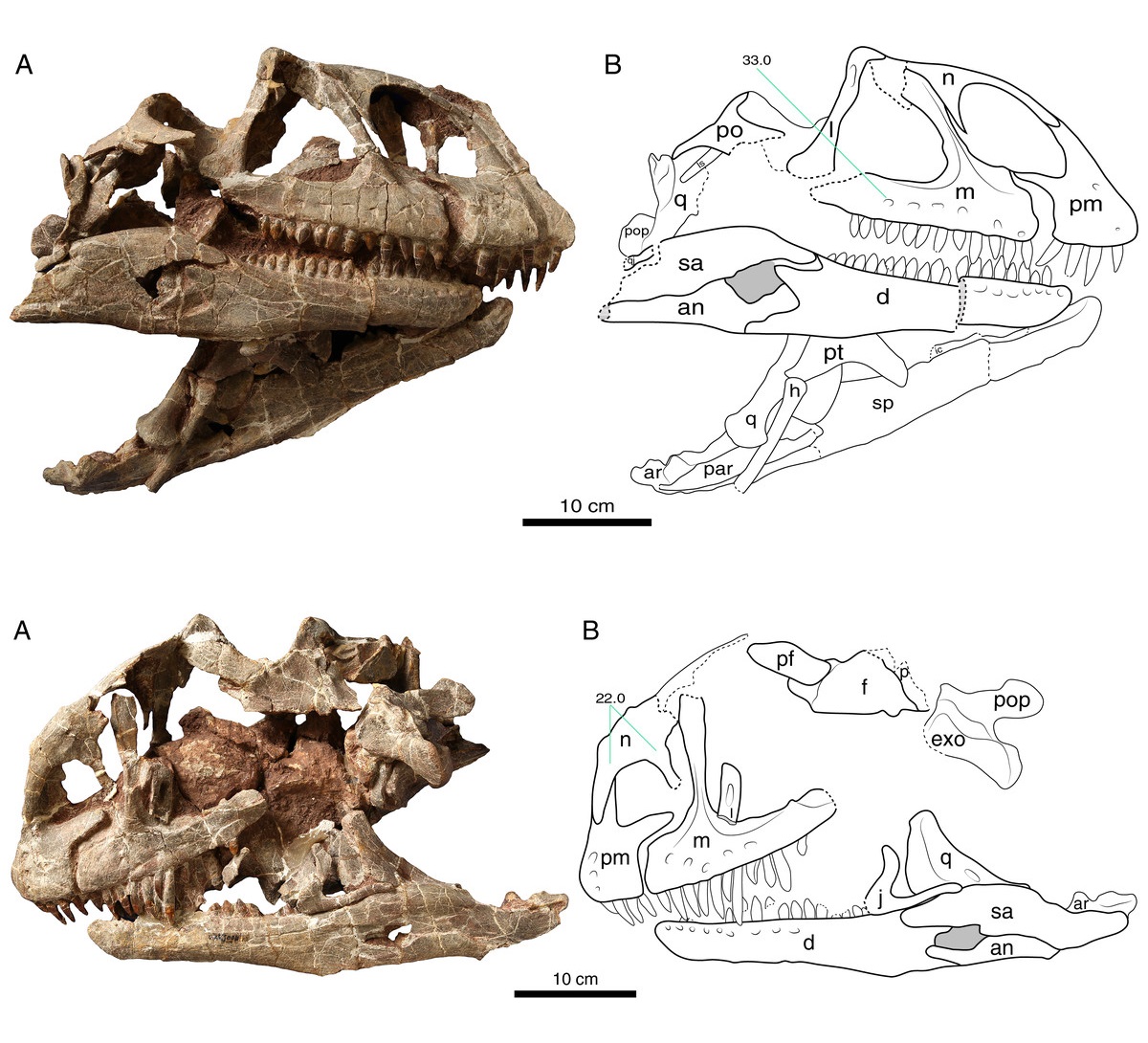
the cranium of Lishulong wangi gen. et sp. nov. 
 Photograph (A) and interpretative line drawing (B), 
in right lateral view and left lateral view.

Systematic Paleontology
Dinosauria Owen, 1842
Saurischia Seeley, 1888

Sauropodomorpha von Huene, 1932 (sensu Sereno, 2007)
Massopoda Yates, 2007
Sauropodiformes Sereno, 2007 (sensu McPhee et al., 2014)

Lishulong wangi gen. et sp. nov.

Holotype: LFGT-ZLJ0011. An associated partial skeleton that includes the cranium and mandible, and nine cervical vertebrae (axis and C3–C10)

Differential diagnosis: A large non-sauropodan sauropodiform dinosaur with the following unique combination of character states (autapomorphies are indicated by an asterisk): width of the anteroventral process of nasal at its base less than that of its anterodorsal process*; size of the neurovascular foramen at the posterior end of the lateral maxillary row not larger than the others*; shape of the supraoccipital is semilunate and wider than high in posterior view; height to length ratio of the dentary greater than 0.2; lingual concavities of the teeth present; lateral expansion at the anterior region of the dorsal surface of the cervical neural spines*.


Type locality and horizon: The specimen was discovered near the Jiudu Village in Konglongshan Town (formerly named Chuanjie Township), Lufeng County, Yunnan Province, China; and the upper-middle part of the Shawan Member of the Lufeng Formation (Fang et al., 2000), Lower Jurassic. Magnetostratigraphic analyses (Cheng et al., 2004; Huang et al., 2005) revealed the age to be Early Jurassic (late Sinemurian–Toarcian).

Etymology: The generic name is from ‘Lishu’ (chestnut tree in Chinese spelling), the name of the locality where the specimen was found, and ‘long’ refers to a dragon (in Chinese spelling); this specific epithet is in honor of Mr. Zheng-Ju Wang, for his great contributions to the early discoveries of vertebrate fossils from Lufeng.


Qian-Nan Zhang​, Lei Jia, Tao Wang, Yu-Guang Zhang and Hai-Lu You​. 2024. The largest sauropodomorph skull from the Lower Jurassic Lufeng Formation of China. PeerJ. 12:e18629 DOI: doi.org/10.7717/peerj.18629 


Thursday, August 15, 2024

[Paleontology • 2024] Campananeyen fragilissimusThey all floated in the Cretaceous: New rebbachisaurid (Sauropoda: Diplodocoidea) with a highly pneumatized skeleton from the Upper Cretaceous (lower Cenomanian) of Patagonia, Argentina


 Campananeyen fragilissimus
 Lerzo, Fernández-Baldor, Canale, Whitlock, Otero & Gallina, 2024


ABSTRACT
Rebbachisaurids are a group of basal diplodocoid sauropods that diversified primarily in Gondwana between the early Lower Cretaceous and the early Upper Cretaceous. Their phylogenetic relationships are still under debate given the fragmentary and incomplete nature of its remains. Here, we provide a detailed description of the postcranial remains of Campananeyen fragilissimus gen. et sp. nov. from the Candeleros Formation (lower Cenomanian) of Neuquén Province, Argentina. Campananeyen presents notable features that allow it to be recognised as a new species by the presence of an underdeveloped crista prootica, paraoccipital process internally hollow and a fuse dorsal alar arm of the ilium. The phylogenetic analysis recovered this taxon as a basal rebbachisaurid closely related to Zapalasaurus, Sidersaura and the specimen from La Amarga Formation MACN-Pv-N 35. The new rebbachisaurid is recovered as the sister taxon of Sidersaura due the presence of procoelous posterior caudal vertebrae and dorsoventrally flattened posterior caudal centra. C. fragilissimus presents an extreme pneumatization of the sacral region with an autapomorphic dorsal alar arm of the sacral transverse processes. Finally, the phylogenetic analysis supports a South American origin for Rebbachisauridae and an early diversification to Africa and Europe by the Barremian-Aptian as previously suggested.

KEYWORDS: Candeleros formation, Dinosauria, Pneumatization, Gondwana, Campananeyen, Rebbachisauridae


Campananeyen fragilissimus gen. et sp. nov. 


Lucas N. Lerzo, Fidel Torcida Fernández-Baldor, Juan I. Canale, John A. Whitlock, Alejandro Otero and Pablo A. Gallina. 2024. They all floated in the Cretaceous: New rebbachisaurid (Sauropoda, Diplodocoidea) with a highly pneumatized skeleton from the Upper Cretaceous (lower Cenomanian) of Patagonia, Argentina. Historical Biology: An International Journal of Paleobiology. DOI: doi.org/10.1080/08912963.2024.2383708