Showing posts with label Bird of Prey. Show all posts

Friday, December 8, 2023

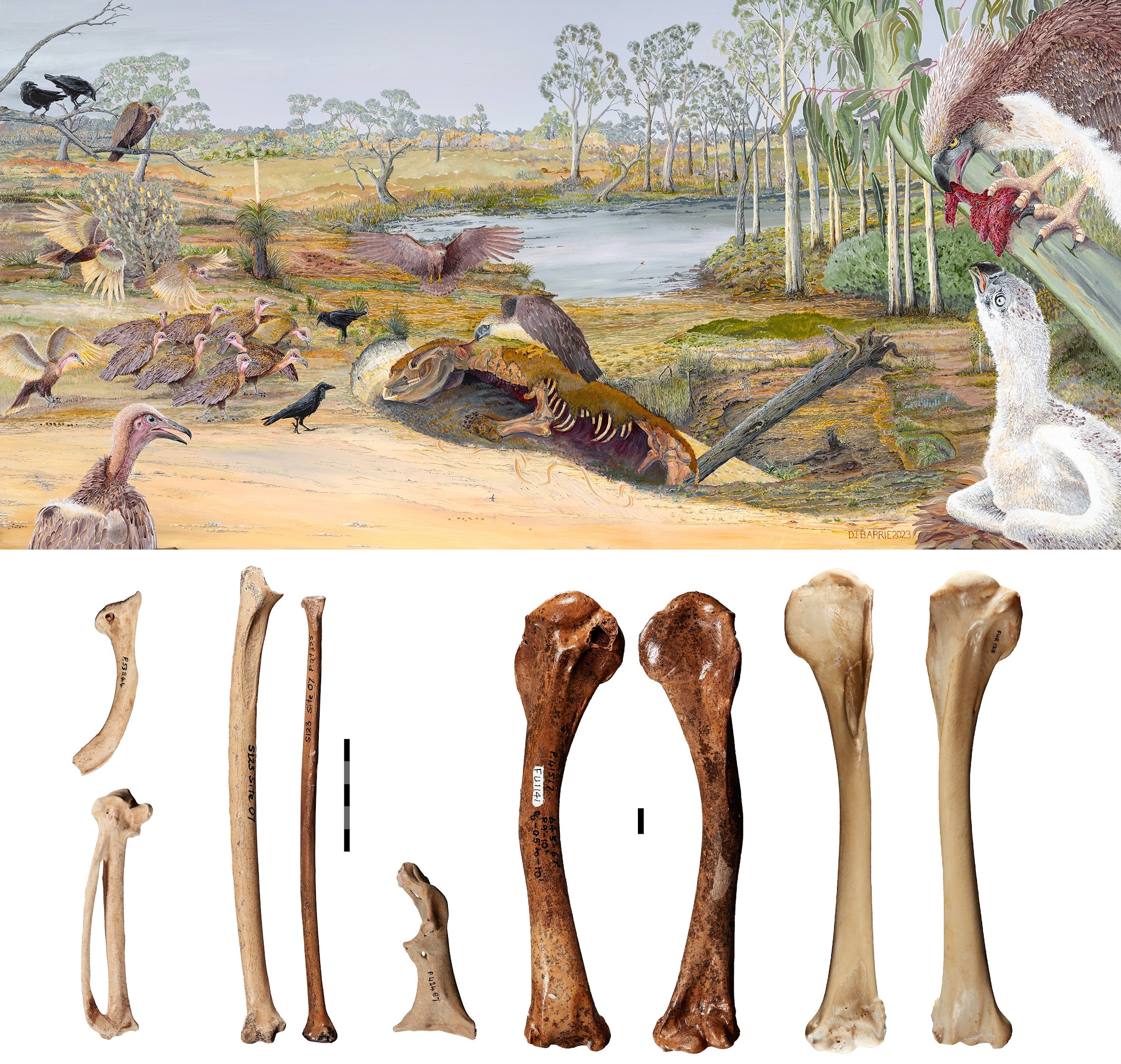
[PaleoOrnithology • 2023] Dynatoaetus pachyosteus • Pleistocene Raptors from Cave deposits of South Australia, with A Description of A New Species of Dynatoaetus (Accipitridae): Morphology, Systematics and Palaeoecological Implications


A flock of vultures (Cryptogyps lacertosus) and Australian ravens watch and wait (left), as an adult eagle Dynatoaetus pachyosteus feeds on the carcass of a dead Diprotodon (centre), while a younger bird seeks to join in. In the nearby treetops, a second adult D. pachyosteus feeds its hungry chick (right).

Mather, Lee, Fusco, Hellstrom & Worthy, 2023
Artwork: John Barrie

ABSTRACT 
The Pleistocene fossil record of Australian raptors (Accipitridae: eagles, hawks and Old World vultures) is very poorly understood with only three distinct extinct species confirmed until now. The small Necrastur alacer remains unstudied; however recent research has established Cryptogyps lacertosus as a valid species that, along with the very large Dynatoaetus gaffae, has potential affinities with the Aegypiinae–Circaetinae clade. These, along with a single large liv- ing inland raptor, the Wedge-tailed Eagle Aquila audax, suggest that Australia had an impover- ished diversity of large raptors compared to other similar continental regions. However, fossil material similar in size to A. audax from multiple Pleistocene cave deposits raises the possibility of further taxa and is here assessed. A partial skeleton from Green Waterhole/Fossil Cave in the Tantanoola District of South Australia is referred to Cryptogyps lacertosus on the basis of similar size to bones of this species and that the associated coracoid is identical to that found with a tarsometatarsus that was previously referred to this species, coming from Leaena’s Breath Cave on the Nullarbor Plain, Western Australia. This partial skeleton allowed additional material from the Old Collections, Wellington Caves, and Walli Caves in New South Wales to be referred to this species. A second species, more robust than A. audax, is identified from material from Victoria Fossil Cave at Naracoorte. Phylogenetic analyses determined this species to be the sister taxon of the much larger Dynatoaetus gaffae recently described from several Australian sites, and so we name it as Dynatoaetus pachyosteus sp. nov. Further fragmentary remains attributable to either A. audax, C. lacertosus or D. pachyosteus are recorded from sites in the Wellington Caves complex, NSW. This study increases the known diversity of raptors in Pleistocene Australia, consistent with the presence of the more diverse megafaunal prey that existed at the time.

KEYWORDS: Pleistocene extinction, Australia, Aegypiinae, Circaetinae, avian predators, avian scavengers, taxonomy


A flock of vultures (Cryptogyps lacertosus) and Australian ravens watch and wait (left), as an adult eagle Dynatoaetus pachyosteus feeds on the carcass of a dead Diprotodon (centre), while a younger bird seeks to join in. In the nearby treetops, a second adult D. pachyosteus feeds its hungry chick (right).
Artwork: John Barrie


Ellen K. Mather, Michael S. Y. Lee, Diana A. Fusco, John Hellstrom and Trevor H. Worthy. 2023. Pleistocene Raptors from Cave deposits of South Australia, with A Description of A New Species of Dynatoaetus (Accipitridae: Aves): Morphology, Systematics and Palaeoecological Implications. Alcheringa: An Australasian Journal of Palaeontology. DOI: 10.1080/03115518.2023.2268780 
https://drive.google.com/drive/folders/16mcI69azApGg9oSEPUrI1Mcbn0nmrM2P
  theconversation.com/giant-eagles-and-scavenging-vultures-shared-the-skies-of-ancient-australia-216358
 theguardian.com/australia-news/2023/nov/17/prehistoric-australian-vultures-and-eagles-brought-to-life-in-gory-new-painting


Thursday, December 7, 2023

[PaleoOrnithology • 2023] Vultur messii • A New fossil Condor (Aves, Cathartiformes: Cathartidae) from the Early Pliocene of Catamarca Province, Argentina


Vultur messii
  Degrange, Bonini, Georgieff & Ibañez, 2023


 ABSTRACT
Condors are New World vultures (Cathartiformes, Cathartidae) with broad wings and short tails. The fossil record of condors (Aves, Cathartiformes) in South America is scarce, and particularly in Argentina most of the remains assigned to condors have been debated. Here, we present a new fossil species of Cathartidae found in the Early Pliocene of Catamarca province, Argentina, that belongs to the extant genus Vultur. The new species, Vultur messii sp. nov. is considered to be the only valid fossil species of this iconic genus of birds. The presence of a fossil Vultur species, recovered from deposits older than 4.8 Ma, coincides with the rise of the pampean hills and the Andes, and the beginning of the regional aridification. The existence of incipient mountain chains may also indicate that the centre of origin of this genus is linked to the Andes mountain, which in turn indicates an earlier arrival and diversification of the condors in South America.

KEYWORDS: Cathartids, Vultur, Mio-pliocene, Catamarca, Andalhuala Formation


 Vultur messii sp. nov. 
 
Federico J. Degrange, Ricardo A. Bonini, Sergio M. Georgieff and Lucía M. Ibañez. 2023. A New fossil Condor (Aves, Cathartiformes) from the Early Pliocene of Catamarca province, Argentina. Historical Biology: An International Journal of Paleobiology. DOI: 10.1080/08912963.2023.2288612 

Tuesday, September 13, 2022

[PaleoOrnithology • 2022] A 14,000-year-old Genome sheds light on the Evolution and Extinction of A Pleistocene Vulture


in Ericson, Irestedt, Zuccon, ... et Qu, 2022. 
Artwork: Julian Hume   facebook.com/JulianHume5

Abstract
The New World Vulture [Coragyps] occidentalis (L. Miller, 1909) is one of many species that were extinct by the end of the Pleistocene. To understand its evolutionary history we sequenced the genome of a 14,000 year old [Coragyps] occidentalis found associated with megaherbivores in the Peruvian Andes. occidentalis has been viewed as the ancestor, or possibly sister, to the extant Black Vulture Coragyps atratus, but genomic data shows occidentalis to be deeply nested within the South American clade of atratus. Coragyps atratus inhabits lowlands, but the fossil record indicates that occidentalis mostly occupied high elevations. Our results suggest that occidentalis evolved from a population of atratus in southwestern South America that colonized the High Andes 300 to 400 kya. The morphological and morphometric differences between occidentalis and atratus may thus be explained by ecological diversification following from the natural selection imposed by this new and extreme, high elevation environment. The sudden evolution of a population with significantly larger body size and different anatomical proportions than atratus thus constitutes an example of punctuated evolution.


a Fossils identified as [Coragyps] occidentalis collected in the cave Casa del Diablo situated at c. 3800 m a.s.l. in the Altiplano of southern Peru (marked with a red star on the map).
 b Localities for fossil Coragyps specimens were identified as either atratus (blue) or occidentalis (red).


Per G. P. Ericson, Martin Irestedt, Dario Zuccon, Petter Larsson, Jean-Luc Tison, Steven D. Emslie, Anders Götherström, Julian P. Hume, Lars Werdelin and Yanhua Qu. 2022. A 14,000-year-old Genome sheds light on the Evolution and Extinction of A Pleistocene Vulture. Communications Biology.  857. DOI: 10.1038/s42003-022-03811-0 

Wednesday, August 14, 2019

[Ornithology • 2019] Ancient DNA from A 2,500-year-old Caribbean Fossil Places An Extinct Bird (Caracara creightoni) in A Phylogenetic Context


Caracara creightoni

in Oswald, Allen, Witt, et al., 2019. 

Highlights: 
• New methods and unique fossil sites offer potential to recover tropical bird aDNA.
• The bird, Caracara creightoni, went extinct upon human arrival in the Caribbean.
 • We obtained mitochondrial genome data from C. creightoni.
Caracara creightoni was sister to the two extant continental Caracara species.
• It shared a common ancestor with extant species during the Pleistocene.

Abstract
Since the late Pleistocene humans have caused the extinction of species across our planet. Placing these extinct species in the tree of life with genetic data is essential to understand the ecological and evolutionary implications of these losses. While ancient DNA (aDNA) techniques have advanced rapidly in recent decades, aDNA from tropical species, especially birds, has been historically difficult to obtain, leaving a gap in our understanding of the extinction processes that have influenced current distributions and biodiversity. Here we report the recovery of a nearly complete mitochondrial genome from a 2,500 year old (late Holocene) bone of an extinct species of bird, Caracara creightoni, recovered from the anoxic saltwater environment of a blue hole in the Bahamas. Our results suggest that this extinct species is sister (1.6% sequence divergence) to a clade containing the extant C. cheriway and C. plancus. Caracara creightoni shared a common ancestor with these extant species during the Pleistocene (1.2-0.4 MYA) and presumably survived on Cuba when the Bahamas was mostly underwater during Quaternary interglacial intervals (periods of high sea levels). Tropical blue holes have been collecting animals for thousands of years and will continue to improve our understanding of faunal extinctions and distributions. In particular, new aDNA techniques combined with radiocarbon dating from Holocene Bahamian fossils will allow us to place other extinct (species-level loss) and extirpated (population-level loss) vertebrate taxa in improved phylogenetic, evolutionary, biogeographic, and temporal contexts.

Keywords: aDNA, Bahamas, Extinction, Falconiformes, Holocene fossils

phylogeny of focal Caracara species and other members of the Falconidae.


 Jessica A. Oswald, Julia M. Allen, Kelsey E. Witt, Ryan A. Folk, Nancy A. Albury, David W. Steadman and Robert P. Guralnick. 2019. Ancient DNA from A 2,500-year-old Caribbean Fossil Places An Extinct Bird (Caracara creightoni) in A Phylogenetic Context. Molecular Phylogenetics and Evolution. DOI: 10.1016/j.ympev.2019.106576

Friday, February 20, 2015

[Ornithology • 2015] First Investigation on the Diet of the Eastern Grass Owl Tyto longimembris During the Nesting Period in Thailand


upper: Grass Owl Tyto longimembris longimembris - Chicks in nest
photo:  Akalak Kunsorn | orientalbirdimages.org
lower: Different sizes of pellets and prey’s skulls of eastern grass owl.

Abstract
 The eastern grass owl Tyto longimembris (นกแสกทุ่งหญ้า) was first detected in Thailand in July 2006 at Nong Lom, a grassland in open peat swamp located in the south part of Nong Bong Khai Non-hunting Area, Chiang Rai. Here, it is considered to be a rare resident. At this site, we studied the diet of eastern grass owl by analysing regurgitated pellets collected at their nests during the breeding season from December 2010 to February 2011. We collected 67 pellets from five nests and identified 33 mammal skulls. To identify prey species, DNA was extracted from skulls and was analysed based on molecular techniques. The dietary remains consisted of three murids (Muridae), with the house rat Rattus rattus the dominant species detected (16 skulls, 48.5 % occurrence), and the remainder being Asian house mouse Mus musculus (13 skulls, 39.4%) and ricefield mouse Mus caroli (4 skulls, 12.1%). 

Key words: eastern grass owl, diet, pellet, nocturnal raptor


Akalak Kunsorn, Siriwadee Chomdej, Narit Sitasuwan, Prasit Wangpakapattawong,Chatmongkon Suwannapoom and Brett K. Sandercock. 2015. First Investigation on the Diet of the Eastern Grass Owl During the Nesting Period in Thailand.  Raffles. Bull. Zool. 63: 27–32. 

Kasorndorkbua, C., Kunsorn, A. & Wongchai, C. 2008. Nesting records of eastern grass owl Tyto (capensis) longimembris in Chiang Rai, northern Thailand. BirdingASIA. 9: 91–93.

Wednesday, September 25, 2013

[Ornithology • 2013] Discovery of the critically endangered Flores Hawk-Eagle Nisaetus floris on Alor island, Indonesia


The Flores Hawk Eagle Nisaetus floris was first treated as a separate species by Gjershaug et al. (2004) because it is morphologically distinct from Changeable Hawk Eagle N.cirrhatus; it was previously considered to be a subspecies of the latter. It is now an Indonesian endemic only known to occur on Flores, Sumbawa and Lombok as well as on two satellite islands, Satonda near Sumbawa and Rinca near Flores. Komodo was mentioned by Coates & Bishop (1997) as part of the range but no further details were provided. However further confirmation came in November 2011 when a bird was photographed on a tiny island just 800 m from Komodo, perched in mangroves, presumably examining a colony of fruit bats roosting there.

......


Collaerts P, Collaerts E, Verbelen P, Trainor C.R. 2013. Discovery of the critically endangered Flores Hawk-Eagle Nisaetus floris on Alor island, Indonesia. BirdingASIA. 19:48-51.

[Ornithology • 2006] Taxonomy and Conservation status of Hawk-eagles (genus Nisaetus) in South-East Asia


Javan Hawk-eagle Spizaetus bartelsi 
by Trond Haugskott

Morphological, vocal and molecular data have been used to reevaluate the taxonomy of some Asian Nisaetus taxa. This name is used instead of Spizaetus because the latter genus is polyphyletic with clades in Asia, South America and Africa. The Changeable Hawk-eagle complex (N. cirrhatus cirrhatus, N. c. limnaeetus, N. c. floris, N. lanceolatus and N. philippensis) has been studied. We propose that Nisaetus floris (Flores Hawk-eagle) should be treated as a distinct species, whereas the taxonomic status of Nisaetus c. cirrhatus and N. c. limnaeetus is still uncertain. We also propose that the Philippine Hawk-eagle should be split into two species Nisaetus philippensis and N. pinskeri. In the Mountain Hawk-eagle Nisaetus nipalensis complex, we propose that Nisaetus kelaarti (Legge’s Hawk-eagle) should be treated as a distinct species. The conservation status of Nisaetus floris, Nisaetus kelaarti and Nisaetus bartelsi has been evaluated from population density estimates, which are based on territory size. N. floris and N. bartelsi qualify for the category “Endangered” on the IUCN Red List, whereas N. kelaarti qualifies as “Near Threatened”. The changes in taxonomy of Nisaetus floris and N. kelaarti meet the qualification for being included in the Red List. 


Gjershaug, Jan Ove. 2006. Taxonomy and Conservation status of Hawk-eagles (genus Nisaetus) in South-East Asia. Doctoral theses at NTNU (Norwegian University of Science and Technology). pp. 91. 

[Ornithology • 2004] Nisaetus (Spizaetus) floris | Flores Hawk Eagle • The Taxonomic Status of the Flores Hawk Eagle Spizaetus floris


Abstract
The Changeable Hawk Eagle Spizaetus cirrhatus complex ranges from India (cirrhatus) through South-East Asia (mainly limnaeetus) to Flores, Sumbawa and Lombok, Indonesia (floris). The latter taxon is morphologically very distinct from the widespread limnaeetus. It has diagnostic white patches on the upperside of the inner parts of the primaries, a juvenile-like adult plumage, and it is much larger than limnaeetus. It is allopatric with limnaeetus without any known geographical overlap. The large morphological differences indicate that the two taxa are reproductively isolated. We suggest that Spizaetus floris be treated as a distinct species with the English name of Flores Hawk Eagle.

Figure 1. Ranges of taxa in the Changeable Hawk Eagle Spizaetus cirrhatus complex.


Gjershaug, J. O., Kwaløy, K., Røv, N., Prawiradilaga, D. M., Suparman, U. & Rahman, Z. 2004. The Taxonomic Status of the Flores Hawk Eagle Spizaetus floris. Forktail. 20: 55–61.