Showing posts with label Rediscovery. Show all posts

Monday, March 2, 2026

[Botany • 2026] Stigmatodactylus antennatus (Orchidaceae) • A New Species from West Papua Province, Indonesia, and the Rediscovery and Reinterpretation of S. gibbsiae


 Stigmatodactylus antennatus Schuit., Saputra & Wanma,

in Schuiteman, Saputra, Wanma et Heatubun, 2026. 

Abstract
Two species of Stigmatodactylus have recently been observed in the Arfak Mountains of West Papua Province, Indonesian New Guinea. One of these is clearly undescribed and is here described as Stigmatodactylus antennatus Schuit., Saputra & Wanma, a species uniquely characterised by the presence of a pair of antennae on the lip. The other is believed to be S. gibbsiae (Kores) Kores. This species was only known from the type material collected in the Arfak Mountains more than a century ago, in 1913. There are, however, significant discrepancies between the protologue and the material recently found. We interpret these discrepancies as misinterpretations of the poor type material of S. gibbsiae, and provide images based on fresh material. An identification key to the four species of Stigmatodactylus in New Guinea is included.

Keywords: Acianthus; Arfak mountains; identification key; taxonomy

  Stigmatodactylus antennatus
 (A) Plant habit; (B) flower; (C) dorsal sepal; (D) lateral sepal; (E) petal; (F) lip; (G) lip callus; (H) column. Drawn after the type material by André Schuiteman.


 Stigmatodactylus antennatus.
(a) In situ, Schuiteman et al. 23-277; (b) inflorescence, Schuiteman et al. 24-102; (c) flower detail showing callus with antennae, Schuiteman et al. 23-277. Photos: André Schuiteman.

  Stigmatodactylus antennatus Schuit., Saputra & Wanma, spec. nov. 


 André Schuiteman, Reza Saputra, Jimmy F. Wanma and Charlie D. Heatubun. 2026. A New Species of Stigmatodactylus (Orchidaceae) from West Papua Province, Indonesia, and the Rediscovery and Reinterpretation of S. gibbsiae. Plants. 15(4), 58. DOI: doi.org/10.3390/plants15040589 [13 February 2026]

Saturday, January 3, 2026

[Botany • 2025] Untangling tightly bound knots: a reappraisal of Campbellia (Orobanchaceae), with the Rediscovery of C. aurantiaca after more than 175 years


Campbellia aurantiaca  

in Salim, Mathew, Arunraj, Sanjai et Gopallawa, 2025.    

Summary
The long-standing ambiguities on the taxonomic status of Campbellia Wight and C. aurantiaca Wight are resolved, and this particular species is rediscovered after more than 175 years from the Western Ghats, India.

Key Words: Christisonia-Campbellia complex, endemic, holoparasite, Robert Wight, Western Ghats


Campbellia aurantiaca Wight


P. M. Salim, Jose Mathew, P. T. Arunraj, V. N. Sanjai and B. Gopallawa. 2025. Untangling tightly bound knots: a reappraisal of Campbellia (Orobanchaceae), with the Rediscovery of C. aurantiaca after more than 175 years.  Kew Bulletin. DOI: doi.org/10.1007/s12225-025-10282-z [02 December 2025]

Monday, December 29, 2025

[Botany • 2025] Begonia sordidissima (Begoniaceae, sect. Baryandra) Resolving a Taxonomic Enigma: Rediscovery of the Mindanao endemic Begonia sordidissima after over a Century confirms its distinct status from B. mindorensis

 
Begonia sordidissima Elmer, 

in Naive, Along, Rozano et Ruales, 2025. 

Abstract
Begonia sordidissima has been considered as a synonym of B. mindorensis since 1923. Our recent fieldwork led to the rediscovery of B. sordidissima in Mindanao after more than a century, prompting a detailed morphological study that confirms its reinstatement as a distinct species. We designate lectotypes for both names and provide an emended description, including new data on pistillate flowers, photographs, updated distribution information, habitat preference, and a preliminary IUCN conservation assessment. This work underscores the critical need for continued field exploration and taxonomic revision in biodiversity-rich yet threatened regions such as the Philippines.

Biodiversity hotspot, megadiversity, nomenclature, Philippines, section Baryandra, Eudicots


Begonia sordidissima Elmer (1915)


MARK ARCEBAL K. NAIVE, ARCHIE A. ALONG, RALPH RJ E. ROZANO and JECO JED J. RUALES. 2025. Resolving a Taxonomic Enigma: Rediscovery of the Mindanao endemic Begonia sordidissima (Begoniaceae) after over a Century confirms its distinct status from B. mindorensisPhytotaxa. 730(3); 269-276. DOI: doi.org/10.11646/phytotaxa.730.3.4 [2025-11-21]
 x.com/begoniARCIIae/status/1991703043910639991
 

Friday, August 1, 2025

[Entomology • 2025] Losgna occidentalis • Rediscovery and Description of A New Species of Losgna (Cameron 1903) (Hymenoptera: Ichneumonidae): Reviving a forgotten ichneumonid Genus in India


Losgna occidentalis 
Om Chaudhary & Reinisch, 2025

 
Abstract
The Darwin wasp genus Losgna (Cameron, 1903) (subfamily Ichneumoninae), is poorly documented in India, with no new species described since Heinrich’s work in 1965. Here we rediscover the genus in India and describe a new species collected from an urban dry scrub forest in Chandigarh. A taxonomic key for the identification of Indian Losgna is provided along with the illustrations of the new species and Generitype. The study significantly extends the known distribution of Losgna in the Oriental region and highlights the under-explored diversity of Ichneumoninae in India and the need for further taxonomic research.

Hymenoptera, Ichneumonidae, Darwin wasps, parasitic wasps, Chandigarh


Losgna occidentalis sp. nov.
A—face, frontal view, B—face and propodeum side view
C—propodeum, dorsal view, D—basal tergites, dorsal view.

Losgna occidentalis sp. nov. 


Karmannye Om CHAUDHARY and Sophia REINISCH. 2025. Rediscovery and Description of A New Species of Losgna (Cameron 1903): Reviving a forgotten ichneumonid Genus in India.  Zootaxa. 5632(3); 595-600. DOI: doi.org/10.11646/zootaxa.5632.3.11 [2025-05-08]

Thursday, July 31, 2025

[Entomology • 2025] Rediscovery of Pseudomyrmecion ramalium Bedel, 1885 (Coleoptera: Cerambycidae): A rare endemic saproxylic Longhorn Beetle in the Djebel Edough Forest, Algeria

 
Pseudomyrmecion ramalium Bedel, 1885

in Hadiby, Boukheroufa, Vitali, ... et Sakraoui, 2025. 

Abstract
The rediscovery of Pseudomyrmecion ramalium Bedel, 1885, a rare and endemic saproxylic longhorn beetle, in the Djebel Edough forest in Algeria is reported. Hind wings are for the first time showed and described, evidencing the brachyptery of this species. Erroneous nomenclatorial, biological and chorological data referred by previous authors are discussed and corrected. This species, which had not been observed in the region since 1900, is an obligate saproxylic insect exclusively associated with the Algerian oak Quercus canariensis Willd. Classified as an endangered species on the IUCN Red List due to its rarity and the threats to its habitat, P. ramalium represents a conservation priority. Its rediscovery highlights the need for further research to assess the current state of its population and better understand its ecological requirements. This information will be crucial for developing effective conservation strategies and preserving its fragile habitat.

Coleoptera, Rediscovery, Pseudomyrmecion ramalium, saproxylic beetle, endangered species, Djebel Edough forest

Capture site and field photos in the Edough forest massif (North-East Algeria).

Pseudomyrmecion ramalium Bedel, 1885, male, from Edough forest (Badji Mokhtar University, Annaba, Algeria).
Dorsal view, tegmen, median lobe and hind wings. Scale bar = 1 mm. (Photo and drawings F. Vitali).


RACHED HADIBY, MEHDI BOUKHEROUFA, FRANCESCO VITALI, YASMINE ADJAMI, ABDELAZIZ FRIH, FERIEL SAKRAOUI. 2025. Rediscovery of Pseudomyrmecion ramalium Bedel, 1885: A rare endemic saproxylic Longhorn Beetle in the Djebel Edough Forest, Algeria (Coleoptera, Cerambycidae).  Zootaxa. 5632(3);547-556. DOI: doi.org/10.11646/zootaxa.5632.3.7 [2025-05-08]

Thursday, July 24, 2025

[Botany • 2025] Rediscovery of the endemic Vanda thwaitesii (Orchidaceae) after 160 years in the central highlands of Sri Lanka and its lectotypification


Vanda thwaitesii Hook.f. 

in Gopallawa, Madola, Yakandawala, Jayasinghe et Ranasinghe, 2025.  

Summary
Vanda thwaitesii, an endemic species to Sri Lanka was rediscovered nearly 160 years after its presumed extinction from the Rangala area of the Knuckles Mountain range, marking the first sighting since its initial record in 1861. The occurrence of this species in India was reported in 1998, however, later it was identified as a different species, Vanda sathishii. Rediscovery of V. thwaitesii was a part of a project ‘National Botanical Survey’ conducted by Department of National Botanic Gardens, Sri Lanka. A lectotypification, a detailed taxonomic description and a detailed illustration are provided. Based on the IUCN Red List categories and criteria, V. thwaitesii is assessed as Critically Endangered.
 
Key Words: Biodiversity Conservation, Critically Endangered, Knuckles Mountain, Vanda sathishii.

Vanda thwaitesii.
A, B flower (front view); C flower (side view); D habit; E flower (showing adaxial view of the lip); F flower (lateral view); G column and labellum (front view); H leaf tip (adaxial view); J floral bract (adaxial view); K dissected flower; L column and labellum (lateral view); M lip (abaxial view); N seed capsules.
photos: Himesh Jayasinghe & Bhathiya Gopallawa.

Vanda thwaitesii Hook.f. (Hooker 1898: 193); Jayaweera (1981: 220). 

Type: Sri Lanka, Knuckles Mountains, Rangala area, Hunnasgiriya,
coloured painting with floral analysis by H. de Alwis labelled Aerides tessellata and numbered C.P. 3378 (lectotype: icon. PDA!, designated here), ....
 

Bhathiya Gopallawa, Indrakheela Madola, Deepthi Yakandawala, Himesh Jayasinghe and Subhani Ranasinghe. 2025. Rediscovery of the endemic Vanda thwaitesii (Orchidaceae) after 160 years in the central highlands of Sri Lanka and its lectotypification. Kew Bulletin. DOI: doi.org/10.1007/s12225-025-10280-1 [10 July 2025]

Saturday, May 31, 2025

[Invertebrate • 2025] Rediscovery and Phylogenetic Position of A Long-lost Typhloperipatus williamsoni Kemp, 1913 (Onychophora: Peripatidae) after 111 Years from Arunachal Pradesh, India


Typhloperipatus williamsoni Kemp, 1913 

in Narayanan, Priyadarsanan, Ranjith, Sahanashree et Ananthram, 2025. 

ABSTRACT
Typhloperipatus williamsoni, a long-lost species of the phylum Onychophora (velvet worms), is rediscovered after over a century in the Siang Valley in Arunachal Pradesh, India. The rediscovery is based on two individuals, one collected near the type locality (Kalek, Arunachal Pradesh, India) and the other from a previously unknown location (Yingku, Arunachal Pradesh, India). We provide additional natural history and distribution information about this poorly known species, and the first live images. Molecular data for T. williamsoni is generated for the first time to understand its phylogenetic position within Peripatidae. The phylogenetic analyses based on three mitochondrial genes (12S, 16S and COI) recovered T. williamsoni as a sister to Southeast Asian Eoperipatus. Further, the biogeographic scenario of Asian peripatids is briefly discussed based on the molecular dating analysis.

KEYWORDS: Velvet worms, Siang expedition, natural history, molecular analysis, biogeography
 

 Typhloperipatus williamsoni Kemp, 1913 


Surya Narayanan, D.R. Priyadarsanan, A.P. Ranjith, R. Sahanashree and Aravind Neelavar Ananthram. 2025. Rediscovery and Phylogenetic Position of A Long-lost Typhloperipatus williamsoni Kemp, 1913 (Onychophora: Peripatidae) after 111 Years from Arunachal Pradesh, India. Journal of Natural History. 59(17-20); 1167-1180. DOI: doi.org/10.1080/00222933.2025.2483434 [11 Apr 2025]

Monday, April 28, 2025

[Botany • 2025] Rediscovery of Crepidium parryae After Nearly 100 Years and Taxonomic Notes on Crepidium purpureum and C. khasianum [Notes on Asian Orchidaceae II]


Crepidium parryae (Tang & F.T.Wang) Marg. [1926]

in Gogoi & Kumar, 2025.

ABSTRACT
Crepidium parryae, originally known from Mizoram, has been rediscovered in Arunachal Pradesh after nearly 100 years. This paper provides a comprehensive description of the species, including taxonomic notes, color plates, line drawings, habitat information, and an assessment of its conservation status. Furthermore, Crepidium assamicum K. Gogoi & J. Sharma and C. meghalayense M. Murugesan, Sushil K. Singh, & A. A. Mao are now synonymized under C. purpureum (Lindl.) Szlach., while C. falcifolium Nuammee, Seelanan & H. A. Pedersen, and C. matsudae (Yamam.) Szlach. are synonymized under C. khasianum (Hook.f.) Szlach., based on their morphological similarities. Taxonomic notes supporting these synonymies are also included.

Keywords: C. metallicumC. octodentatumCrepidium acuminatum, Malaxideae, new synonyms


Crepidium parryae (Tang & F.T.Wang) Marg.


Khyanjeet Gogoi and Pankaj Kumar. 2025. Notes on Asian Orchidaceae II: Rediscovery of Crepidium parryae After Nearly 100 Years and Taxonomic Notes on Crepidium purpureum and Crepidium khasianumFeddes Repertorium. DOI: doi.org/10.1002/fedr.70009 [27 March 2025]

Friday, April 18, 2025

[Herpetology • 2025] Rediscovery of the Skink Sphenomorphus anomalopus (Boulenger, 1890) (Squamata: Scincidae): First Documentation of its natural history and live coloration


  Sphenomorphus anomalopus (Boulenger, 1890)  

in Sinovas et Grismer, 2025.

Abstract
The rediscovery and photographic documentation of Sphenomorphus anomalopus from Gunung Leuser National Park in North Sumatra, Indonesia, after a 109-year hiatus allowed us, for the first time, to observe its behavior and assess its microhabitat. Historical descriptions of this species’ coloration were never based on live material and, as such, did not convey the vibrant and contrasting nature of its lemon-yellow, orange, reddish, and greyish pattern configuration. Its color pattern and possible sexual dichromatism are described based on seven males and one presumed female photographed in situ. A short observation period clearly indicated that S. anomalopus is not an arboreal species, as had been previously hypothesized, but a terrestrial species that forages in rock-strewn leaf litter in sun-exposed localities, such as beneath canopy gaps and other open areas like many other terrestrial skinks.

Scincidae, Sumatra, Indonesia, Penang, coloration, conservation, Reptilia


 Sphenomorphus anomalopus from Sumatra, Indonesia.
 A. Female from Bukit lawang, Bohorok, Kabupaten de langkat, North Sumatra 20852, Indonesia. Photo by Ivan leshukov.
B. Male from Langkat Regency, North Sumatra, Indonesia showing elongate 4 th toe. Photograph by Marco Mora.
C-E. Male from Gunung leuser National Park, North Sumatra, Indonesia. Photographs by Pablo Sinovas.


Pablo SINOVAS and L. Lee GRISMER. 2025. Rediscovery of the Skink Sphenomorphus anomalopus (Boulenger, 1890) (Squamata: Scincidae): First Documentation of its natural history and live coloration.  Zootaxa. 5620(3)485-492. DOI: doi.org/10.11646/zootaxa.5620.3.8 [2025-04-10]

Wednesday, March 19, 2025

[Ichthyology • 2020] A Century after! Rediscovery of the ancient catfish Diplomystes Bleeker 1858 (Siluriformes: Diplomystidae) in coastal river basins of Chile and its implications for conservation.


 Diplomystes nahuelbutaensis  Arratia, 1987

in Muñoz-Ramírez, Briones, Colin, Fierro, Górski, Jara et Manosalva, 2020. 

ABSTRACT
The ancient catfish family Diplomystidae, with seven species endemic to rivers of southern South America, represents one of the oldest branches of the diverse order Siluriformes. With most species endangered, new reports of these species become extremely valuable for conservation. Currently, it is assumed that Diplomystes species inhabit only Andean (large) basins, and that they are extinct from coastal (small) basins from which their presence have not been recorded since 1919. Here, we document new records of the family Diplomystidae in the Laraquete and Carampangue basins, two coastal basins from the Nahuelbuta Coast Range, Chile, with no previous reports. This finding represents the rediscovery of the genus in coastal basins in more than a Century. Based on analysis of mitochondrial DNA sequences, the collected specimens were found to be closely related to Diplomystes nahuelbutaensis from the Andean Biobío Basin, but sufficiently differentiated to suggest that coastal basin populations are a different management unit. These populations are important because, contrary to previous thoughts, they prove these catfish can survive in small river networks, providing unique opportunities for research and conservation. The conservation category of Critically Endangered (CE) is recommended for the populations from the Laraquete and Carampangue basins.

Keywords: Management Unit; Mitochondrial DNA; Rare Species; Streams; Threatened Species

  Individuals of Diplomystes nahuelbutaensis recorded in this study and their habitat.
A. individual collected in Laraquete (Lar01); B. individual collected and released in Carampangue. C. individual collected in Laraquete (Lar02) and released;
D. Habitat of D. nahuelbutaensis in the Cabrera River, Carampangue Basin.


Carlos P. Muñoz-Ramírez, Raul Briones, Nicole Colin, Pablo Fierro, Konrad Górski, Alfonso Jara and Aliro Manosalva. 2020. A Century after! Rediscovery of the ancient catfish Diplomystes Bleeker 1858 (Siluriformes: Diplomystidae) in coastal river basins of Chile and its implications for conservation. Neotropical Ichthyology. 18(1)DOI: 10.1590/1982-0224-2019-0073
RESUMEN: La familia de bagres Diplomystidae, con siete especies endémicas de ríos del sur de Sudamérica, es uno de los linajes mas antiguos del diverso orden Siluriformes. Al estar la mayoría de las especies amenazadas, nuevos registros de éstas son extremadamente valiosos para su conservación. Actualmente, se ha asumido que los Diplomystidos se distribuyen solo en cuencas Andinas (más grandes), y que sus especies estarían extintas en cuencas de menor tamaño como las costeras, sin registros desde 1919. En este trabajo documentamos la familia Diplomistidae en las cuencas de Carampangue y Laraquete, dos cuencas costeras de la Cordillera de Nahuelbuta, Chile, lo que representa el primer registro de esta familia en estas cuencas costeras. Además, este hallazgo representa el re-descubrimiento de la familia en cuencas costeras después de un siglo. Sobre la base de análisis de ADN mitocondrial, los especímenes colectados se relacionaron más cercanamente con poblaciones de la especie Diplomystes nahuelbutaensis presente en la cuenca del Biobío. Sin embargo, existen diferencias genéticas suficientes entre las poblaciones costeras y las del Biobío para justificar su separación como unidad de manejo distinta. Estas poblaciones costeras son importantes porque demuestran que los Diplomístidos pueden sobrevivir en cuencas de pequeño tamaño, ofreciendo oportunidades únicas para su investigación y conservación. Se recomienda la categoría de conservación En Peligro Critico de Extinción (CR) para las poblaciones de las cuencas Laraquete y Carampangue.
Palabras clave: ADN Mitocondrial; Especie Amenazada; Especie Rara; Esteros; Unidad de Manejo

Monday, February 3, 2025

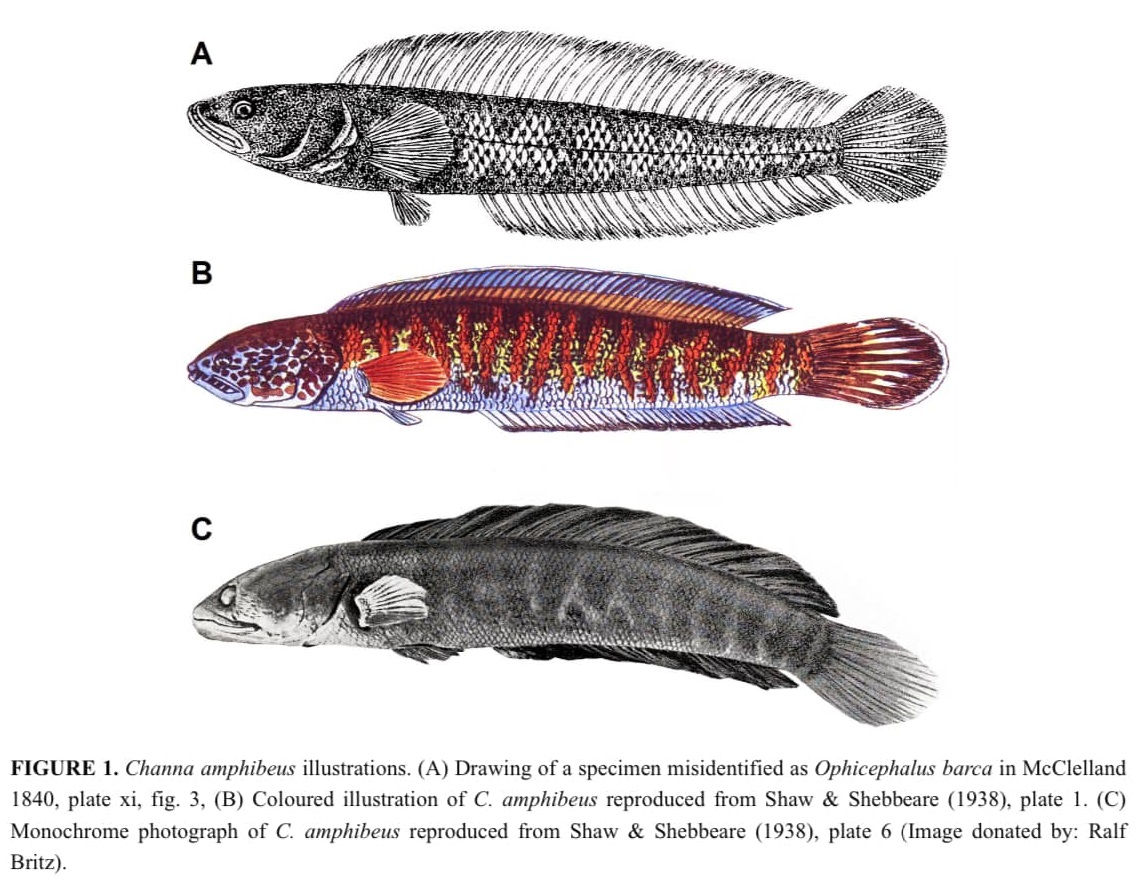
[Ichthyology • 2025] Lost for more than 85 years—Rediscovery of Channa amphibeus (McClelland, 1845) (Labyrinthici: Channidae), the World’s Most elusive Snakehead Species


Channa amphibeus (McClelland, 1845)

in Praveenraj, Thackeray, Moulitharan, Vijayakrishnan et Nanda, 2025. 
 
Abstract
The Chel Snakehead or Bora Chung, Channa amphibeus, is a large snakehead species endemic to the Himalayan region of India. Channa amphibeus was last recorded from specimens collected in the years between 1918 and 1933 (Shaw & Shebbeare 1938), leading to speculations that it may have gone extinct. Here, we report the re-discovery of the species after more than 85 years, based on three specimens collected in the year 2024, and additional photographic records. We also provide the first live image of C. amphibeus, along with biometric, and genetic data.

Pisces, Chel Snakehead, Bora Chung, Channa barca, potentially extinct, rare


Jayasimhan PRAVEENRAJ, Tejas THACKERAY, Nallathambi MOULITHARAN, Balaji VIJAYAKRISHNAN and Gourab Kumar NANDA. 2025.  Lost for more than 85 years—Rediscovery of Channa amphibeus (McClelland, 1845), the World’s Most elusive Snakehead Species (Teleostei, Labyrinthici, Channidae).  Zootaxa. 5583(1); 87-100. DOI: doi.org/10.11646/zootaxa.5583.1.4 

Sunday, January 12, 2025

[Herpetology • 2024] Rediscovery and Revision of the Diagnostic Characters of Opisthotropis daovantieni (Squamata: Natricidae) from southern Vietnam, with notes on its hemipenial morphology and defensive behavior


Opisthotropis daovantieni Orlov, Darevsky & Murphy, 1998

in Gao, Zhang, V. Nguyen, Jiang, T. Nguyen, Li et Ren, 2024. 
Photographs by Jia-Tang Li.

Abstract
The Tien’s Mountain Stream Snake, Opisthotropis daovantieni Orlov, Darevsky, and Murphy, 1998, has been represented solely by its type series, with no additional specimens reported in the past two decades. As a result, limited data exist and O. daovantieni remains one of the least studied members of its genus. Based on a re-examination of the type series, analysis of newly collected topotypic specimens, and a review of museum collections, this study provides an updated and comprehensive morphological characterization of O. daovantieni including detailed descriptions of hemipenial morphology, revised diagnostic characters, phylogenetic positioning, and ecological insights. Based on morphological comparisons with congeners, we also define the informal Opisthotropis spenceri group to facilitate future taxonomic work. In addition, this study documents a previously unreported defensive behavior involving tail-poking, observed in the field and thus far unique within the genus Opisthotropis.

Keywords: diagnostic characters, hemipenis, Opisthotropis spenceri group, sulcus spermaticus, tail-poking behavior


Photographs of Opisthotropis daovantieni (CIB 109024) in life.
 (A) General view of body, (B) lateral head view, and (C) ventral view of body.
Photographs by Jia-Tang Li.

Habitat of Opisthotropis daovantieni in Vietnam.
(A) Macrohabitat, and (B) microhabitat.
Photographs by Jia-Tang Li.
 

Zong-Yuan Gao, Yong Zhang, Vu Nguyen, Ke Jiang, Tao Nguyen, Jia-Tang Li and Jin-Long Ren. 2024. Rediscovery and Revision of the Diagnostic Characters of Opisthotropis daovantieni Orlov, Darevsky, and Murphy, 1998 (Squamata: Natricidae) from southern Vietnam, with notes on its hemipenial morphology and defensive behavior. Asian Herpetological Research. DOI: doi.org/10.3724/ahr.2095-0357.2024.0048 


Thursday, January 2, 2025

[Botany • 2021] Rediscovery and Expansion of the Distribution of Phyllanthus itatiaiensis Brade (Phyllanthaceae) in southeastern Brazil


 Phyllanthus itatiaiensis Brade, 

in Mendes, Athiê-Souza, Ribeiro, Gomes, Carrijo et Sales, 2021.  

Abstract
We report here the rediscovery of Phyllanthus itatiaiensis Brade (Phyllanthaceae) after 50 years, as well as its occurrence in Minas Gerais State in southeastern Brazil. We provide a taxonomic diagnosis, in situ photographs, a distribution map, and a reassessment of its conservation status, which will contribute to our knowledge of this rare and endemic species as well as our ability to protect it.

Keywords: Atlantic domain, Biodiversity hotspot, Endemism, Phyllanthus subsect. Clausseniani, Southeastern Brazil, Taxonomy

 Phyllanthus itatiaiensis.
A, B. Habitat, with emphasis on the Pedra do Altar rock formation. C, D. Habitat. E. Staminate flower. F. Pistillate flower and fruits.
Photographs: Caio Baez (A, B); J. Külkamp (C-F).


 Jone Clebson Ribeiro Mendes, Sarah Maria Athiê-Souza, Rayane de Tasso Moreira Ribeiro, Caio Baez Gomes, Tatiana Tavares Carrijo and Margareth Ferreira de Sales. 2021. Rediscovery and Expansion of the Distribution of Phyllanthus itatiaiensis Brade (Phyllanthaceae) in southeastern Brazil. Check List. 17(2): 695-700. DOI: 10.15560/17.2.695

Saturday, November 30, 2024

[Botany • 2024] Petrocodon leveilleanus • Re-discovery and Taxonomic Clarification of Oreocharis leveilleana (Gesneriaceae) in Guizhou, China, over 100 years


Petrocodon leveilleanus (Fedde) X.X.Bai & F.Wen,

in Xiong, He, Zhou, Wen et Bai, 2024. 

Abstract
Oreocharis leveilleana Fedde was collected in Ta-pin in 1910 and published in 1911. The collected location was verified within western Luodian County, Guizhou Province, China. However, there have been no records of the species’ collection for more than 100 years since then. After extensive investigations by our research team on the type locality and its surrounding areas, we found that it is widely distributed in western Luodian County and eastern Wangmo County, Guizhou Province, China. During further research on the original literature, type specimens and type locality of O. leveilleana, the taxonomic position of O. leveilleana, which was once treated as a synonym of O. auricula (S.Moore) C.B.Clarke, was found to have a taxonomic problem. Through morphological research combined with geographical distribution analysis, it has been determined that it should belong to the genus Petrocodon Hance and it is the same species as P. coccineus (C.Y.Wu ex H.W.Li) Yin Z.Wang. According to the regulations and suggestions of the 2018 "International Code of Nomenclature for Algae, Fungi, and Plants (Shenzhen Code)", we propose and confirm a new combination – Petrocodon leveilleanus (Fedde) X.X.Bai & F.Wen and treat P. coccineus as a synonym of the new combination. Due to its unique bright red flowers within Petrocodon, its original Chinese name has been retained.

Key words: Oreocharis, Petrocodon, Petrocodon coccineus, new combination, synonym

Petrocodon leveilleanus
A plant B bracts C leaves D corolla E peduncle F dissected flower G Pistil H Sepals
(photographs by Xin-Xiang Bai).

 Petrocodon leveilleanus (Fedde) X.X.Bai & F.Wen, comb. nov.
 
Oreocharis leveilleana Fedde, Repert. Spec. Nov. Regni Veg. 10: 64. 1911. 
O. esquirolii H.Lév., Repert. Spec. Nov. Regni Veg. Berlin. 9: 447. 1911 [non Léveillé (1911b: 329)]. 
Type: China, Guizhou: Ta-pin, March 1910, Joseph Henri Esquriol 2051 (E: holotype, E00067459).

Petrocodon coccineus (C.Y.Wu ex H.W.Li) Yin Z.Wang, J. Syst. Evol. 49(1): 60. 2011. syn. nov. 
Calcareoboea coccinea C.Y.Wu ex H.W.Li, Acta Bot. Yunnan. 4(3): 243. 1982. 
Type: China, Yunnan: Xichou, Gankou, 26 May 1964, C.S. Wang 463 (KUN: holotype, KUN1219117).

Chinese Vernacular name: 朱红苣苔 (Zhū Hóng Jù Tái).

Distribution and habitat: Luodian County, Wangmo County, Libo County and Zhenning County of Guizhou Province, as well as in the southeastern Yunnan Province and the southwestern and northern Guangxi Zhuang Autonomous Region of China and northern Vietnam. The species grow on wet rocks under the forest canopy at an elevation of 500–1500 m.

 Xiao-Kai Xiong, Song-Tao He, Yu-Lu Zhou, Fang Wen and Xin-Xiang Bai. 2024. Re-discovery and Taxonomic Clarification of Oreocharis leveilleana (Gesneriaceae) in Guizhou, China, over 100 years. PhytoKeys. 242: 21-29. DOI: doi.org/10.3897/phytokeys.242.115955