Showing posts with label Journal: Zoologica Scripta. Show all posts

Tuesday, October 14, 2025

[Ichthyology • 2025] Integrated Molecular and Morphological Analyses Resolve Long-Standing Classification Challenges in the Sinistral Flatfish Family Bothidae (Teleostei: Carangiformes)


Bothidae Smitt, 1892
Taeniopsettidae Amaoka, 1969

Monolenidae  n. fam. 
Grammatobothidae n. fam. 

in Tongboonkua, Chanet et Chen, 2025. 

ABSTRACT
The flatfish family Bothidae comprise 170 currently recognised species in 20 genera, classified under two subfamilies. Although previous morphological and molecular studies have supported the monophyly of the family, its intrafamilial relationships remain largely unexplored, and the monophyly of the 20 existing genera has yet to be thoroughly evaluated. This study aims to address these long-standing systematic issues, particularly at the generic level, and to elucidate the sister-group relationships within Bothidae using a comprehensive set of samples of 87 morphospecies across 19 genera, and DNA sequence data from two mitochondrial and three nuclear gene markers. Our results reveal that the subfamily Bothinae is paraphyletic with respect to monophyletic Taeniopsettinae. Additionally, ‘Bothinae’ can be subdivided into three main clades (Bothinae 1–3). At the generic level, while Grammatobothus is resolved as monophyletic (=Bothinae 1) and as the sister group to the remaining bothids, four other specious genera—ArnoglossusLaeopsParabothus, and Psettina—are not. To resolve these taxonomic inconsistencies, we integrate evidence from phylogeny, morphology, and biogeography. Consequently, we propose elevating Taeniopsettinae to family statusestablishing two new families—Monolenidae (=Bothinae 2) and Grammatobothidae—each comprising a single genus, and restricting the family Bothidae to Bothinae 3. We also refine the usage of the valid generic names Arnoglossus (=Arnoglossus V), Laeops (=Laeops II), Parabothus (=Parabothus III), and Psettina (=Psettina III), and recommend the resurrection of previously synonymised bothid genera as well as the establishment of new genera. These taxonomic revisions are ongoing and will be elaborated upon in a forthcoming study.

Keywords: left-eyed flounder, morphology, multigene phylogeny, new family, Pleuronectoidei, systematics


Bothidae Smitt, 1892 

Taeniopsettidae Amaoka, 1969

Monolenidae  n. fam. Tongboonkua, Chanet & Chen, 2025
Type genus: Monolene Goode, 1880

Grammatobothidae n. fam. Tongboonkua, Chanet & Chen, 2025
Type genus: Grammatobothus Norman, 1926
 

Pakorn Tongboonkua, Bruno Chanet and Wei-Jen Chen. 2025. Integrated Molecular and Morphological Analyses Resolve Long-Standing Classification Challenges in the Sinistral Flatfish Family Bothidae (Teleostei: Carangiformes). Zoologica Scripta. DOI: doi.org/10.1111/zsc.70020 [25 September 2025]

Sunday, July 27, 2025

[Herpetology • 2025] Crossodactylodes alairi • Historical Fragmentation in Atlantic Forest Explains the Diversification of a Clade of Mountaintop Bromeligenous Frogs (Anura: Leptodactylidae: Crossodactylodes)


Crossodactylodes alairi
 Santos, Gehara, Oswald, Ferreira, Santos, Garcia, Zamudio, Haddad & Magalhães, 2025


ABSTRACT
The Atlantic Forest domain is a biodiversity hotspot with remarkable amphibian diversity, including over 700 species, 70% of which are endemic. Most of these endemic species have restricted geographic ranges, often confined to mountainous areas, as exemplified by the leptodactylid genus Crossodactylodes. These frogs are characterised by small body sizes, a bromeligenous habit and limited dispersal abilities, with species often restricted to their type localities. Previous studies have revealed geographically structured lineages within the genus, even when separated by short distances. Here, we focused on a clade of Crossodactylodes comprising three lineages from southeastern Brazil, inhabiting montane forest ‘islands’ distinct from surrounding lowland areas regarding vegetation structure and microclimate. We integrated genetic, geographic, morphometric and qualitative morphological data to assess species boundaries through species delimitation analyses and validation procedures. This integrative approach provided evidence supporting the recognition of one lineage as a distinct taxonomic entity, which we formally describe herein as Crossodactylodes alairi sp. nov. Additionally, we applied coalescent simulations and supervised machine-learning approaches to evaluate alternative diversification hypotheses. Our results provide strong support for fragmentation models, suggesting that divergences within the focal lineages were driven by climate-related habitat fragmentation during the Plio-Pleistocene. Given that these lineages inhabit a non-macrorefugium region of the Atlantic Forest, their evolutionary trajectories were likely shaped by survival in isolated microrefugia that offered stable and suitable microclimatic conditions amidst broader environmental changes.

Keywords: Anura, integrative taxonomy, microendemism, microrefugia, Paratelmatobiinae, speciation, species delimitation

Geographic distribution of the three lineages addressed in this study (FG, ST and SL), which occur on distinct mountaintops within the Atlantic Forest in the state of Espírito Santo, southeastern Brazil. The inset in the bottom right corner shows the vegetation structure in the locality where lineage SL occurs, characterised by low trees, the presence of shrubs and lichens and a high density of epiphytic and ground bromeliads (photo: A. P. Araújo).

Crossodactylodes alairi sp. nov., holotype in life (UFMG-AMP 14201, male, SVL 21.1 mm).

Crossodactylodes alairi sp. nov.
 
Crossodactylodes bokermanni—Almeida et al. (2011, 557 [their appendix 1], in part);
Montesinos et al. (2012, 112 [their appendix 1]).

Diagnosis. Crossodactylodes alairi is diagnosable from its congeners by the following combination of characters: (1) absence of vomerine odontophores; (2) adult males lacking vocal slits; (3) absence of dorsolateral fold; (4) inner metacarpal tubercle in adult males weakly widened; (5) discs of fingers II–IV slightly expanded; (6) hindlimbs lacking transverse bars; (7) skin on males dorsum coarsely granular; (8) SVL 17.2–18.6 mm (females) and 17.0–21.1 mm (males); (9) in life, iris uniformly dark brown or light brown with dark brown fine reticulations; (10) upper eyelid margin granular, with a pronounced tubercle in its medial region; (11) disc of Finger I rounded; (12) medial region of the upper lip not anteriorly projected.

Etymology. The specific epithet honours Alair Tedesco, a park ranger who worked at Parque Estadual do Forno Grande for 27 years, dedicating much of his life to conserving the region. Even in retirement, he continues to collaborate with researchers and visitors, enthusiastically sharing his vast knowledge of the area. 
Suggested common names: Alair's bromeliad frog (English); rãzinha-de-bromélia-de-Alair (Portuguese).


Marcus Thadeu T. Santos, Marcelo Gehara, Caroline B. Oswald, Rodrigo B. Ferreira, Fabrício R. Santos, Paulo C. A. Garcia, Kelly R. Zamudio, Célio F. B. Haddad and Rafael F. Magalhães. 2025. Historical Fragmentation in Atlantic Forest Explains the Diversification of a Clade of Mountaintop Bromeligenous Frogs (Leptodactylidae: Crossodactylodes). Zoologica Scripta. DOI: doi.org/10.1111/zsc.70001 [11 July 2025]

Monday, April 28, 2025

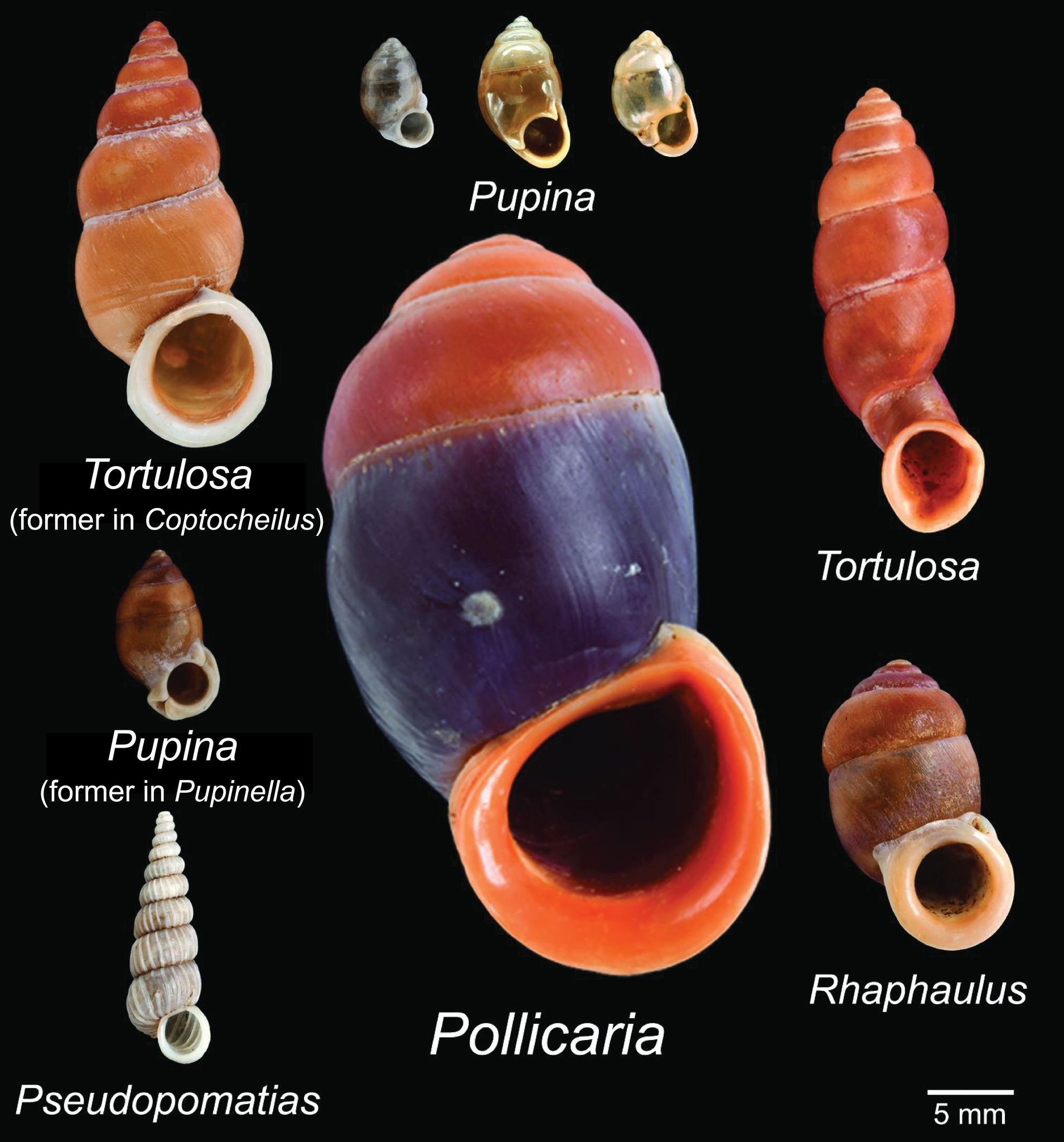
[Mollusca • 2025] Molecular Phylogeny of the Operculated Land Snail Family Pupinidae (Caenogastropoda: Cyclophoroidea) in mainland Southeast Asia


Molecular Phylogeny of the Family Pupinidae

in Jirapatrasilp, Tongkerd, Páll-Gergely, Lee, Panha, Becher, Hausdorf et Sutcharit, 2025.

Abstract
The operculated land snail family Pupinidae from mainland Southeast Asia has been systematically revised based on shell morphology. Despite previous morphological studies, the evolutionary relationships within this family remained unclear. This study represents the first comprehensive molecular phylogeny of this snail group, utilising two mitochondrial (COI and 16S rRNA) and two nuclear (5.8S rRNA + ITS2 and 28S rRNA) genetic markers. Additionally, we conducted phylogenetic analyses of Pupina species from 1106 loci generated through double-digest restriction site-associated DNA sequencing (ddRADseq). It turned out that Southeast Asian Pollicaria emerged as a sister clade to Central American Aperostoma of the Megalomastomatidae, leading to the resurrection of the Pollicariidae. Among the remaining pupinid genera, Tortulosa was nested within the Coptocheilus clade, while Pupina and Pupinella were not monophyletic. The previously recognised Pupina arula species group was found to be monophyletic and was reclassified into Tylotoechus (formerly a Pupina subgenus), based on distinctive conchological characters such as an extending parietal tooth from a parietal callus and a wide, outward-curving posterior canal. However, some Pupina and Tylotoechus species were not retrieved as monophyletic, suggesting the presence of multiple ‘cryptic species’. Divergence time estimation indicated that the Pupinidae split could date back to the Late Triassic to Early Cretaceous, with the first diversification of pupinid genera occurring during the Middle Jurassic and Early Cretaceous. This successful reconstruction of a robust phylogeny using ddRADseq loci demonstrates the significant potential of RADseq techniques in elucidating the evolutionary relationships of deeply divergent taxa. Further studies incorporating the type species Tylotoechus destructus and Pupina keraudrenii are necessary to justify the usage of these genera.

Keywords: cryptic species, ddRADseq, divergence time estimation, Pollicariidae, systematics


A-C Pollicaria [Pollicariidae]
Tortulosa [Pupinidae] E-H Pupina [Pupinidae]
 Jirapatrasilp et al. (2022)

Jirapatrasilp et al. (2022)


 Parin Jirapatrasilp, Piyoros Tongkerd, Barna Páll-Gergely, Chi-Tse Lee, Somsak Panha, Elisa Becher, Bernhard Hausdorf and Chirasak Sutcharit. 2025. Molecular Phylogeny of the Operculated Land Snail Family Pupinidae (Caenogastropoda, Cyclophoroidea) in mainland Southeast Asia. Zoologica Scripta. DOI: doi.org/10.1111/zsc.12727 [07 April 2025]

 A-C หอยหูช้างสกุล Pollicaria D หอยเกลียวเชือกฝาสปริงสกุล Tortulosa E-H หอยเปลือกมันสกุล Pupina 

Saturday, April 19, 2025

[Herpetology • 2025] Homonota chelemini • A New Gecko (Phyllodactylidae: Homonota whitii group) from the Diaguita highlands, Argentina, with an updated phylogeny for the genus


Homonota chelemini 
Morando, Sánchez, Vrdoljak, Pérez, Sites & Avila, 2025
 

Abstract
The South American Transition Zone (SATZ) connects the Neotropical and Andean regions, stretching from western Venezuela to northern Chile and central-western Argentina. In Argentina, the northwestern Altoandina Cuyana province includes arid and semi-arid ecosystems, particularly the Diaguita District, spanning Catamarca, La Rioja and northern San Juan. This mountainous region, including the Sierra de Famatina and Cordillera Frontal de los Andes, hosts species adapted to extreme conditions. Despite its biodiversity, the region's endemicity and phylogenetic uniqueness remain poorly understood, especially as these ecosystems face growing climate threats, such as heatwaves. Geckos (Order Gekkota) are one of the oldest lizard clades, with divergences over 150 million years ago. Particularly, the genus Homonota (Phyllodactylidae) is endemic to the southern cone of South America, primarily in Argentina, with species also found in Brazil, Paraguay, Bolivia and Uruguay. As part of a broader investigation on geckos of this genus and to advance their systematic study, we generated data from two mitochondrial and 12 autosomal loci across 14 species, along with a comprehensive morphological dataset of meristic measurements and scale counts. Detailed analyses were conducted within an integrative species assessment framework. Consequently, we describe a new species of Homonota from the Diaguita biogeographic district in northwestern Argentina, representing the northernmost member of the H. whitii group. The species inhabits a mountainous region known for its micro-endemism, further highlighting the area as an important biodiversity hotspot for dryland ecosystems. Additionally, we provide an updated molecular phylogenetic hypothesis for the genus, offering new insights into the evolutionary history within Homonota and the broader biodiversity of the SATZ.

Keywords: endemic, integrative taxonomy, lizard, NW Argentina,  South American Transition Zone (SATZ)


Homonota chelemini sp. n. 


Mariana Morando, Kevin I. Sánchez, Juan E. Vrdoljak, Cristian H. F. Pérez, Jack W. Sites Jr. and Luciano J. Avila. 2025. A New Gecko (Phyllodactylidae: Homonota whitii group) from the Diaguita highlands, Argentina, with an updated phylogeny for the genus. Zoologica Scripta, 00, 1–19. DOI: doi.org/10.1111/zsc.12725 [01 March 2025]

Un nuevo gecko para la fauna de lagartijas de Argentina

Thursday, October 24, 2024

[Mollusca • 2023] Parabrachidontes amnicus • A New lineage of Fresh- and Brackish-water Mussels (Bivalvia: Mytilidae) from Southeast Asia


Parabrachidontes amnicus 
K. S. Tan, S. H. M. Tan, Sanpanich, Duangdee & Ambarwati, 2023


Abstract
Three species of mussels collected from fresh- and low salinity (10 psu or lower) brackish-water environments in southern Thailand, Singapore, northern Borneo and south Sulawesi formed a new, well-supported and distinct mytilid clade based on molecular phylogeny. All are small (< 30 mm) species with either radially ribbed or smooth shells. Internally, the upper edges of the ascending lamellae of the outer and inner demibranchs are, respectively, fused to the mantle lobes and visceral mass. A new genus Parabrachidontes is proposed to accommodate the three species. Of the species in the new genus, one is described as new (Parabrachidontes amnicus sp. n.), and the other two poorly known species (P. leucostictus and P. cochinensis) are re-described. The Parabrachidontes clade is closely related to Mytella, Perna and Arcuatula. Together, they formed a well-supported clade, most members of which have ctenidial edges attached to the mantle and/or visceral mass. These genera are clearly distinct phylogenetically from two other mytilid clades containing brackish- and fresh-water species with ctenidia free of the mantle: one comprising the genera Limnoperna and Sinomytilus (together constituting the Limnoperninae), and the other Xenostrobus and Vignadula (forming the Xenostrobinae). We therefore suggest the existence of at least three lineages of mytilids living in rivers and estuaries of East Asia and Australasia.

Keywords: Mytiloidea, Pteriomorphia, systematics, taxonomy

Parabrachidontes amnicus sp. n., Khlong Pak Bara, Satun Province, Thailand.
a, b. Holotype, PMBC 30680, SL = 15.2 mm, BET 1 (see Figure 1);
c, d. Paratype, ZRC.MOL 24083, SL = 14.8 mm, BET 2 (see Figure 1);
e, f. Paratype, PMBC 30681, SL = 15.6 mm, BET 3 (see also Table S1).

Parabrachidontes amnicus sp. n.


Koh Siang Tan, Samuel H. M. Tan, Kitithorn Sanpanich, Teerapong Duangdee, Reni Ambarwati. 2023. A New lineage of Fresh- and Brackish-water Mussels (Bivalvia, Mytilidae) from Southeast Asia. Zoologica Scripta. 52(3); 298-313. DOI: doi.org/10.1111/zsc.12585

Saturday, June 22, 2024

[Ornithology • 2024] Sakesphoroides niedeguidonae • A New Antshrike (Aves: Thamnophilidae) endemic to the Caatinga and the Role of Climate Oscillations and Drainage Shift in Shaping Cryptic Diversity of Neotropical Seasonal Dry Forests


 male [back] and female [front] individuals of Sakesphoroides niedeguidonae
Cerqueira, Gonçalves, Quaresma, Silva, Pichorim & Aleixo, 2024

 Illustration by Eduardo Brettas


[Pattern 1] Sakesphoroides niedeguidonae
Cerqueira, Gonçalves, Quaresma, Silva, Pichorim & Aleixo, 2024
 
[Pattern 2] Sakesphoroides cristatus (Wied, 1831)

 
Abstract
The Caatinga is the largest patch of Seasonal Dry Tropical Forest in the Neotropics, located in northeastern Brazil and characterized mainly by deciduous vegetation and extreme rainfall seasonality. It has historically been treated as a biologically impoverished domain, but recent studies uncovered new diversification patterns and several new taxa of frogs, mammals, insects, and fishes. Here we employed a dense sampling regime to evaluate whether the São Francisco River (SFR) would have promoted genetic diversification and fixed phenotypic differences and how Quaternary climatic oscillations shaped distribution and population sizes in a Caatinga endemic species, the Silvery-cheeked Antshrike (Sakesphoroides cristatus). We adopted an integrative approach using multilocus genetic, plumage, vocal data, and ecological niche modelling (ENM) to characterize evolutionary units and niche suitability in past scenarios. We recovered strong genetic structure across the SFR that was congruent with plumage and vocal variation, revealing a yet undescribed species named herein as Sakesphoroides niedeguidonae, sp. nov.. The splitting time estimated between the newly described species and S. cristatus is consistent with the establishment of the modern course of SFR, with a more recent course shift apparently promoting the secondary contact between the two species in the Raso da Catarina region. After their split, both species experienced increases in population sizes and range sizes at similar times during the Last Glacial Maximum. We expect other Caatinga avian endemic lineages to show similar patterns of genetic differentiation across the SFR that were enhanced by Quaternary climatic oscillations.

Geographic distribution of diagnostic plumage characters in Sakesphoroides cristatus females. Green and blue circles represent diagnostic patterns numbered 1 and 2, respectively, recovered from plumage analyses using study skins and digital photographs (see text for details). The dark-blue line represents the modern course of the São Francisco River (SFR), with the red dashed lines representing the estimated position of abandoned meanders of a Late Pleistocene paleocourse of the SFR. The colour gradient represents altitudinal variation.
Credit photos: Rocílio Ribeiro Rocha (pattern 1) and Oberdan Nunes (pattern 2).

...
Once we defined S. cristatus as the applicable name for clade 2 and no taxon name is available for clade 1 birds, herein we describe the latter group as a new species:


 male [back] and female [front] individuals of Sakesphoroides niedeguidonae 
Illustration by Eduardo Brettas, from Cerqueira et al., 2024)


Sakesphoroides niedeguidonae, sp. nov. Cerqueira, Gonçalves, Quaresma, Silva, Pichorim & Aleixo

Northern Silvery-cheeked Antshrike (English).
Choca-do-nordeste-de-cauda-barrada (Portuguese).

 Diagnosis: 
Morphology: The new species is assigned to the genus Sakesphoroides based on its morphological diagnostic characters as described by Grantsau (2010), and its sister relationship to Sakesphoroides cristatus.

Males of Sakesphoroides niedeguidonae are similar in plumage to Sakesphoroides cristatus, but females differ from the former by distinct crown, back, and tail colours, (Table 1). Sakesphoroides niedeguidonae has an overall lighter (Amber) colour rather than Chestnut as S. cristatus. The back is olive brown in S. niedeguidonae, whereas that of S. cristatus is Cinnamon-Brown. The overall tail colour in S. niedeguidonae is darker than in S. cristatus, with the most conspicuous difference being the black and white barring, replaced in S. cristatus only by discreet dull brown and rufous bars and complete absence of white barring (Figure S1).

Voice: The loudsong of S. niedeguidonae is slightly similar in general pattern to that of S. cristatus, but differs conspicuously by the shape of the first notes. While the loudsong of S. niedeguidonae has initial notes with an ascending–descending pattern of frequency modulation, looking visually like an inverted ‘U’ letter on sound spectrograms, that of S. cristatus has initial ascending notes reaching quickly a high frequency (~2300 Hz) and then descending to the maximum amplitude and continuing to descend further to a lower frequency (~580 Hz), which confers to it a sigmoid shape on spectrograms (Figure 2). Additionally, the loudsong of S. niedeguidonae differs from that of S. cristatus by a significantly greater number of notes, longer overall duration, and slower pace in total song (see Table 3). Female recordings present noticeable higher pitched songs than males (ML579640291; Macaulay Library of Natural Sounds, Cornell Laboratory of Ornithology, Ithaca).

Etymology: 
It is our pleasure to name this species in honour of Niède Guidon, a Brazilian archaeologist who in 1970's explored the largest and oldest concentration of prehistoric sites in the Americas. Niède's efforts helped to create the Serra da Capivara National Park in Piauí state, where her research found evidence of artefacts that have provoked a re-evaluation of the traditional theories about human settlement in the Americas. Moreover, she is a symbol of power and persistence in preserving the Caatinga environment not just for archaeological purposes but also considering biodiversity and local human communities, highlighting the Caatinga as a singular place in the world, which has inspired us every day.

The English name (Northern Silvery-cheeked Antshrike) is a reference to its range in the Caatinga domain and the sister taxon S. cristatus (now called Southern Silvery-cheeked Antshrike). The Portuguese name (Choca-do-nordeste-de-cauda-barrada) highlights the main plumage feature in females distinguishing the new species from S. cristatus (Choca-do-nordeste in Portuguese). Both names maintain in its composition the name used in S. cristatus for an easy reference to their close phylogenetic relationship.


Pablo Cerqueira, Gabriela R. Gonçalves, Tânia F. Quaresma, Marcelo Silva, Mauro Pichorim and Alexandre Aleixo. 2024. A New Antshrike (Aves: Thamnophilidae) endemic to the Caatinga and the Role of Climate Oscillations and Drainage Shift in Shaping Cryptic Diversity of Neotropical Seasonal Dry Forests. Zoologica Scripta. DOI: 10.1111/zsc.12672

Nova espécie de ave da Caatinga é descoberta e tem origem em variações históricas do São Francisco
https://abori.com.br/ambiente/aves-da-caatinga-mudancas-climaticas-nova-especie/

Friday, October 27, 2023

[Herpetology • 2023] Independent Origins or Single Dispersal? Phylogenetic Study supports early Cenozoic Origin of Three Endemic Indo-Sri Lankan Lygosomine Skink Genera


Kaestlea, Ristella and Lankascincus

in Ghosh, Sil, Ukuwela & Datta-Roy, 2023
 
Abstract
The Western Ghats-Sri Lanka biodiversity hotspot is home to three endemic Lygosomine (Reptilia, Scincidae) skink genera—Kaestlea, Ristella and Lankascincus. Phylogenetic reconstructions in the past have suggested a sister relationship between the Western Ghats endemic Ristella and the Sri Lankan endemic Lankascincus, while the placement of Kaestlea has been uncertain. We reconstruct a global, genus-level, multi-locus phylogeny of the sub-family Lygosominae to ask if these endemic genera share an immediate common ancestor, that is, did they arise from a single dispersal event? Furthermore, to understand the possible centres of origin and dispersal routes of these three genera of Indo-Sri Lankan skinks, we construct a time-calibrated phylogeny and perform ancestral range evolution. We find that Kaestlea does not share an immediate ancestor with Ristella + Lankascincus. Therefore, their presence in the Indian subcontinent results from two independent colonization events. Both these dispersal events likely occurred during the late Palaeocene-early Eocene from the Asian landmass. Our molecular dating and ancestral range evolution analyses add further evidence of probable transoceanic dispersal in skinks and early land connections between the Indian subcontinent and Asia. It also reveals that these skinks were some of the earliest lizards to disperse into the Indian subcontinent.

Keywords: dispersal, early Eocene, late Palaeocene, Lygosominae, KaestleaLankascincusRistella


Avrajjal Ghosh, Maitreya Sil, Kanishka B. Ukuwela and Aniruddha Datta-Roy. 2023. Independent Origins or Single Dispersal? Phylogenetic Study supports early Cenozoic Origin of Three Endemic Indo-Sri Lankan Lygosomine Skink Genera. Zoologica Scripta. DOI: 10.1111/zsc.12635
Researchgate.net/publication/374762333

Saturday, August 12, 2023

[Ichthyology • 2023] Molecular Phylogeny and Systematics of the South Asian Freshwater-fish Genus Puntius (Cypriniformes: Cyprinidae)


in Sudasinghe, Rüber & Meegaskumbura, 2023.  
  DOI: 10.1111/zsc.12618 

Abstract
During the past decade, the ca 120 species of small, colourful tropical Asian freshwater fishes previously referred to the cyprinid genus Puntius have been shown to consist of multiple morphologically distinct evolutionary lineages that resolve as monophyletic groups in molecular studies. Many of these clades have been allocated to new genera such as Dawkinsia, Desmopuntius, Haludaria, Oliotius, Pethia, Puntigrus, Sahyadria, Striuntius and Waikhomia. Others have been assigned to existing but previously poorly delineated genera such as Barbodes and Systomus, while some 40 species remain in Puntius. The divergent morphology of several species retained in Puntius suggests, however, that the systematics of this group requires further attention. Here, based on a phylogeny incorporating newly generated data from the mitochondrial cytochrome b (cytb), mitochondrial cytochrome c oxidase subunit 1 (cox1), nuclear recombination activating protein 1 (rag1), and interphotoreceptor retinoid-binding protein (irbp) gene markers, we investigate the interrelationships of the species of Puntius in Sri Lanka in the wider context of their Indian and Southeast Asian congeners. We identify three well-supported monophyletic groups that warrant recognition as new genera: Rohanella (type species Puntius titteya), Plesiopuntius (type species Gnathopogon bimaculatus) and Bhava (type species Puntius vittatus). The first of these is endemic to rainforest streams in Sri Lanka's perhumid southwestern wet zone, whereas the latter two are widely distributed in both Sri Lanka and southern India, including the Western Ghats. Our study highlights the presence of distinct evolutionary lineages among several widespread species.
  
Keywords: Cypriniformes, India, Smiliogastrinae, Sri Lanka, taxonomy


 Plesiopuntius gen. nov. bimaculatus
[Puntius bimaculatus
Bhava gen. nov. vittata
[Puntius vittatus]
 Rohanella gen. nov. titteya
[Puntius titteya]


Hiranya Sudasinghe, Lukas Rüber and Madhava Meegaskumbura. 2023. Molecular Phylogeny and Systematics of the South Asian Freshwater-fish Genus Puntius (Teleostei: Cyprinidae). Zoologica Scripta. DOI: 10.1111/zsc.12618


Sunday, April 30, 2023

[Ornithology • 2023] Evolutionary History of New World Crakes (Aves: Rallidae) with Emphasis on the Tribe Laterallini


in Depino, Pérez-Emán, Bonaccorso et Areta, 2023.   

Abstract 
New World crakes are intriguing, poorly known birds with cursorial cryptic habits; they belong to two unrelated tribes: Laterallini and Pardirallini. Recent genetic studies contributed to the phylogenetic knowledge of these tribes, but a complete phylogenetic reconstruction is still missing. Here, we present the most taxonomically complete dated gene-based phylogeny of New World crakes, with an emphasis on the Laterallini, including for the first time sequences of Coturnicops notatus, Laterallus levraudi, L. jamaicensis tuerosi and L. xenopterus. We used multilocus (mtDNA + nucDNA) phylogenetic analyses and interpreted our results in light of the natural history of the group. Our novel results show that: (1) L. xenopterus is sister to L. leucopyrrhus; (2) L. j. tuerosi is sister to L. spilonota; (3) C. notatus is sister to the clade that groups the remaining New World black crakes (L. jamaicensis, L. j. tuerosi, L. rogersi, L. spilonota and L. spilopterus); and (4) L. levraudi and L. melanophaius conform a recently diverged clade. Thus, our results indicate polyphyly in this group, particularly for Laterallus and, for the first time, for Coturnicops. We show that some discrepancies with previous studies stem from misidentified samples or sequences of L. leucopyrrhus and Anurolimnas fasciatus. Finally, we provide new preliminary insights into species limits of some taxa, specifically for L. levraudi, L. melanophaius and L. j. tuerosi. Our results set the stage for integrative taxonomic assessments at the generic level in the Laterallini by incorporating phylogenetic (gene-based) and natural history data.

Keywords: Coturnicops notatus, Laterallus jamaicensis tuerosi, Laterallus levraudi, Laterallus xenopterus,natural history, rails, systematics 


 Emiliano A. Depino, Jorge L. Pérez-Emán, Elisa Bonaccorso and Juan I. Areta. 2023. Evolutionary History of New World Crakes (Aves: Rallidae) with Emphasis on the Tribe Laterallini. 
Zoologica Scripta. DOI: 10.1111/zsc.12595  


Sunday, March 12, 2023

[Herpetology • 2023] Integrative Approach resolves the Systematics of Barred Wolf Snakes in the Lycodon striatus Complex (Reptilia: Colubridae)


Barred Wolf Snakes in the Lycodon striatus Complex
 
in Amarasinghe, Masroor, Lalremsanga, Weerakkody, ... et Jablonski, 2023.
 
Abstract
We reviewed the systematics of Lycodon striatus (Shaw, 1802), including all available name-bearing types of its synonyms after evaluating phylogeographic (genetics), morphological (morphometry, meristic, and hemipenes), osteological and distribution evidence. Lycodon striatus sensu lato is widely distributed throughout South and Central Asia and mimics elapids. Based on phylogenetic analyses of mitochondrial DNA, we demonstrate that populations from (i) eastern and central Peninsular India plus Sri Lanka and (ii) south-western parts of Central Asia form two different clades representing two distinct species: L. striatus sensu stricto and L. bicolor comb. nov. respectively. These two clades are sisters to L. deccanensis (in the case of L. striatus) and L. jara (in the case of L. bicolor) and together form two main sister radiations. Although the external morphological variability is high in both species, the genetic variability is higher only in L. striatus but not distinct enough to represent more than one species if using the phylogenetic or biological species concept. The phylogeny of the L. aulicus group hints at Sri Lankan L. striatus, likely having evolved in continental Asia through a probable overland dispersal across the Bay of Bengal (present Palk Strait) into Sri Lanka. This dispersal may have been facilitated by low sea levels during the Pleistocene glaciations when Sri Lanka was connected to mainland India. After considering genetic divergence (with a p-distance of 1.8%–2.1% in the mitochondrial cytochrome b gene) and morphological evidence, we synonymize the Sri Lankan subspecies, L. s. sinhaleyus Deraniyagala, 1955, with L. striatus sensu stricto. The eastern and central Indian L. striatus (i.e. L. striatus sensu stricto) is morphologically distinct and deeply divergent genetically compared to Tajik and Pakistani L. bicolor with a p-distance of 13.6% in cytochrome b gene (mtDNA). Interestingly, L. bicolor is conspecific (p-distance 1.4%) with L. mackinnoni, a western Himalayan endemic, and it reveals intraspecific clinal variation.

Keywords: Asia, iconotype, Lycodon mackinnoniLycodon striatus sinhaleyus, neotype, nomen dubium, subspecies


Amarasinghe A. Thasun Amarasinghe, Rafaqat Masroor, Hmar T. Lalremsanga, Sanjaya Weerakkody, Natalia B. Ananjeva, Patrick D. Campbell, Stevie R. Kennedy-Gold, Sanjaya K. Bandara, Andrey M. Bragin, Atthanagoda K. A. Gayan, Vivek R. Sharma, Amit Sayyed, Lal Biakzuala, Andradige S. Kanishka, Sumaithangi R. Ganesh, Ivan Ineich, Anslem de Silva, Lakshman J. M. Wickramasinghe, Sampath S. Seneviratne, Nikolay A. Poyarkov, Gernot Vogel and Daniel Jablonski. 2023. Integrative Approach resolves the Systematics of Barred Wolf Snakes in the Lycodon striatus Complex (Reptilia, Colubridae). Zoologica Scripta. DOI: 10.1111/zsc.12587 


Saturday, February 4, 2023

[Herpetology • 2023] Cyrtodactylus hutan & C. kapitensis • Genomic Analysis of Bornean Geckos (Gekkonidae: Cyrtodactylus) reveals Need For Updated Taxonomy


Cyrtodactylus sp. 
Davis, Nashriq, Woytek, Wikramanayake, Bauer, Karin, Brennan, Iskandar & Das, 2023


Abstract
Using molecular genetic data, recognised diversity within the gecko genus Cyrtodactylus has more than doubled, with many lineages that were once thought to be wide-ranging being delimited into multiple independent species. On the Southeast Asian island of Borneo, there has been a recent renewed focus on reptile taxonomy, as genetic data have demonstrated a high amount of unrecognised biodiversity. We herein advance this taxonomic trend by delimiting three distinct species within the Cyrtodactylus consobrinus species complex: C. consobrinusC. kapitensis sp. n., and C. hutan sp. n. To do so, we use a combination of ddRADseq and single-locus data, and morphological data. Using genomic data, we test species and population boundaries within the consobrinus species complex and show minimal population structure but high species-level diversity. Despite not finding uniquely diagnostic morphological characters to delimit the new species, we suggest a combination of characters that can be used to identify each lineage. Lastly, we use our data to comment on the status of C. malayanus, with indications that this lineage is also better considered a species complex. These data highlight the prevalence of unrecognised lineages on Borneo, many of which face threats due to increasing deforestation and other anthropogenic pressures.

Keywords: ddRADseq, morphology, multispecies coalescent, population genetics, Southeast Asia, species delimitation


Hayden R. Davis, Izneil Nashriq, Kyra S. Woytek, Shanelle A. Wikramanayake, Aaron M. Bauer, Benjamin R. Karin, Ian G. Brennan, Djoko T. Iskandar and Indraneil Das. 2023. Genomic Analysis of Bornean Geckos (Gekkonidae: Cyrtodactylus) reveals Need For Updated Taxonomy. Zoologica Scripta. DOI: 10.1111/zsc.12575