Showing posts with label Campanulaceae. Show all posts

Monday, June 15, 2026

[Botany • 2018] Lobelia hongiana (Campanulaceae) • A New Species from Guangxi, China


Lobelia hongiana Q.F.Wang & G.W.Hu, 

in Li, Wei, Liu, Chen, Hu et Wang, 2018.

Abstract
Lobelia hongiana, a new species of Campanulaceae from Guangxi, South China, is described and illustrated here. This new species is most similar to L. chinensis and L. loochooensis, but differs by its elliptic-obovate or oblanceolate leaf, 2.5–3 mm long greenish-carmine hypanthium, 5 or 6 calyx lobes, purplish-white corolla, with yellowish-green blotches at the base of lower lobes, glabrous filaments, 7–8 mm long broadly obconic capsule. Molecular phylogenetic analysis has been conducted based on ITS and two chloroplast sequences (atpB and rbcL) and 14 taxa in Lobelia are included. L. hongiana is well supported as a new species by the evidence from both morphology and molecular phylogeny.

Keywords: Hypsela, Lobelia chinensis, Lobelia loochooensis, Southern China
 
Photos of Lobelia hongiana Q.F.Wang & G.W.Hu: morphology.
A Habitat B Part of one individual C A stem bearing leaves and a flower D–G Flower viewed from different orientations H–I Fruit viewed from different orientations.

Lobelia hongiana Q.F.Wang & G.W.Hu, sp. nov.

Diagnosis: The new species is distinguished from L. chinensis and L. loochooensis by its elliptic-obovate or oblanceolate leaves, usually sinuate-dentate margin; hypanthium 2.5–3 mm long, greenish-carmine; calyx lobes 5 or 6, shorter than hypanthium; corolla purplish-white, yellowish- green blotches at the base of lower lobes; glabrous filaments; broadly obconic capsule, 7–8 mm long; flowering time from May to July.


Distribution and ecology: The new species has been found in Huixian Wetland, Guangxi Zhuang Autonomous Region in China, with only two populations. There is a high probability that L. hongiana is also distributed at adjacent areas, given its vegetative propagation traits. Its living environment is wetland and farmland.

Phenology: The new species was found in flower from May to July.

Etymology: Species epithet, “hongiana”, is in honour of Prof. De-Yuan Hong who made a significant contribution to the authors’ knowledge of Campanulaceae.

 Zhi-Zhong Li, Neng Wei, Yan Liu, Jin-Ming Chen, Guangwan Hu and Qing-Feng Wang. 2018. Lobelia hongiana (Campanulaceae), A New Species from Guangxi, China. PhytoKeys. 95: 27-36.  DOI: doi.org/10.3897/phytokeys.95.20245

Thursday, April 16, 2026

[Botany • 2026] Lobelia janardhananii (Lobeliaceae) • A New Species from the Western Ghats of India


Lobelia janardhananii K.M.P.Kumar & Sunil, 

in Sunil, Prabhukumar, Sivadas, Sanilkumar et Robi, 2026.

Abstract
A new species of Lobelia, L. janardhananii K.M.P.Kumar & Sunil is described from Kerala, India. It resembles Lobelia heyneana Schult. in herbaceous habit and axillary solitary flowers but differs from the latter by leaf shape, texture, flower length, compressed or ancipitous pedicel, characters of calyx lobe, the colour of corolla tube and lobe, size and colour of stamens, stylar length and seeds. A detailed description and photographs are provided for the identification of the species.

Keyword: Agasthyamala Biosphere Reserve, Kerala, Lobelia heyneana, Lobelia janardhananii, perennial, taxonomy

Lobelia janardhananii sp. nov.
 A–C. Flowering shoot, D. C.S. of stem, E. Leaf adaxial side, F. Leaf abaxial side.

Lobelia janardhananii sp. nov.
A. Flower, B. Pedicel with bracteoles, C. Calyx, D. Calyx lobe, E. Corolla split open, F. Staminal column with anthers, G. Anthers, H. Style and stigma, H1. Stigma closeup view, I. Immature capsule, J. Seeds.

Lobelia janardhananii K.M.P.Kumar & Sunil, sp. nov.  

Diagnosis: Lobelia janardhananii sp. nov. is morphologically similar to L. heyneana, but differs in the rhomboid, elliptic or ovate leaves, 1.5–4 × 0.4–2 cm, attenuate base (vs. elliptic to sub-orbicular, 0.6–0.8 × 0.4– 0.8 cm; base truncate and decurrent); flowers 14–17 mm long (vs. 8.7–9.2 mm long); pedicel compressed or ancipitous, bibracteolate near middle (vs. trigonous, bracteoles absent); sepals toothed, hirsute abaxially (vs. entire, glabrous on both sides); corolla tube blue (vs. tube white); upper lip 3–4 mm long, whitish-blue; lower lip bright blue (vs. upper lip white; lower lip pale violet); filament of stamens 4.5–5 mm long, purplish (vs. 1.3–1.4 mm long, light green).  

Etymology: The specific epithet is to honour the contributions of Sri. N.K. Janardhanan, Gardner, Herb Garden, Arya Vaidya Sala, Kottakkal, for his 45 years of dedicated service towards the conservation of threatened plants, especially medicinal plants. 


Chandrasseril Narayanan Sunil, Konickal Mambetta Prabhukumar, Deepu Sivadas, Malayil Gopalan Sanilkumar and Aloor Jose Robi. 2026. A New Species of Lobelia (Lobeliaceae) from the Western Ghats of India. Taiwania. 71(2); 243-246 DOI: 10.6165/tai.2026.71.243 [2026 March 21] 
 

Friday, March 13, 2026

[Botany • 2026] Solenopsis sphaciotica (Campanulaceae: Lobelioideae) • A New Species from Crete


Solenopsis sphaciotica Cambria, Giusso, Miniss. & Brullo,

in Cambria, Giusso Del Galdo, Minissale, Siracusa et Brullo, 2026. 

Abstract
A new species of Solenopsis (Campanulaceae), S. sphaciotica, is described and illustrated from Crete, Greece. Morphologically, it shows close affinities with S. gutermannii by having a small size, annual habit and rosulate leaves. Although it was previously confused with S. minuta due to similarities in habit and some flower traits, several relevant morphological features clearly distinguish it from the latter. Furthermore, while it shares the annual life form, rosulate leaves and corolla shape with S. antiphonitis, it is also well differentiated from that species. This study provides a comprehensive examination of the species’ morphology, seed coat and pollen micro-sculpturing, ecology, distribution, conservation status and taxonomic relationships.

Key words: Lobelioideae, Mediterranean region, morphology, pollen, seed testa, Solenopsis, taxonomy

Phenological features of Solenopsis sphaciotica.
A. Natural habitat (Crete); B, C. Habit; D. Flower (frontal view).
 Photos by S. Cambria.

Solenopsis sphaciotica Cambria, Giusso, Miniss. & Brullo, sp. nov.
  
Diagnosis. The new species is similar to Solenopsis minuta in having rosulate leaves, bracteole indumentum and corolla colour; however, it differs in having a much reduced annual habit with smaller morphological characters throughout, a more reduced leaf rosette, leaves without margin glands, smaller bracteoles, shorter calyx (1.1–2 mm long), paler and much smaller corolla (4–5 mm), up to 0.12 mm long papillae, occurring only at the base of the lower lip, shorter anther tube, staminal filament and style and smaller capsule and seeds.

Etymology. The specific epithet, sphaciotica, refers to Hora Sfakion, the locality where the new species grows.


 Salvatore Cambria, Gianpietro Giusso Del Galdo, Pietro Minissale, Giuseppe Siracusa and Salvatore Brullo. 2026. Solenopsis sphaciotica (Campanulaceae) A New Species from Crete. PhytoKeys. 271: 259-272.  DOI: doi.org/10.3897/phytokeys.271.175650 [12 Mar 2026]

Monday, July 28, 2025

[Botany • 2024] Burmeistera luciae (Campanulaceae: Lobelioideae) • A New Species from the Pacific Slope of the Northwestern Andes of Colombia


Burmeistera luciae Zapata-Corr., Garzón & D. Ruiz-Mol., 

in Zapata-CorreaGarzón-Venegas, Holguín et Molina, 2024. 
 
Abstract
A new species of Burmeistera (Campanulaceae, Lobelioideae) from the Pacific slope of the Northwestern Andes of Colombia, in the Antioquia and Chocó departments, is described. Burmeistera luciae is distinguished by being a hemiepiphytic herb with scandent and glabrous stems; ebracteate peduncle, obconic hypanthium, and its most particular feature, the filiform, ascending, and curved calyx lobes in anthesis; corolla lobes forming an obtuse angle in relation to the tube, falcate; ventral anthers barbate; ellipsoid berries that turn a striking fuchsia color when mature. These characters differentiate it from Burmeistera serraniaguae, B. succulenta, and B. crocodila, the three most morphologically similar species that also inhabit the humid Andean regions of the Chocó biogeographic region between Colombia and Ecuador. Additional comments related to its distribution, etymology, and conservation status are presented.

Antioquia, Asterales, Chocó biogeographic region, Neotropical flora, Eudicots

 Field images of Burmeistera luciae Zapata-Corr., Garzón & D. Ruiz-Mol.
A. Leaves, adaxial view. B. Leaves, abaxial view. C. Flower bud, lateral view. D. Flower at anthesis, lateral view; detail of ventral anthers barbate and stigma in lower left inset. E. Immature berry, lateral view. F. Mature berry, lateral view G. Mature fruit, cross-section.
A–G based on D. Zapata-C. et al. 3051. Photographs by Andrés F. Caro H.

Burmeistera luciae Zapata-Corr., Garzón & D. Ruiz-Mol., sp. nov.

 Details of flowers and fruits in three morphologically similar species.
 A-C. Burmeistera serraniaguae Garzón & F. González; A. Flower at anthesis, ventral view. B. Flower at anthesis. C. Mature berry.
D-F. Burmeistera succulenta H. Karst. & Triana; D. Flower bud. E. Flower at anthesis. F. Mature berry.
G-I. Burmeistera luciae Zapata-Corr., Garzón & D. Ruiz-Mol.; G. Flower bud. H. Flower at anthesis. I. Mature berry.
 A-C based on Garzón et al. 485; D-F based on Garzón 491; G-I based on D. Zapata-C. et al. 3051 (type).


Diego Alejandro ZAPATA-CORREA, Javier GARZÓN-VENEGAS, Andrés Felipe Caro HOLGUÍN and Daniel Ruiz MOLINA. 2024. A New Species of Burmeistera (Campanulaceae, Lobelioideae) from the Pacific Slope of the Northwestern Andes of Colombia. Phytotaxa. 637(3); 269-277. DOI: doi.org/10.11646/phytotaxa.637.3.5 [2024-02-22] 

Wednesday, April 23, 2025

[Botany • 2025] Solenopsis gutermannii (Campanulaceae) • A New Species from Kefalonia (Ionian Islands, Greece)


 Solenopsis gutermannii Brullo, Cambria, Costanzo& Giusso,
 
in Brullo, Gilli, Berger, Cambria, Costanzo, Siracusa et Galdo. 2025. 

Abstract
A new species of Solenopsis (Campanulaceae), S. gutermannii is described and illustrated. It is endemic to Kefalonia island, Greece, where it is very rare and localized in flat clay surfaces that are periodically submerged. This species is a very small annual hygrophyte, characterized by rosulate leaves or with slightly caulescent stems, long-pedunculated flowers, bilabiate corolla, and papillate near the throat. It exhibits close affinities primarily with S. minuta, with which it was previously identified, and additionally with S. antiphonitis, due to similarities in habit and certain flower traits. Nevertheless, several relevant morphological features serve to distinguish it from these species. Its morphology, seed coat and pollen SEM micro-sculpturing, ecology, phenology, distribution, conservation status, and taxonomic relationships are also examined.

Keywords: Lobelioideae; Mediterranean region; morphology; pollen; seed testa; Solenopsis; taxonomy

 Solenopsis gutermannii from type locality.
(A) Habit; (B) Habit magnification (×2); (C) Leaves; (D) Bracteoles; (E) Flower (frontal view); (F) Flower (lateral view); (G) Open corolla; (H) Open calyx; (I) Calyx with capsule; (J) Anthers (frontal view); (K) Anthers (lateral view); (L) Style and stigma; (M) Corolla papillae; (N) Seeds.
Drawing: S. Brullo.

 Habit of living plants of  Solenopsis gutermannii from Kefalonia.
(A) Stemless individual. (B) Caulescent individual.

 Solenopsis gutermannii Brullo, Cambria, Costanzo& Giusso, sp. nov.  

Diagnosis: Solenopsis gutermannii is similar to S. minuta in having usually rosulate leaves, bracteole indumentum, and corolla colour, but it differs in having a permanent annual habit, being acaulescent or briefly scapose, having a leaf rosette 1.2–2 cm in diameter, leaves no more than 12 mm long, with blade entire or weakly crenate without glands at the margin, usually smaller, with a smaller bracteole, smaller calyx (2.5–3.3 mm long), shorter calyx lobes, shorter corolla (6–7 mm long), smaller upper lips of the corolla (2.5–2.7 × 1.8–2.2 mm), not papillate, shorter lower lip of the corolla (3.7–4.2 mm long), papillate at the base, with papillae usually being shorter (0.02–0.2 mm), the staminal filaments and anther tube usually being shorter, the capsule being smaller and papillose, and the seeds smaller.

Etymology: The species is dedicated to the late Walter Gutermann, Austrian botanist from Vienna (1935–2023), and expert on the flora of Austria and the Ionian Islands (Greece), who was the first to discover this species in Kefalonia.


Salvatore Brullo, Christian Gilli, Andreas Berger, Salvatore Cambria, Emanuele Costanzo,Giuseppe Siracusa and Gianpietro Giusso del Galdo. 2025. Solenopsis gutermannii (Campanulaceae), a New Species from Kefalonia (Ionian Islands, Greece). Taxonomy. 5(1); 13; DOI: doi.org/10.3390/taxonomy5010013  [7 March 2025]


Monday, August 26, 2024

[Botany • 2024] Asyneuma yildizianum (Campanulaceae) • A New Species from SW Türkiye


Asyneuma yildizianum Yıldırım & Özdöl, 

in Yıldırım et Özdöl, 2024.
zeybekdeğneği  ||  DOI: 10.1007/s12225-024-10206-3 

Summary
Asyneuma yildizianum Yıldırım & Özdöl (Campanulaceae) is described as a new species from the Babadağ mountain range near the counties of Tavas and Babadağ in the province of Denizli in southwestern Türkiye. Diagnostic characteristics, a full description, and comprehensive photographs and micromorphology of the pollen and seeds are provided. It is morphologically related to A. virgatum subsp. cichoriiforme and A. ilgazense. The new species differs from related taxa mainly by its caespitose habit, perennial monocarpic life form, (6 –) 8 – 20-stemmed at base, 5 – 22 cm long stem and sky blue to pale violet flowers. A preliminary IUCN Red List assessment of the new species is supplied.

Key Words: Anatolia, Flora, new taxa, Turkey

A – C Asyneuma yildizianum habit when in flower.


Asyneuma yildizianum Yıldırım & Özdöl sp. nov. 


Etymology. The new Asyneuma species was named in honour of Turkish Botanist Prof. Dr Bayram Yıldız, an expert on the taxonomy of the genus Asyneuma.

Vernacular name. The Turkish name of this species is suggested as “zeybekdeğneği” according to the guidelines in Menemen et al. (2016).
 

Hasan Yıldırım and Tuğkan Özdöl. 2024. Asyneuma yildizianum (Campanulaceae), A New Species from SW Türkiye.  Kew Bulletin. DOI: doi.org/10.1007/s12225-024-10206-3

Monday, June 10, 2024

[Botany • 2024] Campanula densiciliata (Campanulaceae) • A New Species from Western Himalaya, India


 Campanula densiciliata Acharya Balkrishna, Harsh Singh, B.Joshi & R.K.Mishra, 

in Balkrishna, H. Singh, Joshi, Srivastava, Aa. Kumar, Am. Kumar, Vats, V. Singh et Mishra, 2024.

Abstract 
A new species Campanula densiciliata from Yamunotri, Uttarakhand is described and illustrated. The new species is closely related with other previously described species namely, Campanula argyrotricha and C. latifolia but, differ in its rounded leaf base with sinuate margins, much reduced calyx teeth less than half of the corolla with crenate margin, elliptic corolla lobes and different lengths of stigmatic lobes. The new species is found in humus rich soil under Rhododendron forest. 

Key words: Campanula densiciliata, new species, Uttarakhand, Yamunotri

  Campanula densiciliata Acharya Balkrishna, Harsh Singh, B.Joshi & R.K.Mishra:
A. Habit; B.; C. Front view of campanulate flower; D. Side view of campanulate flower; E. Leaf.


Campanula densiciliata Acharya Balkrishna, Harsh Singh, B.Joshi & R.K.Mishra sp. nov.

Diagnosis:— Campanula densiciliata shares similarities with C. argyrotricha, but it differs in sinuate leaves, rounded leaf base, reduced, crenate calyx teeth (less than half of the corolla), elliptic corolla lobes, and different lengths of stigmatic lobes (vs. dentate, crenate to serrate leaves, attenuate or cuneate base, entire calyx teeth half as long as corolla with entire or dentate margin and oblongoblanceolate to oblong-obovate corolla lobes, where stigmatic lobes are equally placed in C. argyrotricha. It is also similar to C. latifolia Linnaeus (1753: 165) but differs in ovate-elliptic, small (1.8–2.8 × 1.7–2.2 cm) leaves, solitary, terminal inflorescence, small flower c. 2.8 cm long, anther 1.4 mm long, stigmatic lobes with two different lengths (vs. lanceolate to ovate, large (12 × 7 cm) leaves, inflorescence on the axils of upper leaves forming a raceme, large flower 3–4 cm long, anther 8-11 mm long, same length stigmatic lobe).
  
Etymology:—The specific epithet ‘densiciliata’ is derived from its densely hairy margin of the calyx lobes.


Acharya Balkrishna, Harsh Singh, Bhasker Joshi, Anupam Srivastava, Aashish Kumar, Amit Kumar, Prashant Vats, Vikram Singh and Rajesh Kumar Mishra. 2024. A New Species of Campanula L. (Campanulaceae) from Western Himalaya, India.  Phytotaxa. 652(3);227-234. DOI: 10.11646/phytotaxa.652.3.4

Wednesday, April 10, 2024

[Botany • 2021] Campanula oreodoxa (Campanulaceae) • A New critically endangered Species from the Aladagh Mountains, NE Iran


Campanula oreodoxa Arjmandi & Memariani,

in Arjmandi, Ejtehadi, Memariani, Joharchi et Mesdaghi, 2021

Abstract
Campanula oreodoxa (Campanulaceae) is described and illustrated as a new sub-alpine species from North Khorassan province, Iran. The new species belongs to C. sect. Oreocodon based on dehiscence of the capsules with three middle pores at the base and absence of appendages between the calyx lobes. It is compared morphologically with the closely related species including C. hystricula and C. lourica. The micromorphological characters of seed coat and pollen grains of the new species are presented and compared with the chasmophytic allies in the area. Notes on distribution, habitat characterization, and the associated flora are provided. The new species is assessed as critically endangered (CR) and the conservation value of the habitats in the area is discussed.

Keywords: conservation, endemism, Khorassan- Kopet Dagh, micromorphology, Oreocodon, Saxicolae, taxonomy, Eudicots


Campanula oreodoxa Arjmandi & Memariani, sp. nov.


Ali Asghar Arjmandi, Hamid Ejtehadi, Farshid Memariani, Mohammad Reza Joharchi and Mansour Mesdaghi. 2021. Campanula oreodoxa (Campanulaceae), A New critically endangered Species from the Aladagh Mountains, NE Iran. Phytotaxa. 521(3); 193-202. DOI: 10.11646/phytotaxa.521.3.4

Thursday, March 7, 2024

[Botany • 2024] Campanula bergomensis (Campanulaceae) • A New Species from Bergamo Prealps (Northern Italy)


Campanula bergomensis  F. Mangili & L. Mangili, 

in Valle, Eustacchio, Gallo,  Beretta, Bonelli, Zanzottera, Gianfranceschi, Federici, F. Mangili, L. Mangili, Perico, Traini et Caccianiga, 2024. 
 
Abstract
A new species of Campanula (Campanulaceae), C. bergomensis sp. nov., is described from the Bergamo Prealps (Orobic Prealps, Lombardy, Northern Italy), based on both morphological and molecular evidence. The new species was considered in the past as an isolated population of C. cespitosa, which presents an eastern Alpine distribution. C. bergomensis is morphologically well distinguishable from C. cespitosa on the number of flowers in the racemose inflorescence, the corolla shape, and the whitish-yellow pollen surface with many spinulae. Genetically, the presence of an insertion of 81-bp in the trnL-F sequences is very characteristic. Further studies are needed to better define the phylogenetic relationship among the three closely related species, C. bergomensis, C. cespitosa and C. cochleariifolia. C. bergomensis inhabits dolomitic debris cones at low elevations. The species is range-restricted and is severely threatened by human activities. Therefore, it is urgent to adopt protection and conservation measures for the new species.

Key words: Biodiversity, Campanula cespitosa, Endemism, Genetics, Morphology

 
Morphological features of Campanula bergomensis
 A: plant habitus (scale bar 5 cm). B: the plant in its habitat. C: winter habitus. D: leaf shapes (scale bar 1 cm). E, F: flower shape and fresh pollen color (scale bars 1 cm).  

Campanula bergomensis F. Mangili & L. Mangili sp. nov. 

Etymology:—The epithet refers to the Province of Bergamo (called “Bergomum” in Roman antiquity), where all known populations of the new species are found.

Morphological comparison between Campanula bergomensis sp. nov. (A, C, E, G) and C. cespitosa (B, D, F, H).
A, B: plants habitus (scale bars 5 cm). C, D: flower shape. E, F: dried pollen color. G, H: pollen ornamentation observed with SEM (scale bars 5 µm).

 
Barbara Valle, Elena Eustacchio, Guido Roberto Gallo, Mario Beretta, Marco Bonelli, Alice Zanzottera, Luca Gianfranceschi, Germano Federici, Federico Mangili, Luca Mangili, Giovanni Perico, Myriam Traini and Marco Caccianiga. 2024. Campanula bergomensis (Campanulaceae), A New Species from Bergamo Prealps (Northern Italy).  Phytotaxa. 637(2); 120-132. DOI: 10.11646/phytotaxa.637.2.1

Sunday, February 25, 2024

[Botany • 2022] Solenopsis bacchettae (Campanulaceae: Lobelioideae) • A New Species from Sardinia


Solenopsis bacchettae Brullo, C.Brullo, Tavilla, Siracusa & Cambria, 

in S. Brullo, C. Brullo, Tavilla, Siracusa et Cambria, 2022. 

Abstract
A new species of Solenopsis (Campanulaceae), S. bacchettae from Sardinia (Italy) is described and illustrated. Previously, it was misidentified as S. bivonae, due to its habit and corolla shape, but several relevant morphological features allow to distinguish it from the latter. Its morphology, seed coat and pollen micromorphology, ecology, distribution, conservation status and taxonomic relationships are presented.

Keywords: angiosperms, Asterales, Italy, Laurentia, Mediterranean, flora, taxonomy


Solenopsis bacchettae Brullo, C.Brullo, Tavilla, Siracusa & Cambria


Salvatore Brullo, Cristian Brullo, Gianmarco Tavilla, Giuseppe Siracusa and Salvatore Cambria. 2022. Solenopsis bacchettae (Campanulaceae, Lobelioideae), A New Species from Sardinia. Nordic Journal of Botany. DOI: 10.1111/njb.03773

[Botany • 2019] Adenophora xiaoxiensis (Campanulaceae) • A New Endangered Species from central China


Adenophora xiaoxiensis D.G.Zhang, D.Xie & X.Y.Yi, 

in Yi, Xie, C. Zhang, Wang, Kang, Subedee et D.G. Zhang, 2019. 

Abstract
Adenophora xiaoxiensis (Campanulaceae), a new species from central China is described and illustrated. Molecular phylogenetic analysis (based on nuclear ribosomal ITS and the plastid regions trnL-F and matK) and morphology support recognition of A. xiaoxiensis as a distinct species sister to A. wilsonii. Adenophora xiaoxiensis has ovate-elliptic to broadly lanceolate cauline leaves with irregularly biserrate margins, triangular-ovate calyx lobes with 1-3 pairs subulate or linear teeth and a white corolla. About 70 individuals were observed in a restricted area of less than 100 m2. The habitat could be easily disturbed or destroyed, thus, we assessed it as endangered (EN), based on Criteria D of the International Union for Conservation of Nature Red List Categories.

Keywords: Eudicots, molecular phylogeny, morphology, Adenophora, taxonomy, endangered, IUCN

 Images of living plants of Adenophora xiaoxiensis.
A. Habit and individual, B. Inflorescence, C. Basal leaves, D. Root, E. Stamens and style, F. Sepals.

Adenophora xiaoxiensis D. G. Zhang, D. Xie & X. Y. Yi, sp. nov. 

Diagnosis. Adenophora xiaoxiensis differs from A. wilsonii in its irregularly biserrate leaf margins, ovate-elliptic to broad lanceolate cauline leaves, triangular-ovate calyx lobes with 1–3 pairs of subulate or linear teeth and white corolla 

 Morphological comparison of Adenophora wilsonii (A1-A6) and  Adenophora xiaoxiensis (B1-B6) based on flower.
Legends: (A1, B1) inflorescence; (A2, B2) flower; (A3, B3) pistil and stamen; (A4, B4) sepal; (A5, B5) leaves; (A6, B6) type specimens.


Xin-Yu Yi, Dan Xie, Cheng Zhang, Yi-Qin Wang, Yong-Quan Kang, Bijay Raj Subedee and Dai-Gui Zhang. 2019. Adenophora xiaoxiensis (Campanulaceae), An Endangered Species from China. Phytotaxa. 402(2); 88–96. DOI: 10.11646/phytotaxa.402.2.2 

Wednesday, January 31, 2024

[Botany • 2019] Campanula cremnophila (Campanulaceae)Molecular and Morphological Survey on A New isophyllous Species from Croatia


Campanula cremnophila Bogdanović, Rešetnik, M.Jeričević, N.Jeričević & Brullo,


in Bogdanović, Rešetnik, M. Jeričević, N. Jeričević et Brullo, 2019. 

Abstract
Within the isophyllous group of Campanula ser. Garganicae, represented by species of prevalent Adriatic and Ionian distribution, a rare new endemic species named C. cremnophila is described and illustrated from Pelješac Peninsula and the nearby Elaphite islands of Olipa and Jakljan (southern Croatia). It is a chasmophyte growing on calcareous rocky crevices near the sea, showing close relationship with C. garganica from southern Italy. Phylogenetic analyses based on nuclear ITS and chloroplast trnL–trnF data emphasized that C. cremnophila is distinct from other species of this group, forming a subclade with C. garganica and C. poscharskyana. The morphology, SEM microstructure of seeds and pollen grains, taxonomical relationships, ecology, conservation status of C. cremnophila, as well as an identification key including the species of the ser. Garganicae, are provided.
 
Keywords: Campanula, Dalmatia, Endemic, Phylogeny, Series Garganicae, Taxonomy

Campanula cremnophila.
a habitat; b inflorescence with flower and buds; c habit; d flowers and leaves
(photographs by S. Bogdanović and N. Jeričević)

Campanula cremnophila Bogdanović, Rešetnik, M.Jeričević, N.Jeričević & Brullo, sp. nov.

Etymology: The Greek epithet “cremnophila” refers to the ecological requirement of this species, which is a chasmophyte growing in the rocky crevices.


Sandro Bogdanović, Ivana Rešetnik, Mirjana Jeričević, Nebojša Jeričević and Salvatore Brullo. 2019. Molecular and Morphological Survey on Campanula cremnophila (Campanulaceae), A New isophyllous Species from Croatia. Plant Systematics and Evolution. 305; 687–703. DOI: 10.1007/s00606-019-01599-x 

Thursday, December 7, 2023

[Botany • 2020] Burmeistera quimiensis (Campanulaceae: Lobelioideae) • A New Species from the Cordillera del Cóndor Range in southeast Ecuador


 Burmeistera quimiensis Mashburn & Á.J.Pérez, 

 in Mashburn, Pérez,  Persson, Zapata, Cevallos et Muchhala, 2020.

Abstract
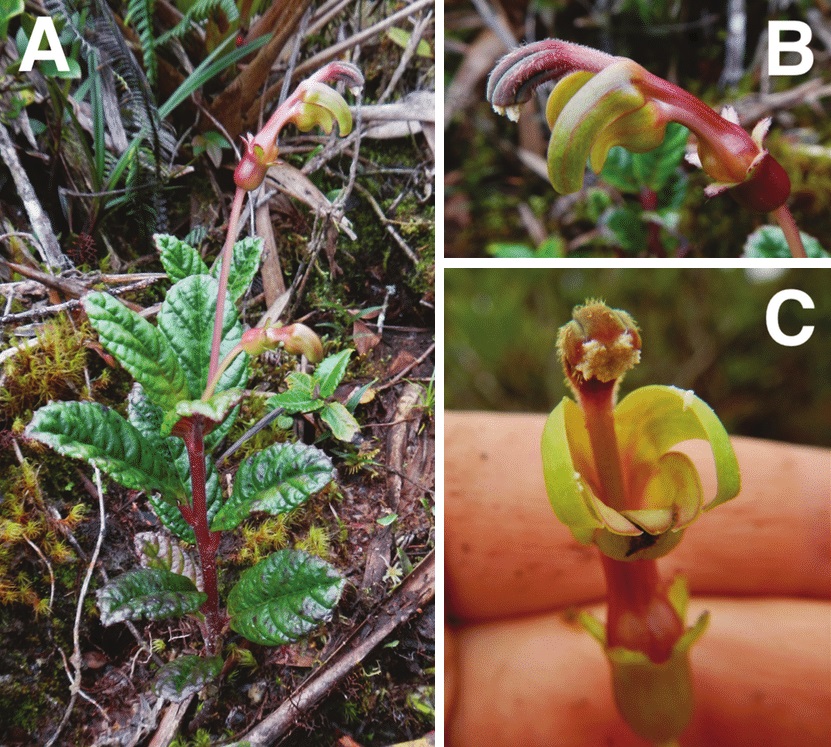
A new taxon belonging to the genus Burmeistera (Campanulaceae, Lobelioideae) is described from El Quimi Biological Reserve in Morona Santiago Province, southeast Ecuador. Burmeistera quimiensis is characterized by its red-violet stems and veins, spiral phyllotaxy, bullate, ascending leaves with a revolute margin, puberulous abaxial leaf surface, cupuliform hypanthia, and thick-walled white to red-violet fruits with reflexed pedicels. Photos of the new species are given, as well as a distribution map of known collection localities, and its relationships with other species are discussed.
 
Keywords: Andean tepuy, biodiversity, elfin forest, Girón-Paute Valley, Hollín Formation, taxonomy, Eudicots

 Burmeistera quimiensis Mashburn & Á.J.Pérez, sp. nov.
A. View of adaxial leaf surface and erect flowers. B. Lateral view of a flower in male stage with pollen load at anther tube orifice. C. Ventral view of a flower in male stage with pollen load at anther tube orifice. D. View of red-violet veins on abaxial leaf surface and red-violet fruits. E. View of white fruits and reflexed position of the fruits.
A, B, D, E from AP 11518, C from AP 11442.
 Photographs by Álvaro J. Pérez.
 
Burmeistera quimiensis Mashburn & Á.J.Pérez, sp. nov.


Brock Mashburn, Álvaro J. Pérez, Claes Persson, Nicolás Zapata, Daniela Cevallos and Nathan Muchhala. 2020. Burmeistera quimiensis (Lobelioideae, Campanulaceae): A New Species from the Cordillera del Cóndor Range in southeast Ecuador. Phytotaxa433(1); 67–74. DOI: 10.11646/phytotaxa.433.1.7

Friday, June 23, 2023

[Botany • 2023] Clermontia hanaulaensis (Campanulaceae: Lobelioideae) • A New, critically endangered Species from Maui, Hawaiian Islands


Clermontia hanaulaensis H.Oppenheimer, Lorence & W.L.Wagner, 

in Oppenheimer, Lorence et Wagner, 2023. 

Abstract
Clermontia hanaulaensis H.Oppenheimer, Lorence & W.L.Wagner, sp. nov., a newly discovered, narrowly distributed endemic species, is herein described based on its morphological characteristics and illustrated with field photos and a line drawing. It is currently known only from the slopes of Hana‘ula, in Pōhākea Gulch, Mauna Kahālāwai, west Maui, Hawaiian Islands. It differs from all other species of Clermontia Gaudich. by the combination of its (2)3–4(–5) flowered inflorescence, violet colored perianth often suffused with creamy white streaks or sometimes creamy white with violet-purple irregular veins, (30)35–45(–50) mm long, perianth tube 15–25(–27) mm long, 9–10 mm wide, the lobes 20–26 mm long, (2–)3–3.5 mm wide, with petaloid calyx lobes 1/2–4/5 as long as the petals. A key to the Clermontia species and subspecies occurring on Maui is provided. Its habitat is described. Its conservation status is proposed as critically endangered (CR), and conservation efforts are discussed.

Key words: Campanulaceae, Clermontia, conservation, endemism, Hawaiian Islands

Clermontia from Pōhākea Gulch area, west Maui
A–C Clermontia hanaulaensis H. Oppenheimer, Lorence & W.L. Wagner A, B habit, from field images of type collection with purple and white perianth (from Oppenheimer & Severson H82102) C mature fruit, taken in Sep. 2020
D–F from other Clermontia plants in Pōhākea Gulch showing variations that could represent hybridization between C. hanaulaensis and other sympatric species or between other species in the area D habit, form with shorter, wider calyx showing slight separation of calyx tube from corolla tube, taken in Sep. 2020 (unvouchered) E habit, form with shorter, wider calyx, taken in Aug. 2020 (unvouchered) F habit, form with white perianth, taken in Aug. 2020 (H. Oppenheimer & K. Severson H82101, BISH, PTBG, US). All photos by H. Oppenheimer.

Clermontia hanaulaensis H.Oppenheimer, Lorence & W.L.Wagner
A habit of flowering stem B detail of flower at anthesis C fruit. (A, B, drawn from type collection and field images of type plant (Oppenheimer & Severson H82102; isotype US) C drawn from field image of non-type plant in Pōhākea Gulch).
Illustration by Alice Tangerini.
 
 Clermontia hanaulaensis H.Oppenheimer, Lorence, & W.L.Wagner, sp. nov.

Etymology: The specific name honors Hana‘ula, a peak on southern Mauna Kahālāwai (aka west Maui Mountains). Lit. red bay (Pukui et al. 1966); + Latin suffix -ensis, indicating a place of origin or growth. The Hawaiian vernacular names ‘ōhā wai, ‘ōhā, hāhā, ‘ōhāhā, ‘ōhā wai nui, and ‘ōhāhā wai nui apply to other species of Clermontia (Pukui and Elbert 1986; Lammers 1991; Wagner et al. 1999).
 

Hank Oppenheimer, David H. Lorence and Warren L. Wagner. 2023. Clermontia hanaulaensis (Campanulaceae, Lobelioideae), A New, critically endangered Species from Maui, Hawaiian Islands. PhytoKeys. 227: 167-179. DOI: 10.3897/phytokeys.227.100725