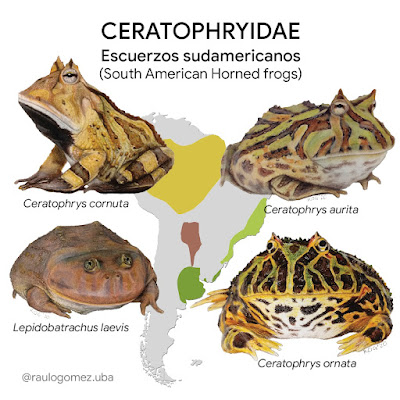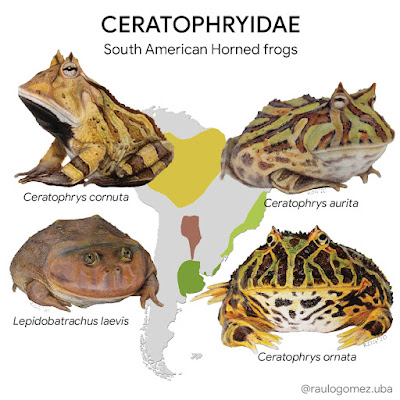
Showing posts with label Ceratophryidae. Show all posts

Friday, July 21, 2023

[Paleontology • 2022] Lepidobatrachus dibumartinezA New Old Budgett Frog: An Articulated Skeleton of an Early Pliocene Lepidobatrachus (Anura: Ceratophryidae) from western Argentina


Lepidobatrachus dibumartinez
Turazzini & Gómez, 2022

 
 ABSTRACT
The South American horned frogs or ‘escuerzos’ (Ceratophryidae) are among the best-known neobatrachians and comprise the genera Chacophrys, Ceratophrys, and Lepidobatrachus. Their relatively rich fossil record, which dates back to the Late Miocene and is largely concentrated in the Argentinean Pampas, consists mostly of variably complete cranial remains and comparatively few, mainly isolated, postcranial bones of Ceratophrys, whereas only three specimens of Lepidobatrachus are known. Here we describe two extra-Pampean ceratophryid records from the Upper Miocene–Lower Pliocene of Huayquerías del Este, Mendoza Province, Argentina, including Lepidobatrachus dibumartinez sp. nov. based on a well-preserved articulated skeleton. The new species is part of the stem of Lepidobatrachus and is diagnosed on the basis of several cranial and postcranial traits, including a large kite-shaped dorsal dermal shield. The new taxon sheds light on the evolution of a dorsal shield in the group, as well as on their paleobiogeographic history, adding support to the hypothesis of a broader ancestral distribution of Lepidobatrachus, whose diversification might have been triggered by the Late Miocene marine introgression of the Paranaense Sea. Also, it indicates that the prevalent climatic conditions during the Early Pliocene in western Argentina were much warmer and less dry than today. Finally, we discuss the potential value of the new records in calibrating the time-tree of Ceratophryidae.

 
Guillermo F. Turazzini and Raúl O. Gómez. 2022. A New Old Budgett Frog: An Articulated Skeleton of an Early Pliocene Lepidobatrachus (Anura, Ceratophryidae) from western Argentina. Journal of Vertebrate Paleontology. 42(5); e2207092. DOI: 10.1080/02724634.2023.2207092 


Wednesday, January 26, 2022

[Paleontology • 2021] The Fossil Record and Phylogeny of South American Horned Frogs (Anura, Ceratophryidae)


in Gómez & Turazzini, 2021.


Abstract
South American horned frogs (Ceratophryidae), with their large heads, wide gapes and fang-like teeth, are among the most charismatic, best-known and well-studied neobatrachian anurans. The family comprises 12 extant species with hyperossified skulls and has a relatively rich fossil record, particularly in the Pampas, which dates back to the late Miocene. However, several records have been overlooked in recent summaries, and many taxonomic assignments remain indeterminate or are questionable and have yet to be tested within a quantitative phylogenetic framework. Here we provide a complete up-to-date survey of the palaeontological record of Ceratophryidae, including some remarkable new records. We also tested their systematic position through comprehensive phylogenetic analyses based on osteological data, providing several synapomorphies for all relevant nodes. Finally, we discuss these integrated data in relation to divergence time estimates, and propose a set of fossil calibrations that provide hard minimum bounds for crown-group Ceratophryidae and the subclades within it, and illuminate the acquisition of polyploidy within the group.

Keywords: Ceratophrys, Lepidobatrachus, Chaco, Pampas, phylogenetics, osteology, calibration point


Anura Fischer, 1813 
Neobatrachia Reig, 1958 
Nobleobatrachia Frost, Grant, Faivovich, Bain, Haas, Haddad, de Sá, Channing, Wilkinson, Donnellan, Raxworthy, Campbell, Blotto, Moler, Drewes, Nussbaum, Lynch, Green & Wheeler, 2006 

Ceratophryidae Tschudi, 1838 

Type genus: Ceratophrys Wied-Neuwied, 1824.


Chacophrys Reig & Limeses, 1963

Chacophrys pierottii (Vellard, 1948) 
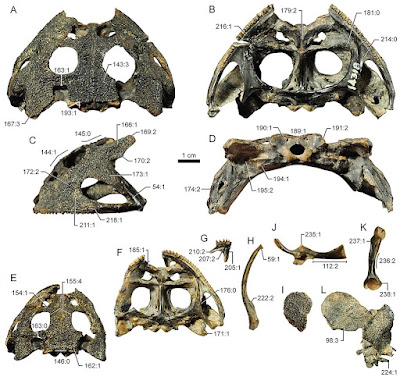
 Ceratophrys ameghinorum. MACN Pv 14318 (holotype)

Ceratophrys Wied-Neuwied, 1824 

Ceratophrys ameghinorum Fernicola, 2001 

Ceratophrys aurita (Raddi, 1823)

Ceratophrys ornata (T. Bell, 1843) 


Lepidobatrachus Budgett, 1899 

Lepidobatrachus australis Nicoli, 2015 


Conclusions:
 The oldest record of South American horned frogs dates back to the late Miocene and represents total-group Ceratophrys, providing a hard minimum bound for Ceratophryidae. However, other Miocene records are fragmentary or show morphologies not represented among extant species, obscuring their phylogenetic relationships. The known fossil record of Ceratophrys is relatively rich but is restricted mostly to the clade comprising species with a dorsal shield, including Ce. ornata and Ce. aurita. Our phylogenetic analyses consistently recovered the extinct Ce. ameghinorum and its kin, including two putative new forms, as more closely related to Ce. aurita than to any other extant species. The known fossil record of Lepidobatrachus is sparse and likely restricted to the Pliocene, but shows that the total group inhabited regions outside its present day Chacoan distribution. Phylogenetic analyses recovered the Pliocene L. australis and a new form from western Argentina as part of total-group Lepidobatrachus, but lying outside the crown-group. Crown-group Lepidobatrachus and Chacophrys have no known fossil record to date. Extinct taxa that remain valid are mostly from the Pliocene of Buenos Aires Province, whereas almost all of the Quaternary record that can be confidently assigned to species level represents extant taxa. Integration of ploidy data from extant species and fossils in our phylogenetic framework suggests that in Ce. ornata and Ce. aurita octoploidy arose through tetraploidy late in the Quaternary.


Raúl Orencio Gómez and Guillermo Fidel Turazzini. 2021. The Fossil Record and Phylogeny of South American Horned Frogs (Anura, Ceratophryidae). Journal of Systematic Palaeontology. 19(2); 91-130. DOI: 10.1080/14772019.2021.1892845

Sunday, January 4, 2015

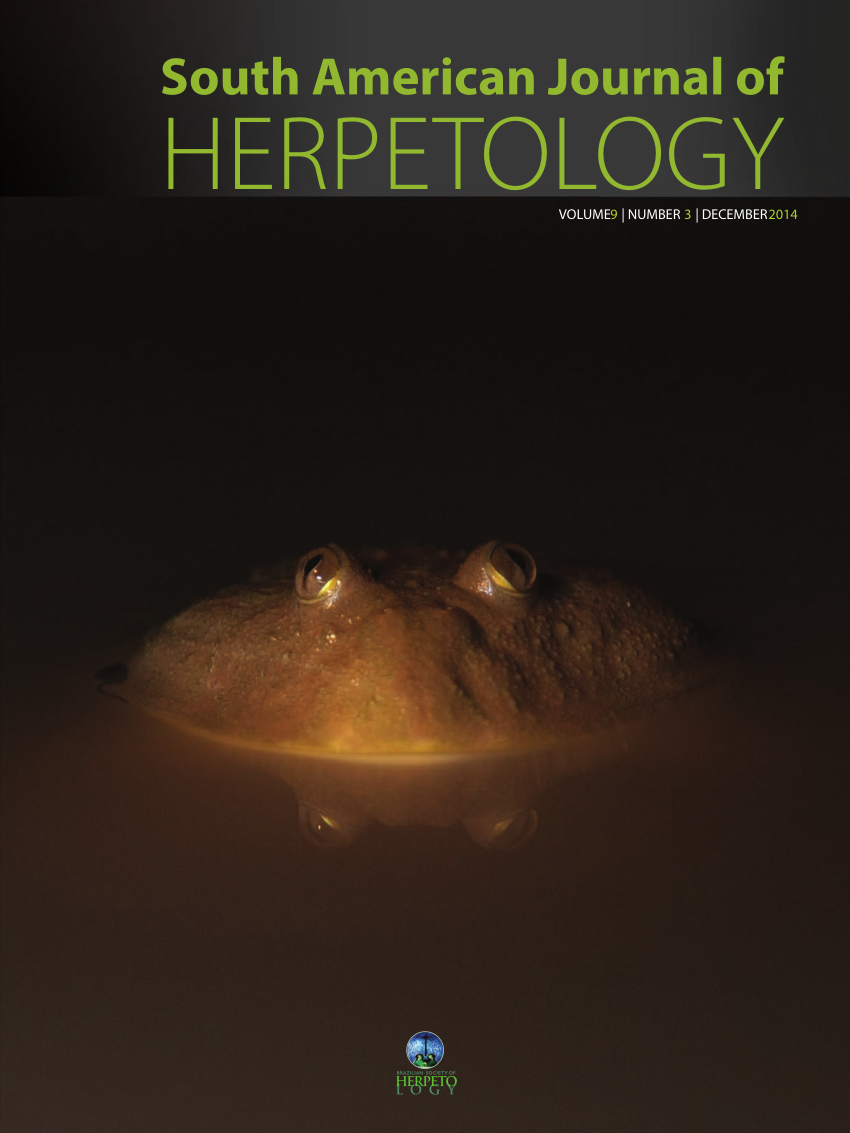
[Herpetology • 2014] Big, Bad, and Beautiful: Phylogenetic Relationships of the Horned Frogs (Anura: Ceratophryidae)


ABSTRACT
The horned frog family, Ceratophryidae, currently comprises three genera and 12 extant species, distributed from the Caribbean lowlands to the Pampean grasslands. Horned frogs are fossorial species that are remarkable in terms of their adult and larval morphology, karyotype, behavior, and other aspects of their biology. In this paper we present a molecular phylogenetic analysis with the goals of: (1) exploring the relationships among the species of Ceratophryidae; (2) studying the evolution of polyploidy; (3) studying the evolution of cocoon formation and larval development duration associated with surviving in semiarid environments; and (4) reviewing the ceratophryid fossil record that could be relevant as calibration points in molecular divergence estimations. The analysis included 11 of the 12 extant species and, when possible, multiple exemplars per species, as well as multiple outgroups. Sequence data were obtained on seven mitochondrial and six nuclear genes for up to 8200 bp per specimen. Our results indicate that the individual monophyly of Ceratophrys and Lepidobatrachus is well corroborated. The monotypic Chacophrys is recovered as the sister taxon of Lepidobatrachus, but with Jackknife frequency < 50%. Lepidobatrachus asper is the sister taxon of L. laevis + L. llanensis. Relationships within Ceratophrys are congruent with an earlier proposal, with a clade composed of the species possessing a dorsal bony shield (Ce. aurita, Ce. cranwelli, Ce. joazeirensis, and Ce. ornata), and another clade composed of Ce. stolzmanni, Ce. calcarata, and Ce. cornuta. Unlike earlier proposals, the octoploid species (Ce. aurita, Ce. joazeirensis, and Ce. ornata) are not monophyletic, as the diploid Ce. cranwelli, and Ce. ornata are sister taxa. This result implies an ambiguous optimization of ploidy levels, with either a single origin of octoploidy with a subsequent reversal to diploidy, or two independent origins of octoploidy being equally parsimonious; both alternatives are quite unusual from the perspective of chromosome evolution. Our results suggest that ceratophryids diversified in semiarid environments and three independent events resulted in three species subsequently occupying temperate or tropical humid areas. This early diversification in semiarid areas explains the retention of characteristics associated with these environments (like the production of a cocoon of dead skin during estivation, and possibly an accelerated larval period and development) in species present in humid areas. A revision of the fossil record of this family of frogs indicates that there are only two fossil remains that could serve as calibration points for molecular clock estimation, but a number of issues associated with them preclude their use.

Keywords: Ceratophrys, Chacophrys, Divergence time estimation, Fossil calibration, Hyloides, Karyotype evolution, Lepidobatrachus, Semiarid environments


 Julián Faivovich, Laura Nicoli, Boris Blotto, Martín O. Pereyra, Diego Baldo, J. Sebastían Barrionuevo, Marissa Fabrezi, Erik R. Wild and Celio F. B. Haddad. 2014. Big, Bad, and Beautiful: Phylogenetic Relationships of the Horned Frogs (Anura: Ceratophryidae).
South American Journal of Herpetology. 9(3):207-227.
 DOI: dx.doi.org/10.2994/SAJH-D-14-00032.1