Showing posts with label Caucasus. Show all posts

Thursday, September 18, 2025

[Mollusca • 2025] Caucasopsiinae subfam. nov. Little Treasures hidden in the Darkness: Diversity and Phylogeny of stygobiotic Hydrobiidae (Gastropoda) of the Caucasus


Caucasopsiinae Chertoprud & Vinarski,

in Chertoprud, Ekimova, Palatov, Grego, Mumladze et Vinarski, 2025

Highlights
• Hydrobiidae inhabit groundwaters on both south and north sides of the Great Caucasus.
• Caucasian hydrobiids are represented by three distinct phylogenetic lineages of subfamily taxonomical rank.
• A new subfamily of Hydrobiidae endemic to the Caucasus is described.
• A high morphological variability in the shell morphology within Caucasopsiinae subfam.nov. has been revealed.
• Female reproductive system morphology better supports high-level taxa phylogeny than other features.

Abstract
Hydrobiidae is the most diverse and species-rich freshwater gastropod family in the Palearctic. Their diversity in the Caucasus region remains largely unexplored and the phylogenetic relationships with European taxa have not been clarified yet. The primary objective of this study is to perform a molecular phylogenetic analysis of the stygobiotic Hydrobiidae of the Caucasus with an increased taxon sampling and incorporation of multiple molecular markers. We show that the Caucasian hydrobiids are represented by three distinct lineages of a subfamily rank: (1) Caucasopsiinae subfam. nov., comprises most of the stygobiotic hydrobiid genera endemic to Caucasus; (2) Belgrandiellinae includes a single stygobiotic genus Sitnikovia and a complex of crenobiotic genera; (3) Islamiinae is represented by a single monotypic genus. The Caucasian stygobiotic hydrobiids are represented by 13 genera, five of which were identified as new for science, and at least 37 species, including a significant number (20 species) of putative new taxa. Analysis of the soft-body anatomy revealed that the female reproductive system showed the best congruence with the phylogenetic relationships. Shell morphology showed high variability at both inter- and intrageneric level, questioning the generic assignment of species based on empty shells. The Caucasian stygobiotic Hydrobiidae show high endemism at all taxonomical levels from species to subfamilies, which probably reflects their long evolution in relative isolation from the hydrobiid clades inhabiting other regions.
 
Keywords: Groundwater ecosystems, Integrative taxonomy, Freshwater snails, Endemism, New Subfamily, Springsnails


Class Gastropoda Cuvier, 1795
Subclass Caenogastropoda Cox, 1960

Superfamily Truncatelloidea Gray, 1840
Family Hydrobiidae W. Stimpson, 1865

Subfamily Caucasopsiinae Chertoprud et Vinarski, n. Subf.

Type genus: Caucasopsis Grego et Mumladze, 2020
Type species: Caucasopsis letsurtsume Grego et Mumladze, 2020

Shells of Caucasian Hydrobiidae (SEM photographs):
A – Caucasopsis sp. 3; B – Caucasopsis sp. 8; C – Caucasopsis letsurtsume, conic form; D – Caucasopsis letsurtsume, robust form;
E – Pontohoratia birsteini; F – Caucasopsis vinarskii comb. nov.; G – Imeretiopsis gorgoleti;
 H – Schapsugia pulcherrima; I – Gen. 2; J – Gen. 1; K – Caucasogeyeria chrysomallos; L – Gen. 3; M – Sitnikovia megruli.


Elizaveta Chertoprud, Irina Ekimova, Dmitry Palatov, Jozef Grego, Levan Mumladze and Maxim Vinarski. 2025. Little Treasures hidden in the Darkness: Diversity and Phylogeny of stygobiotic Hydrobiidae (Mollusca: Gastropoda) of the Caucasus. Molecular Phylogenetics and Evolution.  213, 108439. DOI: doi.org/10.1016/j.ympev.2025.108439 

Sunday, September 14, 2025

[Mollusca • 2020] Imeretiopsis gen. nov., Caucasopsis gen. nov., Caucasogeyeria colchis, C. chrysomallos, Imeretiopsis prometheus, Kartvelobia sinuata, Hausdorfenia shareula, ... • The Phylogeny of stygobiotic Sadlerianinae Szarowska, 2006 (Gastropoda: Hydrobiidae) from Georgia with Descriptions of Five New Genera and Twenty-one New Species [Revealing the stygobiotic and crenobiotic Molluscan Biodiversity Hotspot in Caucasus: Part I]


 5–8 Caucasogeyeria colchis sp. nov., live specimens Pirveli Balda, spring in the village
9–12 C. chrysomallos sp. nov.  

in Grego, Mumladze, Falniowski, Osikowski, Rysiewska, Palatov et Hofman, 2020.

Abstract
The position of the southwestern Caucasus as a stygobiotic Mollusca hotspot is confirmed. Molecular data of stygobiotic gastropods revealed the diversity of subfamily Sadlerianinae Szarowska, 2006, inhabiting the subterranean environment of Georgia. In addition to the well-known endemic genera Pontohoratia Vinarski, Palatov & Glöer, 2014 and Motsametia Vinarski, Palatov & Glöer, 2014, five more genera were identified in northwestern Georgia as new to the scienceKartvelobia gen. nov., Imeretiopsis gen. nov., Caucasopsis gen. nov., Caucasogeyeria gen. nov., and Hausdorfenia gen. nov. Additionally, 21 new species were found to inhabit the studied area (Samegrelo, Imereti, Racha regions in Georgia).

Keywords: cave, biodiversity, freshwater, interstitial, mtDNA, molecular taxonomy, spring, subterranean

Caucasogeyeria specimens used for molecular and anatomical studies
 1 Caucasogeyeria chrysomallos sp. nov. 2–4 C. ignidona sp. nov. 5–8 C. colchis sp. nov., live specimens Pirveli Balda, spring in the village 9–12 C. chrysomallos sp. nov. The numbers correspond to individuals. Photograph A. Falniowski, J. Grego, A. Rysiewska.


 Jozef Grego, Levan Mumladze, Andrzej Falniowski, Artur Osikowski, Aleksandra Rysiewska, Dimitry M. Palatov and Sebastian Hofman. 2020. Revealing the stygobiotic and crenobiotic Molluscan Biodiversity Hotspot in Caucasus: Part I. The Phylogeny of stygobiotic Sadlerianinae Szarowska, 2006 (Mollusca, Gastropoda, Hydrobiidae) from Georgia with Descriptions of Five New Genera and Twenty-one New Species. ZooKeys. 955: 1-77. DOI: doi.org/10.3897/zookeys.955.51983 


Monday, September 1, 2025

[Ichthyology • 2023] Ponticola alasanicus • A New freshwater Goby (Gobiiformes: Gobiidae) from the Alazani River Basin, Georgia


Ponticola alasanicus
 Epitashvili, Japoshvili & Mumladze, 2023 
 

Abstract
Background: The South Caucasus Region and Georgia, in particular, is a biodiversity hotspot and characterised by high diversity of landscapes and ecosystems, as well as high levels of endemism. At the same time, diversity of freshwater organisms in the region remains poorly studied, including fishes. The freshwater fish fauna of the South Caucasus Region consists of 119 fish species, of which 13 species belong to the order Gobiiformes. It should be noted that gobies are amongst the poorly studied taxa in Georgia and probably unknown/undescribed species still living in the Georgian freshwater ecosystems which requires further research.

New information: Ponticola alasanicus, a new species is described from the Alazani River, western Caspian Sea Basin, Georgia. It is distinguished from its congeners in the Caspian and Black Sea Basins by having the following features: dorsal fin with VI-VII spines and 15½-16½ branched rays, anal fin with 10½-12½ branched rays; lateral line with 48-55 scales; laterally compressed body with dark brown and black blotches - scales ctenoid; first and second dorsal fins almost touching with dorsal fins bases; head large, depressed, wider than deep, its length approaches almost 3.4th of standard length; nape scaled completely; cycloid scales cover upper part of opercle, cheeks noticeably swollen; snout longer than eye, eye diameter 4.5 times its head length; lower jaw slightly protruding; upper lip is uniform; pelvic disc short, elongated and flat, not reaching the anus; the pectoral fins extends vertically through first branched dorsal fin; caudal fin rounded. Ponticola alasanicus sp. n. belongs to P. syrman group and it is separated by a minimum Kimura 2-parameter distance of 3.5, 3.6 and 4.8% from P. syrman, P. iranicus and P. patimari, respectively.  

Keywords: Ponticola alasanicus sp. n., freshwater gobies, DNA barcoding, taxonomy, Western Caspian Sea Basin

Live specimen of Ponticola alasanicus sp. n. from the type location.

Ponticola alasanicus sp. nov. 

Diagnosis: D1 – VI, D2 I / 15½-16½, A I / 10½ – 12½; nape scaled completely, scales cycloid and ctenoid, cycloid scales covering upper part of opercle; lateral line system with sub-orbital row d continuous; predorsal area is linearly concave in middle; first dorsal fin with oblique black stripe between first two or three rays, the tip of the first 3-4 rays is transparent white; species has one large dark spot at the base of the pectoral fin; ventral disc has oval/elongated shape, short, not reaching anus.


 Giorgi Epitashvili, Bella Japoshvili and Levan Mumladze. 2023. Ponticola alasanicus sp. n. (Gobiiformes, Gobiidae) from the Alazani River Basin, Georgia. Biodiversity Data Journal. 11: e101095. DOI: 10.3897/BDJ.11.e101095 

Thursday, August 28, 2025

[Entomology • 2025] Dyspessa sudoli • Another New Armenian Species (Lepidoptera: Cossidae: Cossinae: Endagriini)


Dyspessa sudoli Saldaitis, Yakovlev, Dobrzański & Prozorov, 

in SaldaitisYakovlevDobrzański,  Kalashian, Müller et Prozorov, 2025. 

Abstract
A new species from Armenia, Dyspessa sudoli sp. nov., is described in the present article. It is compared with the Armenian Dyspessa gayane Yakovlev et al., 2025 and Dyspessa daralagezi Yakovlev, 2008b, and occurring closely to Dyspessa stroehlei Yakovlev, 2008a described from Kars Province in northeastern Turkey. Adults of both sexes, their genitalia, map with collection localities, and habitat for the new species are illustrated.

Lepidoptera, biodiversity, Caucasus mixed forests ecoregion, fauna, new taxon, transcaucasia, West Asia

FIGURES 1–6. Adults of Dyspessa spp. from Armenia.
1–2. Dyspessa gayane. 3–6. Dyspessa sudoli sp. nov.
Depositories: 1. WIGJ. 2, 6. ASV. 3. Upper Silesian Museum. 4. GMF. 5. DSL. Scale bars—1 cm.

Dyspessa sudoli Saldaitis, Yakovlev, Dobrzański & Prozorov sp. nov.

 Habitat of Dyspessa sudoli sp. nov. 
(Photo by X. Dobrzański).


Aidas SALDAITIS, Roman V. YAKOVLEV, Xavier DOBRZAŃSKI, Mark KALASHIAN, Günter C. MÜLLER, Alexey M. PROZOROV. 2025. Dyspessa sudoli sp. nov.—Another New Armenian Species (Lepidoptera, Cossidae, Cossinae, Endagriini).  Zootaxa. 5659(3); 426-438. DOI: doi.org/10.11646/zootaxa.5659.3.7 [2025-07-04]

Wednesday, March 26, 2025

[Diplopoda • 2025] Acanthophorella didi, A. spinicoxa, ... • Four New cavernicolous Species of the Genus Acanthophorella Antić & Makarov, 2016 (Diplopoda: Chordeumatida: Anthroleucosomatidae) from Georgia, Caucasus


 Acanthophorella didi, A. gaumarjos
 A. eto
, A. spinicoxa 

AntićMargalitadze & Šević, 2025

Abstract
Four new, presumably troglobiotic species of the chordeumatidan genus Acanthophorella Antić & Makarov, 2016 are described from several Georgian caves. Acanthophorella didi sp. nov. and A. gaumarjos sp. nov. were discovered in three and one cave in the Racha karst massif, respectively, while A. eto sp. nov. and A. spinicoxa sp. nov. are known each from two caves in the Sataplia-Tskaltubo karst massif and Zemo Imereti plateau, respectively. All four species are properly diagnosed, described, and richly illustrated. Vulvae are described for the first time in Acanthophorella barjadzei Antić & Makarov, 2016, and new records are added for A. valerii Antić in Antić et al., 2023. Notes on the ecology and localities are given for new species. The distribution map and a key to all 10 species of the genus are presented. Distribution and troglomorphism within the genus are briefly discussed.

 Myriapoda, biospeleology, cave, millipedes, Sakartvelo, troglomorphism


Acanthophorella didi Antić, Margalitadze & Šević sp. nov.
Acanthophorella eto Antić, Margalitadze & Šević sp. nov.
Acanthophorella gaumarjos Antić, Margalitadze & Šević sp. nov.
Acanthophorella spinicoxa Antić, Margalitadze & Šević sp. nov.


Dragan ANTIĆ, Ana MARGALITADZE and Mirko ŠEVIĆ. 2025. Four New cavernicolous Species of the Genus Acanthophorella Antić & Makarov, 2016 (Diplopoda, Chordeumatida, Anthroleucosomatidae) from Georgia, Caucasus.  Zootaxa. 5609(1); 41-69. DOI: doi.org/10.11646/zootaxa.5609.1.3 [2025-03-19]

Saturday, January 4, 2025

[Crustacea • 2024] Proasellus abini • A New Species of the Genus Proasellus (Isopoda: Asellidae) from the Abin River Basin, with the preliminary data on the Diversity of the Genus in the southwestern foothills of the Russian Caucasus


Proasellus abini 
Marin & Sinelnikov, 2024
 

ABSTRACT 
 A new stygobiotic species of the genus Proasellus Dudich, 1925 (Crustacea: Isopoda: Asellidae), Proasellus abini sp. n., is described from the hyporheic habitats and groundwater of the Abin River basin, located in the southwestern foothills of the Caucasian Ridge. The new species is morphologically and genetically close to Proasellus linearis Birštein, 1967, known from the Evstafiev Sсhel (=Ashamba River) near Gelendzhik. Data on phylogeny, ecology and feeding of the species and other SW Caucasian species of the genus are also presented in the paper.

KEY WORDS: Crustacea, diversity, Proasellus, new species, hyporhea, stygobiotic, southwestern Caucasus, Russia.

General view and natural habitat of Proasellus abini sp. n.:
 A — a forest well, Shids, general view; B, C — individuals of the new species on the bottom and walls of the well; D, F — general dorsal view of alive individual of the new Proasellus abini sp.n. and its lateral view (E).

 Proasellus abini sp. n.

 
Marin I.N. and Sinelnikov S.Yu. 2024. A New Species of the Genus Proasellus (Crustacea: Isopoda: Asellidae) from the Abin River Basin, with the preliminary data on the Diversity of the Genus in the southwestern foothills of the Russian Caucasus. Invertebrate Zoology. 21(1); 81–93. 
  x.com/iee_ras/status/1871075641082237437

Monday, December 23, 2024

[Crustacea • 2024] Proasellus mikhaili • A New stygobiotic Species of the genus Proasellus Dudich, 1925 (Isopoda: Asellidae) from the Black Sea coast of the Caucasus, Russia


 Proasellus mikhaili Palatov & Chertoprud, 2024

Map of collection sites in the Black Sea coast of the Caucasus, general view and natural habitats of described species: A — habitus of P. mikhaili sp.n., paratype (♂); 6 — collection sites
C — photos of collection sites of P. mikhaili: 6a — spring stream (rheokrene) on Kadosh Cape, 3.5 km to NW of Tuapse town, ...; 6b — the Agoy River on the NE outskirts of Agoy village, ...


ABSTRACT 
A new stygobiotic species of water louses of the genus Proasellus Dudich, 1925 (Crustacea: Isopoda), P. mikhaili sp. n., is described from springs and groundwaters in the vicinity of the town of Tuapse on the Black Sea coast of the northwestern Caucasus, Russia. Representatives of this genus are reported for the first time from this coastal area. This new species is characterized by a number of unique features that immediately distinguish it from all known other Caucasian species of the genus. At present, this is the only species described from the region that has three connecting hooks in the retinacula of male pleopods I, as well as a shortened exopodite of pleopod V, significantly shorter than the endopodite in length. Among the diagnostic characters of this species are also a poor ornamentation of pereopods I–VII and a specific chetotaxis of the pleotelson represented by a dense covering of thin, hair-like setae. Probably, this species is an endemic of the Tuapsinsky District.

KEY WORDS: Crustacea, Asellidae, new species, stygobionts, crenobionts, local endemism, Transcaucasia.

Map of collection sites for Proasellus mikhaili sp. n. in the Black Sea coast of the Caucasus, general view and natural habitats of described species: 
A — habitus of P. mikhaili sp.n., paratype (♂);
B — map of collection sites for Proasellus in the Black Sea coast of the Caucasus. Numbers refer to: 1 — P. infirmus; 2 — P. linearis; 3 — P. ljovuschkini; 4 — P. similis; 5 — P. abini; 6 — P. mikhaili sp. n.;
C — photos of collection sites of P. mikhaili: 6a — spring stream (rheokrene) on Kadosh Cape, 3.5 km to NW of Tuapse town, 44°07ʹ37.55″N 39°02ʹ03.92″E; 6b — the Agoy River on the NE outskirts of Agoy village, 44°09ʹ05.1″N 39°02ʹ59.7″E.

Order Isopoda Latreille 1816 
Suborder Asellota Latreille, 1802 

Superfamily Aselloidea Latreille, 1802 
Family Asellidae Latreille, 1802 
Genus Proasellus Dudich, 1925 
 
Proasellus mikhaili sp. n.

DIAGNOSIS. Medium sized, depigmented species. Antenna I with six to seven flagellar articles, flagellum of antenna II with 42–55 articles. Inner plate of maxillula with five or six apical pappose setae. Propodus I elongate, oval, its inferior margin without a proximal apophysa, with two or three robust spiniform setae. Dactylus I with four or five short robust setae on inferior margin and ...

ETYMOLOGY. The species is named in honor of the renowned Russian hydrobiologist Mikhail Vitalievich Chertoprud (30.01.1975–23.02.2023), who spent many years studying aquatic invertebrates in the Krasnodar Territory and repeatedly conducted hydrobiological training courses at Cape Kadosh near Tuapse. 


Dmitry M. Palatov and Elizaveta M. Chertoprud. 2024. A New stygobiotic Species of the genus Proasellus Dudich, 1925 (Crustacea: Isopoda: Asellidae) from the Black Sea coast of the Caucasus, Russia. Invertebrate Zoology. 21(3); 369–383. 

Tuesday, December 17, 2024

[Crustacea • 2024] Protracheoniscus krivolutskyi • A New Species of the Genus Protracheoniscus Verhoeff, 1917 (Isopoda: Oniscidea: Agnaridae) from the northwestern Caucasus


Protracheoniscus krivolutskyi Gongalsky, 

in Gongalsky, Byzov et Medvedev, 2024

ABSTRACT 
 Protracheoniscus krivolutskyi sp. n. (Agnaridae) is described from the Utrish State Nature Reserve at the Black Sea coast of Russia. Analysis of COI gene and Scanning Electron Microscopy support the validity of this species. Affinities of the species within the genus are discussed.

KEY WORDS: Isopoda, COI, phylogenetic analysis, Oniscidea, Abrau Peninsula, woodlouse, Protracheoniscus.

Alive specimen of Protracheoniscus krivolutskyi sp. n. (female), from the Urtish State Nature Reserve, NE Caucasus, Russia, kept in culture.

TAXONOMY 
Class Malacostraca Latreille, 1802 
Order Isopoda Latreille, 1817 
Family Agnaridae Schmidt, 2003 

Genus Protracheoniscus Verhoeff, 1917 

Protracheoniscus krivolutskyi Gongalsky sp. n.
 
DIAGNOSIS. The species of Protracheoniscus is characterized by the antennal flagellum with the articles of a ratio 1:2; noduli laterales are located anteriorly of the middle line of pereonite 1.

ETYMOLOGY. The species name krivolutskyi originates from Prof. Dr. Dmitri A. Krivolutsky (1939–2004), a prominent Russian soil zoologist who encouraged the first author to study soil biology.


Konstantin B. Gongalsky, Philipp S. Byzov and Dmitry A. Medvedev. 2024. A New Species of the Genus Protracheoniscus Verhoeff, 1917 (Isopoda: Oniscidea: Agnaridae) from the northwestern Caucasus. Arthropoda Selecta. 33(1): 65–75. DOI: doi.org/10.15298/arthsel.33.1.06  

Sunday, December 8, 2024

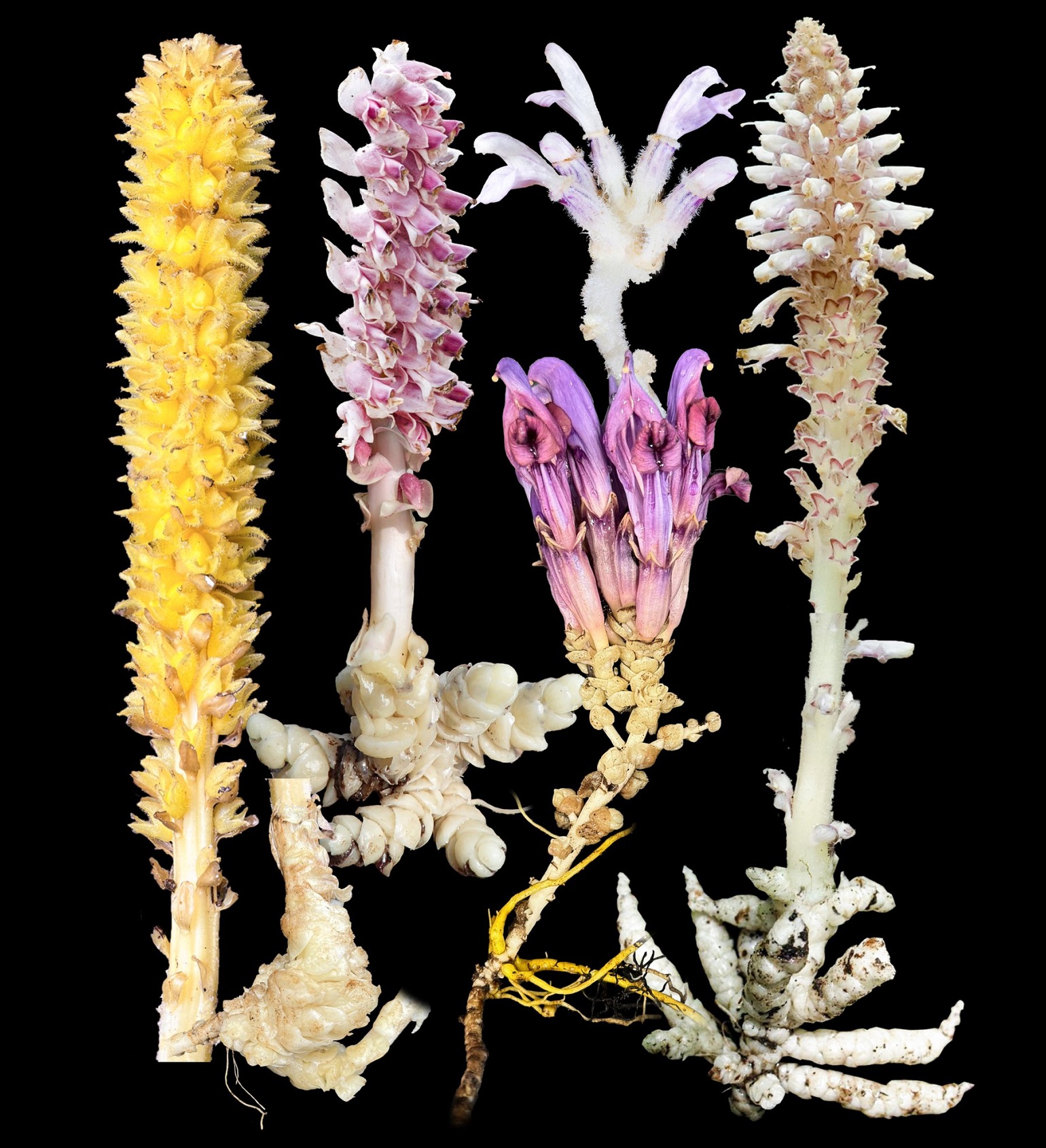
[Botany • 2024] A Taxonomic Monograph of the Eurasian holoparasitic plant Genus Lathraea L. (Orobanchaceae)


 Five species of Lathraea
 Lathraea squamariaLathraea clandestina, Lathraea japonicaLathraea rhodopeaLathraea purpurea

in Hatt, Tsiftsis et Thorogood, 2024. 

Abstract
A taxonomic monograph is presented for Lathraea L. (Orobanchaceae), a genus of holoparasitic plants distributed across Europe and Asia. Plants in this genus are characterised by their underground stems, achlorophyllous scales with internal gland-lined cavities, and, in some species, explosive seed dehiscence. Despite their conspicuousness, no taxonomic treatment of the genus has been written since 1930. Our work draws upon extensive international field data and a comprehensive survey of herbarium specimens. Detailed descriptions are provided for each species, along with full synonymy, distribution maps, and notes on habitat, host specificity, phenology, ecology, ethnobotany and threat risk. We present evidence to consolidate Lathraea into five species, resolving taxonomic confusion. The infrageneric classification is reviewed and a key to species is provided. Species are illustrated with photographs of living and dried material.

Lamiales, Lathraea, Orobanchaceae, Lathraea squamariaLathraea clandestina, parasitic plants, holoparasite, Lathraea japonicaLathraea rhodopeaLathraea purpurea, Eudicots


Sebastian A. Hatt, Spyros Tsiftsis and Chris J. Thorogood. 2024. A Taxonomic Monograph of the Eurasian holoparasitic plant Genus Lathraea L. (Orobanchaceae). Phytotaxa. 672(1); 1-29. DOI: doi.org/10.11646/phytotaxa.672.1.1

Friday, November 29, 2024

[Botany • 2024] Orobanche dagestanica (Orobanchaceae) • A New Species from the Greater Caucasus


Orobanche dagestanica Ó.Sánchez, Piwow., Fateryga, Svirin & Murtaz., 

in Piwowarczyk, Sánchez Pedraja, Fateryga, Svirin et Murtazaliev, 2024.
 
Abstract
A new, probably endemic species, Orobanche dagestanica is described from Dagestan in Russia (the Greater Caucasus). The species grows in alpine shale scree slopes, and is a parasite of the roots of species from the genus Lophiolepis (Asteraceae). Based on morphological and phylogenetic data, the newly-described species belongs to Orobanche subsect. Curvatae, and specifically to O. ser. Krylowianae, however it is distinct from all other taxa in this group. A detailed description, diagnosis, illustrations, a comparison with related species, as well as phylogenetic analysis are provided.

Curvatae, Krylowianae, holoparasites, Dagestan, Lophiolepis, Cirsium, taxonomy, Eudicots


Renata Piwowarczyk, Óscar Sánchez Pedraja, Alexander V. Fateryga, Sergey A. Svirin and Ramazan A. Murtazaliev. 2024. Orobanche dagestanica (Orobanchaceae): A New Species from the Greater Caucasus.  Phytotaxa. 653(1); 67-78. DOI: doi.org/10.11646/phytotaxa.653.1.5


Monday, November 25, 2024

[Arachnida • 2024] Maimuna antalyensis, Tegenaria beyazcika, T. egrisiana, ... • New Taxonomic and Faunistic Data on the Funnel-weavers (Araneae: Agelenidae) of Turkiye and the Caucasus, with Five New Species


Habitus of Tegenaria egrisiana sp. nov. (A, B), T. dalmatica (C), T. beyazcika sp. nov. (D), and T. tekke (E), dorsal view.
 A, D males B, C, E females.
in Zamani, Kaya et Marusik, 2024. 
  
Abstract
New taxonomic and faunistic data on the agelenid spiders of Turkiye and the Caucasus are provided. Five species are described as new to science: Maimuna antalyensis sp. nov. (♂♀; Turkiye: Antalya), Tegenaria ballarini sp. nov. (♂♀; Turkiye: Antalya), T. beyazcika sp. nov. (♂; Turkiye: Antalya), T. egrisiana sp. nov. (♂♀; Georgia: Imereti), and T. hoeferi sp. nov. (♂♀; Armenia: Kotayk). Tegenaria lazarovi Dimitrov, 2020, syn. nov. is proposed as a new junior synonym of T. averni Brignoli, 1978. Persiscape caucasica (Guseinov, Marusik & Koponen, 2005) is newly reported from Armenia, and T. chumachenkoi Kovblyuk & Ponomarev, 2008 is reported for the first time from Turkiye. New distribution records for T. dalmatica Kulczyński, 1906, T. hamid Brignoli, 1978, T. longimana Simon, 1898 and T. percuriosa Brignoli, 1972, and topotype material for T. tekke Brignoli, 1978 are reported. The record of Eratigena fuesslini (Pavesi, 1873) from Turkiye is found to be based on a misidentification, and is herein attributed to T. hamid. The presence of an embolic spine, unknown in any other species of Tegenaria, is documented in T. anhela Brignoli, 1972 for the first time. Photographs are provided for all treated species.

Key words: Anatolia, Armenia, Georgia, Maimuna, new record, new synonymy, Persiscape, Tegenaria

Habitus of Tegenaria egrisiana sp. nov. (A, B), T. dalmatica (C), T. beyazcika sp. nov. (D), and T. tekke (E), dorsal view.
 A, D males B, C, E females.

 
Alireza Zamani, Rahşen S. Kaya, Yuri M. Marusik. 2024. New Taxonomic and Faunistic Data on the Funnel-weavers (Araneae, Agelenidae) of Turkiye and the Caucasus, with Five New Species. ZooKeys. 1218: 251-286. DOI: doi.org/10.3897/zookeys.1218.135249

Tuesday, October 8, 2024

[Mollusca • 2023] The Land Snail Family Clausiliidae (Gastropoda: Pulmonata: Stylommatophora) in Georgia: Overview, Novel Records and A New Species; Mucronaria (M.) kartvelica

 
 Mucronaria (Mucronariakartvelica 
Mumladze, Grego & Szekeres, 2023 


Abstract
The Caucasus ecoregion is one of the most important biodiversity hotspots in western Eurasia. Georgia is situated in the middle of this area, between the ranges of the Greater and Lesser Caucasus, a position providing exceptionally balanced environmental conditions for its flora and fauna. Animal groups of low mobility, such as land snails, are important indicators of the past and present geographic and climatic events shaping these unique ecosystems. We give an overview of the land snail family Clausiliidae in Georgia that includes 30 species, among which eight are endemic to this country. Their distribution areas are reassessed in the light of novel georeferenced occurrence data resulting from recent field work. Aspects of the origin, diversity, habitat requirements and conservation status of the Georgian Clausiliidae fauna are discussed. Additionally, Mucronaria (Mucronaria) kartvelica sp. n. is described from the Racha-Lechkhumi and Kvemo Svaneti Region.

Key words: Caucasus, endemisms, land snails, new species, zoogeography

 Mucronaria (Mucronariakartvelica sp. n., holotype (ISU TM-T003-H).
Scale bar: 3 mm.  

Mucronaria (Mucronariakartvelicasp. n.

 Differential diagnosis: The reduced, diffuse palatal plicae and the less elongate shell shape distinguish the new species from members of the subgenus Mucronaria (Index) Boettger, 1877 and position it in the subgenus Mucronaria (Mucronaria) Boettger, 1877. Mucronaria (M.) kartvelica sp. n. differs from all other species of its subgenus by the slender and strongly costate shell. By contrast, Mucronaria (M.) acuminata has ventricose shell with glossy, densely striate surface and very weak lamella superior, Mucronaria (M.) duboisi has strong, to the peristome margin extended lamella inferior and long, well outlined palatal plicae, whereas Mucronaria (M.) strauchi (Boettger, 1878) is less elongate, more densely costate, and its ribs are more widely spaced on the neck than on the rest of the last whorl.

Etymology: The name of the new species refers to its occurrence in Sa-kartvelo (native historic name for Georgia).

The habitat (A) and a live individual (B) of Mucronaria (Mucronariakartvelica sp. n.


Levan Mumladze, Jozef Grego and Miklós Szekeres. 2023. The Land Snail Family Clausiliidae (Gastropoda, Pulmonata, Stylommatophora) in Georgia: Overview, Novel Records and A New Species. Caucasiana. 2: 29-61. DOI: doi.org/10.3897/caucasiana.2.e101013

Sunday, January 28, 2024

[Diplopoda • 2023] Acanthophorella aurita, A. devi & A. valerii • Review of the Genus Acanthophorella Antić & Makarov, 2016 (Chordeumatida: Anthroleucosomatidae), with descriptions of three New Species from the Caucasus


Troglobiotic members of the genus Acanthophorella Antić & Makarov, 2016 in situ.
A–B. Acanthophorella barjadzei Antić & Makarov, 2016, ♂ from Nikortsminda Sakinule Cave. C–D. Acanthophorella barjadzei Antić & Makarov, 2016, ♂ from Muradi Cave.
E–F. Acanthophorella devi Antić sp. nov., types, ♂. G–H. Acanthophorella valerii Antić sp. nov., holotype, ♂ (NHMW MY10366).

in Antić, Šević, Barjadze & Makarov, 2023. 
Photos by Dragan Antić.

ABSTRACT
The present paper is devoted to the description of three new species of the genus Acanthophorella Antić & Makarov, 2016 from Georgia, western Caucasus: A. devi Antić sp. nov. and A. valerii Antić sp. nov., both presumed troglobionts and each from a single cave, and the epigean A. aurita Antić sp. nov. The troglobiotic Acanthophorella barjadzei Antić & Makarov, 2016 is reported from two additional caves, with further descriptive notes given. Notes on the ecology and localities, and a distribution map for all six species of the genus are presented. A key is given to all members of the Flagellophorella complex. The relationships within the complex and the distribution and troglomorphism in the genus Acanthophorella are briefly discussed.

Keywords: caves, Georgia, Flagellophorella complex, millipedes, taxonomy

Troglobiotic members of the genus Acanthophorella Antić & Makarov, 2016 in situ.
 A–B. Acanthophorella barjadzei Antić & Makarov, 2016, ♂ from Nikortsminda Sakinule Cave. C–D. Acanthophorella barjadzei Antić & Makarov, 2016, ♂ from Muradi Cave.
E–F. Acanthophorella devi Antić sp. nov., types, ♂♂.
G–H. Acanthophorella valerii Antić sp. nov., holotype, ♂ (NHMW MY10366).
Photos by Dragan Antić.


Dragan Antić, Mirko Šević, Shalva Barjadze and Slobodan Makarov. 2023. Review of the Genus Acanthophorella Antić & Makarov, 2016 (Diplopoda, Chordeumatida, Anthroleucosomatidae), with descriptions of three New Species from the Caucasus. European Journal of Taxonomy. 908(1), 39–76. DOI: 10.5852/ejt.2023.908.2337


Wednesday, September 6, 2023

[Herpetology • 2023] Darevskia arribasi • A New Species of the Genus Darevskia Arribas, 1999 (Sauria: Lacertidae) from South Ossetia


 Darevskia arribasi
 Tuniyev, Petrova & Lotiev, 2023


Abstract
A new species of rock lizards of the genus Darevskia Arribas, 1999 — Darevskia arribasi sp. nov. is described from vicinity of Ertso Lake in South Ossetia. In comparison of Darevskia arribasi sp. nov. with other species of the «saxicola-brauneri» complex [D. lindholmi (Szczerbak, 1962), D. saxicola (Eversmann, 1834), D. brauneri (Mehely, 1909) (including D. b. brauneri, D. b. myusserica Doronin, 2011, D. b. darevskyi (Szczerbak, 1962), and D. szczerbaki (Lukina, 1963)], the new species is characterized by the smallest body size among all representatives of this complex L♂♂ — 55 – 62 mm; ♀♀ — 58 – 63 mm. The number of scales around the middle of the body (Sq.) in D. arribasi sp. nov. (52 – 58, more often 54 – 56) also significantly less than for D. saxicola sensu lato in generally. Along the throat from ear to ear fold there are 36 – 42 scales, less than in D. saxicola sensu lato. Two large preanal shields present in front of the anal shield in half of the individuals examined; in a quarter of individuals on both sides of the small central preanal there are by one enlarged lateral preanal shield, in another quarter all preanal shields are of the same size. Central temporal (Massetericum) always developed; always six pair of mandibulars, three in contact; collar straight, extremely rarely slightly serrated; ribs on the caudal scales are expressed to some extent; rostral usually separated from frontonasal by nasal shields. The coloration of adult males is olive-lettuce, or olive-brown from above; adult females are grey-brown; juvenile coloration coffee-brown with the blue and black spots on the edge of the outer ventral shields at the middle of trunk. Taxonomical status of new species is well supported with result of analysis of the mitochondrial cytochrome b data.

Keywords: Caucasus; South Ossetia; Darevskia arribasi sp. nov.


Holotype of Darevskia arribasi sp. nov. (SNP No. 1928).


Boris S. Tuniyev, T. V. Petrova, K. Yu. Lotiev. 2023. A New Species of the Genus Darevskia Arribas, 1999 from South Ossetia (Reptilia: Sauria: Lacertidae). Russian Journal of Herpetology.  30(4); 237-248. DOI: 10.30906/1026-2296-2023-30-4-237-248