Showing posts with label Pliocene. Show all posts

Saturday, March 14, 2026

[Paleontology • 2026] Crocodylus lucivenatorLucy’s peril: A Pliocene crocodile from the Hadar Formation, north-eastern Ethiopia


Crocodylus lucivenator
 Brochu, Drumheller, Campisano, Tekle, Getachew, Head, Platt & Leaphart, 2026
 
Artwork by Tyler Stone

Abstract
We herein describe a new crocodile, Crocodylus lucivenator sp. nov., from palaeoanthropological sites in the Pliocene Hadar Formation in north-eastern Ethiopia. It shares derived features and plesiomorphic states with two Pleistocene species of Crocodylus from East Africa. Conversely, C. lucivenator bears a midline boss on the dorsal surface of the rostrum similar to those of modern Neotropical crocodiles and late Miocene crocodiles from Libya and Kenya. A boss is also present on Pliocene specimens from Kanapoi in Kenya previously referred to C. thorbjarnarsoni. Some C. lucivenator also have a more substantial prenarial rostrum than other Palaeoafrican Crocodylus, though not to the same extent as in extant Crocodylus, and its expression is variable. Phylogenetic analysis supports a close relationship between C. lucivenator, Kanapoi CrocodylusC. anthropophagus, C. thorbjarnarsoni, and fossils from the Turkana Basin previously misreferred to C. checchiai. A close relationship with Neoafrican Crocodylus is rejected, reinforcing a comparatively recent arrival for Neoafrican Crocodylus in East Africa. Crocodylus lucivenator and the Kanapoi form are very similar, but an exclusive relationship is not unambiguously supported in our analysis. The phylogenetic placement of the Palaeoafrican clade depends on how one regards the prenarial rostrum, and positions outside crown Crocodylus or close to the Neotropical clade can be equally optimal. One mandible preserves pathological structures consistent with injuries sustained during intraspecific combat. Crocodylus lucivenator appears to have been the only crocodylian in the Hadar Formation, while coeval deposits in the Turkana Basin preserve as many as four species. The reason for this disparity is unclear.
 
Keywords: Crocodylus lucivenator, Hadar Formation, Pliocene, prenarial rostrum, cladistic assessment, Turkana Basin


Crocodylus lucivenator sp. nov.

Etymology. luci-, Latin for light, but here used with reference to A.L. 288-1 (Lucy), the iconic Australopithecus afarensis skeleton from Hadar; -venator, Latin, hunter. There is no evidence A.L. 288-1 was ever attacked by a crocodile, but her species (and most likely Lucy herself) would doubtless have been pursued as prey by this species.


Christopher A. Brochu, Stephanie K. Drumheller, Christopher Campisano, Getahun Tekle, Tomas Getachew, Jason J. Head, Nathan C. Platt & Daniel Leaphart. 2026. Lucy’s peril: A Pliocene crocodile from the Hadar Formation, north-eastern Ethiopia. Journal of Systematic Palaeontology. 24(1); 2614954. DOI: doi.org/10.1080/14772019.2026.2614954 [11 Mar 2026]

Monday, December 29, 2025

[PaleoEntomology • 2025] Apis aibai • A honey bee fossil (Hymenoptera: Apidae) from the Late Pliocene to Early Pleistocene Teragi Group, Hyogo Prefecture, Japan: Bridging a Gap in Apis Evolutionary History


Apis (Apisaibai 
Takahashi & Takahashi, 2025
 

Abstract
A new fossil honey bee Apis (Apisaibai sp. nov. was discovered in the Late Pliocene–Early Pleistocene lacustrine deposit in Hyogo Prefecture, Japan. Fossil species are identified based on their distinct forewing venation, thick, lighter-colored abdomens, and hind legs. Honeybee fossils exhibit a highly uneven distribution across time. Fossil species are primarily derived from older Oligocene–Miocene deposits, mostly in Europe and China, while fossils of a few modern species have been recovered from younger Pleistocene and Holocene deposits. Apis (Apis) aibai sp. nov. bridges the gap between older and younger fossil records. Additionally, this species represents the most recent extinct honey bee and the oldest known record of the subgenus Apis.

Key words: Apini, Apoidea, Cenozoic, fossil record, insect fossil, lacustrine deposit

Photographs of Apis (Apis) aibai sp. nov. (SOU-002).
A. Fossil-bearing piece (38.3 mm × 67.1 mm × 9.8 mm); B. Studied fossil reflecting dorsal view of SOU-002.

 Apis (Apis) aibai sp. nov.
 [New Japanese name: Tajima-mitsubachi]

Diagnosis. Medium-sized honey bee (body length approximately 10.0 mm). Wings hyaline. Forewing length approximately 8.4 mm. Vein 1Rs strongly slanted posterobasally, as long as vein 1Rs+M, subparallel to vein 2Rs, forming a slender subparallelogram-shaped 1st submarginal cell. Cross vein 1cu-a 0.7–0.8 times its length distant to vein 1M (basal vein). Cubital index 4.5. Hind tibia 2.3 times longer than wide, as long as basitarsus. Abdomen 1.4 times wider than thorax.


 Yui Takahashi and Jun-ichi Takahashi. 2025. A honey bee fossil (Hymenoptera, Apidae) from the Late Pliocene to Early Pleistocene Teragi Group, Hyogo Prefecture, Japan: Bridging a Gap in Apis Evolutionary History. ZooKeys. 1255: 291-301. DOI: doi.org/10.3897/zookeys.1255.162389

Thursday, July 17, 2025

[PaleoMammalogy • 2025] Vulcanoscaptor ninoti • An unexpected Scalopini mole (Mammalia: Talpidae) from the Pliocene of Europe sheds light on the phylogeny of talpids


Vulcanoscaptor ninoti Linares-Martín, 2025,

in Linares-Martín, Furió, Gómez de Soler, Agustí, Oms, Grandi, Blain, Moreno-Ribas, Piñero et Campeny, 2025
Artwork by Jesús Gamarra / IPHES-CERCA

Abstract
The Pliocene Konservat-Lagerstätten maar lake site of Camp dels Ninots (NE Iberian Peninsula) has recently delivered a partial skeleton of a mole (family Talpidae) with many elements in anatomical connection. At a first glance, molar and humerus size, geological time interval, and geographical location suggested that this specimen could correspond to Talpa minor. However, after some mechanical preparation of the clay block (matrix removal, consolidation, and cleaning) and a micro-CT scan, this excellently preserved specimen turned out to be an unknown species to science. The resulting 3D models of this new form, Vulcanoscaptor ninoti gen. et sp. nov., revealed some peculiar morphological traits in teeth, mandible, and postcranial elements, which according to the phylogenetic analysis carried out, would allocate this new species within the tribe Scalopini. This is surprising, because the closest relatives of the new species within this tribe live nowadays in North America, and only some related taxa had been previously reported in the Oligocene and Miocene fossil record from Europe. The postcranial construction of this specimen reveals a highly fossorial lifestyle supported by a complex forelimb structure. How such a specialized digging animal reached the maar lake sediments where it was finally preserved is still to be solved. Some hypotheses consider swimming abilities for this extinct species. Alternatively, this specimen could be the remaining portions of a floated or scavenged carcass whose remains fell into the lake and reached the anoxic bottom.
 
Keywords: Camp dels Ninots, Maar, Konservat-Lagerstätten, Spain, Fossorial


Partial skeleton of Vulcanoscaptor ninoti gen. et sp. nov. (CN10-O17-NIV11-12)


Vulcanoscaptor ninoti gen. et sp. nov.

Diagnosis (genus and species). [No trait alone is diagnostic, but the combination of characters is unique within the Talpidae] Small sized mole with dental formula ???3/2143. Doubled mesostyle in M1 and M2. Double rooted P4. Presence of a parastyle in P4. Lower premolar row without gaps. Enlarged i2. Absence of metastylid in m2. Robust and small postcranial remains. Pit for M. flexor digitorum profundus ligament present. Straight medial edge of humeral trochlea. Fusiform shape of the humeral capitulum. Well-developed and transverse olecranon crest. Anconal and coronoid processes present in the ulna. Presence of capitular process in the radius. Scaphoid and lunar not co-ossified.

Etymology. Name of the genus derived from the Latin word of ‘Vulcan’, the Roman god of fire, in reference to the volcanic nature of the source area, and ‘-scaptor’, from the ancient Greek word ‘scaptein’, to dig. Name of the species invoking ‘ninot’, the local word to refer the opaline nodules ‘doll-shaped’ typically found in the type-locality of the species, Camp dels Ninots.

Realistic reconstruction of Vulcanoscaptor ninoti.
Artwork by Jesús Gamarra / IPHES-CERCA


Adriana Linares-Martín, Marc Furió, Bruno Gómez de Soler, Jordi Agustí, Oriol Oms, Federica Grandi, Hugues-Alexandre Blain, Elena Moreno-Ribas, Pedro Piñero and Gerard Campeny. 2025. An unexpected Scalopini mole (Talpidae, Mammalia) from the Pliocene of Europe sheds light on the phylogeny of talpids. Scientific Reports. 15, 24928. DOI: doi.org/10.1038/s41598-025-10396-1 [10 July 2025]
 

Wednesday, May 21, 2025

[PaleoMammalogy • 2025] Eophyseter damarcoi • A New Pliocene Sperm Whale (Odontoceti: Physeteridae) from Vigliano D’Asti, Piedmont, Northwest Italy


 Eophyseter damarcoi 
Bisconti, Daniello, Stecca & Carnevale, 2025


Abstract
A new sperm whale species is described from the late Zanclean (Early Pliocene) of Piedmont, northwest Italy, based on a partial vertebral column and parts of the forelimb. The new taxon, Eophyseter damarcoi gen. nov. sp. nov., is characterized by elongated vertebral centra in the thoracic and lumbar regions of the vertebral column, wider and higher articular facets for the occipital condyles in the atlas, elliptical and dorsoventrally compressed posterior articular facet of the axis-bearing block, ulna with posteriorly convex margin. These characters distinguish Eophyseter damarcoi gen. nov. sp. nov.from other physeteroids and show that the vertebral proportions are differently arranged with respect to those of the extant sperm whale species. A phylogenetic analysis was performed to understand the relationships of Eophyseter damarcoi gen. nov. sp. nov. by adding 20 postcranial characters to a previous character x taxon matrix; it revealed that E. damarcoi gen. nov. sp. nov. forms a clade with P. macrocephalus. A taphonomic analysis suggested that the carcass of the holotype specimen of Eophyseter damarcoi gen. nov. sp. nov. was exploited by sharks and colonized by barnacles and molluscs; however, a quick burial prevented its total destruction by other invertebrates, as usual in the cetacean fossil record from the Pliocene of Piedmont.

Keywords: Italy; Physeteridae; Phylogeny; Eophyseter; Physeteroidea; Piedmont; Pliocene; Postcranial skeleton.

Reconstruction of the sperm whale Eophyseter damarcoi gen. nov sp. nov. (MGPTPU 13864, holotype). 
 B) Piero Damarco, to whom Eophyseter damarcoi gen. nov. sp. nov. is dedicated, applying the final touch to the skeleton MGPT-PU 13864 on display in Asti.

Class MAMMALIA Linnaeus, 1758 
Order Cetacea Brisson, 1762 
Clade Neoceti Fordyce & Muizon, 2001 

Parvorder Odontoceti Flower, 1867 
Superfamily Physeteroidea Gray, 1868 
Family Physeteridae Gray, 1821 

Genus Eophyseter gen. nov.

Etymology: Eo is a Greek word (ήώς) that means dawn, meaning ancestral, old. Physeter derives from the Greek φυσώ meaning blower. Diagnosis of genus: Eophyseter damarcoi gen. nov. sp. nov. shows a unique morphology of the atlas, in the axis-bearing cervical block, in the proportions of the vertebral column and in the ulna. 

Diagnostic characters are the following: (1) the atlas is characterized by articular facets for the occipital condyles that protrude dorsally to the body of the vertebra and reach the height of the superior surface of the neural arch; (2) the articular surface for occipital condyles are comparatively wider than those of all the other physeteroids in which the atlas is preserved, and their ventromedial portion is comparatively longer; (3) in the axis-bearing cervical block, the epiphysis of the 7th cervical vertebra is dorsoventrally compressed and transversely widened to form showing an elliptical outline (it is transversely narrow and rounder in all the other physeteroids in which the axis-bearing block is preserved); (4) the lengths of the vertebral centra are comparatively more elongated than those of physeterids in which the vertebral column is known; in particular, in a long portion of the thoracic and lumbar regions of the vertebral column, the lengths of the centra are almost equal to the corresponding widths and heights (this pattern contrasts with that of extant sperm whales in which the length values are lower than those of heights and widths); (5) the posterior border of the ulna is posteriorly convex rather than being straight or concave as in other physeterids in which the ulna is preserved.

Eophyseter damarcoi gen. nov. sp. nov.

Etymology: The patronymic damarcoi is to honor Piero Damarco (Fig. 2B) who coordinated and executed extensive preparation of the specimen and who dedicated his life to the discovery and curation of the fossil treasures of Piedmont, Northwest Italy

 
Michelangelo Bisconti, Riccardo Daniello, Riccardo Stecca and Giorgio Carnevale. 2025. A New Pliocene Sperm Whale from Vigliano D’Asti, Piedmont, Northwest Italy. RIVISTA ITALIANA di PALEONTOLOGIA e STRATIGRAFIA. 131(1): 139-175. DOI: doi.org/10.54103/2039-4942/22338

Thursday, May 15, 2025

[PaleoMammalogy • 2025] Civettictis vulpidens • Cranial and Endocranial Morphology of A New Species of Giant Civet (Carnivora: Viverridae) from the early Pliocene of Langebaanweg ‘E’ Quarry, South Africa


the skull and mandible of (A) Civettictis vulpidens from Langebaanweg 
and (B) living African civet Civettictis civetta .

Civettictis vulpidens

Churcher, Hurlburt, Govender & Valenciano, 2025

Abstract
We present an extensive cranial sample of an extinct large viverrid from the Pliocene Varswater Formation at Langebaanweg ‘E’ Quarry (South Africa, 5.2 Ma), comprising a complete skull, multiple dentaries, and isolated dentition. The intermediate temporal position of Langebaanweg relative to Toros Menalla (Chad, 7 Ma) and Laetoli1 (Tanzania, 3.8–3.5 Ma), the type localities of Sahelictis korei and ‘Viverra’ leakeyi respectively, influenced the historical attribution of the known material of this viverrid as belonging to either taxon. The re-evaluation of the classical material from this locality, in conjunction with these new specimens, permits its assignment to a new species, named Civettictis vulpidens. It emerges as the most complete sample of a large viverrid in the fossil record. Civettictis vulpidens sp. nov , exhibits some intraspecific variable traits, particularly regarding the degree of development of the P4 parastyle, and the cuspids position in the m2. It differs from C. leakeyi in the upper canine cross sections, which is circular and without smaller cristae on the distal face, in the absence of P3 mesial and distal accessory cusp, and in a more primitive morphology of the carnassials, comprising a relatively longer P4 metastyle, a reduced to absent P4 paraconule, a reduced m1 metaconid, and a shorter and slenderer m1 talonid, with no crista obliqua. It also differs from S. korei in a relatively shorter P4 mestastyle, a more bunodont M1, a slenderer P3, and a better developed m1 talonid with an entoconid. Our cladistic analysis demonstrates a sister-group relationship of C. vulpidens sp. nov., with a clade composed of C. leakeyi and the extant Civettictis civetta (African civet), which is morphologically distinct from the extant Viverra zibetha (large Indian civet). We also obtained a relationship of successive sister groups between, Civettictis Megaviverra, and Sahelictis. The endocast of C. vulpidens sp. nov., has the same superficial brain morphology in C. civetta, with the addition of an ectosylvian sulcus on the left hemisphere, a long entolateral sulcus on each hemisphere and an anteroposteriorly oriented sulcus medial to the right coronal sulcus. We propose the term “entocoronal” for this sulcus. The endocranial skull surface is damaged where a left entocoronal sulcus might have been reproduced. The common presence of a straight posterior cerebellar vermis distinguishes both C. civetta and C vulpidens sp. nov. from V. zibethaViverra megaspila Viverra tangalunga and Viverricula indica. Preliminary ecomorphological comparison show that this giant civet is less specialised and larger than the modern C. civetta and may have played a mesocarnivore role in the Langebaanweg fauna, like the smaller-sized canine Eucyon khoikhoi from the same locality.

Keywords: Neogene • Africa • Civettictis • Viverra • brain endocast

Comparative figure of the skull and mandible of Civettictis vulpidens from Langebaanweg (left) and those of the living African civet Civettictis civetta (right).

 
Churcher, Charles S.; Hurlburt, Grant R.; Govender, Romala and Valenciano, Alberto. 2025. Cranial and Endocranial Morphology of A New Species of Giant Civet (Carnivora, Viverridae) from the early Pliocene of Langebaanweg ‘E’ Quarry, South Africa. Palaeontographica Abteilung A. Band 329 Lieferung 3-6. 151 - 199. DOI: doi.org/10.1127/pala/2025/0157 [Mar 24, 2025]
 

Tuesday, May 6, 2025

[PaleoEntomology • 2025] Tacola kamitanii • A New Species of fossil Butterfly (Lepidoptera: Nymphalidae: Limenitidinae) from the Upper Pliocene to Lower Pleistocene Teragi Group, Hyogo Prefecture, Japan


Tacola kamitanii 
Aiba, Takahashi & Saito, 2025 
 

Abstract
This study describes a new fossil butterfly species, Tacola kamitanii sp. nov., from the Upper Pliocene to the Lower Pleistocene Teragi Group in Hyogo Prefecture, Japan. The new fossil is characterized by remarkably large wings, with an estimated forewing length of 48 mm and a wingspan of 84 mm. This new fossil species belongs to the genus Tacola based on the following characteristics: both discal cells open, smoothly curved humeral veins, and a thick thorax and abdomen. However, it does not identify with any modern relatives of Tacola with a small discal cell, straight 1A+2A anal vein of the forewing, or long hindwing median vein. Therefore, the fossil was identified as a new species of the genus Tacola and one of the largest species in the subfamily Limenitidinae. The modern relatives of Tacola are distributed in the subtropics and tropics, while this fossil species may have survived in the temperate zone. This is the first named Limenitidini fossil and the youngest example of an extinct butterfly.

Keywords: butterfly fossil, fossil insect, Haruki Mudstone, Limenitidini, Tacola, Teragi Group


Photographs of Tacola kamitanii sp. nov., holotype, SOU-001. A, ventral side, SOU-001-A; B, dorsal side, SOU-001-B.

Reconstruction of Tacola kamitanii sp. nov. and comparison with extant species.
A, habitus of Neptis alwina (Nagano Pref., Koumi machi, Japan. VII. 1992). B, forewing of N. alwina. C, hindwing of N. alwina.
D, habitus of Athyma perius (Da Nang. City, Vietnam, VIII, 2014). E, forewing of A. perius. F, hindwing of A. perius.
G, habitus of Tacola larymna (Ho Chi Minh, south Vietnam, IX, 2003). H, forewing of T. larymna. I, hindwing of T. larymna.
J, habitus of Tacola kamitanii sp. nov. The dotted line area was estimated with reference to the forewing morphology of T. larymna (type species of the genus Tacola). K, forewing of T. kamitanii sp. nov. L, hindwing of T. kamitanii sp. nov. The blue arrows indicate contact point of vein M3 and vein CuA1. The green arrows indicate anal vein 1A+2A. The red arrows indicate humeral vein. Fossil wing length and general shape were estimated based on the wing proportions of T. larymna. Scale bar: 1.0 cm. 

G, habitus of Tacola larymna (Ho Chi Minh, south Vietnam, IX, 2003). H, forewing of T. larymna. I, hindwing of T. larymna
J, habitus of Tacola kamitanii sp. nov. The dotted line area was estimated with reference to the forewing morphology of T. larymna (type species of the genus Tacola). K, forewing of T. kamitanii sp. nov. L, hindwing of T. kamitanii sp. nov. The blue arrows indicate contact point of vein M3 and vein CuA1. The green arrows indicate anal vein 1A+2A. The red arrows indicate humeral vein. Fossil wing length and general shape were estimated based on the wing proportions of T. larymna. Scale bar: 1.0 cm. 


Order Lepidoptera Linnaeus, 1758
Superfamily Papilionoidea Latreille, 1802

Family Nymphalidae Rafinesque, 1815
Subfamily Limenitidinae Behr, 1864
Tribe Limenitidini Behr, 1864

Genus Tacola Moore, 1898

Tacola kamitanii sp. nov.
 [New Japanese name: Kamitani-onimisuji]

Diagnosis.—Large nymphalid butterfly (estimated forewing length 48 mm, estimated wingspan 84 mm). Both wings with completely open discal cells. Forewing discal cell relatively small. The forewing has cell streaks and an upper postdiscal band with a straight anal vein 1A+2A. Vein R2 arises from the cell. Hindwing has smoothly curved humeral vein and longer vein M. Thorax and abdomen thick.

Type locality and horizon.—The Umigami, Shin’onsen Town, Hyogo Prefecture, Japan (Figure 1). However, exact locality remains unknown. Based on the lithofacies of tuffaceous siltstone, the stratigraphic horizon is correlated with the Upper Pliocene to Lower Pleistocene, Haruki Mudstone of the Teragi Group (Kinugasa, 1981; Kamitani, 1990).

Etymology.—After Kiyoshi Kamitani, a fossil collector.


Hiroaki Aiba, Yui Takahashi and Kotaro Saito. 2025. New Species of fossil Butterfly (Nymphalidae: Limenitidinae) from the Upper Pliocene to Lower Pleistocene Teragi Group, Hyogo Prefecture, Japan. Paleontological Research. 29; 76-86. DOI: doi.org/10.2517/prpsj.240023 

Monday, April 28, 2025

[PaleoMammalogy • 2025] Megafauna Mobility: Assessing the Foraging Range of an extinct macropodid from central eastern Queensland, Australia


  Fossil Protemnodon individuals recovered from cave deposits at Mt Etna 

in Laurikainen Gaete, Dosseto, Arnold, Demuro, Lewis et Hocknull, 2025. 
 
Abstract
Understanding the factors that influence the geographic range of extinct megafaunal species is crucial for reconstructing their ecology and extinction dynamics. For extant herbivores, it has been demonstrated that large body mass provides the potential for greater geographic range. Allometric scaling relationships are observed in placental mammals but have not been well-established for marsupials, in particular, extinct marsupial megafauna. Here, we employ a phylogenetic generalised least squares regression model using extant macropodids to estimate home ranges for individuals from the extinct genus Protemnodon. The regression model predicts a mean home range of 11.6 ±  5.8 km2 This prediction, centred on Mt Etna caves, incorporates several distinct geological features with variable, known 87Sr/86Sr isotope ratios. Fossil Protemnodon individuals recovered from cave deposits at Mt Etna returned 87Sr/86Sr values similar to that of the host limestone, in which the cave systems formed, and the broader Mount Alma Formation. This similarity suggests that individuals foraged close to where they were fossilised, indicating a smaller home range than predicted. Smaller home ranges for individuals with a large body-mass were unexpected, attributed to a unique combination of individual behaviour, diet and/or locomotion regime within stable rainforest environments. Our results suggest that, foraging ranges in marsupial megaherbivores may be more strongly associated with environmental quality rather than body mass. New in-situ uranium-thorium and single-grain TT-OSL ages refine, and are in agreement with, previous interpretations of chronology, indicating that rainforest-adapted fauna persisted at Mt Etna until at least 280 ka. We propose that small home ranges in a stable environment, such as rainforests, predisposed these megafauna macropodids to extinction after 280ka, driven by an increasingly dry and unstable climate. Our results underscore the need for regionally specific biologies of individuals, populations and species when considering extinction pathways for Pleistocene fauna.
 
Cross sections of megafauna enamel. Samples QML1311H-WIGL8543 to QML1312-WIGL8554. Strontium transects can be identified by a series of large depressions running along the enamel/dentine. 


Conclusions: 
New TT-OSL ages and open system U-Th ages support previous site chronologies established for the Mt Etna caves, and further constrain fossil accumulation in stratigraphic units QML1311H, QML1311C/D, to ~ 280 – 330 ka. Whilst linear regression models predict species of Protemnodon should have occupied relatively large ranges, strontium isotope measurements of teeth indicate that Protemnodon from Mt Etna Caves had a limited foraging range with movements restricted to the local Mount Alma Formation, with the exception of one specimen originating at least 1 km away. Limited foraging ranges and therefore home range in Mt Etna Protemnodon contrast modelled ranges based on body mass. These differences are suggested to have been driven by resource availability, dietary preferences, and/or locomotory biomechanics, that limited the terrestrial dispersal capacity. Limited foraging ranges support conclusions drawn from extant macropodids suggesting foraging ranges may be more strongly associated with climate and environment. There is potential these limiting ranges may have also been a contributing factor to extinction of Protemnodon at Mt Etna caves. Localised, restricted, populations of Protemnodon may have been well-adapted to a closed-forest environment, however, they were unable to sustain this as intensifying aridification and resource degradation, predisposed them to localised extinction due to their limited dispersal capabilities.


Christopher Laurikainen Gaete, Anthony Dosseto, Lee Arnold, Martina Demuro, Richard Lewis and Scott Hocknull. 2025. Megafauna Mobility: Assessing the Foraging Range of an extinct macropodid from central eastern Queensland, Australia. PLoS ONE. 20(4): e0319712. DOI: doi.org/10.1371/journal.pone.0319712  [April 23, 2025]
https://theconversation.com/fossil-teeth-show-extinct-giant-kangaroos-spent-their-lives-close-to-home-and-perished-when-the-climate-changed-250057

Friday, January 3, 2025

[PaleoMammalogy • 2024] Exposed Weapons: A Revised Reconstruction of the Facial Anatomy and Life Appearance of the Saber-toothed Cat Megantereon (Felidae: Machairodontinae)


Reconstruction of the external appearance of the head of Megantereon in different angles and with different facial expressions

in Antón, Siliceo, Pastor, Jiangzuo et Salesa, 2024.

Abstract
Megantereon was a widespread saber-toothed felid from the Pliocene and Pleistocene of the Old World and North America, but its rarity in the fossil record makes it complicated to restore its life appearance. Lack of complete specimens makes it necessary to combine information from fossils of different individuals to reconstruct their facial anatomy. In this work, we combine the analysis of skulls and mandibles of Megantereon from various fossil sites with the study of extant carnivorans through dissection, 3D scans, and the observation of live individuals. Megantereon combined very elongated upper canines with mandibular flanges that were not deep enough to match the length of the sabers, as well as a wide maxilla combined with narrow incisor rows and mandibular symphysis. Such features are compatible with the presence of exposed canines in life, because the narrow symphysis allows room to accommodate lips and other soft tissues medial to the sabers, while the protrusion of the tips of the upper canines beyond the mental flanges makes it unlikely that they would be enveloped in soft tissue sheaths, which would dangle with the inherent risk of puncture. Megantereon was transitional between saber-toothed felids with covered upper canines, where saber length fits with mental flange depth, and the derived Smilodon where the upper canines are much longer than the flanges and the lips fit between upper canines and mandible, leaving the upper canine crowns largely exposed in life.

Keywords: anatomy, muscles, Paleobiology, Smilodontini


Sequential reconstruction of the head of Megantereon:
 (a) skull and mandible; (b) deep muscles and other structures; (c) superficial muscles; and (d) reconstructed external appearance.
md, m. digastricus; ml, m. levator nasolabialis; mm, m. masseter; mo, m. orbicularis oris; mp, mystacial pad; mt, m. temporalis; mz, m. zygomaticus; nc, nasal cartilage; orl, outer rim of lower lip; p, platysma; pct, pad of connective tissue; tfl, tongue-like flap of lower lip.

Reconstruction of the external appearance of the head of Megantereon in different angles and with different facial expressions:
 
(a) skull and reconstructed head with relaxed mouth in lateral view; (b) skull and reconstructed head with closed mouth in frontal view; (c) skull and reconstructed head with relaxed mouth in frontal view; (d) skull and reconstructed head with relaxed mouth in perspective view; and (e) skull and reconstructed head in perspective view, yawning.


Mauricio Antón, Gema Siliceo, Juan Francisco Pastor, Qigao Jiangzuo and Manuel J. Salesa. 2024. Exposed Weapons: A Revised Reconstruction of the Facial Anatomy and Life Appearance of the Saber-toothed Cat Megantereon (Felidae, Machairodontinae). The Anatomical Record. DOI: doi.org/10.1002/ar.25622 


Monday, October 28, 2024

[PaleoMammalogy • 2024] Unveiling the Neuroanatomy of Josephoartigasia monesi and the Evolution of Encephalization in Caviomorph Rodents

 
 Josephoartigasia monesi Rinderknecht & Blanco, 2008

in Ferreira, Rinderknecht, de Moura Bubadué, Gasparetto, Dozo, Sánchez-Villagra et Kerber, 2024. 
  the Neuromy of  and the  of   in Caviomorph Rodents.  

Artistic reconstruction by Márcio L. Castro  facebook.com/MarciolCastro


Abstract
Caviomorph rodents are an exceptional model for studying the effects of ecological factors and size relations on brain evolution. These mammals are not only speciose and ecologically diverse but also present wide body size disparity, especially when considering their fossil relatives. Here, we described the brain anatomy of the largest known rodent, Josephoartigasia monesi, uncovering distinctive features within this species regarding other taxa. Albeit resembling extant pacarana Dinomys branickii, J. monesi stands out due to its longer olfactory tract and well-developed sagittal sinus. Challenging the previous hypothesis that giant rodents possessed comparatively smaller brains, we found that J. monesi and another giant extinct rodent, Neoepiblema acreensis, are within the encephalization range of extant caviomorphs. This was unraveled while developing the a Phylogenetic Encephalization Quotient (PEQ) for Caviomorpha. With PEQ, we were able to trace brain-size predictions more accurately, accounting for species-shared ancestry while adding the extinct taxa phenotypic diversity into the prediction model. According to our results, caviomorphs encephalization patterns are not the product of ecological adaptations, and brain allometry is highly conservative within the clade. We challenge future studies to investigate caviomorphs encephalization within different taxonomic ranks while increasing the sampled taxa diversity, especially of extinct forms, in order to fully comprehend the magnitude of this evolutionary stasis.
 
Keywords: Adaptive regimes, Allometric trends, Brain evolution, Cranial endocast, South America, Brain Structure and Function


Artistic reconstruction of Josephoartigasia monesi.
Art by Márcio L. Castro


José Darival Ferreira, Andrés Rinderknecht, Jamile de Moura Bubadué, Luiza Flores Gasparetto, Maria Teresa Dozo, Marcelo R. Sánchez-Villagra and Leonardo Kerber. 2024. Unveiling the Neuroanatomy of Josephoartigasia monesi and the Evolution of Encephalization in Caviomorph Rodents.  Brain Structure and Function. 229; 971–985. DOI: doi.org/10.1007/s00429-024-02762-y

Saturday, September 14, 2024

[Paleontology • 2024] Makrokylindrus itoi • A beautifully preserved comma shrimp (Pancrustacea: Peracarida) from the Plio-Pleistocene of Japan and the fossil record of crown Cumacea


 Makrokylindrus itoi 
Luque & Gerken, 2024

 
Abstract
 Comma shrimp, or cumaceans, are diverse benthic crustaceans, yet they are one of the groups with the poorest fossil record, hindering our understanding of the evolution of the group in deep time. Here, we describe a new species of fossil comma shrimp, Makrokylindrus itoi sp. nov., from the Plio-Pleistocene of Japan. The singular fossil is exceptionally preserved, including details of the carapace, cuticle, and some appendages, and it represents the first known fossil of the family Diastylidae and only the fourth fossil crown group cumacean known to date. We suggest that the scarce and sparsely known fossil record of cumaceans likely reflects a lack of recognition due to their small size and unfamiliar anatomy, making fossil cumaceans easy to misidentify, be confused with crustacean larvae of unknown affinities, or be interpreted as fragments of other crustaceans (taxonomic bias), rather than a lack of fossilization potential (taphonomic bias).

Keywords: Cenozoic, Diastylidae, exceptional preservation, Neogene, quaternary 

Fossil comma shrimp (Cumacea: Diastylidae) Makrokylindrus itoi sp. nov., holotype YPM 549224, from the Plio-Pleistocene Hijikata Formation, Kakegawa Group, Shizuoka prefecture, Japan.
 (A) Photograph of whole holotype. (B) Close-up of the carapace, the Pereonites 1–4, first and second pereopods, and third maxilliped. (C) Close-up of the cuticular ultrastructure of the branchiostegite. (D) Close-up of the uropod, telson, and Pereonites 1 and 2. (E) Close-up of the cuticular ultrastructure of the second pereonite. (F) Close-up of the fourth pereopod. (G) Close-up of the first to third pleonites and some pleopods. (H) Schematic line drawing of holotype, showing details of the body parts and cuticular ornamentation.
White numbers 1–5, Pereonites 1–5; Mxp3, third maxilliped; P1, Pereopod 1; P2, Pereopod 2; P4, Pereopod 4; pl1=, pleopod 1; pl2=, pleopod 2; Pl1–Pl6, Pleonites or Pleonal somites 1–6; psr, pseudorostrum; t, telson; U, uropod.
 Images and line drawing by J. Luque and S. Gerken

  Systematic paleontology
Arthropoda von Siebold, 1848
Malacostraca Latreille, 1802
Cumacea Krøyer, 1846
Diastylidae Bate, 1856
Makrokylindrus Stebbing, 1912

  Makrokylindrus itoi sp. nov.

 Diagnosis: The carapace, pereon, and pleon were covered with small and large pits arranged in a scale-like pattern. The carapace bore a line of large pits that paralleled the ventral margin. The pseudorostral lobes were 0.5× the total carapace length. The telson was cylindrical, and it was at least 3× longer than pleonite 6 length, with the post-anal portion much shorter than the pre-anal.

 Etymology: The specific epithet honors the late Mr. Takashi Ito, an avid fossil collector and artist from Japan who discovered and collected the holotype, made it available for study, and donated it to the Yale Peabody Museum.


Javier Luque and Sarah Gerken. 2024. A beautifully preserved comma shrimp (Pancrustacea: Peracarida) from the Plio-Pleistocene of Japan and the fossil record of crown Cumacea. Invertebrate Biology. DOI: doi.org/10.1111/ivb.12440

Monday, September 2, 2024

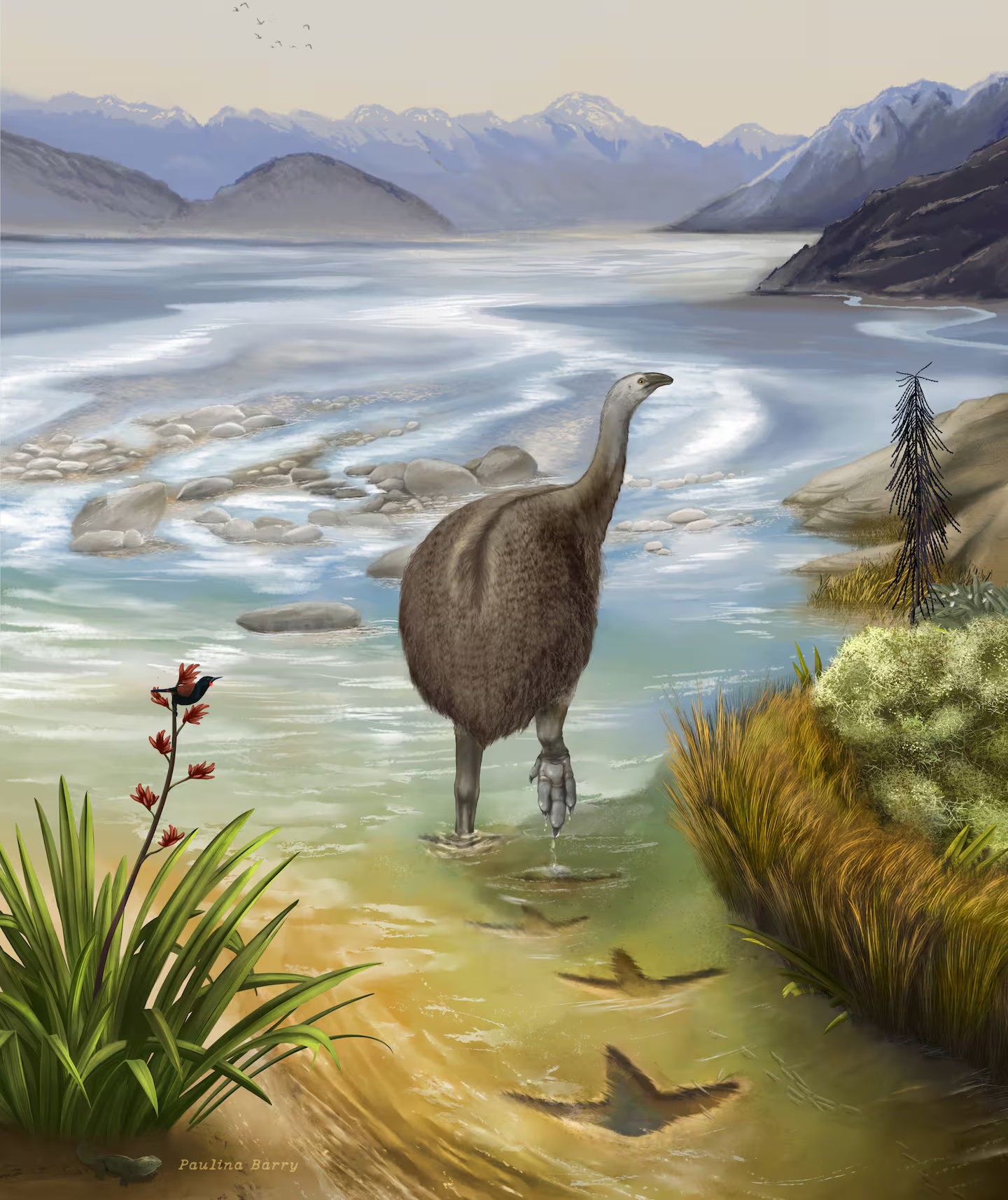
[PaleoOrnithology • 2024] The Moa Footprints from the Pliocene – early Pleistocene of Kyeburn, Otago, New Zealand


An artist’s impression of the moa which created the Kyeburn footprints.

in Fleury, Burns, Richards, Norton, Read, Wesley, Fordyce et Wilcken, 2024. 
 Artwork by Paulina Barry.
 
ABSTRACT
In March, 2019, a trackway of seven footprints was found at a riverbank outcrop of Maniototo Conglomerate Formation in the Kyeburn River, Central Otago, South Island, New Zealand. In this study, we describe this first known occurrence of moa (Dinornithiformes) footprints to be found and recovered in Te Waipounamu/South Island. Footprints of the trackway were ∼46 mm deep, 272–300 mm wide and 260–294 mm in length. An associated separate footprint was 448 mm wide and 285 mm long. Cosmogenic nuclide dating of adjacent overlying beds from the same formation establishes a mean minimum age of burial age for the tracks of 3.57 Ma (+1.62/−1.18 Ma) with a mode of 2.9 Ma, which we interpret to be Late Pliocene, with a conservative age range of Pliocene to Early Pleistocene. The trackway maker is identified as a moa from the Emeidae family, probably from the genus Pachyornis, with a mean mass of 84.61 kg that was travelling at a speed of 2.61 kmh−1. The single adjacent footprint was made by an individual from the family Dinornithidae, most likely from the genus Dinornis with an estimated mass of 158 kg. These moa footprints represent the second earliest fossil record of moa.

KEYWORDS: Trackway, moa footprint‌, Dinornithiformes, cosmogenic nuclide dating, Pliocene‌, Maniototo Conglomerate


Kane Fleury, Emma Burns, Marcus D. Richards, Kevin Norton, Stephen Read, Rachel Wesley, R. Ewan Fordyce and Klaus Wilcken. 2024. The Moa Footprints from the Pliocene – early Pleistocene of Kyeburn, Otago, New Zealand. Journal of the Royal Society of New Zealand. 54(5); 620-642. DOI: doi.org/10.1080/03036758.2023.2264789 
Special issue: Fossil vertebrates from Southern Zealandia: taonga of international significance. Guest Editors: Carolina Loch, Daniel Thomas, Jeffrey Robinson

www.linkedin.com/posts/pamela-naidoo-ameglio_feathery-moas-fossilised-footprints-ancient-activity-7132122722146385920-rgTz

Tuesday, August 20, 2024

[PaleoOrnithology • 2025] Agapornis longipes • A New Species of Lovebird (Aves: Psittaculidae: Agapornis) from the Plio-Pleistocene of the Cradle of Humankind (Gauteng, South Africa)


Agapornis longipes
Pavia, Braga, Delfino, Kgasi, Manegold, Steininger, Zipfel & Val, 2025
  
Artwork by Martina Cadin

Abstract
A new parrot species of the genus Agapornis (Aves, Psittaculidae), namely Agapornis longipes nov. sp., is described from the Plio-Pleistocene of Kromdraai, Cooper’s Cave, and Swartkrans in the Cradle of Humankind, South Africa. The new species is represented by all major wing bones (humerus, ulna, and carpometacarpus) and by the tarsometatarsus, together with a fragmentary mandible and coracoid. The size of the bones indicates a small species of Agapornis with an elongated tarsometatarsus, proportionately the longest of all known species of Agapornis. This lengthening of the legs might be related to feeding adaptation of the extinct species, as the longer legs may have favored this ground feeder in the high and dense grassland characteristic of the Cradle of Humankind during the Plio-Pleistocene transition and the Early Pleistocene.

Keywords: Birds, Parrot, Osteology, Paleoecology, Cooper’s Cave, Kromdraai, Swartkrans

 Systematic paleontology
Aves Linnaeus, 1758
Psittaciformes Wagler, 1830
Psittaculidae Vigors, 1825
Agapornithinae Salvin, 1882

Genus Agapornis Selby, 1836

 Agapornis longipes nov. sp. from the Plio-Pleistocene of the Cradle of Humankind.
A-C. Holotype, right tarsometatarsus KWPoc 70e from Kromdraai in dorsal (A), plantar (B), and proximal (C) views. D. Paratype, left tarsometatarsus SKX 18624 from Swartkrans in proximal view. E, F. Paratype, right humerus CD 16165b from Cooper’s Cave in caudal (E) and cranial (F) views. G. Paratype, left ulna KWPoc 244d from Kromdraai in ventral view. H. Paratype, left carpometacarpus KWPoc 167c from Kromdraai in ventral view. I. Paratype, left coracoid CD 16332 from Cooper’s Cave in dorsal view. J. Paratype, left humerus KW 7951 from Kromdraai in caudal view. K. Rostrum mandibulae CD 16381e from Cooper’s Cave in dorsal view.
Abbreviation: tcd, tuberculum craniodistalis. Scale bar: 10 mm.

Agapornis longipes nov. sp.

Derivation of the name: The new species shows the longest tarsometatarsus of all extant and extinct species of Agapornis in proportion to the humerus, as shown by the ratio of humerus to tarsometatarsus lengths.

Holotype: KWPoc 70e, complete right tarsometatarsus.

 Life reconstruction of an air of Agapornis longipes nov. sp. feeding on the ground in the Early Pleistocene of the Cradle of Humankind (Gauteng, South Africa) during the dry season
(Artwork by Martina Cadin).

 
Marco Pavia, José Braga, Massimo Delfino, Lazarus Kgasi, Albrecht Manegold, Christine Steininger, Bernhard Zipfel and Aurore Val. 2024. A New Species of Lovebird (Aves, Psittaculidae, Agapornis) from the Plio-Pleistocene of the Cradle of Humankind (Gauteng, South Africa). Geobios. In Press. DOI: doi.org/10.1016/j.geobios.2024.05.006