Showing posts with label Spinosauridae. Show all posts

Friday, February 20, 2026

[Paleontology • 2026] Spinosaurus mirabilis • Scimitar-crested Spinosaurus species from the Sahara caps stepwise spinosaurid radiation


Spinosaurus mirabilis
Sereno, Vidal, Myhrvold, Johnson-Ransom, Ciudad Real, Baumgart, Sánchez Fontela, Green, Saitta, Adamou, Bop, Keillor, Fitzgerald, Dutheil,  Laroche, Demers-Potvin, Simarro, Gascó-Lluna,  Lázaro, Gamonal, Beightol, Reneleau, Vautrin, Bertozzo, FGranados, Kinney-Broderick, Mallon, Lindoso, Ramezani & Jahandar, 2026
 
Artwork: Dani Navarro

 Abstract
INTRODUCTION: The fossils of Spinosaurus aegyptiacus, a giant sail-backed, fish-eating theropod dinosaur from northern Africa, have inspired competing lifestyle interpretations, either as a semiaquatic ambush predator stalking shorelines and shallows or a fully aquatic predator in pursuit of prey underwater. Its bones and teeth have been found only in coastal deposits near marine margins, a locale potentially consistent with either lifestyle interpretation.

RATIONALE: In the central Sahara, a new fossiliferous area (Jenguebi) was discovered in beds equivalent in age [Farak Formation; Cenomanian ~95 million years ago (Mya)] to those yielding fossil remains of S. aegyptiacus. We describe from this area a new species, Spinosaurus mirabilis sp. nov., which is very similar to S. aegyptiacus in skeletal form but with a much taller, scimitar-shaped cranial crest. Two new sauropods were found in close association with the new spinosaurid buried in fluvial sediments indicative of an inland riparian habitat.

RESULTS: Spinosaurus mirabilis sp. nov. is distinguished by the low profile of its snout, a hypertrophied nasal-prefrontal crest, greater spacing of posterior maxillary teeth, and other features. Its features highlight the extraordinary specializations of both species of the genus Spinosaurus, including interdigitating upper and lower teeth. Principal component analysis of body proportions places spinosaurids between semiaquatic waders (e.g., herons) and aquatic divers (e.g., darters) distant from all other predatory dinosaurs. A time-calibrated phylogenetic analysis resolves three evolutionary phases: an initial Jurassic radiation when their distinctive elongate fish-snaring skull evolved and split into two distinctive designs, baryonychine and spinosaurine; an Early Cretaceous circum-Tethyan diversification when both reigned as dominant predators; and a final early Late Cretaceous phase when spinosaurines attained maximum body size as shallow water ambush specialists limited geographically to northern Africa and South America.

CONCLUSION: The discovery of the tall-crested S. mirabilis sp. nov. in a riparian setting within an inland basin supports a lifestyle interpretation of a wading, shoreline predator with visual display an important aspect of its biology. At the end of the Cenomanian about 95 million years ago, an abrupt eustatic rise in sea level and the attendant climate change brought the spinosaurid radiation to an end.


Sheathed bony head crests in extinct and living dinosaurs. Spinosaurus mirabilis sp. nov., evolved the tallest head crest of any theropod dinosaur, drawing attention to the midline ornamentation that characterizes the cranium and axial skeleton of all spinosaurids. In life, the crest would have been extended to some degree by a keratinous sheath, as in the living helmeted guinea fowl (Numida meleagris). Visual signaling, as is the case in guinea fowl and other crested avians, was likely the function of spinosaurid cranial crests and trunk and tail sails. Scale bar, 20 cm for S. mirabilis and 3 cm for N. meleagris.

Spinosaurus mirabilis


A single Spinosaurus mirabilis rears over a carcass of the coelacanth Mawsonia on the forested bank of a river some 95 million years ago in what is now the Sahara Desert in Niger. A scimitar-shaped head crest and interdigitating teeth characterize this wading giant, one of the last-surviving species of a spinosaurid radiation some 50 million years in the making.
Artwork: Dani Navarro

Sereno, Paul C.; Vidal, Daniel; Myhrvold, Nathan P.; Johnson-Ransom, Evan; Ciudad Real, María; Baumgart, Stephanie L.; Sánchez Fontela, Noelia; Green, Todd L.; Saitta, Evan T.; Adamou, Boubé; Bop, Lauren L.; Keillor, Tyler M.; Fitzgerald, Erin C.; Dutheil, Didier B.; Laroche, Robert A. S.; Demers-Potvin, Alexandre V.; Simarro, Álvaro; Gascó-Lluna, Francesc; Lázaro, Ana; Gamonal, Arturo; Beightol, Charles V.; Reneleau, Vincent; Vautrin, Rachel; Bertozzo, Filippo; Granados, Alejandro; Kinney-Broderick, Grace; Mallon, Jordan C.; Lindoso, Rafael M.; Ramezani, Jahandar. 2026. Scimitar-crested Spinosaurus species from the Sahara caps stepwise spinosaurid radiation. Science. 391 (6787) eadx5486. DOI: doi.org/10.1126/science.adx5486 [19 Feb 2026] 
 
Editor’s summary: Recent descriptions of and debates about the massive, fish-eating dinosaur Spinosaurus have brought this striking predator to the forefront of the dinosaur pantheon. Its huge size and distinctive morphology have stimulated much debate about the degree to which it lived an aquatic lifestyle. Sereno et al. describe a crested fossil Spinosaurus found in northern Africa as a new species. The researchers argue that this group of dinosaurs underwent three phases of evolution with increasing aquatic adaptations and existence in habitats around the Tethys Sea. —Sacha Vignieri


Wednesday, July 2, 2025

[Paleontology • 2025] The Occurrence of Spinosauridae (Dinosauria: Theropoda) during the Cretaceous of Asia: Implications for Biogeography and Distribution


Selected material of Asian spinosaurids.
 (A) Siamosaurus suteethorni (SM-TF2043). (B) Khok Kruat spinosaurid tooth (SM-PNS-2018). 
(C) A tooth from Nakazato locality, Gunma, Japan (GMNH-PV-999  cast).  (D) A  tooth  from  Kanna  locality,  Gunma,  Japan  (KDC-PV-0003  cast).  
(E) Ichthyovenator laoensis dorsal vertebra (cast of MDS BK10). (F) Sam Ran spinosaurid dorsal neural spine (SM-KK14, Samathi et al., in prep.). 
(G) Ichthyovenator laoensis caudal vertebra (cast of MDS BK10). (H) Phuwiang spinosaurid B caudal vertebra (SM-PW9B-15). Photographs taken by the authors. Not to scale.

in Samathi et Puntanon, 2025.

Abstract
The theropod dinosaur clade Spinosauridae lived on almost all continents during the Cretaceous. It has been suggested that the group originated in Laurasia, likely in Europe. Asian spinosaurid fossils have been discovered in Southeast and East Asia, particularly from Barremian–Aptian deposits of the Early Cretaceous, with some additional evidence from Cenomanian-aged sediments in the Late Cretaceous. The presence of this theropod clade in Asia, including Thailand, Malaysia, Laos, China, and Japan, may have been influenced by the regression of the Uralian seaway, which temporarily connected Europe and Asia via an ephemeral landbridge. This change likely affected the dispersal of spinosaurids from Europe, facilitating their spread across Asia and shaping their evolution through geographic vicariance. This study reviews the Asian fossil record of Spinosauridae to examine their emergence, paleogeographic distribution, and dispersal patterns. The reports of Asian spinosaurids suggested that the distribution of this clade in Asia is complex and dubious due to the incompleteness of materials and uncertainty of the age of several fossil-bearing strata. The spinosaurid ancestors dispersed along the coastal shoreline from Europe by crossing ephemeral landbridge during pre-Barremian. Then, they spread out to Thailand, Malaysia, southern China, and Japan. The presence of Late Cretaceous spinosaurids in China suggests that Asian spinosaurids persisted until the extinction event of this clade, as happened in western Laurasia and Gondwana during the Cenomanian.

Keywords: Asia, dispersal event, Early Cretaceous, Spinosauridae


Selected material of Asian spinosaurids.
 (A) Siamosaurus suteethorni (SM-TF2043). (B) Khok Kruat spinosaurid tooth (SM-PNS-2018). (C) A tooth from Nakazato locality, Gunma, Japan (GMNH-PV-999  cast).  (D) A  tooth  from  Kanna  locality,  Gunma,  Japan  (KDC-PV-0003  cast). 
 (E) Ichthyovenator laoensis dorsal vertebra (cast of MDS BK10). (F) Sam Ran spinosaurid dorsal neural spine (SM-KK14, Samathi et al., in prep.). (G) Ichthyovenator laoensis caudal vertebra (cast of MDS BK10). (H) Phuwiang spinosaurid B caudal vertebra (SM-PW9B-15). Photographs taken by the authors. Not to scale.

The regions of Asia (Southeastern Asia + Eastern Asia) from which spinosaurid remains were reported. Abbreviation: (GP), “Grès supérieurs” Formation; (KK), Khok Kruat Formation; (KTD), Kitadani Formation;  Mangchuan  Formation  (MC);  (SK),  Sao  Khua  Formation;  (TBG), Tembling  Group;  (XI), Xinlong Formation; Yuasa Formation (YU).


Adun Samathi and Kridsanupong Puntanon. 2025. The Occurrence of Spinosauridae (Dinosauria: Theropoda) during the Cretaceous of Asia: Implications for Biogeography and Distribution. Thai Geoscience Journal. 6(9), 13–28. https://ph03.tci-thaijo.org/index.php/TGJ/article/view/3652

 การศึกษาการกระจายพันธุ์ทางสัตวภูมิศาสตร์ของสไปโนซอร์ในเอเชีย
นักวิจัยจากหน่วยวิจัยไดโนเสาร์ มหาวิทยาลัยมหาสารคาม ศึกษาการกระจายพันธุ์ทางสัตวภูมิศาสตร์ของไดโนเสาร์กินเนื้อวงศ์สไปโนซอริเด้ หรือพวกไดโนเสาร์กินปลาที่มีกะโหลกและฟันคล้ายจระเข้ และบางชนิดมีกระโดงหลังหรือสันหลังสูง โดยงานนี้ได้โฟกัสที่สไปโนซอริเด้ที่พบในเอเชีย ได้แก่ ไทย ลาว มาเลเซีย จีน และญี่ปุ่น โดยคาดว่าพวกมันอพยพมาจากยุโรปในยุคครีเตเชียสตอนต้น (pre-Barremian หรือก่อน 125 ล้านปีก่อน) ผ่านสะพานแผ่นดินชั่วคราว
...

Monday, December 9, 2024

[Paleontology • 2024] Theropod Dinosaur Diversity of the lower English Wealden: Analysis of a tooth-based fauna from the Wadhurst Clay Formation (Lower Cretaceous: Valanginian) via phylogenetic, discriminant and machine learning methods


An Early Cretaceous floodplain in southeastern England, 135 million years ago:
a spinosaur takes over the carcass of an ornithopod, much to the annoyance of the smaller tyrannosaurs (left) and dromaeosaurids.


in Barker, Handford, Naish, Wills, Hendrickx, ... et Gostling, 2024. 
artwork by Anthony Hutchings.
 
Abstract
The Lower Cretaceous Wealden Supergroup of southern England yields a diverse assemblage of theropod dinosaurs, its taxa being represented by fragments in addition to some of the most informative associated skeletons of the European Mesozoic. Spinosaurids, neovenatorid allosauroids, tyrannosauroids and dromaeosaurids are among reported Wealden Supergroup clades. However, the majority of relevant specimens are from the Barremian Upper Weald Clay and Wessex formations, and theropod diversity in the older Berriasian–Valanginian Hastings Group has remained poorly known, the fragmentary specimens reported thus far remaining enigmatic both in terms of phylogenetic affinities and sometimes provenance. A better understanding would be welcome given the paucity of Berriasian–Valanginian dinosaurs worldwide. Here, we describe an assemblage of Hastings Group theropod teeth from the Valanginian Wadhurst Clay Formation, mostly collected from the Ashdown Brickworks locality near Bexhill, East Sussex. These teeth were assessed using phylogenetic, discriminant and machine learning analyses and were found to include members of Spinosauridae, Tyrannosauroidea and Dromaeosauridae, in addition to others that remain of uncertain affinity within Coelurosauria. The taxa appear distinct from those already known from Wealden Supergroup strata: the spinosaurid cannot be referred to Baryonyx or the tyrannosauroid to Eotyrannus, for example, but we have not named new taxa at this time. Combined with other findings in the Wadhurst Clay Formation, our study indicates that Valanginian theropod diversity was comparable to that of younger Wealden Supergroup units, implying that the ‘characteristic’ theropod components of Wealden faunas were established early in the deposition of this famous geological succession.

Keywords: theropod, Wealden Supergroup, phylogenetics, machine learning, dinosaur, Cretaceous

Theropod teeth from the Wadhurst Clay Formation.
A, BEXHM 1995.485 (morphotype I). B, BEXHM 2002.50.123 (morphotype II). C, BEXHM 2002.50.124 (morphotype III). D, BEXHM 2005.29 (morphotype IV). E, NHMUK PV R37630 (morphotype V).
 A, C–E, lingual; B, labial view. Scale bar represents 10 mm.

Schematic representation of the theropod diversity throughout the Wealden Supergroup, with specimens from the Wealden Group (Wessex sub-basin) and the Hastings and Weald Clay groups (Weald sub-basin).

An Early Cretaceous floodplain in southeastern England, 135 million years ago: a spinosaur (centre) takes over the carcass of an ornithopod, much to the annoyance of the smaller tyrannosaurs (left) and dromaeosaurids (bottom right).
artwork by Anthony Hutchings.


Chris T. Barker, Lucy Handford, Darren Naish, Simon Wills, Christophe Hendrickx, Phil Hadland, Dave Brockhurst and Neil J. Gostling. 2024. Theropod Dinosaur Diversity of the lower English Wealden: Analysis of a tooth-based fauna from the Wadhurst Clay Formation (Lower Cretaceous: Valanginian) via phylogenetic, discriminant and machine learning methods. Papers in Palaeontology. DOI: doi.org/10.1002/spp2.1604


Friday, April 19, 2024

[Paleontology • 2024] A Reassessment of the historical Fossil Findings from Bahia State (Northeast Brazil) reveals A diversified Dinosaur Fauna in the Lower Cretaceous of South America


faunal components of the Marfim Formation (Valanginian–Hauterivian), the Recôncavo Basin during Lower Cretaceous
Tietasaura derbyiana
Bandeira, Navarro, Pêgas, Brilhante, Brum, de Souza, da Silva & Gallo, 2024


ABSTRACT
Supposed dinosaur remains were collected between 1859 and 1906 in the Lower Cretaceous Recôncavo Basin (Northeast Brazil). Since these materials remained undescribed, and most were considered lost. Recently, some of these historical specimens were rediscovered in the Natural History Museum of London, providing an opportunity to revisit them after 160 years. The specimens come from five different sites, corresponding to the Massacará (Berriasian-Barremian) and Ilhas (Valanginian-Barremian) groups. Identified bones comprise mainly isolated vertebral centra from ornithopods, sauropods, and theropods. Appendicular remains include a theropod pedal phalanx, humerus, and distal half of a left femur with elasmarian affinities. Despite their fragmentary nature, these specimens represent the earliest dinosaur bones discovered in South America, enhancing our understanding of the Cretaceous dinosaur faunas in Northeast Brazil. The dinosaur assemblage in the Recôncavo Basin resembles coeval units in Northeast Brazil, such as the Rio do Peixe Basin, where ornithopods coexist with sauropods and theropods. This study confirms the presence of ornithischian dinosaurs in Brazil based on osteological evidence, expanding their biogeographic and temporal range before the continental rifting between South America and Africa. Additionally, these findings reinforce the fossiliferous potential of Cretaceous deposits in Bahia State, which have been underexplored since their initial discoveries.

KEYWORDS: Recôncavo Basin, Massacará Group, Ilhas Group, Ornithischia, Sauropoda, Theropoda


 Paleontographical reconstruction of the hypothetical paleoenvironment of the Recôncavo Basin during Lower Cretaceous: A, faunal components of the Marfim Formation (Valanginian–Hauterivian); B, faunal components of the Pojuca Formation (Hauterivian–Barremian). The Salvador Formation is partially synchronous with both units, sharing coeval components.
Artwork by Matheus Gadelha.


Dinosauria Owen Citation1842
Ornithischia Seeley Citation1888
Genasauria Sereno Citation1986

Neornithischia Cooper Citation1985
Cerapoda Sereno Citation1986

Ornithopoda Marsh Citation1881
Elasmaria Calvo et al. Citation2007

Tietasaura gen. nov. 

Etymology: The generic epithet is a combination of Tieta (nickname for Antonieta in Portuguese) and -saura (σαύρα), the genitive form of -saurus and meaning lizard in ancient Greek. The name Tieta honours the main character from the homonymous novel ‘Tieta do Agreste’ by the famous author Jorge Amado, who was born in Bahia and lived in Salvador City. The name Antonieta further means ‘priceless’, alluding to the value of Tietasaura derbyiana sp. nov. as the first nominal ornithischian species from Brazil.
 

Tietasaura derbyiana sp. nov.

Etymology: The specific epithet is an eponym honouring Orville A. Derby (1851–1915), founder and the first director from Brazilian Mineralogical and Geological Commission (Serviço Geológico e Mineralógico do Brasil, nowadays SGB), being also the former director of the National Museum of Rio de Janeiro (MN) and one of the pioneers of palaeontology in the Recôncavo Basin. Despite all tragedies in his life and the blatant lack of governmental support, Derby valiantly fought for the scientific progress of the Brazilian geosciences.

Holotype: NHM-PV R.3424, represented by a distal half of a small left femur.

Diagnosis: Small sized elasmarian ornithopod exhibiting an unique combination of character states on the femur (putative autapomorphies marked with an asterisk): presence of a marked anterior linea muscularis followed by several longitudinal striae converging distally towards the intercondylar extensor groove; broad but shallow intercondylar extensor groove; stout supracondylar ridges that extends medially; fibular supracondylar ridge sinuous and bearing a lateral fossa*; hemispherical distal femoral condyles in the posterior view, being the tibial condyle twice as large as fibular condyle; distinct prominent crest in the median margin of the tibial condyle*; fibular condyle with straight lateral margin and continuous in the distal view, lacking an indentation formed by a condyloid (rectangular) process; presence of an offset condylid, medial to the fibular condyle; broad and deep intercondylar flexor fossa, subtriangular in shape and much extending into the diaphysis.

Type locality and horizon: The holotype of Tietasaura derbyiana was recovered at a beach near the Plataforma Station (Locality 3), Salvador City, Bahia State. The shale facies outcropping in this locality are associated with the Valanginian – Hauterivian Marfim Formation (Ilhas Group, Recôncavo Basin).
...

 
Kamila L. N. Bandeira, Bruno A. Navarro, Rodrigo V. Pêgas, Natan S. Brilhante, Arthur S. Brum, Lucy G. de Souza, Rafael C. da Silva and Valéria Gallo. 2024. A Reassessment of the historical Fossil Findings from Bahia State (Northeast Brazil) reveals A diversified Dinosaur Fauna in the Lower Cretaceous of South America. Historical Biology: An International Journal of Paleobiology. DOI: 10.1080/08912963.2024.2318406    Researchgate.net/publication/379778273_fossil_findings_from_Bahia_NE_Brazil


Friday, March 8, 2024

[Paleontology • 2024] Diving Dinosaurs? Caveats on the Use of Bone Compactness and pFDA for inferring Lifestyle


 Spinosaurus aegyptiacus

in Myhrvold, Baumgart, Vidal, Fish, Henderson, Saitta et Sereno, 2024. 
Reconstruction by Dani Navarro

Abstract
The lifestyle of spinosaurid dinosaurs has been a topic of lively debate ever since the unveiling of important new skeletal parts for Spinosaurus aegyptiacus in 2014 and 2020. Disparate lifestyles for this taxon have been proposed in the literature; some have argued that it was semiaquatic to varying degrees, hunting fish from the margins of water bodies, or perhaps while wading or swimming on the surface; others suggest that it was a fully aquatic underwater pursuit predator. The various proposals are based on equally disparate lines of evidence. A recent study by Fabbri and coworkers [2022] sought to resolve this matter by applying the statistical method of phylogenetic flexible discriminant analysis to femur and rib bone diameters and a bone microanatomy metric called global bone compactness. From their statistical analyses of datasets based on a wide range of extant and extinct taxa, they concluded that two spinosaurid dinosaurs (S. aegyptiacus, Baryonyx walkeri) were fully submerged “subaqueous foragers,” whereas a third spinosaurid (Suchomimus tenerensis) remained a terrestrial predator. We performed a thorough reexamination of the datasets, analyses, and methodological assumptions on which those conclusions were based, which reveals substantial problems in each of these areas. In the datasets of exemplar taxa, we found unsupported categorization of taxon lifestyle, inconsistent inclusion and exclusion of taxa, and inappropriate choice of taxa and independent variables. We also explored the effects of uncontrolled sources of variation in estimates of bone compactness that arise from biological factors and measurement error. We found that the ability to draw quantitative conclusions is limited when taxa are represented by single data points with potentially large intrinsic variability. The results of our analysis of the statistical method show that it has low accuracy when applied to these datasets and that the data distributions do not meet fundamental assumptions of the method. These findings not only invalidate the conclusions of the particular analysis of Fabbri et al. but also have important implications for future quantitative uses of bone compactness and discriminant analysis in paleontology.


Nathan P. Myhrvold, Stephanie L. Baumgart, Daniel Vidal, Frank E. Fish, Donald M. Henderson, Evan T. Saitta and Paul C. Sereno. 2024. Diving Dinosaurs? Caveats on the Use of Bone Compactness and pFDA for inferring Lifestyle. PLoS ONE. 19(3): e0298957. DOI: 10.1371/journal.pone.0298957


Sunday, February 25, 2024

[Paleontology • 2024] Riojavenatrix lacustris Increasing the Theropod Record of Europe: A New basal spinosaurid (Theropoda: Spinosauridae) from the Enciso Group of the Cameros Basin (La Rioja, Spain). Evolutionary Implications and Palaeobiodiversity


Riojavenatrix lacustris 
 Isasmendi, Cuesta, Díaz-Martínez, Company, Sáez-Benito, Viera, Torices & Pereda-Suberbiola, 2024

Reconstruction by Adrián Blázquez Riola  twitter.com/AdriSuchoBlaink

Abstract
A new member of Spinosauridae from the Enciso Group (uppermost Barremian–lower Aptian) from Igea (La Rioja, Spain) is here erected on the basis of axial, pelvic girdle, and hindlimb elements that exhibit a unique combination of characters. Riojavenatrix lacustris gen. et sp. nov. is one of the latest Iberian and European spinosaurid taxa. It retains a triangular pubic boot, like the megalosaurids, and a medial condyle of the femur that shows a transitional stage between the anteroposteriorly oriented long axis of non-spinosaurid theropods and the posteromedially oriented long axis of Spinosauridae. The spinosaurid record of Iberia ranges from the late Hauterivian–early Barremian to the latest Barremian–early Aptian so far, and both the oldest and the most recent evidence comes from the Cameros Basin, where spinosaurid remains are especially abundant in the Barremian deposits. A review of the spinosaurid record has allowed us to dismiss the presence of the genus Baryonyx from Iberia; hence, only Camarillasaurus, Iberospinus, Protathlitis, Riojavenatrix gen. nov., and Vallibonavenatrix are considered to be present in the Early Cretaceous of Iberia. According to this study, Riojavenatrix is one of the youngest baryonychines in the fossil record.

Baryonychinae, dinosaur, Early Cretaceous, Europe, Iberian Peninsula, Megalosauroidea, Spinosauridae, Theropoda


Riojavenatrix lacustris gen. et sp. nov

Erik Isasmendi, Elena Cuesta, Ignacio Díaz-Martínez, Julio Company, Patxi Sáez-Benito, Luis I Viera, Angelica Torices and Xabier Pereda-Suberbiola. 2024. Increasing the Theropod Record of Europe: A New basal spinosaurid from the Enciso Group of the Cameros Basin (La Rioja, Spain). Evolutionary Implications and Palaeobiodiversity. Zoological Journal of the Linnean Society., zlad193. DOI: 10.1093/zoolinnean/zlad193


Friday, May 19, 2023

[Paleontology • 2023] Protathlitis cinctorrensis • A New spinosaurid Dinosaur Species (Theropoda: Spinosauridae) from the Early Cretaceous of Cinctorres, Spain


Protathlitis cinctorrensis
Santos-Cubedo, Santisteban, Poza & Meseguer, 2023


Abstract
A new spinosaurid genus and species is described based on the right maxilla and five caudal vertebrae of a single specimen from the Arcillas de Morella Formation (Early Cretaceous) at the locality of Cinctorres (Castellón, Spain). Protathlitis cinctorrensis gen. et sp. nov. is diagnosed by one autapomorphic feature as well as by a unique combination of characters. The autapomorphy includes a subcircular depression in the anterior corner of the antorbital fossa in the maxilla. The new Iberian species is recovered as a basal baryonychine. The recognition of Protathlitis cinctorrensis gen. et sp. nov. as the first baryonychine dinosaur species identified from the Arcillas de Morella Formation (late Barremian) from the same time as Vallibonavenatrix cani, the first spinosaurine dinosaur from the same formation in the Morella subbasin (Maestrat Basin, eastern Spain), indicates that the Iberian Peninsula was home to a highly diverse assemblage of medium-to-large bodied spinosaurid dinosaurs. It seems that spinosaurids appeared during the Early Cretaceous in Laurasia, with the two subfamilies occupying the western part of Europe during this period. Later, during the Barremian–Aptian, they migrated to Africa and Asia, where they would diversify. In Europe, baryonychines were dominant, while in Africa, spinosaurines were most abundant.


Protathlitis cinctorrensis gen. et sp. nov.


Andrés Santos-Cubedo, Carlos de Santisteban, Begoña Poza and Sergi Meseguer. 2023. A New spinosaurid Dinosaur Species from the Early Cretaceous of Cinctorres (Spain). Scientific Reports. 13: 6471. DOI: 10.1038/s41598-023-33418-2

Thursday, May 11, 2023

[Paleontology • 2023] A Reappraisal of the Cranial and Mandibular Osteology of the spinosaurid Irritator challengeri (Dinosauria: Theropoda)


Irritator challengeri  Martill, Cruickshank, Frey, Small & Clarke, 1996

in Schade, Rauhut, Foth, Moleman et Evers, 2023. 

ABSTRACT
Although originally described almost three decades ago, the holotype of Irritator challengeri from the Lower Cretaceous Romualdo Formation of Brazil still represents the most complete spinosaurid skull known to science. Here, we present a detailed description of the skull of Irritator based on digital reconstructions from medical and micro computed tomography (µCT) data. Segmentation reveals the near-complete palatal complex and braincase, an unusual morphology of the retroarticular process, a large, ventrally inclined surangular shelf and the tooth replacement pattern. The digitally reconstructed skull anatomy indicates a robust dentition, a field of binocular vision in front of the skull with an inclined snout orientation, a relatively weak but fast bite, as well as laterally spreading and rotating lower jaw rami during jaw opening. We modified an existing phylogenetic matrix of Tetanurae to account for new observations on the morphology of Irritator and analysed this using parsimony and Bayesian methods. Results support Spinosauridae as members of Megalosauroidea and recover a monophyletic Carnosauria (Megalosauroidea + Allosauroidea). Parsimony analysis recovers Monolophosaurus nested within Megalosauroidea as sister taxon to spinosaurids, but this is not supported by the Bayesian analysis. Bayesian time-calibration and evolutionary rate analysis indicate that spinosaurid evolution happened fast, despite a long ghost lineage of at least 35 million years. High evolutionary rates over a prolonged time can explain the highly derived skull morphology of spinosaurids. This study provides an in-depth look into the evolution of spinosaurid skull anatomy and refines our understanding of these specialized Mesozoic predators.

Keywords: Dinosaur; Theropod; Spinosaurid; Cretaceous; Mesozoic; Brazil


Theropoda Marsh, 1881
Tetanurae Gauthier, 1986
Megalosauroidea Fitzinger, 1843; sensu Carrano et al. (2012)

Spinosauridae Stromer, 1915
Spinosaurinae (Stromer, 1915); sensu Sereno et al. (1998)

Irritator challengeri Martill, Cruickshank, Frey, Small and Clarke, 1996

Holotype. SMNS 58022, largely complete skull, missing most of the premaxillae, anterior ends of the maxillae, and anteriormost parts of both mandibles.

Locality and horizon. Near Buxexé, close to Santana do Cariri, Ceará State, northeastern Brazil (see Sues et al., 2002: 535). Lower part of the Romualdo Formation (Santana Formation of some authors; see discussion in Arai and Assine, 2020) of the Santana Group, late Aptian (Arai and Assine, 2020).


Marco Schade, Oliver W. M. Rauhut, Christian Foth, Olof Moleman, and Serjoscha W. Evers. 2023. A Reappraisal of the Cranial and Mandibular Osteology of the spinosaurid Irritator challengeri (Dinosauria: Theropoda). Palaeontologia Electronica. 26(2): a17.DOI: 10.26879/1242
 
palaeo-electronica.org/content/2023/3821-the-osteology-of-irritator


Wednesday, February 15, 2023

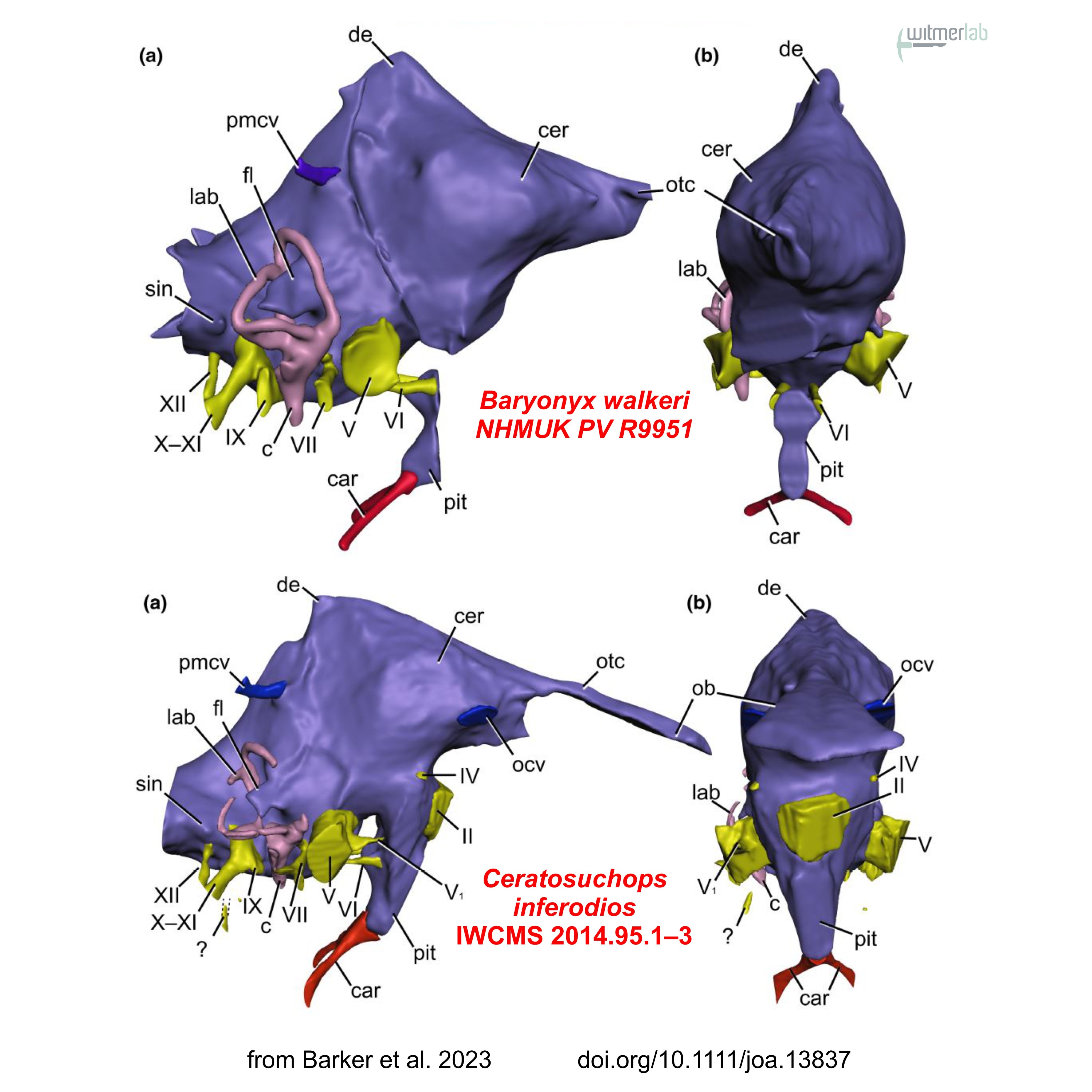
[Paleontology • 2023] Modified Skulls but Conservative Brains? The Palaeoneurology and Endocranial Anatomy of baryonychine Dinosaurs (Theropoda: Spinosauridae)


Ceratosuchops inferodios and the orientation of the endocast in the skull.

in Barker, Naish, Trend, Michels, ... et Gostling, 2023. 
Illustration: Anthony Hutchings

Abstract
The digital reconstruction of neurocranial endocasts has elucidated the gross brain structure and potential ecological attributes of many fossil taxa, including Irritator, a spinosaurine spinosaurid from the “mid” Cretaceous (Aptian) of Brazil. With unexceptional hearing capabilities, this taxon was inferred to integrate rapid and controlled pitch-down movements of the head that perhaps aided in the predation of small and agile prey such as fish. However, the neuroanatomy of baryonychine spinosaurids remains to be described, and potentially informs on the condition of early spinosaurids. Using micro-computed tomographic scanning (μCT), we reconstruct the braincase endocasts of Baryonyx walkeri and Ceratosuchops inferodios from the Wealden Supergroup (Lower Cretaceous) of England. We show that the gross endocranial morphology is similar to other non-maniraptoriform theropods, and corroborates previous observations of overall endocranial conservatism amongst more basal theropods. Several differences of unknown taxonomic utility are noted between the pair. Baryonychine neurosensory capabilities include low-frequency hearing and unexceptional olfaction, whilst the differing morphology of the floccular lobe tentatively suggests less developed gaze stabilisation mechanisms relative to spinosaurines. Given the morphological similarities observed with other basal tetanurans, baryonychines likely possessed comparable behavioural sophistication, suggesting that the transition from terrestrial hypercarnivorous ancestors to semi-aquatic “generalists” during the evolution of Spinosauridae did not require substantial modification of the brain and sensory systems.


Artist's impression of Ceratosuchops inferodios and the orientation of the endocast in the skull.
Illustration: Anthony Hutchings
 

Chris Tijani Barker, Darren Naish, Jacob Trend, Lysanne Veerle Michels, Lawrence Witmer, Ryan Ridgley, Katy Rankin, Claire E. Clarkin, Philipp Schneider and Neil J. Gostling. 2023. Modified Skulls but Conservative Brains? The Palaeoneurology and Endocranial Anatomy of baryonychine Dinosaurs (Theropoda: Spinosauridae). Journal of Anatomy. DOI: 10.1111/joa.13837
www.southampton.ac.uk/news/2023/02/oldest-spinosaur-brains-revealed.page