Showing posts with label Journal: Reinwardtia. Show all posts

Thursday, January 18, 2024

[Botany • 2023] Nepenthes calcicola (Nepenthaceae) • A New Pitcher Plant from Gulf Province, Papua New Guinea


Nepenthes calcicola Gary W.Wilson, S.Venter & Damas,

in Wilson, Venter & Damas, 2023. 
 Photos by S. Venter.
 
Abstract
A new species of pitcher plant from rain forest on limestone karst in the Purari River catchment in the Gulf Province of Papua New Guinea is described and illustrated as Nepenthes calcicola Gary W.Wilson, S.Venter & Damas. It is distinguished from N. neoguineensis on the basis of its distribution, ecology, habitat, and pitcher and inflorescence morphology. The new species is illustrated, and description is here given. The species is assessed as Vulnerable (VU) according to IUCN criteria.

Keywords: Nepenthaceae; pitcher; Papua New Guinea; taxonomy; karst
 
Nepenthes calcicola Gary W.Wilson, S.Venter & Damas.
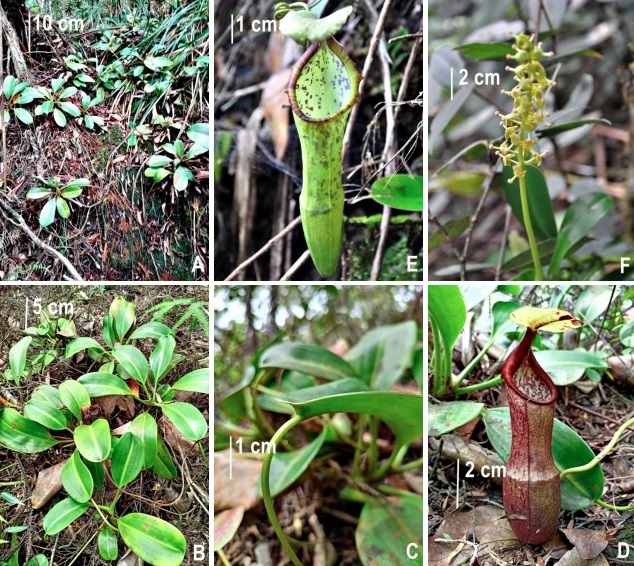
A. Habit with lower pitcher. B. Habit with mid-level pitchers. C. Habit with male inflorescence. D. A rosette of pitchers E. Field Assistant Siwi with mid-level rosette.
 (from the type, Collection S. Venter 14170 lodged at CNS).
 Photos by S. Venter.

Nepenthes calcicola Gary W.Wilson, S.Venter & Damas, spec. nov.

Nepenthes calcicola differs from N. neoguineensis in having stems that grow beneath the layer of leaf litter (vs. stems above leaf litter); short stems and rosettes of pitchers present (vs. absent); spur terete and recurved (vs. dorsiventrally flattened and not recurved; female inflorescence peduncle 160–190 × 3.0–4.0 mm (vs. 120–150 × 2.0 –2.5 mm); tepals obovate to broadly-obovate (vs. orbicular-elliptic).

Etymology. The specific epithet describes the calcareous substrate the plants grow in


 Gary W. Wilson, Stephanius Venter, Kapiro Q. Damas. 2023.  Nepenthes calcicola (Nepenthaceae), A New Pitcher Plant from Gulf Province, Papua New Guinea. REINWARDTIA.  22(2); 103‒109. DOI: 10.55981/reinwardtia.2023.4536 

Sebuah jenis baru kantong semar dari hutan hujan di batugamping di DAS Sungai Purari di Provinsi Teluk Papua Nugini dipertelakan dan diilustrasikan sebagai Nepenthes calcicola Gary W.Wilson, S.Venter & Damas. Jenis ini dibedakan dari N. neoguineensis berdasarkan distribusi, ekologi, habitat, dan morfologi kantong dan perbungaannya. Pertelaan dan ilustrasi dari jenis baru ini disajikan dalam naskah ini. Status konservasi jenis ini berdasarkan kriteria IUCN adalah jenis rentan (VU). 
Kata kunci: Batugamping, kantong, Nepenthaceae, Papua Nugini, taksonomi.

Sunday, December 10, 2023

[Botany • 2017] Trichotosia gabriel-asemiana (Orchidaceae) • A New Species from Tambrauw, West Papua Province, Indonesia


Trichotosia gabriel-asemiana Mambrasar & Schuit., 

in Mambrasar et Schuiteman. 2017.

Abstract
A new species of orchid, Trichotosia gabriel-asemiana Mambrasar & Schuit. from West Papua, Indonesia, is described and illustrated, including a colour photograph.

Keywords: New species, Tambrauw, Trichotosia gabriel-asemiana

Trichotosia gabriel-asemiana Mambrasar & Schuit., spec. nov. 
Habit and flower. Photo taken from type location by YM Mambrasar (BO).

Trichotosia gabriel-asemiana Mambrasar & Schuit., spec. nov. 

Diagnosis. This species is similar to Trichotosia microphylla Blume and T. dalatensis by its slender, creeping rhizome, short leaves (less than 2 cm long), and solitary flowers with an abaxial, conical callus near the lip apex. Trichotosia dalatensis has flowers that are similar in size and in the maroon colour, but differs in having a glabrous, uniformly thick lip with a distinct adaxial callus, whereas T. gabriel-asemiana has a lip that is sparsely pilose abaxially and which is abruptly divided into a fleshy basal part and a thin  textured upper part, but lacks an adaxial callus. Trichotosia microphylla has larger, yellowish green flowers (lip ca. 9 mm long, vs. 4 mm in T. gabriel-asemiana), with the lip not pubescent abaxially, and not abruptly divided into a fleshy basal part and a thinner upper part.

Etymology. Named in honour of Gabriel Asem, Regent of Tambrauw Regency since 2011, who in 2015 declared Tambrauw regency a conservation zone.
 

Yasper Michael Mambrasar and Andre Schuiteman. 2017. Trichotosia gabriel-asemiana (Orchidaceae), A New Species from Tambrauw, West Papua Province, Indonesia. REINWARDTIA. 16(2); 107–110. DOI: 10.14203/reinwardtia.v16i2.3310

Tuesday, May 9, 2023

[Botany • 2020] Bulbophyllum trinervosum (Orchidaceae: Epidendroideae: Bulbophyllinae) • A New Species of section Macrocaulia from West Java, Indonesia


Bulbophyllum trinervosum Victoriano & Y.R.Yudistira, 

in Victoriano et Yudistira, 2020. 

Abstract
A new species of Bulbophyllum (Orchidaceae: Bulbophyllinae) in section Macrocaulia from West Java, Indonesia is described as Bulbophyllum trinervosum Victoriano & Y.R.Yudistira spec. nov. This miniature orchid is found around Cakrabuana mountain range at an elevation of 1,300–1,550 m. The key characteristic of this species is unique among section Macrocaulia in having three nerves on its median sepal instead of five like the other species in this section.

Keywords: Bulbophyllum, Indonesia, Java, new species, orchids.


Bulbophyllum trinervosum Victoriano & Y.R.Yudistira, spec. nov.
 
Bulbophyllum trinervosum is similar to B. ovalifolium but differs in having a smaller flower, with three longitudinal veins on the median sepal (B. ovalifolium: five), an obovate lip with emarginate apex (B. ovalifolium: tongue-shaped, sub-acute apex) and oblong, oblique, folded petals each with one indistinct vein, the colour is identical to the lip (B. ovalifolium: oval–oblong and unfolded petals, with one distinctive vein, the colour is identical to the lateral sepals).

Etymology. From Latin trēs, the cardinal numeral of three for combination (tri-), and nervosus means sinewy or nerved. Thus, the epithet means three-nerved Bulbophyllum, it refers to the three longitudinal veins on the median sepal of this species.


 Malcolm Victoriano and Yuda Rehata Yudistira. 2020. Bulbophyllum trinervosum, A New Species of section Macrocaulia (Orchidaceae: Bulbophyllinae) from West Java, Indonesia. Reinwardtia. 19(1): 67‒73. DOI: 10.14203/reinwardtia.v19i1.3850

Wednesday, November 30, 2022

[Botany • 2022] Nepenthes harauensis (Nepenthaceae) • A New Species from West Sumatra, Indonesia


Nepenthes harauensis Hernawati, R.Satria & Chi.C.Lee,

in Hernawati, Satria & Lee, 2022. 

Abstract
 A new species of Nepenthes (Nepenthaceae) from the Harau region of West Sumatra is described as Nepenthes harauensis Hernawati, R.Satria & Chi.C.Lee. This species shares specific characteristics with both N. bongso and N. singalana but is unique in its thickly coriaceous and petiolate leaves, which are elliptic-oblong and have a distinctly peltate tendril insertion.

Keywords: Harau, Nepenthaceae, Nepenthes, Sumatra.


Nepenthes harauensis Hernawati, R.Satria & Chi.C.Lee.
A. Population of N. harauensis in the habitat. B. Habit of the short shoots. C. Leaf apex showing peltate tendril insertion. D. Lower pitcher. E. Upper pitcher. F. Male inflorescence. G. Fruits. H. Glandular zone on the lid.
From Nepenthes-Team Padang (Hernawati, Havid, Ihsan) NPT 220921-1. 
Photos by Robi Satria and Havid Ramadhan.

Nepenthes harauensis Hernawati, R.Satria & Chi.C.Lee. spec. nov.

Nepenthes harauensis has several morphological characteristics similar to N. bongso, but the pitcher shape is more like the N. singalana. The most prominent distinguishing character is the thick and stiff coriaceous leaf structure, the peltate tendril insertion, and the sheath-like petiole, which clasps the stem for ¾– ½ of its circumference.

Distribution. Nepenthes harauensis is only known from the type locality in Harau, West Sumatra, Indonesia. 
 
Etymology. The specific name refers to the place “Harau,” a sub-district of Lima Puluh Kota Regency.


 Hernawati Hernawati, Robi Satria and Ch'ien C. Lee. 2022. Nepenthes harauensis, A New Species of Nepenthaceae from West Sumatra. Reinwardtia. 21(1); 19‒23. DOI: 10.14203/reinwardtia.v21i1.4306

ABSTRAK — Jenis baru Nepenthes (Nepenthaceae) dari kawasan Harau Sumatra Barat dipertelakan sebagai Nepenthes harauensis Hernawati, R.Satria & Chi.C.Lee. Jenis ini mempunyai kemiripan karakter morfologi dengan N. bongso dan N. singalana tetapi memiliki keunikan dalam tekstur daun yang tebal dan kaku, berbentuk jorong yang melonjong, mempunyai tangkai daun dan memiliki sisipan sulur yang jelas menyerupai perisai. 
Kata kunci: Harau, Nepenthaceae, Nepenthes, Sumatra. 


Tuesday, May 17, 2022

[Botany • 2020] Begonia tjiasmantoi (Begoniaceae, sect. Petermannia) • A New Species from West Sulawesi, Indonesia


Begonia tjiasmantoi Ardi & D.C.Thomas

in Ardi & Thomas, 2020. 

A new species, Begonia tjiasmantoi Ardi & D.C.Thomas is described from Mamasa, West Sulawesi, Indonesia. The species is endemic to West Sulawesi and belongs to Begonia section Petermannia. A provisional conservation assessment indicates a Critically Endangered status.  

Keywords: new species, critically endangered, conservation assessment, a new species, endangered status

Begonia tjiasmantoi Ardi & D.C.Thomas.
A. Habit; scale bar: 5 cm. B. Stipule; scale bar: 5 mm. C.Male inflorescence; scale bar: 10 mm. D. Male inflorescence and female flower; scale bar: 10 cm. E. Male flower, front and side view; scale bar: 5 mm. F. Female flower, front view; scale bar: 5 mm. G. Infructescence; scale bar: 10 mm. H. Ovary cross-section, axile placentation and bilamellate placentae; scale bar: 2 mm.
A–H from WI 562. Photos: W.H. Ardi. 

Begonia tjiasmantoi Ardi & D.C.Thomas spec.nov. 
§ Petermannia

Begonia tjiasmantoi has a rhizomatous stem, male and female flowers with yellow tepals and male flowers with relatively few stamens (22‒24). This character combination differentiates it from other Sulawesi Begonia species. The rhizomatous growth habit of Begonia tjiasmantoi is similar to the growth habit of the orange-tepalled B. ignita C.W.Lin & C.I.Peng, but B. tjiasmantoi can be differentiated by its strongly asymmetric, ovate toelliptic leaves (8–11 × 3.5–5.5 cm); cymose-paniculate male inflorescence with subumbellate partial inflorescences with up to 6 flowers; yellow male flower tepals that are relatively small (6–8 ×7.5–8.5 mm) and have few stamens (22–24);female flowers with shorter pedicels (3–4 mm), 5(–6) yellow tepals, and a cylindrical seed-bearing part of the fruit. Begonia ignita has symmetric or subsymmetric cordiform leaves that are larger (7–12 × 6.5–11 cm); racemose-cymose male inflorescence with monochasial partial inflorescences with up to 3 flowers; orange male flower tepals that are larger in size (10–15 × 9–11mm), more stamens (35–45); female flowers with longer pedicels (6–13 mm), 4 (or rarely 2, 3 or 5)orange tepals, and an ellipsoid seed-bearing part of the fruit. 

Etymology. The species epithet refers to Wewin Tjiasmanto, the Chairmain of the Tjiasmanto Conservation Fund, who has generously supported the Sulawesi Begonia Project. 

 
Wisnu Handoyo Ardi and Daniel C. Thomas. 2020. Begonia tjiasmantoi, A New Species from West Sulawesi. Reinwardtia. 19(2); 61‒65. DOI: 10.14203/reinwardtia.v19i1.3848  


Saturday, January 1, 2022

[Botany • 2021] Etlingera comosa (Zingiberaceae: Alpinioidea) • A New Species from Central Sulawesi, Indonesia


Etlingera comosa Ardiyani & Ardi, 

in Ardiyani, Ardi, Hutabarat & Poulsen, 2021.

Etlingera comosa Ardiyani & Ardi, a new and unusual species from Tentena, Central Sulawesi exhibiting terrestrial as well as epiphytic habit is described here. It is compared to the morphologically closest Etlingera sublimata A.D.Poulsen, but differs in having tufted sheath, bilobed and asymmetric ligule, loose peduncular bracts, densely pubescent fertile bracts and longer filament. Colour plates, notes on its conservation status and DNA barcode data for the new species are also provided.

Keywords: Acanthodes group, DNA barcode, epiphytic, Etlingera sublimata, Indonesia, Zingiberales


Etlingera comosa Ardiyani & Ardi spec. nov. 

Similar to Etlingera sublimata A.D.Poulsen by the spiny bracts and thecae dehiscent through their entire length but E. comosa differs from E. sublimata in having tufted sheath (vs. not tufted), bilobed, asymmetric ligule (vs. entire), peduncular bracts only loosely enclosing base of spike and partly exposed the axis (vs. peduncular bracts enclosing base of spike, peduncle axis not exposed), fertile bracts densely pubescent (vs. glabrous with ciliate margin), longer stamen (9 mm vs. 5 mm), longer filament (3.5–4.5 mm vs. 0.5 mm) and shorter anther (4 mm vs. 5–5.5 mm).  

Etymology. The epithet comosa refers to the tufted hairs of the sheath. 
 
 
  Marlina Ardiyani, Wisnu Handoyo Ardi, Prima Wahyu Kusuma Hutabarat and Axel Dalberg Poulsen. 2021. Etlingera comosa, A New Species (Zingiberaceae: Alpinioidea) from Central Sulawesi. Reinwardtia. 20(2); 63−68.  DOI: 10.14203/reinwardtia.v20i2.4243


Saturday, July 31, 2021

[Botany • 2021] Begonia robii (Begoniaceae) • A New Species of Begonia from Lima Puluh Kota, West Sumatra, Indonesia


Begonia robii Ardi & Girm.

in Ardi, Girmansyah & Hughes, 2021.

A new species of Begonia sect. Jackia (Begoniaceae), Begonia robii Ardi & Girm., is described from West Sumatra and is a limestone karst endemic in the Tanah Datar dan Lima Puluh Kota Regency. Its provisional IUCN threatened category is considered to be Endangered.

Keywords: Endemic, limestone, Jackia

  
Begonia robii Ardi & Girm.
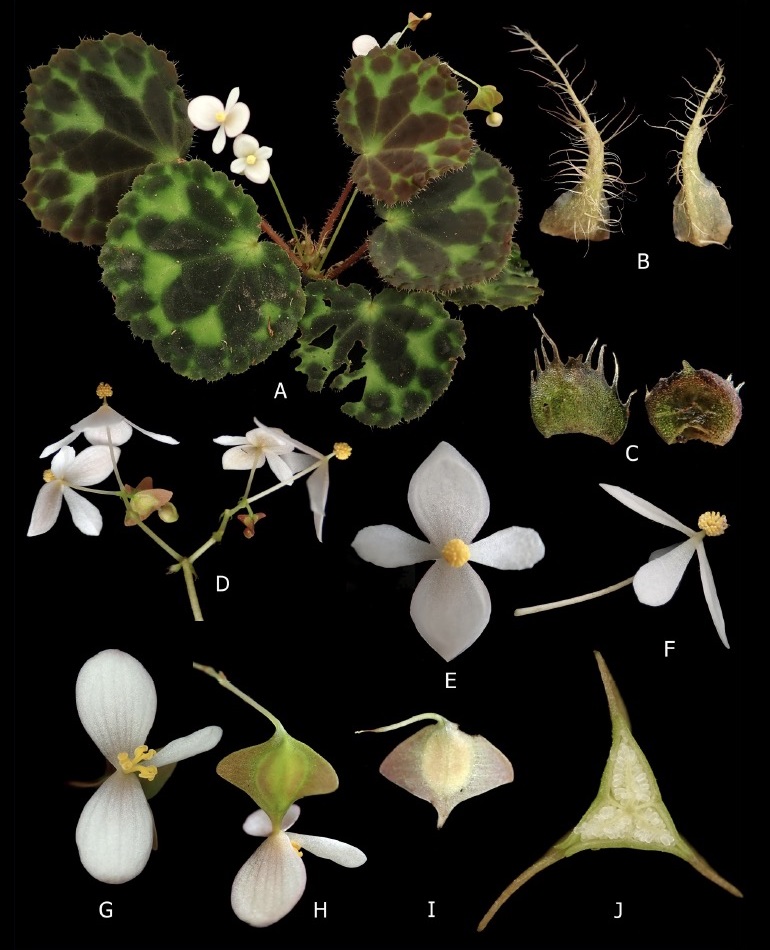
A. Plant habit. B. Stipules. C. Bracts. D. Inflorescence. E. Male flower, front view. F. Male flower, side view. G. Female flower, front view. H. Female flower, side view. I. Fruit. J. Ovary, cross section of middle part.
From Wisnu Ardi WI 761. Photos by W.H. Ardi. 

Begonia robii Ardi & Girm. sp. nov. 
§ Jackia.
 
A limestone adapted species closely related to Begonia droopiae Ardi (Ardi & Hughes, 2010), in terms of its habit and variegated leaves, however it can be easily distinguished by its rounded leaf apex which have pale green blotches between the veins (not acuminate at the apex and green on the veins only), outer male flower tepals which are elliptic to obovate with an acute to rounded apex (vs. elliptic to suborbicular with a rounded apex), female flowers with two or three tepals, outer tepals 4‒12 × 7‒8.5 mm, elliptic (vs. female flower with three tepals, outer tepals 5.5‒6 × 4.5‒ 6 mm, orbicular to suborbicular), ovary ca. 8 × 5‒ 6 mm, ovoid to ellipsoid, wings equal to subequal with a truncate to cuneate base, and a cuneate apex (vs. globose to broadly ellipsoid ovary, 6‒7 × 10‒13 mm, wings equal with rounded base and apex).

Distribution. Sumatra, endemic to West Sumatra, Lima Puluh Kota and Tanah Datar Regencies (Harau valley, Lintau Buo and Halaban). Fig. 1. 

Etymology. The epithet is after the collector, Robi Satria.


  Wisnu Handoyo Ardi, Deden Girmansyah and Mark Hughes. 2021. Begonia robii, A New Species of Begonia from Lima Puluh Kota, West Sumatra. Reinwardtia. 20(1); 37-41. DOI: 10.14203/reinwardtia.v20i1.4141


ABSTRAK ARDI, W. H., GIRMANSYAH, D. & HUGHES, M. 2021. Begonia robii, jenis baru Begonia dari Lima Puluh Kota, Sumatra Barat. Reinwardtia 20(1): 37–41.
 — Jenis baru Begonia seksi Jackia (Begoniaceae) dipertelakan dari Sumatra Barat, dan merupakan jenis endemik bebatuan kapur di Kabupaten Tanah Datar dan Lima Pulu Kota. Evaluasi status konservasi berdasarkan IUCN untuk Begonia robii adalah terancam. 
Kata kunci: Endemik, batu kapur, Jackia.

Thursday, July 8, 2021

[Botany • 2021] Nepenthes longiptera (Nepenthaceae) • A New Species of Nepenthes and Its Natural Hybrids from Aceh, Sumatra, Indonesia


 Nepenthes longiptera Victoriano

in Victoriano,. 2021.

 A new species of Nepenthes (Nepenthaceae) from Aceh Province, Indonesia, Nepenthes longiptera  Victoriano is herein described and illustrated. The species is unique among all other Nepenthes in  Sumatra by the presence of wings on its upper pitchers. Comprehensive description, photographs,  geographical distribution and preliminary IUCN conservation assessment are provided for the new species. Hybrids of this  new taxon with other species are also reported in this paper.  

Keywords: Nepenthes, carnivorous plant, Aceh, Sumatra, new species

Nepenthes longiptera Victoriano spec. nov.
 A. Lower pitcher, mostly bright in colour, ranging from red to orange, or red with speckles. B. Intermediate pitcher, the transition from lower to upper pitcher, usually still retains the colouration of lower pitchers. C. Upper pitcher, with its unique characteristic that still has wings which mostly reduced to ribs in other species, the colour is pure green when mature. 
 Photos by Malcolm Victoriano.

Nepenthes longiptera Victoriano spec. nov. 
Vining plant with upper pitcher in locus classicus.  

Nepenthes longiptera Victoriano

Nepenthes longiptera is similar to N. tobaica but differs in having larger habit, with well developed upper pitcher wings (N. tobaica: reduced to ribs); rhomboid stem in cross-section (N. tobaica: obtusely triangular); and the presence of an appendage under the lid (N. tobaica: absent).

Etymology. From Latin longus means long and Latinised Greek pteron means wing; referring to the presence of a relatively long pair of wings of the upper pitchers, it runs down from below the peristome to the apex of the tendril. It is resembling the fins of Long-Finned Prickleback fish, Xenolumpenus longipterus Shinohara & Yabe

CONCLUSION: 
Nepenthes longiptera is a new species from Aceh, Sumatra, Indonesia. It is similar to N. tobaica but differs in having larger habit, with well developed wings on upper pitcher (N. tobaica: reduced to ribs); rhomboid stem in cross-section (N. tobaica: obtusely triangular); and the presence of an appendage under the lid (N. tobaica: absent). This new species is probably endemic to Aceh province and only known from Nagan Raya and Central Aceh Regency. It has several putative natural hybrids with other Sumatran species which are never been recorded in Aceh before. Some Acehense species such as N. lavicola, N. mikei and N. tobaica are abundant in highland forests but these species had been recorded with no hybrid with other species in this area (McPherson, 2009).


 Malcolm Victoriano. 2021. A New Species of Nepenthes (Nepenthaceae) and Its Natural Hybrids from Aceh, Sumatra, Indonesia. Reinwardtia. 20(1); 17-26. DOI: 10.14203/reinwardtia.v20i1.3932


Tuesday, February 16, 2021

[Botany • 2020] Etlingera tjiasmantoi (Zingiberaceae) • A New Species from Central Sulawesi, Indonesia


Etlingera tjiasmantoi Ardiyani & Ardi 

in Ardiyani, Ardi, Santoso & Poulsen, 2020.


Abstract

 A new species of Etlingera, Etlingera tjiasmantoi Ardiyani & Ardi, was discovered at Tentena, Central Sulawesi, and is described here. This species resembles Etlingera flexuosa A.D.Poulsen and Etlingera mamasarum A.D.Poulsen & Ardiyani but differs from both in having thecae dehiscing through their entire length and in the obovoid, glabrous and spineless fruits. The DNA barcode data, the line drawings of flower and fruit and the plate of E. tjiasmantoi were presented.
               
Keywords: DNA barcode, Etlingera flexuosa, E. mamasarum, Indonesia, Zingiberales.


Inflorescences of Etlingera species.
A. Etlingera flexuosa (Poulsen et al. 2655, the type).
B. E. mamasarum (Ardiyani et al. Sulbar 004, the type).
C. Etlingera tjiasmantoi (M. Ardiyani et al. 1007, the type).
Photos by A. D. Poulsen, M. Ardiyani & W. H. Ardi.


Fig. 1. Etlingera tjiasmantoi Ardiyani & Ardi spec. nov.
A. Leaves (upper surface). B. Leaves (lower surface). C. Leaf base, ligule and petiole. D. Base of leafy shoot and inflorescence arising from the rhizome. E. Inflorescence with three freshly opened flowers. F. Infructescence. G. a. Two flowers with a fertile bract each. b. Bract. c. Bracteole. d. Calyx. e. Flower with bracteole and calyx removed. f. Corolla lobes. g. Labellum. h. Flower with calyx, corolla lobes and labellum removed. i. Fruit.
From M. Ardiyani et al. 1007. Photos by M. Ardiyani & W.H. Ardi.


Etlingera tjiasmantoi Ardiyani & Ardi spec. nov. 

Etlingera tjiasmantoi is similar to E. flexuosa A.D.Poulsen and E. mamasarum A.D.Poulsen & Ardiyani in having entire ligules with ± emarginate apex, long petioles (around 4 cm), elongated elliptic to narrowly ovate laminas, pointed calyces, and ± pink flowers but E. tjiasmantoi differs from both in having thecae dehiscing through their entire length (vs. in upper part) and in the obovoid, glabrous and spineless fruits (vs. pyriform or round, pubescent and with small spines).

Habitat & Ecology. Grows in secondary forest by the road between Tentena and Bada, near a waterfall and a stream at about 1,700 m asl.

 Etymology. The epithet honours Mr. Wewin Tjiasmanto who funded the botanical trip to Central Sulawesi, and who is greatly concerned for wildlife, taxonomy, exploration and conservation.

 
 Marlina Ardiyani, Wisnu Handoyo Ardi, Wahyudi Santoso and Axel Dalberg Poulsen. 2020. Etlingera tjiasmantoi (Zingiberaceae), A New Species from Central Sulawesi. Reinwardtia. 19(2); 103‒108. DOI: 10.14203/reinwardtia.v19i2.3972

Congratulations to Dr. Marlina Ardiyani @MarlinaArdiyani and Wisnu Ardi @Begonia_Wisnu who in March this year, discovered a new species of Etlingera in Central Sulawesi. Today, E. tjiasmantoi is published in REINWARDTIA bringing the number of Etlingera species in Sulawesi to 48.


Saturday, August 17, 2019

[Botany • 2019] Rhododendron widjajae (Ericaceae: Section Schistanthe) • A New Species from Sulawesi, Indonesia


Rhododendron widjajae Argent & Mambrasar

in Argent & Mambrasar, 2019.
 facebook.com/MichaelMambrasar

A new species of Rhododendron section Schistanthe (= subgenus Vireya) is described, Rhododendron widjajae Argent & Mambrasar. It is compared with the two most similar species and the differences demonstrated.

Key words: Ericaceae, Indonesia, Mt. Mekongga, new species, Rhododendron, Sulawesi.


 Rhododendron widjajae Argent & Mambrasar, spec. nov.
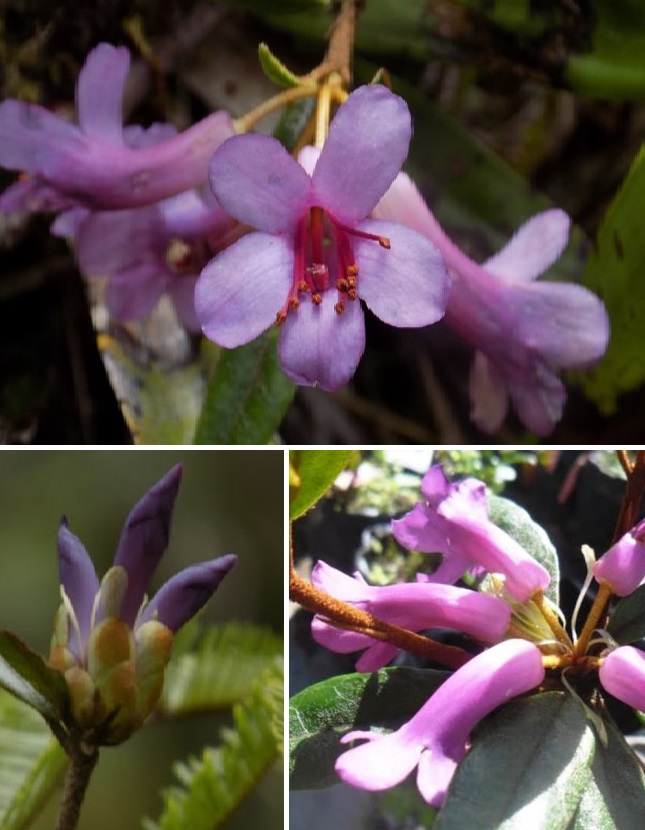
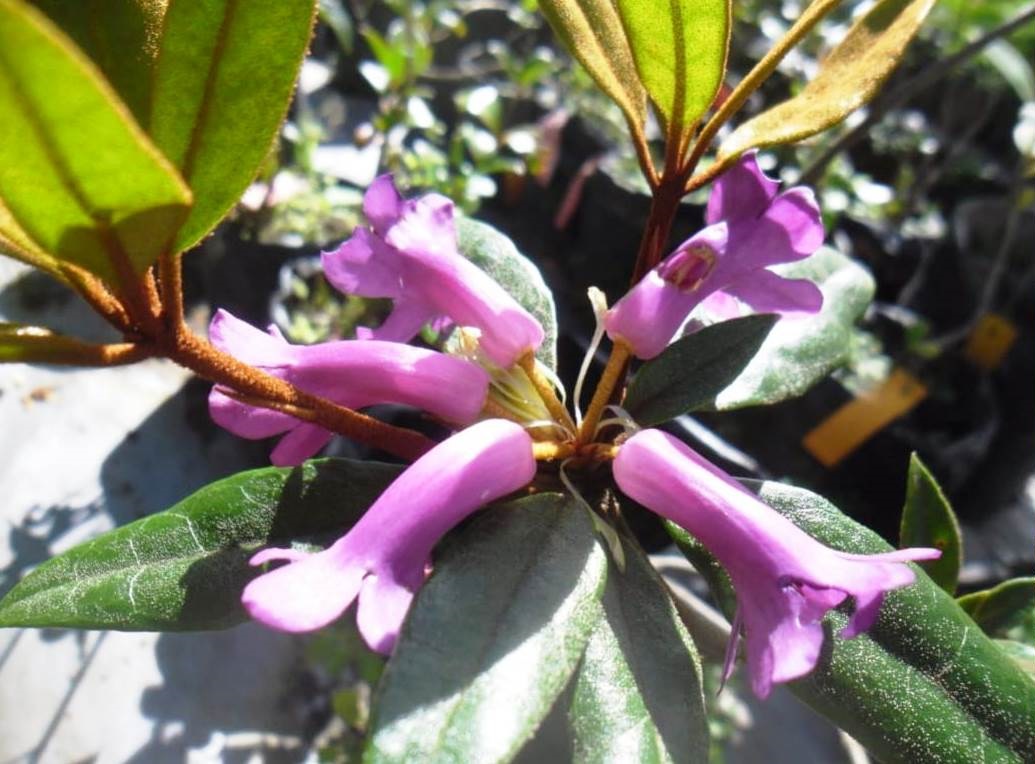
Photograph of the living plant from type location.
 Photo: Elizabeth A. Widjaja.

Rhododendron widjajae Argent & Mambrasar, spec. nov.

Diagnosis. Similar to Rhododendron pseudobuxifolium Sleumer in its size of flower. It differs in having twigs which are without the short hairs of that species; in having pedicels without simple hairs and the corolla is sparsely scaley outside not glabrous and glabrous inside, not shortly hairy. Superficially similar to R. celebicum (Blume) DC. but smaller and significantly differing from that species by the hairy filaments and ovary.

Habitat and ecology. Mt. Mekongga is a volcanic peak rising to 2,779 m in the north-west part of South East Sulawesi. This new species was collected in the sub-alpine area at 2,658 m asl. which is close to the summit (2,779 m). This area is described as: jagged limestone karst and the Rhododendron was probably an epiphyte. The associated species have not been recorded but will no doubt have been semi-open dwarf shrubs.

Etymology. Named in honour of Prof. Elizabeth A. Widjaja, former senior researcher at the Herbarium Bogoriense and joint collector of this species for her contribution to Indonesian botany.


 George Argent and Yasper Michael Mambrasar. 2019. Rhododendron widjajae (Ericaceae, Section Schistanthe) A New Species from Sulawesi.  Reinwardtia. 18(1); 27‒30. DOI: 10.14203/reinwardtia.v18i1.3700    


Wednesday, July 3, 2019

[Botany • 2019] Etlingera mamasarum • An Update of the Genus Etlingera (Zingiberaceae) in Sulawesi including the Description of A New Species


Etlingera mamasarum A.D.Poulsen & Ardiyani 

in Ardiyani & Poulsen, 2019.

Abstract

A new species, Etlingera mamasarum A.D.Poulsen & Ardiyani was discovered in Gunung Gandangdewata National Park, West Sulawesi. It is similar to Etlingera flexuosa A.D.Poulsen but differs in having flowers which are shorter than the bracts. It is described, illustrated and DNA barcoded. Three additional species (Etlingera cylindrica A.D.Poulsen, E. grallata A.D.Poulsen, E. spinulosa A. D.Poulsen) were documented in this national park and represent new records for West Sulawesi Province. We also update information on the morphology of E. calobates A.D.Poulsen, correct an error in the typification of Alpinia chrysogynia (K.Schum.) K.Schum. and discuss the distribution of the Achasma Group of Etlingera east of Wallace’s Line.

Keywords: DNA barcoding, Etlingera calobates, E. mamasensium, E. megalocheilos, Indonesia, Zingiberales.

Fig. 1. Etlingera mamasarum A.D.Poulsen & Ardiyani, spec. nov. 
A. Fertile bract and flower. B. Bracteole. C. Calyx. D. Flower, calyx removed. E. Stamen, dorsal view. F. Labellum, flattened, dorsal view G. Stamen, lateral view H. Stamen, style and stigma, ventral view. J. Ovary and epigynous gland, dorsal view. K. Ovary and epigynous gland, ventral view. L. Fruit with ± persistent bract, bracteole and calyx. Drawn from the type by Axel Dalberg Poulsen.

Fig. 2. Etlingera mamasarum A.D.Poulsen & Ardiyani, spec. nov.
A. Leafy shoot. B. Inflorescence, lateral and front view. C. Fertile bract. D. Fertile bract and flower. E. Bracteole. F. Calyx. G. Flower, calyx removed. H. Corolla lobes. I. Labellum. J. Flower with calyx, corolla lobes and labellum removed. Photos: Marlina Ardiyani.

Etlingera mamasarum A.D.Poulsen & Ardiyani, spec. nov.

Type: Indonesia, West Sulawesi Province, Mamasa, Rantepongko Village, Gunung Gandangdewata, ..., 1,642 m, flowering and fruiting, 21 April 2016, M. Ardiyani with W. Santoso, Obet, Ama, A. Kartonegoro, D. Wulansari Sulbar 004 (Holotype: BO!; iso E!), Fig. 1, 2 & 3. DNA barcoding in Table 2. 

Diagnosis. Similar to Etlingera flexuosa A.D. Poulsen but differs in the length of the flowers which are shorter than the bracts, the longer petiole (45–55 mm in E. mamasarum vs 10–40 mm in E. flexuosa), the length to width ratio of the lamina (3.5–4 vs 4.2–5.6), the shape of the base of the lamina (rounded to cordate vs cuneate to auriculate), the size of the fertile bract (5.5−7 × 2.5−3.3 cm vs 2–5 × 0.6–2.5 cm), the position of the pedicel (4 mm stalk above the bracteole vs 1–4 mm below bracteole), the longer bracteole (3.6 cm vs 1.7–3 cm), the apices of the calyx spreading laterally to opposite sides of the flower (vs pointed straight forward), and the shape and size of the labellum (unevenly panduriform, 20–21 × 16 mm vs ovate, 17–22 × 14–20 mm).

Distribution. So far known only from the type locality at Gunung Gandangdewata. 

Habitat & Ecology. Grows in primary forest on a moderate slope not far from river at about 1,700 m. 

Etymology. The epithet honours the people of Mamasa, West Sulawesi, where the new species was found.

Local name & uses. Katimbang (Mamasa language), fruits are eaten.


 Marlina Ardiyani and Axel Dalberg Poulsen. 2019. An Update of the Genus Etlingera (Zingiberaceae) in Sulawesi including the Description of A New Species. Reinwardtia. 18(1); 49–60. DOI: 10.14203/reinwardtia.v18i1.3729

Jenis baru Etlingera mamasarum A.D.Poulsen & Ardiyani telah ditemukan di Taman Nasional Gunung Gandangdewata, Sulawesi Barat. Jenis baru ini mirip dengan Etlingera flexuosa A.D.Poulsen tetapi berbeda dalam karakter bunga yang lebih pendek dari braktea. Jenis baru tersebut dipertelakan, diilustrasikan dan dilakukan barkoding DNA. Tiga jenis lainnya (Etlingera cylindrica A.D.Poulsen, E. grallata A.D.Poulsen, E. spinulosa A.D.Poulsen) telah didokumentasikan dan merupakan rekaman baru untuk provinsi Sulawesi Barat. Informasi morfologi E. calobates A.D.Poulsen telah diperbaharui, kesalahan tipifikasi Alpinia chrysogynia (K.Schum.) K.Schum. telah dikoreksi dan informasi persebaran E. megalocheilos (Griff.) A.D.Poulsen di timur garis Wallace didiskusikan dalam tulisan ini. 
Kata Kunci: Barkoding DNA, Etlingera calobates, E. mamasarum, E. megalocheilos, Indonesia, Zingiberales.


Monday, February 25, 2019

[Botany • 2018] Rhododendron meagaii (Ericaceae) • A New Species of Rhododendron Subgenus Vireya from Papua, Indonesia


 Rhododendron meagaii Mambrasar & Hutabarat

in Mambrasar & Hutabarat, 2018. 

ABSTRACT
 Rhododendron meagaii, is described and illustrated as a new species in subgenus Vireya (Ericaceae) from Mount Salju, District of Abenaho, Yalimo Regency, Papua Province, Indonesia. Characters distinguishing this new species from related species are discussed.

Key words: District of Abenaho, New Guinea, new species, Papua Province, Rhododendron meagaii.


Rhododendron meagaii Mambrasar & Hutabarat spec. nov. 

 Type: Indonesia, Papua Province, Yalimo Regency, Abenaho District, Mount Salju, 23 May 2016, Michael Mambrasar 239 (Holotype: BO! iso: E! K!).

Diagnosis. Distinct in section Hadranthe Schltr. in having the combination of characters: elliptic leaves, long stalked dendroid scales, a glabrous corolla and stamens of irregular lengths.


Etymology. Name in honour of Organes Meaga (†), Kebun Raya Biologi Wamena technician who helped in collecting this species.


Rhododendron meagaii Mambrasar & Hutabarat, spec. nov. Trima kasih Almarhum Organes Meagaii pahlawan botani dari Kebun Biologi Wamena. Jasamu akan selalu dikenang melalui nama ilmiah dari Rhododendron ini........


  Yasper M. Mambrasar and Prima W. K. Hutabarat. 2018. Rhododendron meagaii, A New Species of Rhododendron Subgenus Vireya (Ericaceae) from Papua, Indonesia. Reinwardtia. 17(2); 97‒100. DOI: 10.14203/reinwardtia.v17i2.3570
facebook.com/photo.php?fbid=10216633757330649

ABSTRAK: Rhododendron meagaii, dipertelakan dan digambar sebagai jenis baru pada submarga Vireya (Ericaceae) dari Gunung Salju, Distrik Abenaho, Kabupaten Yalimo, Provinsi Papua, Indonesia. Didiskusikan pula karakter yang membedakan jenis baru ini dengan jenis yang terdekat.
Kata kunci: Distrik Abenaho, jenis baru, Provinsi Papua, Pulau Nugini, Rhododendron meagaii.

Mambrasar, Y. M. & Hutabarat, P. W. K. 2018. Rhododendron meagaii, jenis baru Rhododendron submarga Vireya (Ericaceae) dari Papua, Indonesia. Reinwardtia17(2); 97‒100.