Showing posts with label Tetanurae. Show all posts

Tuesday, August 20, 2024

[Paleontology • 2024] Alpkarakush kyrgyzicus • A new theropod dinosaur (Theropoda: Metriacanthosauridae) from the Callovian Balabansai Formation of Kyrgyzstan


Alpkarakush kyrgyzicus 
 Rauhut, Bakirov, Wings, Fernandes & Hübner, 2024
  

Abstract
Recent fieldwork in the late Middle Jurassic Balabansai Formation of Kyrgyzstan has yielded a partial skeleton of a large theropod dinosaur. The material includes a few bones of the skull (postorbital, quadratojugal), dorsal and sacral vertebrae, fragments of the pectoral girdle and forelimbs, and an almost complete pelvic girdle and hindlimbs, and is here made the type of a new theropod taxon, Alpkarakush kyrgyzicus gen. et sp. nov. Alpkarakush can be diagnosed by an extremely developed orbital brow on the postorbital, a pneumatic opening leading into cavities in the neural arch from the centroprezygodiapophyseal fossa in the posterior dorsal vertebrae, an almost enclosed ventral sulcus in manual phalanx II-1, a narrow and deep intercondylar groove on the anterior side of the distal femur, and an epicondylar crest on the distal femur that is offset from the distal end. A second, fragmentary, and smaller specimen from the same site represents the same taxon. Based on long bone histology, the type of Alpkarakush represents a late subadult individual, whereas the smaller specimen is a juvenile, possibly indicating gregarious behaviour. Phylogenetic analysis places Alpkarakush in the Metriacanthosauridae, underlining the diversity and wide distribution of this clade in the Jurassic of Asia.

Central Asia, Middle Jurassic, Tetanurae, Metriacanthosauridae, bone histology

 Outline reconstruction of Alpkarakush kyrgyzicus, with recovered elements indicated. Scale bar is 1 m.

SYSTEMATIC PALAEONTOLOGY
Dinosauria Owen, 1842,
Saurischia Seeley, 1887,
Theropoda Marsh, 1881,
Tetanurae Gauthier, 1986,
Metriacanthosauridae Paul, 1988

Alpkarakush gen. nov.
 
Etymology: Named after Alpkarakush, a mythological large bird [Алпкаракуш] that often comes to the help of heroes in critical moments in the ‘Manas’ epos, one of the central mythological elements in Kyrgyz culture (Seiilbek et al. 2018).

Alpkarakush kyrgyzicus sp. nov.

Etymology: The species epithet refers to the Kyrgyz Republic, the provenance of the type specimen.

Diagnosis: Alpkarakush kyrgyzicus can be diagnosed by the following combination of characters (autapomorphies are indicated by *): extremely developed supraorbital brow on the postorbital, overhanging the orbit; posterior dorsal vertebrae with a channel leading from the centroprezygodiapophyseal fossa posteromedially into pneumatic chambers in the neural arch*; sacral vertebrae with fused neural spines that are approximately as high as the combined height of the vertebral centrum plus neural arch; manual phalanx II-1 with a ventral sulcus proximally that is almost completely enclosed by medial and lateral ventral flanges*; dorsal margin of the ilium slopes steeply posteroventrally*; brevis fossa on ilium reduced to a small medial shelf; shaft of pubis strongly bowed anteriorly; well-developed longitudinal depression on the posterolateral side of the pubic shaft adjacent to the pubic boot (based on paratype); unusually high pubis/tibia ratio (1.22 or higher); articulated ischia with pronounced ischial boots that are convex distally and fused anteriorly, but separated posteriorly; ischium with small obturator flange that is offset from the pubic peduncle; pubic peduncle of ischium very long; iliac articulation in proximal ischium cup-shaped; narrow and deep intercondylar groove on the anterior side of distal femur*; robust and well-developed medial epicondylar crest on distal femur, considerably offset proximally from distal end*; tibia with robust, bulbous fibular flange; astragalus and calcaneum fused.

Type locality and horizon: Locality FTU-1, just west of the town of Tashkumyr, Jalal-Abad Oblast, Kyrgyzstan (Figs 1, 2). The specimens were found in the higher part of the Balabansai Formation, Callovian.


Oliver W. M. Rauhut, Aizek A. Bakirov, Oliver Wings, Alexandra E. Fernandes and Tom R. Hübner. 2024. A new theropod dinosaur from the Callovian Balabansai Formation of Kyrgyzstan. Zoological Journal of the Linnean Society. 201(4); zlae090. DOI: doi.org/10.1093/zoolinnean/zlae090


Friday, June 14, 2024

[Paleontology • 2024] Diuqin lechiguanae • A New unenlagiine (Theropoda: Dromaeosauridae) from the Bajo de la Carpa Formation (Neuquén Group, Upper Cretaceous) of Neuquén Province, Patagonia, Argentina


Diuqin lechiguanae 
Porfiri, Baiano, dos Santos, Gianechini, Pittman & Lamanna. 2024
 

Abstract
Background: 
Unenlagiine paravians are among the most relevant Gondwanan theropod dinosaur clades for understanding the origin of birds, yet their fossil record remains incomplete, with most taxa being represented by fragmentary material and/or separated by lengthy temporal gaps, frustrating attempts to characterize unenlagiine evolution.

Results and conclusions: 
Here we describe Diuqin lechiguanae gen. et sp. nov., a new unenlagiine taxon from the Upper Cretaceous (Santonian) Bajo de la Carpa Formation of the Neuquén Basin of Neuquén Province in northern Patagonia, Argentina that fills a substantial stratigraphic gap in the fossil record of these theropods. Although known only from a very incomplete postcranial skeleton, the preserved bones of Diuqin differ from corresponding elements in other unenlagiines, justifying the erection of the new taxon. Moreover, in several morphological aspects, the humerus of Diuqin appears intermediate between those of geologically older unenlagiines from the Neuquén Basin (e.g., Unenlagia spp. from the Turonian–Coniacian Portezuelo Formation) and that of the stratigraphically younger, larger-bodied Austroraptor cabazai from the Campanian–Maastrichtian Allen Formation. Consequently, the morphology of the new taxon appears to indicate a transitional stage in unenlagiine evolution. Phylogenetic analysis recovers Diuqin as a paravian with multiple plausible systematic positions, but the strongest affinity is with Unenlagiinae. The humerus of the new form exhibits subcircular punctures near its distal end that are interpreted as feeding traces most likely left by a conical-toothed crocodyliform, mammal, or theropod, the latter potentially corresponding to a megaraptorid or another unenlagiine individual. Thus, in addition to filling important morphological and temporal gaps in unenlagiine evolutionary history, the new taxon also offers information relating to the paleoecology of these theropods.

Keywords: Unenlagiinae, Dromaeosauridae, Cretaceous, Bajo de la Carpa Formation, Patagonia, South America, Biostratigraphy, Phylogeny, Paleoecology, Megaraptoridae

Left humerus of Diuqin lechiguanae gen. et sp. nov. (MUCPv 1401/4) in lateral (A), medial (B), anterior (C), posterior (D), proximal (E), and distal (F) views.
Abbreviations: brf, brachial fossa; cr, crest; dldpr, distolateral deltopectoral ridge; dpc, deltopectoral crest; ect, ectepicondyle; ent, entepicondyle; ics, intercondylar sulcus; int, internal tuberosity; rac, radial condyle; sul, sulcus; tm, tooth marks; trab, trabecular tissue; tub, tuberosity; ulc, ulnar condyle. Asterisk indicates hypothesized autapomorphic feature (the distally arising distolateral deltopectoral ridge). Scale bar equals 5 centimeters


Systematic paleontology
Theropoda Marsh, 1881  
Tetanurae Gauthier, 1986 

Coelurosauria Huene, 1920 
Paraves Sereno, 1997 

Dromaeosauridae Matthew & Brown, 1922 
Unenlagiinae Bonaparte, 1999  

Diuqin lechiguanae gen. et sp. nov.
 
Holotype: MUCPv 1401, a fragmentary but associated postcranial skeleton consisting of the posteriormost sacral vertebral neural arch, an anterior caudal vertebral neural arch, the nearly complete left humerus, and four unidentified fragments (at least two of which may be small pieces of vertebrae). Accessioned in the Museo de Ciencias Naturales of the Universidad Nacional del Comahue in Neuquén, Neuquén Province, Argentina to ensure free access to qualified researchers in perpetuity.

Locality and horizon: The specimen was collected from the isthmus between the southeast coast of Lago Barreales and the northwest coast of Lago Mari Menuco, in Neuquén Province, northwestern Patagonia, Argentina (Fig. 1), from a stratum of the Bajo de la Carpa Formation of the Neuquén Group (Upper Cretaceous: Santonian).

Associated fauna: An isolated megaraptorid theropod tooth (MUCPv 1557; see below) and fragmentary bones of an indeterminate sauropod were also found near the site that yielded the D. lechiguanae holotype (MUCPv 1401). The megaraptorid tooth was found approximately 2–3 m from Diuqin, whereas the sauropod fragments were found some 10–12 m away.

Diagnosis: First unenlagiine theropod dinosaur to be discovered from the Bajo de la Carpa Formation (Neuquén Group, Upper Cretaceous), exhibiting the following autapomorphies and a unique combination of characters. Autapomorphies: (1) horizontal accessory lamina between spinopostzygapophyseal laminae on posteriormost sacral vertebra; (2) pair of elliptical, bilateral, dorsolaterally–ventromedially oriented foramina immediately anterolateral to base of neural spine in (at least) posteriormost sacral and anterior caudal vertebrae; (3) distolateral deltopectoral ridge of humerus arises on distal half of deltopectoral crest. Unique combination of characters: postzygapophyses of posteriormost sacral vertebra strongly posteriorly projected; humeral deltopectoral crest oriented anteriorly (also present in Austroraptor cabazai); absence of sulcus between deltopectoral crest and humeral shaft (also present in Austroraptor); sharp crest proximal to humeral ectepicondyle with proximally positioned tubercle (also present in Buitreraptor).

Etymology: Genus name: Diuqin (from Mapuzungun, the language of the Mapuce people indigenous to the region where the fossil was found), bird of prey. Species name: lechiguanae, after Lechiguana, the witch in the 1975 film Nazareno Cruz y el Lobo (directed by eminent Argentinian filmmaker Leonardo Favio) who foresaw that the film’s titular character would become a werewolf. Intended etymology: “Lechiguana’s bird of prey.”


Juan D. Porfiri, Mattia A. Baiano, Domenica D. dos Santos, Federico A. Gianechini, Michael Pittman and Matthew C. Lamanna. 2024. Diuqin lechiguanae gen. et sp. nov., A New unenlagiine (Theropoda: Paraves) from the Bajo de la Carpa Formation (Neuquén Group, Upper Cretaceous) of Neuquén Province, Patagonia, Argentina. BMC Ecology and Evolution. 24: 77. DOI: 10.1186/s12862-024-02247-w


Sunday, February 25, 2024

[Paleontology • 2024] Riojavenatrix lacustris Increasing the Theropod Record of Europe: A New basal spinosaurid (Theropoda: Spinosauridae) from the Enciso Group of the Cameros Basin (La Rioja, Spain). Evolutionary Implications and Palaeobiodiversity


Riojavenatrix lacustris 
 Isasmendi, Cuesta, Díaz-Martínez, Company, Sáez-Benito, Viera, Torices & Pereda-Suberbiola, 2024

Reconstruction by Adrián Blázquez Riola  twitter.com/AdriSuchoBlaink

Abstract
A new member of Spinosauridae from the Enciso Group (uppermost Barremian–lower Aptian) from Igea (La Rioja, Spain) is here erected on the basis of axial, pelvic girdle, and hindlimb elements that exhibit a unique combination of characters. Riojavenatrix lacustris gen. et sp. nov. is one of the latest Iberian and European spinosaurid taxa. It retains a triangular pubic boot, like the megalosaurids, and a medial condyle of the femur that shows a transitional stage between the anteroposteriorly oriented long axis of non-spinosaurid theropods and the posteromedially oriented long axis of Spinosauridae. The spinosaurid record of Iberia ranges from the late Hauterivian–early Barremian to the latest Barremian–early Aptian so far, and both the oldest and the most recent evidence comes from the Cameros Basin, where spinosaurid remains are especially abundant in the Barremian deposits. A review of the spinosaurid record has allowed us to dismiss the presence of the genus Baryonyx from Iberia; hence, only Camarillasaurus, Iberospinus, Protathlitis, Riojavenatrix gen. nov., and Vallibonavenatrix are considered to be present in the Early Cretaceous of Iberia. According to this study, Riojavenatrix is one of the youngest baryonychines in the fossil record.

Baryonychinae, dinosaur, Early Cretaceous, Europe, Iberian Peninsula, Megalosauroidea, Spinosauridae, Theropoda


Riojavenatrix lacustris gen. et sp. nov

Erik Isasmendi, Elena Cuesta, Ignacio Díaz-Martínez, Julio Company, Patxi Sáez-Benito, Luis I Viera, Angelica Torices and Xabier Pereda-Suberbiola. 2024. Increasing the Theropod Record of Europe: A New basal spinosaurid from the Enciso Group of the Cameros Basin (La Rioja, Spain). Evolutionary Implications and Palaeobiodiversity. Zoological Journal of the Linnean Society., zlad193. DOI: 10.1093/zoolinnean/zlad193


Friday, May 19, 2023

[Paleontology • 2023] Protathlitis cinctorrensis • A New spinosaurid Dinosaur Species (Theropoda: Spinosauridae) from the Early Cretaceous of Cinctorres, Spain


Protathlitis cinctorrensis
Santos-Cubedo, Santisteban, Poza & Meseguer, 2023


Abstract
A new spinosaurid genus and species is described based on the right maxilla and five caudal vertebrae of a single specimen from the Arcillas de Morella Formation (Early Cretaceous) at the locality of Cinctorres (Castellón, Spain). Protathlitis cinctorrensis gen. et sp. nov. is diagnosed by one autapomorphic feature as well as by a unique combination of characters. The autapomorphy includes a subcircular depression in the anterior corner of the antorbital fossa in the maxilla. The new Iberian species is recovered as a basal baryonychine. The recognition of Protathlitis cinctorrensis gen. et sp. nov. as the first baryonychine dinosaur species identified from the Arcillas de Morella Formation (late Barremian) from the same time as Vallibonavenatrix cani, the first spinosaurine dinosaur from the same formation in the Morella subbasin (Maestrat Basin, eastern Spain), indicates that the Iberian Peninsula was home to a highly diverse assemblage of medium-to-large bodied spinosaurid dinosaurs. It seems that spinosaurids appeared during the Early Cretaceous in Laurasia, with the two subfamilies occupying the western part of Europe during this period. Later, during the Barremian–Aptian, they migrated to Africa and Asia, where they would diversify. In Europe, baryonychines were dominant, while in Africa, spinosaurines were most abundant.


Protathlitis cinctorrensis gen. et sp. nov.


Andrés Santos-Cubedo, Carlos de Santisteban, Begoña Poza and Sergi Meseguer. 2023. A New spinosaurid Dinosaur Species from the Early Cretaceous of Cinctorres (Spain). Scientific Reports. 13: 6471. DOI: 10.1038/s41598-023-33418-2

Thursday, May 11, 2023

[Paleontology • 2023] A Reappraisal of the Cranial and Mandibular Osteology of the spinosaurid Irritator challengeri (Dinosauria: Theropoda)


Irritator challengeri  Martill, Cruickshank, Frey, Small & Clarke, 1996

in Schade, Rauhut, Foth, Moleman et Evers, 2023. 

ABSTRACT
Although originally described almost three decades ago, the holotype of Irritator challengeri from the Lower Cretaceous Romualdo Formation of Brazil still represents the most complete spinosaurid skull known to science. Here, we present a detailed description of the skull of Irritator based on digital reconstructions from medical and micro computed tomography (µCT) data. Segmentation reveals the near-complete palatal complex and braincase, an unusual morphology of the retroarticular process, a large, ventrally inclined surangular shelf and the tooth replacement pattern. The digitally reconstructed skull anatomy indicates a robust dentition, a field of binocular vision in front of the skull with an inclined snout orientation, a relatively weak but fast bite, as well as laterally spreading and rotating lower jaw rami during jaw opening. We modified an existing phylogenetic matrix of Tetanurae to account for new observations on the morphology of Irritator and analysed this using parsimony and Bayesian methods. Results support Spinosauridae as members of Megalosauroidea and recover a monophyletic Carnosauria (Megalosauroidea + Allosauroidea). Parsimony analysis recovers Monolophosaurus nested within Megalosauroidea as sister taxon to spinosaurids, but this is not supported by the Bayesian analysis. Bayesian time-calibration and evolutionary rate analysis indicate that spinosaurid evolution happened fast, despite a long ghost lineage of at least 35 million years. High evolutionary rates over a prolonged time can explain the highly derived skull morphology of spinosaurids. This study provides an in-depth look into the evolution of spinosaurid skull anatomy and refines our understanding of these specialized Mesozoic predators.

Keywords: Dinosaur; Theropod; Spinosaurid; Cretaceous; Mesozoic; Brazil


Theropoda Marsh, 1881
Tetanurae Gauthier, 1986
Megalosauroidea Fitzinger, 1843; sensu Carrano et al. (2012)

Spinosauridae Stromer, 1915
Spinosaurinae (Stromer, 1915); sensu Sereno et al. (1998)

Irritator challengeri Martill, Cruickshank, Frey, Small and Clarke, 1996

Holotype. SMNS 58022, largely complete skull, missing most of the premaxillae, anterior ends of the maxillae, and anteriormost parts of both mandibles.

Locality and horizon. Near Buxexé, close to Santana do Cariri, Ceará State, northeastern Brazil (see Sues et al., 2002: 535). Lower part of the Romualdo Formation (Santana Formation of some authors; see discussion in Arai and Assine, 2020) of the Santana Group, late Aptian (Arai and Assine, 2020).


Marco Schade, Oliver W. M. Rauhut, Christian Foth, Olof Moleman, and Serjoscha W. Evers. 2023. A Reappraisal of the Cranial and Mandibular Osteology of the spinosaurid Irritator challengeri (Dinosauria: Theropoda). Palaeontologia Electronica. 26(2): a17.DOI: 10.26879/1242
 
palaeo-electronica.org/content/2023/3821-the-osteology-of-irritator


Wednesday, February 15, 2023

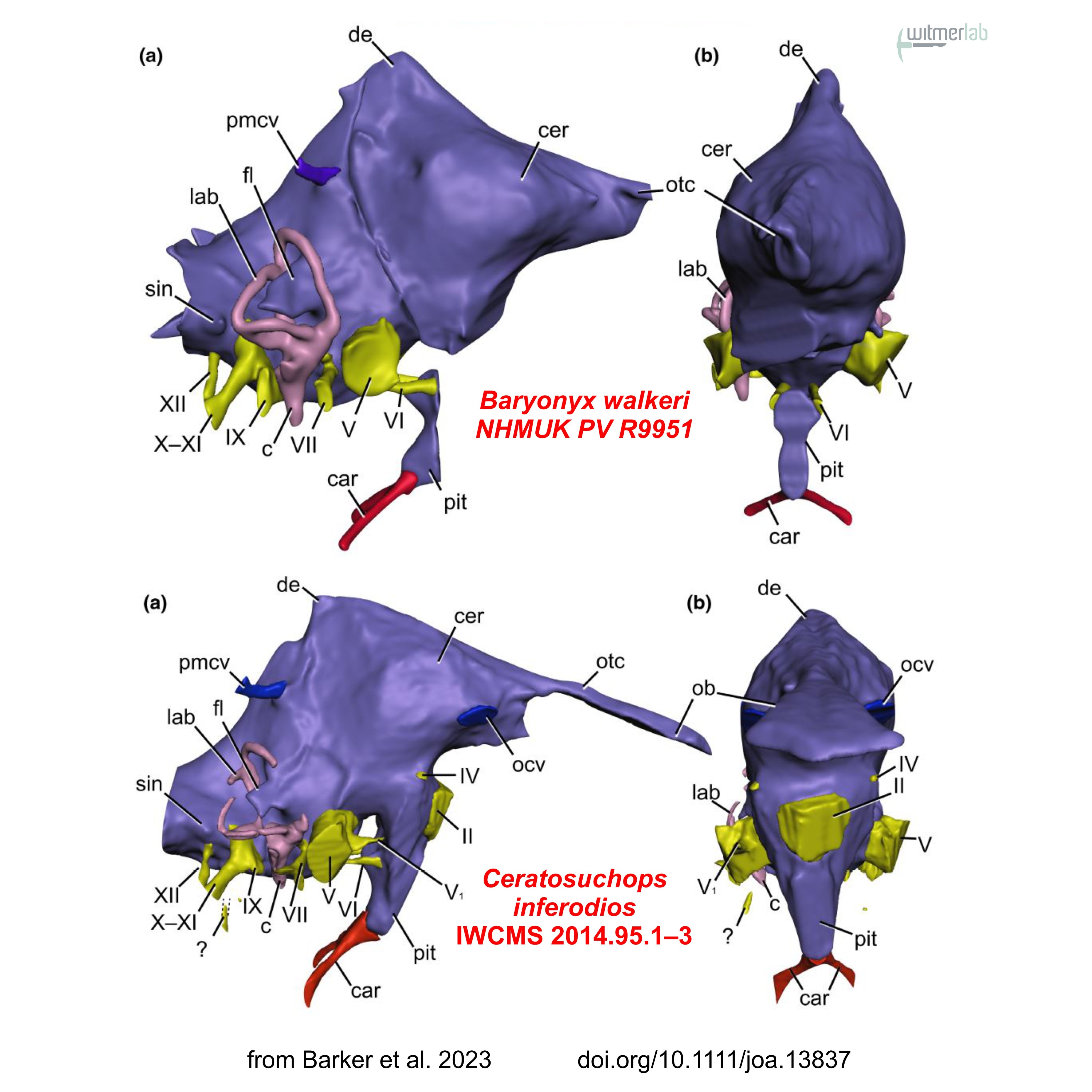
[Paleontology • 2023] Modified Skulls but Conservative Brains? The Palaeoneurology and Endocranial Anatomy of baryonychine Dinosaurs (Theropoda: Spinosauridae)


Ceratosuchops inferodios and the orientation of the endocast in the skull.

in Barker, Naish, Trend, Michels, ... et Gostling, 2023. 
Illustration: Anthony Hutchings

Abstract
The digital reconstruction of neurocranial endocasts has elucidated the gross brain structure and potential ecological attributes of many fossil taxa, including Irritator, a spinosaurine spinosaurid from the “mid” Cretaceous (Aptian) of Brazil. With unexceptional hearing capabilities, this taxon was inferred to integrate rapid and controlled pitch-down movements of the head that perhaps aided in the predation of small and agile prey such as fish. However, the neuroanatomy of baryonychine spinosaurids remains to be described, and potentially informs on the condition of early spinosaurids. Using micro-computed tomographic scanning (μCT), we reconstruct the braincase endocasts of Baryonyx walkeri and Ceratosuchops inferodios from the Wealden Supergroup (Lower Cretaceous) of England. We show that the gross endocranial morphology is similar to other non-maniraptoriform theropods, and corroborates previous observations of overall endocranial conservatism amongst more basal theropods. Several differences of unknown taxonomic utility are noted between the pair. Baryonychine neurosensory capabilities include low-frequency hearing and unexceptional olfaction, whilst the differing morphology of the floccular lobe tentatively suggests less developed gaze stabilisation mechanisms relative to spinosaurines. Given the morphological similarities observed with other basal tetanurans, baryonychines likely possessed comparable behavioural sophistication, suggesting that the transition from terrestrial hypercarnivorous ancestors to semi-aquatic “generalists” during the evolution of Spinosauridae did not require substantial modification of the brain and sensory systems.


Artist's impression of Ceratosuchops inferodios and the orientation of the endocast in the skull.
Illustration: Anthony Hutchings
 

Chris Tijani Barker, Darren Naish, Jacob Trend, Lysanne Veerle Michels, Lawrence Witmer, Ryan Ridgley, Katy Rankin, Claire E. Clarkin, Philipp Schneider and Neil J. Gostling. 2023. Modified Skulls but Conservative Brains? The Palaeoneurology and Endocranial Anatomy of baryonychine Dinosaurs (Theropoda: Spinosauridae). Journal of Anatomy. DOI: 10.1111/joa.13837
www.southampton.ac.uk/news/2023/02/oldest-spinosaur-brains-revealed.page

Thursday, June 9, 2022

[Paleontology • 2022] A European Giant: A Large Spinosaurid (Dinosauria: Theropoda) from the Vectis Formation (Wealden Group, Early Cretaceous), UK


in Barker​, Lockwood, Naish, ... et Gostling, 2022.  

Abstract 
Postcranial elements (cervical, sacral and caudal vertebrae, as well as ilium, rib and limb bone fragments) belonging to a gigantic tetanuran theropod were recovered from the basal unit (the White Rock Sandstone equivalent) of the Vectis Formation near Compton Chine, on the southwest coast of the Isle of Wight. These remains appear to pertain to the same individual, with enormous dimensions similar to those of the Spinosaurus holotype and exceeding those of the largest European theropods previously reported. A combination of features—including the presence of spinodiapophyseal webbing on an anterior caudal vertebra—suggest that this is a member of Spinosauridae, though a lack of convincing autapomorphies precludes the identification of a new taxon. Phylogenetic analysis supports spinosaurid affinities but we were unable to determine a more precise position within the clade weak support for a position within Spinosaurinae or an early-diverging position within Spinosauridae were found in some data runs. Bioerosion in the form of curved tubes is evident on several pieces, potentially related to harvesting behaviour by coleopteran bioeroders. This is the first spinosaurid reported from the Vectis Formation and the youngest British material referred to the clade. This Vectis Formation spinosaurid is unusual in that the majority of dinosaurs from the Lower Cretaceous units of the Wealden Supergroup are from the fluviolacustrine deposits of the underlying Barremian Wessex Formation. In contrast, the lagoonal facies of the upper Barremian–lower Aptian Vectis Formation only rarely yield dinosaur material. Our conclusions are in keeping with previous studies that emphasise western Europe as a pivotal region within spinosaurid origination and diversification.


Chris T. Barker​, Jeremy A.F. Lockwood, Darren Naish, Sophie Brown, Amy Hart, Ethan Tulloch and Neil J. Gostling. 2022.  A European Giant: A Large Spinosaurid (Dinosauria: Theropoda) from the Vectis Formation (Wealden Group, Early Cretaceous), UK. PeerJ. 10:e13543. DOI: 10.7717/peerj.13543

Wednesday, September 29, 2021

[Paleontology • 2021] Ceratosuchops inferodios & Riparovenator milnerae • New Spinosaurids from the Wessex Formation (Early Cretaceous, UK) and the European Origins of Spinosauridae


Ceratosuchops inferodios and Riparovenator milnerae 

 Barker, Hone, Naish, Cau, Lockwood, Foster, Clarkin, Schneider & Gostling, 2021
Illustration: Anthony Hutchings 

Abstract
Spinosaurids are among the most distinctive and yet poorly-known of large-bodied theropod dinosaurs, a situation exacerbated by their mostly fragmentary fossil record and competing views regarding their palaeobiology. Here, we report two new Early Cretaceous spinosaurid specimens from the Wessex Formation (Barremian) of the Isle of Wight. Large-scale phylogenetic analyses using parsimony and Bayesian techniques recover the pair in a new clade within Baryonychinae that also includes the hypodigm of the African spinosaurid Suchomimus. Both specimens represent distinct and novel taxa, herein named Ceratosuchops inferodios gen. et sp. nov. and Riparovenator milnerae gen. et sp. nov. A palaeogeographic reconstruction suggests a European origin for Spinosauridae, with at least two dispersal events into Africa. These new finds provide welcome information on poorly sampled areas of spinosaurid anatomy, suggest that sympatry was present and potentially common in baryonychines and spinosaurids as a whole, and contribute to updated palaeobiogeographic reconstructions for the clade.

Known material referred to the baryonychines Ceratosuchops inferodios (rear) and Riparovenator milnerae (front) recovered at Chilton Chine (Isle of Wight, UK). White bones represent recovered elements. The arrangement of the elements in the caudal series is estimated; their relative position in the true series, and relationship with respect to each other (bar for those of the largely articulated mid-caudal series), are estimated. 
Image credit: Dan Folkes (CC-BY 4.0). Scale bar: 100 cm.


DINOSAURIA Owen, 1842.
THEROPODA Marsh, 1881.
TETANURAE Gauthier, 1986.

SPINOSAURIDAE Stromer, 1915.
BARYONYCHINAE Charig and Milner, 1986, sensu Sereno et al., 1998.

CERATOSUCHOPSINI clade nov.

Definition: The most inclusive branch-based clade containing Ceratosuchops inferodios but not Baryonyx walkeri and Spinosaurus aegyptiacus.

Included taxa: Ceratosuchops inferodios; Riparovenator milnerae; Suchomimus tenerensis Sereno et al., 1998.

Diagnosis: postorbital facet of frontal dorsoventrally thick (height more than 40% of length) and excavated by a deep, longitudinal slot; well-defined and strongly curved anterior margins of supratemporal fossa; occipital surface of the basisphenoid collateral oval scars excavated.


Genus Ceratosuchops nov.

Etymology: kératos (Greek, κέρας)—“horn”, prominent postorbital boss and rugose orbital brow; soûkhos (Greek, Σοῦχος)—“crocodile”; óps (Greek, ὄψ)—“face”.

Ceratosuchops inferodios sp. nov.
 
Etymology: īnfernus (Latin)—underworld, hell; erodiós (Greek, ερωδιός)—heron, in reference to its presumed heron-like ecology.

Holotype: Associated premaxillary bodies (IWCMS 2014.95.5) and posterior premaxillary fragment (IWCMS 2021.30); a near complete but disarticulated braincase (IWCMS 2014.95.1-3) (Fig. 3).

Type locality and type horizon: Wessex Fm. (Barremian), Chilton Chine, near Brighstone (Isle of Wight, UK).


Genus Riparovenator gen. nov.

Etymology: Rīpārius (Latin)–relating to the riverbank; vēnātor (Latin) –hunter.
 
Riparovenator milnerae sp. nov.
 
Etymology: In honour of Angela Milner and her contributions to spinosaurid palaeobiology (and palaeontology as whole).

Holotype: Associated premaxillary bodies (IWCMS 2014.95.6); a disarticulated braincase (IWCMS 2014.96.1, 2; 2020.448.1, 2); a left “preorbital” fragment (partial lacrimal and prefrontal) (IWCMS 2014.96.3) (Fig. 4).

Type locality and type horizon: Between the Chilton Chine and Brighstone Sandstones, Wessex Fm. (Barremian), Chilton Chine, near Brighstone (Isle of Wight, UK).


 Chris T. Barker, David W. E. Hone, Darren Naish, Andrea Cau, Jeremy A. F. Lockwood, Brian Foster, Claire E. Clarkin, Philipp Schneider and Neil J. Gostling. 2021. New Spinosaurids from the Wessex Formation (Early Cretaceous, UK) and the European Origins of Spinosauridae. Scientific Reports. 11: 19340. DOI: 10.1038/s41598-021-97870-8