Showing posts with label Ankylopollexia. Show all posts

Friday, August 22, 2025

[Paleontology • 2025] Istiorachis macarthurae • The Origins of Neural Spine Elongation in iguanodontian dinosaurs and the Osteology of A New sail-back styracosternan (Ornithischia: Iguanodontia) from the Lower Cretaceous Wealden Group of England


Istiorachis macarthurae  
Lockwood, Martill & Maidment, 2025 
 
Original artwork by James Brown.

Abstract
The Wealden Group of southern England was deposited during the late Berriasian to early Aptian interval. It records a critical time in the development of iguanodontian dinosaur diversity, which increased from low levels during the Jurassic to higher levels in the Aptian and Albian. A new iguanodontian dinosaurIstiorachis macarthurae gen. et sp. nov. from the Wessex Formation (Wealden Group) of the Isle of Wight, exhibits hyperelongation of the dorsal and caudal neural spines, suggesting that it possessed a possible sail structure. Ancestral state reconstruction for the relative height of dorsal neural spines in iguanodontians demonstrates that modest elongation began with Ankylopollexia in the Late Jurassic and elongation became established during the Berriasian stage of the Early Cretaceous, albeit with widely disparate values. Hyperelongation of neural spines occurred more sporadically throughout the Cretaceous, being recorded most often in the Barremian and early Aptian. Possible explanations for neural spine elongation in Ankylopollexia include biomechanical advantage, perhaps related to greater mass and a locomotory shift towards quadrupedalism, and visual signalling driven either by sexual selection or species recognition, or both. The function of elongate neural spines was probably pluralistic and differed in different taxa. No single explanation fully supports the variation seen throughout the Cretaceous.

Keywords: Iguanodontia, diversity, sexual signalling, Isle of Wight, ossified tendons, Barremian


SYSTEMATIC PALAEONTOLOGY
DINOSAURIA Owen 1842
ORNITHISCHIA Seeley 1888
ORNITHOPODA Marsh 1881

IGUANODONTIA Baur 1891
ANKYLOPOLLEXIA Sereno 1986
STYRACOSTERNA Sereno 1986

Genus Istiorachis nov.

Derivation of name: The name is derived from the Ancient Greek words ἱστίον (istion), meaning a sail, and ῥάχις (rachis), the spine or backbone. It refers to the probable sail-back appearance of the dinosaur.

Istiorachis macarthurae sp. nov.
 
Derivation of name: The species name honours Dame Ellen MacArthur, an English sailor who in 2005 set a world record for the fastest solo non-stop voyage around the world on her first attempt and who also founded the Ellen MacArthur Cancer Trust for young people on the Isle of Wight.

Holotype: MIWG 6643 is a partial skeleton composed of the following elements: one cervical vertebra, eight dorsal vertebrae, three dorsal rib heads, a partial sacrum, seven caudal vertebrae, both pubes and both ischia.

Location & horizon: MIWG 6643 was excavated by the late Mr Nicholas Chase from the ‘Black Band’ (bed L11 in Stewart 1978), a plant debris bed cropping out c. 100 m east of Grange Chine, lying above the Grange Chine Sandstone in the Wessex Formation. The site is a c. 1.5-m-thick bed that has occasionally yielded dinosaur remains, including IWCMS 1997.550, the holotype specimen of the tyrannosauroid theropod Eotyrannus lengi (Hutt et al. 2001; Naish & Cau 2022). Unfortunately the excavation site was poached and an unknown amount of the skeleton was taken before collection could be completed.

Diagnosis: Istiorachis macarthurae differs from all other iguanodontians by possessing one autapomorphy, namely two anterior parasagittal tuberosities present on the ventral surface of a posterior dorsal vertebra, marking a change from vertebrae with a ventral keel to a flat surface. A posterior cervical vertebra has a damaged anteroventral process at the base of the neural spine, potentially representing a second autapomorphy. Istiorachis macarthurae also possesses the following features, which, although not unique to the taxon, occur in a unique character combination. An interpostzygapophyseal fossa and tubular cavity is located between the origin of the postzygapophyses and above the neural canal: a similar fossa is also seen in ...

Istiorachis macarthurae gen. et sp. nov. (MIWG 6643). Life restoration.
Original artwork by James Brown.

Istiorachis macarthurae gen. et sp. nov. holotype (MIWG 6643).
Skeletal reconstruction. Scale bar represents 500 mm.
 

Jeremy A. F. Lockwood, David M. Martill and Susannah C. R. Maidment. 2025.  The Origins of Neural Spine Elongation in iguanodontian dinosaurs and the Osteology of A New sail-back styracosternan (Dinosauria, Ornithischia) from the Lower Cretaceous Wealden Group of England. Papers in Palaeontology. DOI: doi.org/10.1002/spp2.70034 [21 August 2025]

Thursday, July 11, 2024

[Paleontology • 2024] Comptonatus chasei • A New iguanodontian Dinosaur (Iguanodontia: Hadrosauriformes) from the Lower Cretaceous Wessex Formation of the Isle of Wight, southern England


Comptonatus chasei
Lockwood, Martill & Maidment, 2024

 artwork by John Sibbick.
 
Abstract
A new iguanodontian dinosaur, Comptonatus chasei gen. et sp. nov., is described from the Lower Cretaceous Wessex Formation of the Isle of Wight. These strata provide an important record of a critical time in the development of iguanodontian diversity. The specimen, which is described here for the first time, was found and excavated in 2013 and represents the most complete iguanodontian skeleton discovered in the Wealden Group for a century. A new taxon is diagnosed by several autapomorphies found in the neurocranium, teeth, coracoid and other parts of the body, together with a unique suite of characters. These include a dentary with a straight ventral border, and a markedly expanded prepubic blade. These features set it apart from the sympatric Mantellisaurus atherfieldensis, Brighstoneus simmondsi and Iguanodon cf. bernissartensis, increasing the known diversity of this clade in the Barremian–early Aptian of England.  

Keywords: Barremian, Wealden Group, supraoccipitalvomer, diversity

Systematic palaeontology
Dinosauria Owen, 1842
Ornithischia Seeley, 1887

Ornithopoda Marsh, 1881
Iguanodontia Baur, 1891

Ankylopollexia Sereno, 1986
Styracosterna Sereno, 1986

Hadrosauriformes Sereno, 1997

Comptonatus gen. nov.

Etymology: Comptonatus (‘the Compton thunderer’) is a contraction of the words ‘Compton’ on the Isle of Wight and ‘tonatus’, the Latin for thundered, and reflects the place of discovery and the large size of the animal.

Location and horizon: The Wessex Formation, ‘middle’ Barremian, Lower Cretaceous. IWCMS 2014.80 was excavated during September–October 2013, from a plant debris bed on National Trust property to the west of the fault in Compton Bay, and close (c. 50 m) to where IWCMS 2013.175, a skeleton of Valdosaurus canaliculatus Galton, Citation1977 (Barrett, Citation2016) was excavated the previous year. The excavation was conducted under the supervision of Dinosaur Isle Museum (IWCMS) and site records and drawings were collected by Mr Stephen Hutt, the then curator. The site exposes a deep (c. 3 m) plant debris bed that occasionally yields articulated dinosaur remains, but frequently produces the trunks of large conifers, usually attributed to Pseudofrenelopsis parceramosa (Francis, Citation1987). Other vertebrate remains uncovered from the excavation site include ganoid fish scales (cf. Scheenstia sp.), an indeterminate crocodilian tooth and several very large, but fragmentary iguanodontian remains, including three pedal phalanges, a neural arch, and some rib sections.

 Comptonatus chasei gen. et sp. nov. (IWCMS 2014.80).
Preliminary reconstruction of the skull. Shaded areas represent material present in the holotype.
Abbreviations: d, dentary; f, frontal; m, maxilla; n, nasal; nc, neurocranium; orb, orbit; p, parietal; pa, paroccipital process; pf, prefrontal; po, postorbital; q, quadrate, s, surangular; sq, squamosal. Scale bar represents 100 mm.

 Comptonatus chasei gen. et sp. nov. (IWCMS 2014.80). Life restoration.
Original artwork by John Sibbick.


Comptonatus chasei gen. et sp. nov.

Etymology: The specific name honours the late Mr Nick Chase, winner of the Palaeontological Association’s Mary Anning Award in 2018, who made the initial discovery and through his lifetime contributed enormously to the collections at Dinosaur Isle Museum, Isle of Wight, and the Natural History Museum, London (Lockwood et al., Citation2019).

 
Jeremy A. F. Lockwood, David M. Martill and Susannah C. R. Maidment. 2024. Comptonatus chasei, A New iguanodontian Dinosaur from the Lower Cretaceous Wessex Formation of the Isle of Wight, southern England. Journal of Systematic Palaeontology. 22(1); 2346573. DOI: doi.org/10.1080/14772019.2024.2346573

Saturday, April 9, 2016

[Paleontology • 2017] Datonglong tianzhenensis • A New Hadrosauroid Dinosaur from the Late Cretaceous of Tianzhen, Shanxi Province, China


Datonglong tianzhenensis  
 Xu, You, Wang, Wang, Yi & Jia, 2016

Abstract  
 A new non-hadrosaurid hadrosauroid dinosaur (Datonglong tianzhenensis gen. et sp. nov.) is reported. The new taxon is recovered from the Upper Cretaceous Huiquanpu Formation of Tianzhen County, Shanxi Province in northern China, and represented by an almost complete right dentary with dentition. Different from all other hadrosauroids, Datonglong possesses two functional teeth in each alveolus, and the pattern of ridge development on the lingual surface of its dentary crown shows a unique combination of character states (for example: distally offset primary ridge; well-developed secondary ridge; no additional ridge(s); slightly distally curved apical half of primary ridge). Comparative studies indicate advanced non-hadrosaurid hadrosauroids experienced a complex pattern in the evolution of their dentary, especially dentary dentition. Derived hadrosaurid features occurred frequently in these taxa, such as high height/width ratio of tooth crown in Bactrosaurus, one primary and one faint ridges in Gilmoreosaurus, median placed primary ridge in Zhanghenglong, rostrally inclined coronoid process in Nanningosaurus, and two functional teeth in each alveolus in Datonglong. This implies incredible diversities and attempts close to the origin of Hadrosauridae and difficulties to elucidate their phylogenetic relationships.

Key words: Tianzhen, Shanxi; Late Cretaceous; dinosaur, hadrosauroid


Fig. 2 Photos of right dentary of Datonglong tianzhenensis gen. et sp. nov. (SXMG V 00005)
A. lateral view; B: medial view. C: dorsal view; D. caudal view; E. close-up of partial dentition in B; E is not in scale

Systematic paleontology

Dinosauria Owen, 1842
Ornithischia Seeley, 1887
Ornithopoda Marsh, 1881

Iguanodontia Dollo, 1888 sensu Sereno, 2005
Ankylopollexia Sereno, 1986 sensu Sereno, 2005
Styracosterna Sereno, 1986 sensu Sereno, 2005

Hadrosauriformes Sereno, 1997 sensu Sereno, 1998
Hadrosauroidea Sereno, 1986 sensu Sereno, 2005

Datonglong gen. nov.
Datonglong tianzhenensis sp. nov.

Holotype: SXMG V 00005, almost complete right dentary with dentition.

Etymology: The generic name “Datong” is after “Datong City”, and Tianzhen is a county belonging to it; “long” means “dragon” in Chinese. The specific name “Tianzhen” is after “Tianzhen County”, where the current material is discovered.

Locality and horizon: Kangdailiang Quarry, Tianzhen County, Datong City, Shanxi Province, China. Huiquanpu Formation, Upper Cretaceous.


 Shi-Chao Xu, Hai-Lu You, Jia-Wei Wang, Suo-Zhu Wang, Jian Yi and Lei Jia. 2016. A New Hadrosauroid Dinosaur from the Late Cretaceous of Tianzhen, Shanxi Province, China. Vertebrata PalAsiatica. 54(1): 67−78. 
New hadrosauroid dinosaur found from the late Cretaceous of Shanxi, China http://phy.so/378632791 via @physorg_com

Thursday, December 31, 2015

[Paleontology • 2015] Sirindhorna khoratensis | สิรินธรน่า โคราชเอนซิส • A New Basal Hadrosauroid Dinosaur from the Lower Cretaceous Khok Kruat Formation in Nakhon Ratchasima Province, Northeastern Thailand


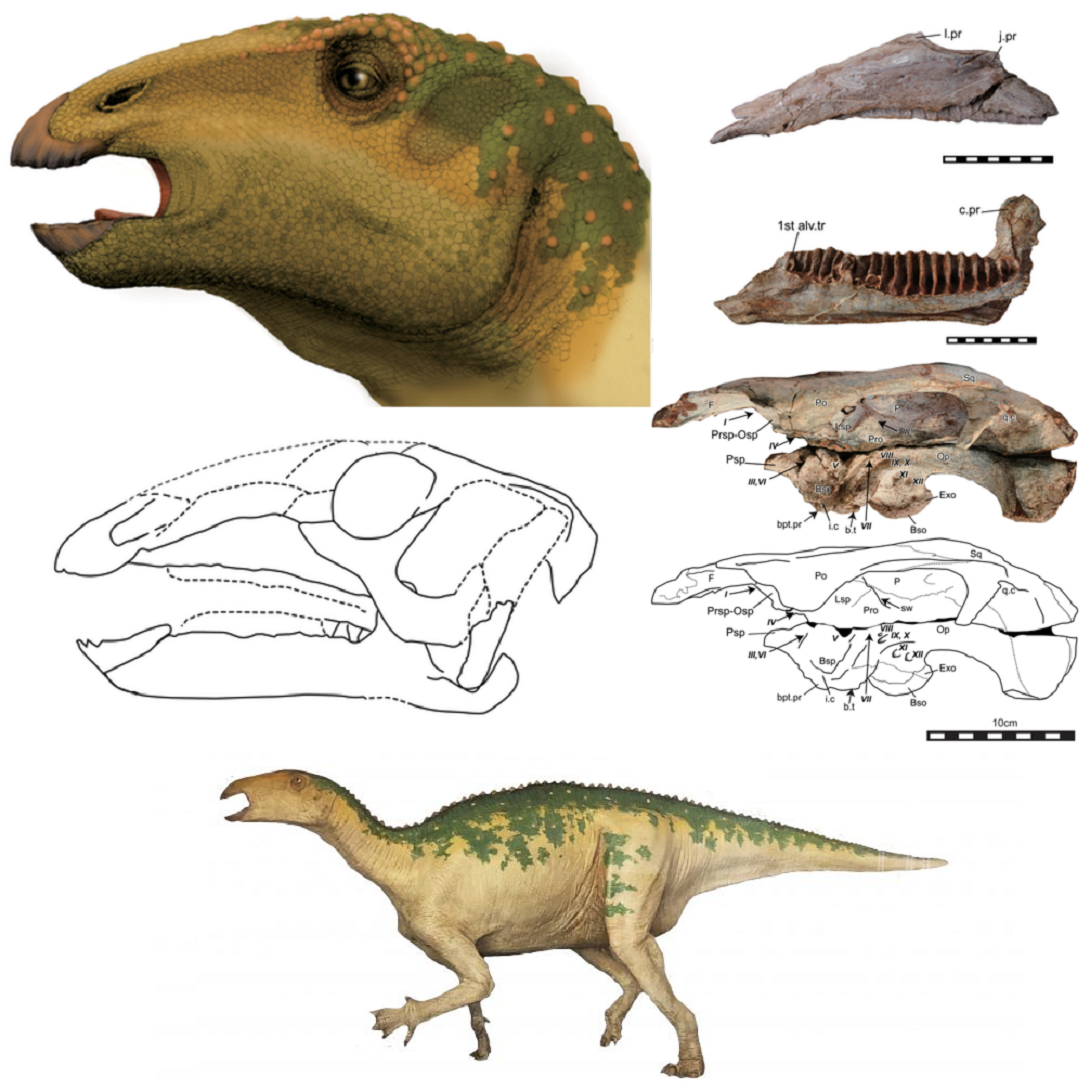
สิรินธรน่า โคราชเอนซิส |  Sirindhorna khoratensis  Shibata, Jintasakul, Azuma & You, 2015

Fig 16. Skull of Sirindhorna khoratensis. (A) A composite skull reconstruction of Sirindhorna. Several elements are reversed. (B) Life restoration of the head of Sirindhorna by Yoko Ohnish.
Scale bar equals 10 cm. Dashed line indicates missing elements.

Abstract

A new basal hadrosauroid dinosaur from the Lower Cretaceous Khok Kruat Formation of Thailand, Sirindhorna khoratensis gen. et sp. nov is described. The new taxon is based on composite skull and mandible including premaxilla, maxilla, jugal, quadrate, braincases, predentary, dentaries, surangular, and maxillary and dentary teeth. It is diagnostic by such characters as, sagittal crest extending along entire dorsal surface of the parietal and reaching the frontoparietal suture (autapomorphy), transversely straight frontoparietal suture, caudodorsally faced supraoccipital, no participation of the supraoccipital in the foramen magnum, mesiodistally wide leaf-shaped dentary tooth with primary and secondary ridges on the lingual surface of the crown, perpendicularly-erected and large coronoid process of dentary, and nonvisible antorbital fossa of the maxilla in lateral view. Phylogenetic analysis revealed S. khoratensis as among the most basal hadrosauroids. Sirindhorna khoratensis is the best-preserved iguanodontian ornithopod in Southeast Asia and sheds new light to resolve the evolution of basal hadrosauriforms.


Introduction

Fossil records of non-hadrosaurid hadrosauriform dinosaurs in Asia have been accumulated in this century. Although these discoveries mainly came from China and Mongolia, new findings have been known from Uzbekistan, Kazakhstan, Japan and Thailand. However, well-preserved iguanodontian specimens were restricted in China and Mongolia; for instance, Jinzhousaurus yangi was known as the almost complete articulated skeleton found from Liaoning Province, Xuwulong yueluni was represented by an articulated skeleton without appendages from Gansu Province of China, and Probactrosaurus gobiensis from Inner Mongolia was described including several individuals of cranium and post cranial portions. In contrast, although two iguanodontians known from the Lower Cretaceous of Thailand, Siamodon (maxilla and referred braincase) and Ratchasimasaurus (dentary), none of them provides enough characters to discuss their phylogenies in detail. The new taxon in this study is known from extensive remains including a disarticulated skull and mandibles, and is much more complete than material of the aforementioned Thailand iguanodontians. This new material was collected from one locality of the Lower Cretaceous Khok Kruat Formation during the first term of Japan-Thailand Dinosaur Project (abbreviated as JTDP), including the preliminary excavation by NRRU in 2005. We describe this material and discuss its phylogenetic position based on a cladistic analysis.


Fig 1. Locality map and stratigraphic column for Sirindhorna.
(A) Map of Nakhon Ratchasima Province, Thailand, (B) localities of Sirindhorna (star mark), Ratchasimasuarus (R) and Siamodon (S), (C) stratigraphic column for the Khorat Group.

Fig 3. Photo (A) and line drawing (B) of the left lateral side of the skull (NRRU3001-166).


Systematic Paleontology

Dinosauria Owen, 1842
Ornithischia Seeley, 1887

Iguanodontia Dollo, 1888 sensu Sereno, 2005 
Ankylopollexia Sereno, 1986 sensu Sereno, 2005 
Styracosterna Sereno, 1986 sensu Sereno, 2005 

Hadrosauriformes Sereno, 1997 sensu Sereno, 1998
Hadrosauroidea Sereno, 1986 sensu Sereno, 2005

Sirindhorna gen. nov.
urn:lsid:zoobank.org:act:40C4FBA5-455F-45AE-AD5A-33B6A6FB8723

Sirindhorna khoratensis, sp. nov.
urn:lsid:zoobank.org:act:54C342F2-EB92-4047-8F78-714025579CB5

Etymology: Dedication to the Princess Maha Chakri Sirindhorn, Thailand, for her contribution to the support and encouragement of paleontology in Thailand. The specific name comes from the name of the locality, Khorat, which is the informal name of Nakhon Ratchasima Province, northeastern Thailand.

Diagnosis: Basal hadrosauroid distinguished by an autapomorphy: sagittal crest extending along entire dorsal surface of the parietal and reaching the frontoparietal suture, and the following unique combination of characters: relatively straight frontoparietal suture, caudodorsally faced supraoccipital, no participation of the supraoccipital in the foramen magnum, antorbital fossa of the maxilla not visible, slightly rostrally deepening dentary ramus, simple troughs for dentary alveoli with vertical walls and tooth crown-shaped base, vertical coronoid process expanded along rostral and caudal margins, and dentary teeth with primary and secondary ridges but no accessory ridges.

Holotype: An articulated braincase comprising the supraoccipital, exoccipitals, opisthotics, prootics, parietals, frontals, basioccipital, basisphenoid orbitosphenoids, parasphenoid and laterosphenoids, with postorbitals and squamosals (NRRU3001-166)

Referred materials: Disarticulated elements of skull and mandibles: a braincase articulating with a left postorbital (NRRU-A2035), dorsal half of a braincase (NRRU3001-65), caudal portion of a braincase (NRRU3001-179), a right premaxilla (NRRU-A3623), a left maxilla (NRRU-A2048), a right maxilla (NRRU-A2047), a right jugal (NRRU3001-7), a right quadrate (NRRU3001-175), a predentary (NRRU3001-169), a left dentary (NRRU3001-14), a right dentary (NRRU3001-167), a right surangular (NRRU3001-137), isolated maxillary teeth (NRRU-A1956, A3630, A3649, NRRU3001-157, 163), an isolated dentary tooth (NRRU3001-28).

Locality and horizon: In Ban (meaning “village”) Saphan Hin, Suranaree Subdistrict, Muaeng Nakhon Ratchasima District, Nakhon Ratchasima Province, Thailand. Lower Cretaceous (Aptian) Khok Kruat Formation.

Fig 15. Comparisons with other Thailand iguanodontians.
(A) Holotypic left maxilla of Siamodon, (B) holotypic right dentary of Ratchasimasaurus, (C) left maxilla of Sirindhorna (NRRU-A2048), (D) left dentary of Sirindhorna (NRRU3001-167).
Scale bars equal 10 cm.    DOI: 10.1371/journal.pone.0145904

Conclusions
The Early Cretaceous hadrosauroid dinosaur, Sirindhorna khoratensis, is described based upon cranial elements. This is the first report of well-preserved ornithopod skull in Southeast Asia (See reconstruction, in Fig 16). Sirindhorna shows general morphological features of hadrosauriforms, such as the low-triangle shaped maxilla, a broad leaf-shaped dentary tooth crown with one prominent primary and one secondary ridges, exclusion of the supraoccipital from the foramen magnum, and the closure of the antorbital fenestra. Uniquely, the craniocaudally-elongated parietals form a long saggital crest extending to the frontoparietal suture in Sirindhorna. Moreover, upper and lower jaws of Sirindhorna show evident differences from the other two Thailand hadrosauriforms, Siamodon nimingami and Ratchasimasaurus suranareae. Phylogenetic analysis recovers Sirindhorna as the most basal hadrosauroid.


Masateru Shibata, Pratueng Jintasakul, Yoichi Azuma and Hai-Lu You. 2015. A New Basal Hadrosauroid Dinosaur from the Lower Cretaceous Khok Kruat Formation in Nakhon Ratchasima Province, Northeastern Thailand. PLoS ONE. 10 (12): e0145904.  DOI: 10.1371/journal.pone.0145904


Sirindhorna khoratensis: Fossils of unknown dinosaur found in Thailand | The Japan Times http://www.japantimes.co.jp/news/2016/01/15/national/science-health/fossils-unknown-dinosaur-found-thailand


โดยความร่วมมือของคณะสำรวจไทยจากมหาวิทยาลัยราชภัฏนครราชสีมา [Nakhon Ratchasima Rajabhat University: NRRU] และพิพิธภัณฑ์ไดโนเสาร์จังหวัดฟุกุอิ [Fukui Prefectural Dinosaur Museum] ประเทศญี่ปุ่น ได้ศึกษาและขุดค้นภาคสนามที่ตำบลสุรนารี อำเภอเมืองนครราชสีมา จังหวัดนครราชสีมา ในชั้นตะกอนหินกรวดสีแดง ในหมวดชั้นหินโคกกรวด ซึ่งเป็นชั้นตะกอนหินที่ก่อตัวในช่วงต้นยุคครีเตเชียสเมื่อประมาณ 110 ล้านปีก่อน

การขุดค้นพบครั้งนี้ได้พบชิ้นส่วนฟอสซิลกระโหลกของไดโนเสาร์กินพืชกลุ่มออร์นิโธพอด ชิ้นกระดูกส่วนท้ายทอย ปลายจะงอยปากบน และกรามล่าง ซึ่งจากการศึกษาลักษณะเอกลักษณ์นั้น ฟอสซิลของไดโนเสาร์ตัวใหม่นี้มีลักษณะบางประการที่ดูคล้ายคลึงกับไดโนเสาร์ในกลุ่มอิกัวโนดอน แต่มีลักษณะของปลายจะงอยปากทรงสามเหลี่ยมแบนที่เป็นลักษณะของกลุ่มฮาโดรซอร์ที่พัฒนาขึ้น

. . . การค้นพบนี้คณะวิจัยได้ขอพระราชทานชื่อสายพันธุ์ไดโนเสาร์ชนิดใหม่นี้จากสมเด็จพระเทพรัตนราชสุดาฯ สยามบรมราชกุมารี เพื่อเฉลิมพระเกียรติ โดยไดโนเสาร์สายพันธุ์นี้มีชื่อวิทยาศาสตร์ว่า สิรินธรน่า โคราชเอนซิส (Sirindhorna khoratensis) ซึ่งชื่อสายพันธุ์นั้นได้ใช้คำว่า โคราช ชื่อเดิมของจังหวัดนครราชสีมา 

สิรินธรน่า เป็นไดโนเสาร์กินพืชในกลุ่มฮาโดรซอร์ที่มีลักษณะโบราณมาก ซึ่งอาศัยอยู่ในช่วงเวลาและหมวดหินที่ใกล้เคียงกันอย่างไดโนเสาร์สายพันธุ์ สยามโมดอน (Siamodon nimingami) และราชสีมาซอรัส (Ratchasimasaurus suranareae) แม้ว่าการศึกษาจะระบุว่าสองสายพันธุ์ที่กล่าวมาจะอยู่ในกลุ่มอิกัวโนดอนมากกว่า

ฮาโดรซอร์ หรือไดโนเสาร์ปากเป็ดเป็นกลุ่มไดโนเสาร์กินพืชที่พัฒนาขนาดให้ใหญ่ขึ้นมากในช่วงปลายยุคครีเตเชียส ซึ่งเป็นหนึ่งในกลุ่มไดโนเสาร์กินพืชที่อาศัยอยู่ในภูมิภาคซีกโลกเหนืออย่างเอเชีย-ยุโรป และอเมริกาเหนือ และสูญพันธุ์ในช่วงปลายยุคครีเตเชียส


ผศ.ดร.ประเทืองเปิดเผยว่า การขุดค้นพบฟอสซิลไดโนเสาร์อิกัวโนดอนสายพันธุ์ใหม่ของโลกในครั้งนี้ เกิดขึ้นจากความร่วมมือระหว่างนักวิจัยจากประเทศไทย และนักวิจัยจากประเทศญี่ปุ่น โดยศาสตราจารย์ ดร.โยอิชิ อะซูมา ผอ.สถาบันวิจัยไดโนเสาร์ มหาวิทยาลัยฟูกุอิ และพิพิธภัณฑ์ไดโนเสาร์ฟูกุอิ ประเทศญี่ปุ่น เป็นหัวหน้าคณะทีมวิจัยฟอสซิลไดโนเสาร์จากแหล่งบ้านสะพานหิน ต.สุรนารี อ.เมือง จ.นครราชสีมา โดยเริ่มวิจัยตั้งแต่ปี พ.ศ. 2550 ซึ่งที่ผ่านมาได้มีการขุดพบฟอสซิลไดโนเสาร์อิกัวโนดอนต์สายพันธุ์ใหม่ของโลกมาแล้ว 2 สกุล ได้แก่ ราชสีมาซอรัส และสยามโมดอน ส่วนฟอสซิลอิกัวโนดอนต์ที่ทำการวิจัยครั้งนี้ ประกอบไปด้วย ชิ้นส่วนกะโหลก ขากรรไกรบน ล่าง ฟัน และชิ้นส่วนอื่นๆ รวม 19 ชิ้น จากชั้นหินกรวดมนปนปูน ในหมวดหินโคกกรวด มีอายุประมาณ 115 ล้านปีก่อน ที่มีระบบนิเวศเป็นแบบกึ่งแห้งแล้ง ซึ่งฟอสซิลอิกัวโนดอนต์ตัวนี้ มีความแตกต่างจากอิกัวโนดอนต์ 2 สกุลที่พบในโคราชมาก่อน เช่น มีขากรรไกรล่าง ที่มีอัตราส่วนระหว่างความยาวและความสูงน้อยกว่าราชสีมาซอรัส หรือมีขากรรไกรบนทรงต่ำหรือลาดเอียงมากกว่าสยามโมดอน เป็นต้น

ได้รับพระมหากรุณาธิคุณในวโรกาส 60 พรรษา สมเด็จพระเทพรัตนราชสุดาฯ สยามบรมราชกุมารี พระราชทานพระราชานุญาตให้ใช้พระนามของพระองค์ เป็นชื่อสกุลว่า “สิรินธรน่า” ส่วนชื่อชนิด ใช้ชื่อโคราชซึ่งเป็นแหล่งค้นพบ คือ โคราชแดนซิส รวมเป็นชื่อทางการว่า “สิรินธรน่า โคราชเอนซิส” โดยมีขนาดความยาวตั้งแต่หัวจรดหาง ประมาณ 6 เมตร สูงประมาณ 2 เมตร หนักประมาณ 1 ตัน มีอายุอยู่ในช่วงประมาณ 115 ล้านปีก่อน ทั้งนี้สำหรับไดโนเสาร์อิกัวโนดอน อยู่ในประเภทไดโนเสาร์กินพืชที่มีกระดูกสะโพกแบบนก ต่างจากไดโนเสาร์กินพืชพวกซอโรพอตหรือพวกคอยาวหางยาว ที่มีกระดูกสะโพกแบบสัตว์เลื้อยคลาน ไดโนเสาร์กลุ่มอิกัวโนดอนนี้ พบมากกว่า 60 สกุล เพราะมีวิวัฒนาการต่อเนื่องกันมานานกว่า 100 ล้านปี และพบกระจายกว้างขวางทั่วโลก ลักษณะเด่นของอิกัวโนดอนต์ คือมีฟันคล้ายฟันอิกัวน่า แต่มีขนาดใหญ่กว่ากันมาก ไม่มีฟันในส่วนหน้าของขากรรไกรบน-ล่าง แต่มีจงอยปากที่เป็นกระดูกแข็งแทน ขาหลังแข็งแรง ใหญ่ และยาวกว่าขาหน้า จึงเป็นไดโนเสาร์ที่วิ่งได้เร็วด้วย 2 เท้า แต่เวลาเดินหรือแทะเล็มกินใบไม้ยอดไม้ระดับต่ำ จะเดินด้วย 4 เท้า อาจแบ่งได้เป็น 2 พวกย่อย คือ พวกที่มีหัวแม่มือเป็นเดือยแหลม ไว้ป้องกันตัวหรือแกะเมล็ดไม้ที่มีเปลือกแข็ง เช่น อิกัวโนดอน จึงหมายถึงกลุ่มไดโนเสาร์ที่ประกอบด้วยสกุลอิกัวโนดอน และสกุลอื่นๆ ที่คล้ายอิกัวโนดอน สำหรับสิรินธรน่า จะจัดอยู่ในกลุ่มย่อยที่ 1 คือ พวกที่มีหัวแม่มือเป็นเดือยแหลม รวมทั้งราชสีมาซอรัสและสยามโมดอน ก็จัดอยู่ในอิกัวโนดอนกลุ่มย่อยนี้ด้วย

ขึ้นทะเบียนซากไดโนเสาร์พันธุ์ใหม่โลก "สิรินธรนา โคราชเอนซิส" อายุ 100 ล้านปี
news.thaipbs.or.th/content/261064 #ThaiPBS via @ThaiPBS
พระราชทาน ‘สิรินธรน่า โคราชเอนซิส’ ฟอสซิลไดโนเสาร์สายพันธุ์ใหม่ที่ขุดพบ: http://www.matichon.co.th/news/7220

Thursday, December 17, 2015

[Paleontology • 2015] Morelladon beltrani • A New Sail-Backed Styracosternan (Dinosauria: Ornithopoda) from the Early Cretaceous of Morella, Spain


Morelladon beltrani 
Gasulla, Escaso, Narváez, Ortega & Sanz, 2015
doi:  
10.1371/journal.pone.0144167

Abstract

A new styracosternan ornithopod genus and species is here described based on a partial postcranial skeleton and an associated dentary tooth of a single specimen from the Arcillas de Morella Formation (Early Cretaceous, late Barremian) at the Morella locality, (Castellón, Spain). Morelladon beltrani gen. et sp. nov. is diagnosed by eight autapomorphic features. The set of autapomorphies includes: very elongated and vertical neural spines of the dorsal vertebrae, midline keel on ventral surface of the second to fourth sacral vertebrae restricted to the anterior half of the centrum, a posterodorsally inclined medial ridge on the postacetabular process of the ilium that meets its dorsal margin and distal end of the straight ischial shaft laterally expanded, among others. Phylogenetic analyses reveal that the new Iberian form is more closely related to its synchronic and sympatric contemporary European taxa Iguanodon bernissartensis and Mantellisaurus atherfieldensis, known from Western Europe, than to other Early Cretaceous Iberian styracosternans (Delapparentia turolensis and Proa valdearinnoensis). The recognition of Morelladon beltrani gen. et sp. nov. indicates that the Iberian Peninsula was home to a highly diverse medium to large bodied styracosternan assemblage during the Early Cretaceous.


Systematic Palaeontology

Dinosauria Owen 1842
Ornithischia Seeley 1887
Ornithopoda Marsh 1881

Iguanodontia Dollo, 1888 sensu Norman, 2015 
Ankylopollexia Sereno, 1986 sensu Norman, 2015 
Styracosterna Sereno, 1986 sensu Norman, 2015 

Morelladon gen nov.
urn:lsid:zoobank.org:act:2BEA6D12-8836-4F4C-9616-134FDDC9618E

Morelladon beltrani sp nov.
urn:lsid:zoobank.org:act:EEB70705-B246-48D8-8B79-C5E0A8C6C38C

Etymology: The generic name is derived from Morella (the name of the type locality) and odon (Greek word for “tooth”). The specific name is for Víctor Beltrán, for his involvement and collaboration in the localization of the different fossil sites at the Mas de la Parreta Quarry.

Holotype: CMP-MS-03, a partial skeleton including a complete right dentary tooth, six almost complete dorsal vertebrae, a dorsal centrum, several fragments of dorsals neural spines, two dorsal ribs fragments, a nearly complete sacrum, two haemal arches, ilia, incomplete pubes and ischia, and the right tibia (Figs 2–14). Measurements of select elements of Morelladon beltrani are given in S1 Supporting Information.


Fig 7. Dorsal vertebrae series of the holotype specimen of Morelladon beltrani (CMP-MS-03).


Fig 11. Pelvic girdle of the holotype specimen of Morelladon beltrani (CMP-MS-03).

Fig 1. Geographic location of the holotype specimen of Morelladon beltrani (CMP-MS-03).
(A) Castellón province and Morella locality in Spain. (B) Schematic regional map of area of Morella locality indicating location of the Mas de la Parreta Quarry (black star). (C) Photography showing the location of the holotype site in the CMP-MS area (dash line).

Locality and horizon: The specimen was collected in the Mas de Sabaté (CMP-MS) site within the Mas de la Parreta Quarry at Morella, Spain (Fig 1). The Arcillas de Morella Formation has traditionally been dated as early Aptian in age, but new palynological data indicates a Barremian age for this Iberian Formation.

Fig 16. Phylogenetic relationships of Morelladon beltrani (CMP-MS-03). Time-calibrated strict consensus tree resulting from the analysis of the modified data matrix from Norman .
Abbreviations: AF, Africa; AS, Asia; AU, Australia; EU, Europe; NA, North America, SA, South America.doi:  10.1371/journal.pone.0144167

Conclusions
Despite the limited material known from the type specimen, a suite of autapomorphies supports the validity of Morelladon beltrani. In addition, Morelladon can be distinguished from other styracosternan iguanodontians on the basis of a unique combination of characters. Regardless of the phylogenetic analysis carried out, Morelladon is clearly nested within the clade that contains its synchronic and sympatric contemporary European taxa Iguanodon bernissartensis and Mantellisaurus atherfieldensis, and the lower Albian Proa valdearinnoensis from the Iberian Peninsula.

Styracosternans are by far the most abundantly represented group of dinosaurs in the Arcillas de Morella Formation including, besides Morelladon beltrani, several individuals assigned to Iguanodon bernissartensis and probably to Mantellisaurus atherfieldensis. In addition, the recognition of Morelladon beltrani provides a distinguishing component of the Arcillas de Morella Formation respect to its equivalent upper Wealden facies from northwest Europe (Belgium and England), also characterized by the presence of the medium-large bodied styracosternans Iguanodon bernissartensis and Mantellisaurus atherfieldensis. Finally, the discovery of Morelladon beltrani gen. et sp. nov. combined with other recent named taxa (e.g., Delapparentia turolensis, Proa valdearinnoensis, Iguanodon galvensis) recognizes the Iberian Peninsula as a highly diverse Early Cretaceous medium-large bodied styracosternan assemblage worldwide.


José Miguel Gasulla, Fernando Escaso, Iván Narváez, Francisco Ortega and José Luis Sanz. 2015. A New Sail-Backed Styracosternan (Dinosauria: Ornithopoda) from the Early Cretaceous of Morella, Spain. PLoS ONE. 10(12): e0144167. doi:  10.1371/journal.pone.0144167

New species of 'sail-backed' dinosaur found in Spain http://bit.ly/1OlWhTl via @EurekAlertAAAS

[Paleontology • 2012] Proa valdearinnoensis • An Unusual New Basal Iguanodont (Dinosauria: Ornithopoda) from the Lower Cretaceous of Teruel, Spain


Proa valdearinnoensis
McDonald, Espílez, Mampel, Kirkland & Alcalá, 2012

Abstract
We describe a new basal iguanodont, Proa valdearinnoensis, from the Lower Cretaceous (lower Albian) Escucha Formation of Teruel Province, Spain. The new taxon is known from abundant cranial and postcranial material belonging to several individuals, and is distinguished by an autapomorphy (predentary comes to a point at its rostral margin, with divergent lateral processes) and a unique combination of characters. Proa fills part of an otherwise lengthy temporal gap (early Aptian–Santonian) in the European fossil record of basal iguanodonts. A preliminary phylogenetic analysis places Proa in a polytomy with Iguanodon bernissartensis and more derived iguanodontians (Hadrosauroidea). Proa is more basal than the Valanginian Hypselospinus and late Barremian-early Aptian Mantellisaurus, suggesting a long ghost lineage leading to Proa.

Key Words: Proa valdearinnoensis gen. et sp. nov., Iguanodontia, Early Cretaceous, Escucha Formation, Spain


Systematic Paleontology

Dinosauria Owen 1842
Ornithischia Seeley 1887
Ornithopoda Marsh 1881

Iguanodontia Dollo 1888 (sensu Sereno 2005)
Styracosterna Sereno 1986 (sensu Sereno 2005)

Ankylopollexia Sereno 1986 (sensu Sereno 2005)
Hadrosauriformes Sereno 1997 (sensu Sereno 1998)

Proa valdearinnoensis gen. et sp. nov. 

Etymology. The generic name is the Spanish word for prow (‘proa’), in reference to the pointed shape of the predentary. The specific name is in reference to Val de Ariño, the traditional name of the coal mining area around the municipality of Ariño, near which the fossils were discovered, with the Latin ending -ensis (‘from’).


Andrew T. McDonald, Eduardo Espílez, Luis Mampel, James I. Kirkland and Luis Alcalá. 2012. An Unusual New Basal Iguanodont (Dinosauria: Ornithopoda) from the Lower Cretaceous of Teruel, Spain. Zootaxa. 3595: 61–76.


[Paleontology • 2011] Delapparentia turolensis • A New Iguanodontoid Dinosaur (Ornithischia: Ornithopoda) from the Lower Cretaceous of Galve, Spain


Delapparentia turolensis  Ruiz-Omeñaca, 2011


ABSTRACT
An ornithopod dinosaur postcranial skeleton from the Early Cretaceous of Galve (Teruel province, Spain), assigned to Iguanodon bernissartensis by the French paleontologist Albert de Lapparent in 1960, is redescribed. It comes from La Maca 3 locality, early Barremian in age (Camarillas Formation) and it is made of several cervical vertebrae, fragmentary remains of the dorsal and sacral series, several caudal vertebrae, fragments of cervical, dorsal and sternal ribs, fragments of chevrons and ossified tendons, and an incomplete left hip. It has been identified as an «iguanodontid» (i.e., a non-hadrosaurid iguanodontoid) by the presence of a deep prepubic blade and the absence of antitrochanter on ilium. The skeleton represents a new iguanodontoid taxon, Delapparentia turolensis nov. gen et sp., characterized by the following autapomorphies: 1) posterior dorsal ribs with long, parallel and unfused capitulum and tuberculum, 2) ossified sternal ribs, and 3) straight and lateromedially expanded preacetabular process of ilium (convergent in Zalmoxes). It also presents a combination of anterior dorsal ribs with a pneumatic foramen, and a ischium of big size in relation to ilium.

Key words: Dinosauria, Iguanodontoidea, postcranial skeleton, lower Barremian, Teruel province, Lapparent


J.I. Ruiz-Omeñaca. 2011. Delapparentia turolensis nov. gen et sp., un nuevo dinosaurio iguanodontoideo (Ornithischia: Ornithopoda) en el Cretácico Inferior de Galve. Delapparentia turolensis nov. gen et sp., A New Iguanodontoid Dinosaur (Ornithischia: Ornithopoda) from the Lower Cretaceous of Galve (Spain). Estudios Geológicos. 67(1); 83-110. doi: 10.3989/egeol.40276.124