Showing posts with label Turonian. Show all posts

Wednesday, November 22, 2023

[Paleontology • 2023] Yaguarasaurus regiomontanus • A New Species of Yaguarasaurus (Mosasauridae: Plioplatecarpinae) from the Agua Nueva Formation (upper Turonian – ?Lower Coniacian) of Nuevo Leon, Mexico


 Yaguarasaurus regiomontanus
 Rivera-Sylva, Longrich, Padilla-Gutierrez, Guzmán-Gutiérrez, Escalante-Hernández & González-Ávila, 2023

artwork: Luis Rey facebook.com/LuisRey5560
 
Abstract
The Mosasauridae underwent a major radiation early in the Late Cretaceous, with the subfamilies Plioplatecarpini and Tylosaurini appearing in the Turonian. Here we report an almost complete mosasaur skull assigned to the plioplatecarpine genus Yaguarasaurus. The specimen was discovered southwest of Vallecillo in the northeastern Mexico state of Nuevo Leon, about 80 km north of Monterrey, in a laminated limestone layer of the upper member of the Agua Nueva Formation (Upper Turonian - ?Lower Coniacian). The specimen is referred to as a new species, Yaguarasaurus regiomontanus. This is the first report of Yaguarasaurus from Mexico and the most complete of the Americas. At roughly 5 m in length, it is one of the earliest large mosasaurids. Along with Yaguarasaurus columbianus, Russellosaurus coheni, and an unnamed plioplatecarpine from Texas, it documents the rapid diversification and expansion of plioplatecarpines in the marine realm in the Turonian.

Systematic paleontology
Lepidosauria Haeckel 1866
Squamata Oppel, 1811.

Mosasauridae Gervais, 1853.
Plioplatecarpinae Dollo, 1884.

Yaguarasaurus Páramo, 1994


Yaguarasaurus regiomontanus sp. nov. 


Conclusions: 
A new plioplatecarpine mosasaurid, Yaguarasaurus regiomontanus, is reported from the Turonian-?Coniacian of Nuevo Leon, in Mexico. It closely resembles Yaguarasaurus columbianus from the Turonian of Columbia but exhibits derived features suggesting it may be more closely related to later plioplatecarpines. It is one of the earliest large mosasaurids and one of the first plioplatecarpines, documenting the initial radiation of mosasaurids in the Turonian following mid-Cretaceous extinctions in ...


Héctor E. Rivera-Sylva, Nicholas R. Longrich, José M. Padilla-Gutierrez, José Rubén Guzmán-Gutiérrez, Víctor M. Escalante-Hernández and José G. González-Ávila. 2023. A New Species of Yaguarasaurus (Mosasauridae: Plioplatecarpinae) from the Agua Nueva Formation (upper Turonian – ?Lower Coniacian) of Nuevo Leon, Mexico. Journal of South American Earth Sciences. In Press, 104694. DOI: 10.1016/j.jsames.2023.104694

Saturday, June 17, 2023

[Paleontology • 2023] Sarabosaurus dahli • A New lower Turonian mosasaurid from the Western Interior Seaway and the Antiquity of the unique basicranial circulation pattern in Plioplatecarpinae


Sarabosaurus dahli 
Polcyn, Bardet, Albright & Titus, 2023

Artwork by Andrey Atuchin
 
Abstract
We describe and name a new mosasaur taxon, Sarabosaurus dahli gen. et sp. nov., from the lower Turonian part of the Tropic Shale in Utah, USA. The holotype specimen preserves significant portions of the skull and axial postcranial skeleton. It was found in the upper part of the Watinoceras devonense Ammonite Zone, bounded by radioisotopic dates above and below, and is thus about 93.7 Ma, the oldest mosasaurid taxon known from the Western Interior Seaway. The new taxon possesses a vascular pattern of the basisphenoid heretofore only seen in late diverging plioplatecarpine mosasaurids. Reevaluation of the morphology of the basisphenoid of previously described Turonian mosasaurs using μCT techniques reveals the derived condition is also present in Yaguasaurus and the incipient condition in Tethysaurus and Russellosaurus. In these two taxa, the canals enter the basisphenoid, but do not pass into the basioccipital. Instead, they exit only high on the posterior wall of the sella turcica, in a position similar to the basilar artery of other lizards. This vascular pattern, both in its incipient and derived states, is unique among squamates and supports inclusion of the aforementioned taxa in a monophyletic Plioplatecarpinae, for which we provide an emended diagnosis. Phylogenetic analysis recovers Sarabosaurus dahli gen. et sp. nov. as the sister taxon to Yaguarasaurus and all other later diverging plioplatecarpines, with Russellosaurus and Tethysaurus as successive sister taxa. Tylosaurine mosasaurids retain the primitive condition of the basisphenoid vascularization pattern and implies a tylosaurine-plioplatecarpine divergence in the late Cenomanian or earliest Turonian.

Keywords: Plioplatecarpinae, Tylosaurinae, Turonian, Mosasauridae, Tropic Shale

Schematic reconstruction of the skull of Sarabosaurus dahli gen. et sp. nov. showing preserved elements in (A) lateral, (B) dorsal, and (C) ventral views. Some elements mirrored from opposite side. Reconstructed portions based on Tethysaurus nopscai (SMU75486) and Russellosaurus coheni (SMU73056).
(D) Isolated zygopophysis showing growth rings with relative topographic relief shown in the third panel with legend given in microns, and (E), broken edge of zygosphene showing laminar bone deposition, interpreted as corresponding to annual growth.
Scale bars equal 10 cm for A-C and 1mm for D and E.

Systematic paleontology
Reptilia Linnaeus, 1758
Squamata Oppel, 1811

Mosasauridae Gervais, 1852
Russellosaurina Polcyn and Bell, 2005
Plioplatecarpinae Dollo, 1884

Included Genera— Platecarpus Cope, 1869; Plioplatecarpus Dollo, 1882; Angolasaurus Antunes, 1964; Ectenosaurus Russell, 1967; Selmasaurus Wright and Shannon, 1988; Yaguarasaurus Paramo, 1994; Tethysaurus Bardet et al., 2003; Russellosaurus Polcyn and Bell, 2005; Latoplatecarpus Konishi and Caldwell, 2011; Plesioplatecarpus Konishi and Caldwell, 2011; Romeosaurus Palci et al., 2013; Gavialimimus Strong et al. 2020.

Emended Diagnosis. (compare with Russell, 1967; Bell, 1997; Lingham-Soliar, 1994; Konishi and Caldwell, 2011); small to medium size mosasaurids (2-6 meters); canals for basilar artery enter basisphenoid below abducens nerve exits and above internal carotid artery path, internally converging medially giving rise to the basilar artery, and in some taxa continue posteriorly within the basisphenoid and basioccipital, exiting on medullary floor of the basioccipital as paired canals or a single bilobate canal; premaxilla bears ventral median ridge just posterior to dentigerous portion; quadrate suprastapedial process elongate, reaching mid-height of quadrate in most taxa; two or three foramina on ventrolateral face of retroarticular process in most taxa; marginal tooth crown with sub-circular basal cross-section and medially finely striated, laterally faceted or fluted to various extent; parietal rami-supratemporal contact obliquely or horizontally oriented.

Remarks. The novel vascular pattern present in the basisphenoid of the Sarabosaurus dahli gen. et sp. nov. described herein is shared with Tethysaurus, Russellosaurus, Yaguarasaurus, and all other mosasaurid genera previously recognized as belonging to the subfamily Plioplatecarpinae (sensu Konishi and Caldwell, 2011). This vascular pattern is unique amongst mosasaurs and non-mosasaurian squamates and strongly supports the monophyly of this more inclusive arrangement to the exclusion of Tylosaurinae contra Konishi and Caldwell (2011), justifying the newly emended Plioplatecarpinae.


Sarabosaurus gen. nov.

Etymology. Sarabosaurus (Suh-raib-o-sawr-us) is derived from ’Sarab’, an Arabic word meaning ‘desert mirage’ and the Greek ‘sauros’ meaning lizard. The ’lizard of the desert mirage’ pays homage to the mirages often seen in the hot Tropic Shale badlands in the summer, which provided but a glimpse of the life that flourished in the long vanished Cretaceous Western Interior Seaway.

Diagnosis. The new taxon is diagnosed by the following unique combination of characters: premaxilla is anteriorly blunt, broadly arcuate in dorsal view with a small edentulous rostrum, ethmoid nerve enters premaxilla in a deep position, well below the dorsal surface and exits on dorsal surface as large irregularly spaced foramina, atavistic or paedomorphic retention of egg tooth, anterior internarial bar triangular in cross section; dermal sculpting present on the lateral face of maxillae; supradental portion of maxilla at external naris is transversely broader than tall; frontal supraorbital region is nearly square with dermal sculpting on the dorsal surface; prefrontal and postorbitofrontal separated by frontal supraorbitally, posterolateral alae of frontal rounded, posterior terminus of squamosal tear-drop-shaped without dorsal (parietal) process; relatively large lumina of semicircular canals; posteromedial vascular canal enters basisphenoid below abducens nerve exit, giving rise to basilar artery anteriorly and posteriorly forming a central vestibule within basisphenoid, pterygoid tooth row not elevated, sigmoidal, and bears at least 14 tooth positions, some of which are present on basisphenoid ramus; quadrate ventral body rostrocaudally thin, expanded ventral medial flange, small posterior ‘infrastapedial’ process, and poorly developed posteroventral ascending alar rim; dentary robust with small prow in front of first tooth position and medial ridge exposes nearly entire tooth root; tall well-developed median ridge on splenial; large zygosphenes present to at least the sacral vertebrae; depressed oval condyles on cervical and anterior trunk vertebrae, condyles on sacral and pygal vertebrae slightly taller than wide; anterior caudal vertebrae wider than tall; mid to posterior caudal vertebrae taller than wide.

 Sarabosaurus dahli gen. et sp. nov..

Holotype. UMNH VP21800 (GLCA 24271), fragments of cranium, mandible, and vertebrae representing cervical, dorsal, pygal, and caudal series.

Type Locality. GLCA site 327, Glen Canyon National Recreation Area, Kane County, Utah, USA (detailed locality data on file at UMNH).

Stratigraphic Occurrence. Lower part of the Mytiloides kossmati Inoceramid biozone, upper Pseudaspidoceras flexuosum North American ammonoid biozone.

Age. Early Turonian, bounded by radioisotopic dates on bentonites and constraining the horizon that produced the specimen to about 93.7 Ma.

Etymology. The species epithet, dahli, is in honor of the many contributions of Steve Dahl, longtime volunteer at Grand Staircase-Escalante National Monument, Kanab, Utah.

(A) Turonian paleogeography with political boundary overlay showing site GLCA 327. (B) Reference map of study area along southern border of Kaiparowits Plateau. Finely dotted line separates Glen Canyon National Recreation Area from Grand Staircase-Escalante National Monument. Star denotes location of type specimen. Modified from Albright et al. (2007a). (C) Generalized stratigraphic column of GLCA 327. A, B, C, and D, are bentonites of Elder (1991).Abbreviations: LS, Limestone beds. Lim., Limonite bed, and approximate local stratigraphic position of Cenomanian-Turonian boundary. (D) GLCA 327 during recovery of (UMNH VP 21800/GLCA 24271), Sarabosaurus dahli gen. et sp. nov.. Base map in A licensed from Colorado Plateau Geosystems, Inc.


Conclusions: 
Herein we described and named a new mosasaur taxon, Sarabosaurus dahli gen. et sp. nov., from the Watinoceras devonense Ammonite Zone of the Tropic Shale, Utah. The holotype specimen is confidently dated at about 93.7 Ma based on radioisotopic dates from bentonites above and below the horizon from which it was preserved, and is thus the oldest named mosasaur taxon known from the Western Interior Seaway. Although the specimen exhibits numerous plesiomorphic traits, remarkably, the basisphenoid preserved with the specimen shows the derived plioplatecarpine basicranial circulation pattern, which is unique amongst squamates, and represents a key evolutionary novelty. We describe the basicranial circulation pattern in select mosasaurids, identifying a morphocline consisting of three types. We show the mosasaur subfamilies Tylosaurinae, Mosasaurinae, and Halisaurinae retain the plesiomorphic squamate condition (Type1), while de novo vascular morphology supplants the basilar artery in Tethysaurus and Russellosaurus (Type 2), and the advanced plioplatecarpine (Type 3) condition is present in Yaguarasaurus and all other plioplatecarpines in which it can be assessed. Though some details remain unknown due to incomplete preservation of the basioccipital and the basisphenoid, Sarabosaurus dahli gen. et sp. nov. is inferred to possess the Type 3 condition because the basicranial canal for the basilar artery trends posteromedially within the basisphenoid as in later diverging plioplatecarpines. Recognition of the incipient (Type 2) condition in Tethysaurus and Russellosaurus, and the Type 3 condition in Yaguarasaurus and Sarabosaurus dahli gen. et sp. nov., provides the basis for an emended diagnosis of a more inclusive Plioplatecarpinae. The remarkable influence of these new data on the branching patterns recovered in our phylogenetic analysis, underscores the importance of discovery of new informative specimens, and the application of technology such as μCT in the search for new characters that elucidate the basal relationships and evolutionary patterns of mosasaurids.
 

Michael J. Polcyn, Nathalie Bardet, L. Barry Albright III and Alan Titus. 2023. A New lower Turonian mosasaurid from the Western Interior Seaway and the Antiquity of the unique basicranial circulation pattern in Plioplatecarpinae. Cretaceous Research. 105621; In Press. DOI: 10.1016/j.cretres.2023.105621 


Thursday, February 25, 2021

[Paleontology • 2021] Dzharatitanis kingi • First Rebbachisaurid Sauropod Dinosaur from Asia


Dzharatitanis kingi 
Averianov & Sues, 2021


Abstract
Dzharatitanis kingi gen. et sp. nov. is based on an isolated anterior caudal vertebra (USNM 538127) from the Upper Cretaceous (Turonian) Bissekty Formation at Dzharakuduk, Uzbekistan. Phylogenetic analysis places the new taxon within the diplodocoid clade Rebbachisauridae. This is the first rebbachisaurid reported from Asia and one of the youngest rebbachisaurids in the known fossil record. The caudal is characterized by a slightly opisthocoelous centrum, ‘wing-like’ transverse processes with large but shallow PRCDF and POCDF, and the absence of a hyposphenal ridge and of TPRL and TPOL. The neural spine has high SPRL, SPDL, SPOL, and POSL and is pneumatized. The apex of neural spine is transversely expanded and bears triangular lateral processes. The new taxon shares with Demandasaurus and the Wessex rebbachisaurid a high SPDL on the lateral side of the neural spine, separated from SPRL and SPOL. This possibly suggests derivation of Dzharatitanis from European rebbachisaurids. This is the second sauropod group identified in the assemblage of non-avian dinosaurs from the Bissekty Formation, in addition to a previously identified indeterminate titanosaurian.

Fig 1. Dzharatitanis kingi, USNM 538133 (holotype), anterior caudal vertebra
in posterior (A), right lateral (B), and anterior (C) views.
Scale bar = 10 cm.

Systematic paleontology
Sauropoda Marsh, 1878 
Neosauropoda Bonaparte, 1986 
Diplodocoidea Marsh, 1884 
Rebbachisauridae Bonaparte, 1997 

Genus Dzharatitanis gen. nov.
 
Diagnosis: Differs from Limaysaurus and Tataouinea by convex anterior centrum articular surface. Differs from Lavocatisaurus and Limaysaurus by absence of pleurocoel on centrum. Differs from Comahuesaurus by ‘wing-like’ transverse process. Differs from Amazonsaurus by dorsally directed ventral surface of transverse process. Differs from Cathartesaura, Comahuesaurus, Demandasaurus, Itapeusaurus, and Tataouinea by shallow PRCDF. Differs from Cathartesaura, Itapeusaurus, Katepensaurus, and Tataouinea by absence of TPRL. Differs from Comahuesaurus, Demandasaurus, and Nigersaurus by absence of ventral contact between prezygapophyses. Differs from Comahuesaurus, Demandasaurus, Itapeusaurus, Limaysaurus, Nigersaurus, and Tataouinea by absence of ventral contact between postzygapophyses. Differs from Demandasaurus and Tataouinea by absence of hyposphenal ridge. Differs from Amazonsaurus, Cathartesaura, Katepensaurus, Limaysaurus, Nigersaurus, and Tataouinea by absence of SPRL and SPOL contact. Differs from Amazonsaurus, Cathartesaura, Katepensaurus, Limaysaurus, Nigersaurus, Tataouinea, and Rebbachisaurus by large SPDL on lateral side of neural spine separate from SPRL and SPOL. Differs from Amazonsaurus, Cathartesaura, Comahuesaurus, Itapeusaurus, Lavocatisaurus, and Limaysaurus by presence of lateral process of neural spine. Differs from Rebbachisaurus by proximodistally shorter and anteroposteriorly wider neural spine, which is convex anteriorly in lateral view, and by much wider PRSL.
 
Occurrence: Central Asia; Late Cretaceous (Turonian).

Etymology: From the Dzharakuduk locality in Uzbekistan and Greek τιτάν (titan), a pre-Olympian god in ancient Greek mythology. The generic name is in the feminine gender.


Dzharatitanis kingi sp. nov. 
 2015 Titanosauria indet.: figure 7 in [2].

Holotype: USNM 538127, nearly complete anterior caudal vertebra. Found by David J. Ward and Hans-Dieter Sues during the URBAC (Uzbekistan/Russian/British/American/Canadian) joint paleontological expedition working in Uzbekistan in 1997.

Type locality and horizon: Dzharakuduk, 32 km SW of Mynbulak, Navoi Viloyat, Uzbekistan. The Bissekty Formation, exposed along the Dzharakuduk escarpment, extends from approximately 42°06’22.60’’ N and 62°37’09.00’’ E to 42°05’44.22’’ N and 62°41’06.49’’ E. Age: Late Cretaceous (Turonian). For additional geological details see Redman and Leighton [5].

Etymology: In memory of our colleague and friend Dr. Christopher King (1943–2015) who did much work on the geology of Cretaceous strata in Central Asia.

Remarks: USNM 538127 is likely the first caudal vertebra because of its slightly opisthocoelous centrum and the absence of chevron facets. First caudals with opisthocoelous centra are known for several rebbachisaurids (see Comparison).

 
Alexander Averianov and Hans-Dieter Sues. 2021. First Rebbachisaurid Sauropod Dinosaur from Asia.   PLoS ONE. 16(2): e0246620. DOI: 10.1371/journal.pone.0246620

New diplodocus-like dinosaur from Uzbekistan as the first rebbachisaurid found in Asia.
 

Wednesday, November 27, 2019

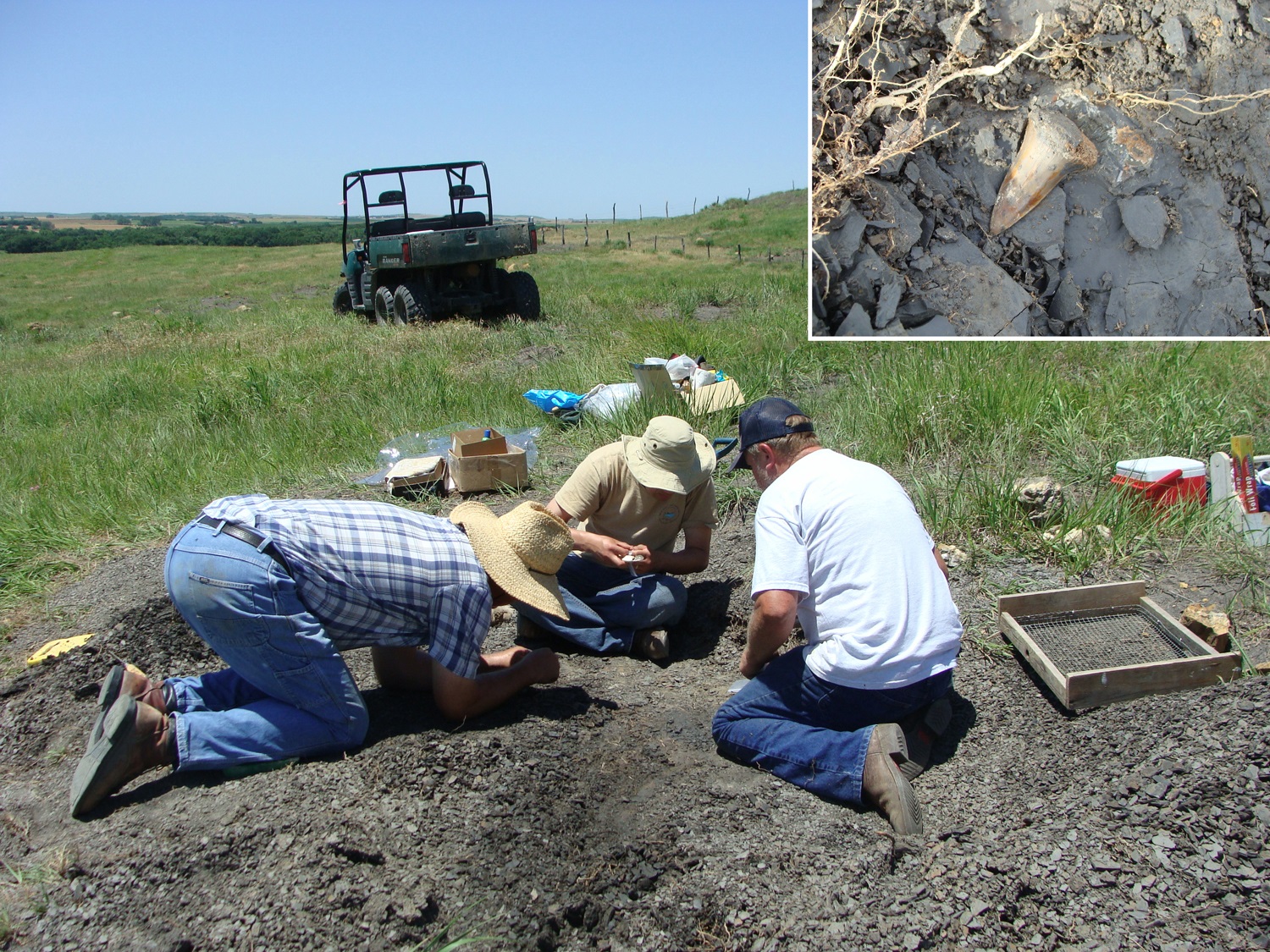
[PaleoIchthyology • 2019] Cretodus houghtonorum • A New Large Late Cretaceous Lamniform Shark from North America, with Comments on the Taxonomy, Paleoecology, and Evolution of the Genus Cretodus


  Cretodus houghtonorum
Shimada & Everhart, 2019


ABSTRACT
We describe a partial skeleton of the Late Cretaceous shark, Cretodus, collected from the Blue Hill Shale (middle Turonian) in north-central Kansas, U.S.A. It consists of 134 disarticulated teeth, 61 vertebrae, 23 placoid scales, and fragments of calcified cartilage. The scale morphology suggests that Cretodus was a rather sluggish shark, and the vertebral morphology affirms its placement into Lamniformes. With a strong tendency towards monognathic heterodonty, the dental morphology indicates that the specimen belongs to a new species, Cretodus houghtonorum, sp. nov., increasing the total known species of Cretodus to five. The five species can be divided into three distinct groups: the longiplicatus/semiplicatus-grade, gigantea/houghtonorum-grade, and crassidens-grade. Cretodus, that successively evolved by broadening the tooth crown. The individual of C. houghtonorum, sp. nov., is estimated to be about 515 cm in total length (TL). Our vertebra-based growth analysis suggests that the shark was about 118 cm TL at birth and that the species had an estimated maximum growth length of 684 cm TL. The large size at birth indicates that the intrauterine cannibalism behavior of embryos seen in extant lamniforms had already evolved by the Late Cretaceous. Where C. houghtonorum, sp. nov., preferred nearshore environments, the specimen co-occurred with isolated teeth of Squalicorax and fragments of two dorsal fin spines of a hybodont shark, circumstantially indicating that the individual of Cretodus fed on the much smaller hybodont and was scavenged by Squalicorax.


SYSTEMATIC PALEONTOLOGY

Class CHONDRICHTHYES Huxley, 1880
Subclass ELASMOBRANCHII Bonaparte, 1838

Cohort EUSELACHII Hay, 1902
Subcohort NEOSELACHII Compagno, 1977

Order LAMNIFORMES Berg, 1958

Family PSEUDOSCAPANORHYNCHIDAE Herman, 1979

Included Genera— Cretodus Sokolov, 1965; Eoptolamna, Kriwet, Klug, Canudo, and Cuenca-Bescos, 2008a; Leptostyrax Williston, 1900; Protolamna Cappetta, 1980; Pseudoscapanorhynchus Herman, 1977.

Genus CRETODUS Sokolov, 1965

Included Species— Cretodus crassidens (Dixon, 1850); C. gigantea (Case, 2001); C. houghtonorum, sp. nov. (this study); C. longiplicatus Werner, 1989; C. semiplicatus (Agassiz, 1843).


CRETODUS HOUGHTONORUM, sp. nov.

    Lamna semiplicata Agassiz, 1843: Cappetta, 1973:506, figs. 3.7, 3.7’.
    Odontaspis macrota Agassiz, 1843: Edward, 1976:67, fig. 1d–h.
    Cretodus semiplicatus (Agassiz, 1843): Wolberg, 1985a:10, figs. 3.10–3.21; Wolberg, 1985b:4, fig. 3f, g, j.
    Cretodus crassidens (Dixon, 1850): Welton and Farish, 1993:98, 1a, b, 2, two leftmost teeth on row ‘a’ and third tooth from the left on row ‘b’ on p. 99 (others on pp. 98–99 questionable).
    Cretodus semiplicatus (Agassiz, 1843): Williamson et al., 1993:figs. 5.6–5.8.
    Cretodus crassidens (Dixon, 1850): Cappetta and Case, 1999:21, fig. 2a–h; Cicimurri, 2004a:9–10, fig. 5e; Shimada, 2006b:166, figs. 3b, 4d; Becker et al., 2010:255, 257, figs. 5.6–5.9, 6.1?
    Cretodus sp.: Shimada et al., 2010a:fig. 4c.
    Cretodus crassidens: Bice and Shimada, 2016:177, fig. 3h (not 3g); Ouroumova et al., 2016: fig. 2l.

Diagnosis— Cretodus differing from all other known species of the genus by having teeth with moderately wide principal cusp, small lateral cusplets relative to principal cusp in tall, erect teeth, ‘V’-shaped crown base, relatively narrow tooth neck on lingual face, ‘V’-shaped basal root concavity, and short root lobes.

Etymology— The species name, houghtonorum, is in honor of Keith and Deborah Houghton, the owners of the land where the Cretodus specimen was found and who kindly donated the specimen to FHSM for the purpose of this present study.


Kenshu Shimada and Michael J. Everhart. 2019. A New Large Late Cretaceous Lamniform Shark from North America, with Comments on the Taxonomy, Paleoecology, and Evolution of the Genus CretodusJournal of Vertebrate Paleontology. e1673399. DOI: 10.1080/02724634.2019.1673399

Dinosaur-era shark fossil discovered in Kansas; researchers name it Cretodus houghtonorum
Fossil dig leads to unexpected discovery of 91-million-year-old shark new to science  phys.org/news/2019-11-fossil-unexpected-discovery-million-year-old-shark.html 

Sunday, October 6, 2019

[Paleontology • 2019] Ferrodraco lentoni • A New Ornithocheirid Pterosaur from the Winton Formation (Cenomanian–lower Turonian) of Queensland, Australia


Ferrodraco lentoni
Pentland, Poropat, Tischler, Sloan, Elliott, et al., 2019

Illustration by Travis R. Tischler.

Abstract
The Australian pterosaur record is poor by world standards, comprising fewer than 20 fragmentary specimens. Herein, we describe the new genus and species Ferrodraco lentoni gen. et sp. nov., based on the most complete pterosaur specimen ever found in Australia, and the first reported from the Winton Formation (Cenomanian–lower Turonian). The presence of premaxillary and mandibular crests, and spike-shaped teeth with subcircular bases, enable Ferrodraco to be referred to Anhangueria. Ferrodraco can be distinguished from all other anhanguerian pterosaurs based on two dental characters: the first premaxillary and mandibular tooth pairs are small; and the fourth–seventh tooth pairs are smaller than the third and eighth ones. Ferrodraco was included in a phylogenetic analysis of Pterosauria and resolved as the sister taxon to Mythunga camara (upper Albian Toolebuc Formation, Australia), with that clade occupying the most derived position within Ornithocheiridae. Ornithocheirus simus (Albian Cambridge Greensand, England), Coloborhynchus clavirostris (Valanginian Hastings Sands, England), and Tropeognathus mesembrinus (upper Aptian–lower Albian Romualdo Formation, Brazil) were resolved as successive sister taxa, which suggests that ornithocheirids were cosmopolitan during the Albian–Cenomanian. Furthermore, the stratigraphic age of Ferrodraco lentoni (Cenomanian–lower Turonian) implies that anhanguerians might have survived later in Australia than elsewhere.

Systematic palaeontology
Pterosauria Kaup, 1834
Pterodactyloidea Plieninger, 1901
Ornithocheiroidea Seeley, 1891 sensu Kellner, 2003

Anhangueria Rodrigues and Kellner, 2013
Ornithocheirae Seeley, 1870
Ornithocheiridae Seeley, 1870
Ornithocheirinae Andres, Clark and Xu, 2014
Figure 3: Ferrodraco lentoni gen. et sp. nov. holotype skull and mandible AODF 876.
(A) dorsal view; (B) anterior view; (C) left lateral view; (D) ventral view; (E) right lateral view; (F) schematic of left lateral view; and (G) schematic of right lateral view.
Abbreviations: d, dentary; dcr, (preserved base of) dentary crest; ll#, lower left (alveolus number); lr#, lower right (alveolus number); man, mandibular ramus; ms, mandibular symphysis; pmcr, premaxillary crest; pmx-mx, premaxilla–maxilla; ul#, upper left (alveolus number); ur#, upper right (alveolus number). Scale bar = 50 mm.

Figure 2: Ferrodraco lentoni gen. et sp. nov. holotype specimen AODF 876.
All preserved elements were photographed and scaled to the same size, then articulated where possible. These were then used as the basis for the scaling of the skeletal reconstruction, the missing parts of which were based on the skeletal reconstruction of Tropeognathus mesembrinus by Witton. Scale bar = 50 mm.

Ferrodraco lentoni gen. et sp. nov.

Holotype: Australian Age of Dinosaurs Fossil (AODF, Winton, Queensland, Australia) 876 (‘Butch’): anterior portion of skull comprising partial premaxillae, maxillae and dentaries (including premaxillary and mandibular crests and the mandibular symphysis); partial left frontal; left mandibular articular region comprising the surangular, angular and articular; five partial cervical vertebrae; partial right scapulocoracoid; partial left ulna; partial left radius; left proximal and distal carpals; left metacarpal IV; proximal end of right metacarpal IV; fragmentary left non-wing manual phalanges; partial left first wing phalanx (IV-1); and associated fragments. Several elements, including the skull and mandible and many of the appendicular elements (based on key-fits between adherent matrix on anatomically adjacent elements) were clearly articulated post-fossilisation; however, erosion and soil rotation led to fragmentation of the specimen prior to its excavation.

Type horizon and locality: Winton Formation (Cenomanian–lower Turonian); Australian Age of Dinosaurs Locality (AODL, Winton, Queensland, Australia) 245 (the ‘Pterosaur Site’), Belmont Station, Winton, Queensland, Australia (Fig. 1).
Diagnosis: Anhanguerian pterodactyloid diagnosed by the following autapomorphies: (1) first tooth pair of the premaxilla and mandible smaller than other anterior teeth; (2) fourth up to seventh teeth smaller than third and eighth.

Figure 1: Location of the Ferrodraco lentoni gen. et sp. nov. type locality (AODL 245).
(a) Map of Australia showing the location of Queensland. (b) Map of Queensland showing the distribution of Winton Formation outcrop. (c) Map of the Winton area showing Winton Formation outcrop, the location of Belmont Station, and museums in the region. 

Etymology: From the Latin ferrum (iron), in reference to the ironstone preservation of the holotype specimen, and the Latin draco (dragon). The species name honours former Winton Shire mayor Graham Thomas ‘Butch’ Lenton, in recognition of his years of service to the Winton community and support to the Australian Age of Dinosaurs Natural History Museum.
Figure 7: Time-calibrated phylogenetic trees of Ornithocheiroidea (Pterosauria: Pterodactyloidea), with some non-anhanguerian nodes collapsed for simplicity. The box next to each taxon demarcates its temporal range (including stratigraphic uncertainty), whereas the colour of each box reflects the palaeoenvironmental setting from which the taxon derives (yellow = terrestrial; blue = marine).
 (A) Tree based on the matrix of Andres et al. 2014, with Ferrodraco lentoni gen. et sp. nov. and Mythunga camara included; (B) Tree based on the matrix of Lü et al. 2018, with Ferrodraco lentoni gen. et sp. nov. included.

Figure 8: Life restoration of Ferrodraco lentoni gen. et sp. nov.  as an ornithocheirid pterosaur.
Illustration by Travis R. Tischler.

Figure 6: Australian pterosaur holotype cranial material.
(A) Ferrodraco lentoni gen. et sp. nov.  holotype skull and mandible (AODF 876);
(B) Mythunga camara Molnar and Thulborn, 2007 holotype skull and mandible (QM F18896);
and (C) Aussiedraco molnari Kellner, Rodrigues and Costa, 2011 holotype mandible (QM F10613).
Scale bar = 20 mm.


Adele H. Pentland, Stephen F. Poropat, Travis R. Tischler, Trish Sloan, Robert A. Elliott, Harry A. Elliott, Judy A. Elliott and David A. Elliott. 2019. Ferrodraco lentoni gen. et sp. nov., A New Ornithocheirid Pterosaur from the Winton Formation (Cenomanian–lower Turonian) of Queensland, Australia. Scientific Reports. 9: 13454. DOI: 10.1038/s41598-019-49789-4


Tuesday, February 6, 2018

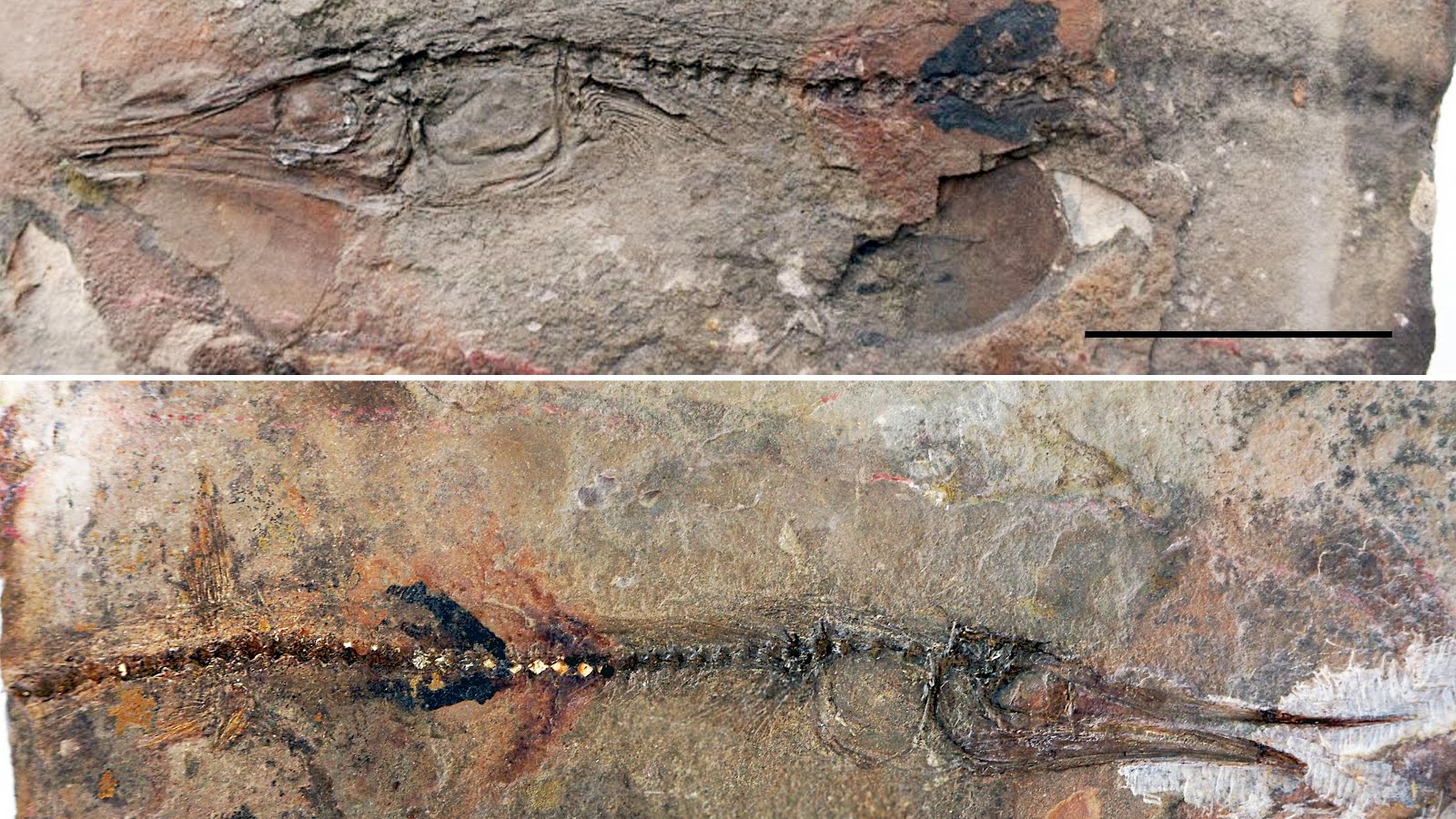
[PaleoIchthyology • 2018] Candelarhynchus padillai • A New Cretaceous Dercetid Fish (Neoteleostei: Aulopiformes) from the Turonian of Colombia


Candelarhynchus padillai 
Vernygora, Murray, Luque, Ruge & Fonseca, 2018


Abstract
The extinct neoteleost family Dercetidae includes elongate, long-jawed marine fishes that are known from the Late Cretaceous to Paleocene in deposits from the Levant, Europe, North Africa, England, Mexico and Brazil. The fossil record of the family in South America is very sparse and previously was restricted to outcrops in Brazil. Herein we describe a new dercetid fish from the Turonian of Colombia, †Candelarhynchus padillai gen. et sp. nov. A single articulated specimen is preserved in part and counterpart; the posterior part of the fish is missing. The specimen differs from other dercetid species by the following unique combination of morphological features: lack of scutes on the flanks of the body, presence of a single pair of transverse processes associated with the abdominal vertebrae, roofed posttemporal fossa, single row of small conical teeth on the dentary and maxilla, toothless premaxilla ornamented with pronounced longitudinal striations and protruding forward far beyond the anterior end of the dentary, and relatively large pectoral fins positioned high on the body. When included in a phylogenetic analysis of †Enchodontoidei, †C. padillai gen. et sp. nov. falls within a monophyletic family Dercetidae and is placed as sister taxon to the Late Cretaceous dercetid †Hastichthys from Israel, indicating faunal connections between the Eastern and Western Tethys. The new taxon provides novel insights into the distribution of dercetid fishes in the Western Tethys region during the early Late Cretaceous.

Keywords: Dercetidae, Enchodontoidei, Teleostei, San Rafael Formation, South America, palaeobiogeography


Oksana Vernygora, Alison M. Murray, Javier Luque, Mary Luz Parra Ruge & María Euridice Paramo Fonseca. 2018. A New Cretaceous Dercetid Fish (Neoteleostei: Aulopiformes) from the Turonian of Colombia. Journal of Systematic Palaeontology.  DOI: 10.1080/14772019.2017.1391884
ResearchGate.net/publication/321048665_A_new_Cretaceous_dercetid_fish_Neoteleostei_Aulopiformes_from_the_Turonian_of_Colombia
 twitter.com/JournalSystPal/status/930475709369344001

Ten-year-old boy helps paleontologists discover ancient fish species /phy.so/436700390 via @physorg_com
10-Year-Old Discovers Rare 'Lizard Fish' Fossil  on.natgeo.com/2EC3rXH via @NatGeo