Showing posts with label Aulopiformes. Show all posts

Monday, April 20, 2026

[Ichthyology • 2026] Redefinition of Stemonosudis intermedia (Ege, 1933) (Aulopiformes: Paralepididae) and Description of Stemonosudis dianea, A New Species from the western Atlantic Ocean


[A-B] Stemonosudis dianea  Ho & Bemis, 2026 
Stemonosudis intermedia  (Ege, 1933)
 
 
Abstract
We examined specimens of slender barracudina in the genus Stemonosudis collected from the western Atlantic Ocean. Investigation revealed that seven specimens represent the first adult records of Stemonosudis intermedia (Ege, 1933), previously known only from juveniles. We redescribed S. intermedia based on the holotype and newly recognized adult and juvenile specimens, and using this ontogenetic series, we document changes in coloration from light-brown juveniles to black adults. We also determined that some specimens from the western Atlantic Ocean previously identified as S. intermedia represent a new species, which we describe herein based on three adults and five juvenile specimens. The new species differs from congeners by having 43–44 anal-fin rays, 117–121 total vertebrae and a pale mouth, gill chamber and gill arches, among a combination of other characters. We also provide information on the lectotype of S. similis (Ege, 1957), which remains known only from the type series.

Keywords: biodiversity, biogeography, Ichthyology, nomenclature, taxonomy


Stemonosudis dianea sp. nov., fresh coloration.
(a) Holotype USNM 407498, 332 mm SL, photograph by Cristina Castillo.
(b) Paratype USNM 407509, 348 mm SL, photograph by Sandra Raredon.

 Stemonosudis dianea sp. nov.
English name: Diane's Slender Barracudina

Stemonosudis intermedia (Ege, 1933), fresh coloration of adults. Right side photographed, reflected to face left. USNM 407096, 277 mm SL. (a) Lateral view of body. (b) Close up of head.
Photographs by Ross Robertson.


Hsuan-Ching Ho and Katherine E. Bemis. 2026. Redefinition of Stemonosudis intermedia (Ege, 1933) and Description of A New Species from the western Atlantic Ocean (Aulopiformes: Paralepididae). Journal of Fish Biology. DOI: doi.org/10.1111/jfb.70342 [30 March 2026]
https://www.fisheries.noaa.gov/feature-story/ferocious-predator-and-important-prey-new-barracudina-species-named-smithsonian


Monday, June 30, 2025

[Ichthyology • 2025] Synodus autumnus • A New Species of Lizardfish (Aulopiformes: Synodontidae) from the Indo-Pacific Region


Synodus autumnus  
Furuhashi & Motomura, 2025


Abstract
The Indo-Pacific lizardfish Synodus autumnus sp. nov. (Aulopiformes, Synodontidae) is morphologically distinct from all other nominal species of Synodus, and is described as new. It is characterized by the following combination of characters: dorsal-fin rays 11–13; anal-fin rays 8–10; lateral-line scales 49–51; scale rows above lateral line 3.5; scale rows below lateral line 4.5; vertebrae 49–52; anterior gill rakers 22–29; peritoneal spots 0–5; anterior palatine teeth in a discrete group, longer than posterior palatine teeth; anterior nostril flap long, broad, leaf-like, extending above and behind posterior margin of posterior nostril when laid back; posterior process of pelvic girdle wide; posterior part of preopercle scaled; body with 5 reddish saddle-like blotches; and lateral surface below lateral line with a straight row of brown blotches when fresh. The new species is similar to Synodus binotatus Schultz, 1953 and Synodus rubromarmoratus Russell & Cressey, 1979, but these species differ in having 52–56 and 53–55 lateral-line scales, respectively. In addition, S. binotatus has blotches below the lateral line in a zigzag pattern, and S. rubromarmoratus has anterior and posterior palatine teeth similar in length, 14–25 teeth on the tongue, and 0–5 peritoneal spots. No color pattern differences were apparent between the new species and S. rubromarmoratus, making differentiation between the two species in underwater photographs impossible; consequently, underwater photographs and unsupported catalog records were excluded from the reassessment of each species’ distribution. Examination of specimens reported as S. rubromarmoratus revealed that the true S. rubromarmoratus has been collected only in Australian waters, whereas S. autumnus sp. nov. is widely distributed in the eastern Indian and Pacific oceans.

Key words: Description, morphology, Synodus binotatusSynodus lobeli, taxonomy, Teleostei

Fresh holotype of Synodus autumnus sp. nov. (KAUM–I. 180000, 54.2 mm SL, Segaura, Kushi, Bonotsu, Minami-satsuma, Satsuma Peninsula, southern Kyushu, Japan).
A. Lateral view; B. Dorsal view; C. Ventral view.

Fresh paratypes of Synodus autumnus sp. nov.
A. KAUM–I. 82280, 58.3 mm SL, Japan; B. KPM-NI 43326, 45.8 mm SL, Japan, photo by H. Senou.

 Synodus autumnus sp. nov.
 New English name: Autumn Lizardfish; 
new standard Japanese name: Iroha-eso

Diagnosis. A new species of Synodus with the following combination of characters: Dorsal-fin rays 11–13; anal-fin rays 8–10; lateral-line scales 49–51; scale rows above lateral line 3.5; scale rows below lateral line 4.5; vertebrae 49–52; anterior gill rakers 22–29; peritoneal spots 0–5; anterior palatine teeth in a discrete group, longer than posterior palatine teeth; ANF long and broad, leaf-like, extending above and behind posterior margin of posterior nostril when laid back; posterior process of pelvic girdle wide; posterior part of preopercle scaled; body with 5 reddish saddle-like blotches; lateral surface below lateral line with a straight row of brown blotches when fresh.

Underwater photograph of holotype of Synodus autumnus sp. nov. (KAUM–I. 180000, 54.2 mm SL) just before collection at a depth of 5 meters off Segaura, Satsuma Peninsula, southern Kyushu, Japan. Photo by M. C. Sato.

Etymology. Scientific and English names of the new species are derived from its body color, which is reminiscent of shrub and tree colors that change in autumn. “Iroha” means the leaves of plants that change color in autumn.


 Ryusei Furuhashi and Hiroyuki Motomura. 2025. Synodus autumnus, A New Species of Lizardfish (Aulopiformes, Synodontidae) from the Indo-Pacific Region, and A Reassessment of Distributional Records of Synodus rubromarmoratusZooKeys. 1243: 191-206. DOI: doi.org/10.3897/zookeys.1243.147259

Saturday, January 25, 2025

[Ichthyology • 2024] Aulopus chirichignoae • A New flagfin (Aulopiformes: Aulopidae) from the eastern Pacific Ocean


Aulopus chirichignoae
Béarez, Zavalaga, Miranda, Mennesson, Campos-Leónand & Jiménez-Prado, 2024 

 
Abstract
A new species of the Aulopidae is described from the waters of southern Ecuador and northern Peru. Aulopus chirichignoae sp. nov. was previously confused with Aulopus bajacali Parin & Kotlyar, 1984, but it differs from this species by a significantly marked elongation of the dorsal fin rays in males (absent in females), a smaller head, modal differences in dorsal and anal ray counts (15 vs 14 and 11 vs 12, respectively), a higher number of vertebrae (50–51 vs 47–49), and color differences, especially on the dorsal fin. DNA barcoding analysis supported the status of new species, evidencing a 4.2% and 2.8% divergence with Aulopus filamentosus (Bloch, 1792) and A. bajacali, respectively. A sequence of an Aulopus sp., collected in the Tropical Eastern Pacific, matches the new species with only a 0.4% divergence, indicating that Aulopus chirichignoae sp. nov. is distributed at least as far north as the Paramount Seamount at 3°20.35’N, ca. 400 km north of the Galápagos Islands.

Pisces, new species, fish, taxonomy, Peru, Ecuador, Tropical Eastern Pacific, DNA barcode


Aulopus chirichignoae sp. nov. 


Philippe BÉAREZ, Fabiola ZAVALAGA, Junior MIRANDA, Marion I. MENNESSON, Sarita CAMPOS-LEÓN and Pedro JIMÉNEZ-PRADO. 2024. Aulopus chirichignoae, A New flagfin from the eastern Pacific Ocean (Teleostei, Aulopiformes, Aulopidae). Zootaxa. 5458(1); 108-118. DOI: doi.org/10.11646/zootaxa.5458.1.6  

Friday, April 24, 2020

[Ichthyology • 2020] Lestidium longilucifer, L. australis & L. rofeni • Three New Species of the Barracudina Genus Lestidium (Aulopiformes: Paralepididae) from the Indo-West Pacific


[upper; A, B, C] Lestidium longilucifer &
[lower; A, C, D]  Lestidium rofeni 

 Ho, Graham & Russell, 2020

Abstract
Three new species of the genus Lestidium with complete lateral line are described from the Indo-west Pacific Ocean. Lestidium longilucifer sp. nov., from Western Australia and Taiwan, belongs to the Lestidium atlanticum species complex and can be separated from other congeners by having 41–43 prehaemal vertebrae, 85–88 total vertebrae and 126–146 total lateral-line scales; and body proportions. Lestidium australis sp. nov. from eastern Australia and Lestidium rofeni sp. nov. from Taiwan and the Philippines together with Lestidium prolixum form the L. prolixum species complex. These three species can be separated from each other by a combination of different fin positions, vertebral formula, number of lateral-line scales and pigmentation.

Keywords: Pisces, taxonomy, ichthyology, Aulopiformes, Australia, Taiwan


Family Paralepididae
Genus Lestidium Gilbert, 1905
Lestidium Gilbert, 1905:607 
(Type species: Lestidium nudum Gilbert, 1905)

Diagnosis. Body moderately long, not especially slender; luminescent duct in abdominal cavity unbranched, extending forward to below opercle or before anterior margin of eye; nostrils well before a vertical through posterior end of maxilla; lateral line complete or incomplete; no light organ at anterior margin of orbit; a small luminescent duct along lower margin of orbit or absent; ventral adipose fin well-developed along margin between anus and AFO; DFO at above same vertical at or behind VFO, if behind, always before midpoint of V‒A; and anal-fin rays 26‒34.


FIGURE 1. Lestidium longilucifer sp. nov. 
A. Holotype, AMS I.22821-063, 260 mm SL, preserved. B. Paratype, AMS I.31175- 002, 219 mm SL, fresh, arrow points the VFO. C. Paratype, NMMB-P26017, 205 mm SL, fresh.

Lestidium longilucifer sp. nov. 
Long light-organ barracudina

Diagnosis. Lestidium longilucifer sp. nov. is one of three species recognized in the Lestidium atlanticum species complex with a luminescent duct extending beyond the anterior margin of the eye. It can be distinguished from its two congeners L. atlanticum and L. orientale in having prehaema vertebrae 41–43; predorsal vertebrae 38–40; prepelvic vertebrae 37–39; preanal vertebrae 56–59; total vertebrae 85–88; total lateral-line scales 126–146; and relatively short jaws.

Etymology. The specific name longilucifer is derived from the combination of Latin longus and lucifer, referring to the long luminescent duct that extends well forward of the eye. 

Distribution. The species is currently known only from the type series collected from northwestern Australia and southern Taiwan.


Lestidium nigrirostrum sp. nov.
 Australian Robust Barracudina

Diagnosis. A species in the Lestidium prolixum species complex with a complete lateral-line, and a simple luminescent duct originating below opercle; it can be further distinguished from two other congeners in the species complex in having 31‒34 anal-fin rays; prehaemal vertebrae 35–38 and total vertebrae 87–90; lateral-line ended at caudal fin base, with 142–157 scales; DFO clearly behind tip of adpressed pelvic fin, V–D 5.6–8.5%SL and 28.6–38.6%V–A; 5‒7 lateral-line scales and 4‒7 vertebrae between VFO and DFO; dorsum dark brownish, melanophores extending downward to the lateral-line along its entire upper margin; anterior portions of snout and lower jaw blackish; abdomen with a very broad black sub-margin. 

Etymology. The specific name is derived from Latin niger and rostrum, in referring to the black snout. 

Distribution. The species is currently known from waters off eastern Australia, ranging from the Coral Sea off central Queensland to Bass Strait and into the Tasman Sea.


FIGURE 6. Lestidium rofeni sp. nov.
A. Holotype, NMMB-P28479, 245 mm SL, fresh. B. preserved holotype. C. Paratype, NMMB-P27926, 248 mm SL, fresh. D. Paratype, NMMB-P27927, 239 mm SL, fresh.

Lestidium rofeni sp. nov. 
Rofen’s Barracudina

Diagnosis. A species in the Lestidium prolixum species complex with a complete lateral line and a simple luminescent duct originating below opercle.; L. rofeni can be further distinguished from two other congeners in the species complex in having 30‒33 anal-fin rays; prehaemal vertebrae 36–38 and total vertebrae 87–90; lateral-line ending at caudal fin base, with 123–139 scales; DFO clearly behind tip of adpressed pelvic fin; V–D 6.7–8.7% SL and 30.2–36.7% V–A; 5‒7 lateral-line scales and 5‒8 vertebrae between VFO and DFO; scattered melanophores away from upper margin of lateral line before VFO, entirely translucent on remaining section of lateral line; abdominal ridge with none or scattered melanophores.

Etymology. The species is named after Robert R. Rofen (previously R. R. Harry), former research director of George Vanderbilt Foundation, Stanford University, who contributed a lot of knowledge on paralepidid fishes.

Distribution. The species is currently known only from Taiwan and the Philippines, but is likely widespread in northwestern Pacific Ocean. Off southern Taiwan, smaller specimens were collected by mid-water trawl (<100 m depth) and larger specimens usually caught by demersal trawl (> 300 m), which may suggest the adults shift to deeper waters with growth/age.


Hsuan-Ching Ho, Ken Graham and Barry Russell. 2020. Three New Species of the Barracudina Genus Lestidium (Aulopiformes: Paralepididae) from the Indo-West Pacific. Zootaxa. 4767(1); 71–88.  DOI: 10.11646/zootaxa.4767.1.3


Tuesday, February 6, 2018

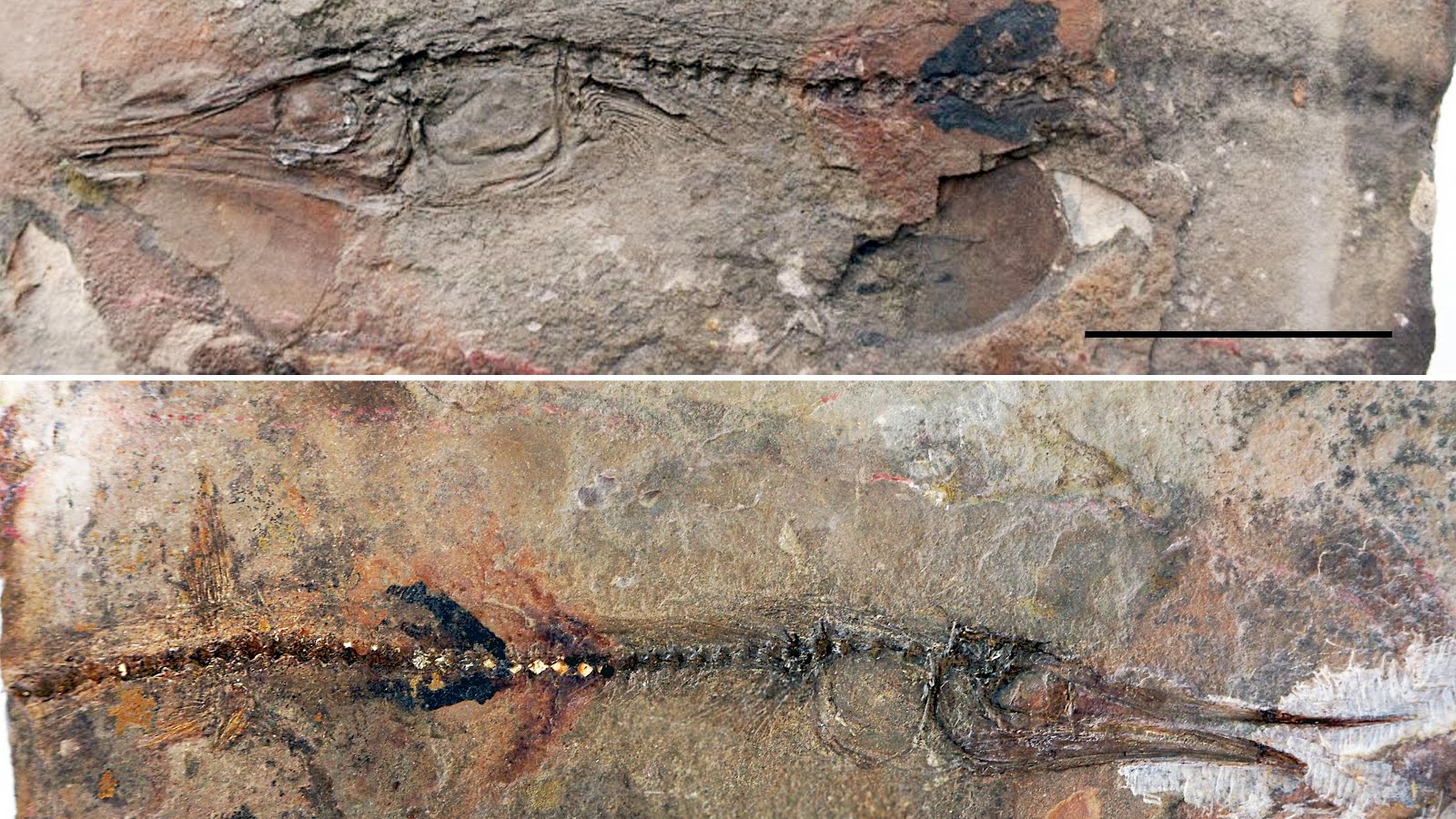
[PaleoIchthyology • 2018] Candelarhynchus padillai • A New Cretaceous Dercetid Fish (Neoteleostei: Aulopiformes) from the Turonian of Colombia


Candelarhynchus padillai 
Vernygora, Murray, Luque, Ruge & Fonseca, 2018


Abstract
The extinct neoteleost family Dercetidae includes elongate, long-jawed marine fishes that are known from the Late Cretaceous to Paleocene in deposits from the Levant, Europe, North Africa, England, Mexico and Brazil. The fossil record of the family in South America is very sparse and previously was restricted to outcrops in Brazil. Herein we describe a new dercetid fish from the Turonian of Colombia, †Candelarhynchus padillai gen. et sp. nov. A single articulated specimen is preserved in part and counterpart; the posterior part of the fish is missing. The specimen differs from other dercetid species by the following unique combination of morphological features: lack of scutes on the flanks of the body, presence of a single pair of transverse processes associated with the abdominal vertebrae, roofed posttemporal fossa, single row of small conical teeth on the dentary and maxilla, toothless premaxilla ornamented with pronounced longitudinal striations and protruding forward far beyond the anterior end of the dentary, and relatively large pectoral fins positioned high on the body. When included in a phylogenetic analysis of †Enchodontoidei, †C. padillai gen. et sp. nov. falls within a monophyletic family Dercetidae and is placed as sister taxon to the Late Cretaceous dercetid †Hastichthys from Israel, indicating faunal connections between the Eastern and Western Tethys. The new taxon provides novel insights into the distribution of dercetid fishes in the Western Tethys region during the early Late Cretaceous.

Keywords: Dercetidae, Enchodontoidei, Teleostei, San Rafael Formation, South America, palaeobiogeography


Oksana Vernygora, Alison M. Murray, Javier Luque, Mary Luz Parra Ruge & María Euridice Paramo Fonseca. 2018. A New Cretaceous Dercetid Fish (Neoteleostei: Aulopiformes) from the Turonian of Colombia. Journal of Systematic Palaeontology.  DOI: 10.1080/14772019.2017.1391884
ResearchGate.net/publication/321048665_A_new_Cretaceous_dercetid_fish_Neoteleostei_Aulopiformes_from_the_Turonian_of_Colombia
 twitter.com/JournalSystPal/status/930475709369344001

Ten-year-old boy helps paleontologists discover ancient fish species /phy.so/436700390 via @physorg_com
10-Year-Old Discovers Rare 'Lizard Fish' Fossil  on.natgeo.com/2EC3rXH via @NatGeo