Showing posts with label Paraguay. Show all posts

Monday, May 5, 2025

[Mammalogy • 2025] Myotis guaraniUnveiling the Shelf Life: A New cryptic Species of Myotis (Chiroptera: Vespertilionidae) from South America revealed by an integrative taxonomy approach


Myotis guarani   
Novaes, Cláudio, Bertocchi, Oliveira, Semedo, Saldanha, Wilson & Moratelli, 2025

Photo: Guilherme S. T. Garbino.
 
Abstract
Myotis is a diverse genus of vesper bats with a global distribution. Currently, over 35 Neotropical species are recognized, but molecular studies suggest the existence of a large number of distinct evolutionary lineages, revealing cryptic diversity. Thus, this genus poses a challenge for systematists since its high species diversity is not reflected in phenotypic differences. Using an integrative approach, we identified and described here a new species of Myotis. Ecological niche modeling indicates a strong association with the South American Chaco, Pantanal, and Cerrado ecoregions—spanning Argentina, Bolivia, Paraguay, and Brazil. Phylogenetic inference, genetic divergence, and morphological analyses support the recognition of the new species. Additionally, we present a set of external and skull diagnostic characters by comparing them with other Neotropical Myotis species. Specimens of this new species have been deposited in biological collections for more than 120 years. This discovery underscores the importance of systematic studies based on multiple lines of evidence and highlights the crucial role of natural history museums as biological repositories.

Argentina, Bolivia, Brazil, Chaco, ecological niche modeling, integrative taxonomy, Pantanal, Paraguay, phylogeny, species delimitation 

Myotis guarani collected in Mato Grosso, Brazil.
Photo: Guilherme S. T. Garbino.

 
Roberto Leonan M Novaes , Vinícius C Cláudio , Natasha A Bertocchi , Karoliny de Oliveira , Thiago B F Semedo , Juliane Saldanha , Don E Wilson , Ricardo Moratelli. 2025. Unveiling the Shelf Life: A New cryptic Species of Myotis (Chiroptera, Vespertilionidae) from South America revealed by an integrative taxonomy approach. Journal of Mammalogy. gyaf016. DOI: doi.org/10.1093/jmammal/gyaf016 [27 March 2025]

Resumo: Myotis é um gênero diverso de morcegos vespertilionídeos com distribuição global. Mais de 35 espécies neotropicais são atualmente reconhecidas, porém, estudos moleculares indicam um número maior de linhagens evolutivas distintas, indicando existência de diversidade críptica. Logo, esse gênero impõe um desafio para a taxonomia, pois a sua alta diversidade de espécies não é refletida fenotipicamente. Usando uma abordagem integrativa, nesse estudo identificamos e descrevemos uma nova espécie de Myotis. Modelagem de nicho ecológica indicou uma forte associação ao Chaco, Pantanal e Cerrado da Argentina, Bolívia, Brasil e Paraguai. Inferências filogenéticas, divergência genética e análises morfológicas corroboram o reconhecimento da nova espécie. Adicionalmente, apresentamos um conjunto de caracteres diagnósticos (externos e cranianos) identificados a partir de comparações com outras espécies neotropicais de Myotis. Os espécimes dessa nova espécie foram depositados em coleções biológicas por mais de 120 anos. Essa descoberta reforça a importância de estudos sistemáticos baseados em múltiplas linhas de evidências e o papel dos museus de história natural como repositórios biológicos.

Argentina, Bolívia, Brasil, Chaco, delimitação de espécies, filogenia, modelagem de nicho ecológico, Pantanal, Paraguai

Thursday, May 1, 2025

[Entomology • 2022] Description of A Neotropical Gall Inducer on Araceae: Arastichus gen. nov. (Hymenoptera: Eulophidae) and Two New Species


the lifecycle of Arastichus gallicola with its host plant, Thaumatophyllum solimoesense (Arecaceae).  

Arastichus Gates, Hanson, Jansen-González & Zhang, gen. nov.

in Zhang, Gates, Hanson et Jansen-González, 2022.  
Illustrated by Taina Litwak x.com/TainaLitwak1

Abstract
A new genus of a Neotropical gall inducing tetrastichine eulophid on Araceae is described and confirmed using Ultraconserved Elements (UCE) phylogenomic data. Arastichus Gates, Hanson, Jansen-González & Zhang, gen. nov., includes two new species and one species transferred from Aprostocetus Westwood: A. capipunctata Gates, Hanson, Jansen-González & Zhang, sp. nov., A. gallicola (Ferrière), comb. nov., and A. gibernau, Gates, Hanson, Jansen-González & Zhang, sp. nov.

Keywords: Chalcidoidea, Philodendron, Phytophagy, Tetrastichinae, Thaumatophyllum

Illustration of the lifecycle of Arastichus gallicola with its host plant, Thaumatophyllum solimoesense (Arecaceae).
Illustrated by Taina Litwak.

 Arastichus gallicola (Ferrière), comb. nov.

 Arastichus capipunctata Gates, Hanson, Jansen-González & Zhang, sp. nov.

 Arastichus gibernau Gates, Hanson, Jansen-González & Zhang, sp. nov.


 Y. Miles Zhang, Michael W. Gates, Paul E. Hanson and Sergio Jansen-González. 2022. Description of A Neotropical Gall Inducer on Araceae: Arastichus, gen. nov. (Hymenoptera, Eulophidae) and Two New Species. Journal of Hymenoptera Research. 92: 145-171. DOI: 10.3897/jhr.92.85967

Tuesday, August 15, 2023

[Herpetology • 2023] Adenomera guarani • Redescription of Adenomera diptyx (Boettger, 1885) (Anura: Leptodactylidae) and Description of A closely related New Species


Adenomera guarani
Zaracho, Lavilla, Carvalho, Motte & Basso, 2023


 ABSTRACT
Adenomera is a genus of Neotropical leaf-litter frogs widely distributed in South America and regarded taxonomic-wise challenging. One of these is the open-habitat Adenomera diptyx from Paraguay, which may correspond to a species complex. An integrative analysis of morphological variation, in combination with acoustic and molecular data of several populations from Argentina, Paraguay, and Brazil resulted in the recharacterization of nominal A. diptyx and the description of a new, closely related species. Adenomera diptyx is recognized by its advertisement call given at a high repetition rate (176–299 per minute), and the dorsal color pattern consisting of a light mid-dorsal line and a dark brown interorbital bar with irregular black edges. In comparison with A. diptyxthe new species, Adenomera guarani sp. nov., produces its advertisement call at a lower repetition rate (73–147 per minute), and the dorsal color pattern consists of a light, broad, mid-dorsal stripe and a mask-like patch in the interorbital region. The redefinition of A. diptyx will contribute to future studies focusing on the taxonomic status of other genetic lineages tentatively assigned to this species complex, which could represent additional unnamed species in the open-habitat Adenomera clade.

Keywords: Argentina, Chacoan region, cryptic species, integrative taxonomy, Paraguay
  
Adenomera guarani sp. nov., holotype, ♂ (UNNEC 9074), Corrientes, Argentina, SVL: 21.6 mm.
 Coloration in life.

Adenomera guarani sp. nov. 

Diagnosis: Adenomera guarani sp. nov. is recognized within Adenomera by the following combination of character states: (1) body robust, (2) medium size (adult male SVL = 20.1–26.4 mm); (3) light-colored, broad mid-dorsal stripe with diffuse borders, extending from above the vent to the scapular region; (4) a dark mask-like  pattern  formed  by  an  inverted  triangle  in  the  interorbital  region;  (5)  toe  tips  unexpanded  with tapered point; (6) antebrachial tubercle absent; (7) exotrophic larvae; (8) labial tooth row formula (LTRF):  2(2)/3(1);  (9)  single-note  advertisement  call;  (10)  call  notes  formed  by  incomplete  pulses;  (11) relatively high note repetition rate (73–147 per minute); and (12) low pulse number (4–9 per note).

Etymology: The specific name guarani, used as a noun in apposition and refers to the Guaraní, a native indigenous group that inhabited in the past a vast region in South America, including areas where the new species occurs. Currently, a few indigenous communities still live in wild areas. However, the Guaraní language (Avañe′ẽ), is usually spoken by people in Paraguay and other neighboring countries and also utilized to name innumerous geographical features (e.g., rivers, wetlands, hills), animals, plants, towns, and cities.

Adenomera guarani sp. nov. Dorsal color patterns.
A–C. UNNEC 9075 (♂), 9551 (paratype, ♀), 9003 (paratype, ♂) (Paso de la Patria, Corrientes).
D–O.  LGE 25740 (paratype, ♂), UNNEC 9704 (♂), 8366 and 8365 (paratypes, ♀), 8505 (♂), 8293 (♂), 8354 (♂), 11965 to 11969 (♂), (Corrientes city, Corrientes).


Víctor H. Zaracho, Esteban O. Lavilla, Thiago R. Carvalho, Martha Motte and Néstor G. Basso. 2023. Redescription of Adenomera diptyx (Boettger, 1885) (Anura, Leptodactylidae) and Description of A closely related New Species. European Journal of Taxonomy. 888(1), 1–45. DOI: 10.5852/ejt.2023.888.2205


Wednesday, March 9, 2022

[Herpetology • 2022] Phalotris shawnella • A New Species of Phalotris (Serpentes, Colubridae, Elapomorphini) from Paraguay


Phalotris shawnella  
Smith, Brouard & Cacciali,. 2022


Abstract
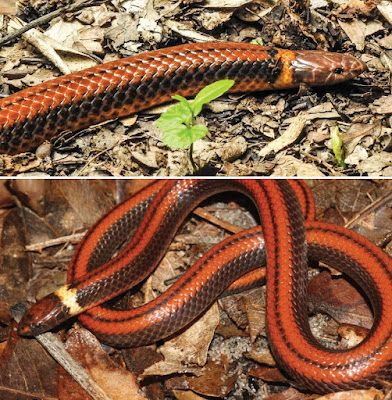
A new species of Phalotris from the nasutus group, Phalotris shawnella sp. nov., is described. It can be distinguished from the other members of the group by having the following combination of characters: 1) fifth supralabial in contact with parietal, 2) vertebral stripe present, 3) yellowish nuchal collar (2 or 3 dorsal scales long), 4) dull reddish color of head, 5) broad, solidly or near solidly dark, lateral bands, 6) red-orange ventral scales lightly and irregularly spotted with black mainly on the posterior half of the body and 7) a bilobed, extremely asymmetrical hemipenis, with enlarged, curved, lateral spines. The species is only known from a recent specimen collected in the Cerrado zone of northeastern Paraguay at Rancho Laguna Blanca, San Pedro department, and two photographic records of live specimens from this and an additional locality. Limited ecological data based on observations of a captive individual, and a wild record, are provided, and a conservation assessment is performed for this extremely limited range Paraguayan endemic snake.

Key Words: endemic, hemipenis, Phalotris nasutus, Phalotris shawnella sp. nov.


Coloration in life of Phalotris shawnella sp. nov.
A. Detail of the head of the holotype (CZPLT-H-594); B. Dorsolateral view of the holotype;
C. Juvenile topotype specimen, kept in captivity and which later escaped; D. Live specimen photographed at Colonia Volendam.
(A–C photographed by Jean-Paul Brouard, D photographed by Marko Fast).

Phalotris shawnella sp. nov.

Diagnosis: Phalotris shawnella sp. nov. is assigned to the nasutus group on account of the pointed snout with prominent rostral shield and the fusion of the second and third temporal plates (Fig. 3A). The new species can be distinguished from all other members of the nasutus group by the combination of the following characters: 1) fifth supralabial in contact with parietal, 2) vertebral stripe present, 3) yellowish nuchal collar (2 or 3 dorsal scales long), 4) dull reddish color of head in adults, 5) broad, solidly or near solidly dark lateral bands, 6) red-orange ventral scales lightly and irregularly spotted with black, mainly on the posterior half of the body, and 7) a bilobed, extremely asymmetrical hemipenis, with enlarged, curved, lateral spines. 

Etymology: The species name is a combination of the first names of two remarkable young people who were born around the same time as Fundación Para La Tierra, and who inspired its founders to work towards the study and conservation of the Paraguayan fauna, so that one day they might inherit a better world: Shawn Ariel Smith Fernández and Ella Bethany Atkinson. The epithet is not Latin, is invariable (word in apposition) and is made up of elements of both of their names.


Suggested hypothesis of phylogenetic relationships among species within the Phalotris nasutus group, based on a first proposal by Ferrarezzi (1993). This hypothesis shows a probable change in characters during evolution. *Note that the reduction of 1st temporals is visible in P. labiomaculatus where the 1st temporal is rather small or absent in some specimens (Hamdan et al. 2013). Base map: biomes of the world, according to Olson et al. (2001)


 Paul Smith, Jean-Paul Brouard and Pier Cacciali. 2022. A New Species of Phalotris (Serpentes, Colubridae, Elapomorphini) from Paraguay. Zoosystematics and Evolution. 98(1): 77-85. DOI: 10.3897/zse.98.61064


Resumen: Se presenta la descripción de una nueva especie de Phalotris del grupo nasutus, Phalotris shawnella sp. nov. puede ser diferenciada de otros miembros del grupo por tener la siguiente combinación de caracteres: 1) quinta supralabial en contacto con la parietal, 2) presencia de una estría vertebral oscura, 3) collar nucal amarillento (de 2 ó 3 escamas de ancho), 4) coloración rojiza en la cabeza, 5) ancha faja lateral muy oscura o bastante oscura, 6) escamas ventrales rojo-anaranjadas e irregularmente salpicadas de negro principalmente en la parte posterior del cuerpo, y 7) hemipenes bilobados, extremadamente asimétricos, con espinas laterales agrandadas y curvas. La especie se la conoce únicamente de un ejemplar colectado en el Cerrado en el noreste de Paraguay en el Rancho Laguna Blanca, departamento de San Pedro, además de dos registros fotográficos de ejemplares vivos, uno de esta misma localidad y otro de una localidad adicional. Se proveen datos ecológicos limitados, en base a observaciones de un ejemplar en cautiverio, y otro en la naturaleza, así como una propuesta de evaluación del estado de conservación para este endemismo de Paraguay de rango extremadamente limitado.

Palabras claves: endémico, hemipene, Phalotris nasutus, Phalotris shawnella sp. nov.

Monday, May 10, 2021

[Herpetology • 2021] Odontophrynus reigi • A New Burrowing Frog of the Odontophrynus americanus Species Group (Anura, Odontophrynidae) from Subtropical Regions of Argentina, Brazil, and Paraguay


Odontophrynus reigi 
Rosset, Fadel, Guimarães, Carvalho, Ceron, Pedrozo, Serejo, Souza, Baldo & Mângia, 2021


Abstract
A new species of frog of the genus Odontophrynus is described from grassland of the subtropical regions of Argentina, Brazil, and Paraguay based on morphological, osteological, bioacoustical, cytogenetic, and molecular evidence. The new species is characterized by having medium size; rostral and eye-nostril glandular warts well developed; several long glandular ridges, longitudinally oriented, on dorsum; several medium-sized, nearly rounded, dark-brown dorsal blotches; light mid-dorsal stripe continuous and well defined or restricted to the head and the urostyle regions; and mid-dorsal stripe, interorbital, and dorsolateral bands with a moderately whitish highlight, light brown, or reddish coloration. Additionally, the new species has a skull with nasals slightly separated both from each other and frontoparietals, and frontoparietal fontanelle not exposed. The advertisement call consists of a single multipulsed note with a dominant frequency of 820–1,121 Hz and a pulse rate of 99.3–140.7 pulses/s. The chromosomal complement is diploid with 2N = 2X = 22 chromosomes and nucleolar organizer regions on the interstitial regions of the short arm of chromosome pair 4. The phylogenetic analysis allowed us to recover the new species belonging to the O. americanus species group with genetic distances from its congeners ranging from 2.11 to 4.82% in a partial sequence of 16S ribosomal RNA gene. The new species is geographically isolated from the other currently known diploid species of the group, but in some localities is found in sympatry or syntopy with the tetraploid O. americanus.


Coloration patterns and variation in glandular warts from adult males of Odontophrynus reigi in life.
 (A) Holotype, LGE 19810, (B) paratype, LGE 19878, Candelaria, Misiones, (C) paratype, LGE 19848, Capital, Misiones, (D) paratype, ZUFMS-AMP 09655, Bonito, Mato Grosso do Sul, (E) nontype specimen, LGE 19875, Iguazu, Misiones, and (F) unvouchered specimen, Capital, Misiones.


Odontophrynus reigi, new species

Etymology.—The specific epithet honors Osvaldo Alfredo Reig (Buenos Aires, Argentina, 1929–1992) for his noteworthy contributions to the biological sciences of South America (Reig and Fontdevila, 1989; Boido and Tenner, 1991; Fontanals, 2012). He published more than 200 studies on morphology, anatomy, cytogenetics, paleontology, and systematics of amphibians, reptiles, and mammals. Regarding amphibians, Reig proposed the suborder Neobatrachia, and described two of the oldest known species of frogs, Notobatrachus degiustoi and Vieraella herbsti, from the Jurassic of Patagonia, Argentina. He worked at Universidad de Buenos Aires and Instituto Miguel Lillo (Argentina), Universidad Simón Bolívar (Venezuela), and Universidad Austral (Chile), among other academic centers, where he was strongly committed to scientific development, education of young researchers, and consolidation of working groups. Sadly, he had to go into exile from Argentina and Chile due to coups d’etat. In 1973, Reig received his Ph.D. in Zoology and ´ Paleontology from the University of London. In 1989, the Universidad Autonoma de Barcelona named him as Doctor ´ Honoris Causa.


Sergio D. Rosset, Renata Moleiro Fadel, Carla da Silva Guimarães, Priscila Santos Carvalho, Karoline Ceron, Mariana Pedrozo, Renata Serejo, Victória dos Santos Souza, Diego Baldo and Sarah Mângia. 2021. A New Burrowing Frog of the Odontophrynus americanus Species Group (Anura, Odontophrynidae) from Subtropical Regions of Argentina, Brazil, and Paraguay. Ichthyology & Herpetology. 109(1); 228-244. DOI 10.1643/h2020056


Friday, October 11, 2019

[Herpetology • 2019] Leptodactylus apepyta • A New Frog of the Leptodactylus fuscus Species Group (Anura: Leptodactylidae), endemic from the South American Gran Chaco


Leptodactylus apepyta 
Schneider, Cardozo, Brusquetti, Kolenc, Borteiro, Haddad, Basso & Baldo, 2019


Abstract 
A new species of Leptodactylus frog (Anura: Leptodactylidae) from the South American Gran Chaco, morphologically similar and previously confused with the widespread Leptodactylus mystacinus, is described through the use of multiple sources of evidence (molecular, external morphology, coloration, osteology, bioacoustics, and behavior). The phylogenetic analysis with partial sequences of mitochondrial rDNA genes (12S and 16S) recovered the new species within the L. fuscus group, being highly divergent (>3% genetic distance in 16S). The new species was recovered as sister taxa of L. mystacinus, from which it is distinguished by tympanum coloration, cephalic index, dorsum and legs coloration, and some osteological differences in nasals and prevomers. This new frog is characterized by a moderate body size (SVL 46.80–66.21 mm), distinctive color pattern (reddish dorsal surfaces of body with noticeable black stripes in the dorsolateral folds), a circular and dark tympanum with dark tympanic annuli, and behavior of males that call on top of fallen logs and tree branches close to the ground.


Figure 5: Leptodactylus apepyta sp. nov.
(A) Dorsolateral view of the holotype (LGE 8114) in life; (B) male vocalizing from a log (LGE 15240).
Photos: Diego Baldo.

Leptodactylus apepyta sp. nov.

Etymology: The specific epithet is an indeclinable noun, constructed from the words of the Guaraní language apé (= back of the neckdorsum) and pytã (= red), in reference to the intense brick red dorsum of adult and juvenile live specimens.

Definition and diagnosis: 
Leptodactylus apepyta sp. nov. is assigned to the L. fuscus group (sensu Heyer (1969b)) by its phylogenetic position, and by the presence of the following synaphomorphies (Ponssa, 2008): (1) tectum nasi and alary process of premaxilla at the same level; (2) frontoparietal with posterior margin convex, and (3) cultriform process of parasphenoid sited between neopalatines.

The new species is diagnosed within the L. fuscus group by the following combination of character states: (1) moderate size sensu Heyer & Thompson (2000) (SVL 46.80–61.41 mm in males; 51.67–66.21 mm in females); (2) robust body aspect in dorsal view; (3) head wider than long (CI 0.77–0.95); (4) small, circular, and dark tympanum, with dark tympanic annuli; (5) black broad stripe from tip of snout to the insertion of the forelimb; (6) a distinct light upper lip stripe; (7) one or two pairs of dorsolateral folds, with distinct uninterrupted dark stripes coincident with the upper pair, and interrupted dark stripes in the dorsolateral folds of the flanks; (8) reddish color on dorsal surfaces of body and limbs; (9) dorsum with small dark spots; (10) thigh, tibia, and tarsus with broad, diffuse, and dark bars; and (11) advertisement call composed by a single, short (30–68 ms), and non-pulsed note; call rate of 3.86–7.69 calls/s, without harmonic structure and with dominant frequency between 2,155 and 2,457 Hz; (12) males usually call on the top of fallen logs and low branches of trees.

Figure 6: Intraspecific variation observed in Leptodactylus apepyta sp. nov. (A) LGE 8085, (B) LGE 8087, (C) LGE15241, (D) LGE 8114, (E) LGE 8181, (F) LGE 9399, (G) LGE 15240, (H) LGE 15232, (I) IIBP-H 729, (J) LGE 8113, (K) LGE 8384, (L) LGE 8086.
See Appendix II for locality data. Photos: Diego Baldo.

Rosio G. Schneider, Dario E. Cardozo, Francisco Brusquetti, Francisco Kolenc, Claudio Borteiro, Célio Haddad, Nestor G. Basso and Diego Baldo. 2019. A New Frog of the Leptodactylus fuscus Species Group (Anura: Leptodactylidae), endemic from the South American Gran Chaco.  PeerJ. 7:e7869. DOI: 10.7717/peerj.7869


Sunday, February 17, 2019

[Ichthyology • 2019] Gymnogeophagus jaryi • A New Species of the Neotropical Cichlid Genus Gymnogeophagus (Teleostei: Cichliformes) from the Middle Paraná Basin, Misiones, Argentina


Gymnogeophagus jaryi
Alonso, Terán, Aguilera, Říčan, Casciotta, Serra, Almirón, Benítez, García & Mirande, 2019


Abstract
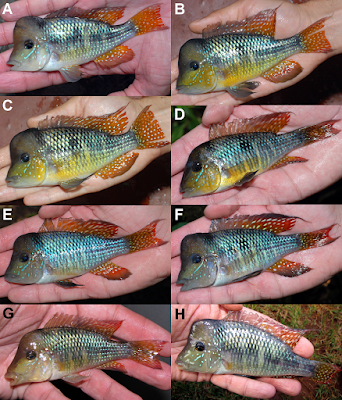
Gymnogeophagus jaryi, new species, is described from Southern tributaries of the Middle Paraná basin in Misiones. It can be distinguished from all other members of the genus, except from G. australis and G. caaguazuensis, by the presence of a hyaline to grey anterior portion of the dorsal fin. Gymnogeophagus jaryi differs from G. caaguazuensis by a longer caudal peduncle, caudal fin not lyrate, central portion of scales on dorsal portion of trunk light iridescent blue and by white spots in soft portion of dorsal fin in adult males, and from G. australis by the light iridescent blue coloration of central portion of scales on the dorsal portion of trunk and tail, and by the lack of scales on the soft portion of the dorsal fin. Additionally, it can be diagnosed by the following unique combination of characters: 10–11 dorsal-fin branched rays, 27–30 E1 scales, absence of lips thickening, and, in males, by the possession of a hump in adults, caudal fin not lyrate, presence of large white spots forming transversal stripes distally and in anterior area of the dorsal fin’s soft portion, central area of scales on the dorsal portion of the trunk light iridescent blue, lack of scales on the base of the dorsal fin’s soft portion, absence of a conspicuous and oblique dark band from the eye to the anterior border of the head, anterior portion of dorsal fin hyaline to grey, scales of the midlateral spot each bearing a semicircular light blue blotch, head hump starting at the horizontal through the eyes, concave anterior profile in lateral view, base of unpaired fins yellow, and whitish hyaline spots on caudal fin. The new species, based on mtDNA phylogeny, is the sister species of G. caaguazuensis from the Paraguay basin and is closely related to G. australis.

Fig 1. Live specimens of Gymnogeophagus jaryi sp. nov. in left lateral view from type locality. From Cuña Pirú stream, Paraná River basin, near Aristóbulo del Valle, Misiones Province, Northeastern Argentina.
 (A) Holotype, male CI-FML 7463, 113.1 mm SL, (B) Paratype, female CI-FML 7464, 73.3 mm SL.


Fig 3. Live specimens of Gymnogeophagus jaryi sp. nov. in left lateral view, paratype and non-type adult male specimens.
(A) MLP 11293, paratype, same locality as holotype (Cuña Pirú); (B,C) MLP 11295, paratype (Cuña Pirú); (D,E,F) MLP 11365, non-type (Ñacanguazú); (G) Paraguay, not preserved (Ype Curu); (H) Paraguay, not preserved (Manduviyú). It needs to be considered that these pictures of the alive specimens have been taken at night and out of water using the camera’s flash light iluminating from the latterals of the fish, which have slightly altered the colors seen. Also, holding them in hand while taking the pictures produced a slight translucent redish aspect to the fins.

Gymnogeophagus jaryi, new species

Diagnosis: The number of E1 scales, 27–30 (vs. 23–25), and the possession of a cephalic hump in adult males, distinguishes the new species from all species of the G. rhabdotus species group (G. rhabdotus, G. meridionalis, G. setequedas, G. che, G. terrapurpura and G. taroba). It is distinguished from all species of the G. gymnogenys group, except G. caaguazuensis and G. australis, by having the anterior portion of the dorsal fin grey to hyaline, in few specimens grey slightly reddish, with no markings (vs. red to yellow with hyaline spots or elongated transversal blotches). It differs from G. caaguazuensis by a longer caudal peduncle (18.5–22.0 vs. 13.9–17.4, % SL), caudal fin not lyrate (vs. lyrate), central portion of scales on dorsal portion of trunk light iridescent blue (vs. golden to greenish) and, in adult males, white spots in the soft portion of the dorsal fin, sometimes elongated in the distal portion forming lines (vs. with spaced small silvery to bright blue dots in G. caaguazuensis). It differs from G. australis by the light iridescent blue coloration of the central portion of scales on the dorsal portion of trunk and tail (vs. with golden central portion of scales) and by the lack of scales on dorsal-fin soft portion (vs. present). It is distinguished from G. balzanii by a lower body depth and less branched dorsal-fin rays (10–11 vs. 12–15). It can be further distinguished from G. peliochelynion, G. labiatus and G. pseudolabiatus by the absence of thickening in the lips (vs. present); from G. gymnogenys and G. mekinos by the absence of a conspicuous and oblique dark band from the anterior margin of eye to the anterior border of head; from G. gymnogenys also by presence of elongated spots distally in the soft portion of the dorsal fin (vs. large round spots); from G. mekinos also by dorsal fin coloration (vs. spiny portion without markings, soft portion with only few dots, distally immaculate). Additionally, the new species differs from G. constellatus by a semicircular light blue spot on each scale of the midlateral spot (vs. large white spot) and by spiny posterior portion with short narrow stripes or spots (vs. long wide stripes) and soft portion with dots and lines distally (vs. long wide stripes); from G. tiraparae by lacking the over-developed head hump (hump starting only at the horizontal plane through the eyes, forming a concave profile of the snout in lateral view vs. hump starting already from the upper lip, forming a convex profile at eyes height) and by a different coloration pattern of the dorsal fin (spiny posterior portion with short narrow stripes or spots and soft portion with dots and lines distally vs. dorsal fin hyaline with two horizontal series of moderately elongated light blue dots between dorsal-fin spines, and a series of light blue stripes between soft rays, and a red ground color between the two series of dots); from G. lipokarenos by presenting a red distal margin on posterior half of dorsal fin (vs. red distal margin along the entire fin), by lower peduncle length 18.5–22.0% of SL (vs. 14.1–17.9% of SL in G. lipokarenos); from G. missioneiro by having the base of unpaired fins yellow (vs. red) and by the presence of separated dots in both the spiny and soft portions of dorsal fin (vs. long wide stripes in G. missioneiro); and from G. lacustris by having lips, branchiostegal membrane and isthmus grey (vs. orange), unpaired fin-bases yellowish (vs. light olivaceous to reddish), by hyaline or white spots on caudal fin (vs. longitudinal stripes), and by absence of a dark vertical stripe through the eyes (vs. present in G. lacustris) (Figs 1–3).
....

Etymology: The specific epithet is derived from the Guaraní word “jarýi”, meaning grandmother. It is dedicated to the Non-Governmental Organization of “Abuelas de Plaza de Mayo”, created in 1977 whose objective is to locate and restore to their legitimate families all the children disappeared by the last Argentine dictatorship. A noun in apposition.

Fig 6. Habitats of Gymnogeophagus jaryi. at Middle Paraná River basin, Misiones, Argentina.
 (A, B, C) Type Locality at Cuñá Pirú stream;(B) rocks and driftwood in the margins; (C) rapids with marginal vegetation; D) Ñacanguazú stream. All photos show localities after rains in turbid conditions.

Distribution: Gymnogeophagus jaryi is known from several tributaries of the Southern Middle Paraná: the Cuña Pirú basin, the Garuhapé basin, and the Ñacanguazú basin in Argentina, Misiones and, based on photographs and mtDNA sequences it is also present in the Manduviyú, Pirapó and Ype Curú basins in Paraguay.


Fig 7. Phylogenetic relationships of Gymnogeophagus jaryi based on cytb marker. Analysis by parsimony under extended implied weighting. Numbers above branches denote GC values. Image of G. caaguazuensis and G. constellatus were taken and modified from their original description


Felipe Alonso, Guillermo E. Terán, Gastón Aguilera, Oldřich Říčan, Jorge Casciotta, Wilson Sebastián Serra, Adriana Almirón, Mauricio F. Benítez, Ignacio García and Juan Marcos Mirande. 2019. Description of A New Species of the Neotropical Cichlid Genus Gymnogeophagus Miranda Ribeiro, 1918 (Teleostei: Cichliformes) from the Middle Paraná Basin, Misiones, Argentina. PLoS ONE. 14(2): e0210166. DOI:  10.1371/journal.pone.0210166


Tuesday, July 3, 2018

[Botany • 2018] Manihot takape (Euphorbiaceae) • A New Tuberous Subshrub from the Paraguayan Chaco


Manihot takape  De Egea & Peña-Chocarro 
in De Egea Elsam, Carmen Peña-Chocarro, Mereles & Céspedes, 2018 

Abstract
Manihot takape De Egea & Peña-Chocarro, sp. nov. is described and illustrated as a new species from the Paraguayan Chaco. It was collected while carrying out fieldwork related to the study of the most important Wild Crop Relatives of the country’s flora. Morphological characteristics that differentiate this species from closely related taxa, as well as its habitat, geographical distribution and conservation status are provided.

Keywords: Paraguay, dry Chaco, Manihotae, endemism

Figure 1. Manihot takape.
A Habit (Krapovickas & Cristóbal 44224) B Pistillate flower with calyx open (Krapovickas & Cristóbal 44224) C Staminate flower (Aquino & Quarti 470) D Staminate flower with calyx split and open (Aquino & Quarti 470) E Dried capsule (J. De Egea et al. 1793) F Seed, ventral side (J. De Egea et al. 1793). Drawn by Laura Simón.

Manihot takape De Egea & Peña-Chocarro, sp. nov.
  
Diagnosis: Subshrubs 0.5−0.8(−1) m tall, all parts glabrous; stems branched from base, suberect to decumbent; petiole attachment basal to occasionally narrowly peltate (less than 0.2 cm from lamina base), lamina unlobed or shallowly to deeply 3(−5)−lobed, several intermediate states found in the same plant; inflorescence a cluster of 2−6 subspicate racemes 14−33 cm long; flowers creamy-white, occasionally reddish, glabrous; pistillate flowers geminate, long pedicellate, sepals distinct, disc plicate; staminate flowers numerous, subsessile, sepals connate 1/4 their length, disc lobulate; capsules light green, unwinged, smooth when fresh, rough when dried.
....

Figure 3. Manihot takape  (J. De Egea et al. 1793).
 A Habit B Uprooted plant C Roots in cross-section D–E Leaves - note the variability in leaf forms F Immature fruit.

Distribution and ecology: This species has been collected in dry areas of the Paraguayan Chaco, more specifically within the Departments of Boquerón and Presidente Hayes (Fig. 4). These areas are characterised by sandy and loose soils (regosols) resulting from silted palaeo-riverbeds of the Pilcomayo river delta. The species is frequent in open wooded savannahs, locally called espartillares, dominated by the grass Elionurus muticus (Spreng.) Kuntze (espartillo) and scattered with tree species such as Schinopsis cornuta Loes. (Anacardiaceae), Astronium fraxinifolium Schott (Anacardiaceae), Jacaranda mimosifolia D.Don (Bignoniaceae) and Tabebuia aurea Benth. & Hook.f. ex S.Moore (Bignoniaceae). Based on the data available so far, the restricted distribution of Manihot takape could represent an endemism of the dry Chaco. However, more surveys and collections will be needed to confirm the extension of the species distribution range.

Etymology: The specific epithet stems from the vernacular name takape (Guarani language). This word is used for a particular habitat characterised by a wooded savannah or open woodland (Bertoni 1940). The word is also applied to small woody plants (i.e. subshrubs). This is based on the word takã (twig or branch) and the suffix ‘pe’ (short or dwarf). Both meanings fit the newly described species of Manihot.


 Juana De Egea Elsam, María del Carmen Peña-Chocarro, Fátima Mereles and Gloria Céspedes. 2018. Manihot takape sp. nov. (Euphorbiaceae), A New Tuberous Subshrub from the Paraguayan Chaco. PhytoKeys. 103: 1-12. DOI:  10.3897/phytokeys.103.26307


Thursday, March 1, 2018

[Herpetology • 2018] Homonota marthae • A New Species of Homonota (Squamata, Phyllodactylidae) from the central region of northern Paraguay


Homonota marthae
Cacciali, Morando, Avila & Koehler, 2018

   DOI: 10.3897/zse.94.21754 

Abstract
Homonota is a gecko distributed in central and southern South America with 12 species allocated in three groups. In this work, we performed molecular and morphological analyses of samples of Homonota from the central region of northern Paraguay, comparing the data with those of related species of the group: H. horrida and H. septentrionalis. We found strong molecular evidence (based on 16S, Cyt-b, and PRLR gene sequences) to distinguish this lineage as a new species. Morphological statistical analysis showed that females of the three species are different in metric characters (SVL and TL as the most contributing variables), whereas males are less differentiated. No robust differences were found in meristic characters. The most remarkable trait for the diagnosis of the new species is the presence of well-developed keeled tubercles on the sides of the neck, and lack of a white band (crescent-shaped) in the occipital area, which is present in H. horrida and H. septentrionalis. Nevertheless, in our sample, we found three specimens (one juvenile and two young adults) that exhibit the white occipital band. Thus, this character seems only reliable in adults of the new species. The new species is parapatric to H. septentrionalis, both inhabiting the Dry Chaco of Paraguay.

Key Words: Dry Chaco, Gekkota, phylogeny, South America, taxonomy

Figure 4. Dorsal (A) and ventral (B) views of the holotype of Homonota marthae

Figure 6. Plate showing the difference in scalation among individuals of similar sizes and same gender, of Homonota marthae (A, C, E) and H. septentrionalis (B, D, F). Note the more developed keeled tubercles on the sides of the neck in the former species. 

Homonota marthae sp. n.

Diagnosis: A species of Homonota assigned to the horrida group given its relationship (based on molecular evidence) with H. horrida, and by the color pattern composed of a vertebral and five to seven transversal clear lines appearing as a banded Homonota smilar to H. horrida and H. septentrionalis. Homonota marthae has a robust body, and prominently keeled tubercles disposed in four to eight longitudinal rows on the dorsum.
....

Etymology: This species is named in honor of our indefatigable colleague Martha Motte, who is not only dedicated to safekeeping the herpetological collection of the “Museo Nacional de Historia Natural del Paraguay”, but also does a great job in providing selfless support to scientists that are striving to improve the knowledge of the Paraguayan herpetofauna.

Habitat and distribution: Homonota marthae is known from the central area of the Paraguayan Dry Chaco in the Department of Boquerón (Fig. 5). The environment is a xeric forest with abundance of thorny vegetation and almost absence of a herbaceous stratum. Nevertheless, a more detailed analysis of museum collections is advisable for a better knowledge of the distribution of this species.

This species is a dry forest inhabitant, but it is also frequently found in human dwellings. Talbot (1978) recorded the use of logs of Drunken tree (Chorisia speciosa: Malvaceae) as shelter by Homonota in the Dry Chaco, since the wood of this tree keeps high water levels. Additionally, Cacciali et al. (2007a) demonstrated the use of subterranean caves (usually armadillo burrows) by Homonota in several areas of the Paraguayan Chaco.


 Pier Cacciali, Mariana Morando, Luciano Javier Avila and Gunther Koehler. 2018. Description of A New Species of Homonota (Reptilia, Squamata, Phyllodactylidae) from the central region of northern Paraguay.  Zoosystematics and Evolution. 94(1): 147-161.  DOI: 10.3897/zse.94.21754

Saturday, April 22, 2017

[Herpetology • 2017] Revision of the Phylogeny and Chorology of the Tribe Iphisini with the Revalidation of Colobosaura kraepelini Werner, 1910 (Squamata, Gymnophthalmidae)


Colobosaura kraepelini Werner, 1910


Abstract
The family Gymnophthalmidae contains nearly 235 species with a distribution range from southern Mexico to central Argentina as well as in the Antilles. Among gymnophthalmids, the genus Colobosaura is a member of the tribe Iphisini, and currently is considered monotypic (C. modesta). The diversity of the tribe was studied recently, with the erection of several new genera. In this work genetic and morphological data of specimens of Colobosaura recently collected in Paraguay were analyzed. Genetic (16S barcode) data indicate that these samples are not conspecific with C. modesta and they are allocated to the nominal species C. kraepelini. Because the original primary type of the latter taxon is considered to be lost, a neotype (SMF 101370) is designated for this species and a redescription provided based on our material. Colobosaura kraepelini is distributed in the Humid Chaco, being the only member of the whole tribe in this ecoregion.

Keywords: 16S barcodes, Humid Chaco, neotype, Paraguay, taxonomy


Figure 3. Neotype of Colobosaura kraepelini (SMF 101370) from the vicinity of Altos, Cordillera Department, Paraguay. 


Colobosaura kraepelini Werner, 1910

Colobosaura kraepelini Werner, 1910: 32 (neotype, SMF 101370 [by present designation] (Fig. 3); type locality: 2.5 km E of Altos (25.2588°S, 57.2850°W, ca 280 masl), Cordillera Department, Paraguay by neotype selection). Original type locality: Puerto Max, San Pedro Department, Paraguay.

Diagnosis: Colobosaura kraepelini differs from the other species of the family Gymnophthalmidae except for C. modesta, by a combination of the following characters: limbs short but well developed; Finger I vestigial, not clawed; dorsal and lateral body scales keeled; four longitudinal series of ventral scales; prefrontal present; occipital present; two pairs of chin shields. Colobosaura kraepelini differs from C. modesta by having two mid-central rows of immaculate scales (vs. four immaculate ventral rows in C. modesta); flanks completely dark (Fig. 3) (vs. clear mottling in that area in C. modesta, Fig. 4); and gular shields profusely suffused with dark reaching the midline (vs. dark mottling restricted to the external edge of the shields, Fig. 5).


Distribution and habitat: The species is distributed in the Humid Chaco. The environment is basically a savanna composed of palms (Copernicia alba), native bunch grasses, and scattered islands of semideciduous temperate forest. The area is adapted to periodical floods from the Paraguay River. The locality of Puerto Max (former type locality of C. kraepelini) consists of a small village and cattle farm with intense anthropic pressure. The new specimens (SMF 101370 and MNHNP 11726) came from the vicinities of the capital city, about 280 km (airline) southwards from the original type locality, also in Humid Chaco.

Figure 4. Specimen of Colobosaura modesta showing lateral coloration patter.
Image by Paul Smith (Fauna Paraguay). 


    Pier Cacciali, Nicolás Martínez and Gunther Köhler. 2017. Revision of the Phylogeny and Chorology of the Tribe Iphisini with the Revalidation of Colobosaura kraepelini Werner, 1910 (Reptilia, Squamata, Gymnophthalmidae).
 ZooKeys. 669; 89-105.  DOI:  10.3897/zookeys.669.12245