Showing posts with label clade nov.. Show all posts

Friday, April 24, 2026

[Paleontology • 2026] The early Origin of Iguanodontia: new insights into the Macroevolution, Diversity and Biogeography of the clade


in  Rotatori, Chiarenza, Fanti et Moreno-Azanza. 2026.
Artwork by Davide Bonadonna
 
Abstract
Iguanodontia (Dinosauria, Ornithischia) is a speciose group of herbivorous dinosaurs that include the famous genus Iguanodon, one of foundational members of the clade Dinosauria. Despite their very long history of research, several aspects of their systematic relationships and their evolutionary history remain somewhat nebulous. There is currently a lack of consensus between different phylogenetic matrices due mainly to: (1) undersampling of postcranial characters; and (2) the absence of several key taxa. We assembled a data matrix from pre-existing datasets, integrating our observations on several overlooked species (mainly from Europe) and extensively sampling cranial and postcranial characters, thereby creating one of the most complete datasets for iguanodontian dinosaurs to date. We performed a series of phylogenetic analyses, employing maximum parsimony and Bayesian inference, and an historical biogeographic analysis. Overall congruent topologies between the two methods recovered, for the first time, a new clade of high-sailed styracosternans here named Ouranosauria. We ran different Bayesian inference analyses, employing morphoclock and fossilized birth–death models. Some of the tip-dated analyses, indicated an Early to Middle Jurassic origin of Iguanodontia during a palaeoclimatically (hyperthermal) and palaeogeographically (continental fragmentation) dynamic context. According to this scenario, the Iguanodontian major radiation could be tracked back to the Pliensbachian–Toarcian, pre-dating by 16 million years the first ichnological evidence attributed to this clade. Furthermore, the diversification of all the major clades occurred by the Late Jurassic, then experienced local extinction events in different areas during the Early Cretaceous. Prior to the Jurassic–Cretaceous transition, iguanodontians spread globally.

Keywords: Dinosauria, phylogenetics, Jurassic, Cretaceous, systematics, Iguanodontia


Filippo Maria Rotatori, Alfio Alessandro Chiarenza, Federico Fanti and Miguel Moreno-Azanza. 2026. The early Origin of Iguanodontia: new insights into the Macroevolution, Diversity and Biogeography of the clade. Palaeontology. DOI: doi.org/10.1111/pala.70057 [22 April 2026] 


Friday, April 17, 2026

[Paleontology • 2026] Ptychotherates bucculentus • A New Taxon of saurischian Dinosaur (Saurischia: Morphoraptor) from the Coelophysis Quarry of New Mexico, USA (Triassic: latest Norian or Rhaetian) highlights herrerasaurian diversity in the latest Triassic


Ptychotherates bucculentus 
Srivastava & Nesbitt, 2026


Abstract
The most complete record of the earliest dinosaur lineages is from the Carnian from the higher latitudes of Pangea (e.g. present-day Brazil, Argentina), but dinosaurian assemblages from the upper stages of the Upper Triassic are better known from the low latitudes of Pangea (present day southwestern USA). How early carnivorous dinosaurian diversity matches or mismatches at various latitudes remains to be documented because of uncertainty around the spatio-temporal ranges and phylogenetic relationships of early dinosaur lineages. We examine low-latitude diversity patterns through the lens of the saurischian dinosaur Tawa hallae and close relatives, including a new species, Ptychotherates bucculentus gen. et sp. nov. The new taxon is known from an incomplete but well-preserved skull (CM 31368) from the uppermost Triassic Coelophysis Quarry in northern New Mexico. The new taxon clearly shares synapomorphies with Tawa hallae, such as distinctive fossae on the quadrate and otoccipital and a dorsoventrally tall and laterally flat jugal. However, the new taxon is distinguishable from all other coeval ornithodirans by a combination of many character states, including the proportionally dorsoventrally deepest jugal known for any Triassic-aged dinosaur. Higher-palaeolatitude ecosystems across Pangea show a complete turnover of carnivorous dinosaurs by neotheropods in the Norian and Rhaetian, but the ‘ChindesaurusTawa’ clade (Morphoraptora clade nov.) coexisted with neotheropods possibly until the End-Triassic Extinction Event. This suggests a low-latitude ‘museum’ where early-diverging lineages survived much longer than at higher latitudes, and that the End-Triassic Extinction Event affected dinosaur diversity more than previously hypothesized.

Keywords: biogeography, Saurischia, extinction, skull, phylogenetics, clade longevity

SYSTEMATIC PALAEONTOLOGY
DINOSAURIA Owen 1842 sensu Langer et al. 2020
SAURISCHIA Seeley 1888 sensu Gauthier et al. 2020

Clade MORPHORAPTORA nov.

Derivation of name: Morphe from the Greek for ‘form, shape’ and raptor from the Latin for ‘robber’, describing the morphological convergence between members of this clade and Theropoda, as if this clade is ‘stealing’ morphology. ‘Morphoraptor’ loosely translates to ‘bodysnatcher’, in honour of the 2007 song by Radiohead in the album In Rainbows, which author S. Srivastava listened to hundreds of times while preparing this manuscript.

The posterior portion of the skull Ptychotherates bucculentus (CM 31368) in posterior view.
Abbreviations: ar, articular bo, basioccipital; bt, basituber; f, frontal; fm, foramen magnum; fno, fenestra ovalis; pa, parietal; par, paroccipital process of the otoccipital; mf, metotic foramen; n, nasal; pbs, parabasisphenoid; pf, prefrontal; po, postorbital; ptf, posttemporal fenestra; qj, quadratojugal; qu, quadrate; rap, retroarticular process; so, supraoccipital; sq, squamosal; st, stapes. Crossed circle indicates posterior direction out of page. Scale bar represents 1 cm.

Digital reconstruction of the skull of Ptychotherates bucculentus (CM 31368) in left lateral view. Dashed lines indicate extrapolation and the coloured infill indicates known bone presence.
Abbreviations: eaf, external antorbital fenestra; en, external naris; emf, external mandibular fenestra; itf, infratemporal fenestra; orb, orbit. Arrow indicates anterior direction. Scale bar represents 2 cm.
 
Genus Ptychotherates nov.
 
Derivation of name: Ptycho from the Greek for ‘fold’ because of the numerous and challenging axes of reorientation on elements of the holotype. Therates from the Greek for ‘hunter’, for the carnivorous habits inferred from its teeth.

 Ptychotherates bucculentus sp. nov.  

Derivation of name: The species epithet is Latin for ‘with full cheeks’ in reference to the exceptionally tall jugal.
 
Diagnosis: Ptychotherates bucculentus bears the following combination of character states (local autapomorphies indicated with *): supratemporal fossa present on posterior portion of the frontal and dorsal surface of the parietal; tapering dorsal process of the maxilla; maxilla lacking antorbital fossa on its posterior portion ventral to the antorbital fenestra; prefrontal symmetrical in lateral view*; jugal body proportionally dorsoventrally deep* (i.e. more than three times as deep as the jugal posterior process, deeper than the length of postorbital ventral process, and more than half the height of the quadrate main body; Table 1); laterally extensive ventral process (= crista interfenestralis) of the otoccipital; ventral process of squamosal anteroposteriorly wide with a lateral fossa on the posterior part; retroarticular process upturned immediately posterior to glenoid; anterolateral portion of postorbital dorsally overhanging orbit; postorbital dorsolaterally overlapping the squamosal; posttemporal fenestra as wide as foramen magnum; nasal and frontals flat dorsally; serrated and recurved teeth with fine serrations (4–5 per 1 mm in the maxilla, 5–6 per 1 mm in the dentary) with pointed apices of the serrations.

Artistic rendition of Ptychotherates bucculentus.
Artwork by Megan Sodano 


Simba Srivastava and Sterling J. Nesbitt. 2026. A New Taxon of saurischian Dinosaur from the Coelophysis Quarry of New Mexico, USA (Triassic: latest Norian or Rhaetian) highlights herrerasaurian diversity in the latest Triassic. Papers in Palaeontology. 12(2); e70069. DOI: doi.org/10.1002/spp2.70069 [14 April 2026]


Monday, January 19, 2026

[PaleoIchthyology • 2025] Apolithabatis seiomaInsights into Stem Batomorphii: A New holomorphic Ray (Chondrichthyes: Elasmobranchii) from the upper Jurassic of Germany


Apolithabatis seioma   
Türtscher, Jambura, Spindler & Kriwet, 2025 
     

Abstract
The Late Jurassic fossil deposits of southern Germany, collectively known as the ’Solnhofen Archipelago’, are one of the world’s most important sources of Mesozoic vertebrates. Complete skeletons of cartilaginous fishes (Chondrichthyes), whose skeletal remains are rare in the fossil record and therefore all the more valuable, are represented, among others, by exceptionally well-preserved rays (superorder Batomorphii). Despite their potential for research in several areas, including taxonomy, morphology, ecology, and phylogeny, the number of studies on these chondrichthyans is still very limited. Here, we identify a previously unknown ray, †Apolithabatis seioma gen. et sp. nov., which represents the first record of a ray species from the upper Kimmeridgian of Painten, Germany, and thus the oldest Late Jurassic ray taxon from Germany based on skeletal remains. This new batomorph is characterised by a unique body shape and a combination of skeletal features that distinguish it readily from all other known Late Jurassic rays. Two different morphometric approaches confirm differences in body shape and proportions to all known Late Jurassic conspecifics. We thus extend the recent taxonomic revision of these rays and include all described holomorphic specimens in a phylogenetic framework using strict cladistic principles. The phylogenetic analysis reveals all Late Jurassic batomorphs to represent a monophyletic group, for which we introduce the new order Apolithabatiformes, which is sister to all other batomorphs representing a stem group. While the phylogenetic relationships within Apolithabatiformes ord. nov. remain largely unresolved, †Apolithabatis gen. nov. is placed as the sister to †Aellopobatis. This highlights that, despite considerable progress in our understanding of the diversity and phylogeny of early rays, difficulties remain in establishing robust relationships within batomorphs. We therefore emphasise the importance of comprehensive studies of completely preserved fossil cartilaginous fishes to obtain a better understanding of chondrichthyan evolution and their systematics in deep time. 

Systematic palaeontology
Class CHONDRICHTHYES Huxley, 1880 
Subclass ELASMOBRANCHII Bonaparte, 1838  

Cohort EUSELACHII Hay, 1902 
Subcohort NEOSELACHII Compagno, 1977 

Superorder BATOMORPHII Cappetta, 1980 

†APOLITHABATIFORMES ord. nov.

We consequently propose a new order, †Apolithabatiformes ord. nov., which includes the single family, †Spathobatidae with the genera †Aellopobatis, †Apolithabatis gen. nov., †Asterodermus, †Belemnobatis, †Kimmerobatis, and †Spathobatis. This order represents the most plesiomorphic clade within Batomorphii being placed on the stem of the total group Batomorphii. It is possible that the hitherto undescribed Late Jurassic batomorph from Argentina, previously considered merely as Batomorphii indet. by Cione (1999) [14], also belongs to this order, which, however, can only be clarified by a detailed examination of the specimen.

Type species. Apolithabatis seioma gen. et sp. nov.

Included taxa: Aellopobatis bavarica, †Apolithabatis seioma gen. et sp. nov., †Asterodermus platypterus, †Belemnobatis spp., †Kimmerobatis etchesi, †Spathobatis spp.

Etymology: The name ’Apolithabatiformes’ is composed of two Greek words, i.e., ’aπολίθωμα’ (apolíthoma) meaning ’fossil’ and ’βατίς’ (batís) meaning ’ray’ or ’skate’.

Diagnostic characters. Elongated mesopterygium contiguous with propterygium and similar in shape; lateral articulation of antorbital cartilages (if present) to nasal capsules; two true fin spines anterior to dorsal fins (absent in some taxa);

Family †SPATHOBATIDAE Dames, 1888 

†APOLITHABATIS gen. nov.

Type species. Apolithabatis seioma gen. et sp. nov.

 Etymology: Identical to that of the order †Apolithabatiformes (see above): the genus name ’Apolithabatis’ is composed of two Greek words, i.e., ’Απολίθωμα’ (apolíthoma) meaning ’fossil’, and ’βατίς’ (batís) meaning ’ray’ or ’skate’.

Stratigraphic and geographic distribution: Only known from the upper Kimmeridgian (Upper Jurassic) of the ’Solnhofen Archipelago’ (Painten), Bavaria, Germany.

Diagnosis: A guitarfish-like batomorph unique in having the following combination of characters: heart-shaped disc that is wider than long; pointed snout; antorbital cartilages present but reaching less than halfway between the nasal capsules and the propterygium; vertebral centra extending less than half of the synarcual length; large mesopterygium tangent to the propterygium; 40 pectoral radials (9 propterygial, 11 mesopterygial, 20 metapterygial); no pectoral radials articulate directly with the scapulocoracoid between the meso- and metapterygium; pectoral radials segmented in up to five segments; at least 16 pairs of ribs; 19 basipterygial radials (including one compound radial); puboischiadic bar curved anteriorly; no postpelvic processes present; broad and triangular lateral prepelvic processes; well-developed and plate-like haemal and supraneural spines; conspicuous bulge-like structure formed by the supraneural spines in front of each dorsal fin; no fin spines present.

APOLITHABATIS SEIOMA gen. et sp. nov.


Environmental reconstruction showing †Apolithabatis seioma gen. et sp. nov. in association with a juvenile pleurosaurid.


     Julia Türtscher, Patrick L. Jambura, Frederik Spindler and Jürgen Kriwet. 2025. Insights into Stem Batomorphii: A New holomorphic Ray (Chondrichthyes, Elasmobranchii) from the upper Jurassic of Germany. PLoS ONE. 20(1): e0310174. DOI: doi.org/10.1371/journal.pone.0310174
 

Sunday, October 12, 2025

[Paleontology • 2025] Xiphodracon goldencapensis • A New long and narrow-snouted ichthyosaur (Ichthyosauria: Leptonectidae) illuminates a complex faunal turnover during an undersampled Early Jurassic (Pliensbachian) interval


Xiphodracon goldencapensis 
 Lomax, Massare & Maxwell, 2025 
 
Artwork by Bob Nicholls

Abstract
Ichthyosaurian faunas before and after the Pliensbachian stage of the Early Jurassic are known from numerous, often complete fossils. The two faunas are very different taxonomically, with only one of the pre-Pliensbachian genera, but none of the species, persisting into the post-Pliensbachian (Toarcian). Pliensbachian ichthyosaurs are rare, yet this interval represents a critical and poorly understood time in ichthyosaurian evolution just c. 10 myr after the end-Triassic mass extinction. Thus, a new ichthyosaur from the mid-Pliensbachian of the Dorset coast of the UK, the most complete ichthyosaur known from that stage, is significant. Xiphodracon goldencapensis gen. et sp. nov. is characterized by a distinct combination of characters and several autapomorphies, including: a unique lacrimal with prong-like projections on its anterior edge, a prefrontal with projections that interdigitate with the nasal and lacrimal, a wedge-shaped external naris with an anterodorsal constriction that forms a distinct foramen (shaped by the nasal, lacrimal and prefrontal), and a maxilla that forms almost the entire border of the external naris. Phylogenetic analyses indicate that X. goldencapensis is more closely related to the late Pliensbachian to Toarcian genus Hauffiopteryx than to earlier genera that continued into the Pliensbachian (e.g. Leptonectes, Ichthyosaurus), and forms a distinct clade (Hauffiopterygia nov.) within a monophyletic Leptonectidae. This indicates that a substantial faunal turnover in diversity occurred towards the end of the early Pliensbachian, leading to a major shift in composition towards a more typical Toarcian ichthyosaur fauna.

Keywords: Ichthyosauria, Pliensbachian, Leptonectidae, Lower Jurassic, faunal turnover, Xiphodracon

The holotype and only known specimen of the hauffiopterygian leptonectid, Xiphodracon goldencapensis (ROM VP52596) from Golden Cap, between Charmouth and Seatown, Dorset, UK.
 The skeleton is exposed in ventrolateral view. The skull has been fully prepared free of matrix whereas most of the skeleton is still in matrix. The left (upper) forefin has been prepared so that it is three-dimensionally preserved and projects upwards. Scale bar represents 20 cm.
Skull of  Xiphodracon goldencapensis (ROM VP52596).
Photograph (A) and interpretative illustration (B) in left lateral view. C, photograph of the right lateral view. Note the unusual, multi-prong projections on the anterodorsal margin of the lacrimal and similar but smaller interdigitating structures on the prefrontal (see also Fig. 4).
Abbreviations: an, angular; den, dentary; ju, jugal; la, lacrimal; mx, maxilla; n, nasal; p, parietal; pmx, premaxilla; po, postorbital; prf, prefrontal; ptf, postfrontal; qj, quadratojugal; sp, splenial; st, supratemporal. Scale bar represents 10 cm.

SYSTEMATIC PALAEONTOLOGY

ICHTHYOSAURIA de Blainville 1835
PARVIPELVIA Motani 1999a
LEPTONECTIDAE Maisch 1998

HAUFFIOPTERYGIA nov. 

Diagnosis: Mid-sized ichthyosaurs <3.5 m in length, characterized by a lack of contact between the nasal and postfrontal; participation of the prefrontal in the external narial opening; forefin with four digits; proximal limb elements polygonal; bicapitate dorsal ribs; lateral gastral elements extending at least two-thirds of the length of the dorsal region; and a rod-like ischium and pubis.

Genus Xiphodracon nov.
 
Derivation of name: Sword-like dragon. Xipho- derived from ancient Greek xiphos meaning ‘sword or sword shaped’ in reference to the long, narrow and sword-like snout, and -dracon, ancient Greek (drakōn) and Latin (dracō) for ‘dragon’, in reference to ichthyosaurs having been informally and colloquially referred to as ‘sea dragons’ for over 200 years.
 
Xiphodracon goldencapensis sp. nov.
 
Derivation of name: Sword-like dragon from Golden Cap. The species epithet goldencapensis refers to the location of discovery at Golden Cap, Dorset, England, UK.

Holotype: ROM VP52596, an almost complete skeleton comprising a three-dimensionally preserved skull, mandible and teeth, pectoral girdle, both forefins, pelvic girdle, parts of both hindfins, and most of the axial skeleton. A cast of ROM VP52596 is in the collections of the State Museum of Natural History Stuttgart, catalogued as SMNS 97790.

Type locality & horizon: East of Golden Cap, between Charmouth and Seatown, Dorset, UK, from the Early Jurassic, early Pliensbachian. Lias Group, Lower Lias Subgroup, Charmouth Mudstone Formation, Green Ammonite Member, Bed 122c (c. 1.5–2 m above Bed 121); Davoei Zone, Maculatum Subzone.

Diagnosis: A mid-sized, c. 3 m hauffiopterygian leptonectid with the following autapomorphies: anterodorsal border of triradiate lacrimal rugosely striated with prominent prong-like projections on its anterior edge; prefrontal anterior process with projecting structures that interdigitate with similar structures on nasal and dorsal lacrimal; posterodorsal foramen connected to the external naris; posterodorsal foramen formed by the nasal, prefrontal and lacrimal; small flange on the nasal and lacrimal forming a constriction that connects the foramen to the narial opening; anterodorsal part of the maxilla ‘split’ by the subnarial process of the premaxilla, creating dorsal and ventral processes; maxilla comprising almost entire ventral margin of naris, which is unique among Early Jurassic ichthyosaurs.


Artwork by Bob Nicholls


Dean R. Lomax, Judy A. Massare and Erin E. Maxwell. 2025. A New long and narrow-snouted ichthyosaur illuminates a complex faunal turnover during an undersampled Early Jurassic (Pliensbachian) interval. Papers in Palaeontology. DOI: doi.org/10.1002/spp2.70038 [09 October 2025] 

Wednesday, July 23, 2025

[Entomology • 2025] A Revised Classification of the Assassin Bugs (Hemiptera: Heteroptera: Reduviidae) based on combined analysis of phylogenomic and morphological data


Assassin bug diversity and examples of unique morphological and behavioural adaptations found across the family.

in Masonick, Knyshov, Gordon, Forero, Hwang, ... et Weirauch, 2025. 
  
Abstract
Assassin bugs (Hemiptera: Reduviidae Latreille) comprise not only one of the largest radiations of predatory animals (22 subfamilies; >6,800 spp.) but also include the medically important kissing bugs (Triatominae Jeannel). Reduviidae are morphologically diverse, engage in an astounding array of predatory strategies and have evolved some of the most unique anti-predator and stealth techniques in the animal kingdom. While significant progress has been made to reveal the evolutionary history of assassin bugs and revise their taxonomy, the non-monophyly of the second largest assassin bug subfamily, Reduviinae Latreille, remains to be addressed. Leveraging phylogenomic data (2,291 loci) and 112 morphological characters, we performed the first data- and taxon-rich (195 reduvioid taxa) combined phylogenetic analysis across Reduvioidea and reconstructed morphological diagnostic features for major lineages. We corroborated the rampant polyphyly of Reduviinae that demands substantial revisions to the subfamilial and tribal classification of assassin bugs. Our new classification for Reduviidae reduces the number of subfamilies to 19 and recognizes 40 tribes. We describe three new subfamilies to accommodate distantly related taxa previously classified as Reduviinae (Heteropinae subfam. nov.Nanokeralinae subfam. nov., and Pasirinae subfam. nov.). Triatominae sensu nov. are expanded to include closely related predatory reduviine genera. Cetherinae Jeannel, Chryxinae Champion, Pseudocetherinae Villiers, Salyavatinae Amyot & Serville and Sphaeridopinae Amyot & Serville are treated as junior synonyms of Reduviinae sensu nov. Epiroderinae Distant are synonymized with Phimophorinae Handlirsch sensu nov. and Bactrodini Stål stat. nov. are reclassified as a tribe of Harpactorinae Amyot & Serville. Psophidinae Distant is treated as a valid subfamily. This new classification represents a robust framework for future taxonomic and evolutionary research on assassin bugs.

Keywords: ancestral state reconstruction, Cimicomorpha, phylogenetic systematics, revised classification, taxonomy, true bugs
 
Assassin bug diversity and examples of unique morphological and behavioural adaptations found across the family.
(a) Holoptilinae: Ptilocnemus femoralis Horváth (© Martin Lagerwey, Australia); (b) Phymatinae: Phymata americana Melin male mate guarding female (© Marie-Lise Beaudin, Canada); (c) Peiratinae: Rasahus arcuiger (Stål) (© sandralamberts, Peru);
(d) Psophidinae stat. nov.Korinchocoris insolitus Miller (© Joshua Wong, Singapore); (e) Ectrichodiinae: nr. Ectrichodia Lepeletier and Serville communal feeding of adults and nymphs on a millipede (© Nick Ramsey, Equatorial Guinea); (f) Emesinae: Ghilianella sp. Spinola (© Thomas Shahan, Belize);
(g) Stenopodainae (© Damien Brouste, New Caledonia); (h) Triatominae sensu nov.Zelurini trib. nov.Zelurus festivus (Stål) (© sandralamberts, Peru); (i) Triatominae sensu nov.: Rhodniini: Rhodnius sp. Stål nymph engorged on blood-meal (© César Favacho);
(j) Phimophorinae sensu nov.Physoderes sp. Westwood (© Nick Porch, Republic of Mauritius); (k) Harpactorinae sensu nov.: Ectinoderini: Amulius sp. Stål forelegs coated with resin (© Julius Simonelli, Indonesia); (l) Harpactorinae sensu nov.: Bactrodini stat. nov.Bactrodes sp. Stål (© Stephen_WV, Brazil),
 (m) Reduviinae sensu nov.: Reduviini stat. nov.sensu nov.Reduvius sonoraensis Usinger (© James Bailey, USA); (n) Reduviinae sensu nov.: Acanthaspidini stat. nov.sensu nov.Inara flavopicta Stål nymph with corpse backpack (© budak, Singapore); (o) Reduviinae sensu nov.: Salyavatini stat. nov.Salyavata macmahanae van Doesburg and Brailovsky (© Tom Murray, Honduras).

Habitus plate of newly described reduviid subfamilies and other revived taxa.
(a)–(b) Heteropinae subfam. nov. (a) Heteropinus mollis (UCR_ENT 00115568). (b) Platymicrus sp. (UCR_ENT 00129721).
(c) Nanokeralinae subfam. nov.Hadrokerala major (UCR_ENT 00052179).
(d)–(e). Pasirinae subfam. nov. (d) Pasira sp. (UCR_ENT 00052217). (e) Pasiropsis sp. (UCR_ENT 00052178).

(f) Triatominae sensu nov.: Opisthacidiini trib. nov.: Opisthacidius sp. (UCR_ENT 00012957). (g) Phimophorinae sensu nov.Nalata squalida (UCR_ENT 00002748).
(h)–(j) Reduviinae sensu nov.: Lenaeini stat. nov. (h) Pseudozelurus arizonicus (UCR_ENT 00004573). (i) Dyakocoris vulnerans (UCR_ENT 00052204). (j) Tiarodes versicolor (UCR_ENT 00052171).

(k) Reduviinae sensu nov.: Euphenini stat. nov., sensu nov.Australocleptes sp. (AMNH_PBI 00218999). (l)–(m). Reduviinae sensu nov.: Psyttalini trib. nov. (l) Varus flavoannulatus (UCR_ENT 00004574). (m) Cerilocus nero (UCR_ENT 00129676)
(n)–(o). Reduviinae sensu nov.: Acanthaspidini stat. nov.sensu nov. (n) Plynoides sp. (UCR_ENT 00129678). (o) Eriopreda feai (UCR_ENT 00129696).


Paul K. Masonick, Alex Knyshov, Eric R. L. Gordon, Dimitri Forero, Wei Song Hwang, Rochelle Hoey-Chamberlain, Tatiana Bush, Stephanie Castillo, Madison Hernandez, Jamie Ramirez, Samantha Standring, Junxia Zhang and Christiane Weirauch. 2025. A Revised Classification of the Assassin Bugs (Hemiptera: Heteroptera: Reduviidae) based on combined analysis of phylogenomic and morphological data. Systematic Entomology. DOI: doi.org/10.1111/syen.12646 [17 July 2024]

Monday, January 27, 2025

[Paleontology • 2022] Geiseleptes delfinoi • A New Gecko (Squamata: Gekkota) from the Eocene of Geiseltal (Germany) implies long-term persistence of European Sphaerodactylidae


 Geiseleptes delfinoi    
Villa, Wings & Rabi, 2022


Abstract
Gekkota (geckos and pygopods) constitute a diverse and early diverging clade of squamates, but their highly fragmentary fossil record allows only limited insights into their evolutionary history. Even long-known classic Palaeogene Lagerstätten, such as the Eocene Messel and Geiseltal, remained uninformative for gecko evolution. Here we describe an articulated near-complete crown-gekkotan skull from the Eocene of Geiseltal. The skull represents one of the most complete and oldest fossil geckos from the Cenozoic and warrants the naming of a new taxon, Geiseleptes delfinoi gen. et sp. nov. Parsimony analysis of an expanded morphological dataset that comprehensively samples fossil geckos recovers at least two lineages in the Palaeogene of Europe: Gekkonidae and Sphaerodactylidae. Further clades may have been present but require further support. The new species, together with several other European extinct taxa, belongs to the extant clade Sphaerodactylidae. Published molecular phylogenies imply a European dispersal from Africa for the clade, and G. delfinoi constrains the timing of this event to no later than the middle Eocene. Within Sphaerodactylidae, several Eocene, Oligocene and Miocene species form the stem-lineage of the extant Mediterranean-endemic Euleptes europaea of which G. delfinoi is the oldest representative. We here define the new clade Euleptinae for this group. Euleptine geckos had an unusually long evolutionary history in Cenozoic Europe and may represent one of the very few vertebrate clades with a persistent presence since the early Palaeogene, indicating extreme adaptability. As the oldest known crown-sphaerodactylid, G. delfinoi represents an important fossil calibration for divergence dating analyses of geckos.

Keywords: Palaeogene, Europe, phylogeny, Sphaerodactylidae, lizard, gecko


 Geiseleptes delfinoi gen. et sp. nov. 


Andrea Villa, Oliver Wings and Márton Rabi. 2022. A New Gecko (Squamata, Gekkota) from the Eocene of Geiseltal (Germany) implies long-term persistence of European Sphaerodactylidae. Papers in Palaeontology. 8(3); e1434. DOI: 10.1002/spp2.1434  
  phys.org/news/2022-06-history-european-geckos.html

Wednesday, January 15, 2025

[Paleontology • 2025] Tameryraptor markgrafi • Re-evaluation of the Bahariya Formation carcharodontosaurid (Theropoda: Carcharodontosauridae) and its implications for allosauroid phylogeny


Tameryraptor markgrafi
Kellermann, Cuesta & Rauhut, 2025
 
Life reconstruction by Joschua Knüppe.

Abstract
The first partial skeleton of a carcharodontosaurid theropod was described from the Egyptian Bahariya Oasis by Ernst Stromer in 1931. Stromer referred the specimen to the species Megalosaurus saharicus, originally described on the basis of isolated teeth from slightly older rocks in Algeria, under the new genus name Carcharodontosaurus saharicus. Unfortunately, almost all of the material from the Bahariya Oasis, including the specimen of Carcharodontosaurus was destroyed during World War II. In 1996, a relatively complete carcharodontosaurid cranium was described from similar aged rocks in Morocco and designated the neotype of the species Carcharodontosaurus saharicus in 2007. However, due to the destruction of the original material, comparisons of the neotype to the Egyptian fossils have so far only been done cursorily. A detailed reexamination of the available information on the Egyptian carcharodontosaurid, including a previously undescribed photograph of the exhibited specimen, reveals that it differs from the Moroccan neotype in numerous characters, such as the development of the emargination of the antorbital fossa on the nasals, the presence of a horn-like rugosity on the nasal, the lack of a dorsoventral expansion of the lacrimal contact on the frontals, and the relative enlargement of the cerebrum. The referability of the Egyptian specimen to the Algerian M. saharicus is found to be questionable, and the neotype designation of the Moroccan material for C. saharicus is accepted here under consideration of ICZN Atricle 75, as it both compares more favorably to M. saharicus and originates from a locality closer to the type locality. A new genus and species, Tameryraptor markgrafi gen. et sp. nov., is proposed for the Egyptian taxon. The theropods of the Bahariya Oasis and the Moroccan Kem Kem Group are thus not as closely related as previously thought, and the proposed faunal similarities between these two strata need further examination.

The holotype of Tameryraptor markgrafi (SNSB-BSPG 1922 X46).
Photograph of the mounted specimen at a point prior to April 1944.

Comparison between Tameryraptor markgrafi [SNSB-BSPG 1922 X 46] and SGM-Din 1.
SNSB-BSPG 1922 X 46: (B) nasalia from left lateral, left maxilla from (D) lateral and (F) medial and endocast in (G) dorsal and (H) left lateral view;  
and SGM-Din1: (A) right nasal in lateral view, right maxilla in (C) lateral and (E) medial view and endocast in (I) dorsal and (J) left lateral view;
Sources: (A, C, E, J) [18], (I) modified from [54], (B, D) UAT 678/20/SNSB-BSPG 1922 X 46, (F) [1], (G, H) MB. R. 2056.

Systematic Paleontology
Theropoda Marsh, 1881
Allosauroidea Marsh, 1878

Carcharodontosauriformes new clade
comprising Carcharodontosaurus saharicus, Sinraptor dongi and all descendants of their most recent common ancestor

Carcharodontosauridae Stromer, 1931

Tameryraptor gen nov. 

Etymology: Tameryraptor meaning “thief from the beloved land” is a combination of one of the more informal ancient Egyptian names for Egypt, (ta-mery) meaning beloved land [Silver, 2021]; and the latin word for thief, raptor
 
  Tameryraptor markgrafi sp. nov.

Etymology: markgrafi in reference to Richard Markgraf, the Austrian fossil collector who discovered most of the dinosaur remains described by Stromer.

Holotype: SNSB-BSPG 1922 X 46, now destroyed. The specimen included parts of the left and right maxilla, both nasals, parts of the braincase and endocast of the braincase, three cervical vertebrae, an anterior to anterior mid-caudal vertebra and chevron, the proximal part of a dorsal rib, a left ischium, right and left pubis, both femora and a left fibula. In the absence of the actual specimen, the descriptions and figures of Stromer [1, 25] and the photograph UAT 678/20 stand as representatives for the holotype, in accordance with ICZN article 73.1.4.

Horizon and Locality: SNSB-BSPG 1922 X 46 was found two kilometers from Ain Gedid on the Western foot of the Gebel Harra (Fig 1) in basal layers of hardened, gypsum-free marl (Layer p of Stromer’s 1914 profile) of the Bahariya Formation, Cenomanian.

Diagnosis: Tameryraptor markgrafi gen. nov sp. nov. is a carcharodontosaurid theropod characterized by the following unique character combination (autapomorphies marked with a *): antorbital fossa visible on nasals in lateral view; small nasal horn on the medial rim of the nasals*; maxilla with well-developed antorbital ridge; maxillary teeth highly symmetrical anteroposteriorly; prefrontal facet on frontal not expanded; frontals vaulted dorsally*; femur with spike like accessory trochanter; proximal fibula more anteriorly than posteriorly expanded.

Skeletal reconstruction of SNSB-BSPG 1922 X 46. Preserved elements shown in white. Each square is 1 sq.m.

Life reconstruction of Tameryraptor markgrafi.
By Joschua Knüppe.


Maximilian Kellermann, Elena Cuesta and Oliver W. M. Rauhut. 2025. Re-evaluation of the Bahariya Formation carcharodontosaurid (Dinosauria: Theropoda) and its implications for allosauroid phylogeny. PLoS ONE. 20(1): e0311096. DOI: doi.org/10.1371/journal.pone.0311096

Thursday, September 5, 2024

[Paleontology • 2024] Qunkasaura pintiquiniestra • A Spanish saltasauroid Titanosaur reveals Europe as a Melting Pot of Endemic and Immigrant Sauropods in the Late Cretaceous


Qunkasaura pintiquiniestra
Mocho, Escaso, Marcos-Fernández, Páramo, Sanz, Vidal & Ortega, 2024. 


Abstract
A new lithostrotian titanosaurQunkasaura pintiquiniestra gen. et sp. nov., is described based on a single partial skeleton from the late Campanian-early Maastrichtian fossil-site of Lo Hueco (Cuenca, Spain). This new taxon is supported by an exclusive combination of characters that highlights strong convergences with members of the South American Aeolosaurini. Qunkasaura allows to reorganise the complex phylogenetic relationships of the increasingly diverse finicretaceous sauropods of Europe. Phylogenetic analyses places Qunkasaura within Saltasauridae and possibly Opisthocoelicaudiinae, together with Abditosaurus. A new clade is established, Lohuecosauria, including Saltasaurus, Lohuecotitan, their most recent common ancestor and all its descendants. Two distinct Ibero-Armorican Campanian-Maastrichtian saltasauroid lineages are recognised: (i) Lirainosaurinae that is exclusive from Europe, and (ii) a saltasaurid lineage with possible opisthocoelicaudiine affinities, with a Laurasian distribution. Lirainosaurinae was a relict lineage including possible dwarf forms that evolved in isolation after reaching Europe before the Late Cretaceous through the Apulian route. The occurrence of opisthocoelicaudiines in Europe may be the result of a Late Cretaceous interchange between Europe and Asia. No evidence of insular dwarfism is found in the Ibero-Armorican opisthocoelicaudiines suggesting that they may have been newcomers to the area that arrived before the ‘Maastrichtian Dinosaur Turnover’ in southwestern Europe.


Qunkasaura pintiquiniestra


Pedro Mocho, Fernando Escaso, Fátima Marcos-Fernández, Adrián Páramo, José Luis Sanz, Daniel Vidal and Francisco Ortega. 2024. A Spanish saltasauroid Titanosaur reveals Europe as a Melting Pot of Endemic and Immigrant Sauropods in the Late Cretaceous. Communications Biology. 7: 1016. DOI: doi.org/10.1038/s42003-024-06653-0


Tuesday, March 15, 2022

[Paleontology • 2022] Hutchemys walkerorum • A Softshell Turtle (Testudines: Trionychidae: Plastomeninae) from the uppermost Cretaceous (Maastrichtian) Hell Creek Formation, North Dakota, USA, with Implications for the Evolutionary Relationships of Plastomenines and Other Trionychids


 Hutchemys walkerorum 
 Jasinski, Heckert, Sailar, Lichtig, Lucas & Dodson, 2022

Illustration: Sergey Krasovskiy

Abstract
Plastomeninae, a clade of fossil turtles that has recently undergone significant revision, are currently known from the Late Cretaceous to the Eocene, with some genera known to survive the end-Cretaceous mass extinction (e.g., Hutchemys). Only one taxon survives past the Paleocene into the Eocene (Plastomenus thomasii). Despite the majority of Hutchemys being known from the Paleocene, only a single species is known from the Cretaceous. Here we describe Hutchemys walkerorum sp. nov. from the Upper Cretaceous of North Dakota. This new species can be assigned to Hutchemys by fading surface sculpturing of the carapace and distally split costals and distinguished from other Hutchemys species by several features, including aspects of the nuchal, costals, and placement of a carapacial constriction. The new species represents the second species of Hutchemys known from the Cretaceous, and potentially provides a direct anagenetic evolutionary lineage to H. tetanetron. It represents a third plastomenine evolutionary lineage present in the Hell Creek fauna of North Dakota, with Gilmoremeys lancensis and Helopanoplia distincta. A phylogenetic analysis recovers H. walkerorum among other Hutchemys species in a monophyletic group of derived plastomenines (Plastomenini clade nov.) and recovers a basal clade of trionychids (Kuhnemydinae subfam. nov.), along with Chitrainae subfam. nov., Cyclanorbinae, and Trionychinae. Trionychids likely originated in Asia during the middle-late Early Cretaceous, while plastomenines, an exclusively North American clade, evolved in, or prior to, the Campanian. Plastomenines were at their peak diversity in the Maastrichtian through the Paleocene, with complete extinction of the clade occurring by the Lutetian (Eocene).


 Hutchemys walkerorum sp. nov.


Steven E. Jasinski, Andrew B. Heckert, Ciara Sailar, Asher J. Lichtig, Spencer G. Lucas and Peter Dodson. 2022. A Softshell Turtle (Testudines: Trionychidae: Plastomeninae) from the uppermost Cretaceous (Maastrichtian) Hell Creek Formation, North Dakota, USA, with Implications for the Evolutionary Relationships of Plastomenines and Other Trionychids. Cretaceous Research. In Press, 105172. DOI: 10.1016/j.cretres.2022.105172

Friday, December 3, 2021

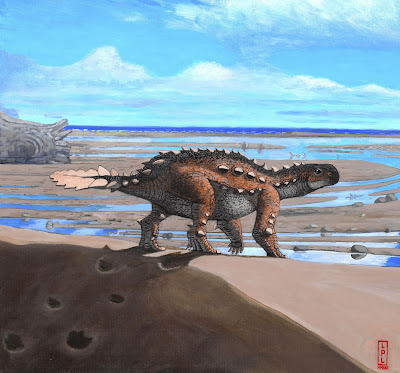
[Paleontology • 2021] Stegouros elengassen • Bizarre Tail Weaponry in A Transitional Ankylosaur (Thyreophora: Parankylosauria clade nov.) from Subantarctic Chile


Stegouros elengassen 
Soto-Acuña, Vargas, Kaluza, Leppe, Botelho, Palma-Liberona, Gutstein, Fernández, Ortiz, Milla, Aravena, Manríquez, Alarcón-Muñoz, Pino, Trevisan, Mansilla, Hinojosa, Muñoz-Walther & Rubilar-Rogers, 2021

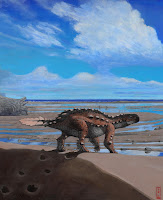
Illustration: Luis Pérez López 

Abstract
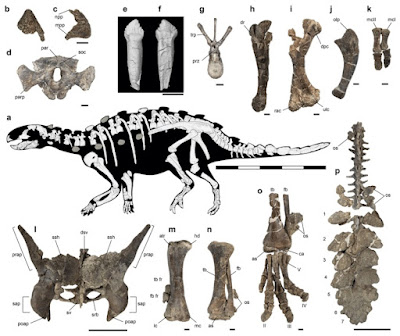
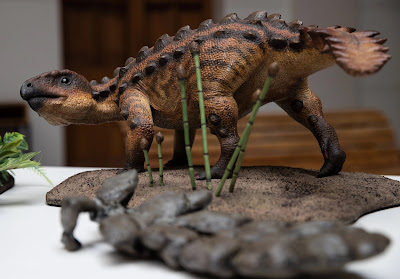
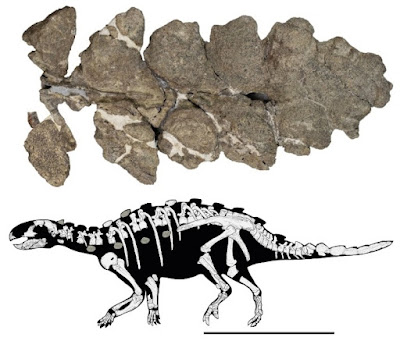
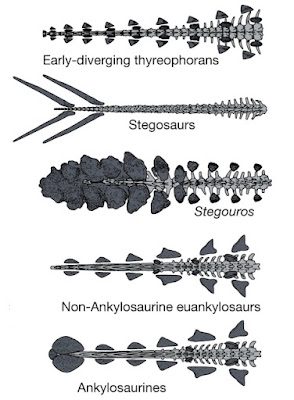
Armoured dinosaurs are well known for forms that evolved specialized tail weapons: paired tail spikes in stegosaurs, and heavy tail clubs in advanced ankylosaurs. Armoured dinosaurs from southern Gondwana are rare and enigmatic, but likely include the earliest branches of Ankylosauria. Here, we describe a mostly complete, semiarticulated skeleton of a small (about 2m) armoured dinosaur from the late Cretaceous of Magallanes in southernmost Chile, a region biogeographically related to West Antarctica. Stegouros elengassen gen. et sp. nov. evolved a large tail weapon unlike any dinosaur: A flat, frond-like structure formed by 7 pairs of laterally projecting osteoderms encasing the distal half of the tail. Stegouros shows ankylosaurian cranial characters, but a largely primitive postcranial skeleton, with some stegosaur-like characters. Phylogenetic analyses placed Stegouros in Ankylosauria, and specifically related to Kunbarrasaurus from Australia and Antarctopelta from Antarctica, forming a clade of Gondwanan ankylosaurs that split earliest from all other ankylosaurs. Large osteoderms and specialized tail vertebrae in Antarctopelta suggest it had a tail weapon similar to Stegouros. We propose a new clade, the Parankylosauria, to include the first ancestor of Stegouros but not Ankylosaurus, and all descendants of that ancestor.

KEYWORDS: dinosaurs, tail weapons, anylosaurus, stegosaurus


Dinosauria Owen, 1842 
Ornithischia Seeley, 1887 
 
Thyreophora Nopcsa 1928 
Ankylosauria Osborn, 1923 

Parankylosauria clade nov. 

Stegouros elengassen gen. et sp. nov. 

Etimology— Stegouros, after the Greek stego (roof) and the Greek uros (tail) in reference to the covered tailelengassen, after an armoured beast in the mythology of the local Aónik’enk people.

Locality and horizon—Río de las Chinas Valley, Estancia Cerro Guido, Magallanes Region, Chilean Patagonia (51°S). Lower section of Dorotea Formation (upper Campanian – lower Maastrichtian), between 71.7 ± 1.2 Ma and 74.9 ± 2.1 Ma10,11 (Supplementary Information section 2, Supplementary Fig. 2).

Armoured dinosaurs are the only amniotes to have evolved three different specialized tail weapons in Stegosauria, Stegouros and Ankylosaurinae.


Sergio Soto-Acuña, Alexander Vargas, Jonatan Kaluza, Marcelo Leppe, Joao Botelho, José Palma-Liberona, Carolina Gutstein, Roy Fernández, Hector Ortiz, Verónica Milla, Bárbara Aravena, Leslie Manríquez, Jhonatan Alarcón-Muñoz, Juan Pino, Christine Trevisan, Héctor Mansilla, Luis Hinojosa, Vicente Muñoz-Walther and David Rubilar-Rogers. 2021. Bizarre Tail Weaponry in A Transitional Ankylosaur from Subantarctic Chile. Nature. DOI: 10.1038/s41586-021-04147-1