Showing posts with label Hadrosaur. Show all posts

Tuesday, May 5, 2026

[Paleontology • 2026] Qianjiangsaurus changshengi • First Report of a Hollow Cranial Crest in an Early-Diverging Duck-Billed Dinosaur, with Implications for Convergent Evolution of Acoustic Signaling


Qianjiangsaurus changshengi  
Dai, Ma, Xiong, Lin, Zeng, Tan, Wang, Zhang & Xing, 2025

in Q. Ma, Y. Ma, Tan, Chen, Lin, ... et Xing, 2026.

Abstract
Cranial crests have evolved multiple times in the evolutionary history of vertebrates, serving primarily for visual display. In duck-billed lambeosaurines, one of the most successful dinosaur clades of the Late Cretaceous, the cranial crest became hollow along the paired premaxillae and nasals, and was secondarily selected as a resonating structure atop the skull roof, facilitating acoustic signaling. Here we report the first instance of a hollow supracranial crest in a non-lambeosaurine ornithopod dinosaur, the early-branching hadrosauroid Qianjiangsaurus changshengi, where the paired accessory endonasal cavities just above the nasal cavity proper occur following the dorsoventral thickening of the nasals. This novel nasal cavity configuration is associated with the helmet-like hollow supracranial crest solely formed by the nasals. Comparative resonance modeling suggests that the nasal cavity of Q. changshengi could amplify low-frequency vocalizations similar to those of late-branching lambeosaurines. Seven analogous skull features (including the hollow supracranial crest) and similar low-frequency acoustic capabilities of nasal cavities between Q. changshengi and late-branching lambeosaurines reveal a striking morphological and functional convergence that would likely facilitate safer, more efficient social communication among hadrosauroids. This convergence can be explained by adaptive evolution under similar selection pressures, combined with developmental constraints due to gene pleiotropy.

Keywords: Qianjiangsaurus changshengi; accessory endonasal cavities; hollow supracranial crest; low-frequency vocalizations; convergent evolution


Qianjiangsaurus changshengi


Qingyu Ma, Yubo Ma, Chao Tan, Jian Chen, Yu Lin, Ming Xiao, Hui Dai, Guangbiao Wei, Jordan C. Mallon, Jun Wang, Han Yao, Zhengting Zou and Hai Xing. 2026. First Report of a Hollow Cranial Crest in an Early-Diverging Duck-Billed Dinosaur, with Implications for Convergent Evolution of Acoustic Signaling. Biology. 15(8), 615. DOI: doi.org/10.3390/biology15080615 [13 April 2026]

 
Simple Summary: Convergent evolution is a peculiar biological process in which distinct taxa or lineages independently evolve analogous features, structures and functions, to adapt to similar necessities. Here we present a classic instance of morphological and functional convergence of the hollow cranial crest among hadrosauroid dinosaurs, based on an excellently preserved skull of the early-branching hadrosauroid Qianjiangsaurus changshengi newly recovered from southwest China, as well as comparative resonant frequency evaluations of its unique endonasal (‘within the nasal bone’) cavities using CT scans and mathematic calculations. The overgrown nasal crest with a novel internal structure in Q. changshengi is morphologically comparable to but structurally non-homologous with the greatly developed hollow supracranial ornamentation and elongate nasal passages seen in lambeosaurines, and thus hugely changes our notions on the cranial evolution of late-branching ornithopod dinosaurs.

Thursday, February 26, 2026

[Paleontology • 2026] Haolong dongi • Cellular-level Preservation of cutaneous spikes in an Early Cretaceous iguanodontian Dinosaur


 Haolong dongi 
Huang, Wu, Mao, Bertozzo, Dhouailly, Robin, Pittman, Kaye, Manucci, He, Wang & Godefroit, 2026  


Abstract
The near-complete and articulated skeleton of a new iguanodontian dinosaurHaolong dongi gen. et sp. nov., from the Lower Cretaceous of northeastern China, preserves exquisitely fossilized skin. The integument includes large overlapping scutate scales along the tail and tuberculate scales around the neck and thorax markedly different from the scale pattern described in other iguanodontians. Remarkably, these scales are interspersed with cutaneous spikes preserved at the cellular level. Tomographic and histological analyses reveal a hollow, cylindrical structure composed of a cornified stratum corneum overlying a pluristratified epidermis with keratinocytes preserved to the level of nuclei, surrounding a porous central dermal pulp. These spikes differ structurally from known protofeathers in non-avian dinosaurs and scaly spines in extant squamates, suggesting a distinct evolutionary origin. Their morphology and distribution imply a primary role in predator deterrence, with potential secondary functions in thermoregulation or mechanoreception. This discovery provides unprecedented insight into the microanatomy of non-avian dinosaur skin and highlights the complexity of skin evolution in ornithischian dinosaurs.


 Haolong dongi gen. et sp. nov.


Jiandong Huang, Wenhao Wu, Lei Mao, Filippo Bertozzo, Danielle Dhouailly, Ninon Robin, Michael Pittman, Thomas G. Kaye, Fabio Manucci, Xuezhi He, Xuri Wang and Pascal Godefroit. 2026.  Cellular-level Preservation of cutaneous spikes in an Early Cretaceous iguanodontian Dinosaur. Nature Ecology & Evolution. 10; 203–210. DOI: doi.org/10.1038/s41559-025-02960-9 [06 February 2026]


Friday, October 3, 2025

[Paleontology • 2025] Ahshislesaurus wimani • A New saurolophine hadrosaurid (Ornithischia: Hadrosauridae) from the Upper Cretaceous (Campanian) Hunter Wash Member, Kirtland Formation, San Juan Basin, New Mexico


Ahshislesaurus wimani 
Dalman, Jasinski, Malinzak, Malinzak, Lucas, Kundrát, Fiorillo, 2025
 
Artwork by Sergey Krasovskiy

A new saurolophine hadrosaurid dinosaur, Ahshislesaurus wimani gen et sp. nov., from the lower Hunter Wash Member of the lower Kirtland Formation (~75.02 Ma) of New Mexico is described. The specimen was briefly described before and referred to the stratigraphically younger Kritosaurus navajovius, which is known from the De-na-zin Member (~73.83–73.49 Ma) of the uppermost Kirtland Formation. The holotype of A. wimani consists of an incomplete diagnostic skull, several isolated cranial elements including the right jugal, quadrate, dentary, and surangular, and a series of articulated cervical vertebrae. In addition to the holotype of A. wimani, several specimens from the same strata may also belong to this newly identified species, including a well-preserved left dentary and a partial skeleton, as well as two humeri, one belonging to a large adult and the other to a juvenile. The skull of A. wimani preserves several taxonomically informative characters that show close affinities with the stratigraphically younger Naashoibitosaurus ostromi from the De-na-zin Member. Together with Naashoibitosaurus, Ahshislesaurus forms a potentially novel clade of flat-headed saurolophine hadrosaurids. This clade suggests the saurolophines were a taxonomically diverse group, which, during the last 20 million years of the Cretaceous, were among the dominant herbivorous dinosaurs in southern Laramidia. Recognition of a new hadrosaurid species from New Mexico also provides further evidence for latitudinal variation in the hadrosaurid fauna during the Late Cretaceous in Laramidia.

Skeleton reconstruction of Ahshislesaurus wimani gen. et sp. nov., (USNM VP-8629), holotype skull.
This includessome of the postcranial specimens from the lower Hunter Wash Member (Kirtland Formation) that may not represent this newspecies, including a postcranial skeleton (NMMNH P-25057); left scapula (NMMNH P-RMS 2013-7); left humerus (NMMNHP-31928); and right isolated ulna (NMMNH P-32885).

SYSTEMATIC PALEONTOLOGY
DINOSAURIA Owen, 1842
ORNITHISCHIA Seeley, 1887

ORNITHOPODA Marsh, 1881
IGUANODONTIA Dollo, 1888

HADROSAURIA von Huene, 1956
HADROSAURIDAE Cope, 1870
SAUROLOPHINAE Brown, 1914

Ahshislesaurus, new genus

Etymology: The genus name Ahshislesaurus is from the Ah-shi-sle-pah Wash Wilderness in the lower Hunter Wash Member of the Kirtland Formation in northwestern New Mexic where the new species was found. Ah-shi-sle-pah Wildernessis located in San Juan County, New Mexico, between Chaco Canyon and the De-na-zin Wilderness. Its name is a phonetic transliteration of Navajo “áshįįh łibá” meaning “salt, it is gray.”.

Ahshislesaurus wimani, new species 

Etymology: The specific epithet, wimani, honors the first Swedish professor of paleontology, Carl Wiman (1867–1944),from Uppsala University, who worked on fossil vertebrates from the San Juan Basin. 

Life reconstruction of Ahshislesaurus wimani gen. et sp. nov. based on the holotype (USNM VP-8629) and closely related taxa.
Artwork by Sergey Krasovskiy


Sebastian G Dalman, Steven E. Jasinski, D Edward Malinzak, ... et Anthony R. Fiorillo. 2025. A New saurolophine hadrosaurid (Ornithischia: Hadrosauridae) from the Upper Cretaceous (Campanian) Hunter Wash Member, Kirtland Formation, San Juan Basin, New Mexico. New Mexico Museum of Natural History and Science Bulletin. Fossil Record. 11: 73–114. (September 2025)  

Tuesday, July 15, 2025

[Paleontology • 2025] Neonatal State and Degree of Necessity for Parental Care in Maiasaura based on inferred Neonatal Metabolic Rates


The hatching of hadrosaurid dinosaur Maiasaura peeblesorum  

in Bert, Woodward, Rinder, Amiot, ... et Cubo, 2025. 
Artwork by Delphine Zigoni linkedin.com: Delphine Zigoni 

Abstract 
We infer the neonatal metabolic rate at rest (RMR) and at maximum activity levels (MMR) of the hadrosaurid dinosaur Maiasaura peeblesorum from the Two Medicine Formation of Montana (USA) using Phylogenetic Eigenvector Maps applied to the following osteohistological features: the Relative Primary Osteon Area and the size of the femoral nutrient foramen as proxies. We investigate the locomotor/motor activity of the neonates by comparing the difference between maximum and minimum rates of oxygen consumption—referred to as aerobic scope and denoted as ΔMR, as a proxy of their activity levels. Applied to Maiasaura, this novel methodology allows for a quantitative assessment of its neonatal state and to deduce its dependence on parental care. The inferred neonatal RMR values for Maiasaura are similar to those of present-day fast-growing endotherms. As for the aerobic scope, M. peeblesorum neonates have a ΔMR value similar to those observed in present-day altricial birds that need intensive parental care. This result is consistent with the previously proposed hypothesis of nidicolous M. peeblesorum requiring parental care. Finally, based on age-estimations from M. peeblesorum neonate remains found both in and outside nest sites, we estimate that this species remained in the nest for approximately 40–75 days. Maiasaura provides a useful ecological baseline from which to infer neonatal states in an other hadrosaur of similar adult size—Hypacrosaurus stebingeri, whose differing ecological traits point to a relatively more precocial condition. The diversity of post-hatching reproductive strategy partly explains the adaptation of hadrosaurs to a wide range of paleolatitudes and environments.

Keywords: Relative primary osteon area, Nutrient foramina, Phylogenetic eigenvector maps, Reproductive strategy

 
Hugo Bert, Holly Woodward, Nicolas Rinder, Romain Amiot, John R. Horner, Christophe Lécuyer, Mariana Sena and Jorge Cubo. 2025. Neonatal State and Degree of Necessity for Parental Care in Maiasaura based on inferred Neonatal Metabolic Rates. Scientific Reports. 15: 24827. DOI: doi.org/10.1038/s41598-025-06282-5 [10 July 2025]

Thursday, February 13, 2025

[Paleontology • 2025] First Occurrence of the Duck-billed Dinosaur Tribe Lambeosaurini (Hadrosauridae: Lambeosaurinae) in South China


Lambeosaurini from Dalangshan Formation of Sihui City, China

in Wang, Xing, Mallon, Miyashita, Za. Liang, Zhang, Ren, Zh. Liang et Xian, 2025.


ABSTRACT
Late Cretaceous Laurasia contained a typical dinosaur fauna consisting of herbivorous hadrosaurids, ceratopsians, and carnivorous tyrannosauroids. Previously, tyrannosauroid teeth have been found in the Upper Cretaceous Dalangshan Formation of Sihui City, China. We describe a fragmentary skeleton of a duck-billed dinosaur from the same general region. The skeleton includes dorsal and caudal vertebrae, a humerus, ilium, femur and tibia. Morphological comparison and cladistic analyses support that this specimen belongs to the tribe Lambeosaurini, which is otherwise poorly represented in China. The new specimens and the previously discovered tyrannosauroid teeth represent the dominant taxa of the typical Late Cretaceous dinosaur fauna of Laurasia.

KEYWORDS: Dinosauria, Hadrosauridae, Lambeosaurinae, Lambeosaurini, Maastrichtian


 the Sihui Museum specimen
Restoration drawing by Han Zhixin


Donghao Wang, Lida Xing, Jordan C. Mallon, Tetsuto Miyashita, Zaoqun Liang, Xianqiu Zhang, Zheng Ren, Zhicong Liang and Minyi Xian. 2025. First Occurrence of the Duck-billed Dinosaur tribe Lambeosaurini (Hadrosauridae: Lambeosaurinae) in South China. Historical Biology: An International Journal of Paleobiology. DOI: doi.org/10.1080/08912963.2025.2454652 

Monday, September 2, 2024

[Paleontology • 2024] Coahuilasaurus lipani • a New Kritosaurin Hadrosaurid (Hadrosauridae: Saurolophinae) from the Upper Campanian Cerro Del Pueblo Formation, Northern Mexico


Coahuilasaurus lipani
Longrich, Velasco, Kirkland, Torres & Serrano-Brañas, 2024
 
Life reconstruction by C. Díaz Frías

Abstract
The Late Cretaceous of Western North America (Laramidia) supported a diverse dinosaur fauna, with duckbilled dinosaurs (Hadrosauridae) being among the most speciose and abundant members of this assemblage. Historically, collecting and preservational biases have meant that dinosaurs from Mexico and the American Southwest are poorly known compared to those of the northern Great Plains. However, evidence increasingly suggests that distinct species and clades inhabited southern Laramidia. Here, a new kritosaurin hadrosaurid, represented by the anterior part of a skull, is reported from the late Campanian of the Cerro del Pueblo Formation, ~72.5 Ma, in Coahuila, Mexico. The Cerro del Pueblo Formation kritosaur was originally considered to represent the same species as a saurolophine from the Olmos Formation of Sabinas, but the Sabinas hadrosaur is now considered a distinct taxon. More recently, the Cerro del Pueblo Formation kritosaur has been referred to Kritosaurus navajovius. We show it represents a new species related to Gryposaurus. The new species is distinguished by its large size, the shape of the premaxillary nasal process, the strongly downturned dentary, and massive denticles on the premaxilla’s palatal surface, supporting recognition of a new taxon, Coahuilasaurus lipani. The dinosaur assemblage of the Cerro del Pueblo Formation shows higher diversity than the contemporaneous fauna of the Horseshoe Canyon Formation in Alberta. Furthermore, Kritosaurini, Lambeosaurini, and Parasaurolophini all persist into the latest Campanian in southern Laramidia after disappearing from northern Laramidia. These patterns suggest declining herbivore diversity seen at high latitudes may be a local, rather than global phenomenon, perhaps driven by cooling at high latitudes in the Late Campanian and Maastrichtian.

Keywords: Dinosauria; Hadrosauridae; Saurolophinae; Kritosaurini; Cretaceous; Campanian; Laramidia; biogeography


 IGM 6685, holotype Coahuilasaurus lipani. (A), rostrum with posterior skull reconstructed in left lateral view; (B), scaled silhouette. The animal is estimated to have been around 8 m in length.

Dinosauria Owen 1842
Ornithopoda Marsh 1881 
Hadrosauridae Cope 1869 
Saurolophinae Brown 1914 (sensu Prieto-Márquez, 2010)
Kritosaurini Brett-Surman 1989 (sensu Prieto-Márquez, 2014)

Coahuilasaurus lipani gen. et sp. nov.

Etymology. Coahuila in reference to Coahuila State + Greek sauros, ‘lizard’; lipani references the Lipani Apache tribe of Coahuila.

Diagnosis. Large kritosaurin with an estimated length of ~8 m (Figure 5). Distinguished by the following unique character combination (* = autapomorphies). The anterior margin of premaxillae is strongly convex in lateral view; the anterodorsal margin of the narial process is subtly sinusoidal in lateral view, being concave anteriorly then weakly convex posteriorly *. The narial aperture is narrow and slot-like and strongly extended anteroventrally *. The premaxillary labrum is deep anteriorly, becoming shallower posteriorly. The posteroventral corner of the premaxillary beak is strongly angular, with the anteroventral margin and posteroventral margin forming approximately a right angle in lateral view *; the posteroventral margin of the premaxilla is strongly concave in lateral view. The premaxilla is short and broad in dorsal view. The oral margin of the beak bears a series of 5–6 small denticles. The palatal surface of the premaxilla forms a horseshoe-shaped ridge projecting far below the oral margin *; the ridge bears three pairs of massive, diamond-shaped denticles*. The nasal–premaxillary contact is posteriorly positioned, probably near the end of the nasal aperture. Very large narial flange of premaxilla *. The predentary oral margin is strongly concave in the lateral view and has a steeply inclined rostroventral margin, and the tip is hooked up strongly in lateral view (approached in Gryposaurus monumentensis). There is a narrow U-shaped notch between predentary lateral processes and ventral processes (shared with Gryposaurus monumentensis); the ventral processes are long and slender. The edentulous end of the dentary is strongly downturned, with a strongly convex anterodorsal margin, and a long ventral contact between the dentaries.
 
 Map showing localities of kritosaurins from the Late Cretaceous of western North America (Laramidia).
1,2, Gryposaurus notabilis (incl. G. incurvimanus) Dinosaur Park Formation, Alberta; 3, Gryposaurus latidens, Two Medicine Formation, Montana; 4, Gryposaurus sp., Bearpaw Shale, Montana; 5, Kritosaurini indet., North Horn Formation, Utah;
6, Rhinorex condrupus, Neslen Formation, Utah; 7, Gryposaurus monumentensis, Kaiparowits Formation, Utah; 8, Anazisaurus horneri, Farmington Formation of the Kirtland Formation of New Mexico; 9, Naashoibitosaurus ostromi, De-Na-Zin Member of the Kirtland Formation of New Mexico; 10, Kritosaurus navajovius, De-Na-Zin Member of the Kirtland Formation of New Mexico;
11, Naashoibito kritosaurin, Naashobito Member of the Kirtland Formation of New Mexico; 12, Gryposaurus (?) alsatei, upper Javelina Formation, Texas; 13, cf. Kritosaurus, UTEP P.37.7, basal Javelina Formation of Texas; Aguja Formation, Texas; 14, Aguja Fm. Kritosaur, AMNH 3079; 15, Coahuilasaurus lipani, Cerro del Pueblo Formation, Coahuila. Map by Ron Blakey.

Conclusions: 
A partial skull from the latest Campanian of the Cerro del Pueblo Formation of Coahuila, Mexico, represents a new species of kritosaurin, Coahuilasaurus lipani (Figure 20). Along with specimens from the Naashoibito Member of the Kirtland Formation in New Mexico, C. lipani documents the persistence of kritosaurins in the south after local extinction in northern Laramidia, a pattern also seen in Parasaurolophini and Lambeosaurini.

Southern faunas not only have distinct species, but different patterns of diversity change, compared to northern Laramidian faunas. Differences in species composition and community structure in different parts of Laramidia mean that further work on the dinosaurs of Mexico and the American Southwest is needed to understand the evolution of dinosaur diversity in western North America. Southern dinosaur faunas may have been characterized by both higher origination rates and lower extinction rates than northern faunas.


 Nicholas R. Longrich, Angel Alejandro Ramirez Velasco, Jim Kirkland, Andrés Eduardo Bermúdez Torres and Claudia Inés Serrano-Brañas. 2024. Coahuilasaurus lipani, a New Kritosaurin Hadrosaurid from the Upper Campanian Cerro Del Pueblo Formation, Northern Mexico. Diversity. 16(9), 531. DOI: doi.org/10.3390/d16090531  

Wednesday, August 28, 2024

[Paleontology • 2025] Qianjiangsaurus changshengi • A New late-diverging non-hadrosaurid hadrosauroid (Iguanodontia: Hadrosauriformes) from southwest China: Support for Interchange of Dinosaur Faunas across East Asia during the Late Cretaceous


Qianjiangsaurus changshengi
Dai, Ma, Xiong, Lin, Zeng, Tan, Wang, Zhang & Xing, 2025

 
Abstract
A non-hadrosaurid hadrosauroid, Qianjiangsaurus changshengi gen. et sp. nov., is named and described here based on an incomplete, partially articulated skeleton from the top of the Upper Cretaceous Zhengyang Formation in Qianjiang District, Chongqing Municipality, southwest China. The skeleton displays a transitional morphology between non-hadrosaurid hadrosauroids and hadrosaurids. The diagnosis of the taxon is therefore defined as a unique combination of characters, including a series of plesiomorphic features typical of non-hadrosaurid hadrosauroids, some apomorphic features common among hadrosaurids but rarely reported in non-hadrosaurid hadrosauroids, and a probable autopomorphy, namely the fan-shaped prepubic process of the pubis strongly anteroposteriorly constricted and dorsoventrally expanded, with the length/height ratio of ∼0.79. Phylogenetic analysis recovers a sister-taxon relationship between Qianjiangsaurus and Plesiohadros outside of Hadrosauridae, and the clade consisting of the two taxa is positioned higher on the tree than Gobihadros and Gilmoreosaurus, but below the clade of Telmatosaurus + Tethyshadros, Eotrachodon and Zhanghenglong. Combining the morphological data with the phylogenetic topology identifies Q. changshengi as a late-branching non-hadrosaurid hadrosauroid. Given that the age assemblage of the eight hadrosauroids closely related to Qianjiangsaurus in phylogeny spans the Santonian–early Maastrichtian time interval, the top of the Zhengyang Formation, from which Qianjiangsaurus is recovered, is possibly restricted to the late Late Cretaceous in age. Hierarchical clustering of twelve hadrosauroid-bearing dinosaur assemblages from the Late Cretaceous deposits of Asia shows a strong correlation between the Zhengyang Formation and the Djadokhta and Baruungoyot formations in Mongolia that supports coeval interchange of dinosaur faunas across East Asia.

Systematic paleontology
Dinosauria Owen, 1842
Ornithischia Seeley, 1888

Iguanodontia Dollo, 1888 sensu Sereno, 1998
Ankylopollexia Sereno, 1986 sensu Sereno, 1998

Hadrosauriformes Sereno, 1997 sensu Sereno, 1998
Hadrosauroidea Cope, 1869 sensu Sereno, 1998


Qianjiangsaurus gen. nov. 
Qianjiangsaurus changshengi sp. nov.


Holotype. CLGRP V00016, an incomplete, partially articulated skeleton, 

Taxonomic status of Qianjiangsaurus changshengi: 
Qianjiangsaurus changshengi entirely represented by the holotype CLGRP V00016 displays a series of plesiomorphic features that are typical of non-hadrosaurid hadrosauroids, including the transversely wide, U-shaped predentary in dorsal view with the smoothly arcuate anterolateral margins, the dentary with no more than 30 alveoli, the right-angled coronoid process relative to the dorsal edge of the main body of the dentary, the dentary tooth crown lingually ornamented with a slightly distally ...


Conclusions: 
Qianjiangsaurus changshengi gen. et sp. nov. is a second formally named hadrosauroid dinosaur from south China, in addition to Nanningosaurus dashiensis. The discovery of this new taxon has furthered our understanding of the diversity and late evolution of non-hadrosaurid hadrosauroids. The holotype of Q. changshengi recovered from the Upper Cretaceous Zhengyang Formation of southeast Chongqing Municipality in southwest China clearly exhibits a transitional morphology between non-hadrosaurid ...


Hui Dai, Qingyu Ma, Can Xiong, Yu Lin, Hui Zeng, Chao Tan, Jun Wang, Yuguang Zhang and Hai Xing. 2024. A New late-diverging non-hadrosaurid hadrosauroid (Dinosauria: Ornithopoda) from southwest China: Support for Interchange of Dinosaur Faunas across East Asia during the Late Cretaceous. Cretaceous Research. In Press, 105995. DOI: doi.org/10.1016/j.cretres.2024.105995

Thursday, July 11, 2024

[Paleontology • 2024] Comptonatus chasei • A New iguanodontian Dinosaur (Iguanodontia: Hadrosauriformes) from the Lower Cretaceous Wessex Formation of the Isle of Wight, southern England


Comptonatus chasei
Lockwood, Martill & Maidment, 2024

 artwork by John Sibbick.
 
Abstract
A new iguanodontian dinosaur, Comptonatus chasei gen. et sp. nov., is described from the Lower Cretaceous Wessex Formation of the Isle of Wight. These strata provide an important record of a critical time in the development of iguanodontian diversity. The specimen, which is described here for the first time, was found and excavated in 2013 and represents the most complete iguanodontian skeleton discovered in the Wealden Group for a century. A new taxon is diagnosed by several autapomorphies found in the neurocranium, teeth, coracoid and other parts of the body, together with a unique suite of characters. These include a dentary with a straight ventral border, and a markedly expanded prepubic blade. These features set it apart from the sympatric Mantellisaurus atherfieldensis, Brighstoneus simmondsi and Iguanodon cf. bernissartensis, increasing the known diversity of this clade in the Barremian–early Aptian of England.  

Keywords: Barremian, Wealden Group, supraoccipitalvomer, diversity

Systematic palaeontology
Dinosauria Owen, 1842
Ornithischia Seeley, 1887

Ornithopoda Marsh, 1881
Iguanodontia Baur, 1891

Ankylopollexia Sereno, 1986
Styracosterna Sereno, 1986

Hadrosauriformes Sereno, 1997

Comptonatus gen. nov.

Etymology: Comptonatus (‘the Compton thunderer’) is a contraction of the words ‘Compton’ on the Isle of Wight and ‘tonatus’, the Latin for thundered, and reflects the place of discovery and the large size of the animal.

Location and horizon: The Wessex Formation, ‘middle’ Barremian, Lower Cretaceous. IWCMS 2014.80 was excavated during September–October 2013, from a plant debris bed on National Trust property to the west of the fault in Compton Bay, and close (c. 50 m) to where IWCMS 2013.175, a skeleton of Valdosaurus canaliculatus Galton, Citation1977 (Barrett, Citation2016) was excavated the previous year. The excavation was conducted under the supervision of Dinosaur Isle Museum (IWCMS) and site records and drawings were collected by Mr Stephen Hutt, the then curator. The site exposes a deep (c. 3 m) plant debris bed that occasionally yields articulated dinosaur remains, but frequently produces the trunks of large conifers, usually attributed to Pseudofrenelopsis parceramosa (Francis, Citation1987). Other vertebrate remains uncovered from the excavation site include ganoid fish scales (cf. Scheenstia sp.), an indeterminate crocodilian tooth and several very large, but fragmentary iguanodontian remains, including three pedal phalanges, a neural arch, and some rib sections.

 Comptonatus chasei gen. et sp. nov. (IWCMS 2014.80).
Preliminary reconstruction of the skull. Shaded areas represent material present in the holotype.
Abbreviations: d, dentary; f, frontal; m, maxilla; n, nasal; nc, neurocranium; orb, orbit; p, parietal; pa, paroccipital process; pf, prefrontal; po, postorbital; q, quadrate, s, surangular; sq, squamosal. Scale bar represents 100 mm.

 Comptonatus chasei gen. et sp. nov. (IWCMS 2014.80). Life restoration.
Original artwork by John Sibbick.


Comptonatus chasei gen. et sp. nov.

Etymology: The specific name honours the late Mr Nick Chase, winner of the Palaeontological Association’s Mary Anning Award in 2018, who made the initial discovery and through his lifetime contributed enormously to the collections at Dinosaur Isle Museum, Isle of Wight, and the Natural History Museum, London (Lockwood et al., Citation2019).

 
Jeremy A. F. Lockwood, David M. Martill and Susannah C. R. Maidment. 2024. Comptonatus chasei, A New iguanodontian Dinosaur from the Lower Cretaceous Wessex Formation of the Isle of Wight, southern England. Journal of Systematic Palaeontology. 22(1); 2346573. DOI: doi.org/10.1080/14772019.2024.2346573

Saturday, February 24, 2024

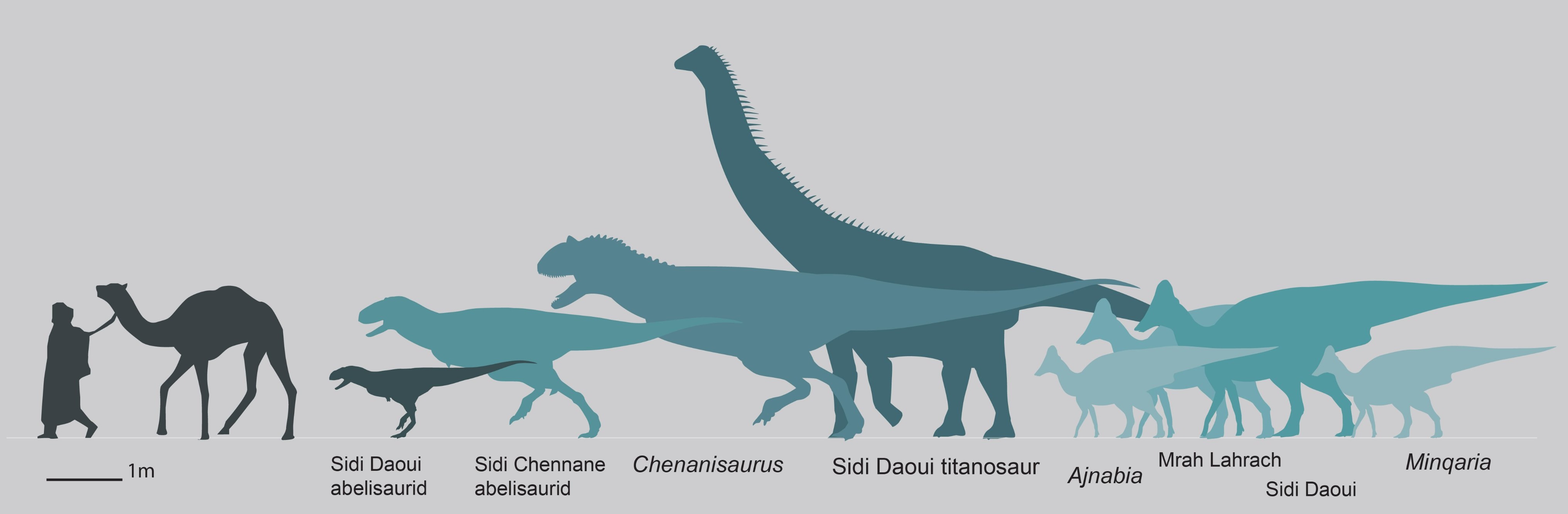
[Paleontology • 2024] Minqaria bata • A New small Duckbilled Dinosaur (Hadrosauridae: Lambeosaurinae) from Morocco and Dinosaur Diversity in the late Maastrichtian of North Africa


 Minqaria bata 
Longrich, Pereda-Suberbiola, Bardet & Jalil, 2024

Reconstruction by Raul Martin 

Abstract
In the Late Cretaceous, northern and southern hemispheres evolved distinct dinosaurian faunas. Titanosaurians and abelisaurids dominated the Gondwanan continents; hadrosaurids, ceratopsians and tyrannosaurs dominated North America and Asia. Recently, a lambeosaurine hadrosaurid, Ajnabia odysseus, was reported from the late Maastrichtian phosphates of the Oulad Abdoun Basin Morocco, suggesting dispersal between Laurasia and Gondwana. Here we report new fossils from the phosphates of Morocco showing lambeosaurines achieved high diversity in the late Maastrichtian of North Africa. A skull represents a new dwarf lambeosaurine, Minqaria bata. Minqaria resembles Ajnabia odysseus in size, but differs in the ventrally positioned jugal facet and sinusoidal toothrow. The animal is small, ~ 3.5 m long, but the fused braincase shows it was mature. A humerus and a femur belong to larger hadrosaurids, ~ 6 m long, implying at least three species coexisted. The diversity of hadrosaurids in Europe and Africa suggests a dispersal-driven radiation, with lambeosaurines diversifying to take advantage of low ornithischian diversity. African lambeosaurines are small compared to North American and Asia hadrosaurids however, perhaps due to competition with titanosaurians. Hadrosaurids are unknown from eastern Africa, suggesting Moroccan hadrosaurids may be part of a distinct insular fauna, and represent an island radiation.

Skull elements of Minqaria bata nov. gen. et sp., MHNM.KHG.1395, holotype: right maxilla, braincase, left dentary. Sidi Chennane, Oulad Abdoun Basin, Upper Couche III, late Maastrichtian. Scale = 5 cm.

Systematic paleontology
Dinosauria Owen, 1842
Ornithischia Seeley, 1887
Iguanodontia, Baur, 1891

Hadrosauridae Cope, 1869
Lambeosaurinae Parks, 1923
Arenysaurini Longrich, Pereda-Suberbiola, Pyron et Jalil, 2021

Minqaria bata gen. et sp. nov.

Diagnosis. Small lambeosaurine characterized by the following character combination, which also differentiates it (where the specimens overlap) from Ajnabia odysseus. Jugal articulation lies very low on maxilla (autapomorphic within lambeosaurinae); ectopterygoid ridge ends at jugal articulation. Ectopterygoid ridge concave in lateral and dorsal views, narrower posteriorly than anteriorly. Neurovascular foramina arranged in a row. Highly domed frontoparietal, with extensive contribution of parietal to the dome, and a triangular parietal table. Maxillary toothrow sinusoidal in lateral or ventral views, with a deep buccal fossa. Dentary short and deep, occlusal margin straight; symphyseal process strongly extended anteriorly, and with straight ventral margin. Alveolar ridges of maxilla and dentary poorly developed. Teeth small, with narrow apices, broad central ridges, and rugose enamel.

Locality and horizon. Sidi Chennane, Oulad Abdoun Basin, Morocco; upper Couche III, late Maastrichtian. 

Etymology. Arabic, ‘minqar’, beak; ‘bata’, duck.


Conclusions: 
A hadrosaurid from the latest Maastrichtian phosphates of Sidi Chennane, Morocco, is distinct from Ajnabia odysseus and represents a new arenysaurin, Minqaria bata. Minqaria differs from Ajnabia in jaw and tooth morphology, suggesting it occupied a distinct niche. Fusion of cranial elements shows that it was mature despite its small size (~ 3.5 m), confirming the existence of small hadrosaurids in North Africa. Similarities with the European Arenysaurus provide further evidence for dispersal of lambeosaurines between the Ibero-Armorican landmass and Africa. A humerus from Sidi Daoui and a femur from Mrah Lahrach belong to larger individuals, suggesting at least three hadrosaur species occur in the phosphates. Even as lambeosaurines declined in the Maastrichtian of North America, they diversified in Africa.


Nicholas R. Longrich, Xabier Pereda-Suberbiola, Nathalie Bardet and Nour-Eddine Jalil. 2024. A New small Duckbilled Dinosaur (Hadrosauridae: Lambeosaurinae) from Morocco and Dinosaur Diversity in the late Maastrichtian of North Africa. Scientific Reports. 14: 3665. DOI: 10.1038/s41598-024-53447-9

Little African duckbill dinosaurs provide evidence of an unlikely ocean crossing
New species of duckbill dinosaur found in Africa indicates they were diverse, with at least three species inhabiting north Africa at the end of the Cretaceous.

Saturday, June 17, 2023

[Paleontology • 2023] Gonkoken nanoi • Relict Duck-billed Dinosaurs (Ornithopoda: Hadrosauroidea) survived into the last age of the Dinosaurs in Subantarctic Chile


Gonkoken nanoi  
Alarcón-Muñoz, Vargas, Püschel, Soto-Acuña, Manríquez, Leppe, Kaluza, Milla, Simon-Gutstein, Palma-Liberona, Stinnesbeck, Frey, Pino, Bajor, Núñez, Ortiz, Mansilla, Rubilar-Rogers & Cruzado-Caballero, 2023


Abstract
In the dusk of the Mesozoic, advanced duck-billed dinosaurs (Hadrosauridae) were so successful that they likely outcompeted other herbivores, contributing to declines in dinosaur diversity. From Laurasia, hadrosaurids dispersed widely, colonizing Africa, South America, and, allegedly, Antarctica. Here, we present the first species of a duck-billed dinosaur from a subantarctic region, Gonkoken nanoi, of early Maastrichtian age in Magallanes, Chile. Unlike duckbills further north in Patagonia, Gonkoken descends from North American forms diverging shortly before the origin of Hadrosauridae. However, at the time, non-hadrosaurids in North America had become replaced by hadrosaurids. We propose that the ancestors of Gonkoken arrived earlier in South America and reached further south, into regions where hadrosaurids never arrived: All alleged subantarctic and Antarctic remains of hadrosaurids could belong to non-hadrosaurid duckbills like Gonkoken. Dinosaur faunas of the world underwent qualitatively different changes before the Cretaceous-Paleogene asteroid impact, which should be considered when discussing their possible vulnerability.

Stratigraphic location of Gonkoken nanoi and geographic distribution of South American duck-billed dinosaurs.
(A) Stratigraphic section of the Dorotea Formation, indicating the location of the bones of Gonkoken nanoi.
(B) Location of the duck-billed dinosaurs from South America: 1, Lapampasaurus cholinoi (Islas Malvinas locality, La Pampa Province, late Campanian to early Maastrichtian, Allen Formation); 2, Kelumapusaura machi (Matadero Hill, General Roca city, Río Negro Province, middle Campanian to early Maastrichtian, Allen Formation); 3, Bonapartesaurus rionegrensis (Salitral Moreno, General Roca Department, Río Negro Province, middle Campanian to early Maastrichtian, Allen Formation); 4, Huallasaurus australis (Arroyo Verde Puelén Department, Río Negro Province, late Campanian to early Maastrichtian, Los Alamitos Formation); 5, Secernosaurus koerneri (Río Chico, east of Lake Colhué Huapi, Chubut Province, Maastrichtian, Lago Colhué Huapi Formation); and 6, Gonkoken nanoi (Río de las Chinas Valley, Magallanes Region, late Campanian to early Maastrichtian, Dorotea Formation).
(C) The quarry from which Gonkoken nanoi bones were excavated (bonebed level).
(D) Detail of a nearly complete tibia.


Gonkoken nanoi gen. et sp. nov., skeletal anatomy. (A) Bones described in this work (white). Some elements are indicated specularly to facilitate their representation. (B) CPAP 5337, right premaxilla in lateral view. (C) CPAP 5341, incomplete left postorbital in lateral view. (D) CPAP 5340, incomplete right maxilla in lateral view. (E) CPAP 5370, left dentary in medial view. (F) CPAP 5343, right quadrate in lateral view. (G) CPAP 5344, cervical vertebra in anterior view. (H) CPAP 5346, dorsal vertebra in anterior view. (I) CPAP 5371, right scapula in lateral view. (J) CPAP 5352, left sternum in ventral view. (K) CPAP 5400, incomplete right rib in anterior view. (L) CPAP 5379, proximal portion of right radius in posterior view. (M) CPAP 5355, incomplete left ulna in anterolateral view. (N) CPAP 5353, left humerus in posterolateral view. (O) CPAP 3054 (holotype), right ilium in lateral view. (P) CPAP 5356, left postacetabular process in lateral view. (Q) CPAP 5357, proximal portion of right ischium in medial view. (R) CPAP 5363, proximal portion of left fibula in lateral view. (S) CPAP 5360, incomplete right femur in distal view. (T) CPAP 5358, left femur in anterior view. (U) CPAP 5362, left tibia in lateral view. (V and W) CPAP 5349, caudal vertebra in anterior and lateral views. (X) CPAP 5364, right metatarsal III in anterior view. Skeleton modified from (31).
 Scale bars, 50 mm [(B) to (G), (J), (K) to (N), (Q), (S), and (V) to (X)] and 100 mm [(H), (I), (O), (P), (R), (T), and (U)].


Systematic paleontology
 Dinosauria Owen, 1842
Ornithischia Seeley, 1887

Ornithopoda Marsh, 1881
Hadrosauroidea Cope, 1870, sensu Madzia et al. (16)

Gonkoken nanoi gen. et sp. nov.

Etymology: The words “gon” (same as, similar to) and “koken” (wild duck or swan) are in the language of the Aónik’enk, the indigenous people that inhabited the region where this species was found (Fernández Garay, 2004). The specific name nanoi is in honor of Mario NanoUlloa, who first found dinosaur bones at Río de las Chinas Valley and provided key logistic help during our expeditions.

Type locality and horizon: Loma Koken (50°42′42″S and 72°32′29″W), El Puesto area, Río de las Chinas Valley, Estancia Cerro Guido, Magallanes Region, Chilean Patagonia (51°S). Upper section of the Dorotea Formation (lower Maastrichtian), between 71.7 ± 1.2 and 70.5 ± 5.0 million years (Ma) (21, 22) (see Materials and Methods).

Diagnosis: Small-sized hadrosauroid dinosaur (total body length ~4 m) presenting the following autapomorphies: a scapula with an anteroventrally curved pseudoacromion process and an ilium with a medioventrally and anteroposteriorly well-developed sacral crest extending posterior to the base of the postacetabular process. Gonkoken also differs from all other members of Hadrosauroidea in its unique combination of characters. Unlike the Hadrosauridae, it shows a maxilla with a jugal articular surface showing a prominent and caudally projecting dorsal tubercle; a dentary with a short diastema, mandibular symphysis oblique relative to its long axis, and tooth rows with less than 30 tooth positions that do not extend beyond the coronoid process and converge anteriorly with the lateral surface of the dentary; quadrate with a medial condyle that is not markedly elevated dorsally compared with the lateral condyle; a deltopectoral crest ...


Jhonatan Alarcón-Muñoz, Alexander O. Vargas, Hans Püschel, Sergio SotoAcuña, Leslie Manríquez, Marcelo Leppe, Jonatan Kaluza, Verónica Milla, Carolina Simon-Gutstein, José Palma-Liberona, Wolfgang Stinnesbeck, Eberhard Frey, Juan Pablo Pino, Dániel Bajor, Elaine Núñez, Héctor Ortiz, Héctor Mansilla, David Rubilar-Rogers and Penélope Cruzado-Caballero. 2023. Relict Duck-billed Dinosaurs survived into the last age of the Dinosaurs in Subantarctic Chile. SCIENCE ADVANCES. 9(24); DOI: 10.1126/sciadv.adg2456