Showing posts with label 2017. Show all posts

Tuesday, November 11, 2025

[Crustacea • 2017] Parasesarma gazi • A New Species of the Genus Parasesarma De Man 1895 (Decapoda: Sesarmidae) from East African Mangroves and Evidence for Mitochondrial Introgression in Sesarmid Crabs


Parasesarma gazi 
Cannicci, Innocenti & Fratini, 

in Cannicci, Schubart, Innocenti, Dahdouh-Guebas, Shahdadi et Fratini, 2017

Abstract
The Sesarmidae (Decapoda; Brachyura: Thoracotremata) is the most speciose family of crabs occurring in the mangroves of East Africa, accounting for 12 species belonging to seven genera. Among these, the genus Parasesarma accounts for a total of four species. Here we describe a new species, Parasesarma gazi sp. nov., based on specimens collected in mangrove forests of Kenya and Tanzania. The phylogenetic position of this new species within the family Sesarmidae was reconstructed, based on three mitochondrial and one nuclear marker. While nuclear data genetically resolve the systematic relationships, mitochondrial data reveal a surprising similarity of Parasesarma gazi sp. nov. and its sister species P. leptosoma. This result may reflect a short history of reproductive isolation or recent mitochondrial introgression between these two species. This is the first time that such an evolutionary event is reported for the family Sesarmidae and for mangrove crabs, in general.

Keywords: Hybridization, Mitochondrial DNA, Nuclear marker, Sesarmidae, Speciation, Molecular phylogeny, Taxonomy

Parasesarma gazi sp. nov. life colours (A), paratype male (14.2 × 11.7 mm) (MZUF 3678); upper view (B).
Parasesarma leptosoma (Hilgendorf, 1869), upper view (C)
Scale bars = 5 mm.

FAMILY SESARMIDAE DANA, 1851

GENUS PARASESARMA, DE MAN, 1895 

PARASESARMA GAZI Cannicci, Innocenti and Fratini sp. nov.
Sesarma (Parasesarma) lenzii De Man 1894.

  Etymology: The name of this new species, Parasesarma gazi, is derived from Gazi Bay (also named Maftaha Bay) and the village of Gazi, on the South coast of Kenya. In Arab, gazi or ghazi is the active participle of the verb gaza ‘to strive for’ or also ‘the one who struggles’. The new species is dedicated to the people of Gazi village and to the staff of the Gazi Mangrove Research Station of KMFRI, since without their help the largest known population of this new species would never have been found. We also believe that ‘the one who struggles’ correspondingly applies to mangrove crabs and their challenging adaptations to intertidal life, and that they are ‘key’ in mangrove ecosystems. The specific name is used as a noun in apposition.

Ecology: At all three sites, Parasesarma gazi sp. nov. was found in the Rhizophora mucronata Lamk, 1804 dominated belt of the mangrove forest, on the muddy floor. Only the specimens collected at Gazi Bay were collected on the lower part of R. mucronata roots, and there was no evidence of climbing behavior, such as in P. leptosoma. In all cases, they were found in areas where the by far dominant crab species was P. guttatum, with which they were mixing and totally overlapping. 


  Stefano Cannicci, Christoph D. Schubart, Gianna Innocenti, Farid Dahdouh-Guebas, Adnan Shahdadi and Sara Fratini. 2017. A New Species of the Genus Parasesarma De Man 1895 from East African Mangroves and Evidence for Mitochondrial Introgression in Sesarmid Crabs.  Zoologischer Anzeiger A Journal of Comparative Zoology269; 89-99. DOI: doi.org/10.1016/j.jcz.2017.08.002


Tuesday, May 13, 2025

[Botany • 2017] Bulbophyllum yunxiaoense (Orchidaceae: Epidendroideae) • A New Species of Bulbophyllum sect. Cirrhopetalum from Fujian, China: Morphological and Molecular analyses


 Bulbophyllum yunxiaoense M.H.Li, J.F.Liu & S.P.Chen,

in Li, Yuan, D.-K. Liu, J.-F. Liu et Chen, 2017. 

Abstract
We have described and illustrated a new species, Bulbophyllum yunxiaoense (Malaxideae, Epidendroideae, Orchidaceae), from Fujian Province in southeast China. The size and overall floral morphology of the new species are similar to those of Bulbophyllum pingtungense, a species endemic to Taiwan Island on the southeast coast of China and its closest relative according to a cladistic analysis of nuclear (ITS) and plastid (matK, trnL-F, and atpI-atpH) DNA sequences. However, B. yunxiaoense is distinguishable from B. pingtungense by flower colour, shorter scape, and longer lateral sepal.

Keywords: Monocots, Asian orchids, Dendrobiinae, phylogenetics, Sect. Cirrhopetalum

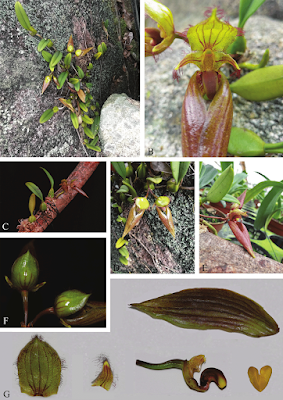
 Bulbophyllum yunxiaoense M.H. Li, J.F. Liu & S.P. Chen. 
A. Habitat and habit. B. Flower, front view. C. Flowering plant. D. Flower, back view. E. Flower, side view. F. Dorsal sepal, back view. G. Anatomy of the flower.

 Bulbophyllum yunxiaoense M.H. Li, J.F. Liu & S.P. Chen.
A. Plant. B. Flower, side view. C. Flower, front view. D. Dorsal sepal, petal, lateral sepal (clockwise). E. Column and lip, side view. F. Pollinarium (Drawn by Li-Jun Chen).


Ming-He LI, Xue-Yan YUAN, Ding-Kun LIU, Jiang-Feng LIU and Shi-Pin CHEN. 2017. Bulbophyllum yunxiaoense sp. nov. (Orchidaceae: Epidendroideae: Malaxideae) from Fujian, China: Morphological and molecular analyses.  Phytotaxa. 332(1); 59–66. DOI: doi.org/10.11646/phytotaxa.332.1.6 [2017-12-15]

Monday, May 12, 2025

[Botany • 2021] Zingiber ultralimitale subsp. matarombeoense (Zingiberaceae) • A New Subspecies from South-East Sulawesi, Indonesia

 
 Zingiber ultralimitale subsp. matarombeoense Ardiyani & Ardi, 

in ArdiyaniArdi et Santoso, 2021.

Abstract
A new subspecies of Zingiber ultralimitale Ardiyani & A.D.Poulsen was found at Matarombeo, South-East Sulawesi. Zingiber ultralimitale subsp. matarombeoense Ardiyani & Ardi, was described, illustrated and barcoded using four barcoding loci (rbcL, trnH-psbA, Internal Transcribed Spacer-ITS, and matK). Provisional conservation status assessment indicates a Critical Endangered (CR) status. The taxonomic placement into section was determined based on morphology, molecular, and pollen SEM data.

Keywords: Indonesia, limestone, scanning electron microscope, South-East Sulawesi, Wallacea, Monocots


Zingiber ultralimitale subsp. matarombeoense Ardiyani & Ardi


MARLINA ARDIYANI, WISNU H. ARDI, WAHYUDI SANTOSO. 2021. Zingiber ultralimitale subsp. matarombeoense Ardiyani & Ardi (Zingiberaceae), A New Subspecies from Sulawesi.  Phytotaxa. 527(1); 32-40. DOI: doi.org/10.11646/phytotaxa.527.1.3 [2021-11-26]


Friday, May 2, 2025

[Botany • 2017] Pleroma carajasense (Melastomataceae) • A New Species endemic to Ironstone Outcrops in the Brazilian Amazon


Pleroma carajasense K.Rocha, R.Goldenb. & F.S.Mey.,

in RochaGoldenbergViana et Meyer, 2017.

Abstract
A new species of Pleroma from Serra dos Carajás, Pará state, Brazil, is described. Pleroma carajasense occurs in southeastern Amazonia, northern Brazil, in canga vegetation, on ironstone outcrops. It is morphologically related to Tibouchina caatingae, because both are shrubs with elliptic to oval leaves, conspicuous petioles (3–17 mm and 10–15 mm, respectively), a pair of elliptic bracteoles, and purple petals, anthers (both cycles) and style. Pleroma carajasense differs from T. caatingae by its chartaceous leaves (versus coriaceous in T. caatingae), with an obtuse to cuneate base (vs. obtuse to subcordate), hypanthium 4–7 × 1.2–4 mm (vs. 10–15 × 3–5 mm). According to IUCN criteria, this species should be considered endangered (EN). A morphological description, illustrations, photos in the field, scanning electronic micrographs of the leaf indumentum and seeds, information on conservation status and distribution are presented.

Keywords: canga, ferruginous soil, Melastomeae, Tibouchina

 Living plant photos of Pleroma carajasense.
 A-C. Habitat and habit of flowering plants. D-E. Inflorescences. F. Flower with a pilose style base. G. Flower with a glabrous style. H. Fruiting plant. I. Mature fruits with persistent sepals.
 A-G by Pedro Viana, H-I by Renato Goldenberg.


Pleroma carajasense K.Rocha, R.Goldenb. & F.S.Mey. sp. nov.


Keila Cristina de Jesus ROCHA, Renato GOLDENBERG, Pedro Lage VIANA, Fabrício Schmitz MEYER. 2017. Pleroma carajasense (Melastomataceae), A New Species endemic to Ironstone Outcrops in the Brazilian Amazon. Phytotaxa. 329(3); 233–242. DOI: doi.org/10.11646/phytotaxa.329.3.4 [December 2017] 

Wednesday, March 19, 2025

[Entomology • 2017] Pukupuku arunachalensis • A New Species (Coleoptera: Scarabaeidae: Rutelinae) from Arunachal Pradesh, India


Pukupuku arunachalensis
 Gupta, Chandra & Bezdek, 2017


Abstract
 A new species of the genus Pukupuku Muramoto, 2006 is described from the state of Arunachal Pradesh (Northeast India): Pukupuku arunachalensis sp. nov. Relevant diagnostic characters are illustrated and compared with closely related species, Pukupuku curtus (Arrow, 1919) and Pukupuku katsurai (Muramoto, 2002). The distribution of the new species is mapped. 

Keywords. New species, taxonomy, Northeast India, diagnosis, Palaearctic Region. 

Order Coleoptera Linnaeus, 1758
Suborder Polyphaga Emery, 1886
Superfamily Scarabaeoidea Latreille, 1802

Family Scarabaeidae Latreille, 1802
Subfamily Rutelinae MacLeay, 1819

Genus Pukupuku Muramoto, 2006

Pukupuku arunachalensis sp. nov.

 Diagnosis: The newly described species can be easily distinguished by its unique structure of aedeagus, shape and size of mandibles which are sharply pointed at end with a small tooth in middle at outer edge (in lateral view), and four times as long as clypeus, pronotum smooth without setae, pygidium smooth (setae absent in male, present in female). See Table 1 for detailed differential characters separating P. arunachalensis sp. nov. from P. curtus and P. katsurai.

Etymology: The name arunachalensis refers to the Northeastern Himalayan state of India, Arunachal Pradesh.


Devanshu Gupta, Kailash Chandra and Aleš Bezděk. 2017. Pukupuku arunachalensis sp. nov. (Coleoptera, Scarabaeidae, Rutelinae) from Arunachal Pradesh, India. European Journal of Taxonomy.  257: 1–11. DOI: doi.org/10.5852/ejt.2017.257
Researchgate.net/publication/312038578_Pukupuku_arunachalensis_sp_nov_from_Arunachal_Pradesh_India

Monday, March 10, 2025

[Entomology • 2017] Cochleopsaltria duffelsi • A New Genus and Species (Hemiptera: Cicadomorpha: Cicadidae) from northern Vietnam


Cochleopsaltria duffelsi 
 Pham & Constant, 2017


Abstract 
A new genus and new species of Cicadidae, Cochleopsaltria duffelsi gen. and sp. nov., are described from northern Vietnam. This genus is allied to the genus Orientopsaltria Kato, 1944 but is distinguished by the broad and very convex distal two thirds of the male opercula, the uncal lobes that are fused at the base and the apically rounded upper pygofer lobes that have no protrusion. A distribution map and biological data for Cochleopsaltria duffelsi gen. and sp. nov. are provided. 

Keywords: Cicada, Cochleopsaltria, Cicadinae, morphology

Cochleopsaltria duffelsi gen. et sp. nov., holotype ♂. A, head and thorax, dorsal view. B, operculum, ventral view. C, operculum, laterodorsal view.

 Distribution of Cochleopsaltria duffelsi gen. et sp. nov. in northern Vietnam.
 Cochleopsaltria duffelsi sp. nov., holotype ♂. A, dorsal view. B, ventral view.

Cochleopsaltria duffelsi gen. and sp. nov.


Hong Thai Pham and Jérôme Constant. 2018. A New Genus and Species of Cicada from Vietnam: Cochleopsaltria duffelsi gen. et sp. nov. (Hemiptera: Cicadomorpha: Cicadidae). Bulletin de la Société royale belge d’Entomologie/Bulletin van de Koninklijke Belgische vereniging voor entomologie. 153;

https://biblio.naturalsciences.be/associated_publications/societe-royale-belge-dentomologie-koninklijke-belgische-vereniging-voor-entomologie-1/srbe-154-2018/pham-constant-bulletin-srbe-kbve-153-3-2017-226-230.pdf


Thursday, August 1, 2024

[Paleontology • 2024] Rapid Volcanic Ash Entombment reveals the 3D Anatomy of Cambrian Trilobites


Artistic reconstruction of two species of trilobite an instant before burial in a flow of volcanic ash 510 million years ago.
Gigoutella mauretanica (Ortega-Hernández, Azizi, Hearing, Harvey, Edgecombe, Hafid & El Hariri, 2017)

in El Albani, Mazurier, Edgecombe, Azizi, El Bakhouch, ... et Paterson, 2024. 

Abstract
Knowledge of Cambrian animal anatomy is limited by preservational processes that result in compaction, size bias, and incompleteness. We documented pristine three-dimensional (3D) anatomy of trilobites fossilized through rapid ash burial from a pyroclastic flow entering a shallow marine environment. Cambrian ellipsocephaloid trilobites from Morocco are articulated and undistorted, revealing exquisite details of the appendages and digestive system. Previously unknown anatomy includes a soft-tissue labrum attached to the hypostome, a slit-like mouth, and distinctive cephalic feeding appendages. Our findings resolve controversy over whether the trilobite hypostome is the labrum or incorporates it and establish crown-group euarthropod homologies in trilobites. This occurrence of moldic fossils with 3D soft parts highlights volcanic ash deposits in marine settings as an underexplored source for exceptionally preserved organisms.

Microtomographic reconstruction of the trilobite species Gigoutella mauretanica in ventral view

Gigoutella mauretanica (Ortega-Hernández, Azizi, Hearing, Harvey, Edgecombe, Hafid & El Hariri, 2017)


Abderrazak El Albani, Arnaud Mazurier, Gregory D. Edgecombe, Abdelfattah Azizi, Asmaa El Bakhouch, Harry O. Berks, El Hafid Bouougri, Ibtissam Chraiki, Philip C. J. Donoghue, Claude Fontaine, Robert R. Gaines, Mohamed Ghnahalla, Alain Meunier, Alain Trentesaux and John R. Paterson. 2024. Rapid Volcanic Ash Entombment reveals the 3D Anatomy of Cambrian Trilobites. SCIENCE. 384, 6703; 1429-1435. DOI: doi.org/10.1126/science.adl4540
 
Editor’s summary: Trilobites are probably the best known denizens of the Cambrian Period. Their distinctive fossilized external forms are well recognized from an extensive fossil record spanning the early Cambrian to the Permian extinction. The vast majority of trilobite fossils display only external morphology, however, leaving much unknown about their internal morphology. El Albani et al. describe several trilobite fossils created by rapid death and preservation due to an underwater pyroclastic flow. This preservation created three-dimensional fossils with a remarkably well-preserved anatomy. This enhanced understanding of trilobite anatomy has revealed several new features and provided key insights into crown group euarthropods. —Sacha Vignieri

 
COVER: This reconstruction of a shallow marine environment shows trilobites being rapidly engulfed by volcanic ash from an eruption that occurred more than 500 million years ago. Recently discovered trilobite fossils from Cambrian-aged rocks in Morocco have revealed three-dimensional soft-tissue anatomy, including features not previously observed in these extinct arthropods. This find highlights marine volcanic ash deposits as important sites of exceptional fossil preservation. || Image: A. El Albani

Thursday, June 27, 2024

[Arachnida • 2017] Oxyopes godeffroyi • The Australian Lynx Spiders (Araneae: Oxyopidae: Oxyopes) of the Godeffroy Collection, including the Description of A New Species


[A] Oxyopes punctatus L. Koch, 1878; [B] Oxyopes sp. indet.;
[E] Oxyopes sp. indet.; and [F] Oxyopes macilentus L. Koch, 1878. 

in Baehr, Harms, Dupérré et Raven, 2017
Images: Robert Whyte.

Abstract
The historical Godeffroy Collection of spiders at the Centrum für Naturkunde (CeNak) in Hamburg comprises several hundred type specimens from Australia and is an essential source for arachnologists around the world. In this paper, we re-describe and illustrate the Australian Oxyopes material from this collection. Most specimens were collected by C. F. Eduard Dämel for the Godeffroy Museum and described in 1871-1881 by pioneering arachnologist Ludwig Carl Christian Koch as part of the first monograph on Australian spiders: Die Arachniden Australiens. Twelve species are redescribed and properly illustrated for the first time: Oxyopes amoenus L. Koch, 1878, Oxyopes attenuatus L. Koch, 1878, Oxyopes elegans L. Koch, 1878, Oxyopes gratus L. Koch, 1878, Oxyopes gracilipes (White, 1849), Oxyopes macilentus L. Koch, 1878, Oxyopes molarius L. Koch, 1878, Oxyopes mundulus L. Koch, 1878, Oxyopes punctatus L. Koch, 1878, Oxyopes quadrifasciatus L. Koch, 1878, Oxyopes rubicundus L. Koch, 1878, and Oxyopes variabilis L. Koch, 1878. Oxyopes lautus L. Koch, 1878 is treated as a numen dubium because both palps are lost. The new species Oxyopes godeffroyi sp. n. is described from this historical material and was probably overlooked by Koch. An identification key for these species is provided and the history of these specimens reviewed briefly. A map shows the localities of the redescribed Oxyopes species and the general distribution of the Oxyopes species in Queensland.

Key Words: Taxonomy, systematics, new species, Amalie Dietrich, Eduard Dämel, Lynx Spiders, Australia


Live images of Oxyopes species from Australia:
 A, Oxyopes punctatus L. Koch, 1878; B, Oxyopes sp. indet.; C, Oxyopes sp. indet.; D, Oxyopes sp. indet.; E, Oxyopes sp. indet.; and F, Oxyopes macilentus L. Koch, 1878.
Images: Robert Whyte.


 Barbara C. Baehr, Danilo Harms, Nadine Dupérré and Robert Raven. 2017. The Australian Lynx Spiders (Araneae, Oxyopidae, Oxyopes) of the Godeffroy Collection, including the Description of A New Species. Evolutionary Systematics. 1; 11-37.  DOI: 10.3897/evolsyst.1.14652


Friday, June 21, 2024

[Arachnida • 2017] Portacosa cinerea • A New Genus for the south-east Australian Grey Wolf Spider (Araneae: Lycosidae: Lycosinae)


Portacosa cinerea  
 Framenau, 2017


Abstract
A new monotypic genus of Australian wolf spiders is proposed to accommodate the common south-east Australian Grey Wolf Spider, Portacosa cinerea gen. n. and sp. n. The genus includes large (total length 9.5–25.0 mm), uniformly grey-coloured wolf spiders with unique genital morphology, i.e. the ventral ridge of the tegular apophysis in the male pedipalp is comparatively sharp and situated towards its retrolateral edge, and the distinct anterior hood of the female epigyne is continuous with the inverted T-shaped median septum. Unlike most other members of the Lycosinae in Australia, the Grey Wolf Spider closes its burrow with a plug-like trapdoor. The species can be found in south-eastern mainland Australia (Queensland, New South Wales, Australian Capital Territory, Victoria, South Australia) and Tasmania. It prefers compacted, open and often sun-exposed habitats such as road verges and river banks, but can also be found in open woodlands and grasslands.

Key Words: 
taxonomy, systematics, Dingosa, trapdoor


 Live images and habitat of Portacosa cinerea gen. n. and sp. n.
 A
, male holotype (WAM T68032) from near Apex Park, Mildura, Victoria. B, male, same locality. 
C, female (WAM T56062) from Specimen Hill Bushland Reserve, Bendigo, Victoria, D, female from Red Hill, Canberra, Australian Capital Territory (WAM T67906);  

Family Lycosidae Sundevall, 1833
Subfamily Lycosinae Sundevall, 1833

Portacosa gen. n.
 
Portacosa cinerea gen. n. and sp. n. 

Etymology: 
The genus-group name is a composite noun derived from the Latin word portus – door, referring to the trapdoor-building behaviour of the type species and –cosa, a generic ending used for genera in the family Lycosidae. The gender is feminine.
The specific epithet is a Latin adjective (cinereus grey), referring to the colour and common name of the species, Grey Wolf Spider.

 Live images and habitat of Portacosa cinerea gen. n. and sp. n. 
E, open Eucalyptus camaldulensis riparian woodland, near Apex Park, Mildura, Victoria, where the holotype male (WAM T68032) was found. F, road embankment in Red Hill, Canberra, habitat of female WAM T67906. 
G, closed burrow of holotype male (WAM T68032). H, open burrow of female WAM T67906 from Red Hill, Canberra.


 Volker W. Framenau. 2017. Portacosa, A New Genus for the south-east Australian Grey Wolf Spider (Araneae, Lycosidae, Lycosinae). Evolutionary Systematics. 1: 77-86. DOI: 10.3897/evolsyst.1.14847

Monday, June 10, 2024

[Mollusca • 2017] Leoparreysia gen. nov. & Trapezidens gen. nov., Radiatula mouhoti, Trapezoideus panhai, ... • New Taxa of Freshwater Mussels (Unionidae) from A Species-rich but overlooked Evolutionary Hotspot in Southeast Asia


Shells of the endemic Parreysiinae taxa from the Sittaung River basin, Myanmar.
 (a) Leoparreysia canefrii Vikhrev, Bolotov et Kondakov gen. et sp. nov., Sittaung River near Taungoo, 
(b) Radiatula mouhoti Vikhrev, Bolotov et Konopleva sp. nov., Sittaung River near Taungoo, 
(c) Lamellidens brandti Bolotov, Konopleva et Vikhrev sp. nov., Pathi River, 
(d) Trapezidens obesa feae Kondakov, Konopleva et Vikhrev gen. et ssp. nov., Myit Kyi Pauk Stream,  
Scale bar = 2 cm.

in Bolotov, Vikhrev, Kondakov, Konopleva, Gofarov, Aksenova et Tumpeesuwan, 2017. 
 (Photos: Ekaterina S. Konopleva).


Abstract
Southeast Asia harbors a unique and diverse freshwater fauna of Mesozoic origin, which is under severe threat of extinction because of rapid economic development and urbanization. The largest freshwater basins of the region are certainly the primary evolutionary hotspots and they attract the most attention as key biodiversity areas for conservation. In contrast, medium-sized rivers are considered low-importance areas with secondary biodiversity, whose faunas originated via founder events from larger basins during the Pleistocene, although such a scenario has never been tested by using a phylogenetic approach. In this investigation, we used freshwater mussels (Unionidae) as a model to estimate the levels of endemism within the Sittaung, a little-known remote basin in Myanmar, compared with the surrounding larger rivers (Irrawaddy, Salween and Mekong). We discovered that the Sittaung represents an exceptional evolutionary hotspot with numerous endemic taxa of freshwater mussels. On the basis of our extensive dataset, we describe two new tribes, two genera, seven species and a subspecies of Unionidae. Our results highlight that medium-sized basins may represent separate evolutionary hotspots that harbor a number of endemic lineages. These basins should therefore be a focus of special conservation efforts alongside the largest Southeast Asian rivers.

Leoparreysiini Vikhrev, Bolotov et Kondakov tribe nov. 
Pilsbryoconchini Bolotov, Vikhrev et Tumpeesuwan tribe nov.


Shells of the endemic Parreysiinae taxa from the Sittaung River basin. (a) Leoparreysia canefrii Vikhrev, Bolotov et Kondakov gen. et sp. nov., Sittaung River near Taungoo, Myanmar (holotype RMBH biv254_4). (b) Radiatula mouhoti Vikhrev, Bolotov et Konopleva sp. nov., Sittaung River near Taungoo, Myanmar (holotype RMBH biv256). (c) Lamellidens brandti Bolotov, Konopleva et Vikhrev sp. nov., Pathi River, Myanmar (holotype RMBH biv243_14). (d) Trapezidens obesa feae Kondakov, Konopleva et Vikhrev gen. et ssp. nov., Myit Kyi Pauk Stream, Myanmar (holotype RMBH biv250_4).
Scale bar = 2 cm. (Photos: Ekaterina S. Konopleva).


Shells of the endemic Pseudodontinae and Rectidentinae taxa from the Sittaung River basin.
 Pseudodontinae (a,b), including (a) Pseudodon bogani Bolotov, Kondakov et Konopleva sp. nov., Kanni River, Myanmar (holotype RMBH biv241_5), and (b) P. manueli Konopleva, Kondakov et Vikhrev sp. nov., Pyowne Stream, Myanmar (holotype RMBH biv246_3).
Rectidentinae (c,d), including (c) Trapezoideus nesemanni Konopleva, Vikhrev et Bolotov sp. nov., Tauk Ue Kupt River, Myanmar (holotype RMBH biv255_2), and (d) T. panhai Konopleva, Bolotov et Kondakov sp. nov., Kyan Hone River (holotype RMBH biv138_4).
Scale bar = 2 cm. (Photos: Ekaterina S. Konopleva).

Haplotype-level phylogeny and distribution of Indo-Chinese Unionidae.
(a) Multi-locus fossil-calibrated phylogeny based on the BEAST 1.8.4 model and obtained for the complete data set of mitochondrial and nuclear sequences (five partitions: three codons of ...
(b) Map of distribution areas. Red circles indicate our collecting localities ...
 

Ivan N. Bolotov, Ilya V. Vikhrev, Alexander V. Kondakov, Ekaterina S. Konopleva, Mikhail Yu. Gofarov, Olga V. Aksenova and Sakboworn Tumpeesuwan. 2017. New Taxa of Freshwater Mussels (Unionidae) from A Species-rich but overlooked Evolutionary Hotspot in Southeast Asia. Scientific Reports. 7, Article number: 11573. DOI: 10.1038/s41598-017-11957-9

Sunday, May 26, 2024

[Crustacea • 2017] Heteromysis cancelli, H. fosteri & H. octopodis • Three New Species of Heteromysis (Mysida: Mysidae: Heteromysini) from the Cape Peninsula, South Africa, with first documentation of a mysid-cephalopod association


Heteromysis octopodis 
Wittmann & Griffiths, 2017


Abstract
Faunistic studies in sublittoral and littoral marine habitats on the Cape Peninsula, South Africa, have yielded three new species belonging to the genus Heteromysis, subgenus HeteromysisH. cancelli sp. n. associated with the diogenid hermit crab Cancellus macrothrix Stebbing, 1924, and H. fosteri sp. n. extracted from ‘empty’ urchin and gastropod shells. The first documented mysid-cephalopod association is reported for H. octopodis sp. n. which was found in dens occupied by Octopus vulgaris Cuvier, 1797, but was also captured from tide pools. The three new species differ from previously known E. Atlantic species, among other characters, by a single spine on the endopods of uropods in combination with large cornea and absence of median sternal processes on thoracic somites. They are also characterized by a white stripe along the dorso-lateral terminal margin of the eyestalks in living specimens. The new species appear quite similar to each other, but are distinguished by different depths of the telson cleft, different distributions of spines on the lateral margins of the telson, different numbers of segments on thoracic endopod 4, and by differently modified setae on the carpus of the third thoracic endopod, as well as on the carpopropodus of the fourth endopod. An updated key to the species of Heteromysis known from the E. Atlantic is given.

Keywords: Crustacea, hermit crab association, octopus association, ectocommensals, taxonomy, key to species, SE. Atlantic

 A subadult female of Heteromysis octopodis sp. n. with 11 mm body length from tide pool
B multi-species association inside den in 3 m depth, occupied by Octopus vulgaris, to the right with the crab Guinusia chabrus; upper arrow points to a mysid school of what we assume to be H. octopodis sp. n., lower arrow to a different but undetermined mysid species.
A, B from Miller’s Point, Cape Peninsula, South Africa; in situ images by Craig Foster B image is taken of the same octopus den from which the samples were collected, but on a different date. 


 Karl J. Wittmann and Charles L. Griffiths. 2017. Three New Species of Heteromysis (Mysida, Mysidae, Heteromysini) from the Cape Peninsula, South Africa, with first documentation of a mysid-cephalopod association. ZooKeys. 685; 15-47.  DOI:  10.3897/zookeys.685.13890

Tuesday, May 7, 2024

[Botany • 2017] Phyllagathis millelunata, P. phyllioides, P. violinifolia, P. wallacei, etc. (Melastomataceae: Sonerileae) • Ten New Species from Sarawak, Borneo


Phyllagathis rivularisP. wallaceiP. millelunata
P. rubrosetosaP. uluP. violinifolia
P. yodaeP. phyllioides
 
P. bicolorP. lii 

in Lin, Chen & Yang, 2018.

Abstract  
Ten undescribed species of Phyllagathis from southwestern Sarawak, named P. bicolorP. lii, P. millelunata, P. phyllioides, P. rivularis, P. rubrosetosa, P. ulu, P. violinifolia, P. wallacei and P. yodae are reported in this study. We describe and illustrate the ten new species after a careful study of the literature, herbarium specimens and living plants.

Keywords: Sonerileae, Melastomataceae, Sarawak, Borneo, Eudicots


Phyllagathis bicolor C.W. Lin, C.F. Chen & T.Y.A. Yang, sp. nov. 
Etymology: Bicolor” refers to the color of the leaves, with dark maroon background surrounded by an emerald green periphery

 Phyllagathis lii C.W. Lin, C.F. Chen & T.Y.A. Yang, sp. nov. 
Etymology: The specific epithet is named in honor of Mr. Weng-Feng Li, who grows this Phyllagathis and provided the specimens for our studies.

 Phyllagathis millelunata C.W. Lin, C.F. Chen & T.Y.A. Yang, sp. nov.
 Etymology: Latin, mille = thousand, luna = moon, referring to the vesiculate translucent (and scintillating in the sunshine) trichomes on both leaf surfaces, resembling numberless moons. 

Phyllagathis phyllioides C.W. Lin, C.F. Chen & T.Y.A. Yang, sp. nov.
Etymology: The specific epithet refers to the resemblance of this new species panduriform leaves to the leaf insect genus “Phyllium”.

 Phyllagathis rivularis C.W. Lin, C.F. Chen & T.Y.A. Yang, sp. nov. 
Etymology: rivularis means “river”, and the epithet refers to the fact that the new species grows along stream banks.


Phyllagathis rubrosetosa C.W. Lin, C.F. Chen & T.Y.A. Yang, sp. nov. 
Etymology:Rubrosetosa” refers to the red hairs on the leaf.

 Phyllagathis ulu C.W. Lin, C.F. Chen & T.Y.A. Yang. sp. nov. 
Etymology: Malay, ulu= upriver; referring to the new species being discovered in upstream Batang Ai.

  Phyllagathis violinifolia C.W. Lin, C.F. Chen & T.Y.A. Yang, sp. nov.
Etymology: The epithet refers to the panduriform-obovate leaves.

 Phyllagathis wallacei C.W. Lin, C.F. Chen & T.Y.A. Yang. sp. nov. 
Etymology: Named in honour of Alfred Russel Wallace, the noted naturalist who explored Simunjan in the19th century, and discovered many wild animals and plants.

 Phyllagathis yodae C.W. Lin, C.F. Chen & T.Y.A. Yang, sp. nov. 
Etymology: The specific epithet was chosen after “Yoda”, a character in Star Wars movies, who has a furry, wrinkled and greenish appearance. This new species is characterized by the hairy, rugose and greenish leaves that resembles Yoda, therefore we choose this special character as the epithet.


Che-Wei Lin, Chien-Fan Chen and T.Y. Aleck Yang. 2017. Ten New Species of Phyllagathis (Trib. Sonerileae, Melastomataceae ) from Sarawak, Borneo.  Phytotaxa. 302(3); 201–228. DOI:  10.11646/phytotaxa.302.3.1

Phyllagathis bicolorP. lii, P. millelunata, P. phyllioides P. rivularis, 
P. rubrosetosa
, P. ulu, P. violinifolia
P. wallacei P. yodae 
  C.W. Lin, C.F. Chen & T.Y.A. Yang

Wednesday, May 1, 2024

[Botany • 2017] Trigonostemon honbaensis (Euphorbiaceae) • A New Species from Mt. Hon Ba, Southern Vietnam


 Trigonostemon honbaensis Tagane & Yahara,  

in Tagane, Yahara, Dang, Toyama et Tran, 2017.

A new speciesTrigonostemon honbaensis Tagane & Yahara (Euphorbiaceae), sp. nov., from Hon Ba Nature Reserve in Khanh Hoa Province, southern Vietnam, is described and illustrated. DNA barcoding data of the rbcL and matK regions is provided. Trigonostemon honbaensis is most similar to T. longifolius Baill. ex Müll.Arg., but distinguished by its less hairy leaves, truncate leaf base (attenuate to obtuse in T. longifolius), larger petals, shorter staminal column, and anthers lacking appendages.

Key words: Euphorbiaceae, Hon Ba Nature Reserve, new species, Trigonostemon, Vietnam

 Trigonostemon honbaensis Tagane & Yahara, sp. nov.
A, flowering branch; B, portion of abaxial surface of leave; C, top branch; D, inflorescence; E & F, staminate flowers. 
A–E: 23 February 2014. 
 Scale bars G = 10 cm; H = 5 mm; J & K = 0.5 mm.


  Shuichiro Tagane, Tetsukazu Yahara, Van-Son Dang, Hironori Toyama and Hop Tran. 2017. Trigonostemon honbaensis (Euphorbiaceae), A New Species from Mt. Hon Ba, Southern Vietnam. Acta Phytotax. Geobot. 68(1): 39–44.