Showing posts with label Iguanidae. Show all posts

Monday, March 24, 2025

[Herpetology • 2025] Iguanas rafted more than 8,000 km from North America to Fiji


A Fijian crested iguana (Brachylophus vitiensis) resting on a coconut palm on the island of Fiji in the South Pacific. The four species of iguanas that inhabit Fiji and Tonga today are descended from ancestors that colonized the island within the past 34 million years, probably by rafting 5,000 miles across the Pacific Ocean from western North America.

in Scarpetta, Fisher, Karin, Niukula, Corl, Jackman et McGuire, 2025. 

Abstract
Founder-event speciation can occur when one or more organisms colonize a distant, unoccupied area via long-distance dispersal, leading to the evolution of a new species lineage. Species radiations established by long-distance, and especially transoceanic, dispersal can cause substantial shifts in regional biodiversity. Here, we investigate the occurrence and timing of the greatest known long-distance oceanic dispersal event in the history of terrestrial vertebrates—the rafting of iguanas from North America to Fiji. Iguanas are large-bodied herbivores that are well-known overwater dispersers, including species that colonized the Caribbean and the Galápagos islands. However, the origin of Fijian iguanas had not been comprehensively tested. We estimated the phylogenetic relationships and evolutionary timescale of the iguanid lizard radiation using genome-wide exons and ultraconserved elements (UCEs). Those data indicate that the closest living relative of extant Fijian iguanas is the North American desert iguana and that the two taxa likely diverged during the late Paleogene near or after the onset of volcanism that produced the Fijian archipelago. Biogeographic models estimate North America as the most probable ancestral range of Fijian iguanas. Our analyses support the hypothesis that iguanas reached Fiji via an extraordinary oceanic dispersal event from western North America, and which spanned a fifth of the earth’s circumference (>8,000 km). Overwater rafting of iguanas from North America to Fiji strengthens the importance of founder-event speciation in the diversification of iguanids and elucidates the scope of long-distance dispersal across terrestrial vertebrates.


A Fijian crested iguana (Brachylophus vitiensis) resting on a coconut palm on the island of Fiji in the South Pacific. The four species of iguanas that inhabit Fiji and Tonga today are descended from ancestors that colonized the island within the past 34 million years, probably by rafting 5,000 miles across the Pacific Ocean from western North America.
photo: Nicholas Hess

A map of the world 34 million years ago, showing hypothesized scenarios for the colonization of Fiji by Brachylophus. Based on new research, the most likely scenario is represented by the dark blue arrow from western North America to Fiji. The small red stars represent sites in North America where fossil iguanids have been found. The ranges of modern iguanids — in the Americas and Fiji and Tonga — are shown in light blue.


Simon G. Scarpetta, Robert N. Fisher, Benjamin R. Karin, Jone B. Niukula, Ammon Corl, Todd R. Jackman and Jimmy A. McGuire. 2025. Iguanas rafted more than 8,000 km from North America to Fiji. Proceedings of the National Academy of Sciences. 122 (12) e2318622122. DOI: doi.org/10.1073/pnas.2318622122 [March 17, 2025]

Iguanas floated to Fiji millions of years ago on an unprecedented raft journey, scientists say
https://www.universityofcalifornia.edu/news/iguanas-floated-fiji-millions-years-ago-unprecedented-raft-journey-scientists-say
 
Significance: Transoceanic dispersal to far-away islands is an important mechanism for the generation of new species lineages and biotas and has captivated scientists since at least the time of Darwin. Determining whether and how such events occur is challenging, particularly for hypothesized dispersals spanning thousands of kilometers. We addressed the enigmatic occurrence of Fijian iguanas via phylogenomic and biogeographic analyses, providing strong evidence that iguanas rafted >8,000 km from North America as early as the Paleogene. This represents the longest documented transoceanic dispersal in terrestrial vertebrates. Our findings elaborate on the importance of long-distance dispersal in the diversification of iguanids. Iguanid lizards display a propensity for overwater dispersal, which could stimulate further research into the predictability of these incredible biogeographic events.

Thursday, February 16, 2023

[Herpetology • 2023] Anolis quimbaya & A. tequendama • Revealing Anole Diversity in the Highlands of the Northern Andes: New and Resurrected Species of the Anolis heterodermus Species Group


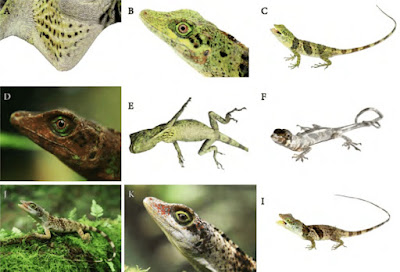
(A) Anolis quimbaya sp. nov., 
(B) A. richteri (Dunn, 1944) revalidated; 
(C) A. tequendama sp. nov.   
Moreno-Arias, Miguel A. Méndez-Galeano, Beltrán & Vargas-Ramírez, 2023

Abstract
The Anolis heterodermus group comprises eight big-headed and short-legged lizard species from the highlands of the northernmost South American Andes. Recent studies revealed unknown lineages within this group that had previously been categorized as a species complex. By widely sampling and applying an integrative taxonomic framework, we (1) assessed the species diversity of the group using a molecular dataset (two mitochondrial and one nuclear markers) along with an inclusive morphological study (scalation, scale configuration and ornamentation, morphometrics, and dewlap and body colour patterns); and (2) we inferred the evolutionary relationships within this species group. Our analyses confirmed the formerly reported differentiation between populations of those high-altitude lizards, and we identified several unknown evolutionary lineages. Our results provided evidence for the existence of nine distinct, independently evolving evolutionary lineages in the heterodermus group. As a result, we described two morphologically and genetically highly distinct lineages as species new to science (A. quimbaya sp. nov. and A. tequendama sp. nov.). We redescribed A. heterodermus and erected as a valid species Anolis richteri, a previously described synonym of A. heterodermus. A taxonomic key for the identification of species of the Phenacosaurus clade was presented. The identification of two additional poorly-known lineages suggested that the diversity of this group of lizards is still unknown; therefore, it is necessary to establish measurements for the group´s conservation, as well as to perform fieldwork and revision of herpetological collections to identify possible hidden diversity within the group.

Keywords: Anole species complex, high altitude lizards, integrative taxonomy, mtDNA, nDNA, morphology, South America

Dewlap and body of female (left) and male (right) of
Anolis heterodermus (A), A. inderenae (B), and A. vanzolinii (C). 

Anolis heterodermus Duméril, 1851 (redescription)

Anolis richteri (Dunn, 1944) revalidated


Dewlap and body of female (left) and male (right) of
Anolis quimbaya sp. nov. (A), A. richteri (B) and A. tequendama sp. nov. (C).


Anolis quimbaya sp. nov.

Diagnosis: Anolis quimbaya sp. nov. shares short limbs, a large, casqued head, a prehensile tail without caudal autotomy, and lamellar subdigital scales of all digits extending from the most proximal phalanges with the other species of the Phenacosaurus clade. Anolis quimbaya sp. nov. differs from A. proboscis, A. orcesi, A. euskalerriari and A. nicefori by the presence of granular scales surrounding dorsal heterogeneous flat scales. Anolis quimbaya sp. nov. further differs from A. heterodermus, A. richteri, A. tetarii, A. inderenae, and A. tequendama sp. nov. by an orange or green dewlap (A. vanzolinii orange only) from A. inderenae, A. heterodermus, A. richteri and A. tetarii by the presence of a discontinuous nuchal crest; from A. heterodermus and A. inderenae by the presence of a continuous row of enlarged sublabials that do not reach the mouth commissure; from A. heterodermus by a V-shaped crown. From A. vanzolinii by < 24 expanded lamellae under second and third phalange of fourth toe and < 35 lamella in total fourth toe, maximum snout-vent length 87 mm (110 mm), femoral length/snout-vent length ratio 0.17 (0.20), tail length/snout-vent ratio 1.19 (1.31), fourth toe length/snout-vent length ratio 0.13 (0.15) and sexual dimorphism in dewlap pattern.

Etymology: The specific epithet is used as a noun in apposition. The name refers to the extinct indigenous ethnic group called the Quimbaya who inhabited the central cordillera of Colombia, where the species is mainly distributed. “Los Quimbaya” in Spanish is also a noun to refer to the indigenous people belonging to the Kimbaya nation, to the people who previously spoke the Kimbaya dialect and the archaeological period when those people lived.

Common name: Quimbaya anole [English]. Anolis quimbaya [Spanish]


Anolis tequendama sp. nov.

Diagnosis: Anolis tequendama sp. nov. shares short limbs, a large casqued head, a prehensile tail without caudal autotomy, and lamellar subdigital scales of all digits extending from the most proximal phalanges with the other species of the Phenacosaurus clade. Anolis tequendama sp. nov. differs from A. proboscis, A. orcesi, A. euskalerriari and A. nicefori, by its strongly heterogeneous dorsal scalation. Anolis tequendama sp. nov. differs from A. nicefori by the presence of granular scales surrounding dorsal heterogeneous flat scales. A. tequendama sp. nov. differs from A. heterodermus, A. richteri, A. tetarii, A. inderenae, A. vanzolinii and A. quimbaya sp. nov. by a male dewlap colour uniformly brown or brown bluish. Anolis tequendama sp. nov. further differs from A. inderenae, A. heterodermus, A. richteri and A. tetarii by the presence of a discontinuous nuchal crest, from A. heterodermus and A. inderenae by the presence of a continuous row of enlarged sublabials that do not reach the mouth commissure; from A. heterodermus by a V-shaped crown; and from A. vanzolinii by < 24 expanded lamellae under second and third phalange of fourth toe and < 35 lamellae in total fourth toe.

Etymology: The specific epithet is used as a noun in apposition. The name refers to the Tequendama Falls, a popular waterfall near Bogotá that is part of the Bogotá River and has cosmological importance for the Muisca indigenous people; inhabitants of the Bogotá Plateau. In the Muisca language (called “Muysccubun”), Tequendama means “he who precipitates downward”, referring to the waterfall.

Common name: Tequendama anole [English]. Anolis tequendama [Spanish]


Conclusion: 
The utilisation of an integrative taxonomic framework allowed us to describe two species new to science: A. quimbaya sp. nov. and A. tequendama sp. nov., redescribe A. heterodermus and erect as a valid species A. richteri, a previous synonym of A. heterodermus. The identification of those lineages, including the two poorly-know lineages 1 and 2 suggests that the diversity of high-altitude lizards of the heterodermus group remains underestimated. The Middle Miocene to Pleistocene period of significant orogenic and climatic events in northern South America that have shaped the group´s evolutionary history may have produced higher diversity than previously existed and that we are now beginning to understand. Since this group of lizards inhabits the threatened Andean montane tropical region (Etter 1993) that is typically characterised by high human population densities and extreme transformation rates, the recognition of its diversity aimed at establishing protective measurements is an urgent priority (see Vargas Ramírez and Moreno-Arias 2014). Fieldwork and careful revision of herpetological collections aimed at increasing knowledge of Lineages 1 and 2, as well as identifying hidden diversity is also urgently needed.

 
 Rafael A. Moreno-Arias, Miguel A. Méndez-Galeano, Iván Beltrán and Mario Vargas-Ramírez. 2023. Revealing Anole Diversity in the Highlands of the Northern Andes: New and Resurrected Species of the Anolis heterodermus Species Group. Vertebrate Zoology. 73: 161-188.  DOI: 10.3897/vz.73.e94265

Monday, January 17, 2022

[Herpetology • 2021] Anolis nemonteae • A New Giant Anole (Iguanidae: Dactyloinae) from southwestern Ecuador


Anolis nemonteae 
 Ayala-Varela, Valverde, Poe, Narváez, Yánez-Muñoz & Torres-Carvajal, 2021

  
Abstract
We describe a new species of Anolis lizard from the Pacific slopes of the Andes of southwestern Ecuador at elevations between 372–1,000 m. The new species belongs to the Dactyloa clade and may be distinguished from other Anolis by size, external anatomy, mitochondrial DNA divergence, and dewlap color. Based on phylogenetic analyses of mitochondrial and nuclear DNA sequence data, we found that the new species is sister to A. fraseri in a clade composed primarily of large Dactyloid species. The new species is known from a protected area in southern Ecuador, Buenaventura Reserve, which suggests that at least some its populations are well protected.

Keywords: Reptilia, Andes, Anolis, phylogeny, South America, systematics, taxonomy

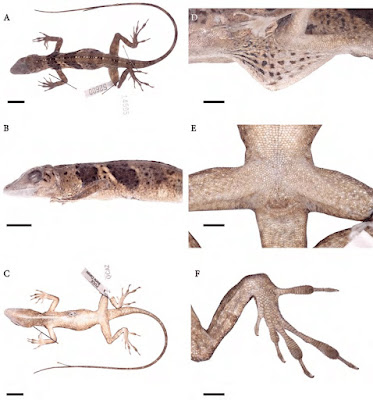
 Preserved holotype of Anolis nemonteae sp. nov. (QCAZ 14595)
in dorsal (A), lateral (B), and ventral (C) views,
with close-ups of dewlap (D), pelvic region (E), and right foot (F).
Scale bars = 10 mm (A, B, C) and 5 mm (D, E, F).
Photographs by M. Masache. 

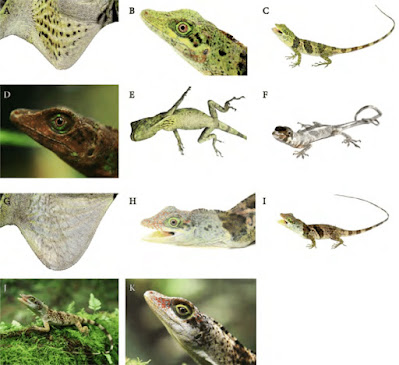
 Variation of color in life of Anolis nemonteae sp. nov.
Adult female QCAZ 14595 (holotype, A, B, C);
adult female JMG 0485 (D); juvenile female QCAZ 14431 (E); hatchling female QCAZ 14660 (F);
 adult male QCAZ 14596 (G, H, I); a
dult male JMG 0484 (J, K).
Photographs by A. E. Narváez (A, B, C, G, H, I), F. Ayala-Varela (E), P. Pintanel (F) and P. Romero (D, J, K).

Anolis nemonteae sp. nov.
Proposed standard English name: Star anoles
Proposed standard Spanish name: Anolis de las estrellas


Fernando Ayala-Varela, Sebastián Valverde, Steven Poe, Andrea E. Narváez, Mario H. Yánez-Muñoz and Omar Torres-Carvajal. 2021. A New Giant Anole (Squamata: Iguanidae: Dactyloinae) from southwestern Ecuador. Zootaxa. 4991(2); 295-317. DOI: 10.11646/zootaxa.4991.2.4 

Wednesday, April 15, 2020

[Herpetology • 2020] Iguana melanoderma Painted Black: A New Melanistic Endemic Species of Iguana Laurenti, 1768 (Squamata, Iguanidae) from Saba and Montserrat Islands (Lesser Antilles)


Iguana melanoderma
Breuil, Schikorski, Vuillaume, Krauss, Morton, Corry, Bech, Jelić & Grandjean, 2020


Abstract
The Lesser Antilles, in the Eastern Caribbean, is inhabited by three Iguana species: the Lesser Antillean iguana Iguana delicatissima, which is endemic to the northernmost islands of the Lesser Antilles, the introduced common iguana from South America, Iguana iguana iguana, represented also by the two newly described endemic subspecies Iguana iguana sanctaluciae from Saint Lucia and Iguana iguana insularis from Saint Vincent and the Grenadines, and Grenada, and the introduced Iguana rhinolopha from Central America. Drawing on both morphological and genetic data, this paper describes the Iguana populations from Saba and Montserrat as a new species, Iguana melanoderma. This species is recognized on the basis of the following combination of characteristics: private microsatellite alleles, unique mitochondrial ND4 haplotypes, a distinctive black spot between the eye and tympanum, a dorsal carpet pattern on juveniles and young adults, a darkening of body coloration with aging (except for the anterior part of the snout), a black dewlap, pink on the jowl, the high number of large tubercular nape scales, fewer than ten medium sized–triangular dewlap spikes, high dorsal spikes, and lack of horns on the snout. This new melanistic taxon is threatened by unsustainable harvesting (including for the pet trade) and both competition and hybridization from escaped or released invasive alien iguanas (I. iguana iguana and I. rhinolopha) from South and Central America, respectively. The authors call for action to conserve Iguana melanoderma in Saba and Montserrat and for further research to investigate its relationship to other melanistic iguanas from the Virgin Islands and coastal islands of Venezuela.

Keywords: Conservation Biology, Iguana, Lesser Antilles, microsatellites, mtDNA, new endemic species, phylogeny


Figure 8. The dorsal carpet pattern of young adults Iguana melanoderma.
 A Montserrat B Saba. The dorsal coloration is formed by darker more or less interrupted dorso-ventral bands (brown, dark grey) on a lighter ground. This pattern disappears in old individuals. The black patch between the eye and the tympanum is already visible.

Figure 9. A Old adult Iguana melanoderma from Montserrat B old adult from Saba. In these old individuals the carpet pattern is absent. The head is almost entirely black, except for the top and the snout. The dewlap, neck, dorsal spikes, and forelimb are black. Dorsal and lateral coloring is more variable, ranging from entirely black to a mosaic of black, brown, and dark green scales.

Iguana melanoderma sp. nov.

Diagnosis: A species of Iguana, with a distinctive melanistic phenotype, with a black dewlap, huge tubercular nape scales, the absence of horns on the snout.

Etymology: The name was chosen to emphasize the most conspicuous feature of this new taxon, from melano meaning black and derma meaning skin.

Common local names are: Melanistic Lesser Antilles iguana, Saban Black iguana


Figure 10. Iguana melanoderma sunbathing at dawn on the Windward coast of Saba.

 Figure 11. A basking Iguana melanoderma optimizing after different trials its warming by a curved position when the sun is low on the horizon on the Windward coast of Saba.

Figure 1. Geographical distribution of the three iguana groups identified by Lazell (1973) in the 1960s and new taxonomic proposition. In the 1960s, the invasive iguanas from South America (Iguana iguana) were only present in the îles des Saintes and Guadeloupe (Basse-Terre) and formed the Central Group. Now, alien iguanas are present and breed on every bank (van den Burg et al. 2018b). The southern group is now considered to support two subspecies Iguana iguana insularis and Iguana iguana sanctaluciae (Breuil et al. 2019). The northern group is considered here as a new species.


 Michel Breuil, David Schikorski, Barbara Vuillaume, Ulrike Krauss, Matthew N. Morton, Elizabeth Corry, Nicolas Bech, Mišel Jelić and Frédéric Grandjean. 2020. Painted Black: Iguana melanoderma (Reptilia, Squamata, Iguanidae) A New Melanistic Endemic Species from Saba and Montserrat Islands (Lesser Antilles). ZooKeys. 926: 95-131. DOI: 10.3897/zookeys.926.48679


Friday, November 2, 2018

[Herpetology • 2018] Anolis dracula • A New Cryptic Species of Anolis Lizard (Iguanidae, Dactyloinae) from northwestern South America


Anolis dracula  
Yánez-Muñoz, Reyes-Puig, Reyes-Puig, Velasco, Ayala-Varela & Torres-Carvajal, 2018


Abstract
A new species of Anolis lizard from the Andean slopes of southwestern Colombia and northwestern Ecuador, from between 1187 and 2353 m in elevation, is described. The new species can be distinguished from other Anolis in squamation, cranial osteology, hemipenial morphology, and nuclear and mitochondrial DNA. The new species is sister to Anolis aequatorialis, and it is suggested that previous records of A. aequatorialis in Colombia correspond to the new species described herein.

Keywords: Anolis dracula sp. n., diversity, morphology, phylogeny, Squamata, taxonomy


Figure 2. Comparison of Anolis dracula sp. n. with similar species.
From top to bottom: male of A. dracula, Holotype DHMECN 12579, 91 mm SVL; male of A. aequatorialis, not collected; male of A. fitchi DHMECN 11628, 74 mm SVL, male of A. podocarpus QCAZ 10126, 87 mm SVL.
Photographs, from top to bottom, by Mario Yánez-Muñoz, Carolina Reyes-Puig, Mario Yánez-Muñoz, and Fernando Ayala Varela. 

Figure 3. Head and throat region of Anolis aequatorialis (top, individual not collected) and Anolis dracula sp. n. (bottom left, DHMECN 12579, holotype, bottom right QCAZ 4365).
Photographs by Mario Yánez Muñoz, Carolina Reyes-Puig, and Santiago Ron.


Figure 4. Dewlap of Anolis dracula sp. n. and three similar species.
A male of A. dracula, paratype DHMECN 12579, 90.9 mm SVL B female of A. dracula, paratype DHMECN12587, 80.2 mm SVL C subadult female of A. dracula, DHMECN 12584, 53.4 mm SVL
D male of A. aequatorialis, QCAZ11605, E male of A. fitchi, QCAZ8770, 90.5 mm SVL F male of A. podocarpus, QCAZ10126, 87.0 mm SVL
Photographs by Mario Yánez-Muñoz (A, B, C), Omar Torres-Carvajal (D), Luis Coloma (E), and Santiago Ron (F). 

Figure 5. Color variation in Anolis dracula sp. n. From top to bottom: Holotype, male DHMECN 12579; male paratype DHMECN 12580; female paratype DHMECN 12760, 72.3 mm SVL; subadult male DHMECN 12578, 70.4 mm SVL.
Photographs by Mario Yánez-Muñoz.

Anolis dracula sp. n.
 Proposed standard English name: Dracula Anole 
Proposed standard Spanish name: Anolis dracula

Diagnosis: We assign Anolis dracula to the Dactyloa clade within Anolis (Poe 2004, Poe et al. 2017) based on the following combination of characters: sexual size dimorphism; large body with high numbers of lamellae; more than 20 scales across the snout; Alpha type caudal vertebrae; prefrontal bone separated from nasal; lengthened dentary and loss of angular.

Anolis dracula is most similar in morphology and coloration to A. aequatorialis (character states in parentheses), but differs from it in the following characters: large and robust hemipenes, 14 mm (4.7 mm; W = 0; p = 0.004), with a well-developed spermatic sulcus (hemipenis small; Figure 8); well-developed parietal crests, bowed outwards and projected laterally (relatively straight parietal crests, without laterally extending edges) (Figure 9); pineal foramen large, oval (rounded and small), and contacting fronto-parietal fissure (pineal foramen not contacting fronto-parietal fissure; Figure 9); rugose (smooth) basioccipital and sphenoccipital tubercles; jugal and squamosal in contact (separated by postorbital; Figure 10); posterior edge of dentary extending over more than a quarter of supra-angular (1/8 the size of supra-angular; Figure 10); dewlap scales cream (green or yellowish green) and in seven (10) rows in males, yellow or turquoise (green or yellowish green) and in five (six) rows in females (Figure 4); edge of dewlap cream (green or yellowish green); dewlap background brown or reddish brown (yellowish green to black), with orange (yellowish green, turquoise or yellowish orange) spots in males; dewlap background reddish brown to black (dark brown to black) in females; throat and chin cream splashed with dark brown (yellowish green); some males exhibit a lateral dark brown ocellus on neck, similar in size to eye (green, turquoise or brown, larger than eye); some females bear a dorsal, longitudinal brown stripe (absent; Figure 3); dark transverse bands on limbs of females weakly defined or absent (limb bands well defined in females, Figs 5, 6); smaller body size, 76.2 ± 8.5 mm SVL, (82.9 ± 9.2 mm; t = 2.96; p = 0.00431); shorter head, 20.6 ± 2.2 mm head length (21.5 ± 1.9; t = 2.18; p = 0.03328); narrower head, 11.1 ± 1.2 mm head width (12.0 ± 1.2 mm; t = 2.99; p = 0.004); shorter forelimbs, 41.4±4.3 mm (45.6 ± 5.4 mm; t = 3.44; p = 0.001); shorter hind limbs, 73.0 ± 7.7 mm (79.1 ± 8.3 mm; t = 2.999; p = 0.004); larger interparietal scale, 1.48 ± 0.25 mm in length (1.22 ± 0.2 mm; t = -4.439; p = -3.85 e-05); narrower tympanum, 2.6 ± 0.3 mm in length (2.8 ± 0.4 mm; t = 2.29; p = 0.027) (Figure 11; Tables 3–4).


Figure 13. Distribution of Anolis dracula sp. n. and A. aequatorialis.
White star represents the type locality of A. dracula and the black star the type locality of A. aequatorialis. The blue line corresponds to the Mira River Basin. The black triangles indicate samples used in the phylogeny for each species. The source of the raster layer for the map is from naturalearthdata.com.

Figure 12. Phylogeny of Dactyloa including Anolis dracula sp. n., 50% majority-rule consensus tree obtained from a Bayesian analysis of 117 specimens, two mitochondrial genes (COI, ND2) and one nuclear gene (RAG1). Numbers above branches correspond to Bayesian posterior probability (PP) values; asterisks represent PP ≥ 0.95; scale bar corresponds to the mean number of nucleotide substitutions per site.
Photographs from top to bottom: Anolis podocarpus (Santiago R. Ron-BIOWEB), A. fitchi (Juan C. Sánchez-BIOWEB), A. aequatorialis (Diego Quirola-BIOWEB), A. dracula (Mario Yánez-Muñoz). 


Etymology: The specific epithet dracula it is a noun in apposition that refers to the Dracula Reserve, located within the distribution of the new species and near its type locality. The Dracula Reserve is an initiative of the EcoMinga Foundation, sponsored by the Orchid Conservation Alliance, Rainforest Trust, University of Basel Botanical Garden, and their individual donors. The Reserve protects an area with a high diversity of orchids of the genus Dracula.


 Mario H. Yánez-Muñoz, Carolina Reyes-Puig, Juan Pablo Reyes-Puig, Julián A. Velasco, Fernando Ayala-Varela and Omar Torres-Carvajal. 2018. A New Cryptic Species of Anolis Lizard from northwestern South America (Iguanidae, Dactyloinae). ZooKeys. 794: 135-163. DOI: 10.3897/zookeys.794.26936


Resumen: Describimos una nueva especie de Anolis de las estribaciones de los Andes del suroccidente de Colombia y noroccidente de Ecuador, entre los 1187 y 2353 metros de elevación. La nueva especie puede ser distinguida de otros Anolis por caracteres de escamación, osteología craneal, morfología hemipenial, y ADN nuclear y mitocondrial. La nueva especie es hermana de A. aequatorialis, por lo que sugerimos que los registros previos de A. aequatorialis en Colombia corresponden a la nueva especie descrita en este artículo.

Palabras clave: Anolis dracula sp. n., diversidad, filogenia, morfología, Squamata, taxonomía

Wednesday, November 29, 2017

[Paleontology • 2017] The Squamation of the Eocene stem-Basilisk Geiseltaliellus maarius (Squamata: Iguanidae: Corytophaninae) from Messel, Germany


Geiseltaliellus maarius  Smith, 2009

life reconstruction by J. Eberhardt & A. Vogel  (SMF)
Smith, 2017SALAMANDRA. 53(4) 

Abstract

 An exceptional new specimen of the stem-basilisk Geiseltaliellus maarius from the middle Eocene of Messel, Germany, preserves details of the squamation of this extinct species. The dorsum and extremities were covered by small, rhomoidal scales, about 0.2 mm in size in most places; somewhat larger scales were present on the lower extremities and on the head. Scales of the venter were arranged in transverse rows, unlike in extant Polychrus and Laemanctus. There is some evidence that the scales on the extremities possessed keels, as in extant basilisks and Polychrus. Keratin appears to be preserved in places. The “Oberhäutchen” is nearly featureless, probably the result of postmortem microbial decomposition; scale organs were not observed. Overall, the body of G. maarius possessed a fine, homogeneous squamation most similar to Basiliscus. Possible sexual dimorphism in the form of the parietal crest raises the prospect of a projecting median keel composed of skin in male G. maarius, although direct evidence on this point is currently lacking. The squamation of the tail is discussed in light of the pseudoautotomy shown by this species. 

Key words: Fossils, Corytophanidae, Eocene, scales, keratin.


Figure 1. Skeleton with skin shadows of Geiseltaliellus maarius, SMF ME 11380a (part).
 (A) Detail of temple region of head. (B) Detail of throat or shoulder region. (C) Detail of right lower leg scales (over tibia and fibula). (D) Detail of left lower leg scales (torn downward and preserved around toe). (E) Detail of digit IV of left pes. Scale bar is 5 mm.

Figure 8. Reconstruction of the squamation of male Geiseltaliellus maarius from Messel.
Juliane Eberhardt (SMF) drew the life reconstruction, colored by Anika Vogel (SMF). 


 K. T. Smith. 2017. The Squamation of the Eocene stem-basilisk Geiseltaliellus maarius (Squamata: Iguanidae: Corytophaninae) from Messel, Germany. SALAMANDRA. 53(4); 519–530.  


Tuesday, June 6, 2017

[Herpetology • 2017] Brachylophus gau • A New Species of Iguana Brachylophus Cuvier 1829 (Iguania: Iguanidae) from Gau Island, Fiji Islands


Brachylophus gau
Fisher, Niukula, Watling & Harlow; 2017

Gau Iguana ||  DOI: 10.11646/zootaxa.4273.3.5 
 
holotype (SUVA H 0264) Painting by Cindy Hitchcock. 

Abstract

The south Pacific iguanas (Brachylophus) currently have three recognized living species in Fiji.  Recent surveys have uncovered more specific variation (morphological and genetic) within the genus and have better defined the geographic ranges of the named species.  One of these recent discoveries is a strikingly different iguana from all other island populations in Fiji which is restricted to Gau Island of the Lomaiviti Province.  Gau is the fifth largest island in Fiji and maintains excellent upland forests in the higher elevations.  We describe this population from Gau Island as a new speciesBrachylophus gau sp. nov., in recognition of its type locality.
  
Keywords: Reptilia, Pacific islands, endemism, conservation, Iguanian, Brachylophus, Gau Island


Brachylophus gau sp. nov. 
Gau Iguana (pronounced Ngau)

Brachylophus fasciatus Gibbons 1984 (first map showing island record); Zug 1991; Morrison 2003 (on maps as literature record). 
Brachylophus bulabula Fisher, Harlow, Edwards, and Keogh 2008. 

FIGURE 2. Illustration of the holotype (SUVA H 0264; left) and paratype female (SUVA H 0265; right) of Brachylophus gau sp. nov. The painting is from photographs of these specimens and others from life. Measurements to scale within illustration. The holotype is missing later 2/3 of tail, but tail drawn here based on photos from other males. 
Painting by Cindy Hitchcock. 

FIGURE 4. Photo of a live male Brachylophus gau sp. nov., illustrating the green throat and diffusion within the dorsal bands. Photo by Joerg Kretzschmar.
FIGURE 5. Photo of live female Brachylophus gau sp. nov., illustrating the overall green coloration and light spotting. Photo by Theo Blossom.

Diagnosis. This species has a unique combination of color pattern characters that distinguish it from all other species of described Brachylophus (Figures 2–7, Table 1). It also does not match any museum specimens we have previously seen in collections, except two from the BMNH that previously lacked specific locality info. These specimens are included in the type series as we were able to determine their provenance as Gau Island (see below in Provenance of Historic Specimens section). Although added to the type series, their measurements are left out of comparisons, but included in Table 2. We found that there are no locality specific museum vouchers that could represent extinct island populations of this species. Otherwise, this species differs from B. vitiensis by having sexually dichromatism, with banded males and females that are either unicolor or with small spots, and a maximum snout vent length for both sexes of 153 mm, versus 255 mm for B. vitiensis. It differs from B. bulabula and fasciatus in that males and females have green throats, whereas in these species males have white solid or white with green/grey spots or blotches, as do the females in most populations. Although in certain populations the females in B. bulabula and fasciatus the throat will be unicolor green, but never the males. It differs from the other three species by having a primarily green colored nasal scale. The mean snout vent length is 149.2 and max size for B. gau is 153 mm (n = 7), versus adult B. fasciatus with a mean 154.5 mm SVL and a maximum 176 mm SVL (n = 57) and B. bulabula with a mean 156.6 mm and a maximum 195 mm SVL (n = 23) (Table 1).

 Etymology. The specific epithet is for the only island where the species is known to occur, Gau.

Distribution. Brachylophus gau appears restricted to the large inland forest patches on Gau Island (Figure 1). Iguanas were reported from Gau by Watling (1986), but no specimens were collected or described. It continues to be widespread in high quality forest habitat in the interior of Gau Island (Figure 8), with some individuals also in degraded forest closer to the coast (Figure 9). Gau is about 136 sq. km. in size and is the fifth largest island in Fiji.


 live female Brachylophus gau sp. nov., illustrating the overall green coloration and light spotting


Robert N. Fisher, Jone Niukula, Dick Watling and Peter S. Harlow. 2017. A New Species of Iguana Brachylophus Cuvier 1829 (Sauria: Iguania: Iguanidae) from Gau Island, Fiji Islands. Zootaxa. 4273(3); 407–422.  DOI: 10.11646/zootaxa.4273.3.5


Tuesday, May 16, 2017

[Herpetology • 2017] Shedding Light On the Imps of Darkness: An Integrative Taxonomic Revision of the Galápagos Marine Iguanas (Genus Amblyrhynchus)


 Amblyrhynchus cristatus godzilla
Miralles, Macleod, Rodríguez, Ibáñez, Jiménez-Uzcategui, Quezada, Vences & Steinfartz, 2017


Abstract
Marine iguanas are among the most highly emblematic taxa of the Galápagos archipelago but have paradoxically received little attention from taxonomists. Amblyrhynchus is currently considered as a monotypic genus with a total of seven subspecies, A. cristatus cristatus, A. c. nanus, A. c. venustissimus, A. c. albemarlensis, A. c. hassi, A. c. mertensi and A. c. sielmanni. Although consensually followed for more than half a century, this classification does not properly reflect the main natural subdivisions inferred by more recent molecular evolutionary studies. We integrate population genetics, phylogenomics and comparative morphology to propose an updated taxonomy reflecting the evolutionary history of this group. We recognize a single species with 11 divergent population clusters at the level of subspecies: A. c. albermarlensis is recognized as a junior synonym of A. c. cristatus, and five new subspecies are described: Amblyrhynchus cristatus godzilla subsp. nov. (San Cristóbal-Punta Pitt), A. c. jeffreysi subsp. nov. (Wolf and Darwin), A. c. hayampi subsp. nov. (Marchena), A. c. trillmichi subsp. nov. (Santa Fé) and A. c. wikelskii subsp. nov. (Santiago). Recognizing the genetically divergent population clusters as subspecies also highlights several of them as management units in need of conservation efforts, such as the two subspecies endemic to San Cristóbal.

Keywords: Amblyrhynchus, Galápagos, integrative taxonomy, management units (MUs), Marine Iguana, new subspecies. 


Fig 5: Overview of the phenotypic diversity among Amblyrhynchus cristatus subspecies: (A–C) Amblyrhynchus cristatus hassi from Santa Cruz (SFM 57412, 57407, 57408) (D–F) A. cwikelskii subsp. nov. from Santiago (SFM 57447, 57448, 57446), (G–N) A. c. cristatus from Fernandina (OUMNH 6176, CAS 11512, 11511, 11510) and Isabela (SFM 64179, 11258, 65996, 65998), (O–Q) A. c. mertensi from San Cristóbal (SFM 57427, 57430, 57424), (R) A. c. trillmichi subsp. nov. (uncollected living specimen), (S) A. c. godzilla subsp. nov. (uncollected living specimen). HT: holotype, NT: neotype, PT: paratype.
  
Fig 6: Overview of the phenotypic diversity among Amblyrhynchus cristatus subspecies.(A–D) Amblyrhynchus cristatus venustissimus from Champion (CAS 11062) and Española (SFM 57415, 49853, 57413), (E–G) A. c. sielmanni (CAS 12565, SFM 57417, CAS 12570), (H–J) A. c. nanus from Genovesa (NHM 1946.8.30.20, SFM 57432, SFM 57445), (K–N) A. c. hayampi subsp. nov. from Marchena (CAS 12467, 12458, 12449, 12471), (O–U) A. c. jeffreysi subspnov. from Wolf (CAS 12690, CAS-SUR 4777, CAS 12693, CAS 12961) and Darwin (CAS 12694, 12696, 12695). HT: holotype, PT: paratype.


Amblyrhynchus cristatus Bell, 1825 

Amblyrhynchus cristatus cristatus Bell, 1825 (Figs 5G–N, 7)
Amblyrhynchus cristatus nanus Garman, 1892 (Figs 6H–J, 7)
Amblyrhynchus cristatus venustissimus Eibl-Eibesfeldt, 1956 (Figs 6A–D, 7)
Amblyrhynchus cristatus hassi Eibl-Eibesfeldt, 1962 (Figs 5A–C, 7)
Amblyrhynchus cristatus mertensi Eibl-Eibesfeldt, 1962 (Figs 5O–Q, 7)
Amblyrhynchus cristatus sielmanni Eibl-Eibesfeldt, 1962 (Figs 6E–G, 7)

Fig 7: Photographic plate showing the different subspecies of Marine Iguana (living mature males exclusively).
(A) Amblyrhynchus cristatus nanus, Genovesa, (B) A. c. hayampi subsp. nov., Marchena, (C) A. c. sielmanni, Pinta, (D, E) A. c. venustissimus, Española and Floreana, respectively, (F) A. c. trillmichi subsp. nov., Santa Fé, (G) A. c. hassi, Santa Cruz, (H) A. c. cristatus, Fernandina, (I) A. c. cristatus, Isabela, (J) A. c. mertensi, San Cristóbal, (K) A. c. godzilla subsp. nov., San Cristóbal, (L) A. c. wikelskii subsp. nov., Santiago.
Pictures from A. Ibañez (E, K), M. Krueger (A), H. Snell (B, D, H), S. Steinfartz (C, I, L), M. Vences (G, J), M. Vitousek (F).  DOI:  10.1093/zoolinnean/zlx007   

Fig 8: Distribution of the different subspecies of Galápagos marine iguanas according to the classification of Eibl-Eibesfeldt (1962) and the new taxonomy proposed herein. The orange dot on the southern coast of San Cristóbal represents the population of putative migrant specimens of A. c. venustissimus.


Amblyrhynchus cristatus hayampi subsp. nov. (Figs 6K–N, 7, 9B)

Etymology: The subspecific epithet hayampi refers to the word used to designate the common iguana in Kichwa (a Quechuan language representing one of the three official languages of Ecuador and currently spoken by a million people in South America).

Geographic distribution: Marchena and very likely its satellite islets (Fig. 8).


Amblyrhynchus cristatus jeffreysi subsp. nov. (Figs 6O–U, 7, 9A)

Etymology: The subspecies name is a patronym for Jeffreys Málaga, a ranger of the Galápagos National Park with an outstanding interest and enthusiasm for the fauna and flora of the Galápagos, and especially for marine iguanas. Jeffreys Málaga has been awarded several times ‘Guardaparque del Año,’ or Park Warden of the Year and has been an essential part of our team during several excursions to the Galápagos.

Geographic distribution: Wolf, Darwin (tentative assignment), Roca Redonda and very likely their satellite islets (Fig. 8).


Amblyrhynchus cristatus godzilla subsp. nov. (Figs 5S, 7, 10)

Etymology: The subspecific epithet refers to the fictional saurian monster from the eponym movie franchise, Godzilla, created by Tomoyuki Tanaka (IMDb, 2016). Explicitly mentioned in the title sequence of the 1990s American remake (Emmerich, 1998), the physical appearance and swimming behaviour of marine iguanas were a significant source of inspiration to the creature′s designer (Patrick Tatopoulos, personal communication). The name is an invariable noun in apposition.

Geographic distribution: Northern (north-eastern) part of San Cristóbal and the satellite islets off the northern coast of San Cristóbal (Fig. 8).


Amblyrhynchus cristatus trillmichi subsp. nov. (Figs 5R, 7)

Etymology: The subspecific epithet refers to Prof. Dr. Fritz Trillmich, a foremost biological researcher in Germany who has spent a lifetime working on the biology of the Galápagos islands. For many years Fritz Trillmich worked together with Martin Wikelski on the island of Santa Fé, where their research on the local population produced important insights into the behaviour and ecology of marine iguanas. In addition to undertaking his own research, Fritz Trillmich is Professor Emeritus of Behavioural Ecology at the University of Bielefeld where he continues to inspire and mentor generations of young researchers who will continue his legacy for years to come.

Geographic distribution: Santa Fé and very likely its satellite islets (Fig. 8).


Amblyrhynchus cristatus wikelskii subsp. nov. (Figs 5D–F, 7, 9C)

Etymology: The subspecies name is a patronym for Prof. Dr. Martin Wikelski in recognition of his outstanding research on marine iguanas for several decades. Martin Wikelski has been fascinated by marine iguanas, which served as a study system for his behavioural and ecological research from his PhD onwards. He has published important papers on marine iguana ecology and conservation, for instance demonstrating the devastating effects of an oil spill on this species, and showing that marine iguanas can shrink in response to starvation induced by El Niño–based climate fluctuations.

Geographic distribution: Santiago, Rábida and very likely their satellite islets (Fig. 8).


Aurélien Miralles, Amy Macleod, Ariel Rodríguez, Alejandro Ibáñez, Gustavo Jiménez-Uzcategui, Galo Quezada, Miguel Vences and Sebastian Steinfartz. 2017. Shedding Light On the Imps of Darkness: An Integrative Taxonomic Revision of the Galápagos Marine Iguanas (Genus Amblyrhynchus).    Zoological Journal of the Linnean Society.   DOI:  10.1093/zoolinnean/zlx007

Godzilla of the Galápagos and other speciation stories

Godzilla marine iguana discovered on Galapagos
Conservation of threatened iconic marine iguanas improved by a new taxonomy