Showing posts with label Solanaceae. Show all posts

Wednesday, November 12, 2025

[Botany • 2025] Solanum stellaticalycinum (Solanaceae) • A New simple-leaved Species of the Pteroidea Clade from Peru


 Solanum stellaticalycinum M.A.Cueva, Treviño & D.Sotomayor, 

in Cueva Manchego, Treviño, Sotomayor, Villalba et Knapp, 2025.
Photos by M.A. Cueva. 
 
Abstract
A new species from the montane forests in central Peru belonging to the Pteroidea clade of Solanum is described and illustrated. Solanum stellaticalycinum M.A.Cueva, Treviño & D.Sotomayor, sp. nov. is known only from the Yanachaga-Chemillén National Park and adjacent areas (Prov. Oxapampa, Dept. Pasco, Peru). With simple leaves, it is morphologically similar to S. anceps Ruiz & Pav., a widespread species in South America, and to S. angustialatum Bitter and S. incurvum Ruiz & Pav., both known from the montane forests of northern and central Peru. Solanum stellaticalycinum is distinguished from all these by its purple pedicels and flowers with linear to narrowly triangular calyx lobes, a membranous corolla with lanceolate lobes and ovoid-conical, smooth or slightly rugose fruits. Here we discuss the taxonomic affinities, distribution and conservation status of this new species. We also include a key to all species of Pteroidea with complete distributions at the country level and department level distributions within Peru.

Key words: Andes, cloud forest, Solanum, taxonomy, Yanachaga-Chemillén

 Solanum stellaticalycinum M.A.Cueva, Treviño & D.Sotomayor. 
A. Habit; B. Inflorescence; C. Flower; D. Floral dissection; E. Anther detail; F. Gynoecium detail. G, H. Fruit longitudinally dissected to reveal seeds (based on M. Cueva et al. 645).
Illustration by Maria I. Villalba.
 
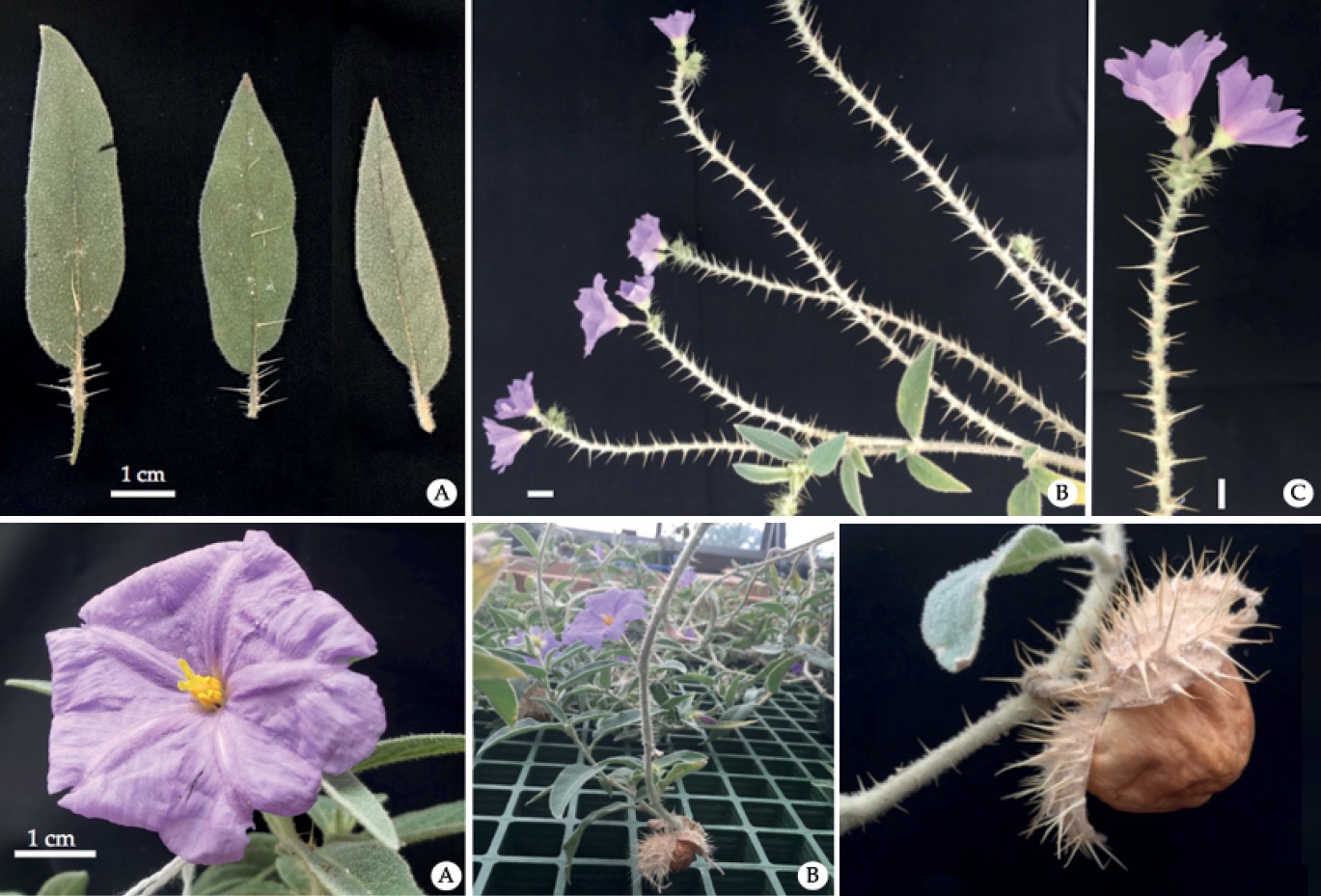
 Solanum stellaticalycinum M.A.Cueva, Treviño & D.Sotomayor.
A, B. Habit; C. Inflorescence; D. Flower at full anthesis; E. Floral buds; F. Fruit (M. Cueva et al. 645).
Photos by M.A. Cueva. 

 Solanum stellaticalycinum M.A.Cueva, Treviño & D.Sotomayor, sp. nov.
 
Diagnosis. Solanum stellaticalycinum differs from all other species of the Pteroidea clade in its calyx with narrow linear lobes and corolla with narrow lanceolate lobes with elongate, acuminate apices that are spreading at anthesis. It differs from the sympatric S. anceps Ruiz & Pav. in its larger flowers and fruits on pendent rather than erect pedicels, and from S. mite Ruiz & Pav. and S. conicum Ruiz & Pav. in its simple, rather than deeply pinnatifid, leaves.

Etymology. The species epithet refers to the shape of the calyx, which is like a star (see Figs 1, 2). This character is not present in any other species of the Pteroidea clade.


Marco A. Cueva Manchego, Italo F. Treviño, Diego A. Sotomayor, María I. Villalba, Sandra Knapp. 2025. Solanum stellaticalycinum, A New simple-leaved Species of the Pteroidea Clade from Peru (Potato Clade, Solanum, Solanaceae). PhytoKeys. 266: 117-128. DOI: doi.org/10.3897/phytokeys.266.166870

Resumen: Se describe e ilustra una nueva especie de los bosques montanos del centro del Peru, perteneciente al clado Pteroidea de Solanum. Solanum stellaticalycinum M.A.Cueva, Treviño & D.Sotomayor, sp. nov. se conoce únicamente del Parque Nacional Yanachaga-Chemillén y áreas adyacentes (Prov. Oxapampa, Depto. Pasco, Perú). Con hojas simples, es morfológicamente similar a S. anceps Ruiz & Pav., una especie ampliamente distribuida en Sudamérica, y a S. angustialatum Bitter y S. incurvum Ruiz & Pav., ambas conocidas de los bosques montanos del norte y centro del Perú. Solanum stellaticalycinum se distingue de todas estas por sus pedicelos morados y flores con lóbulos del cáliz lineales a estrechamente triangulares, una corola membranosa con lóbulos lanceolados y frutos ovoide-cónicos, lisos o ligeramente rugosos. Aquí discutimos las afinidades taxonómicas, la distribución y el estado de conservación de esta nueva especie. También incluimos una clave para todas las especies de Pteroidea con distribuciones completas a nivel de país y distribuciones a nivel de departamento dentro del Perú.

Saturday, August 23, 2025

[Botany • 2025] Jaltomata veracruzana (Solanaceae: Solanoideae: Solaneae) • A New Species from the mountain cloud forests of Veracruz, Mexico

 
Jaltomata veracruzana  

in Martínez‑Flores, Burgos‑Hernández, Martínez-Domínguez et Nicolalde-Morejón, 2025. 

Abstract
A new species from the state of Veracruz, Mexico, previously identified as Jaltomata bohsiana, is described as Jaltomata veracruzana. This species occurs in the mountain cloud forest of the Sierra de Chiconquiaco. It can be distinguished from its congeners by the combination of a black to blackish calyx when in flower, pubescence sparse, corolla with light-purple veins, green pedicels, and ovate-deltoid leaves with sinuate to sinuate-toothed margins, acute apex, and attenuated-truncated base. A preliminary conservation assessment is provided for this new species based on IUCN Red List guidelines. We provide a detailed comparison of this new species with all Jaltomata species distributed in Mexico, including a full description, illustrations, taxonomic notes, comparative table, and an identification key for the genus in Mexico.

conservation status, endemism, Jaltomata, montane cloud forest, Neotropics, Sierra Madre Oriental, Solanaceae, taxonomy, Eudicots


Ma. Mercedes MARTÍNEZ-FLORES, Mireya BURGOS-HERNÁNDEZ, Lilí MARTÍNEZ-DOMÍNGUEZ and Fernando NICOLALDE-MOREJÓN. 2025. Jaltomata veracruzana (Solaneae, Solanoideae, Solanaceae), A New Species from the mountain cloud forests of Veracruz, Mexico. Phytotaxa. 712(2); 141-155. DOI: doi.org/10.11646/phytotaxa.712.2.4 [2025-07-30]

Monday, March 24, 2025

[Botany • 2025] Hyoscyamus labiatus (Solanaceae: Hyoscyameae) • A New Species from Henan, China: Implications for the Delimitation of Hyoscyamus

 
Hyoscyamus labiatus Y. Y. Liu, Q. R. Wang and J. M. Li, 

in Liu, Wang, Mi et Li, 2025. 

Abstract
Hyoscyamus labiatus Y. Y. Liu, Q. R. Wang and J. M. Li, a new species of Hyoscyamus (Solanaceae) from Henan province, China, is described and illustrated here. It is morphologically similar to the known species of Hyoscyamus and Archihyoscyamus, but can be distinguished by corolla 2-lipped, adaxial lip 3-lobed and much longer than abaxial lips, tube slender at base, and stamens 5, inserted on inner side of disk, free, obviously unequal, and exceeding corolla. To infer the systematic position of this new species, phylogenetic analysis was performed based on four chloroplast markers, viz rbcL, ndhF, trnC-psbM and trnL-F. According to the phylogenetic tree, Hyoscyamus labiatus is strongly supported as sister to a monophyletic group containing all species of Hyoscyamus and Archihyoscyamus previously described. Morphological comparison and molecular phylogeny confirmed the identity of the species as a new taxon, and that Archihyoscyamus should be included in Hyoscyamus.

Keywords: Archihyoscyamus, Hyoscyameae, phylogeny, Solanaceae, taxonomy


Hyoscyamus labiatus Y. Y. Liu, Q. R. Wang and J. M. Li, sp. nov. 


Yan-Yan Liu, Qi-Rui Wang, Zeng-Lu Mi and Jia-Mei Li. 2025. Hyoscyamus labiatus sp. nov. (Solanaceae) from Henan, China: Implications for the Delimitation of Hyoscyamus. Nordic J. Botany.  e04525. DOI: doi.org/10.1111/njb.04525 [10 December 2024]

Wednesday, September 20, 2023

[Botany • 2023] Iochroma orozcoae (Solanaceae: Iochrominae) • A New Species from the eastern Andes of Colombia


Iochroma orozcoae A.Orejuela & S.D.Sm, 

in Orejuela, Smith, Villanueva et Deanna, 2023. 

Abstract
Iochroma orozcoae A.Orejuela & S.D.Sm., sp. nov. (Solanaceae) is described from the Andean forests of Cundinamarca in the eastern cordillera of Colombia. Iochroma orozcoae was first collected by the eminent Spanish priest and botanist José Celestino Mutis in the late part of the 18th century, but the specimens have lain unrecognised in herbaria for over 200 years. The species shares many features with its closest relative, Iochroma baumii S.D.Sm. & S.Leiva, but it differs from it in having small flowers with five corolla lobes and few inflorescences per branch, located near the shoot apex with 1 to 4 (–8) flowers, fruits that are greenish-yellow when ripe and its restricted geographic distribution. A description of I. orozcoae is provided, along with a detailed illustration, photographs of live plants, a comparison with closely-related species and a key to all Colombian species of Iochroma Benth. In closing, we emphasise the value of historical collections for the knowledge of biodiversity.

Key words: Andes, Colombia, Iochroma, Iochrominae, IUCN Red List, Solanaceae

Iochroma orozcoae A.Orejuela & S.D.Sm.
A young branch B stem detail C, D leaf detail showing the abaxial and adaxial sides E floriferous branch with flowers in lateral view F floriferous branch with a flower in frontal view G fruits showing the accrescent appressed calyx. Photos by Andrés Orejuela.

Iochroma orozcoae A.Orejuela & S.D.Sm.
A flowering branch B inner corolla surface, showing the stamens C flower. Detail is shown for the simple and branched hairs on the corolla D gynoecium E, F details of the stamens and anthers G fruit with persistent calyx H seed. Drawn by Omar Bernal from Orejuela & Castillo 2942 & Orejuela et al. 3407.


 Iochroma orozcoae A.Orejuela & S.D.Sm., sp. nov.

Diagnosis: 
A Iochroma baumii S.D.Sm. & S.Leiva affinis, sed paucarum inflorescentiae in ramum prope apicem germinis dispositae sunt, quae 1 ad 4 (–8) floribus, flores minores 1.5–2 cm longi; corolla quinque lobis constat, et fructus viridis-flavus colore maturo differt.

Etymology: This species is named in honour of Clara Inés Orozco Pardo, an Associate Professor of botany at the Instituto de Ciencias Naturales of the Universidad Nacional de Colombia. Her dedication to the understanding of Colombian flora, particularly in the fields of taxonomy and systematics of the Brunelliaceae and Solanaceae families, has been remarkable. She has also played a crucial role in mentoring several Colombian botanists, including the first author of this paper.


Andrés Orejuela, Stacey D. Smith, Boris Villanueva and Rocío Deanna. 2023. A New Species of Iochroma Benth. (Solanaceae) from the eastern Andes of Colombia. PhytoKeys. 232: 133-144.  DOI: 10.3897/phytokeys.232.108474

Resumen: Iochroma orozcoae A.Orejuela & S.D.Sm., sp. nov. (Solanaceae) se describe a partir de los bosques andinos de Cundinamarca, en la cordillera oriental de Colombia. Iochroma orozcoae fue recolectada por primera vez por el eminente sacerdote y botánico español José Celestino Mutis a finales del siglo XVIII, pero los especímenes han permanecido sin ser reconocidos en herbarios durante más de 200 años. La especie comparte muchas características con su pariente más cercano, Iochroma baumii S.D.Sm. & S.Leiva, pero difiere de esta en sus flores más pequeñas con cinco lóbulos de la corola y pocas inflorescencias por rama ubicadas cerca del ápice de la rama, con 1 a 4 (–8) flores por inflorescencia, frutos verde-amarillentos al madurar, y su distribución geográfica restringida. Se presenta una descripción de I. orozcoae, junto con una ilustración detallada, fotografías en vivo, una comparación con las especies cercanamente relacionadas y una clave para las especies colombianas de Iochroma Benth. Finalmente, enfatizamos el valor de las colecciones históricas para el conocimiento de la biodiversidad.

Tuesday, June 27, 2023

[Botany • 2023] Hunzikeria gypsophila (Solanaceae: Petunieae) • A New microendemic Species of Hunzikeria from the Gypsum Outcrops of southern Jalisco, Mexico


Hunzikeria gypsophila  Ortiz-Brunel & Díaz-Martínez, 

in Ortiz-Brunel, Díaz-Martínez, Ruíz-Sánchez et Rodríguez, 2023.
 
Abstract
Hunzikeria is a petunioid genus of Solanaceae that includes three species. The genus presents a disjunct distribution between South and North America. Hunzikeria coulteri and H. texana occur in North America, while H. steyermarkiana is reported from Venezuela. During botanical explorations in western Mexico, we found a population of Hunzikeria that differed from the three known species. Believing that we had found an undescribed species, we collected samples and prepared herbarium vouchers. We compared our material with morphological descriptions and herbarium specimens of the other species in the genus. Our results indicate that we discovered a new species, named here as Hunzikeria gypsophila. This new species is a microendemic gypsophyte that inhabits two gypsum ravines in southern Jalisco, Mexico. Hunzikeria gypsophila differs from the other three species in being a subshrub of taller stature and having petiolate leaves, wider leaf blades, longer corolla tubes, and broader corolla limbs. The most morphologically similar species is H. steyermarkiana, which differs in having anthers of equal size, while all the North American species have didynamous anthers. Hunzikeria shows a clear affinity for sedimentary soils and H. gypsophila is the first species recorded on gypsum. The gypsum outcrops of western Mexico have a unique flora, which likely became isolated due to volcanic activity. With this new find, Hunzikeria comprises four species. We provide a key for their identification and a distribution map for Mexico.

Keywords: disjunct distribution, gypsophyte, tropical dry forest


Hunzikeria gypsophila.
A. Adult plant. B. Flower. C. Flower and stigma detail. D. Anthers and stigma. E. Capsule. F. Seed.
Illustration by Fátima Bracamontes based on the type material (J. P. Ortiz-Brunel & P. Díaz 1677).

Mexican Hunzikeria species.
A. Hunzikeria coulteri. B. Hunzikeria texana.
C–F. Hunzikeria gypsophila.
Photographs by Alejandra Martínez-Blancas (A), Miguel González-Botello (B), and Juan Pablo Ortiz-Brunel (C–F).
 
Hunzikeria gypsophila Ortiz-Brunel & Díaz-Martínez, sp. nov. 

Hunzikeria gypsophila is a subshrub taller than H. coulteri, H. steyermarkiana, and H. texana (40–60 vs. 15–20 cm), has longer petioles (12–23 vs. 5–12 mm) and wider leaf blades (16–27 vs. 1.5–13 mm), develops longer corolla tubes (35–48 vs. 10–25 mm), and has broader corolla limb diameter (38–52 vs. 15–23 mm).
...

Etymology:—The specific epithet refers to the preference of the plants for growing only on gypsum soil. 


Juan Pablo Ortiz-Brunel, Paulina Díaz-Martínez, Eduardo Ruíz-Sánchez and Aarón Rodríguez. 2023. A New microendemic Species of Hunzikeria (Petunieae, Solanaceae) from the Gypsum Outcrops of southern Jalisco, Mexico. Phytotaxa. 600(1); 7-15. DOI: 10.11646/phytotaxa.600.1.2

Thursday, December 29, 2022

[Botany • 2022] Solanum scalarium (Solanaceae) • A Newly-described Dioecious Bush Tomato from Judbarra/Gregory National Park, Northern Territory, Australia


Solanum scalarium Martine & T.M.Williams,

in Williams, Hayes, McDonnell, Cantley, Jobson & Martine, 2022.

Abstract
A new species of functionally dioecious bush tomato of Solanum subgenus Leptostemonum is described. Solanum scalarium Martine & T.M.Williams, sp. nov., is a member of the taxonomically challenging “Kimberley dioecious clade” in Australia and differs from other species in the group in its spreading decumbent habit and conspicuously prickly male floral rachis. The species is so far known from one site in Judbarra/Gregory National Park in the Northern Territory. Ex situ crosses and confirmation of inaperturate pollen grains produced in morphologically cosexual flowers indicate that these flowers are functionally female and the species is functionally dioecious. The scientific name reflects the ladder-like appearance of the inflorescence rachis armature of male individuals, the stone staircase that provides access to the type locality at the Escarpment Lookout Walk, and the importance of maintaining equitable and safe access to outdoor spaces. The common name Garrarnawun Bush Tomato is proposed in recognition of the lookout point at this site, a traditional meeting place of the Wardaman and Nungali-Ngaliwurru peoples whose lands overlap in this area.

Keywords: Australia, dioecy, inaperturate pollen, Judburra/Gregory National Park, new species, Northern Territory, Solanaceae, Solanum dioicum


Solanum scalarium Martine & T.M.Williams, in the field
A, C, F type locality and habitat, Escarpment Walk, Judbarra National Park, Northern Territory B–D immature green fruits enclosed in prickly calyx and E prickly male rachis after male flowers have dropped off.
 (Photos by A.J. McDonnell.).

Functionally male individuals of Solanum scalarium in cultivation:
A leaf shape and B, C inflorescence axes of male individuals; note the distinctive spreading straight prickles that give the inflorescence axis a ladder-like appearance.  
Functionally female individuals of Solanum scalarium in cultivation:
 A flower B reproductive branch C leaf shape D, E reflexing of calyx around brown, bony fruits and F overall habit.
(Photos by T.M. Williams.).

 Solanum scalarium Martine & T.M.Williams, sp. nov.

Diagnosis: This species is distinguished from Solanum dioicum W.Fitzg. (as currently delineated) and other Australian functionally dioecious Solanum species of the “Kimberley dioecious clade” by the combination of a spreading decumbent habit and the staminate inflorescence axis armed with relatively stout, spreading, straight prickles.


Etymology: Latin scalare from scala, ladder or stair, and suffix aris, pertaining to; the epithet scalarium is the genitive plural of scalare, indicating ladder-like appearance of staminate inflorescence rachises, which are conspicuously and unusually armed with relatively stout, spreading, straight prickles resembling ladder steps. It is also a nod to the type locality at the Escarpment Walk, Judbarra/Gregory National Park, where stone stairs lead from the car park up to the habitat of this species. By choosing this name we acknowledge the access these steps provide to the newly-described species as well as the importance of providing broad access to nature, outdoor recreation, and scientific discovery. We suggest the use of Garrarnawun Bush Tomato for the English-language common name of the species in recognition of the Garrarnawun Lookout near where the type collection was made, a traditional meeting place of the Wardaman and Nungali-Ngaliwurru peoples whose lands overlap in this area (Parks and Wildlife Commission of the Northern Territory 2021).


Tanisha M. Williams, Jonathan Hayes, Angela J. McDonnell, Jason T. Cantley, Peter Jobson and Christopher T. Martine. 2022. Solanum scalarium (Solanaceae), A Newly-described Dioecious Bush Tomato from Judbarra/Gregory National Park, Northern Territory, Australia. PhytoKeys. 216: 103-116.  DOI: 10.3897/phytokeys.216.85972


Wednesday, July 27, 2022

[Botany • 2022] Doselia gen. nov. (Solanaceae) • Monograph of A New Hemiepiphytic Genus endemic to the northern Andes


Doselia A.Orejuela & Särkinen 

(A, B) D. epifita (S.Knapp) A.Orejuela & Särkinen,
(C) D. galilensis A.Orejuela & Villanueva,
(D) D. huilensis (A.Orejuela & J.M.Vélez) A.Orejuela & Särkinen,
(F-G) D. lopezii (Hunz.) A.Orejuela & Särkinen

in Orejuela, Villanueva, ... et Särkinen, 2022. 

Abstract
A new genus, Doselia A.Orejuela & Särkinen, gen. nov., is described in the tribe Solandreae (Solanaceae) consisting of four species of hemiepiphytic lianas endemic to the premontane forests of the Colombian and Ecuadorian Andes. The genus is distinguished based on the membranous leaves, usually sparsely pubescent with eglandular simple trichomes, pseudo-verticillate leaf arrangement, and elongated, pendulous, and few-flowered inflorescences with showy flowers and conical fruits. Three new combinations are made to transfer species to the new genus previously described as part of the polyphyletic genus Markea Rich. (Doselia epifita (S.Knapp) A.Orejuela & Särkinen, comb. nov., D. huilensis (A.Orejuela & J.M.Vélez) A.Orejuela & Särkinen, comb. nov. and D. lopezii (Hunz.) A.Orejuela & Särkinen, comb. nov.). One new species is described from the western slopes of the eastern cordillera of the Colombian Andes, known only from three localities in the Boyacá, Santander, and Tolima departments (Doselia galilensis A.Orejuela & Villanueva, sp. nov.). The new species is unique in the genus in having glabrescent adult leaves, green-purplish calyces and long, greenish-white, infundibuliform corollas with delicate purplish veins and large lobes tinged with purple, and pubescent styles. Here we provide a revision of Doselia with a distribution map of all species, an identification key, photographs, preliminary conservation assessments, and line drawings of all four species.

Keywords: Colombia, Doselia, Ecuador, endemism, hemiepiphytes, Juanulloeae, lianas, Markea, new species, Solandreae

Doselia A.Orejuela & Särkinen
A pseudoverticillate leaves in D. epifita B infundibuliform cream-purplish corolla of D. epifita
C infundibuliform greenish-white corolla with subtle purple veins of D. galilensis D tubular-campanulate yellowish-green corolla of D. huilensis with strong purple-tinged reticulation along major and minor veins E developing fruit in D. huilensis
F hypocrateriform orange corollas in D. lopezii G pendent long flowering branches in D. lopezii with clustered leaves and orange corollas in frontal view H developing fruit in D. lopezii with a nectariferous disc at the base

(Vouchers: A Orozco et al. 3876 (COL), B no voucher, C Corrales et al. 917 (JBB, TOLI), D Coral 34 (HEEA), E Orejuela & Vélez-Puerta 112 (COL) F Orejuela et al. 727 (JBB) G no voucher H Orejuela & Calderon 170 (COL): 
photos by Alistair Hay, Andreas Kay, Andrés Orejuela, Boris Villanueva, Brayan Coral, and Eduardo Calderon.

Doselia A.Orejuela & Särkinen, gen. nov.
 
Diagnosis: Like Solandra Sw. and Schultesianthus Hunz., but differing from both in having membranous leaves (vs. chartaceous or coriaceous), lacking glandular trichomes, having pendulous inflorescences with long slender peduncles (vs. solitary flowers or short erect inflorescences with thick woody peduncles), distally winged pedicels, and actinomorphic corollas (vs. weakly zygomorphic); differing from Solandra in its smaller corollas (8.5–15 cm vs. 15–40 cm long), flowers borne in groups (vs. solitary), straight filaments and styles (vs. strongly curved and declinate), and 2-locular ovaries (vs. 4-locular); differing from Schultesianthus Hunz. in the chartaceous fruiting calyx with visible venation (vs. a thick, shiny and coriaceous fruiting calyx with no visible venation).

Type species: Doselia lopezii (Hunz.) A.Orejuela & Särkinen comb. nov. 
(basionym Markea lopezii Hunz.)

Etymology: The generic name Doselia is derived from the Spanish word “dosel”, meaning canopy. It refers to the hemiepiphytic lianescent habit of all species of Doselia, with branches rising high up to the canopy to the top of tree crowns. The plants can be challenging to see because of their position on top of the tree canopy unless the plants have their showy pendulous flowers.

Distribution: (Fig. 2). Mid-elevation moist Andean forests from 500 to 2,300 m in Ecuador (Provinces of Morona Santiago, Napo, Pastaza) and Colombia (Departments of Antioquia, Boyacá, Caldas, Caquetá, Huila, Putumayo, Risaralda, Santander, Tolima, Valle del Cauca).


 Andrés Orejuela, Boris Villanueva, Clara Inés Orozco, Sandra Knapp and Tiina Särkinen. 2022. Monograph of Doselia (Solanaceae), A New Hemiepiphytic Genus endemic to the northern Andes. PhytoKeys. 202: 73-96. DOI: 10.3897/phytokeys.202.82101


Resumen: Un nuevo género, Doselia A.Orejuela & Särkinen, gen. nov., es descrito en la tribu Solandreae (Solanaceae), conformado por cuatro especies de lianas hemiepífitas endémicas de los bosques premontanos de los Andes de Colombia y Ecuador. El género se distingue por sus hojas membranáceas con tricomas simples no glandulares, el arreglo pseudoverticilado de las hojas y sus inflorescencias paucifloras, largo pedunculadas y péndulas, flores vistosas y frutos cónicos. Se proponen tres nuevas combinaciones para acomodar especies previamente descritas en el polifilético género Markea Rich. (Doselia epifita (S.Knapp) A.Orejuela & Särkinen, comb. nov., D. huilensis (A.Orejuela & J.M.Vélez) A.Orejuela & Särkinen, comb. nov. and D. lopezii (Hunz.) A.Orejuela & Särkinen, comb. nov.) Una nueva especie es descrita aquí proveniente de la vertiente occidental de la cordillera Oriental de los Andes colombianos, y conocida únicamente de tres localidades en los departamentos de Boyacá, Santander y Tolima (Doselia galilensis A.Orejuela & Villanueva, sp. nov.). La nueva especie se caracteriza por sus hojas glabrescentes cuando adultas, cáliz verde-púrpura, corolas infundibuliformes grandes, blanco-verdosas con una reticulación fina de venas púrpuras, lóbulos corolinos grandes y teñidos de púrpura en su lado ventral y estilos pubescentes. El nuevo género es formalmente descrito incluyendo un mapa de distribución, una clave taxonómica y fotografías e ilustraciones para sus cuatro especies.
Palabras clave: Colombia, Doselia, Ecuador, endemismo, hemiepífitas, Juanulloeae, lianas, Markea, nuevas especies, Solandreae

Tuesday, March 1, 2022

[Botany • 2022] Nicotiana gandarela (Solanaceae) • A New Species of ‘Tobacco’ highly Endangered from the Quadrilátero Ferrífero in Brazil


Nicotiana gandarela Augsten & Stehmann,

in Augsten, Meyer, ... et Stehmann, 2022.  
Photos by J.R. Stehmann.

Abstract
Nicotiana gandarela Augsten & Stehmann (Solanaceae), sp. nov., a small ’tobacco’ known only from one locality at Serra do Gandarela, in the state of Minas Gerais, Brazil, is described and illustrated. It is morphologically characterized by its rosulate basal leaves, red corolla with a short tube not inflated at the apex, and the peculiar habitat, a shaded site under a rocky outcrop ledge along a forested stream. Phylogenetic analyses based on a combined dataset of nuclear (ITS) and plastid (ndhF, trnLF, and trnSG) DNA sequences revealed that the species belongs to the Nicotiana sect. Alatae and is sister to the clade with the remaining species in the section. A key for the identification of Brazilian species of the section is given. The unusual habitat, the small population size, and the intense pressure of mining activities in the surroundings made the species assessed as Critically Endangered (CR), needing conservation efforts to avoid its extinction.

Keywords: Endemism, IUCN, Minas Gerais, mining, molecular phylogeny


Nicotiana gandarela Augsten & Stehmann
 A peculiar habitat of the species, the shaded sites in the base of the shaded ledge B seedlings growing in the site
C habit highlighting the rosulate leaves and the scapose inflorescence
D, E flowers in lateral and frontal view F 2-valvate capsule with many seeds. G seed with sinuous anticlinal walls (Scanning Electron Microscopy)
D–G were obtained from plants of the type population (Augsten and Stehmann 1078, BHCB).
Photos by J.R. Stehmann.


 Nicotiana gandarela Augsten & Stehmann, sp. nov.
  
Diagnosis: Nicotiana gandarela differs from all other species of the Nicotiana sect. Alatae by its short corolla tube (< 15 mm), vivid red corolla limb, and unusual shaded, cave-mouth habitat.

Etymology: The specific epithet “gandarela” is a noun in apposition and refers to Serra do Gandarela, the mountain range complex where this species is found.


 Mariana Augsten, Pablo Burkowski Meyer, Loreta B. Freitas, João A. N. Batista and João Renato Stehmann. 2022. Nicotiana gandarela (Solanaceae), A New Species of ‘Tobacco’ highly Endangered from the Quadrilátero Ferrífero in Brazil. PhytoKeys. 190: 113-129. DOI: 10.3897/phytokeys.190.76111


Thursday, August 12, 2021

[Botany • 2021] Nicotiana insecticida (Solanaceae) • A New Species from Western Australia


Nicotiana insecticida M.W.Chase & Christenh.

in Chase & Christenhusz, 2021. 

Illustration: Deborah Lambkin. 

Summary

The new species Nicotiana insecticida, which is remarkable in its insect trapping abilities, is described here. It is illustrated from plants that were grown from seeds collected near the Minilya Roadhouse on the Northwest Coastal Highway in Western Australia, Australia. They were cultivated at the Royal Botanic Gardens, Kew. Its distinguishing features, taxonomy, ecology, cytology and cultivation are discussed.


Nicotiana insecticida M.W.Chase & Christenh.
A, flower, × 3; B, corolla, face view, opened out, × 3; C, corolla, opened out, × 3; D, style and ovary, × 3; E, leaf, × 3/4; F, habit, × 1/6; G, upper stem, × 9; H, fruit, with calyx, × 3; I, fruit, calyx removed, × 3; J, stem hairs showing dead insects, × 3; K, calyx hairs, × 9.
Drawn by Deborah Lambkin from specimens cultivated at Kew.

Nicotiana insecticida M.W.Chase & Christenh.

Illustration by Deborah Lambkin 

Nicotiana insecticida M.W.Chase & Christenh., spec. nov.  

Etymology: From the Latin for insect killer, a reference to this species killing numerous small insects with its extremely sticky hairs covering all parts of these plants.


Mark W. Chase and Maarten J. M. Christenhusz. 2021. 994. NICOTIANA INSECTICIDA: Solanaceae. Curtis's Botanical Magazine. DOI: 10.1111/curt.12402
Illustrations by Deborah Lambkin 

Sunday, January 31, 2021

[Botany • 2020] Rediscovery and Taxonomic Placement of Solanum polyphyllum Phil. (Solanaceae), A Narrow Endemic from the Chilean Atacama Desert


Solanum polyphyllum Phil.

in Moreira-Muñoz et Muñoz-Schick, 2020. 

Abstract
Although the original description of Solanum polyphyllum Phil. was made in 1891, this species was not seen until it was re-discovered 128 years later in 2019 in the Atacama Desert. Fruits and seeds were previously unknown and a complete description is provided here. This species was not treated in the most recent monograph of Solanum sect. Regmandra, but it should be incorporated in this section due to its glabrous, sessile and entire leaves, which are decurrent onto the stem. Morphologically, S. polyphyllum is similar to S. paposanum, also of section Regmandra, but differs in the entire leaves (against margins with 4–5 acute lobes in S. paposanum) and glabrous leaves (moderately pubescent adaxially and velutinous abaxially in S. paposanum). The rediscovery of S. polyphyllum at a new locality at the same altitudinal belt as the type, re-affirms its restricted distribution and endemism and supports a potential conservation status as an endangered species.

Keywords: Chile, rediscovery, Regmandra, Solanum, Solanum polyphyllum, Solanum sect., Tarapacá Region

Figure 2. Solanum polyphyllum Phil. at an alluvial cone at the Tarapacá precordillera
A habitat B flower details C leaves D flower E calyx F fruits G seeds H habit.
Photos by A. Moreira-Muñoz, drawings by M. Muñoz-Schick.


Solanum polyphyllum Phil., Anales Museo Nacional, Botánica 2: 64, 1891
 
Distribution: Endemic to the Atacama desert of northern Chile; only known from two localities in the precordillera of Tamarugal province, Tarapacá region.

Ecology and habitat: Solanum polyphyllum grows between loose rocks of an alluvial cone on the north side of the Camiña river. It corresponds to a plant of 100 cm high, erect stems, very blue flowers and green-orange berries. The population is composed of only a dozen exemplars. The vegetation of the site is an open bush of low coverage (15%). Other species present on the site are: Cistanthe amarantoides (Phil.) Carolin ex Hershkovitz (Montiaceae), Encelia oblongifolia DC., Helogyne apaloidea Nutt. (both Asteraceae), Malesherbia tenuifolia D.Don (Passifloraceae), Huidobria fruticosa Phil. (Loasaceae), Allionia incarnata L. (Nyctaginaceae) and Exodeconus integrifolius (Phil.) Axelius (Solanaceae).

Conservation status: The limited representation in herbaria, as well as the low abundance in the field, makes the Solanum polyphyllum a candidate for threatened status. Due to its distribution in the two known locations of Compe and Pachica it is Data Deficient, pending further field work. Solanum polyphyllum potentially could be found in Isluga National Park but new surveys are required to corroborate its presence in this protected area.


 Andres Moreira-Muñoz and Melica Muñoz-Schick. 2020. Rediscovery and Taxonomic Placement of Solanum polyphyllum Phil. (Solanaceae), A Narrow Endemic from the Chilean Atacama Desert.  PhytoKeys. 156: 47-54. DOI: 10.3897/phytokeys.156.53703

Monday, February 3, 2020

[Botany • 2020] Solanum hydroides (Solanaceae) • A Prickly Novelty from the Land of the Sugar Loaves, central Brazilian Atlantic Forest


Solanum hydroides Gouvêa & Giacomin

in Gouvêa, de Paula, Stehmann & Giacomin, 2020. 

Abstract
Solanum hydroides Gouvêa & Giacomin, sp. nov., is described from central Brazilian Atlantic Forest. It is known from only three localities in Espírito Santo and Minas Gerais states, where granitic/gneissic outcrops (inselbergs or sugar loaves) are ubiquitous. The new species, here described, belongs to Solanum subgenus Leptostemonum (or the Leptostemonum clade; i.e. the spiny solanums) and is morphologically related to S. hexandrum Vell. and S. sublentum Hiern, with which it shares the shrubby habit, decurrent leaf bases and well-developed calyces that become accrescent, covering glabrous fruits. Solanum hydroides is unique in its combination of comparatively more delicate habit, indumentum of exclusively stellate eglandular trichomes, accrescent but never inflated fruiting calyces that only partially cover the fruits and comparatively shortly lobed and strictly white corollas. The species is threatened with extinction and assessed as Vulnerable (VU), based on the IUCN criteria.

Keywords: Leptostemonum clade, Brazil, inselbergs, new species, eglandular trichomes


Figure 1. Solanum hydroides Gouvêa & Giacomin. (A, G–I field pictures from specimens L.F.A. de Paula et al. 669, BHCB; B–E Y.F. Gouvêa & G.V.A. Santos 325, BHCB).
A Habit (bottom right corner: young plant with larger leaves) B flowering branch C inflorescence and a flower in lateral view (note that calyx does not have a plicate aspect at the base of the calyx tube) D long-styled flower, front view E mature fruit (note the calyx does not completely cover the berry) F scanning electron micrograph of seed G trichomes; upper: the usual morphology of the stellate trichomes of S. hydroides adaxial leaf surface; lower: examples of stellate trichomes with reduced number of rays (note the multiseriate stalks) H stem indumentum; I adaxial leaf surface indumentum.
Scale bars: 30 cm (A); 7.5 cm (B); 1.3 cm (C–D); 1 cm (E); 0.8 mm (F–I). 
Photographs: A by L.F.A de Paula B–E, G–I by Y.F. Gouvêa.

Solanum hydroides Gouvêa & Giacomin, sp. nov.

Diagnosis: Differs from S. sublentum Hiern in its indumentum of strictly stellate eglandular trichomes and in its accrescent, but not inflated, cupuliform fruiting calyx; also differs from S. hexandrum Vell. in its more delicate habit, smaller flowers with white shallowly stellate corollas and in having accrescent, but not inflated, fruiting calyces that partially cover the mature fruits.

Distribution: Endemic to South-eastern Brazil, with records in three localities in north-eastern Minas Gerais (Mun. Teófilo Otoni) and northern (Mun. Nova Venécia) and central (Mun. Santa Teresa) Espírito Santo States (Fig. 2).

Figure 3. Distinctive characters of species morphologically related to Solanum hydroides Gouvêa & Giacomin. 
[A, C, E, G: S. hexandrum Vell. (L.L. Giacomin et al. 875, BHCB);
B, D, F, H: S. sublentum Hiern. (J.R. Stehmann et al. 6372, BHCB)].
 A–B Habit (note difference in robustness) C long-styled flower, front view D inflorescence and flower in back view (note the inflated and plicate aspect of the calyx tube) E inflorescence with fruits in different stages of development (note that the inflated fruiting calyx completely covers the fruit in all stages of development) F long-styled flower G fruits (note the plicate aspect of the fruiting calyx) H–I indumentum of the adaxial leaf surface.
Scale bars: 15 cm (A); 10 cm (B); 3 cm (C); 2 cm (D, G); 1.4 cm (E); 1 mm (F); 1.2 mm (H). Photographs: A, C, E by L.L. Giacomin B, D, F by J.R. Stehmann G–H by Y.F. Gouvêa.

Ecology: Solanum hydroides inhabits the edge of seasonal semi-deciduous tropical rainforests associated with granitic or gneissic rock outcrops (inselbergs) and somewhat disturbed sites at their base, like roadsides and clearings; from 300 to 600 m elevation. It also occasionally grows in epilithic vegetation patches lying on the flatter parts of inselbergs.
  
Etymology: Solanum hydroides is named for the resemblance of the long-stalked stellate trichomes of its calyces to the marine serpulid worm Hydroides Gunnerus, 1768 (illustrative images can be found at the Encyclopedia of Life; e.g. https://eol.org/search?utf88=✓&q=Hydroides).


 Yuri Fernandes Gouvêa, Luiza Fonseca Amorim de Paula, João Renato Stehmann and Leandro Lacerda Giacomin. 2020. Solanum hydroides (Solanaceae): A Prickly Novelty from the Land of the Sugar Loaves, central Brazilian Atlantic Forest.  PhytoKeys. 139: 63-76. DOI: 10.3897/phytokeys.139.46635

Resumo: Solanum hydroides Gouvêa & Giacomin, sp. nov., é aqui descrita para região central da Floresta Atlântica brasileira. Ela é conhecida apenas para três localidades, nos estados do Espírito Santo e Minas Gerais, em uma região onde afloramentos graníticos/gnáissicos (inselbergues ou pães de açúcar) são onipresentes. A nova espécie pertence a Solanum subgen. Leptostemonum (ou Solanum clado Leptostemonum, i.e. espécies espinhentas com tricomas estrelados) e é morfologicamente semelhante a S. hexandrum Vell. e S. sublentum Hiern, com quem compartilha o hábito arbustivo, a base das lâminas foliares decurrentes e cálices bem desenvolvidos, acrescentes em seus frutos glabros. Solanum hydroides é, contudo, a única espécie que apresenta a seguinte combinação de caracteres: hábito delicado, indumento composto apenas por tricomas estrelados egandulares, cálices frutíferos acrescentes, mas nunca inflados, que cobrem parcialmente os frutos e corolas com lóbulos curtos e estritamente brancas. A espécie é considerada como ameaçada de extinção, na categoria Vulnerável (VU), segundo os critérios da IUCN.
Palavras-chave: Clado Leptostemonum, Brasil, inselbergs, espécie nova, tricomas eglandulares