Showing posts with label Tortoise. Show all posts

Saturday, November 1, 2025

[Paleontology • 2025] Manouria morla • the Ancient One: An Early Miocene large Tortoise (Cryptodira: Testudinidae) from the Swamps of Ahníkov, Czechia


Manouria morla   
Chroust, Szczygielski & Luján, 2025
  
Digital painting by Rudolf Hima

Abstract
Tortoises (Testudinidae) are a clade of turtles highly specialized to terrestrial environments, mainly living in semi-arid conditions. Herein, we present Manouria morla sp. nov., a new species of the genus Manouria, which is considered to be the most basal extant testudinid genus. The studied material comes from the Ahníkov I fossil site, formerly known as Merkur or Merkur-North, located in the Most Basin in NW Bohemia (Czechia), dated to the Early Miocene (Burdigalian, MN 3). Manouria morla sp. nov. is the oldest member of the Manouria lineage, which nowadays inhabits SE Asia only, and therefore its biogeography and plausible European origin are discussed. The specific type of multiplication of plastral scutes in the inguinal region is discussed as a new morphological character diagnostic for the genus. Based on zoological studies, specific environmental requirements of the genus Manouria allow us to use this taxon as a proxy for the paleoclimate reconstruction of the Ahníkov I fossil site which suggests a broadleaf evergreen tropical wet forest. The simplified use of fossil testudinids as a proxy for reconstructing semi-arid palaeoclimate is therefore disproven.

Manouria morla sp. nov. (Ahníkov I, Early Miocene),
anterior part of the plastron in A internal view (photograph), B external view (photograph), C internal view, D external view, E left lateral view, F anterior (epiplastral) view, G right lateral view. Posterior part of the plastron in H internal view (photograph), I external view (photograph), J internal view, K external view

Hypothetical reconstruction of the shell of Manouria morla sp. nov. (Ahníkov I, Early Miocene).
A dorsal view of the carapace, B ventral view of the plastron, C dorsal view of the plastron. Preserved parts indicated in grey color


Systematic palaeontology
Testudinata Klein, 1760
Cryptodira Cope, 1868
Testudinoidea Fitzinger, 1826

Pan-Testudinidae Joyce et al., 2004
Testudinidae Gray, 1825

Genus Manouria Gray, 1854

Manouria morla sp. nov. 

Diagnosis: The genus Manouria can be diagnosed by the following autapomorphies: prominent visceral rims associated with the body wall attachment, developed close to the sutures between the peripherals and costals (also on the nuchal and the pygal); thin carapacial elements (costals/neurals); axillary buttresses long and thin and just barely in contact with costal bones; the visceral surface of costal 5 shows the attachment for the inguinal buttress; the sinusoidal shape of the posterior carapacial edge; the presence of the pygal notch; the presence of 12 marginal pairs; coincidence between the costo-peripheral suture and the pleuro-marginal sulcus; significant serration of the posterior peripherals; posterior sulcus of the fifth vertebral coinciding with the suprapygal-pygal suture; overlap of the plastral scutes into the dorsal surface of the anterior and posterior plastral lobes; lateral portion of the humero-pectoral sulcus perpendicular to the axial plane and anteriorly deflected; pectorals medially short; contact between the inguinal and femoral scutes is present; the presence of the multiplication of inguinal scutes.

Etymology. The species is named after Morla, a fantasy character from the book The Neverending Story (orig. Die unendliche Geschichte) written by Michael Ende (1929–1995), firstly published in 1979, later adapted as a movie in 1984. Morla, the Ancient One, is a giant tortoise who lives in the Swamps of Sadness. The new species described herein is the oldest known species of the genus from the Early Miocene of Czechia; therefore, the Ancient One. Its remains come from the swamp deposits of Ahníkov, a parallel to the Swamps of Sadness.

Life restoration of Manouria morla sp. nov.  
Digital painting by Rudolf Hima
 
Conclusion: 
We describe Manouria morla sp. nov., the oldest member of the extant genus Manouria, from the Ahníkov I (formerly known as Merkur or Merkur-North) fossil site from Czechia (MN 3, Early Miocene). To aid the description, Manouria morla sp. nov. was scored and included in a phylogenetic analysis. According to our results, it seems that the genus Manouria originated in Europe just before the MMCO and later spread to Asia, where it persists until now. In the end, the use of the genus Manouria as an environmental indicator is coherent with the knowledge of the swamp ecosystem of the Most Basin.
 

Milan Chroust, Tomasz Szczygielski and Àngel H. Luján. 2025. Manouria morla sp. nov., the Ancient One: an Early Miocene large tortoise from the Swamps of Ahníkov, Czechia. Swiss Journal of Palaeontology. 144, 63. DOI: doi.org/10.1186/s13358-025-00400-6 [03 October 2025]
  x.com/HimaRudolf/status/1974115834210725948


Friday, September 15, 2017

[Herpetology • 2017] Identification of Genetically Important Individuals of the Rediscovered Floreana Galápagos Giant Tortoise (Chelonoidis elephantopus) Provide Founders for Species Restoration Program


Abstract
Species are being lost at an unprecedented rate due to human-driven environmental changes. The cases in which species declared extinct can be revived are rare. However, here we report that a remote volcano in the Galápagos Islands hosts many giant tortoises with high ancestry from a species previously declared as extinct: Chelonoidis elephantopus or the Floreana tortoise. Of 150 individuals with distinctive morphology sampled from the volcano, genetic analyses revealed that 65 had C. elephantopus ancestry and thirty-two were translocated from the volcano’s slopes to a captive breeding center. A genetically informed captive breeding program now being initiated will, over the next decades, return C. elephantopus tortoises to Floreana Island to serve as engineers of the island’s ecosystems. Ironically, it was the haphazard translocations by mariners killing tortoises for food centuries ago that created the unique opportunity to revive this “lost” species today.


Figure 1: Distribution of tortoises among Galápagos Islands and representative photos of tortoise carapace morphology.
(a) Map of the distribution of tortoises among Galápagos Islands along with cartoons indicating carapace morphology for each. Light grey shading indicates domed morphology, unshaded indicates saddle-backed. Extinct species are noted with †. (b) Larger view of Volcano Wolf on northern Isabela Island. The circle indicates the approximate field location of the current study. Examples of Galápagos giant tortoises with domed (c) saddle-backed (d) morphology.  


Joshua M. Miller, Maud C. Quinzin, Nikos Poulakakis, James P. Gibbs, Luciano B. Beheregaray, Ryan C. Garrick, Michael A. Russello, Claudio Ciofi, Danielle L. Edwards, Elizabeth A. Hunter, Washington Tapia, Danny Rueda, Jorge Carrión, Andrés A. Valdivieso and Adalgisa Caccone. 2017. Identification of Genetically Important Individuals of the Rediscovered Floreana Galápagos Giant Tortoise (Chelonoidis elephantopus) Provide Founders for Species Restoration Program. Scientific Reports. 7, Article number: 11471. DOI: 10.1038/s41598-017-11516-2

Back from the dead—how to revive a lost species
 phy.so/424511176 via @physorg_com


Tuesday, February 16, 2016

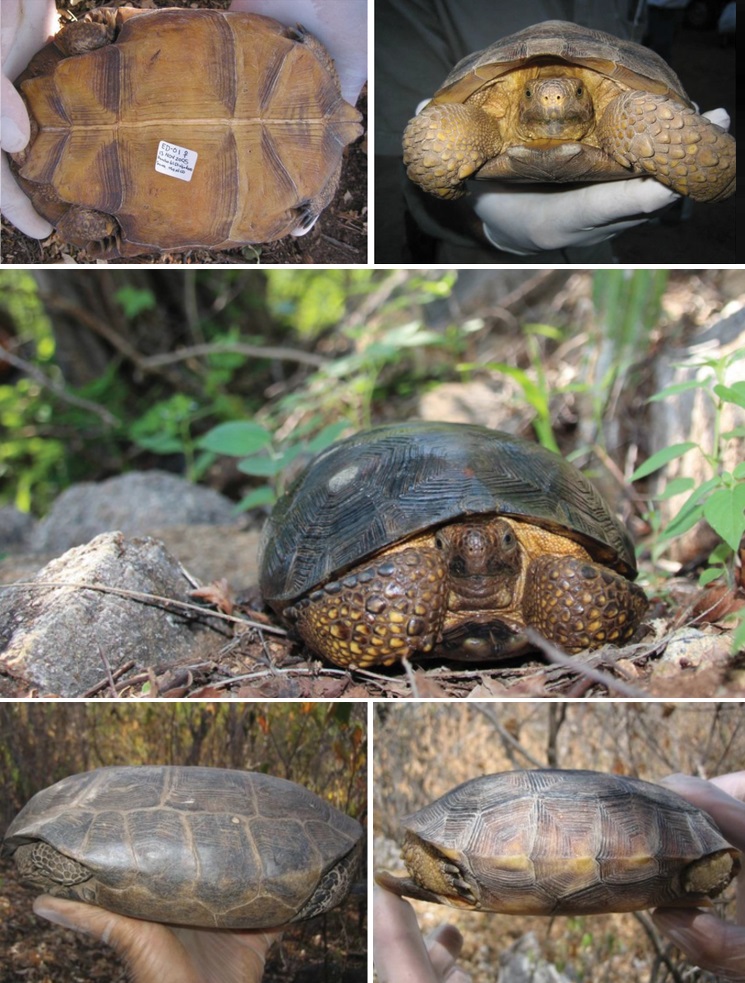
[Herpetology • 2016] Gopherus evgoodei • The Desert Tortoise Trichotomy: Mexico hosts a third, New Sister-species of Tortoise in the Gopherus morafkai-G. agassizii group


Gopherus evgoodei 
Edwards, Karl, Vaughn, Rosen, Meléndez Torres & Murphy, 2016


 Abstract

Desert tortoises (Testudines; Testudinidae; Gopherus agassizii group) have an extensive distribution throughout the Mojave, Colorado, and Sonoran desert regions. Not surprisingly, they exhibit a tremendous amount of ecological, behavioral, morphological and genetic variation. Gopherus agassizii was considered a single species for almost 150 years but recently the species was split into the nominate form and Morafka’s desert tortoise, G. morafkai, the latter occurring south and east of the Colorado River. Whereas a large body of literature focuses on tortoises in the United States, a dearth of investigations exists for Mexican animals. Notwithstanding, Mexican populations of desert tortoises in the southern part of the range of G. morafkai are distinct, particularly where the tortoises occur in tropical thornscrub and tropical deciduous forest. Recent studies have shed light on the ecology, morphology and genetics of these southern ‘desert’ tortoises. All evidence warrants recognition of this clade as a distinctive taxon and herein we describe it as Gopherus evgoodei sp. n. The description of the new species significantly reduces and limits the distribution of G. morafkai to desert scrub habitat only. By contrast, G. evgoodei sp. n. occurs in thornscrub and tropical deciduous forests only and this leaves it with the smallest range of the three sister species. We present conservation implications for the newly described Gopherus evgoodei, which already faces impending threats.

Keywords: Gopherus agassizii, Gopherus morafkai, Sinaloa, Sonora, Testudinidae, Xerobates


Taylor Edwards, Alice Karl, Mercy Vaughn, Philip Rosen, Christina Meléndez Torres and Robert W. Murphy. 2016. The Desert Tortoise Trichotomy: Mexico hosts a third, New Sister-species of Tortoise in the Gopherus morafkai-G. agassizii group. ZooKeys 562: 131-158. DOI:  10.3897/zookeys.562.6124


 The third sister: Long-suspected third desert tortoise species proven to exist in Mexico

Saturday, June 30, 2012

[News 2012] The death of Lonesome George and the extinction of the Pinta Island Giant Tortoise Chelonoidis nigra abingdonii (Günther, 1877)


Lonesome George
Chelonoidis nigra abingdonii


On 24 June 2012 Edwin Naula of the Galápagos National Park announced the death of a Giant Tortoise named Lonesome George at the Charles Darwin Research Station on Santa Cruz Island. Lonesome George had been a resident of the Station since 1972, after it was discovered that his native habitat on the remote, volcanic, Pinta Island had been devastated by introduced feral goats.


Lonesome George was almost certainly the last member of his species, the Pinta Island Giant Tortoise, Chelonoidis nigra abingdoni, (there is another male Tortoise rumored to be a member of the species in Prague Zoo, but this animal has never been formally described in any scientific publication), meaning that his death comes the extinction of the species. The Charles Darwin Research Station had made several attempts to mate Lonesome George with females of the closely related Isobella Island Tortoise, Chelonoidis nigra becki, but this had failed to produce viable eggs (note: technically Chelonoidis nigra abingdoni and Chelonoidis nigra becki are subspecies, but most biologists define species as reproductively isolated units, which would seem to apply here). This was combined with the clearing of feral goats from Pinta Island, with a view to re-introducing the (hybrid) tortoises; it is likely that the Island will now be re-populated by Tortoises from elsewhere in the Galapagos.


The Galapagos Islands have (or had) a distinctive fauna of Tortoises, with many islands, and some regions on larger islands, having evolved their own distinctive strains of Tortoise adapted to local conditions. When Charles Darwin visited the Galapagos in 1835 the Vice Governor of the islands, Nicholas Lawson, boasted of being able to tell what island a tortoise originated from at a glance.

Scientists currently recognize twelve different varieties of Galapagos Tortoise, all currently classified as subspecies of a single species, Chelonoidis nigra. The Pinta Island Tortoise is the second of these to go completely extinct, after the Charles Island Tortoise, Chelonoidis nigra nigra, with the Duncan Island Tortoise, Chelonoidis nigra duncanensis, also extinct in the wild. In addition the Hood Island Tortoise, Chelonoidis nigra hoodensis, is considered Critically Endangered under the terms of the IUCN Red List of Threatened Species, with another four strains being considered Endangered, and the remainder Vulnerable.


by Joe Bauwens: The death of Lonesome George and the extinction of the Pinta Island Giant Tortoise. http://sciencythoughts.blogspot.com/2012/06/death-of-lonesome-george-and-extinction.html