Showing posts with label Salicaceae. Show all posts

Wednesday, March 19, 2025

[Botany • 2024] Carrierea leyensis (Salicaceae) • A New Species from Limestone Areas of Guangxi, China


Carrierea leyensis  Z.C.Lu & W.B.Xu, 

in Lu, Liu, Mo, Chang et Xu, 2024. 

Abstract
Carrierea leyensis Z.C.Lu & W.B.Xu, a new species of Salicaceae was discovered from limestone areas of Guangxi, China. The morphology of C. leyensis is similar to C. dunniana, but differs by its evergreen nature; shorter petioles, only 3–8 mm long, and tomentose or glabrous when old; elliptic leaf blade with cuneate base; shorter inflorescence (1.8–4.5 cm long); smaller flowers; and smaller capsules (1.7–2.7 cm long, 5–9 mm in diam.).

Key words: Carrierea calycina, Carrierea dunniana, morphology, new taxa, taxonomy

Carrierea leyensis sp. nov.
 A habit B trunk C flowering branches D fruiting branches E leaf, view from adaxial side F leaf, view from abaxial side.


 Carrierea leyensis Z.C.Lu & W.B.Xu, sp. nov. 
Chinese name: 乐业山羊角树 
(lè yè shān yáng jiǎo shù)

Diagnosis: Carrierea leyensis Z.C.Lu & W.B.Xu differs from C. dunniana H.Lév. in its evergreen nature; shorter petioles, only 3–8 mm long, and tomentose or glabrous when old; elliptic leaf blades with cuneate base; shorter inflorescences; smaller flowers; and smaller capsules.


Zhao-Cen Lu, Zhi-Rong Liu, Ming-Lin Mo, Shi-Li Chang, Wei-Bin Xu. 2024. Carrierea leyensis, A New Species of Salicaceae from Limestone Areas of Guangxi, China. PhytoKeys. 248: 305-313. DOI: doi.org/10.3897/phytokeys.248.129824  

Tuesday, April 30, 2024

[Botany • 2024] Casearia septandra (Salicaceae) • A New tree Species from the Mountains of Guinea, West Africa


Casearia septandra Breteler & Baldé, 

in Breteler et Baldé, 2024. 

Summary
In the synopsis of Casearia Jacq. in West and Central Africa (Breteler 2008), only a single, poor collection (Adam 3972), identified as C. prismatocarpa Mast., was recorded from the mountains of Guinea. More recently, some other flowering and fruiting specimens of Casearia have been collected from the same region as Adam’s specimen and together they represent a new species. It is illustrated and named herein as Casearia septandra, its distribution is mapped and conservation status assessed as Endangered, according to the IUCN criteria. A key to the four Casearia species of the Upper Guinea region of West Africa is presented.

Key Words: endangered, endemic, montane rainforest, taxonomy, woody plant

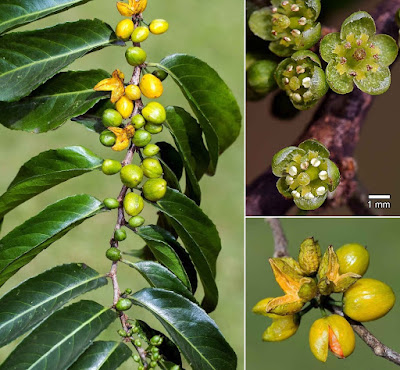
Casearia septandra. A leafy branchlet; B fruits; C dehisced fruit.
A – B from Baldé 1001; C from C. A. Couch et al. 550.
photos: A – B © A. Baldé; C © X. van der Burgt

Casearia septandra Breteler & Baldé sp. nov.


F. J. Breteler and A. Baldé. 2024. Casearia septandra (Salicaceae), A New tree Species from the Mountains of Guinea, West Africa. Kew Bulletin. DOI: 10.1007/s12225-024-10166-8

Saturday, December 16, 2023

[Botany • 2023] Casearia isthmica (Salicaceae) • A New Species from Central Panama and insights into its Phylogenetic Position within the Genus


Casearia isthmica de Mestier & O. Ortiz, 

in de Mestier, Pineda, Fonseca et Ortiz, 2023.

Abstract
We describe here a new species of Casearia from Panama based on both morphological and molecular data. Casearia isthmica sp. nov. is restricted to the mid-elevation cloud forests of Central Panama and presents morphological similarities with two more widespread species, C. sanchezii from high elevation areas of El Salvador and Mexico and C. tremula from the Caribbean, Central America, and Northern South America. Casearia isthmica differs in presenting pedunculated and congested inflorescences with up to 20 flowers, as well as flowers with 12 stamens and a pubescent style. Phylogenetic analysis based on selected plastid (petD, trnK-matK, rpl16 and rps4-trnLF) and nuclear (GBSSI and ITS) markers shows that the new species belongs to subclade B3 of Casearia, a lineage that encompasses species from Central America, Mexico and the Caribbean. Results of the morphological and molecular analysis were congruent and allowed a broader understanding of this new taxon, especially regarding its relationships to other Casearia.

Key words: Molecular phylogeny, Neotropics, new species, Samydeae

Casearia isthmica de Mestier & O. Ortiz
A flowering branch B inflorescence C flowers at anthesis D fruiting branch E leaves F ripe fruit G bark.

Photos A, C, E (back side of the leaf) by Carmen Galdames (Galdames 6153). Photos D, E (front side of the leaf) by Carmen Galdames (Galdames 6642). Photo B by Ernesto Campos (Sumich 151).
 Photos G, E by Ernesto Campos Plate by Marco Cedeño-Fonseca.  
 
Casearia isthmica de Mestier & O. Ortiz 
A branches B twig and stipules C trunk base and roots D lenticellate bark. Photos A, B by Carmen Galdames (Galdames 6642). Photo C by Ernesto Campos (Campos 1087). Photo D by Ernesto Campos. Plate by Marco Cedeño-Fonseca.

 Casearia isthmica de Mestier & O.Ortiz, sp. nov.

Etymology: The specific epithet refers to the geographic distribution of the new species, which is restricted to the Isthmus of Panama.


Astrid de Mestier, Ernesto Campos Pineda, Marco Cedeño Fonseca and Orlando O. Ortiz. 2023. A New Species of Casearia Jacq. (Salicaceae) from Central Panama and insights into its Phylogenetic Position within the Genus. PhytoKeys. 236: 97-112. DOI: 10.3897/phytokeys.236.108651

Friday, May 24, 2019

[Botany • 2019] Populus primaveralepensis (Salicaceae, Malpighiales) • A New Species of White Poplar from the Bosque La Primavera Biosphere Reserve in western Mexico


 Populus primaveralepensis 
A.Vázquez, Muñiz-Castro & Zuno

in Vázquez-García, Muñiz-Castro, Martínez-González, et al., 2019. 

Abstract
 Populus primaveralepensis A.Vázquez, Muñiz-Castro & Zuno sp. nov., a new species from relict gallery cloud forest in Bosque La Primavera Biosphere Reserve (Mexico), is described and illustrated. The new species belongs to P. subsect. Tomentosae Hart., and is morphologically similar to P. luziarum A.Vázquez, Muñiz-Castro & Padilla-Lepe, but differs from it in having taller trees without root suckers, white and ringed young stems and branches, a branching angle of ca 45º, leaves with higher blade to petiole ratio, leafs frequently elliptic or ovate to widely ovate (vs widely ovate to ovatedeltoid), denser inflorescences, and shorter capsules. The conservation status of the species was assessed as Critically Endangered (CR).

Keywords. Mexico, Populus luziarum, Populus simaroa, Populus sect. Aigeiros, Salicaceae.


Fig. 1. Populus primaveralepensis A.Vázquez, Muñiz-Castro & Zuno sp. nov. 
A–E, I–K. VázquezGarcía et al. 10106c leg., IBUG. F–H. Vázquez-García et al. 10106b leg., IBUG. A. Variability of leaves. B. Leaf bud. C. Branch with female inflorescence. D–E. Early and late state of inflorescence. F–G. Late and early male inflorescence. H. Male flower. I. Infrutescence with pappus. J. Capsule complete and in half, with pappus. K. Developing gynoecium. Illustrations: E. E. Vázquez-Verdejo.

Fig. 3. Populus primaveralepensis A.Vázquez, Muñiz-Castro & Zuno sp. nov., male individual, Vázquez-García et al. 10106b leg., IBUG. A–B. Two views of same branch with inflorescence past anthesis. C. Inflorescence at anthesis. D. Branch showing leaf variability and venation. Photographs: A. Vázquez.

Fig. 4. Populus primaveralepensis A.Vázquez, Muñiz-Castro & Zuno sp. nov., female individual, Vázquez-García et al. 10106c leg., IBUG. A. Inflorescence at anthesis. B. Inflorescence past anthesis. C. Developing infrutescence. D. Trunk. E. Branch with leaves and dehiscing capsules, showing the whitish pappus of seeds. Photographs: A. Vázquez.

Populus primaveralepensis A.Vázquez, Muñiz-Castro & Zuno sp. nov.
Fig. 3. male individual, Vázquez-García et al. 10106b leg., IBUG. A–B. Two views of same branch with inflorescence past anthesis. C. Inflorescence at anthesis. D. Branch showing leaf variability and venation. 
Photographs: A. Vázquez.
Fig. 2. Tree showing its habit and bark. J. Padilla Lepe, standing next to the tree; 
photograph: O. Ibarrarán.

Class Magnoliopsida Brongn.
Order Malpighiales Juss. ex Bercht. & J.Presl

Family Salicaceae Mirb.

Genus Populus L.
Section Populus Subsection Tomentosae Hart.

Populus primaveralepensis A.Vázquez, Muñiz-Castro & Zuno sp. nov. 

Differential diagnosis Populus primaveralepensis sp. nov. is morphologically close to P. luziarum, but it differs from the latter in possessing various qualitative and quantitative characters, such as having taller trees with nonsoboliferous habit, branching angle of ca 45º with white and ringed bark, and leaves with higher blade to petiole ratio (large leaves with petioles 2.9–3.9 vs 5.4–6 cm long, leaf blades frequently elliptic or ovate to widely ovate vs widely ovate to ovate-deltoid, 17–18.5 vs 15.5–16 cm long, inflorescences dense vs sparse, and shorter capsules, 1.0–1.8 vs 2.0–2.5 mm (Table 1).
....

Etymology: The epithet honors the collective conservation accomplishments at Bosque La Primavera for its twelfth anniversary as a MaB–UNESCO Biosphere Reserve as well as the biologist Jesús Padilla Lepe, a young and enthusiastic botanical explorer graduated from the Universidad de Guadalajara who discovered the species.

Ethnobotany: The species is locally known as “álamo”. There is no available information on the use of the species in Jalisco; however, sometimes it is kept as a shade tree for cows. Like other species in the genus Populus, P. primaveralepensis sp. nov. is a potential source of cellulose fibers, and can be used as an ornamental tree, or for restoration of watersheds in central Jalisco.


J. Antonio Vázquez-García, Miguel Ángel Muñiz-Castro, Rosa Elena Martínez-González, Gregorio Nieves-Hernández, María Guadalupe Pulido-Ávila, Gerardo Hernández-Vera and Osvaldo Zuno Delgadillo. 2019. Populus primaveralepensis sp. nov. (Salicaceae, Malpighiales), A New Species of White Poplar from the Bosque La Primavera Biosphere Reserve in western Mexico. European Journal of Taxonomy. 498: 1–16.  DOI:  10.5852/ejt.2019.498

Thursday, December 20, 2018

[Botany • 2018] Casearia austroafricana (Samydoideae, Salicaceae) • A New Species of Casearia from South Africa


Casearia austroafricana A.E.van Wyk, R.G.C.Boon & Retief

in van Wyk, Boon & Retief, 2018. 
Photographs: R.G.C. Boon. 

Abstract
Casearia austroafricana, a new species from South Africa, is described, illustrated, mapped, and compared with the two other currently accepted southern African members of the genus, namely C. gladiiformis and C. battiscombei. The new species belongs to Casearia sect. Casearia, and is confined to the provinces of KwaZulu-Natal and Eastern Cape. Known for over 100 years by botanists, material of this species has initially been assigned to C. junodii, but from about the 1960s to C. gladiiformis, for which the former is considered a synonym. Casearia austroafricana is readily distinguished by being a tall (up to ca. 30 m) subcanopy or canopy tree associated with temperate or subtropical forest, and in having twigs of young growth usually markedly zigzag, leaves of mature growth with blade relatively thin, principal lateral veins usually 8–10 pairs, margin distinctly serrate-crenate, flowers with the ovary glabrous, and capsules with relatively few seeds (3 or 4). A conservation assessment of “Least Concern” is recommended for this species based on IUCN Red List categories and criteria. Ecological associates are mentioned, including epiphytic ferns, orchids, birds attracted by the arillate seeds, and Lepidoptera (moths) for which it serves as host-plant.

Keywords: Afromontane Forest, Casearia sect. Casearia, Eastern Cape, epiphytes, KwaZulu-Natal, Lepidoptera, Maputaland Centre of Endemism, Maputaland-Pondoland-Albany Hotspot, Pondoland Centre of Endemism, Samydaceae, Scarp Forest, taxonomy, trees, Eudicots


FIGURE 2. Casearia austroafricana.
 A. Flowering branchlet. B. Flower. C. Flower; one sepal and half the staminal tube removed. D. Part of staminal tube opened out. E. Fruit. F. Dehisced fruit; seeds all shed. G. Seeds, both from same capsule and each covered by an aril.

Scale bar = 10 mm (A, E & F), or 1 mm (B–D & G). A–D from Luckhoff s.n., sub NH 32946, E & G from Miller 5824 and F from Miller 652. Artist: Daleen Roodt.

FIGURE 1. Casearia austroafricana.
A. Fruiting branchlet placed horizontally; to view original hanging orientation, turn plate 90º clockwise. B. Flowers. C. Ripe and dehisced fruit.
Photographs: R.G.C. Boon. 

Casearia austroafricana A.E.van Wyk, R.G.C.Boon & Retief, sp. nov. 
 Casearia austroafricana resembles C. gladiiformis, but is easily distinguished from this species by, amongst others, growing under temperate or subtropical conditions, always in or near forest (vs. tropical, and in either open woodland, thicket or forest), with the trees becoming taller (>20 m vs. <10 m), in having young twigs usually markedly zigzag (vs. straight or weakly zigzag), leaves of mature growth with blade relatively thin (firmly chartaceous vs. coriaceous), margin glandular-serrate (vs. entire), ovary glabrous (vs. hirsute, at least towards the apex), and fewer seeds per capsule (3 or 4 vs. ca. 10)
....

Etymology:—The specific epithet is the Latin for “South Africa”, chosen because the new species is the only member of Casearia endemic to the country.

Common names:— Existing names include swordleaf, southern swordleaf, suidelike bosswaardblaar (Afrikaans), smozob (Zulu?; from Henkel s.n.) and qokama (Xhosa; from Acocks 12820).


Abraham E. van Wyk, Richard G.C. Boon and Elizabeth Retief. 2018. A New Species of Casearia (Samydoideae, Salicaceae) from South Africa. Phytotaxa. 383(3); 273–282. DOI: 10.11646/phytotaxa.383.3.4