Showing posts with label Author: Sangvir.. Show all posts

Tuesday, December 26, 2023

[Botany • 2022] Globba pelecanthera & G. securifer (Zingiberaceae: Globbeae) • Phylogeny of Globba section Nudae and Taxonomic Revision of the new Globba subsection Pelecantherae


Globba pelecanthera Sangvir. & M.F.Newman, 

in Sangvirotjanapat, Fér, Denduangboripant et Newman, 2022.

Abstract
A molecular systematic study of Globba section Nudae (Zingiberaceae) using ITS and matK sequences identifies three major clades, Globba subsection Nudae, G. subsection Mediocalcaratae and a new subsection, Globba subsection Pelecantherae, which is described here. The two species belonging in this subsection, Globba pelecanthera and Globba securifer, which are both new, are described. Rectangular anther appendages are reported in Globba for the first time. Evidence of hybridisation is given. The morphological characters of the flowers, which are likely to be important in pollination, are discussed.

Keywords: Anther appendages, Floral evolution, Hybridisation, Taxonomy
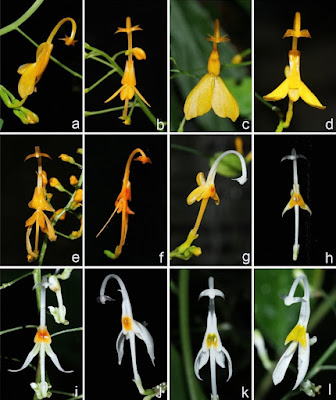
Flower colour variation in Globba section Nudae.
a–e Plain yellow or orange flower: a G. expansa (subsection Nudae), b G. lithophila (subsection Nudae), c G. aranyaniae with red-brown spot on labellum (subsection Nudae), d G. pelecanthera (subsection Pelecantherae), e G. newmanii (subsection Mediocalcaratae).
Yellow with red spot on labellum: f G. decora. g–h Mixture of yellow and white: g G. argyrocycnos, h G. nitens.
i–l White with orange-red or greenish brown or yellow spot: i G. albiflora, j G. lilacina, k G. macrocarpa, l G. chrysochila


Globba subgenus Globba 
section Nudae 
subsection Pelecantherae Sangvir., subsect. nova.

Diagnosis: Belonging to Globba section Nudae by the occurrence of andromonoecy, the ellipsoid fruit with deep, longitudinal furrows and resembling subsection Mediocalcaratae by the anthers with two appendages but differing by the rectangular appendages (not acute) and elliptic to obovate lateral staminodes.

Type species: Globba pelecanthera Sangvir. & M.F.Newman.

Distribution: Cambodia (Mondul Kiri), Laos (Bolikhamxay, Attapeu), Thailand (Ubon Ratchathani).

Notes: Globba pelecanthera and G. securifer belong to Globba section Nudae by their erect inflorescences, small, caducous bracts, the occurrence of andromonoecy and ellipsoid, deeply ridged fruits but both species bear rectangular anther appendages which distinguish them from all species of subsections Nudae and Mediocalcaratae which bear triangular or linear anther appendages. This character, taken with the molecular systematic evidence presented above, justifies the recognition of a new subsection.

Globba pelecanthera Sangvir. & M.F.Newman:
a habit, b front view of functionally male flower, c front and side views of hermaphrodite flower, d anther and appendages of hermaphrodite flower, e ligule.
Scale bars: a = 10 cm; b and c = 1 cm; d and e  = 2 mm.
 All photographs by S. Sangvirotjanapat

Globba pelecanthera Sangvir. & M.F.Newman, sp. nov.

Diagnosis: Similar to Globba ranongensis Picheans. & Tiyaw. by its obovate to elliptic lateral staminodes, but differing by its rectangular anther appendages, 2.5 × 1.5 mm (vs. subtriangular (⚥) or linear (♂)), narrowly rectangular lip, 8.5 × 2.5 mm (vs. deltoid, 5–7 × 7–9 mm), and sandstone habitat (vs. limestone plant).

Etymology: Greek, combining ‘pelekus’ (axe) and ‘anthera’, describing the axe-shaped anther appendages.

Globba securifer Sangvir. & M.F.Newman:
 a habit, b a population in the habitat, c anther and appendages of hermaphrodite and functionally male flowers, d front view of hermaphrodite flower, e side view of hermaphrodite flower Front view of functionally male flower, f front view of functionally male flower, g side view of functionally male flower.
Scale bars: a = 10 cm; c = 2 mm; d–g = 1 cm. 
All photographs by S. Sangvirotjanapat

Globba securifer Sangvir. & M.F.Newman, sp. nov.

Diagnosis: Similar to Globba ranongensis Picheans. & Tiyaw. in its elliptic blades and plain yellow flowers, but differing by its rectangular anther appendages, 2.5 × 1.5 mm (vs. triangular (⚥) or linear (♂)) and sandstone habitat (vs. limestone plant).

Etymology: Securifer means ‘axe-bearing’ in Latin. This epithet, like pelecanthera, refers to the axe-shaped anther appendages of the flower.

Conclusions: 
By adding a much more complete representation of the species and geographical range of section Nudae, we have demonstrated the need for a new subsection, as well as confirming that the two existing subsections are monophyletic.

There are now 28 species in Globba section Nudae, classified among three subsections. Globba subsection Nudae is most diverse in the Northern Floristic Province of Thailand and extends north and westwards, while Globba subsection Mediocalcaratae has a more southerly distribution with species north and south of the Isthmus of Kra. Lastly, the new subsection Pelecantherae is found further east in areas with a very strong dry season.

More study is required, particularly in Myanmar, Bangladesh and India to complete our knowledge of species distributions in these countries and to clarify the status of the doubtful species mentioned by Sangvirotjanapat et al. (2019a).

Hybridisation has been observed, but our methods do not allow much more to be said at present. Further studies using population genetics techniques will shed light on this question.


Sunisa Sangvirotjanapat, Tomáš Fér, Jessada Denduangboripant and Mark F. Newman. 2022. Phylogeny of Globba section Nudae and Taxonomic Revision of the new Globba subsection Pelecantherae. Plant Systematics and Evolution. 308: 5.  DOI: 10.1007/s00606-021-01789-6

Wednesday, December 20, 2023

[Botany • 2023] Globba amicitia (Zingiberaceae: Globbeae) • A New Species from Phou Khao Khouay National Protected Area, Bolikhamxay Province, Laos


Globba amicitia Sangvir. & Souvann., 

in Souvannakhoummane, Lanorsavanh et Sangvirotjanapat, 2023.
ດອກຮ່ວງເຂົ້າມິດຕະພາບ || DOI: 10.20531/tfb.2023.51.2.14 
ดอกเข้าพรรษามิตรภาพ ||   facebook.com/SireePark 
Photographed by K. Souvannakhoummane & S. Lanorsavanh.

Abstract
Globba amicitia (Zingiberaceae: Globbeae), a new species from Laos is described and illustrated. This species is morphologically most similar to G. larsenii, a species from Thailand, in having erect inflorescences and entirely yellow flowers without spots, but easily recognizable by its sessile cincinni and puberulent lateral staminodes. A proposed IUCN Red List assessment and notes on distinguishing characters are provided. A key to species of Globba subgenus Globba in the Indo-Chinese region is included.

Keywords: Cambodia, gingers, Globba larsenii, Indo-China, South-East Asia, Vietnam


Globba amicitia Sangvir. & Souvann.
 (Lanorsavanh & Souvannakhoummane KS2224),
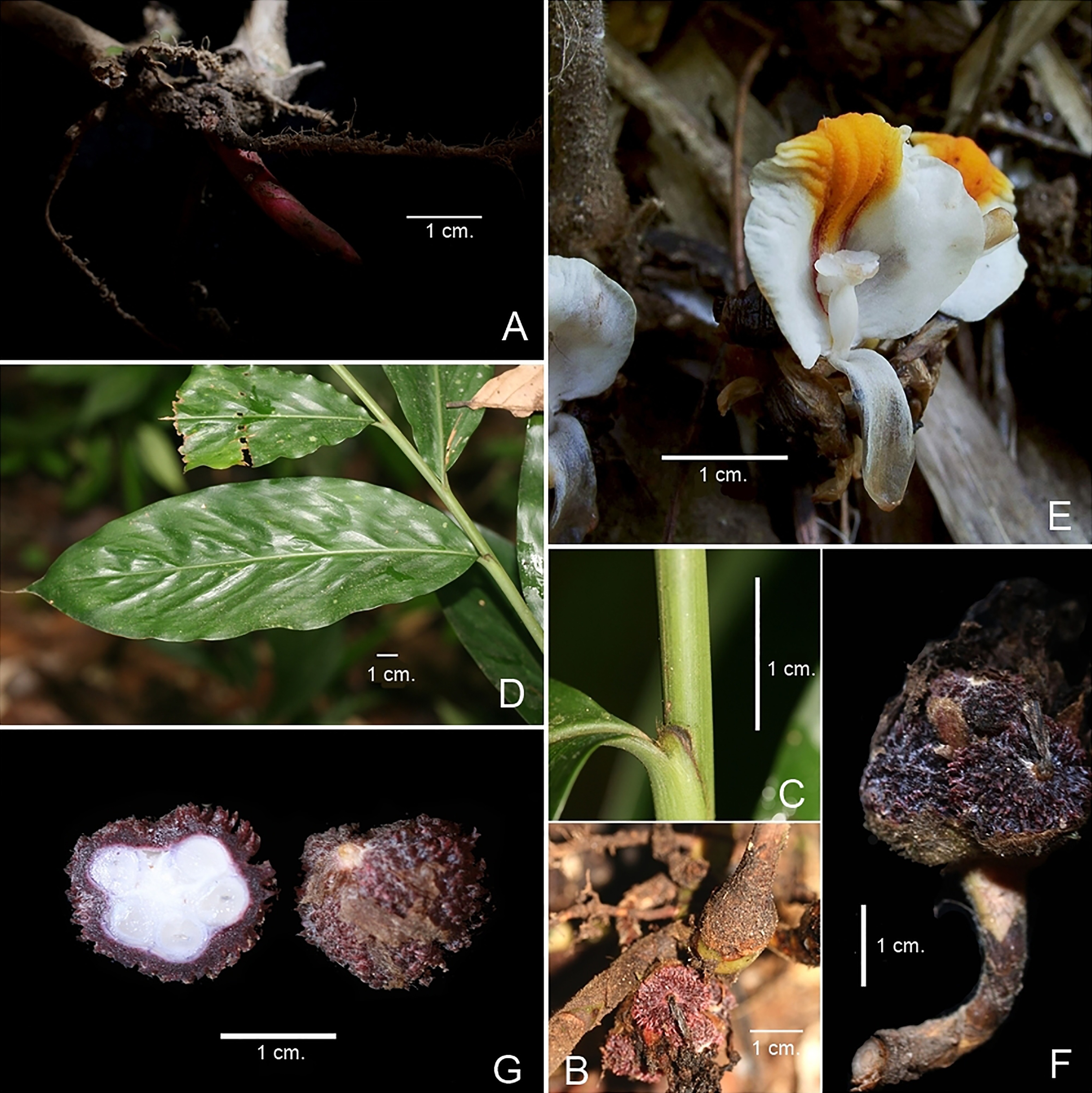
A. habit; B–C. flower front and side views; D. indumentum on lateral staminodes; E. dissection of flower; F. fruit. 
ov=ovary, ca=calyx, dcl= dorsal corolla lobe, lcl= lateral corolla lobe, ls=lateral staminode, lb=labellum, ft=floral tube, nt=nectar tube, fi=filament, at=anther (front and back views)  
Photographed: A & E by K. Souvannakhoummane; B–D, F by S. Lanorsavanh.

Globba amicitia Sangvir. & Souvann., sp. nov.
 (subgenus Globba).

Morphologically similar to Globba larsenii (Fig. 3) in its erect inflorescence, dark reddish brown peduncle, and yellow‐orange flower without spots on the labellum, but differs by sessile cincinni (versus prolonged cincinni in G. larsenii), puberulent lateral staminodes (versus glabrous lateral staminodes),and small plant size, about 15–25 cm tall (versus 30–80 cm tall)(Table 1).

Etymology.— Latin, ‘amicitia’ refers to the friendship between Lao and Thai cultures, and also to the collaboration between Lao and Thai botanists.

Vernacular name.— ດອກຮ່ວງເຂົ້າມິດຕະພາບ (Dok Houang Khao Mitthaparb) (Proposed here).
 

Keooudone Souvannakhoummane, Soulivanh Lanorsavanh and Sunisa Sangvirotjanapat. 2023.Globba amicitia (Zingiberaceae: Globbeae), A New Species from Phou Khao Khouay National Protected Area, Bolikhamxay Province, Laos. THAI FOREST BULL., BOT. 51(2): 157–163. DOI: 10.20531/tfb.2023.51.2.14  

ดร.สุนิสา แสงวิโรจนพัฒน์ โครงการจัดตั้งสถาบันอุทยานธรรมชาติวิทยาสิรีรุกขชาติ มหาวิทยาลัยมหิด ร่วมด้วย อ.แก้วอุดอน​ สุวันนะกุมมาน และ อ.สุลิวัน​  หล้าหน่อสะหวัน จากภาควิชาชีววิทยา คณะทรัพยากรธรรมชาติ มหาวิทยาลัยแห่งชาติลาว ร่วมกันศึกษาพืชวงศ์ขิง สกุลดอกเข้าพรรษา Globba  จากป่าสงวนแห่งชาติภูเขาควาย แขวงบอลิคำไซ ประเทศลาว และได้รายงานเป็นพืชชนิดใหม่ของโลก โดยให้ชื่อว่า Globba amicitia Sangvir. & Souvann. ซึ่ง amicitia หมายถึง มิตรภาพ เป็นการสะท้อนถึงความร่วมมือทางวิชาการของนักพฤกษศาสตร์ของประเทศลาวและไทย 
ดอกเข้าพรรษามิตรภาพ มีช่อดอกเรียวยาว ช่อดอกย่อยสั้นมาก ดอกสีเหลืองล้วน มีรยางค์อับเรณู 4 อัน ซึ่งเป็นลักษณะเด่นที่ใช้ในการจำแนกชนิดได้ ปัจจุบันเป็นพืชเฉพาะถิ่นของลาว และพบที่ภูเขาควายเท่านั้น การประเมินสถานะการอนุรักษ์ในธรรมชาติ (IUCN Red List) ถูกจัดอยู่ในระดับความเสี่ยงขั้นวิกฤติต่อการสูญพันธุ์ (CR – Critically endangered species) เนื่องจากประชากรมีขนาดเล็ก ถือเป็นพืชในวงศ์ขิงอีกชนิดหนึ่งที่ควรอนุรักษ์อย่างเร่งด่วน 


Saturday, May 21, 2022

[Botany • 2022] Wurfbainia ellipticarpa, W. geostachyoides, W. parviflora, etc. • Six New Species of Wurfbainia (Zingiberaceae) from Thailand


Wurfbainia yingyongii Kaewsri, 

in Kaewsri & Sangvirotjanapat, 2022. 

ABSTRACT
Six new species are described from Thailand: Wurfbainia ellipticarpa, W. geostachyoides, W. globosa, W. longiflora,  W. parviflora and W. yingyongii. A line drawing and photographs, information on phenology,  distribution, ecology and etymology, and a proposed IUCN conservation category are provided for each species. A key to the species of Wurfbainia in Thailand is also provided.
 
Keywords: AmomumCardamom, Ginger, Flora, Taxonomy

Wurfbainia ellipticarpa Kaewsri, sp. nov.
 A, Ligule; B, leaves; C, inflorescence; D, mature infructescence; E, young infructescence.
All photographs of the type collection (Kaewsri 024), taken by W. Kaewsri.

Wurfbainia ellipticarpa Kaewsri, sp. nov.

Similar to Wurfbainia villosa (Lour.) Škorničk. & A.D.Poulsen but differs in its narrower labellum (c.1 cm vs c.1.5 cm), inflorescence lax (vs congested) and fruit ellipsoid (vs globose to ovoid).

Habitat. Thrives in dry evergreen forest in light gaps at 800 m altitude.

Etymology. The specific epithet refers to the ellipsoid fruit. 


 Wurfbainia geostachyoides Kaewsri, sp. nov.
 A, Habit; B, stilt roots and inflorescences; C, ligule; D, leaves; E, flower; F, flowers; G, young fruits; H, ripe fruits.
All photographs of the type collection (Kaewsri 223), taken by W. Kaewsri.

Wurfbainia geostachyoides Kaewsri, sp. nov.

Similar to Wurfbainia microcarpa (C.F.Liang & D.Fang) Škorničk. & A.D.Poulsen but differs in its shorter ligule (c.2 mm vs 7–10 mm), abaxial blade surface glabrous (vs tomentose) and lateral staminode apex truncate (vs rounded and hooded).

Habitat. Dry evergreen and tropical rain forest under shrubs or trees or on hill slopes at 260–950m altitude.

Etymology. The specific epithet refers to the distinctly woody rhizome raised above ground with stilt roots, which recalls the genus Geostachys (Baker) Ridl.


  Wurfbainia globosa Kaewsri, sp. nov.
 A, Leaves; B, inflorescence and infructescence; C, flower; D, bract; E, bracteole; F, calyx; G, corolla (dissected); H, labellum; I, stamen; J, stigma; K, fruit.
Drawn from Kaewsri 027 by W. Kaewsri.

Wurfbainia globosa Kaewsri, sp. nov.

Similar to Wurfbainia villosa (Lour.) Škorničk. & A.D.Poulsen but differs in its ligule apex bilobed (vs round or emarginate), calyx apex bilobed (vs trilobed) and labellum apex bilobed (vs shallowly trilobed).

Habitat. Dry evergreen forest under shrubs or trees at 215m altitude.

Etymology. The specific epithet refers to the globose fruit.


Wurfbainia longiflora Kaewsri, sp. nov.

Similar to Wurfbainia uliginosa (J.Koenig) Škorničk. & A.D.Poulsen but differs in its shorter leafy shoot (0.6–1.7 m vs 2.4–4.1 m), inflorescence size (3 × 1.2 cm vs 3–5 × 2–3 cm), longer floral tube (3.7–4.2 cm long including ovary vs c.2.5 cm long including ovary) and young fruit white (vs green).

Habitat. Tropical rain and evergreen forest under shrubs and trees at 215 m altitude.

Etymology. The specific epithet refers to the distinct long floral tube.


Wurfbainia parviflora Kaewsri, sp. nov.

Similar to Wurfbainia micrantha (Ridl.) Škorničk. & A.D.Poulsen but differs in its blade size (11–21 × 2–4 cm vs 15–30 × 0.6–2 cm), blade pubescent on both sides (vs glabrous on both sides) and calyx tube apex bilobed (vs trilobed).

Habitat. Dry evergreen forest in light gaps at c.800 m altitude.

Etymology. The specific epithet refers to the small flower.


Wurfbainia yingyongii Kaewsri, sp. nov.
A, Young leafy shoot; B, pseudostem base; C, ligule; D, leaves; E, inflorescence; F, infructescence; G, fruit (cross-section).
All photographs of the type collection (Kaewsri 001), taken by W. Kaewsri.

Wurfbainia yingyongii Kaewsri, sp. nov.

Similar to Wurfbainia biflora (Jack) Škorničk. & M.F.Newman but differs in its labellum ovate (vs obovate) and orange middle band on labellum (vs mid-red to dark red band).


Habitat. Dry evergreen forest, under shade of shrubs and trees, c.400 m altitude.

Etymology. The specific epithet honours Associate Professor Dr Yingyong Paisooksantivatana, who dedicated his life to the study of Amomum sensu lato in Thailand.

 
W. Kaewsri and S. Sangvirotjanapat. 2022. Six New Species of Wurfbainia (Zingiberaceae) from Thailand. EDINBURGH JOURNAL OF BOTANY. 79; Article 369 (1–23). DOI: 10.24823/EJB.2022.369


Wednesday, January 5, 2022

[Botany • 2022] Globba philippinensis (Zingiberaceae) • A New Endemic Species from Western Visayas, Philippines


 Globba philippinensis Naive, J.A.G. Dalisay, Bangcaya & Sangvir.

in Dalisay, Naive, Bangcaya & Sangvirotjanapat, 2022.
Photos by J.A.G. Dalisay
 
Abstract
A new species, Globba philippinensis Naive, J.A.G. Dalisay, Bangcaya & Sangvir. from Antique Province, Philippines, is herein described and illustrated. A detailed description, colour plates, discussion of similar taxa, information on its distribution and habitat are provided. A preliminary conservation assessment is proposed and a key to the species of Globba section Nudae subsection Mediocalcaratae is amended.

Keyword: Antique Province, Philippine flora, section Nudae, subsection Mediocalcaratae, Zingiberales


Globba philippinensis Naive, J.A.G. Dalisay, Bangcaya & Sangvir.
A. Habit B. Leaves, scale bar: 10 cm C. Excavated rhizome D. Ligule E. Inflorescence F. Flower (front view), scale bar: 2 cm G. Flower (side view), scale bar: 2 cm H. Dissected flowers (fl: flower; ls: lateral staminode, scale bar: 5 mm; la: labellum (no decurrent and cornicula), scale bar: 5 mm; lcl: lateral corolla lobes, scale bar: 5 mm; o: ovary and calyx, scale bar: 1 mm; an: anther, scale bar: 2 mm) I. Fruit, scale bar: 2 cm J. Bulbil, scale bar: 10 mm.
 (Photos by J.A.G. Dalisay).

Globba philippinensis Naive, J.A.G. Dalisay, Bangcaya & Sangvir., sp. nov. 

Diagnosis: Globba philippinensis Naive, J.A.G. Dalisay, Bangcaya & Sangvir. is similar to G. campsophylla K.Schum. (Fig. S1A) and G. argyrocycnos Sangvir. & M.F.Newman (Fig. S1B) in floral structure and flower colour, respectively. Similar to Globba campsophylla K.Schum. in its decurrent labellum, base of filament with cornicula, and linear lateral staminodes but differs in its contrasting flower colour of yellowish orange (floral tube, corolla lobes, lateral staminodes, and labellum lobes) and white (filament and anther thecae) (versus flower pure white with yellow spot at labellum) and bulbils produced at peduncle (versus at tip of the inflorescence). Similar to Globba argyrocycnos Sangvir. & M.F.Newman in its contrasting flower colour of yellowish orange (floral tube, corolla lobes, lateral staminodes, and labellum lobes) and white (filament and anther thecae) but differs in its decurrent labellum base with cornicula (versus decurrent labellum base on filament without cornicula).

Flowers of A. Globba campsophylla K.Schum. B. Globba argyrocycnos Sangvir. & M.F.Newman.
Photos by M.A.K. Naive and (A) and Sunisa Sangvirotjanapat (B).

Ecology: This species found growing in the different type of habitats, such as in agroforestry plantations, along the trails and near creeks and streams from 10 to 100 m above sea level (Fig. S2).  

Etymology: Named after the country of origin, the Philippines, where the species was discovered and collected. 

Vernacular name: Known as “tabayag” by the local people of its type locality. 

Different habitat types of Globba philippinensis
A. Agroforest. B. By the creek. C. Along the trail. D. Near the streams.
Photos by J.A.G. Dalisay.


Jade Ann Grace P. Dalisay, Mark Arcebal K. Naive, Porferio S. Bangcaya and Sunisa Sangvirotjanapat. 2022. Globba philippinensis (Zingiberaceae), A New Endemic Species from Western Visayas, Philippines. Taiwania. 67(1); 25 - 29. DOI: 10.6165/tai.2022.67.25