Wednesday, November 16, 2011

[Herpetology • 2008] 3 new Pristimantis; P. achuar, P. altamnis & P. kichwarum • from the upper Amazon forests in Ecuador


Abstract
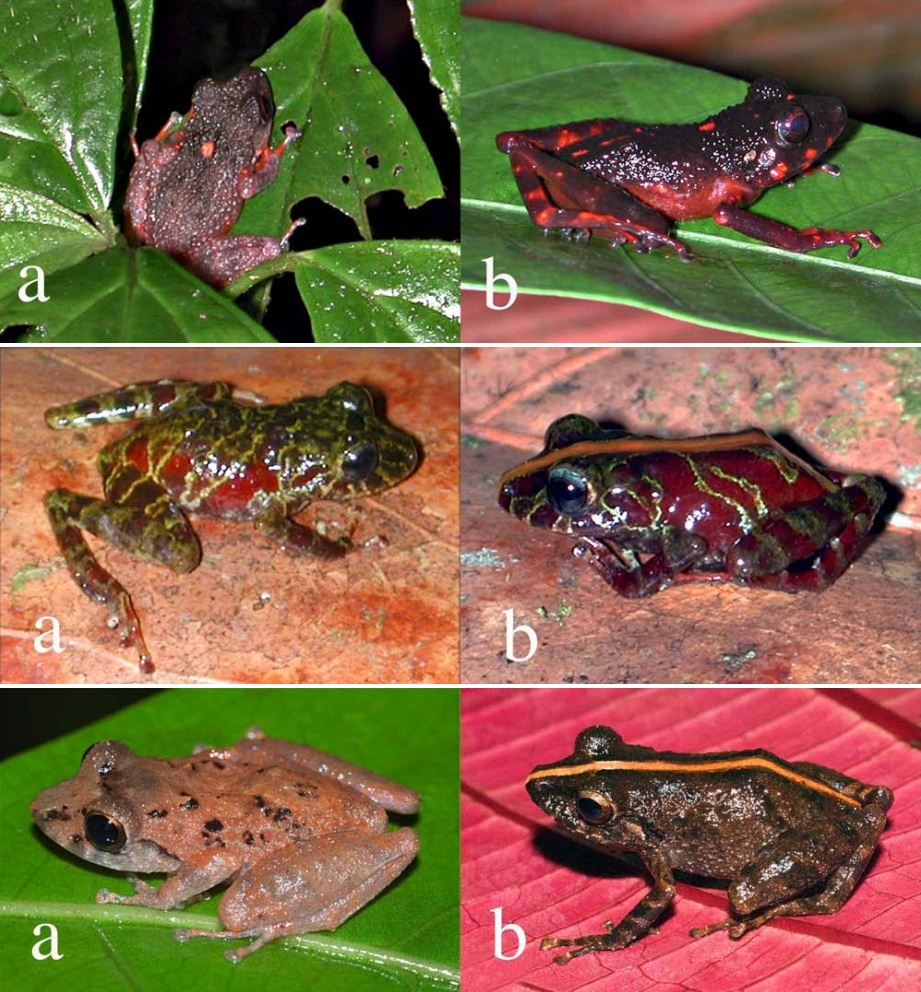
We describe three new species of Pristimantis leaflitter frogs from the upper Amazon basin of Ecuador: Pristimantis achuar, Pristimantis altamnis, and Pristimantis kichwarum. Each of these new species was previously considered to be part of a single species, formerly known as Eleutherodactylus ockendeni (Boulenger) morph B. However, analysis of DNA sequences together with examination of the morphology of more than 600 specimens from Ecuador reveals that multiple species were confused under the same name. The morphological differences among the three new species are subtle but consistent: presence or absence of a black canthal stripe and/or supratympanic ridge, snout-vent length, and ventral colouration. The three species are generally allopatric and geographically restricted, although at some localities two of the species occur sympatrically.

Key words Anura; new species; terrestrial frog; South America; Pristimantis achuar; Pristimantis altamnis; Pristimantis kichwarum


Pristimantis achuar sp. nov. —
:— :— :—

Holotype:— QCAZ 25463 (field number SC11438) an adult female collected at Kapawi Jungle Lodge, Pastaza province, Ecuador (S 02° 32.32 , W 76° 51.50 , altitude 239 m) on 24 June 2003 by KRE and I.G. Tapia.

Etymology:— This species is named for the Achuar indigenous nation of the upper Amazon basin, who are ardent protectors of their biodiversity and generously granted permission to KRE to sample frogs from their land at Kapawi Lodge. The epithet is a noun in apposition.

Natural History:— Individuals were found in primary forest and presumably can also be found in secondary forest. By night they were often perched on the leaves of low vegetation from 0.2 to 1.3 m elevation. By day they were found in the leaflitter.

Distribution:— Pristimantis achuar is found in the lowlands of the Pastaza and Napo rivers in southern Ecuador (see Fig. 5). The species is probably more widely distributed into northern Peru.


Pristimantis altamnis sp. nov. —
:— :— :—

Holotype:— QCAZ 25311 (field number SC 11271), an adult female collected at Cando community, upper Napo river, parroquía Talag, Napo province, Ecuador (S 01° 05.71’, W 77° 55.47’, altitude 680 m) on 3 May 2003 by KRE and T. Sugahara.

Etymology:— This species is named for the swift headwater rivers of the Amazon River, since it is found at localities near the origins of Ecuador’s major rivers (Napo, Pastaza, and Aguarico). The name is a compound adjective of the Latin “altus” for upper and “amnis” for river.

Natural history:— Individuals were found in primary and secondary forest. By night they are often perched on the leaves of low vegetation. By day they were found in leaflitter. 18

Distribution:— Pristimantis altamnis has been found throughout the humid upland tropical forests of eastern Ecuador, at elevations of approximately 400–1000 masl (see Fig. 5). To the east it is replaced by P. kichwarum or P. achuar. Its range limits to the north and south are not known. In the upper Napo River area (Jatun Sacha Biological Station), P. altamnis has been found sympatrically with P. kichwarum.


Pristimantis kichwarum sp. nov. —
:— :— :—

Holotype:— QCAZ 18128 (field number SC7783), an adult male collected at Jatun Sacha Biological Station, parroquía Ahuano, Napo province, Ecuador (S 01°04.45’, W 77°36.93’, altitude 472 m), on 14 November 2001 by KRE and F. Ayala-Varela. MtDNA cytochrome b Genbank accession number EF581033.

Etymology:— This species is named for the indigenous Kichwa communities in the Oriente of Ecuador. They are recognized in this small collective way as a token of appreciation for the engagement of individuals and communities in this research, and for sharing their biodiversity and knowledge. The patronym is a Latin feminine plural genitive of the nation name.

Natural history:— Individuals were found in primary and secondary forest. By night they were found perched on the leaves or stems of low vegetation from 0.2 to 1.5 m elevation. By day they were found in the leaflitter. The following specimens were collected in amplexus: QCAZ 25287 (paratype female) with 25288 (paratype male), 25751 (paratype female) with 25752 (referred male), and 25782 (paratype female) with 25783 (referred male).

Distribution:— Pristimantis kichwarum has been found throughout the humid tropical forests of eastern lowlands of Ecuador in the Napo, Orellana, and Sucumbíos provinces, at elevations of approximately 500 masl and below (see Fig. 5). The extent of its distribution to the east and north is not known. The species is apparently replaced by P. achuar to the south in the Pastaza basin. In the upper regions of the Napo River (Jatun Sacha Biological Station), P. kichwarum has been found sympatrically with P. altamnis.


Elmer, K.R. and Cannatella, D.C. 2008. Three new species of leaflitter frogs from the upper Amazon forests: cryptic diversity within Pristimantis ockendeni” (Anura: Strabomantidae) in Ecuador. Zootaxa 1784: 11–38.
http://kops.ub.uni-konstanz.de/bitstream/handle/urn:nbn:de:bsz:352-opus-75947/Elmer_Cannatella_2008.pdf?sequence=1

[Herpetology • 2008] Pristimantis andinognomus • A Minute New Ecuadorian Andean Frog (Anura: Strabomantidae)


FIG. 2.— Pristimantis andinognomus (holotype) in life. Photo by L. A. Coloma.


ABSTRACT
We describe a new species of Pristimantis from a cloud forest at 2450–2800 m in the Cordillera Oriental in southern Ecuador (Zamora Chinchipe). The new species has a maximum snout–vent length of 17.9 mm (average SVL of 21 males 5 12.3 mm 6 1.2, and of 19 females 5 15.9 mm 6 1.3). This new species is the second smallest frog from Ecuador and smallest Pristimantis. Morphologically and phylogenetically, the new species is similar to P. caeruleonotus and P. colodactylus. It is distinguished from them and its congeners by its size, tuberculation, a distinct color pattern consisting of tan blotches on dorsum, spots on a brown venter, minute brown spots on anterior and posterior surfaces of the thighs, and other morphological features. Determination of small body size in frogs is discussed and meristic data of 40 minute frogs are compiled.

Key words: Cordillera Oriental; Ecuador; Miniaturization; New species; Pristimantis; Reserva Tapichalaca

Pristimantis andinognomus sp. nov.
Holotype.— QCAZ 16695, an adult male (Figs. 1, 2), from Reserva Tapichalaca, on road between Yangana and Valladolid (04u 289 S, 79u 089 W; 2667 m), Provincia Zamora Chinchipe, Ecuador, collected by Italo G. Tapia, Queti M. Tapia on 17 September 2001.

Etymology.— The specific name andinognomus is derived from the New Latin noun Andinus meaning Andes and the New Latin noun gnomus meaning dwarf. Andinognomus means ‘‘Andean dwarf’’ and refers to the small size of the new species, which is currently the smallest of the genus.


Edgar Lehr and Luis A. Coloma. 2008. A Minute New Ecuadorian Andean Frog
(Anura: Strabomantidae, Pristimantis). Herpetologica, 64(3):354-367. 2008.

Tuesday, November 15, 2011

[Herpetology • 2008] Pristimantis leucorrhinus • A new peculiar frog from Yanachaga-Chemillén National Park, Peru


Pristimantis leucorrhinus sp. nov.


Abstract
We describe a new species of frog, Pristimantis leucorrhinus sp. nov., from the Cordillera Yanachaga, Yanachaga Chemillén National Park, on the eastern slopes of the Andes in Central Peru. The new species belongs to the P. unistrigatus group and is characterized by the absence of a tympanum, the presence of horn-like tubercles on upper eyelids and a characteristic colour pattern.

Key words: Anura; Leptodactylidae; Pristimantis; New species; Andes; Peru; Cordillera Yanachaga-Chemillén


FIGURE 1. The holotype of Pristimantis leucorrhinus in dorsolateral view; a) particular of the heel; b) particular of the eye (photo G. Gertosio).


Etymology. The specific name is derived from the Greek nouns leucos, meaning “white”, and rhinos, meaning “snout”. The name refers to the distinctive white squarish spot on the nasal region.


Distribution and habitat. Pristimantis leucorrhinus is known only from the type locality (Fig. 4), a montane cloud forest on the Amazonian slopes of the Peruvian Andes, otherwise known as the Peruvian Yungas. The single specimen was found at night (21:00–23:00 hr) on a composite leaf of a tree, 2–3 meters above the ground, next to a path, during a light rain. No call was associated with this species. Only three other syntopic anurans (all Pristimantis) were found.
According to Catchpole (2004), the study site is classified as primary forest, although very selective logging may have occurred in recent decades. The site is located in a steep valley bottom with a westerly aspect (fig 4). The forest has a dense 15–25 m broken canopy with complex stratification and emergents up to 40 m in height. The dominant canopy trees are of the genera Alchornea Sw., Cedrela P. Browne, Croton L., Escallonia Mutis ex L. f., Ficus L., Hyeronima M. Allemão, Miconia Ruiz & Pav., Oreopanax Decne. & Planch., Persea Mill., Podocarpus L'Hér. ex Pers., and Weinmannia L. The broken canopy is the result of frequent landslides and treefalls that result from high rainfall and very steep slopes (20º–55º). The understory is dominated by shrubs and small trees in the families Ericaceae, Gesneriaceae, Melastomataceae, Piperaceae and Rubiaceae. Tree ferns in the genera Alsophila R. Br., Cyathea Sm. and Dicksonia L'Hér. are prominent. Epiphytes are dense on most trees. These are dominated by the families Araceae, Bromeliaceae, Dryopteridaceae and Orchidaceae. According to two different databases, the average rainfall is 1293–2302 mm (the higher value is considered to be more accurate); the average annual temperature is 14.96 °C with a wet season from
October until April in most years (Catchpole 2004).


Discussion
Pristimantis is the most diverse genus of frogs on the forested slopes of Andes. According to Duellman & Hedges (2005), along the Andes species diversity seems to decrease as one moves south from Colombia and Ecuador to southern Peru. In northern Peru, Duellman & Pramuk (1999) listed 45 species, whereas on the Amazonian slopes of the northern part of the Cordillera Central in Central Peru only 16 species are known so far. However, until recently many mountainous areas in central Peru were poorly surveyed from a herpetological point of view: in the last 10 years 14 new species of “Eleutherodactylus” (now Pristimantis) have been
described (Dwyer 1995; Lehr et al. 2004; Lehr 2005; Duellman & Hedges 2005, Lehr et al. 2006), suggesting that anuran biodiversity of the eastern slopes of the Andes, and in particular of the Cordillera Yanachaga, is still far from well known.

2008. A new peculiar frog species of the genus Pristimantis from Yanachaga-Chemillén National Park, Peru. Zootaxa. 1674: 51–57.: <small> http://www.stefanomazzotti.eu/data/uploads/pubblicazioni-scaricabili/pristi.pdf

[Herpetology • 2008] Phylogeography of Pristimantis (formerly Eleutherodactylus) ridens • across Isthmian Central America


Pristimantis (formerly Eleutherodactylus) ridens
Abstract
We used a phylogeographic approach to elucidate the evolutionary history of a lineage of frogs, known as Pristimantis (formerly Eleutherodactylus) ridens (Anura: Brachycephalidae), restricted to the wet forests occurring along the Caribbean versant of isthmian Central America as well as the disjunct wet forest on the Pacific slope of Costa Rica. We placed our phylogeographic study of P. ridens within a larger molecular phylogenetic analysis of Central American Pristimantis. All phylogenetic inferences were based on a 1455 base pair fragment of mitochondrial DNA, containing the complete ND2 gene and five flanking tRNA genes. Our reconstruction of the intraspecific phylogeny of P. ridens yielded a basal trichotomy dating to an estimated 12+ million years ago (Ma), consisting of central Panama, western Panama, and Costa Rica plus Honduras. Thus, the presence of P. ridens appears to predate the completion of the Isthmus 3.1 Ma. Using a parametric bootstrap (SOWH) test, we evaluated four a priori zoogeographic hypotheses for the origin and spread of P. ridens. This analysis suggested that the P. ridens populations on the Caribbean versant of Costa Rica were established by Pacific versant ancestors only recently, in contrast to the very old lineages found in Panama. Our results support a model of Miocene colonization, long-term geographic stasis, followed by rapid dispersal across the Caribbean lowlands during the Pliocene or Pleistocene.

Keywords: Central America; Dispersal; Mitochondrial DNA; Golfo Dulce; Phylogeography; SOWH test; Eleutherodactyline; Cruentus group; Range expansion


Distribution of Pristimantis (formerly Eleutherodactylus) ridens
across the lowland wet forests of Isthmian Central America


Wang, IJ, AJ Crawford, and E Bermingham. 2008. Phylogeography of the Pygmy Rain Frog (Pristimantis ridens) across the lowland wet forests of Isthmian Central America. Molecular Phylogenetics and Evolution 47: 992-1004.:

[Herpetology • 2008] 2 new Phrynopus; P. auriculatus & P. tribulosus • from the Cordillera oriental in Peru


Abstract
Two small new species of terrestrial frogs of the genus Phrynopus are described from the Andes in the Departament of Pasco in central Peru. The presence of a tympanum in one species is shared with P. peruanus. The second species shares characters with the larger P. dagmaraefrom the Departament of Huánuco. The new species are the smallest known members of the genus.

Key words: Phrynopus, new species, Andes, central Peru


Phrynopus auriculatus new species
Holotype: KU 291633, adult male, 2.9 km N, 5.5 km E (airline) Oxapampa, 2600 m, 10°32'38"S, 75°21'10"W, Departamento Pasco, Peru, obtained on 2 July 1987 by S. Blair Hedges.

Etymology. The specific name is Latin meaning having an ear. The name is applied to this species because of the presence of a differentiated tympanic membrane.

Distribution and ecology. This species is known only from the type locality in humid montane forest, where both individuals were found on the ground after rains.


Phrynopus tribulosus new species

Holotype: KU 291630, adult male, from 2.9 km N, 5.5 km E (airline) Oxapampa, 2600 m, 10°32'38"S, 75°21'10"W, Departamento Pasco, Peru, obtained on 3 July 1987 by S. Blair Hedges.

Etymology. The specific name is Latin meaning thorny. The name refers to the short, thorn-like tubercles on the heel and outer edge of the tarsus.

Distribution and ecology. The species is known only from the type locality in humid montane forest, where it was found deep within a mossy bank by day.


Discussion
Species of Phrynopus have restricted distributions at elevations of 2200–4400 m in the Andes in central Peru. Most frequently they are the only anurans found at the higher elevations, and there are few cases of sympatric pairs of species—P. dagmarae and P. tautzorum, P. heimorum and P. hortspauli, and P. kotosh and P. montium all at elevations above 2900 m in Departamento Huánuco; P. juninensis and P. montium as well as P. oblivius and P. peruanus at elevations in excess of 3000 m in Departamento Junín; P. juninensis and P. paucari at an elevation of 3600 m in Departamento Pasco (Lehr 2007b; Lehr et al. 2002, 2005b). The type locality of the two new species at an elevation of 2600 m harbors three species of Phrynopus, the two species described herein plus P. bracki (Hedges, 1990).

In the Andes in central Peru species of Phrynopus generally occur at higher elevations than do Pristimantis. The localities in the vicinity of Oxapampa are the lowest for species of Phrynopus. At the type locality at 2600 m, the three species of Phrynopus occur sympatrically with Pristimantis bromeliaceus and P. rhabdocnemus, and at San Alberto at 2200 m, Phrynopus bracki occurs sympatrically with these same two species of
Pristimantis, plus Pristimantis sagittulus (Duellman and Hedges 2005; Lehr et al. 2004).

Duellman, W.E. and Hedges, S.B. 2008. Two new minute species of Phrynopus (Lissamphibia: Anura) from the Cordillera oriental in Peru. Zootaxa 1675: 59–66.:

[Herpetology • 2007] 2 new Eleutherodactylus; E. cordovae & E. meridionalis • from the Cordillera Occidental, Northern Peru


Eleutherodactylus cordovae, new species

Abstract
Two new species of Eleutherodactylus are described from the Cordillera Occidental in northern Peruvian departments of Ancash and La Libertad. The new species from La Libertad is assigned to the Eleutherodactylus orestes Group and inhabits puna at elevations of 3400–4010 m. The Eleutherodactylus orestes Group is redefined. The second new species is assigned to the Eleutherodactylus conspicillatus Group; it represents the southernmost species of Eleutherodactylus in the Cordillera Occidental of the Andes


Fig. 3. Map showing type localities of the new species and the Peruvian members of the Eleutherodactylus orestes Group.


Eleutherodactylus cordovae, new species

Etymology.— The new species is dedicated to our friend and colleague, Jesu´s H. Co´rdova, Curator of Herpetology at the Museo de Historia Natural, Universidad Nacional Mayor de San Marcos, Lima, Peru.

Distribution and ecology.— Eleutherodactylus cordovae is known from four localities at elevations of 3400–3985 m between Quiruvilca and Huamachuco (airline distance 37 km) on the eastern slopes of the Cordillera Occidental in northwestern Peru (Fig. 3); calls of E. cordovae were heard up to 4010 m. These localities are in the Puna Ecoregion, as defined by Brack (1986). At the type locality, the dominant vegetation consists of Polylepis sp. and Peruvian Feather Grass (Stipa icchu). All specimens were found under rocks between, or in, clumps of Stipa icchu near small streams. Males called from within clumps of Stipa icchu at 1630–2300 hr.Gastrotheca peruana occurs sympatrically with E. cordovae. Eleutherodactylus cordovae has the local name ‘‘Rana campanita.’’ Rana is the Spanish word for frog, and campanita is the Spanish word for little bell. The local name, ‘‘little bell frog’’, refers to its call, which sounds like a little bell.


Eleutherodactylus meridionalis, new species

Etymology.— The specific name is a Latin adjective meaning southern. The name is used in reference to the species being the southernmost Eleutherodactylus in the Cordillera Occidental.

Distribution and ecology.— Eleutherodactylus meridionalis is known only from the type locality, Caraz (Fig. 4), in the northern part of the Callejo´n de Huaylas in the Rı´o Santa Valley at 2290 m. This area is in the Mountain Steppe (Serranı´a de Esteparia) Ecoregion (Brack, 1986). Nothing is known about the natural history of this frog.


Edgar Lehr and William E. Duellman. 2007. Two New Species of Eleutherodactylus (Anura: Leptodactylidae) from the Cordillera Occidental in Peru. Copeia, 2007(1):140-149.: http://www.bioone.org/doi/abs/10.1643/0045-8511(2007)7%5B140:TNSOEA%5D2.0.CO%3B2

Monday, November 14, 2011

[Herpetology • 2007] 4 new Pristimantis & 3 new Phrynopus • (Leptodactylidae) from Peru


ABSTRACT
Four new species of Pristimantis and three new species of Phrynopus are described from Peru. Two of the new species of Pristimantis are assigned to the orestes species Group, one to the conspicillatus Group, and one to the unistrigatus Group. Three of the new species of Pristimantis were obtained from the Cordillera de Vilcabamba in southern Peru, which is known for high biological diversity and endemism. One of the new species from the Vilcabamba region belongs to the orestes species Group and is separated by approximately 600 km (straightline) from proximate known species of the group (Pristimantis cordovae) in northern Peru. This newspecies is the only one of Pristimantis attaining an elevation of 3,350 m in southern Peru. Two of the new species of Phrynopus are from central Peru, lack a tympanum, and have previously been confused with P. montium; the third species of Phrynopus is described from the Departamento de Ayacucho in southern Peru. Pristimantis pharangobates is excluded from the synonymy of P. rhabdolaemus and considered to be a valid species. Currently, 126 species of eleutherodactyline frogs (Oreobates, Pristimantis, Phrynopus, and Phyllonastes) are known from Peru, representing about 30% of the Peruvian anuran fauna.


Lehr, E. 2007. New eleutherodactyline frogs (Leptodactylidae: Pristimantis, Phrynopus) from Peru. Bulletin of the Museum of Comparative Zoology 159:145-178.

[Herpetology • 2007] 3 new Pristimantis; P. adiastolus, P. albertus & P. minutulus • from Central Peru, South America


Abstract
Three new species of Pristimantis (Lissamphibia, Anura) from montane forests of the Cordillera Yanachaga in Central Peru. We describe three additional new species of Pristimantis from the Cordillera Yanachaga, a part of the Andes in central Peru. Analyses of DNA sequences of the mitochondrial rRNA genes show that one species is a close relative of P. bipunctatus (P. conspicillatus Group), another is a close relative of P. stictogaster (P. peruvianus Group), and the third is related to several species in the P. unistrigatus Group. The first two species are morphologically similar to their closest relatives but occur at lower elevations. Twenty-nine species of Pristimantis and Phrynopus are known from the vicinity of the Cordillera Yanachaga. The number of species, especially of Pristimantis, is high in the humid montane forest in comparison with other sites in humid montane forests in Peru, but the number is lower than on the western slopes of the Andes in Ecuador.

Keywords: Anura, Pristimantis adiastolus sp. nov., Pristimantis albertus sp. nov., Pristimantis minutulus sp. nov., Phrynopus, species diversity, cryptic species, Andes, Yanachaga-Chemillén


— Pristimantis adiastolus sp. nov. —

Holotype - KU 291681, an adult male, from Departamento Pasco, Peru, obtained
on 9 July 1987 by S. Blair Hedges.

Etymology - The specific name is derived from the Greek adiastolos, meaning not separated or confused. The name is used in reference to the similarity of this species with Pristimantis bipunctatus.

Distribution and ecology - This species is known only from lower humid montane forest at an elevation of 1200 m on the eastern slopes of the Cordillera Yanachaga in central Peru. The holotype was perched on a leaf about 1.5 m above the ground in riparian forest at night.


Pristimantis albertus sp. nov.

Holotype - KU 291675, an adult female, from Río San Alberto, 0.9 km N, 2.1 km E Oxapampa, 1970 m, 10°33’36"S, 75°24’W, Departamento Pasco, Peru, obtained on 5 July 1987 by S. Blair Hedges.

Etymology - The specific name is a noun in apposition and refers to the type locality, a river named for Saint Albertus, also known as Albertus Magnus, a renowned scientist and teacher of his time (13th Century).


Pristimantis minutulus sp. nov.

Holotype - KU 291678, an adult female, from 0.0–1.5 km NW Cacazú, 900–1200 m, 10°38’S, 75°07’W, Departamento Pasco, Peru, obtained on 8 July 1987 by S. Blair Hedges.

Etymology - The specific name is the diminutive of the Latin minutus meaning small and is used in reference to the small size of this species.


William E. Duellman & S. Blair Hedges, 2007. Three new species of Pristimantis (Lissamphibia, Anura) from montane forests of the Cordillera Yanachaga in Central Peru. Phyllomedusa. 6(2):119-135. http://www.revistasusp.sibi.usp.br/pdf/philo/v6n2/v6n2a03.pdf

[Herpetology • 2007] 3 new Pristimantis; P. aquilonaris, P. bellator & P. caeruleonotus • from Northern Peru, South America


Pristimantis bellator sp. nov.
"Nueva York" hill, Rio Blanco Basin istrito de Carmen de la Frontera, Provincia de Huancabamba, Departamento de Piura, Peru.
Etymology. The specific name is derived from the Latin noun bellator, meaning
soldier or warrior. The name refers to the dorsal and lateral coloration consisting of green, brown, yellow, and black markings reminding us of camouflage clothing used by soldiers.

Distribution and ecology. This species is known from four localities at elevations of 1900-3100 m in northern Departamento de Piura and adjacent Departamento de Caja marca (Fig. 1), it occurs in paramo and humid montane forest. Pristimantis bellator was found during day on moss and at night on the ground or on vegetation up to 1.7 m above the ground. One individual (MHNSM 24506) was in a terrestrial bromeliad at 1852 h, and another (MHNSM 24507) was in an arboreal bromeliad 2.0 m above ground at 0055 h. Sympatric anurans include Pristimantis aquilonaris, P. colodactylus, P. galdi, P. cajamarcensis, Phrynopus parkeri and an unidentified species of Gastrotheca.


Abstract:
Three new species of Pristimantis are described from montane forests and paramos at elevations of 1900-3200 m in the Cordillera de Huancabamba in the northern Peruvian departamentos de Cajamarca and Piura. The new species are assigned to the Pristimantis unistrigatus Group and are compared with species from southern Ecuador and northern Peru. One of the new species has a black W-shaped occipital fold, and the groin, anterior and posteriorsurfaces of the thigh, the concealed surface of tarsus, and axilla are blackish brown withyellowish-orange or reddish-orange flecks. The second species has an olive green dorsum with black and brown flecks, and a yellow groin and the anterior and posterior surfaces of thighs are yellow. Another species is unique in having blue flecks in the groin and on the anterior and posterior surfaces of the thigh and ventral surfaces of the shank.

Key words: Anura; Huancabamba Depression, Leptodactylidae; New species; Peru; Pristimantis


Fig. 1. Map with the type localities (as indicated by numbered stars) of Pristimantis aquilonaris (1), P. bellator (2), and P. caeruleonotus (2) in northern Peru. The Huancabamba Depression includes the river valleys of Rio Chamaya and Rio Maranon


Pristimantis aquilonaris sp. nov.
from Alto Samaniego Distrito de Carmen de la Frontera, Provincia de Huancabamba, Depar tamento de Piura, Peru,

Etymology. The specific name is the Latin adjective aquilonaris meaning northern. The name is used in reference to one of the collecting sites of the new species which is in northern Peru close to the Ecuadorian border ascompromised by the Rio Blanco.


Pristimantis caeruleonotus sp. nov.
Etymology. The specific name is derived from the Latin adjective caeruleus, meaning sky-blue, and the Latin noun nota, meaning mark or sign. The specific name refers to the sky-blue spots in the axilla, groin and on parts of the hind limbs.

Distribution and ecology. Pristimantis caeruleonotus is known only at elevations of 2500-2900 m in the vicinity of the type locality (Fig. 1). All specimens were found at night at 2000-2240 h on vegetation 0.2-1.5 m above ground. Specimen MTD 46844 was found in a terrestrial bromeliad. Sympatric anurans include P. aquilonaris, P. bellator and P. colodactylus.

Edgar Lehr, César Aguilar, Karen Siu-Ting, Juan Carlos Jordán. 2007. Three New Species of Pristimantis (Anura: Leptodactylidae) from the Cordillera de Huancabamba in Northern Peru. Herpetologica. 63(4). pp. 519-536.: http://www.jstor.org/stable/25209088

[Herpetology • 2007] 3 new Pristimantis; P. dendrobatoides, P. jester & P. saltissimus • from Guayana Highlands, South America


Two of the new species (P. dendrobatoides, P. jester) also have bright, red skin coloration, and the third (P. saltissimus) is either cryptically colored or brightly colored.


Abstract
Three new species of rainfrogs of the genus Pristimantis are described from a large mesa (tepui), the Wokomung Massif, of the Pakaraima Mountains in west-central Guyana. Pristimantis dendrobatoides n. sp. is known from 1385–1411 m, P. jester n. sp. from 1411–1650 m, and P. saltissimus n. sp. from 698–1560 m elevation. The three species are syntopic at elevations around 1400 m in cloud forest. All three taxa are unusual among species of Pristimantis in the production of malodorous and distasteful skin secretions when handled, conditions that are atypical for the genus. Two of the new species (P. dendrobatoides, P. jester) also have bright, red skin coloration, and the third (P. saltissimus) is either cryptically colored or brightly colored.

Key words: Guyana, Wokomung, South America, Ayanganna, Eleutherodactylus, Pristimantis, Pakaraima, tepui, frog, systematics, Guayana Highlands


FIGURE 3. Map of Guyana with the location of the Wokomung Massif in the Pakaraima Mountains (gray shading) and in relation to some other teuis in Guyana. Map modified from one supplied by Philippe J. R. Kok.


Mimic Rainfrog
Pristimantis dendrobatoides n. sp.
from the Wokomung Massif, near Falls Camp, Potaro-Siparuni District, west-central Guyana

Etymology. The name dendrobatoides refers to the general resemblance of these frogs to toxic members of the genus Dendrobates (Greek dendron = tree + bates = one who walks) and Greek oides = resembling. That the new species is malodorous and likely has noxious or toxic skin secretions (see Discussion) adds weight to the selection of this name.


Two new species of the Pristimantis unistrigatus Group
The two new taxa described below are referred to the Pristimantis unistrigatus group as recognized by Lynch and Duellman (1997) by having a coarsely areolate venter, Finger I shorter than Finger II, and Toe III much shorter than Toe V, with the latter extending to the level of the distal subarticular tubercle on Toe IV when adpressed to that toe. Ten recognized species of the Pristimantis unistrigatus group are known from the Guiana Shield (Senaris and MacCulloch 2005), three are informally referred to as sp. 1, sp. 2, and sp. 4 by Lescure and Marty (2000), and two others are being described from Suriname (Savage, Watling, and Donnelly, MS). The two new species differ from nine of these in lacking basal webbing on the toes which is present in P. cantitans (Myers and Donnelly, 1996), P. inguinalis (Parker, 1940), P. marmoratus (Boulenger, 1900), P. ockendeni (Boulenger, 1912), P. yaviensis (Myers and Donnelly, 1996), sp. 1 and sp. 4 of Lescure and Marty (2000) and the two as yet undescribed new Suriname species of Savage, Watling, and Donnelly (MS).


Jester Rainfrog
Pristimantis jester n. sp.
from the round-topped summit on the Wokomung Massif called Mt. Wokomung, Potaro-Siparuni District, west-central Guyana

Etymology. The name jester is to be treated as a noun in apposition. By implication the name refers to the brilliant red and green dorsal coloration of this species that is reminiscent of the garb of a medieval court jester.


Rocket Rainfrog
Pristimantis saltissimus n. sp.

from the Wokomung Massif, near Falls Camp, Potaro-Siparuni District, west-central Guyana
Etymology. The name is from the Latin salto (to jump) + the superlative issimus in reference to the extreme jumping ability of this diminutive frog. In the field it was called the rocket frog.

Three New Malodorous Rainfrogs of the Genus Pristimantis (Anura: Brachycephalidae) from the Wokomung Massif in west-central Guyana, South America: http://www.brucemeans.com/pdf/Means_Savage_3_new_Pristimantis.pdf

Tuesday, October 25, 2011

[Herpetology • 2011] Pristimantis aureoventris • A new highland Pristimantis (Strabomantidae) from Pantepui, northern South America


Pristimantis aureoventris


Abstract
A new strabomantid frog of the genus Pristimantis Jiménez de la Espada, 1871 is described from the Eastern Pantepui Region, Guiana Shield, northern South America. The new species, Pristimantis aureoventris sp. nov., is known so far from two neighbouring tepuis, namely Wei Assipu Tepui (type locality) at the border between Guyana and Brazil and Mount Roraima in Guyana, and occurs between 2210–2305 m elevation. The new taxon is distinguished from all known congeners by the following combination of characters: Finger I < II; tympanum distinct; basal webbing between Toes IVV; broad lateral fringes on fingers and toes; ventral skin areolate; vocal slits absent in male; two non-spinous whitish nuptial pads and vocal sac present in male; high degree of pattern polymorphism; throat, chest, and belly golden yellow, usually with reddish brown to dark brown mottling; internal organs little or not visible through the ventral skin in life. The call of the new species consists of bouts of a single amplitude-modulated (decreasing to the end) note repeated at a rate of ca. 18 notes/min with a dominant frequency ranging from 2180 to 2430 Hz.

Key words: Amphibia, Brazil, Guiana Shield, Guyana, Mount Roraima, systematics, taxonomy, Venezuela, Wei Assipu Tepu


Kok et al. (2011) A new highland species of Pristimantis Jiménez de la Espada, 1871 (Anura: Strabomantidae) from the Pantepui region, northern South America. Zootaxa 2934: 1–19. http://www.mapress.com/zootaxa/2011/f/z02826p068f.pdf

[Herpetology • 2011] Ameerega berohoka • A new cryptic species of poison frog, Ameerega (Anura: Dendrobatidae) from Brazilian Cerrado


Ameerega berohoka Vaz-Silva & Maciel, 2011

Abstract
A new cryptic species of poison frog is described from Central Brazil and included in the Ameerega picta group. Ameerega berohoka sp. nov. occurs in cerrado sensu stricto and gallery forest phytophysiognomies in the Cerrado biome in areas drained by the Araguaia River basin, State of Goiás, Brazil. The new species differs from the other species in the A. picta group by adult morphology, such as dorsal coloration, hand length, nostril shape, and features of advertisement call. Uncorrected p-distances of a fragment of the 16S mitochondrial rRNA gene revealed high divergence among other Ameerega species. The new species seems to be genetically most similar to Ameerega flavopicta (ca. 5.3%).

Key words: Ameerega berohoka sp. nov., Ameerega picta group, poison frog, advertisement call, DNA barcoding


Vaz-Silva W & Maciel NM (2011) A new cryptic species of Ameerega (Anura: Dendrobatidae) from Brazilian Cerrado. Zootaxa 2826: 57-68. http://www.mapress.com/zootaxa/2011/f/z02826p068f.pdf

[Herpetology • 2010] Taxonomic review of Physalaemus olfersii with revalidation of P. lateristriga and description of two new species


Physalaemus orophilus sp. nov.

Abstract
Physalaemus olfersii was described by M.H.K. Lichtenstein and E.K. Martens in 1856 based on two syntypes collected by I.M. Olfers between the years 1818 and 1819. Due to the brevity of it’s original description and high interpopulational variation, a taxonomic review of material assigned to the species is proposed. Morphological comparisons allowed us to associate the syntype of P. olfersii to populations distributed between the state of Espírito Santo and of São Paulo to which the southern limit is the to the municipality of São Paulo. Historical documents allowed us to define an area within Serra do Mar mountain range as the type locality of the species. Morphological and acoutics comparisons of P. olfersii from different localities in southern and southeastern Brazil revealed considerable variation among populations. Differences in call parameters and morphology, led us to conclude that three more species where under the name P. olfersii: Physalaemus lateristriga (Steindachner, 1864) comb. nov. and two new species, Physalaemus feioi sp. nov. and P. orophilus sp. nov.

Key words: Amphibia; Physalaemus lateristriga comb. nov.; Physalaemus feioi sp. nov.; Physalaemus orophilus sp. nov.; Atlantic Rain Forest Domain; Geographic distribution; Advertisement call


Physalaemus olfersii Lichtenstein & Martens 1856

Physalaemus lateristriga (Steindachner, 1864)


Cassini et al. (2010). Taxonomic review of Physalaemus olfersii (Lichtenstein & Martens, 1856) with revalidation of Physalaemus lateristriga (Steindachner, 1864) and description of two new related species (Anura: Leiuperidae). Zootaxa 2491: 1-33. http://www.mapress.com/zootaxa/2010/f/z02491p033f.pdf

Monday, October 3, 2011

[Herpetology • 2010] Amphisbaena carli • A new two-pored Amphisbaena (Family: Amphisbaenidae) from the Brazilian Cerrado biome


Amphisbaena carli

Abstract
Amphisbaena carli sp. nov. is described from a Cerrado region in the southwestern of the state of Bahia, Brazil. The new species is diagnosable by having: small and separated nasal scales; two pre-cloacal pores separated from each other; 221–242 body annuli; 10–13 caudal annuli; 21–23 dorsal and 21–23 ventral segments to a midbody annulus; and tail without visible autotomic constriction. A proposition of standardization of head scalation nomenclature for amphisbaenids and comments on the current status of the genus Amphisbaena are also provided.

Key words: Amphisbaenia, Bahia, Brazil, Head scalation nomenclature, worm lizard


Pinna et al. 2010. A new two-pored Amphisbaena Linnaeus from the endangered Brazilian Cerrado biome (Squamata: Amphisbaenidae). Zootaxa 2569: 44-54. http://www.mapress.com/zootaxa/2010/f/z02569p054f.pdf

[Herpetology • 2011] Phymaturus delheyi & P. sitesi • Two new mountain lizard Phymaturus from northwestern Patagonia, Argentina


Phymaturus delheyi


Phymaturus sitesi


Abstract
Two new species of lizards of the saxicolous and viviparous genus Phymaturus from Patagonia are described. The new species are members of the Phymaturus patagonicus species group distributed only in volcanic plateaus and mountains of southern Argentina. Phymaturus sitesi sp. nov. differs from all other members of the patagonicus group in its unique dorsal pattern of small white spots on a light-gray to brown-gray background and allopatric geographical distribution. Absence of sexual dichromatism differentiated Phymaturus sitesi sp. nov. from P. payuniae, P. zapalensis, and P. delheyi n. sp. , and the midbody scales count differentiated from the P. delheyi sp. nov. and P. nevadoi (with some overlap). Also Phymaturus sitesi sp. nov. presents lower count in the ventral scales than in P. delheyi sp. nov. Phymaturus delheyi sp. nov. can be distinguished from other species of the patagonicus group by unique dorsal pattern of medium size white spots on a dark-brown background and allopatric distribution. The presence of sexual dichromatism differentiates Phymaturus delheyi sp. nov. from P. sitesi sp. nov. and P. nevadoi. Scales around midbody differentiated Phymaturus delheyi sp. nov. from P. payuniae and P. sitesi sp. nov. Also ventral scale count differentiated Phymaturus delheyi sp. nov. from P. sitesi sp. nov. and P. nevadoi (with some overlap).

Key words: Argentina, Iguanidae sensu lato, Liolaemini, patagonicus group, new species, Neuqué

 Luciano Javier Avila, Cristian Hernan Fulvio Pérez, Daniel Pérez and Mariana Morando. Two new mountain lizard species of the Phymaturus genus (Squamata: Iguania) from northwestern Patagonia, Argentina. Zootaxa. 2924: 1-21. : http://www.mapress.com/zootaxa/2011/f/z02924p021f.pdf