Thursday, January 3, 2019

[Ichthyology • 2019] Carcharhinus obsolerus • Lost before Found: A New Species of Whaler Shark (Carcharhiniformes: Carcharhinidae) from the Western Central Pacific known only from Historic Records


Carcharhinus obsolerus
White, Kyne & Harris, 2019

Lost Shark  || DOI: 10.1371/journal.pone.0209387  
Painting by Lindsay Marshall (www.stickfigurefish.com.au) 

Abstract
Carcharhinus obsolerus is described based on three specimens from Borneo, Thailand and Vietnam in the Western Central Pacific. It belongs to the porosus subgroup which is characterised by having the second dorsal-fin insertion opposite the anal-fin midbase. It most closely resembles C. borneensis but differs in tooth morphology and counts and a number of morphological characters, including lack of enlarged hyomandibular pores which are diagnostic of C. borneensis. The historic range of C. obsolerus sp. nov. is under intense fishing pressure and this species has not been recorded anywhere in over 80 years. There is an urgent need to assess its extinction risk status for the IUCN Red List of Threatened Species. With so few known records, there is a possibility that Carcharhinus obsolerus sp. nov. has been lost from the marine environment before any understanding could be gained of its full historic distribution, biology, ecosystem role, and importance in local fisheries.

Fig 1. Lateral view of Carcharhinus obsolerus sp. nov. (NMW 61463; female holotype 433 mm TL).
A. Preserved specimen; B. Painting by Lindsay Marshall (www.stickfigurefish.com.au). 

Fig 2. Head of Carcharhinus obsolerus sp. nov. (NMW 61463; Holotype). 433 mm TL female:
A. lateral view; B. ventral view.

Fig 5. In situ teeth of Carcharhinus obsolerus sp. nov. (ANSP 77121, paratype). 370 mm TL female:
A. upper teeth; B. lower teeth.

Carcharhinus obsolerus White, Kyne & Harris sp. nov.  

Synonymy: Carcharhinus sp.: [Compagno, 1979]: 517, 520, 523, 536 (Borneo); [Compagno, 1988]: 319, 321, 327 (Vietnam, Borneo, and Thailand); [Compagno et al., 1998]: 1359, fig (Vietnam, Borneo, and Thailand)
Carcharhinus porosus: [Compagno et al., 2005]: 71 (Borneo, Saigon, and Bangkok)
Carcharhinus undescribed small species: [Compagno, 1984]: 497 (Borneo, Vietnam, and Thailand)
Carcharhinus sp. (= ‘Carcharhinus porosus’): [Compagno et al., 1998]: 1322.
Carcharhinus sp. A: [Compagno et al., 2005]: 307, fig, pl. 62 (Borneo, Vietnam, and Thailand); [Voigt et al., 2011]: 103, fig 50

Holotype: NMW 61463, female 433 mm TL, Bangkok, Thailand, no date or collector recorded.

Paratypes: ANSP 76859, female late-term embryo 339 mm TL, Ho Chi Minh City, Vietnam, Dec. 1934, coll. H. Rutherfurd; ANSP 77121 (paratype of Carcharhinus tephrodes Fowler), female 370 mm TL, Baram, Sarawak, Malaysian Borneo, 1897, coll. A.C. Harrison Jr. & H.M. Hiller.

Diagnosis.: A small species of Carcharhinus with: a slender body and tail; no interdorsal ridge; head parabolic in dorsal view, relatively wide, interorbital space 11.2–12.0% TL; eyes relatively large, length 2.4–2.9% TL, 10.0–15.1 times in head length; no row of enlarged hyomandibular pores alongside each mouth corner; upper anterior teeth broadly triangular and serrated, with large and coarse (non-lobate) serrations basally; lower anterior teeth with narrower, mostly straight cusps; cusps of upper and lower anterolateral teeth with apical margin slightly recurved; no lateral cusplets; total tooth row counts 27–31/26–29; posterior edge of the mandibular plate with an elongate and crescentic indentation; second dorsal-fin origin well posterior of anal-fin origin, about opposite anal-fin midbase, second dorsal-fin origin to anal-fin origin 1.3–2.5% TL, 0.3–0.6 times second dorsal-fin base; first dorsal fin triangular, not falcate, origin about opposite first third of pectoral-fin inner margin length, free rear tip just anterior to pelvic-fin origins, length 1.7–1.9 times height, inner margin 1.9–2.5 in base; second dorsal fin much smaller than first, slightly smaller than anal fin; base 1.4–2.0 times height; height 22–31% of first dorsal-fin height; anal fin height 1.2–1.5 times second dorsal height, base 1.1–1.2 times second dorsal-fin base; total vertebral counts 114–120, monospondylous precaudal counts 36–40, diplospondylous precaudal counts 18–19, diplospondylous caudal counts 56–66, precaudal counts 54–58; no distinct black markings on fins.
....


Distribution: Uncertain; collection records indicate southern South China Sea (Gulf of Thailand, Vietnam, Malaysian Borneo).

The distribution of Carcharhinus obsolerus is uncertain. Given that this species has not been seen in many decades, a better understanding of the distribution of this species is unlikely unless archaeological or paleontological records are found. While Baram in Sarawak is likely an accurate collection locality, both Bangkok and Ho Chi Minh City specimens may have been caught in other South-east Asian locations and brought into these cities where bigger markets exist. Thus, there is a possibility it had a much more restricted distribution than the three known specimens allude to, but it cannot be ruled out that it had a wider distribution in the South-east Asian region.


Etymology: The specific name is Latin for ‘extinct’ (obsolerus) in allusion to the fact that the species has not been recorded in many decades. Proposed English vernacular name: Lost Shark.


William T. White, Peter M. Kyne and Mark Harris. 2019. Lost before Found: A New Species of Whaler Shark Carcharhinus obsolerus from the Western Central Pacific known only from Historic Records. PLoS ONE. 14(1): e0209387. DOI: 10.1371/journal.pone.0209387  


[Crustacea • 2018] Indochinamon khinpyae • A New Species of Freshwater Crab (Brachyura, Potamidae) from northern Myanmar


 Indochinamon khinpyae  
Ng & Mar, 2018


Abstract
A new species of freshwater crab of the genus Indochinamon Yeo & Ng, 2007 (family Potamidae), is described from highlands north of Myitkyina in Kachin State, Myanmar. Indochinamon khinpyae sp. n. is distinguished from congeners by its very rugose carapace, broad male pleon and distinctively structured male first gonopod; and is the first potamid species recorded from northern Myanmar.

Keywords: Taxonomy, freshwater crab, Burma, Potaminae, Indochinamon, new species, description


Figure 1.  Indochinamon khinpyae sp. n., colour in life, holotype male (57.1×43.2 mm) (ZRC 2018.0713).
A dorsal view B ventral view of cephalothorax.

 Figure 2.  Indochinamon khinpyae sp. n. A, D, F holotype male (57.1×43.2 mm) (ZRC 2018.0713) B, E paratype male (47.2×36.4 mm) (ZRC 2018.0714) C, G paratype male (34.3×26.6 mm) (ZRC 2018.0714). A–C overall habitus D, E frontal view of cephalothorax F, G dorsal view of carapace.

Systematics
Family Potamidae Ortmann, 1896 sensu Yeo and Ng (2004)
Genus Indochinamon Yeo & Ng, 2007

Type species: Potamon villosum Yeo & Ng, 1998, 
by original designation.

Indochinamon khinpyae sp. n.

Diagnosis: Carapace with dorsal surface prominently rugose in large specimens (ca. 45 mm carapace width), frontal and orbital regions prominently rugose, lateral parts of anterolateral and branchial regions with strong oblique striae; mesogastric, urogastric, cardiac and intestinal regions with distinct rugosities and distinct granules (Fig. 2A, D, F); postorbital cristae distinct, margin uneven, outer edge relatively low, not well marked (Fig. 2A, D, F); external orbital tooth distinct, separated from anterolateral margin by deep V-shaped cleft; epibranchial tooth prominent (Fig. 2A, F); anterolateral margin lined with sharp granules, appears serrated (Fig. 2A, F); posterior margin of epistome with distinct median triangle (Fig. 2D); outer surface of chela strongly rugose, upper part rugose with granules (Fig. 3H, I); male thoracic sternum, notably sternites 3 and 4, relatively broad, surface with pits and scattered short, stiff setae (Fig. 3A); male pleon triangular; telson triangular, lateral margins gently sinuous; somite 6 transversely rectangular, much wider than long, lateral margin gently convex (Fig. 3A, B); G1 relatively stout; outer margin of subterminal segment with distinct broad cleft on distal part, terminal segment subcylindrical, gently curving outwards, no visible dorsal flap, distal part tapering to rounded tip (Fig. 4A–D).


Etymology: The species is named after Ms Khin Pyae Pyae Thaw Thar who collected the specimens used for this study. Her name is used here as a noun in apposition.

Colour: In life, the dorsal surfaces of the carapace and outer surfaces of the chelipeds are dark brown; with the ventral surfaces orangish-red; and the ambulatory legs are dark brown to orangish red (Fig. 1).

Habitat: The type locality, Malikha, is a fast-flowing river, the substrate consisting of rocks of various sizes, with the bank sandy. The banks are densely lined with tall trees. This river is a branch of the Ayeyarwady River (= Ayrwarwady River or Myitsone) and is about 43 km north of Myitkyina, the capital city of Kachin State.


 Peter K. L. Ng and Win Mar. 2018. On A New Species of Freshwater Crab, Indochinamon khinpyae, from northern Myanmar (Crustacea, Brachyura, Potamidae). ZooKeys. 811: 47-63. DOI:  10.3897/zookeys.811.29187

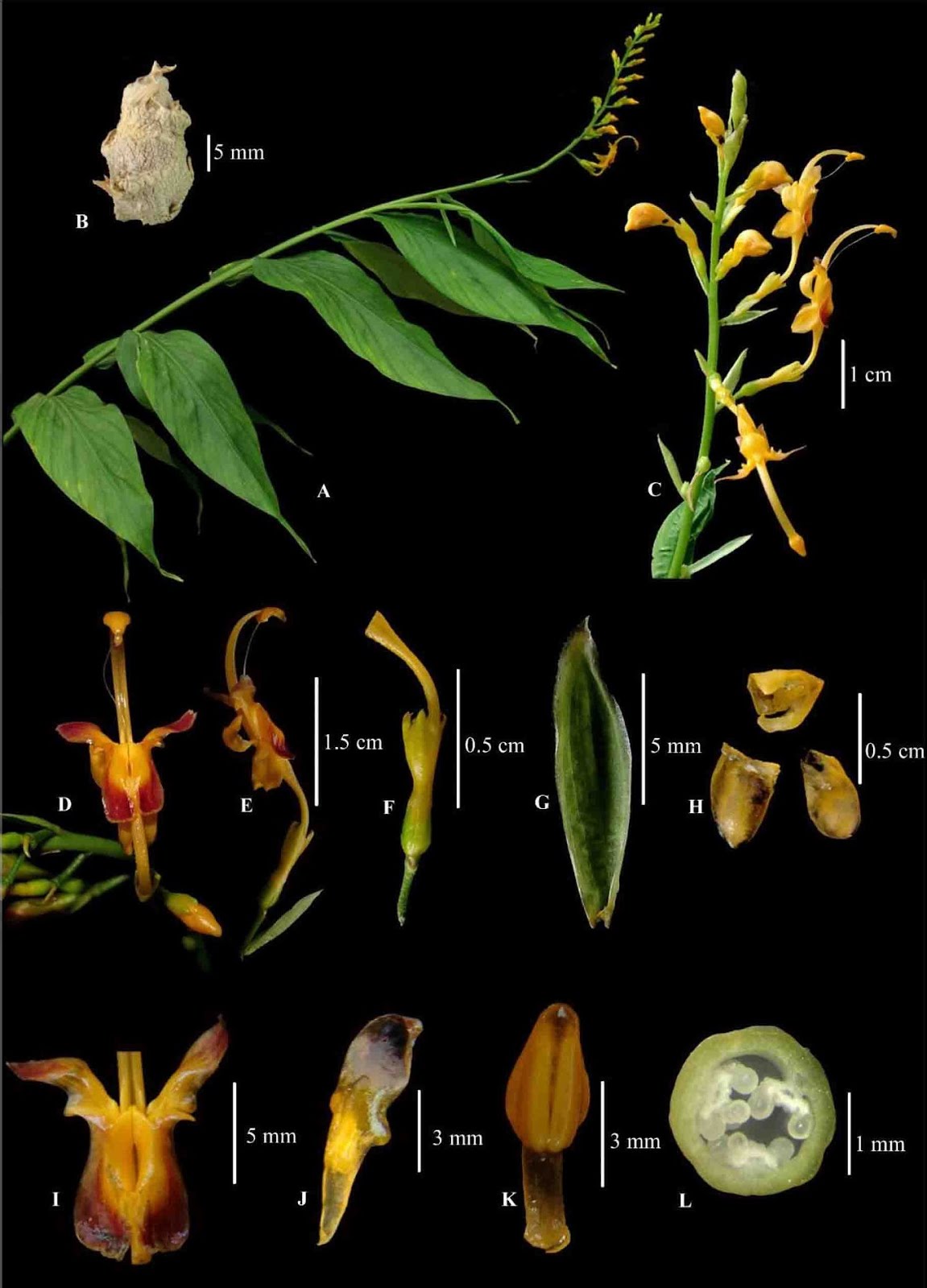
[Botany • 2019] Globba kanchigandhii (Zingiberaceae) • A New Species of Globba from North-East India


Globba kanchigandhii A. Joe & M. Sabu

in Joe, Sabu, Sanoj & Thomas, 2019.

Abstract
A new species of Globba, Globba kanchigandhii, from North-East India is described, illustrated and compared with its allied species. A detailed description, illustration, photographs, distribution, ecology, phenology and relevant notes also provided. A comparison table is also provided.

Keyword: Globba kanchigandhii; G. multiflora; G. macroclada; India; Nagaland; Phek; Zingiberaceae


Fig 1. Globba kanchigandhii:
A: Habit. B: Bulbil. C: Entire flower. D: Bract. E: bracteole. F: Basal part of flower. G: Labellum with lateral staminode and stamen. H: Corolla lobes. I: Dorsal corolla lobe. J: Anther (ventral view). K: Stigma. L: Ovary with epigynous glands and base of style. M: Cross-section of ovary. Illustration by Alfred Joe.

Fig 2. Globba kanchigandhii.
 A: Habit. B: Bulbil. C: Inflorescence. D–E: Flower. D: Front view. E: Lateral view. F: Basal part of flower. G: Bract. H: Corolla lobes. I: Labellum with lateral staminodes. J: Lateral staminode. K: Stamen. L: CS of ovary. Photos by Alfred Joe.

Globba kanchigandhii A. Joe & M. Sabu sp. nov. 

Similar to Globba multiflora Wall. ex Baker, but differs from it in having lesser number of flowers in an inflorescence, glabrous peduncle, erect and horn-like free triangular lateral staminodes, short corolla tube, stigma cylindric and presence of persistent bracts even at flowering stage. 


Distribution and Habitat: Globba kanchigandhii  is so far only known from the type locality, ie. Phek, Nagaland and grows as undergrowth in the evergreen and semi-evergreen forests. 

Etymology: This new species has been named in honour of Dr. Kanchi Gandhi, Harvard University for his valuable contributions to the field of plant nomenclature. 

Notes: This new species is closely allied to G. multiflora in its plant stature, bulbils and labellum colouration. But markedly differ from it in having fewer number flowers in inflorescence, erect and horn-like lateral staminodes, presence of persistent bracts and in its flowering period. The erect lateral staminodes make the species distinct from all known species of Globba. 

Fig. 3. Comparison of related species.
A–B: Globba kanchigandhii. C–D: G. multiflora. E–F: G. macroclada.
Photos A–E by Alfred Joe; F by E. Sanoj.


Alfred Joe, Mamiyil Sabu, E. Sanoj and Valukattil Ponnachan Thomas. 2019. A New Species of Globba (Zingiberaceae) from India. Taiwania. 64(1); 4-8. DOI: 10.6165/tai.2019.64.4  


[Botany • 2018] Tacca khanhhoaensis (Taccaceae) • A New Species from southern Vietnam


Tacca khanhhoaensis V.S. Dang & Vuong

in Dang, Truong, Nguyen & Hoang, 2018.

Abstract
Tacca khanhhoaensis V.S. Dang & Vuong (Taccaceae) is described as a new species from Hon Ba Nature Reserve in southern Vietnam. This species is morphologically similar to T. chantrieri and T. ampliplacenta but differs from its allies by several salient characters: size of leaves and petioles, inflorescent much shorter leaves, number of flowers, stigma lobes, buds colour. A description, conservation assessment, together with photographs and a key to the species of Tacca in Vietnam are presented.

Keywords: Hon Ba Nature Reserve, Khanh Hoa, Taccaceae, Taxonomy, Vietnam


Tacca khanhhoaensis V.S. Dang & Vuong

Figure 2. A Habit B Inflorescent much shorter leaves C Habitat. 
Figure 3. A Inflorescence B Fruits C Flowers, top view showing perianth lobes, stamens and stigma D Outer perianth lobes E Inner perianth lobes F Inner surface of perianth tube G Anther and connective H Longitudinal section of Anther with a pair of theca I Outer involucral bracts J Inner involucral bracts K Stigmas L Finely pubescent hairs at apex of stigma lobes M Black hairs on style N Longitudinal section of flower O Transverse section of fruit P Transverse section of ovary Q Seeds.

Tacca khanhhoaensis V.S. Dang & Vuong, sp. nov.

Diagnosis: Tacca khanhhoaensis is similar to Tacca chantrieri André in leaf shape and bracts, but differs from it in having shorter leaves (up to 45 cm vs. 60 cm long) and petioles (up to 22 cm vs. 43 cm long), inflorescences with fewer flowers (5 to 10 vs. 15 to 25), 2-lobed stigma vs. 3-lobed stigma and dark red buds vs. green buds. The new species is also somewhat similar to T. ampliplacenta L. Zhang & Q.-J. Li of China, but differs from it by having smaller leaves (30–45 × 10–14 cm vs. 55 cm long) and fruits (3–4 × 1.5–2 cm vs. 4–6 × 2–2.5 cm) and very short petioles (22 cm vs. 50 cm long), inflorescent much shorter leaves (vs. longer), number of flowers (5 to 10 vs. 25) and dark red buds vs. black-purple.

Distribution and habitat: Tacca khanhhoaensis is only known from Hon Ba Nature Reserve, Khanh Hoa Province, southern Vietnam. It was growing under the shade of the canopy on dry soil or close to the stream, where Aporosa tetragona Tagane & V.S. Dang, Bambusa sp., Barringtonia macrostachya (Jack) Kurz, Calamus sp., Croton sp., Desmos sp., Goniothalamus flagellistylus Tagane & V.S. Dang, Ixora sp., Microcos tomentosa Sm., Phyllanthus reticulatus Poir. and Streblus indicus (Bureau) Corner are dominant.

Etymology: The name of this species is derived from the name of the province Khanh Hoa, where the species was discovered.


Van Son Dang, Ba Vuong Truong, Thi Phuong Thao Nguyen and Nghia Son Hoang. 2018. Tacca khanhhoaensis V.S. Dang & Vuong (Taccaceae), A New Species from southern Vietnam. PhytoKeys.  114: 115-122.  DOI: 10.3897/phytokeys.114.29367


[Botany • 2019] Holoparasitic Orobanchaceae (Cistanche, Diphelypaea, Orobanche, Phelipanche) in Armenia: Distribution, Habitats, Host Range and Taxonomic Problems


Diphelypaea tournefortii 

in Piwowarczyk, Pedraja, Moral, et al., 2019.

Abstract
The species of holoparasitic genera from the family Orobanchaceae have a specific lifestyle associated with the host, greatly reduced vegetative organs, very variable features and quickly lose their color, resulting in difficulties and mistakes in identification. This study represents the first comprehensive monograph of 36 species from the four holoparasitic genera, Cistanche, Diphelypaea, Phelipanche and Orobanche (Orobanchaceae), in Armenia. This country, as a part of the Caucasus, is one of the most important biodiversity centers in the world, a diversity which includes rich and insufficiently understood holoparasitic plants. Our investigations were based on five years of field work in the Caucasus, and complemented by examination of ca. 1200 herbarium sheets with ca. 3000 specimens from 37 herbaria. We present information on distribution, list of localities, habitat, phenology, host range, taxonomic clarification, illustrations and descriptions for problematic ones, images from the field, proposals for new synonymisations, new combination Phelipanche cernua subsp. sinaica (Beck) Piwow., Ó. Sánchez & Moreno Mor., 20 lectotypes, two epitypes, one neotype are designated here, as well as a key and geospatial conservation assessments for all species based on IUCN criteria.

Keywords: Caucasus, western Asia, parasitic plants, taxonomy, typification, new synonyms, new records, conservation assessment, Eudicots


 Renata Piwowarczyk,  Óscar Sánchez Pedraja, Gonzalo Moreno Moral, George Fayvush, Narine Zakaryan, Nune Kartashyan and Alla Aleksanyan. 2019. Holoparasitic Orobanchaceae (Cistanche, Diphelypaea, Orobanche, Phelipanche) in Armenia: Distribution, Habitats, Host Range and Taxonomic Problems. Phytotaxa.  386(1); 1-106.  DOI: 10.11646/phytotaxa.386.1.1

[Arachnida • 2018] Cyclosa bulla • A New Species of Cyclosa (Araneae: Araneidae) from Southeast Asia


Cyclosa bulla  
Tanikawa & Petcharad, 2018

  DOI: 10.2476/asjaa.67.87 

Abstract
A new species of Cyclosa is described under the name of Cyclosa bulla n. sp. using specimens collected from Thailand, Singapore and Brunei. Females of the species can be easily distinguished from other congeners by the shape of the abdomen, which has a globose posterior end. In contrast, males cannot be distinguished from those of Cyclosa bifida, which seems to be the most closely related species, even by the shape of the palpal organ. In this study, male specimens are identified by DNA barcoding.

Keywords: Cyclosa bulla, taxonomy, COI, barcoding, Thailand, Singapore, Brunei


 Cyclosa bulla n. sp. 
A, female (holotype), dorsal view; B, same, lateral view; C, paratype (male), dorsal view..
 Scales: A–C, 1 mm.

Cyclosa bulla new species 
[Thai name: Mangmoum-Taai-Klom-Cyclosa]

Diagnosis. The new species seems to be closely related to Cyclosa bifida, but females can be easily distinguished from Cyclosa bifida by the posteriorly globose abdomen (Figs. 2A–B). Males of these species cannot be separated morphologically, even by the shape of the palpal organ. Male specimens of the new species can be identified only by DNA sequencing data, e.g. mt-COI.

Etymology. The specific name is derived from the knob-like shaped posterior part of the abdomen; “bulla” is a Latin word that means “globe”. 


Akio Tanikawa and Booppa Petcharad. 2018. A New Species of Cyclosa (Araneae: Araneidae) from Southeast Asia. Acta Arachnologica. 67(2); 87-90. DOI: 10.2476/asjaa.67.87


Wednesday, January 2, 2019

[Botany • 2018] Bruguiera × dungarra (Rhizophoraceae) • A New Hybrid between Mangrove Species B. exaristata and B. gymnorhiza recently discovered in north-east Australia


Bruguiera × dungarra  N.C.Duke & Hidetoshi Kudo
in Duke & Kudo, 2018. 

Abstract
Bruguiera × dungarra (Rhizophoraceae), a previously undescribed hybrid species between B. exaristata and B. gymnorhiza is recorded from north-east Australia. Eight taxa are currently recognised in this Indo West Pacific genus, including three putative hybrids. The newly described hybrid is widely occurring, and it is described here with notes provided on typification, phenology, distribution and habitat. A revised identification key to all Bruguiera taxa is presented, along with a table of comparative diagnostic characters.

Keywords: Bruguiera × dungarra; Rhizophoraceae; hybrid; identification key; intermediate; mangrove; taxonomy


Fig. 4 Bruguiera × dungarra N.C.Duke & Kudo, hybrid nov. a. Foliage with inflorescences; b. trunk and exposed roots; c. habit; d. bark; e. leaves upper and lower surfaces; f. open and closed flower buds; g. leafy rosette with flower buds and mature propagule; h. mature hypocotyl; l. leaf scar node; j. colleter at inner base of interpetiolar stipule; k. petal dehisced and open; l. calyces of mature propagule, expended flower and closed flower bud; m. diagram of open petal (bar length = 10 mm); n. sectioned flower bud showing petals and style. — Collection field reference images for Hidetoshi Kudo & Brian Venables, HK190916A, (CNS!), Cairns, Machans Beach.

Bruguiera × dungarra N.C.Duke & Hidetoshi Kudo, hybrid nov.

Etymology. The location of the type of this new hybrid occurs on the ancestral lands of the Yirrganydji people. For these traditional custodians of the narrow coastal strip from Cairns to Port Douglas, the epithet Dungarra means, ‘belonging to Machans Beach area’.

Distribution — Type location is Machans Beach, near Cairns in Queensland,Australia. Other localities include Holloways Beach also near Cairns in Queensland, Australia, south to around Hinchinbrook Channel and Shoalwater Bay, and further north to the Marrett River estuary in Princess Charlotte Bay. Distribution elsewhere is likely, although possibly restricted to the zone of overlap of putative parents (Fig. 3). Putative parent species co-occur in eastern Indonesia, Timor Leste, southern New Guinea and northern Australia. In Australia, B. × dungarra is likely to occur from Darwin Harbour in the Northern Territory to Port Curtis in Queensland. 

Ecology & Local influences — Uncommon hybrid in the midhigh intertidal zone of intermediate estuarine position (sensu Duke 2006). Often in proximity of stands of higher intertidal B. exaristata, and mid-high intertidal B. gymnorhiza.


Norm C. Duke and Hidetoshi Kudo. 2018. Bruguiera × dungarra, A New Hybrid between Mangrove Species B. exaristata and B. gymnorhiza (Rhizophoraceae) recently discovered in north-east Australia. Blumea - Biodiversity, Evolution and Biogeography of Plants.  DOI:  10.3767/blumea.2018.63.03.03


A Cairns-based citizen scientist has made yet another remarkable discovery. 

[Botany • 2018] Zamia paucifoliolata (Zamiaceae, Cycadales) • A New Species of Zamia from Valle del Cauca, Colombia


Zamia paucifoliolata Calonje


in Calonje, López-Gallego &Castro. 2018. 

Abstract
Zamia paucifoliolata, a new cycad species from the Pacific lowlands of Valle del Cauca, Colombia, is described and illustrated. It is distinguished from other species of Zamia by having an underground stem typically bearing large solitary leaves with eighteen or fewer leaflets, villous strobilar axes, microsporangia borne on both the abaxial and adaxial side of microsporophylls, and seeds that are longer than 18 mm. It is compared to Z. pyrophylla, Z. cunaria, and Z. ipetiensis, species which it most closely resembles.

Keywords: Chocó biogeographic region, systematics, taxonomy, Gymnosperms

FIGURE 1. Vegetative characteristics of Zamia paucifoliolata.
 A. Seedling with eophyll, top and side view. B. Center of petiole showing prickles. C. Adult plant with immature seed strobilus. D. New leaf flush. E. Cataphylls. F. Middle leaflet of adult plant.

FIGURE 2. Reproductive characteristics of Zamia paucifoliolata.
A. Microsporophyll, adaxial side. B. Microsporophyll, abaxial side. C. Cross section of pollen strobilus, adaxial side. D. Closeup of pollen strobilus near pollen release stage. E. Pollen strobilus with peduncle near pollen release stage. F. Immature seed strobilus. G. Megasporophyll with immature seeds, adaxial side. H. Megasporophyll with immature seeds, abaxial side. I. Megasporophyll face, immature. J. Megasporophyll face, mature. K. Seed with ripe sarcotesta. L. Seed sclerotesta.
A–I based on collection López-Gallego et al. 68–69 (HUA), J–K based on Castro et al. 1118–1119 (HUA), L based on Castro et al. 1289 (holotype HUA; isotypes COL, CUVC, FMB, JAUM, MEDEL, TOLI).

Zamia paucifoliolata Calonje sp. nov.

 Diagnosis:— Zamia paucifoliolata most closely resembles Z. pyrophylla from which it is distinguished by the light green leaf flushes, the leaflets that are broader and less numerous, the fewer and larger mature megasporophylls and seeds, and the lighter colored pollen strobili.

FIGURE 3.  Zamia paucifoliolata in its natural habitat at the type locality.
 A. Middle leaflets collected from plants at different stages of development. B. Juvenile plant. C. Adult plant with seed strobilus, showing yellow clay soils in which the species grows. D. Adult plant in habitat with Jonatan Castro (left) and Michael Calonje (right). E. The largest leaf yet observed for this species, measuring 285 cm long and carrying 18 leaflets.

 Etymology:— The specific epithet refers to the small numbers of maximum leaflets produced by leaves of this species which are among the least numerous of any species of Zamia. Leaves on adult plants carry between 10 and 18 leaflets (n=135 leaves, mode=10, mean 11.6), and only a few species with broad, prominently-veined leaflets carry the same number or fewer leaflets. Namely, Z. wallisii Braun (1875: 376), with the broadest leaflets in the genus, has leaves with a maximum of 11 leaflets, Z. dressleri Stevenson (1993: 6) carries up to 14 leaflets, and Z. imperialis Taylor et al. (2008: 421) similarly carries a maximum of 18 leaflets. The small number of leaflets carried by leaves of Z. paucifoliolata readily distinguishes it from its putative relatives Z. cunaria, Z. ipetiensis, and Z. pyrophylla, all of which carry a maximum of 32 leaflets.

Ecology:— The known populations of the species appear to be viable, with a larger proportion of juveniles compared to adults, i.e. evidence of reproduction and regeneration. Plants are distributed in highly dense patches on the understory of the forest, on moderately steep slopes and near small streams. Little is known about leaf phenology, frequency or rate of strobilus production or germination time. Mature seed strobili with ripe seeds have been observed in February and May, whereas pollen strobili have only been observed in late August. Immature seed strobili have been observed in June, August, and September. There is no information yet about microrganisms associated to roots or species interactions involved in pollination or seed dispersal, but a good proportion of viable seeds has been observed in female strobili. The typical herbivores associated to Zamia species, Eumaeus Hübner (1819: 67), have not been observed yet either, but there were signs of herbivory by leaf miners. A permanent plot has been established in one of the populations to monitor population dynamics and other ecological aspects of the species.


 Michael Calonje, Cristina López-Gallego and Jonatan Castro. 2018. Zamia paucifoliolata, A New Species of Zamia (Zamiaceae, Cycadales) from Valle del Cauca, Colombia. Phytotaxa. 385(2); 85–93. DOI:  10.11646/phytotaxa.385.2.4

Resumen: Se describe y se ilustra Zamia paucifoliolata, una nueva especie de cícada de las tierras bajas del Pacífico Colombiano del Valle del Cauca. Se distingue de otras especies de Zamia por su tallo subterráneo típicamente cargando hojas solitarias con 18 folíolos o menos, ejes estrobilares vellosos, presencia de microesporangios en el lado abaxial y adaxial de los microesporofilos, y semillas de mas de 18 mm de longitud. Se compara con Z. pyrophylla, Z. cunaria, y Z. ipetiensis, las especies a las que más se asemeja. 
Palabras clave: Chocó biogeográfico, sistemática, taxonomía

[Fungi • 2019] Enterographa assamica (Roccellaceae sensu lato) • A New Species from North-East India


Enterographa assamica  Pooja Gupta, S. Joseph & G.P. Sinha

in Gupta, Joseph & Sinha, 2019. 

ABSTRACT
 A new species Enterographa assamica, in the family Roccellaceae sensu lato is described from Assam, India. It is characterized by whitish grey thallus, rounded to elongate ascomata with yellowish-white thalline margin and presence of lichexanthone and confluentic acid in the thallus. A key to all the known species of Enterographa in India is also provided.

 KEY WORDS: Arthoniales; Assam; India; Enterographa assamica; Lichenized Ascomycota; Roccellaceae s. l.; Taxonomy. 


Fig. 1. Enterographa assamica.
A. Thallus with ascomata; B & C. Asci with ascospores.
 Scale: A. 1 mm; B & C. 10 µm.

Enterographa assamica Pooja Gupta, S. Joseph & G.P. Sinha sp. nov. 

 Diagnosis: Thallus corticolous, epiperidermal; ascomata rounded to elongate; 0.25–0.55 mm diam., if rounded; 0.5–1(–1.2) × 0.2–0.5 mm, if lirelliform; asci clavate, 8˗spored, 60–80 × 15–19 μm; ascospores hyaline, acicular, transversely 7–11˗septate, slightly curved at the end, (39–)48–55(–60) × 2–3 μm; confluentic acid and lichexanthone present.  


Etymology: The specific epithet refers to the Indian state, Assam, where it was discovered.  


Pooja Gupta, Siljo Joseph and Gopal Prasad Sinha. 2019. Enterographa assamica, A New Species from North-East India. Taiwania. 64(1); 1-3. DOI: 10.6165/tai.2019.64.1   

[Ichthyology • 2018] Channa royi • A New Species of Snakehead (Teleostei: Channidae) from Andaman Islands, India


Channa royi  Praveenraj & Knight

in Praveenraj, Knight, Kiruba-Sankar, et al., 2018. 
Andaman Emerald Snakehead  ||  DOI: 10.21077/ijf.2018.65.4.72827-01 

ABSTRACT
 A new species of snakehead fish Channa royi sp. nov., has been described based on 21 specimens collected from the South, Middle and North Andaman Islands, India. It is distinguished from all its congeners by a greenish-grey dorsum, pale brown to black pectoral fin with 2-3 inconspicuous semicircular bands, a series of 7-9 obliquely-arranged, saddle-like, dark olive to grey oblique streaks on green background on upper half of the body, 42-45 pored lateral-line scales, 12-13 branched caudal rays, 6-7 pre-dorsal scales, 43 vertebrae, two rows of teeth on the lower jaw, an outer row of numerous minute slender, pointed teeth and single inner row of large uniform sized teeth without any large canine like teeth on the anterior fourth of the lower jaw. Phylogenetically C. royi sp. nov. is closely related to C. harcourtbutleri, with a genetic distance (K2-P) of 2.4-2.8%, but morphologically differs in having greater inter-orbital width, fewer pelvic-fin rays (5 vs. 5-7, mode 6); fewer caudal-fin rays (ii- i, 10-12, i-ii vs. ii, 15, ii); more pre-dorsal scales (6-7 vs. 4) and fewer mid row lateral-line scales (9-13 vs. 15-16). Though Channa royi sp. nov. is a part of C. gachua species-group, it differs from the topotypic C. gachua from Bengal with higher pair-wise sequence distance of 19.5-20.9%.

Keywords: Andaman Islands, Channa gachua, Channa limbata, Channa royi sp. nov., Channidae, Snakeheads


Channa royi sp. nov. (a) Adult, 190.5 mm SL, showing black pectoral fin, uncatalogued,
 (b) Adult, 165.1 mm, showing pale grey pectoral fin, uncatalogued.
(both maintained in aquarium) (Photos: J. Praveenraj)

Channa royi sp. nov. (a). holotype prior to preservation (ZSI/ANRC-12467),
 (b). Juvenile specimen, uncatalogued, 44.6 mm SL.
 (Photos:  J. D. M. Knight)

Channa royi, sp. nov. Praveenraj & Knight
Common name: Andaman Emerald Snakehead 

Diagnosis: Channa royi sp. nov. is distinguished from all other species of the genus Channa belonging to the Channa gachua species-group by a combination of following characters: unique greenish-grey dorsum; upper half of body with a series of 7-9 obliquely-arranged, saddle-like, dark olive to grey oblique streaks on green background; throat with marbled pattern; 34-38 dorsal-fin rays; 22-25 anal-fin rays; 42-45 pored scales on body; 1-3 scales on caudal fin base; 3½ scales above lateral line and 6½ scales below lateral line; 6-7 pre-dorsal scales; 43 vertebrae; two rows of teeth on the lower jaw, single outer row of numerous minute slender pointed teeth and single inner row of enlarged uniform teeth without any large canine like teeth on anterior-fourth of the lower jaw; two rows of teeth on palatine; outer row with numerous minute sharp slender teeth and inner row with 4 to 6 large canine like teeth and pectoral fins pale brown to black in adults with 2-3 pale grey to black inconspicuous semicircular bands.
....

Etymology: The species is named after Dr. S. Dam Roy, in appreciation for his immense encouragement and support for the exploration of the freshwater fishes of Andaman and Nicobar Islands. The species name is formed as a noun in the masculine genitive singular. The common name ‘Andaman emerald snakehead’ is given considering its unique greenish dorsum. 

Distribution: Channa royi sp. nov. is currently known only from South, Middle and North Andaman Islands, India and is abundant in ditches, ponds and hill streams of the sampled locations. The holotype was collected from clear, slow flowing water with cobble substrate without much aquatic vegetation.

J. Praveenraj, J. D. M. Knight, R. Kiruba-Sankar, Beni Halalludin, J. J. A. Raymond and V. R. Thakur. 2018. Channa royi (Teleostei: Channidae): A New Species of Snakehead from Andaman Islands, India. Indian J. Fish. 65(4); 1-14.  DOI: 10.21077/ijf.2018.65.4.72827-01  


Tuesday, January 1, 2019

[Herpetology • 2018] Scinax caprarius • A New Frog with Green Bones of the Genus Scinax (Anura: Hylidae), associated with the sub-Andean Forests of the Magdalena River Basin, Colombia


Scinax caprarius Acosta-Galvis, 2018


Abstract 
As a result of the exploration of post-conflict areas in the Colombia BIO project, a new species of green bones frog of the genus Scinax, assignable to the clade Scinax ruber, is described. The species is endemic to the peripheral sub-Andean forests of the middle Magdalena valley in Colombia. This biological entity was previously identified in the scientific literature as Scinax “A”. The new species is recognizable by its average size 28.6-31.1 mm, chromatic pattern and its particular mating call that is similar to the sound of a goat bleating; each vocalization has a duration of 0.21-0.47 s, with a dominant frequency between 2184-3218 Hz.; its larval characteristics were evaluated, which altogether made it possible to clearly differentiate it from other species in the genus in the trans-Andean region of Colombia. With the description of this species, 18 frogs of the genus Scinax are currently recognized in the Colombian territory.

 Keywords. Amphibia. Bioacustics. Tadpoles. Scinaxinae. Taxonomy. 


Scinax caprarius sp. nov. 


Resumen: Como resultado de la exploración de áreas en postconflicto enmarcada en el proyecto Colombia BIO, se realizó la descripción de una nueva especie de Scinax con huesos verdes, asignable al clado de S. ruber. Esta nueva especie es endémica de los bosques subandinos periféricos del valle medio del río Magdalena en Colombia. Esta entidad biológica fue previamente identificada en la literatura científica como Scinax “A” y se caracteriza por su tamaño mediano (28,6-31,1 mm), su patrón cromático y su vocalización, similar al balido de una cabra, con una duración de 0,21-0,47 s, y frecuencia dominante entre 2184-3218 Hz. Sus características larvales en conjunto, permiten diferenciarla claramente de otras especies del género en la región transinterandina de Colombia. Con esta, ascienden a 18 las especies de Scinax documentadas en el territorio colombiano. 

Palabras clave: Amphibia. Bioacústica. Renacuajos. Scinaxinae. Taxonomía. 


Andrés R. Acosta-Galvis. 2018. Una nueva rana de huesos verdes del género Scinax (Anura: Hylidae) asociada a los bosques subandinos de la cuenca del río Magdalena, Colombia [A New Frog with Green Bones of the Genus Scinax (Anura: Hylidae), associated with the sub-Andean Forests of the Magdalena River Basin, Colombia] . Biota Colombiana. 19 (Suppl. 1); 131–159. DOI: 10.21068/c2018.v19s1a11