Tuesday, December 25, 2018

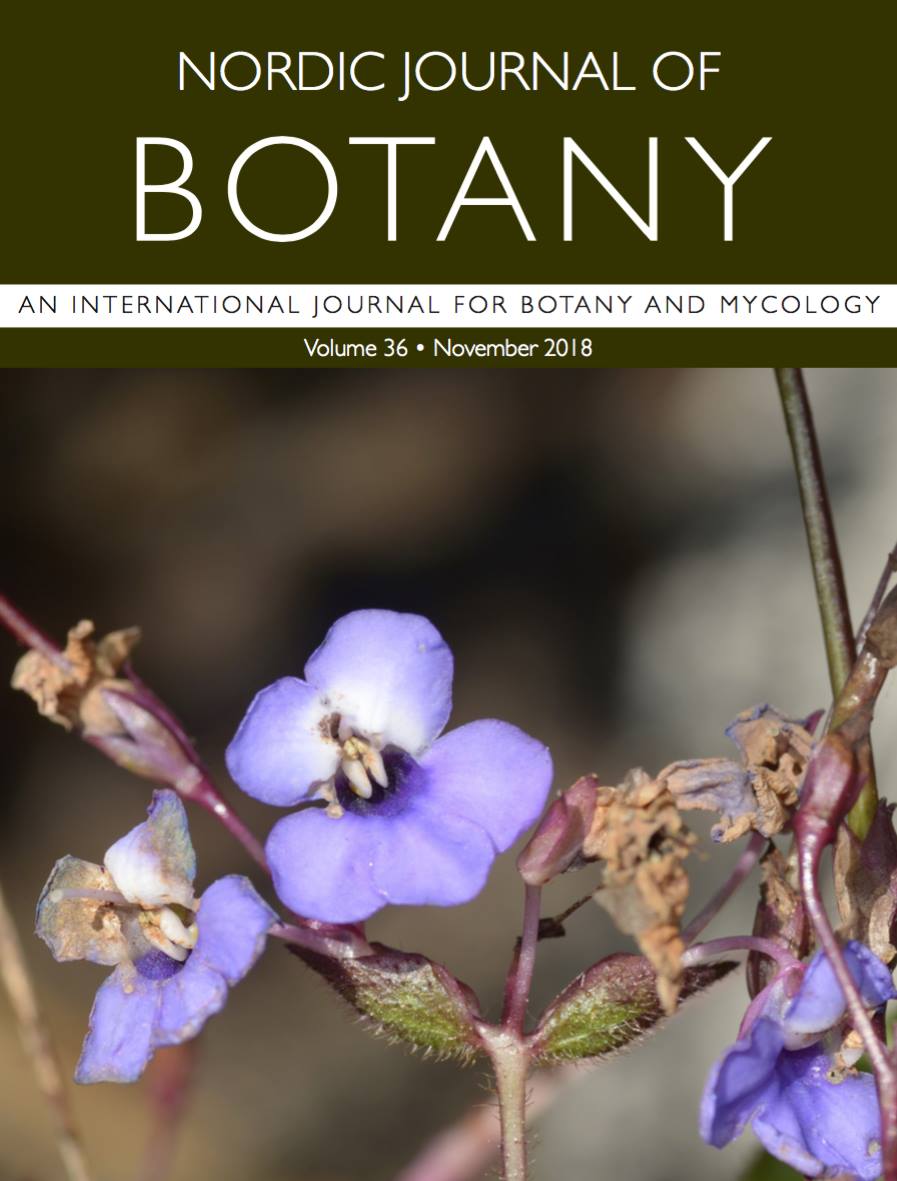
[Botany • 2018] Rachunia cymbiformis • A New Genus and Species of Gesneriaceae from Thailand


 Rachunia cymbiformis D.J.Middleton.

Rachunia D.J.Middleton & C.Puglisi gen. nov.
in Middleton, Khew, Poopath, et al., 2018.  

Abstract 
Rachunia, a new genus of Gesneriaceae from Thailand, is described with a single species, Rachunia cymbiformis. Its relationship to the rest of subtribe Didymocarpinae is investigated through a phylogenetic study based on Bayesian Inference and Parsimony analyses of nuclear ITS and plastid trnL‐trnF (intron‐spacer) sequences. Morphologically, Rachunia differs from the related genera Codonoboea in the large boat‐shaped bracts and orthocarpic vs plagiocarpic fruit; from Microchirita in the bracts, wiry vs fleshy stem, the campanulate vs tubular corolla and the clavate vs chiritoid stigma, and from Henckelia in the clavate vs chiritoid stigma, large boat‐shaped bracts in the inflorescence, free and imbricate sepals, short and campanulate corolla, clavate stigma, and relatively robust orthocarpic fruit.

Keywords: phylogeny, Henckelia, Didymocarpinae


Rachunia cymbiformis D.J.Middleton. close-up of bracts and flower.
Photo by Manop Poopath. 

Rachunia D.J.Middleton & C.Puglisi gen. nov. 

Type species: Rachunia cymbiformis D.J.Middleton. 

Etymology: The genus is named in honour of the Thai botanist Dr Rachun Pooma of the Forest Herbarium Bangkok (BKF) to recognise his great contribution to our understanding of plant diversity in Thailand and the wider region.


Rachunia cymbiformis D.J.Middleton sp. nov. 

Etymology: The specific epithet ‘cymbiformis’ refers to the boat-shaped bracts in the inflorescence.


D. J. Middleton, G. S. Khew, M. Poopath, M. Möller and C. Puglisi. 2018. Rachunia cymbiformis, A New Genus and Species of Gesneriaceae from Thailand. Nordic Journal of Botany. 36(11); e01992. DOI: 10.1111/njb.01992


[Ichthyology • 2018] Evidence of Cryptic Species in the Blenniid Cirripectes alboapicalis species complex, with Zoogeographic Implications for the South Pacific


Cirripectes alboapicalis 
live colors of Clade 1 from Rangitāhua - Kermadec Islands

in Delrieu-Trottin, Liggins, Trnski, et al., 2018. 
 (photograph by Richard Robinson (www.depth.co.nz) 

Abstract
Rapa Nui, commonly known as Easter Island (Chile), is one of the most isolated tropical islands of the Pacific Ocean. The island location of Rapa Nui makes it the easternmost point of the geographic ranges for many western Pacific fish species that are restricted to the subtropical islands south of 20°S latitude. The blenniid fish species Cirripectes alboapicalis has been thought to have one of the most extensive geographic distribution ranges among these southern subtropical fish species, extending from the southern Great Barrier Reef to Rapa Nui. A phylogenetic analysis was conducted to determine the taxonomic status of the species. The results provide genetic evidence that suggests that this formerly South Pacific-wide species comprises at least three cryptic species with allopatric geographic distributions. The analyses reveal the geographic distributions of these clades and their genetic relationships with each other, and with other species within the genus Cirripectes. The processes that culminated in the current geographic distribution of this species complex and the zoogeographic implications of this finding for the South Pacific region are discussed.

Keywords:  Austral Islands, Blenniidae, cryptic species, cytochrome oxidase I, Easter Island, endemism, French Polynesia, Gambier Islands, Kermadec Islands, mtDNA, Phylogeny, Rangitāhua, Rapa Nui


Figure 4. Pictures of specimens from the three genetic clades of this study;
 a live colors (photograph by Richard Robinson (www.depth.co.nz)) and b freshly dead colors (photograph by Carl Struthers Museum of New Zealand Te Papa Tongarewa) of Clade 1 from Rangitāhua - Kermadec Islands
c Clade 2, French Polynesia from Austral - Gambier Islands (photographs by Jeffrey T. Williams)
d Clade 3 Rapa Nui (photograph by Erwan Delrieu-Trottin);
and e Cirripectes obscurus (photograph by Jeffrey T. Williams).

 Erwan Delrieu-Trottin, Libby Liggins, Thomas Trnski, Jeffrey T. Williams, Valentina Neglia, Cristian Rapu-Edmunds, Serge Planes and Pablo Saenz-Agudelo. 2018. Evidence of Cryptic Species in the Blenniid Cirripectes alboapicalis species complex, with Zoogeographic Implications for the South Pacific.  ZooKeys. 810: 127-138. DOI: 10.3897/zookeys.810.28887

[Botany • 2018] Zingiber leucochilum (Zingiberaceae) • A New Species of Zingiber with Running Rhizome from Sichuan [Taxonomic Studies on Zingiber in China VI]


Zingiber leucochilum  L.Bai, Škorničk. & N.H.Xia

in Bai, Leong‐Škorničková, Xia & Li, 2018. 

Abstract
Zingiber leucochilum L.Bai, Škorničk. & N.H.Xia (Zingibereae, Zingiberaceae), a new species from southeastern Sichuan, China, is described and illustrated with a colour plate. Notes on ecology, distribution and a preliminary IUCN conservation assessment are also provided. The new species is assigned to Z. sect. Cryptanthium Horan. and compared to five morphologically similar species from China which share the characteristic well‐elongated and running rhizome, namely, Z. emeiense Z.Y.Zhu, Z. leptorrhizum D.Fang, Z. pauciflorum L.Bai, Škorničk., D.Z.Li & N.H.Xia, Z. smilesianum Craib and Z. yunnanense S.Q.Tong & X.Z.Liu. A key to the above six species is provided and their distributions are mapped.

Figure 1. Zingiber leucochilum sp. nov. 
(A) plant habit, (B)–(C) detail of leaf sheaths, ligules and pulvini, (D) basal part of the pseudostem with inflorescence and part of the rhizome, (E) running rhizome.
Based on the type collection L.Bai et al. 13091040. Photos: Lin Bai.

Figure 2. Zingiber leucochilum sp. nov.
 (A) flower (front view), (B) flower (side view), (C) inflorescence, (D) single flower with bracteole attached and flower dissection, from left: fertile bract, bracteole, dorsal corolla lobe, two lateral corolla lobes, labellum with basally connate lateral staminodes (in ventral and dorsal view), ovary, flower tube and anther (side view), ovary with two epigynous glands.
Based on the type collection L.Bai et al. 13091040. Photos: Lin Bai.

Zingiber leucochilum L.Bai, Škorničk. & N.H.Xia sp. nov.

Etymology: The specific epithet is derived from the Greek leuco- (white) and -chilus (lipped) in reference to the uniformly white-coloured labellum of this species.


Lin Bai, Jana Leong‐Škorničková, Nian‐He Xia and De‐Zhu Li. 2018. Taxonomic Studies on Zingiber (Zingiberaceae) in China VI: Z. leucochilum, A New Species with Running Rhizome from Sichuan.   Nordic Journal of Botany.  36(9); e01840. DOI: 10.1111/njb.01840


Monday, December 24, 2018

[Entomology • 2018] Borneophanus spinosus • A New Genus and Species of Brontinae (Coleoptera, Silvanidae) from Borneo


Borneophanus spinosus 
Yoshida & Hirowatari, 2018


Abstract
A new silvanid genus Borneophanus gen. n. is described based on specimens collected from Malaysian Borneo. A new species, Borneophanus spinosus sp. n., is described herein. Digitiform sensilla on the apical maxillary palpomere is reported in Silvanidae for the first time.

Keywords: Borneophanus, Cucujoidea, digitiform sensilla, Malaysia, Telephanini


Figure 2. Close-up image of head, pronotum, scutellar shield and basis of elytra of Borneophanus spinosus gen. et sp. n., holotype, male.

Figure 1. Habitus of Borneophanus spinosus gen. et sp. n., holotype, male. A dorsal B ventral aspect. 

Borneophanus gen. n. 

Diagnosis: Among telephanine genera, this new genus shares the following character states with Telephanus, Psammoecus, and Indophanus Pal, 1982: apical maxillary palpomere securiform; apical labial palpomere securiform; scutellary striole absent (some species of Malagasy Telephanus have a scutellary striole). This new genus differs from these genera by the combination of the following character states: distinct pair of longitudinal frontal lines present (absent in Telephanus); scutellar shield with a transverse carina and excavate posteriorly (flat in Psammoecus); antennomere IV normal (markedly long, approximately twice as long as combined length of II and III in Indophanus) (Thomas and Nearns 2008; Sen Gupta and Pal 1996). In addition, this new genus possesses the following characteristic morphology: the asymmetric shaped antennomere X (somewhat asymmetric in Bolianus); the sharply protruding elytral apices; the non-folded internal sac; the partly coiled flagellum; and the very long and rolled up spermathecal duct.

Distribution: Malaysia (Sabah and Sarawak states).

Etymology: The new genus name is composed of two words, the locality, Borneo where this new genus was collected, and the Greek phanos meaning bright.


Borneophanus spinosus sp. n.
  
Diagnosis: This new species is superficially similar to some Telephanus species bearing long spines on lateral pronotum and elytra. This new species can be easily distinguished from these species by the distinct pair of longitudinal frontal lines, the asymmetric shaped antennomere X, and the sharply protruding elytral apices.

Etymology: The specific name means thorny and indicates the characteristic long spines.

Remarks: This new species possesses characteristic long spines covering the lateral margins of pronotum and elytra. In possessing such setation, some Telephanus species (e.g., T. paradoxus and T. sellatus Sharp, 1899) are superficially similar to this new species. They can be easily distinguished by the diagnostic character states of these genera. Otherwise, like Telephanus, such setation often occurs as a taxonomic character at the species or species group level; thus, the setal situation is not regarded as a character of this new genus.


 Takahiro Yoshida and Toshiya Hirowatari. 2018. A New Genus and Species of Brontinae from Borneo (Coleoptera, Silvanidae). ZooKeys. 805: 45-57. DOI:  10.3897/zookeys.805.28757

[Botany • 2018] Paphiopedilum papilio-laoticus (Orchidaceae) • A New Species from Laos


 Paphiopedilum papilio-laoticus
Schuit., Luang Aphay & Iio

in Schuiteman, Luang Aphay & Iio. 2018. 
ເອື້ອງດິນແມງກະເບື້ອລາວ ||   Kew.org 


Paphiopedilum papilio-laoticus 
Schuit, Luang Aphay & Iio

ເອື້ອງດິນແມງກະເບື້ອລາວ 


Andre Schuiteman, Sulvng Luang Aphay and Shunsuke Iio. 2018. Paphiopedilum papilio-laoticus (Orchidaceae), A New Species from Laos. Orchideen Journal. 6(4); 1-21. 


ເອື້ອງດິນແມງກະເບື້ອລາວ, ເປັນພືດຊະນິດທີ່ພົບໃນຕະຫຼາດຂາຍດອກເຜິ້ງທີ່ວຽງຈັນ,
ໂດຍ ທ່ານ ສຸລິວົງ   twitter.com/LaoBiodiversity/status/1006445235700883457


Recently, new species of Paphiopedilum have discovered from Laos and descrived. Now other species descovered newly from Laos descrived as a new species, Paphiopedilum papilio-laoticus on OrchideenJournal Vol.6-4, 5 June 2018, by Andre Schuiteman, Sulvng Luang Aphay and Shunsuke Iio.

New orchid species identified in Laos
ພົບດອກເອື້ອງຊະນິດພັນໃໝ່ Paphiopedilum papilio-laoticus ຢູ່ໃນປະເທດລາວ 61.91.93.33/33232 via @sanook

Sunday, December 23, 2018

[Botany • 2018] Oreocharis tribracteata & O. rufescens • Two New Species of Oreocharis (Gesneriaceae) from Northern Vietnam


Oreocharis tribracteata Bramley, H.J.Atkins & Mich.Möller

in Möller, Atkins, Bramley, et al., 2018. 

Abstract
Two new species of Oreocharis, Oreocharis tribracteata and O. rufescens, are described and a key to the species in Vietnam is provided. The new species have distinct features not previously, or rarely, observed in the genus, both showing the partial fusion of the calyx lobes into a tube, and the presence of three bracts in Oreocharis tribracteata.

Keywords. Gesneriaceae, Oreocharis rufescens, Oreocharis tribracteata, Vietnam. 


Oreocharis tribracteata Bramley, H.J.Atkins & Mich.Möller, sp. nov.

Etymology. The species is named for the presence of three bracts, which is rare in the genus and absent from all other Oreocharis species currently known in Vietnam.


Oreocharis rufescens D.J.Middleton, sp. nov.

Etymology. The species is named after the distinctive reddish brown indumentum covering the plant.


M. Möller, H. J. Atkins, G. L. C. Bramley, D. J. Middleton, R. Baines, V. D. Nguyen, H. Q. Bui and S. Barber. 2018. Two New Species of Oreocharis (Gesneriaceae) from Northern Vietnam. Edinburgh Journal of Botany. 75(3); 309-319.  DOI: DOI: 10.1017/S0960428618000148  

[Ichthyology • 2018] Using Morphology to Test DNA-Based Phylogenetic Relationships within the Guiana Shield Catfish Tribe Lithoxini (Siluriformes: Loricariidae)


 Avalithoxus jantjae AUM 39478 (31.9 mm SL), Exastilithoxus fimbriatus AUM 36668 (23.6 mm SL), Lithoxus lithoides AUM 39040 (43.0 mm SL), Paralithoxus bovallii AUM 67127 (51.7 mm SL), P. sp. nov. aff. bovallii (Konawaruk) AUM 35549 (42.6 mm SL), P. planquettei AUM 50395 (47.0 mm SL), and P. surinamensis AUM 51737 (34.7 mm SL). 
in Armbruster, Greene & Lujan, 2018.  
Photos by Jonathan W. Armbruster. facebook.com/JonArmbruster56

As DNA-based phylogenetic analyses have exploded, historically phenotype-based evolutionary hypotheses throughout the tree of life have been rewritten. However, rarely are DNA-based phylogenetic hypotheses tested via the reanalysis of phenotypic data. Skeletons representing all four recognized genera of the Guiana Shield endemic suckermouth armored catfish clade Lithoxini were examined to test a recently published DNA-based phylogenetic hypothesis using morphological evidence. Phylogenetic analysis of 54 mostly osteological characters yielded a single most parsimonious tree of 90 steps that was congruent with the molecular hypothesis: (Avalithoxus, ((Exastilithoxus), (Lithoxus, Paralithoxus))). Lithoxini was a well-supported clade with 20 synapomorphies, as was each of the genera within this clade. Avalithoxus jantjae, which was originally described in Lithoxus, was found to be missing the unique synapomorphies of Lithoxus + Paralithoxus: a spoon-shaped, ventrally oriented process on the metapterygoid and a process on the preoperculo-hyomandibular ridge.


Fig. 6. Single most parsimonious tree of 90 steps, CI ¼ 0.722, numbers above branches are bootstrap values/Bremer decay indices. Avalithoxus jantjae AUM 39478 (31.9 mm SL), Exastilithoxus fimbriatus AUM 36668 (23.6 mm SL), Lithoxus lithoides AUM 39040 (43.0 mm SL), Paralithoxus bovallii AUM 67127 (51.7 mm SL), P. sp. nov. aff. bovallii (Konawaruk) AUM 35549 (42.6 mm SL), P. planquettei AUM 50395 (47.0 mm SL), and P. surinamensis AUM 51737 (34.7 mm SL). 
Photos by Jonathan W. Armbruster.

   
Jonathan W. Armbruster, Lauren Greene and Nathan K. Lujan. 2018. Using Morphology to Test DNA-Based Phylogenetic Relationships within the Guiana Shield Catfish Tribe Lithoxini (Siluriformes: Loricariidae). Copeia. 106(4); 671-680.  DOI: 10.1643/CI-18-121  

[Herpetology • 2018] Hyloscirtus hillisi • A New Treefrog (Anura, Hylidae, Hyloscirtus) from Cordillera del Cóndor with Comments on the Biogeographic Affinity between Cordillera del Cóndor and the Guianan Tepuis


Hyloscirtus hillisi 
Ron, Caminer, Varela-Jaramillo & Almeida-Reinoso, 2018


Abstract
The Hyloscirtus larinopygion group is a clade of 16 species of large hylids that inhabit cascading Andean streams. They have brown coloration that, in most species, contrasts with bright marks. Herein morphological and genetic evidence is used to describe a new species of the group from Cordillera del Cóndor, a sub-Andean mountain chain that has phytogeographic affinities with the Guianan Tepuis. The new species is characterized by dark-brown coloration with contrasting bright orange flecks and by the presence of an enlarged and curved prepollex protruding as a spine. The new species is closely related to H. tapichalaca and an undescribed species from the southern Andes of Ecuador. The genetic distance between Hyloscirtus hillisi sp. n. and its closest relative, H. tapichalaca, is 2.9% (gene 16S mtDNA). Our phylogeny and a review of recently published phylogenies show that amphibians from Cordillera del Cóndor have close relationships with either Andean or Amazonian species. Amphibians do not show the Condor-Guianan Tepuis biogeographic link that has been documented in plants.

Keywords: Biodiversity, Colomascirtus, Ecuador, Hyloscirtus larinopygion group, Peru, prepollical spine, phylogeny

Figure 5. Variation in life of Hyloscirtus hillisi sp. n. from Reserva Biológica El Quimi.
A QCAZ 68649 (adult female, holotype, SVL = 65.78 mm) B QCAZ 68646 (subadult female, SVL = 48.55 mm) C not collected.

Figure 8. Color variation in life of juvenile and metamorphs of Hyloscirtus hillisi sp. n.
A SC 59268 (SVL = 39.52 mm, not preserved) B QCAZ 68648 (SVL = 35.6 mm) C QCAZ 68650 (SVL = 40.73 mm).

Hyloscirtus hillisi sp. n.

Diagnosis: The diagnosis and comparisons are based on one adult female, three adult males, and two subadult females. The new species is diagnosed by the following characters: mean SVL 70.3 mm in adult males (range 66.7–72.3; n = 3), 65.8 mm in one adult female; vomerine odontophores conic-shaped with a gap medially, each process with three to five prominent teeth; supracloacal flap ill-defined; supratympanic fold present; finger webbing formula: I basal II2-—3-III2½—2IV, toe webbing formula: I2-—2II1+—2+III1½—2½IV2½—1+V; forelimbs hypertrophied in males; enlarged and curved prepollex protruding as a spine in both sexes; fleshy calcar absent; dorsum, flanks, and dorsal areas of limbs dark grayish brown with tiny orange marks varying from abundant to sparse; venter dark grayish brown; iris bronze or yellowish with dark brown reticulation.
....

Etymology: The specific name is a noun in the genitive case and is a patronym for David Hillis, an evolutionary biologist who has made significant contributions to the study of the evolution of amphibians and reptiles. During the 1980s, David Hillis carried out fieldwork in Ecuador that resulted in the discovery of three undescribed species of the H. larinopygion group. In 1990, in collaboration with WE Duellman, he published the first phylogeny for the H. larinopygion group using allozyme data (Duellman and Hillis 1990). Currently he is professor at the University of Texas in Austin.

Distribution and natural history: Hyloscirtus hillisi is only known from two nearby sites (airline distance = 1.7 km) on the slopes of a flattop limestone mountain in the Río Quimi basin, Provincia Zamora Chinchipe, at elevations between 1991 and 2134 m (Figure 2). Biogeographic region is Eastern Montane Forest according to Ron et al. (2018) classification. Vegetation at the type locality (Figure 11B, C) was dominated by shrubs (1.5 m tall) with sparse trees (10–15 m tall). The ground had cushioned consistency and was covered by roots and bare soil. Mosses and ground-bromeliads were abundant. This type of ground cover is locally known as bamba. Two adults and one juvenile were found on shrubs next to small streams on the Río Cristalino basin, at an elevation of 2134 m. The tadpoles and juveniles were found in ponds on the margin of Río Cristalino, at an elevation of 1991 m (Figure 11D). Collections took place in July 2017 and April 2018. The site where the adults were collected is ~500 m from the border between Peru and Ecuador. Therefore, the occurrence of H. hillisi in Peru is almost certain.

Figure 11. Habitat of Hyloscirtus hillisi sp. n.
A Hyloscirtus hillisi sp. n. in situ B vegetation at the type locality, Reserva Biológica El Quimi, Ecuador C habitat where the adults were found D habitat where the tadpoles and metamorphs were found. Photographs by Diego Almeida.
  

Figure 2. Records of the Southern Clade of the Hyloscirtus larinopygion group. Locality data were obtained from specimens deposited at Museo de Zoología, Pontificia Universidad Católica del Ecuador (QCAZ), Duellman and Hillis (1990), Almendáriz et al. (2014a), and Rivera-Correa et al. (2016). The arrow indicates the locality where the Northern and Southern clades are sympatric. See text for details.

 Figure 3. Records of the Northern Clade of the Hyloscirtus larinopygion group. Locality data were obtained from specimens deposited at Museo de Zoología, Pontificia Universidad Católica del Ecuador (QCAZ) and Duellman and Hillis (1990). The arrow indicates the locality where the Northern and Southern clades are sympatric. See text for details.


 Santiago R. Ron, Marcel A. Caminer, Andrea Varela-Jaramillo and Diego Almeida-Reinoso. 2018. A New Treefrog from Cordillera del Cóndor with Comments on the Biogeographic Affinity between Cordillera del Cóndor and the Guianan Tepuis (Anura, Hylidae, Hyloscirtus). ZooKeys. 809: 97-124.  DOI: 10.3897/zookeys.809.25207


Thursday, December 20, 2018

[Botany • 2018] Casearia austroafricana (Samydoideae, Salicaceae) • A New Species of Casearia from South Africa


Casearia austroafricana A.E.van Wyk, R.G.C.Boon & Retief

in van Wyk, Boon & Retief, 2018. 
Photographs: R.G.C. Boon. 

Abstract
Casearia austroafricana, a new species from South Africa, is described, illustrated, mapped, and compared with the two other currently accepted southern African members of the genus, namely C. gladiiformis and C. battiscombei. The new species belongs to Casearia sect. Casearia, and is confined to the provinces of KwaZulu-Natal and Eastern Cape. Known for over 100 years by botanists, material of this species has initially been assigned to C. junodii, but from about the 1960s to C. gladiiformis, for which the former is considered a synonym. Casearia austroafricana is readily distinguished by being a tall (up to ca. 30 m) subcanopy or canopy tree associated with temperate or subtropical forest, and in having twigs of young growth usually markedly zigzag, leaves of mature growth with blade relatively thin, principal lateral veins usually 8–10 pairs, margin distinctly serrate-crenate, flowers with the ovary glabrous, and capsules with relatively few seeds (3 or 4). A conservation assessment of “Least Concern” is recommended for this species based on IUCN Red List categories and criteria. Ecological associates are mentioned, including epiphytic ferns, orchids, birds attracted by the arillate seeds, and Lepidoptera (moths) for which it serves as host-plant.

Keywords: Afromontane Forest, Casearia sect. Casearia, Eastern Cape, epiphytes, KwaZulu-Natal, Lepidoptera, Maputaland Centre of Endemism, Maputaland-Pondoland-Albany Hotspot, Pondoland Centre of Endemism, Samydaceae, Scarp Forest, taxonomy, trees, Eudicots


FIGURE 2. Casearia austroafricana.
 A. Flowering branchlet. B. Flower. C. Flower; one sepal and half the staminal tube removed. D. Part of staminal tube opened out. E. Fruit. F. Dehisced fruit; seeds all shed. G. Seeds, both from same capsule and each covered by an aril.

Scale bar = 10 mm (A, E & F), or 1 mm (B–D & G). A–D from Luckhoff s.n., sub NH 32946, E & G from Miller 5824 and F from Miller 652. Artist: Daleen Roodt.

FIGURE 1. Casearia austroafricana.
A. Fruiting branchlet placed horizontally; to view original hanging orientation, turn plate 90º clockwise. B. Flowers. C. Ripe and dehisced fruit.
Photographs: R.G.C. Boon. 

Casearia austroafricana A.E.van Wyk, R.G.C.Boon & Retief, sp. nov. 
 Casearia austroafricana resembles C. gladiiformis, but is easily distinguished from this species by, amongst others, growing under temperate or subtropical conditions, always in or near forest (vs. tropical, and in either open woodland, thicket or forest), with the trees becoming taller (>20 m vs. <10 m), in having young twigs usually markedly zigzag (vs. straight or weakly zigzag), leaves of mature growth with blade relatively thin (firmly chartaceous vs. coriaceous), margin glandular-serrate (vs. entire), ovary glabrous (vs. hirsute, at least towards the apex), and fewer seeds per capsule (3 or 4 vs. ca. 10)
....

Etymology:—The specific epithet is the Latin for “South Africa”, chosen because the new species is the only member of Casearia endemic to the country.

Common names:— Existing names include swordleaf, southern swordleaf, suidelike bosswaardblaar (Afrikaans), smozob (Zulu?; from Henkel s.n.) and qokama (Xhosa; from Acocks 12820).


Abraham E. van Wyk, Richard G.C. Boon and Elizabeth Retief. 2018. A New Species of Casearia (Samydoideae, Salicaceae) from South Africa. Phytotaxa. 383(3); 273–282. DOI: 10.11646/phytotaxa.383.3.4


[Herpetology • 2018] Hemidactylus vijayraghavani • A New Cryptic Species of Ground-dwelling Hemidactylus (Squamata: Gekkonidae) from southern India


Hemidactylus vijayraghavani
Mirza, 2018


ABSTRACT
A new cryptic species of ground-dwelling Hemidactylus (Squamata: Gekkonidae) from southern India. Recently collected specimens of a gecko resembling Hemidactylus reticulatus from northern Karnataka State in southwestern India led me to investigate variation in the species with regards to its morphology and molecular divergence. Results based on existing museum material, combined with molecular data for the mitochondrial cytochrome b gene support the presence of cryptic species within the broadly distributed H. reticulatus complex. Here, I describe a new species of Hemidactylus from northern Karnataka as the frst contribution in resolving the species complex. The integration of molecular and morphological data supports the distinctness of the new species described herein.

Keywords: cytochrome b, phylogeny, species complex, taxonomy


Figure 3. Hemidactylus vijayraghavani sp. nov. in life.
(A) Male holotype, NCBS-BH643. (B) Female paratype, NCBS-BH644. 

Hemidactylus vijayraghavani sp. nov.

Defininition.— A small, fairly stout gecko, ranging in SVL from 36–38.5 mm. Dorsum light brown with reticulate pattern. Dorsal scalation on trunk granular, homogenous, with irregular row of 8–10 smooth, rounded tubercles. Tubercles subequal to adjacent dorsal granular scales. An angular series of 8 precloacal pores in males.
....

Natural history.— The species inhabits dry, open scrub and rock terrain in northern Karnataka. The type locality is a barren hillock adjacent to a seasonal river. The locality is heavily disturbed from activities relating to stone quarrying. Two individuals were found in 2 hr. The geckos actively forage between 1900–1945 hr. Other sympatric reptiles include Eutropis cf. carinata, Hemidactylus parvimaculatus, and Sitana sp. The new species currently known only from the type locality.

Etymology.— The specific epithet is a patronym honoring Prof. K. VijayRaghavan of the National Centre for Biological Sciences, Bangalore for his efforts to enhance science research and education in India. Prof. K. VijayRaghavan is a Fellow of the Royal Society (London) and Principal Scientific Advisor to the Government of India.


Zeeshan A. Mirza. 2018. A New Cryptic Species of Ground-dwelling Hemidactylus (Squamata: Gekkonidae) from southern India.  Phyllomedusa: Journal of Herpetology. 17(2); 169-180. DOI:  10.11606/issn.2316-9079.v17i2p169-180  


Wednesday, December 19, 2018

[Paleontology • 2018] Saltriovenator zanellai • The Oldest Ceratosaurian (Dinosauria: Theropoda), from the Lower Jurassic of Italy, Sheds Light on the Evolution of the Three-fingered Hand of Birds


Saltriovenator zanellai 
Dal Sasso​, Maganuco & Cau, 2018

    DOI: 10.7717/peerj.5976 

Abstract 
The homology of the tridactyl hand of birds is a still debated subject, with both paleontological and developmental evidence used in support of alternative identity patterns in the avian fingers. With its simplified phalangeal morphology, the Late Jurassic ceratosaurian Limusaurus has been argued to support a II–III–IV digital identity in birds and a complex pattern of homeotic transformations in three-fingered (tetanuran) theropods. We report a new large-bodied theropod, Saltriovenator zanellai gen. et sp. nov., based on a partial skeleton from the marine Saltrio Formation (Sinemurian, lowermost Jurassic) of Lombardy (Northern Italy). Taphonomical analyses show bone bioerosion by marine invertebrates (first record for dinosaurian remains) and suggest a complex history for the carcass before being deposited on a well-oxygenated and well-illuminated sea bottom. Saltriovenator shows a mosaic of features seen in four-fingered theropods and in basal tetanurans. Phylogenetic analysis supports sister taxon relationships between the new Italian theropod and the younger Early Jurassic Berberosaurus from Morocco, in a lineage which is the basalmost of Ceratosauria. Compared to the atrophied hand of later members of Ceratosauria, Saltriovenator demonstrates that a fully functional hand, well-adapted for struggling and grasping, was primitively present in ceratosaurians. Ancestral state reconstruction along the avian stem supports 2-3-4-1-X and 2-3-4-0-X as the manual phalangeal formulae at the roots of Ceratosauria and Tetanurae, confirming the I–II–III pattern in the homology of the avian fingers. Accordingly, the peculiar hand of Limusaurus represents a derived condition restricted to late-diverging ceratosaurians and cannot help in elucidating the origin of the three-fingered condition of tetanurans. The evolution of the tridactyl hand of birds is explained by step-wise lateral simplification among non-tetanuran theropod dinosaurs, followed by a single primary axis shift from digit position 4 to 3 at the root of Tetanurae once the fourth finger was completely lost, which allowed independent losses of the vestigial fourth metacarpal among allosaurians, tyrannosauroids, and maniraptoromorphs. With an estimated body length of 7.5 m, Saltriovenator is the largest and most robust theropod from the Early Jurassic, pre-dating the occurrence in theropods of a body mass approaching 1,000 Kg by over 25 My. The radiation of larger and relatively stockier averostran theropods earlier than previously known may represent one of the factors that ignited the trend toward gigantism in Early Jurassic sauropods.


Figure 1: Fossil location and geological setting. (A–C) Outline maps of Italy, Lombardy, Varese Province, and Saltrio Municipality; (D) satellite view of the Saltrio area, with map marker indicating the Saltrio quarry; (E) map marker indicating the stratigraphic log in the Saltrio quarry; (F) the ammonite Paracoroniceras cf. gmuendense and (G) the nautiloid Cenoceras striatum, both found associated in the layer containing the dinosaur bones; (H) glauconite present as accessory mineral in block C (counterpart of block A of Fig. 2); (I) the discordance between the Dolomia Principale Fm. and the Saltrio Fm.; (J) thin sections of the layer embedding the dinosaur bones; (K) stratigraphic log of the Saltrio quarry, based on Croce (2005), with geological time scale and ammonites zones based on Sacchi Vialli (1964) and Ogg & Hinnov (2012). Abbreviations: c, crinoids; f, foraminifers; g, gastropods; o, ostracods. Scale bars equal 200 km in (A), 30 km in (B), six km in (C), one km in (D), one mm in (K), and 150 cm in (L). Photos by F. Berra, G. Bindellini, M. Croce, and G. Pasini; drawings by M. Croce and S. Maganuco.

Figure 1: Fossil location and geological setting.
(A–C) Outline maps of Italy, Lombardy, Varese Province, and Saltrio Municipality.
Scale bars equal 200 km in (A), 30 km in (B), six km in (C).

Figure 1: Fossil location and geological setting.
 (D) satellite view of the Saltrio area, with map marker indicating the Saltrio quarry; (E) map marker indicating the stratigraphic log in the Saltrio quarry; (F) the ammonite Paracoroniceras cf. gmuendense and (G) the nautiloid Cenoceras striatum, both found associated in the layer containing the dinosaur bones; (H) glauconite present as accessory mineral in block C (counterpart of block A of Fig. 2); (I) the discordance between the Dolomia Principale Fm. and the Saltrio Fm.; (J) thin sections of the layer embedding the dinosaur bones; (K) stratigraphic log of the Saltrio quarry, based on Croce (2005), with geological time scale and ammonites zones based on Sacchi Vialli (1964) and Ogg & Hinnov (2012). Abbreviations: c, crinoids; f, foraminifers; g, gastropods; o, ostracods.
Scale bars equal one mm in (K), and 150 cm in (L). Photos by F. Berra, G. Bindellini, M. Croce, and G. Pasini; drawings by M. Croce and S. Maganuco.

Figure 2: Taphonomy of the Saltrio theropod (block A). Bones of Saltriovenator mapped in temporal sequence (A–C), gradually emerging from the embedding rock during acid preparation of block A. Numbers refer to each fragment, not to a specific anatomical position. The latter is reported in other figures, for fragments that were later reconnected into more complete bones. Abbreviations as in text, and as follows: ind, indeterminate bone; ir, indeterminate rib; l (left) and r (right) are specified for fragments of paired bones certainly (appendicular elements) or tentatively (ribs) positioned in the skeleton. Macroborings facing front, side and back are mapped respectively with yellow circles, semicircles, and hatched circles. Scale bars equal 10 cm. Photos by G. Bindellini and C. Dal Sasso.

Figure 4: Selected elements used in the diagnosis of Saltriovenator zanellai n. gen. n. sp. Right humerus in medial (A), frontal (B) and distal (C) views; (D) left scapula, medial view; (E) right scapular glenoid and coracoid, lateral view; (F) furcula, ventral view; tooth, labial (G) and apical (H) views; (I) left humerus, medial view; right second metacarpal in dorsal (J), lateral (L) and distal (N) views; first phalanx of the right second digit in dorsal (K), lateral (M) and proximal (O) views; (P–T) right third digit in proximal, dorsal and lateral views; (U) right distal tarsal IV, proximal view; third right metatarsal in proximal (V) and frontal (X) views; second right metatarsal, proximal (W) and frontal (Y) views; (Z) reconstructed skeleton showing identified elements (red).
Abbreviations as in text, asterisks mark autapomorphic traits. 
Scale bars: 10 cm in (A)–(E), (I), and (U)–(Y); two cm in (F), and (J)–(T); one cm in (G). 
Photos by G. Bindellini, C. Dal Sasso and M. Zilioli; drawing by M. Auditore.


Figure 5: Cranio-mandibular fragments, tooth, and ribs of Saltriovenator zanellai. Indeterminate cranial fragment (A–B); right splenial in lateral (C), rostral (D) and ventral (E) views; right prearticular in lateral (F) and rostral views (G); sketch of the right prearticular of MOR 693 (Allosaurus fragilis) with virtual cross-section (H) diagnostic for G, also confirmed by CT slicing of the left side element of MOR 693 (I); splenial and prearticular in medial view, positioned in a reconstructed right lower jawof Saltriovenator (J). Maxillary or dentary tooth in labial (K) and apical (L) views; close-up of the distal carina and denticles in lingual (M) and distal (N) views. Left cervical rib (O) in craniolateral view; fragmentary right (P) and left (Q) dorsal ribs in craniolateral view.
Abbreviations as in text, ribs labeled as in Fig. 2 maps and caption. Scale bars equal two cm in (A)–(I), five cm in (J), one cm in (K), five mm in (L), one mm in (M)–(N), five cm in (O)–(Q). 
Photos by G. Bindellini, C. Dal Sasso, and M. Zilioli; drawing by C. Dal Sasso.

Systematic Paleontology

DINOSAURIA Owen, 1842
THEROPODA Marsh, 1881

NEOTHEROPODA Bakker, 1986
CERATOSAURIA Marsh, 1884

Saltriovenator zanellai gen. et sp. nov.


Etymology. Saltrio, Italian toponym name, from the locality where the holotype was found; venator, Latin word for hunter, it also refers to a type of Roman gladiator; zanellai, Latin genitive dedicated to Angelo Zanella, who discovered the fossil.

Holotype. MSNM V3664, very fragmentary and disarticulated skeleton (Figs. 4–13), represented by the following elements (among brackets, number of fragments per bone): partial right splenial (2) and right prearticular (1); cervical (1) and dorsal (9) ribs; furcula (1), incomplete left scapula (16), right scapular glenoid (1), partial right coracoid (5), fragmentary right sternal plate (2); right humerus (2), and proximal half of left humerus (2); ?right ?distal carpal, right metacarpal II, right phalanx II-1, fragmentary right phalanx II-2, and tip of the ?second right ungual phalanx; complete third right manual digit (phalanges III-1 to III-4); right distal tarsals III and IV, proximal portions of right metatarsals II, III, IV, and V(2).

Referred material. MSNM V3659, one maxillary or dentary tooth (Figs. 4 and 5).

Comments. As noted above, the discovery of all skeletal elements at the same time in a very restricted spot, the fact that all of them are of matching size, and that fragmentary and anatomically adjacent elements are of matching morphology, leave no doubt that all bones referred to the holotype come from the same individual. We prudentially exclude from the holotype the single tooth, which was found relatively associated to the bones but lacking its root and any jaw bone connection, thus raising the doubt that it might represent a shed tooth.

Type locality. “Salnova” quarry, Saltrio, Varese Province, Lombardy (northern Italy).

Horizon and Age. Saltrio Fm. (sensu Gnaccolini, 1964), bucklandi Zone, early Sinemurian (199.3–197.5 mya) (Ogg & Hinnov, 2012).

Diagnosis. Mid-to-large sized ceratosaurian characterized by the following unique combination of anatomical features (autapomorphies marked by asterisk—see also Fig. 4): humerus with deltopectoral crest protruding craniomedially for more than twice the shaft diameter, with distal lamina forming an abrupt corner (about 90°) with the proximodistal axis of the humeral shaft; metacarpal II with hypertrofied semicircular extensor lip protruding over the condylar level* and bordering dorsolaterally a very deep and wide extensor pit; phalanx II-1 with flexor palmar groove which is deep and narrow*, and bearing a distinct bump distal to the dorsal extensor process*; manual ungual III with prominent flexor tubercle which is distinctly separated from articular facet by a concave cleft.

 .....


Simplified evolutionary tree of predatory dinosaurs (theropods). Saltriovenator predates the massive meat-eating dinosaurs by over 25 million years: it is the oldest known ceratosaurian, and the world's largest predatory dinosaur from the Lower Jurassic. During the Jurassic, the three- fingered tetanuran theropods appeared, which gave rise to birds.


Conclusions
Saltriovenator zanellai gen. et sp. nov. is a new theropod dinosaur from the Lower Jurassic of Northern Italy. It represents the third named species of non-avian dinosaur from Italy, the first of Jurassic age. Saltriovenator shows a combination of ceratosaurian and tetanuran features, supporting close relationships between the two averostran lineages with the exclusion of coelophysoid-grade theropods. It also represents the first skeletal material supporting the occurrence of large and robustly-built predatory dinosaurs just at the aftermath of the Triassic–Jurassic boundary extinction events. Accordingly, the Italian ceratosaurian fills a stratigraphic and ecomorphological gap between the relatively more gracile coelophysoid-grade neotheropods (known from the Late Triassic to the Early Jurassic) and the large-bodied averostrans that occupied the majority of the apex predatory roles in the terrestrial ecosystems between the Middle Jurassic and the end of the Cretaceous.

The phylogenetic framework integrated with the new combination of features present in Saltriovenator dismisses the “II–III–IV homology pattern” in the interpretation of the tetanuran (and avian) hand, and suggests a complex process leading to the atrophied forelimb of later ceratosaurians. The evolution of a stocky and robust hand occurred in ceratosaurians before the relative shortening and the loss of predatory function: such a step-wise scenario raises intriguing perspectives on what adaptive and developmental factors led from a “Saltriovenator-like” condition to the aberrant condition present in Limusaurus and abelisaurids.


Cristiano Dal Sasso​, Simone Maganuco and Andrea Cau. 2018. The Oldest Ceratosaurian (Dinosauria: Theropoda), from the Lower Jurassic of Italy, Sheds Light on the Evolution of the Three-fingered Hand of Birds.   PeerJ. 6:e5976.  DOI: 10.7717/peerj.5976

The oldest large-sized predatory dinosaur comes from the Italian Alps phys.org/news/2018-12-oldest-large-sized-predatory-dinosaur-italian.html via @physorg_com

Meet Saltriovenator: Oldest Known Big Predatory Dinosaur - Dead Things  bit.ly/2EuANJX