Thursday, December 24, 2015

[Herpetology • 2015] Phrynocephalus sakoi • A New Species of Phrynocephalus (Agamidae, Sauria) from Al Sharqiyah Sands, Northeastern Oman, Dedicated to the Memory of Sako Tuniyev (1983 – 2015)


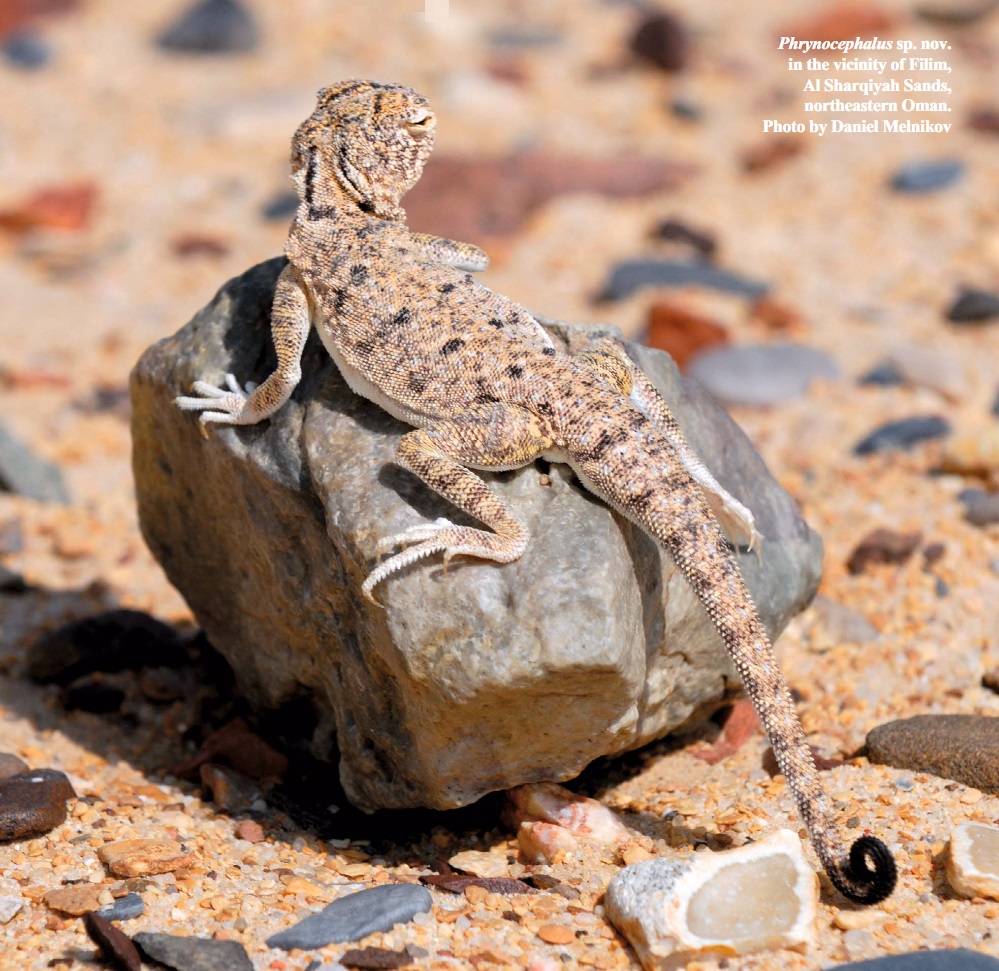
Phrynocephalus sakoi 
 Melnikov, Melnikova, Nazarov, Al-Johany & Ananjeva, 2015

Phrynocephalus
sp. nov.
in the vicinity of Filim, Al Sharqiyah Sands, northeastern Oman.
Photo by Daniel Melnikov.

Abstract

A revision of taxonomic structure of Phrynocephalus arabicus Anderson, 1894 complex was presented in our previous paper. However further investigations showed that specimens from southern Arabia do not refer to one species. A new species from Al Sharqiyah Sands, northeastern Oman is described. It differs morphologically from all other representatives of Ph. arabicus complex by body and tail proportions, dorsal coloration, undertail coloration and genetic characters. Phrynocephalus arabicus sensu stricto is distributed in Yemen, southwestern Oman, UAE, and southern Saudi Arabia. Phrynocephalus nejdensis Haas, 1957 is valid species, based on the morphological and genetic difference. Taxonomic status of Phrynocephalus macropeltis Haas, 1957 needs further confirmation with material from the type locality.

Keywords: Squamata; Acrodonta; Agamidae; Phrynocephalus sp. nov.; Al Sharqiyah Sands, northeastern Oman


Phrynocephalus sakoi sp. nov. 

Holotype: ZISP 28705, adult male (Fig. 4).
Paratypes: ZISP 28706 – 28710, ZISP 27089, CAS251008, 251022, 251023 (Fig. 5, Table 3).

Type locality. Al Sharqiyah Sands, Filim vicinity, northeastern Oman.

Diagnosis. A large and “heavy” Phrynocephalus species  with  tail  longer  than  body  in  both  sexes;  five-star shape bright orange pattern on head in females and black in males, two bright orange stripes on the neck in female sand black in males, two longitudinal rows of six bright orange (salmon) patches on the dorsum in females and black in males; with white under tail coloration without bands in both sexes with black distal third in males and black quarter in females  (two  bands)  and  no  bands  in white proximal part.

Etymology. Species dedicated to the memory of our close friend and colleague Sako Tuniyev, who tragically passed away on January 5, 2015. His death was shockand big tragedy for all who know him. The new species dedicated to the memory of young zoologist in the beginning of his carrier, with many fresh ideas and new collaborative projects, to a good son of distinguished father, to a father of two kids and a good husband, to our brother and colleague. We will always keep him in our hearts

Distribution. Species expected to be isolated in Al Sharqiyah Sands, northeastern Oman.


Fig. 7. Variation of dorsal coloration in living Phrynocephalus sakoi sp. nov. males in situ:
a,b, hard substrate (gravel) form;c,d, fine sand form.

DISCUSSION: Additional studies of Ph. arabicus sensu lato from southern Arabia showed that it is polytypical complex. Ph. sakoi sp. nov. from Al Sharqiyah Sands is characterized by morphological and genetic differences. This isolated desert consists of many large North-South linear dunes that are separated from each other by 2–3 km intervals (Radies et al., 2004; Edgell, 2006). A new species of endemic gecko Stenodactylus sharqiyahensis was also described from the Al Sharqiyah Sands (Metallinou and Carranza, 2013). Arabia is characterized by high speciesdiversity of lizards, as indicated by descriptions of manynew species in the last years (Carranza and Arnold, 2012; Melnikov and Pierson 2012; Melnikov et al., 2012a,2013a, 2013b, 2014; Nazarov et al., 2013). Some areas like Al Sharqiyah Sands are characterized by high level of endemism and needs special study. 

According to the molecular phylogenetic analyses and morphological results Ph. arabicus complex represent at least four well distinguished taxa. They are: Ph. arabicus sensu stricto from the southern Arabia (Yemen, southwestern Oman, southern Saudi Arabia, UAE), Ph. nejdensis from the northwestern Arabia (southern Jordan, northern and central Saudi Arabia), Ph. ahvazicus from the northwestern Iran, and Ph. sakoi sp. nov. represented by an isolated population in the Al Sharqiyah Sands, northeastern Oman. This four species are divided into two groups: southwestern Arabian Ph. arabicus + northeastern Arabian Ph. ahvazicus and northwestern Arabian Ph. nejdensis + southeastern Ph. sakoi sp. nov. Taxonomic status of Ph. macropeltis from the eastern coastal Arabia (eastern Saudi Arabia) needs further confirmation with material from the type locality (work in progress).

Daniel Melnikov, Ekaterina Melnikova, Roman Nazarov, Awadh Al-Johany and Natalia Ananjeva. 2015. A New Species of Phrynocephalus (Agamidae, Sauria) from Al Sharqiyah Sands, Northeastern Oman, Dedicated to the Memory of Sako Tuniyev (1983 – 2015). Russian Journal of Herpetology. 22(4): 301–309.
 
http://rjh.folium.ru/index.php/rjh/article/view/1030

[Herpetology • 2015] Phrynocephalus lutensis • A New Iranian Phrynocephalus (Squamata: Agamidae) from the Hottest Place on Earth and A Key to the Genus Phrynocephalus in southwestern Asia and Arabia


Phrynocephalus lutensis Kamali & Anderson, 2015

FIGURE 3. Body of Phrynocephalus lutensis sp. nov.
a. Phrynocephalus lutensis sp. nov. ♂ holotype; b. Phrynocephalus lutensis sp. nov. ♂ holotype. Ventral view; c. Phrynocephalus lutensis sp. nov. ♀ paratype. Dorsal view; e. Phrynocephalus lutensis sp. nov. ♂ holotype. Dorsal trunk scales, anterior to the right; f. Phrynocephalus lutensis sp. nov. ♂ holotype. Dorsal view of hind limb and proximal tail. g. Phrynocephalus lutensis sp. nov. ♀ holotype. Ventral view of right hind foot and toes.
All photos by K. Kamali.  DOI: 10.11646/zootaxa.3904.2.4

Abstract

A new species of agamid lizard, Phrynocephalus lutensis sp. nov., is described from the Lut Desert in Iran. It is a species adapted to wind-blown sand in this semi-isolated basin. It appears to be most closely similar to P. luteoguttatus and P. euptilopus on the basis of external morphology. A key to the 19 known Phrynocephalus species of southwestern Asia and Arabia is presented for the first time.

Keywords: Dasht-e Lut, Lut Desert, Kerman Province, checklist


Phrynocephalus lutensis sp. nov. 
Lut Desert Toad Headed Agama

FIGURE 2. Habitat (type locality) of Phrynocephalus lutensis sp. nov.. Dasht-e Lut (Lut Desert), Kerman Province, Iran.
Photo M. Ghazvinian.

Habitat (Fig. 2). The substratum on and in which the species is found is wind-blown sand, to which the morphology, and especially the fringed digits and nostril valves, are well adapted. The immediate habitat lies at the south-easternmost edge of the Dasht-e Lut, a semi-enclosed basin, surrounded by mountains, similar to such basins throughout southern Central Asia. The area in which this species lives is called Rig-e Yalan (Mega Dune). The elevation of the area from which the specimens were taken was about 700–1000 meters above sea level with high elevated dunes with height of about 400 meters in some parts. Within the Dasht-e Lut, wherein Mega Dune lies, is the hottest point in the world. The surface temperature in warm seasons goes up to 70.7°C (as recorded by NASA) and in cold seasons and at night it decreases to -10°C (reported by collector). At the time that specimens were taken the lowest and highest daily air temperatures were 15° and 30°C, respectively.
Thus far, nothing is known of the species’ behavior or ecology.


Discussion: Based on Arnold’s (1999) analysis of external morphology and his phylogenetic tree, Phrynocephalus lutensis sp. nov. would form a clade with P. euptilopus Alcock & Finn 1896 (Fig. 5) and to P. luteoguttatus Boulenger 1887 (Fig. 6), and these to a larger clade also including P. interscapularis and P. sogdianus. All occur in similar sandy deserts, P. interscapularis the most widely distributed, the other four narrowly distributed, P. lutensis in southeastern Iran, P. luteoguttatus and P. euptilopus in the Dasht-e Margo south of the Helmand River in southwestern Afghanistan and Pakistani Balochistan. Still lacking is a morphological and molecular analysis of the entire genus and a phylogeographical hypothesis based thereon. However, as we lack for P. lutensis sp. nov.. Arnold’s analysis of skeletal and soft anatomy, this remains only a speculation.


Kamali, Kamran & Steven C. Anderson. 2015. A New Iranian Phrynocephalus (Reptilia: Squamata: Agamidae) from the Hottest Place on Earth and A Key to the Genus Phrynocephalus in southwestern Asia and Arabia. Zootaxa. 3904(2): 249–260.  DOI: 10.11646/zootaxa.3904.2.4
ResearchGate.net/publication/272099589_A_New_Iranian_Phrynocephalus_Reptilia_Squamata_Agamidae_from_the_hottest_place_on_earth_and_a_key_to_the_genus_Phrynocephalus_in_southwestern_Asia_and_Arabia


Phrynocephalus ahvazicus MELNIKOV, MELNIKOVA, NAZAROV, RAJABIZADEH, AL-JOHANY, AMR & ANANJEVA, 2014
Phrynocephalus ananjevae MELNIKOV, MELNIKOVA, NAZAROV & RAJABIZADEH, 2013

Wednesday, December 23, 2015

[Herpetology • 2015] Description and Phylogeny of Three New Species of Synophis (Colubridae, Dipsadinae) from the tropical Andes in Ecuador and Peru; Synophis bogerti, S. zamora & S. insulomontanus


Figure 5. Four species of Synophis from Ecuador and Peru:
  
 Synophis calamitus (QCAZ 11931, upper left); S. bogerti sp. n. (QCAZ 13586, upper right); S. zamora sp. n. (QCAZ 13854, lower left); S. insulomontanus sp. n. (CORBIDI 13940, lower right). 
Photographs by Diego Quirola, Omar Torres-Carvajal and Germán Chávez. 
  
DOI: 10.3897/zookeys.546.6533 
Abstract

The discovery of three new species of Synophis snakes from the eastern slopes of the tropical Andes in Ecuador and Peru is reported. All previous records of S. bicolor from eastern Ecuador correspond to S. bogerti sp. n., which occurs between 1000–1750 m along a large part of the Amazonian slopes of the Ecuadorian Andes. In contrast, Synophis zamora sp. n. is restricted to southeastern Ecuador, including Cordillera del Cóndor, between 1543–1843 m. Synophis insulomontanus sp. n. is from the eastern slopes of the Andes in central and northern Peru, between 1122–1798 m, and represents the first record of Synophis from this country. All three new species share in common a large lateral spine at the base of the hemipenial body. A molecular phylogenetic tree based on three mitochondrial genes is presented, including samples of Diaphorolepis wagneri. Our tree strongly supports Synophis and Diaphorolepis as sister taxa, as well as monophyly of the three new species described here and S. calamitus. Inclusion of Synophis and Diaphorolepis within Dipsadinae as sister to a clade containing Imantodes, Dipsas, Ninia, Hypsiglena and Pseudoleptodeira is also supported.

Keywords: Andes, Dipsadinae, Ecuador, new species, Peru, snakes, Synophis, systematics


Figure 5. Four species of Synophis from Ecuador and Peru:   Synophis calamitus (QCAZ 11931, upper left); S. bogerti sp. n. (QCAZ 13586, upper right); S. zamora sp. n. (QCAZ 13854, lower left); S. insulomontanus sp. n. (CORBIDI 13940, lower right). 
Photographs by Diego Quirola, Omar Torres-Carvajal and Germán Chávez.    DOI: 10.3897/zookeys.546.6533


Omar Torres-Carvajal, Lourdes Echevarría, Pablo Javier Venegas, Germán Chávez and Jeffrey Camper. 2015. Description and Phylogeny of Three New Species of Synophis (Colubridae, Dipsadinae) from the tropical Andes in Ecuador and Peru.
ZooKeys. DOI: 10.3897/zookeys.546.6533


Resumen
Se reporta el descubrimiento de tres especies nuevas de serpientes Synophis de las estribaciones orientales de los Andes tropicales en Ecuador y Perú. Todos los registros previos de S. bogerti del oriente ecuatoriano corresponden a S. bogerti sp. n., la cual ocurre entre 1000–1750 m a lo largo de gran parte de las estribaciones amazónicas de los Andes ecuatorianos. En contraste, Synophis zamora sp. n. se restringe al suroriente de Ecuador, incluyendo la Cordillera del Cóndor, entre 1543–1843 m. Synophis insulomontanus sp. n. es de las estribaciones orientales de los Andes del centro y norte del Perú, entre 1122–1798 m, y representa el primer registro de Synophis para este país. Todas las tres especies nuevas comparten en común una espina lateral larga en la base del cuerpo del hemipene. Un árbol molecular filogenético, basado en tres genes mitocondriales es presentado, incluyendo muestras de Diaphorolepis wagneri. Nuestro árbol apoya fuertemente a Synophis y Diaphorolepis como taxa hermanos, así como la monofilia de las tres especies descritas y de S. calamitus. La inclusión de Synophis y Diaphorolepis dentro de Dipsadinae, como hermanas a un clado que contiene a Imantodes, Dipsas, Ninia, Hypsiglena y Pseudoleptodeira también es apoyada.

Three new fishing snake species fished out of the Andean slopes in South...
http://bit.ly/1TNh0DB via @Pensoft @EurekAlertAAAS

[Herpetology • 2015] Genetics, Morphology, Advertisement Calls, and Historical Records Distinguish Six New Polyploid Species of African Clawed Frog (Xenopus, Pipidae) from West and Central Africa


Fig 7. Pictures of resurrected and new species in life; Xenopus calcaratus, X. parafraseri, X. mellotropicalis, X. eysoole, X. allofraseri, X. kobeli and  X. fischbergi

Abstract

African clawed frogs, genus Xenopus, are extraordinary among vertebrates in the diversity of their polyploid species and the high number of independent polyploidization events that occurred during their diversification. Here we update current understanding of the evolutionary history of this group and describe six new species from west and central sub-Saharan Africa, including four tetraploids and two dodecaploids. We provide information on molecular variation, morphology, karyotypes, vocalizations, and estimated geographic ranges, which support the distinctiveness of these new species. We resurrect Xenopus calcaratus from synonymy of Xenopus tropicalis and refer populations from Bioko Island and coastal Cameroon (near Mt. Cameroon) to this species. To facilitate comparisons to the new species, we also provide comments on the type specimens, morphology, and distributions of X. epitropicalis, X. tropicalis, and X. fraseri. This includes significantly restricted application of the names X. fraseri and X. epitropicalis, the first of which we argue is known definitively only from type specimens and possibly one other specimen. Inferring the evolutionary histories of these new species allows refinement of species groups within Xenopus and leads to our recognition of two subgenera (Xenopus and Silurana) and three species groups within the subgenus Xenopus (amieti, laevis, and muelleri species groups).


Fig 7. Pictures of resurrected and new species in life; 
Xenopus calcaratus, X. parafraseri, X. mellotropicalis, X. eysoole, X. allofraseri, X. kobeli and  X. fischbergi


Host-Parasite co-evolution: Influences of allopolyploid evolution

The parasite fauna of Xenopus is characterized by its extraordinary richness. Within metazoan parasites, for instance, there are over 25 genera from 7 major invertebrate groups; a richer assemblage than in most other anurans. This diversity reflects a dual origin of the parasites: some (such as Protopolystoma, Dollfuschella, Oligolecithus and Progonimodiscus) are typical of anurans; others (including Gyrdicotylus, Cephalochlamys and the camallanid nematodes) are typical of fish, representing transfers associated with ecological overlaps in habitat and diet. For both subsets of parasites, the representatives infecting Xenopus have exceptional specializations such as the brood pouch and velum of the leech Marsupiobdella, the attachment organ and excretory system of the monogenean Gyrdicotylus, and the ereynetal organ of the mite, Xenopacarus.

In addition to parallel evolution of host and parasite, patterns of parasite infection are influenced by allopolyploid evolution of Xenopus. For example, species of Cephalochlamys occur in all tetraploid species of subgenus Xenopus so far examined, but not in octoploids, even when the octoploids co-occur with infected X. victorianus [a tetraploid]. This is consistent with the possibility that increased gene dosage or inheritance of resistance genes with complementary functions in octoploids confers parasite resistance. Parasites from the genus Protopolystoma provide a counter-example of increased susceptibility of higher ploidy levels. Most species in this parasite genus infect only one anuran host species. However, the tetraploid species X. victorianus and X. parafraseri and the octoploid species X. wittei each are infected by two Protopolystoma species (X. victorianus: P. xenopodis and P. microsclera; X. parafraseri: P. fissilis and P. ramulosus; X. wittei: P. fissilis and P. simplicis). That P. fissilis occurs in X. parafraseri and in X. wittei could represent shared inheritance of an ancestral susceptibility derived from a diploid ancestor. Interestingly, in X. victorianus and X. wittei, although two parasite species occur side-by-side in the same host populations, they never co-occur as adults within the same host individuals.

The effects of host interspecies hybridization (not involving genome duplication) on susceptibility to parasite infection have been investigated in X. laevis and X. muelleri. These host species each have species-specific Protopolystoma parasites and laboratory-generated F1 hybrids are also largely resistant. This study illustrates a selective advantage of host hybridization for enhanced immune function to helminth parasites that extends to other important pathogens such as viruses and bacteria. This advantage could have facilitated the establishment of newly emerged polyploid species alongside their parental species in the same habitats.

Central Africa: A species diversity hotspot for African clawed frogs

Over half of Xenopus species occur in Central Africa, including the six new species described here, the resurrected species X. calcaratus, and nine other previously known species: X. amieti, X. andrei, X. boumbaensis, X. epitropicalis, X. fraseri, X. longipes, X. poweri, X. pygmaeus, X. tropicalis. This list includes representatives of both subgenera, and each species group as newly defined (but not the Ethiopian endemic X. largeni). Three of these species (X. epitropicalis, X. poweri, and X. pygmaeus) have distributions centered in the Congo Basin, X. fischbergi has a large range over much of the northern Congo Basin, but the rest are probably endemic to the portion of Central Africa northwest of the Congo River.

What could explain this high species diversity in Central Africa? Persistent forest habitat could have played a role in maintaining or augmenting species diversity of African clawed frog. Indeed, the Albertine Rift region also hosts a high species diversity of African clawed frogs, including several octoploids (four species) and a dodecaploid, and this region probably harbored forest habitat for an extended period. Another feature of the Central African Xenopus diversity is a large number of species with high ploidy levels; specifically three of the seven octoploid species and three of the four described dodecaploid species occur in Central Africa. These species are a result of multiple independent allopolyploidization events that combined a few ancestral genomes in several unique ways. The diversity of octoploid and dodecaploid species raises the question of whether allopolyploidization conferred a selective advantage for species in Central Africa, such as those related to immune function discussed above.


Ben J. Evans, Timothy F. Carter, Eli Greenbaum, Václav Gvoždík, Darcy B. Kelley, Patrick J. McLaughlin, Olivier S. G. Pauwels, Daniel M. Portik, Edward L. Stanley, Richard C. Tinsley, Martha L. Tobias and David C. Blackburn. 2015. Genetics, Morphology, Advertisement Calls, and Historical Records Distinguish Six New Polyploid Species of African Clawed Frog (Xenopus, Pipidae) from West and Central Africa. PLoS ONE. 10(12): e0142823  DOI:  10.1371/journal.pone.0142823
http://www.plosone.org/article/fetchObject.action?uri=info:doi/10.1371/journal.pone.0142823&representation=PDF


African clawed frogs with multiple sets of DNA deepen mystery of 'lost ancestors' http://www.cbc.ca/1.3368301

Tuesday, December 22, 2015

[Herpetology • 2015] Cyrtodactylus petani • The fourth Bent-toed Gecko of the Genus Cyrtodactylus (Squamata: Gekkonidae) from Java, Indonesia


Farmer’s Bent-toed Gecko  | Cyrtodactylus petani 
Riyanto, Grismer & Wood, 2015

FIGURE 2. Living specimens of Cyrtodactylus petani sp. nov. from Jeladri, Pasuruan, Java.
(A) Adult male paratype MZB.Lace 11712 (SVL=56.6 mm). (B) Gravid female paratype MZB.Lace 11711. (SVL=53.8 mm).
FIGURE 6. Microhabitats where specimens of Cyrtodactylus petani sp. nov. were collected.
 (A) paddy field embankment with vegetation. (B) Rocks in the riverbank.

Abstract
Cyrtodactylus petani sp. nov. is a new species of Bent-toed Gecko from Java, Indonesia that had been masquerading under the name C. fumosus (Müller, 1895). The new species is differentiated from C. fumosus and all its Sundaland congeners by having the following combination of morphological characters: a maximum SVL of 57.2 mm; nine or ten supralabials; seven or eight infralabials; strongly tuberculate body and limbs; 20–25 paravertebral tubercles; 30–35 ventral scales; enlarged precloacal scales; enlarged femoral scales; 17–18 subdigital lamellae on the fourth toe; 31–35 continuous precloacal and femoral pores in males, pores absent in females; no precloacal groove; no enlarged median subcaudals; tubercles on anterior portion of tail; no reticulated pattern on top of head; a blotched dorsal pattern; and no paired, dark, semi-lunar shaped blotches on the nape.


Keywords: Reptilia, Cyrtodactylus, new species, Java, taxonomy, Gekkonidae


Systematics 
Cyrtodactylus petani sp. nov. 
(Cicak Jari Lengkung Petani: Farmer’s Bent-toed Gecko)


Etymology. The specific epithet petani refers to the fact that the type series was collected on a farm. Petani means a farmer in the Indonesian Language and is here treated as a noun in apposition.


FIGURE 5. Distribution map of Javan Cyrtodactylus.
Red circle is holotype of Cyrtodactylus petani sp. nov. Green circles are paratype localities of C. petani.Yellow circles are known localities of C. semiadii. The distribution of the widespread species, C. marmoratus and C. fumosus are not shown.

Discussion: 
Cyrtodactylus petani sp. nov. is the fourth species of Cyrtodactylus from Java that was not reported in previous herpetofaunal surveys of East Java. As suggested by Riyanto et al. (2014), C. fumosus from Java includes multiple undescribed species. Together, with other recent findings, including the discovery of a new Cyrtodactylus (Riyanto et al. 2014), a new Chiromanthis (Riyanto & Kurniati, 2014), a new Eutropis (Mausfeld & Böhme 2002), a suspected new species of Ptychozoon (Brown et al. 2012), a new record for Polypedates otilophus (Riyanto et al. 2009), and a relatively new Dendrelaphis (Rooijen & Vogel 2008), this discovery suggests much is yet to be learned concerning the herpetofaunal composition of Java. This discovery also indicates that the diversity of Cyrtodactylus continues to rise even in highly disturbed areas. 


Riyanto, Awal, L. L. Grismer & Wood, P. L., Jr. 2015. The fourth Bent-toed Gecko of the Genus Cyrtodactylus (Squamata: Gekkonidae) from Java, Indonesia.
Zootaxa. 
4059(2): 351–363.  DOI: 10.11646/zootaxa.4059.2.6

Monday, December 21, 2015

[Herpetology • 2015] Sorting Out Moss Frogs: mtDNA Data on Taxonomic Diversity and Phylogenetic Relationships of the Indochinese Species of the Genus Theloderma (Anura, Rhacophoridae)


Fig. 1. Theloderma species of Indochina and Thailand.
a, Th. horridum (Thailand, Satun Province, Tha Le Ban N. P., photo N. A. Poyarkov); b, Th. stellatum (Thailand, Uthai Thani Province, Hauy Kha Khaeng W. S.; photo P. Pawangkhanant); c, Th. cf. stellatum [described below as Theloderma vietnamense sp. nov.] (Vietnam, Kon Tum Province, Kon Plong); d, Th. pictum (Thailand, Satun Province, Tha LeBan N. P.; photo P. Pawangkhanant); e, Th. licin (Thailand, Satun Province, Tha Le Ban N. P., photo P. Pawangkhanant); f, Th. cf. asperum, northern population (Vietnam, Vinh Phuc Province, Tam Dao; photo N. L. Orlov); g, Th. cf. asperum, southern population (Vietnam, Kon Tum Province, Kon Plong; photo N. L. Orlov); h, Th. asperum (Thailand, Kamphaeng Phet Province, photo P. Pawangkhanant); i, Th. ryabovi, male (Vietnam, Kon Tum Province, Kon Plong; photo N. L. Orlov); j, Th. ryabovi, female (Vietnam, Kon Tum Province, Kon Plong; photo N. L. Orlov); k, Th. bicolor (Vietnam, Lao Cai, Fan Si Pan Mt.; photo N. L. Orlov); l, Th. corticale (Vietnam, Quang Tri Province, Ban Cup; photo N. L. Orlov); m, Th. gordoni, northern population (Vietnam, Lao Cai, Sa Pa; photo N. L. Orlov); n, Th. gordoni, southern population (Vietnam, Kon Tum Province, Kon Plong; photo N. L. Orlov); o, Th. lateriticum (Vietnam, Bac Giang; photo Nguyen Thien Tao); p, Th. rhododiscum (China, Yunnan; photo N. L. Orlov); q, Th. palliatum (Vietnam, Lam Dong Province, Bi Doup; photo E. A. Galoyan); r, Th. chuyangsinense (Vietnam, Dak Lak Province, Chu Yang Sin; photo N. A. Poyarkov); s, Th. truongsonense (Vietnam, Quang Tri Province, Ban Cup; photo N. L. Orlov); t, Th. bambusicola (Vietnam, Lam Dong Province, Cat Loc; photo N. A. Poyarkov); u, Th. cf. nebulosum (Vietnam, Kon Tum Province; photo N. L. Orlov); v, Th. cf. truongsonense (Vietnam, Kon Tum Province, Kon Plong; photo N. L. Orlov); w, (Vietnam, Khanh Hoa Province, Hon Ba; photo A. B. Vassilieva); x, Th. petilum (Vietnam, Dien Bien Province, Muong Nhe; photo Le Trung Dung).
N. A. Poyarkov, N. L. Orlov, A. V. Moiseeva, et al. 2015. Russian Journal of Herpetology. 22(4) 


Abstract

We discuss phylogenetic relationships and taxonomic diversity of the rhacophorid frogs of the genus Theloderma in sight of the novel phylogenetic data obtained from the Bayesian analysis of the up to 1987 bp length fragment of mtDNA (12S rRNA, tRNAval, and 16S rRNA) from the 90 specimens of 21 nominal species of Theloderma and 3 species of Nyctixalus. Our data suggest monophyly of the tribe Nyctixalini, including Th. moloch, and indicate deep divergence between the three major clades: Th. horridum + Th. stellatum group, Nyctixalus and the rest of the Theloderma species (Theloderma sensu stricto). We establish new subgenus Stelladerma subgen. nov. for Th. horridum + Th. stellatum group and discuss provisional taxonomy of Nyctixalini. We also indicate that the taxonomic status of the certain Indochinese Theloderma requires reassessment. In particular, our data suggest deep divergence between Malayan and Indochinese taxa of Th. asperum group and indicate non-monophyly of Th. asperum sensu lato; we resurrect the name Th. albopunctatum (Liu et Hu, 1962) for the Indochinese species. We provide molecular evidence for synonimization of Th. chuyangsinense Orlov et al., 2012 with Th. palliatum Rowley et al., 2011; as well as morphological and genetic evidence for syninomization of Th. bambusicola Orlov et al., 2012 with Th. laeve (Smith, 1924). We indicate a deep morphological and genetic differentiation within the Th. truongsonense (Orlov et Ho, 2005) complex. Finally, we report on the deep divergence within Th. stellatum Taylor, 1962 from eastern Thailand, southern Cambodia, and Vietnam, and describe a new species, Theloderma vietnamense sp. nov., based on morphological, acoustic and genetic lines of evidence.

Keywords: mitochondrial DNA; molecular phylogeny; sequence divergence; morphology; morphometrics; advertisement call; cryptic species; Vietnam


Fig. 1. Theloderma species of Indochina and Thailand.
a, Th. horridum (Thailand, Satun Province, Tha Le Ban N. P., photo N. A. Poyarkov); b, Th. stellatum (Thailand, Uthai Thani Province, Hauy Kha Khaeng W. S.; photo P. Pawangkhanant); c, Th. cf. stellatum [described below as Theloderma vietnamense sp. nov.] (Vietnam, Kon Tum Province, Kon Plong); d, Th. pictum (Thailand, Satun Province, Tha LeBan N. P.; photo P. Pawangkhanant); e, Th. licin (Thailand, Satun Province, Tha Le Ban N. P., photo P. Pawangkhanant); f, Th. cf. asperum, northern population (Vietnam, Vinh Phuc Province, Tam Dao; photo N. L. Orlov); g, Th. cf. asperum, southern population (Vietnam, Kon Tum Province, Kon Plong; photo N. L. Orlov); h, Th. asperum (Thailand, Kamphaeng Phet Province, photo P. Pawangkhanant); i, Th. ryabovi, male (Vietnam, Kon Tum Province, Kon Plong; photo N. L. Orlov); j, Th. ryabovi, female (Vietnam, Kon Tum Province, Kon Plong; photo N. L. Orlov); k, Th. bicolor (Vietnam, Lao Cai, Fan Si Pan Mt.; photo N. L. Orlov); l, Th. corticale (Vietnam, Quang Tri Province, Ban Cup; photo N. L. Orlov); m, Th. gordoni, northern population (Vietnam, Lao Cai, Sa Pa; photo N. L. Orlov); n, Th. gordoni, southern population (Vietnam, Kon Tum Province, Kon Plong; photo N. L. Orlov); o, Th. lateriticum (Vietnam, Bac Giang; photo Nguyen Thien Tao); p, Th. rhododiscum (China, Yunnan; photo N. L. Orlov); q, Th. palliatum (Vietnam, Lam Dong Province, Bi Doup; photo E. A. Galoyan); r, Th. chuyangsinense (Vietnam, Dak Lak Province, Chu Yang Sin; photo N. A. Poyarkov); s, Th. truongsonense (Vietnam, Quang Tri Province, Ban Cup; photo N. L. Orlov); t, Th. bambusicola (Vietnam, Lam Dong Province, Cat Loc; photo N. A. Poyarkov); u, Th. cf. nebulosum (Vietnam, Kon Tum Province; photo N. L. Orlov); v, Th. cf. truongsonense (Vietnam, Kon Tum Province, Kon Plong; photo N. L. Orlov); w, (Vietnam, Khanh Hoa Province, Hon Ba; photo A. B. Vassilieva); x, Th. petilum (Vietnam, Dien Bien Province, Muong Nhe; photo Le Trung Dung).
N. A. Poyarkov, N. L. Orlov, A. V. Moiseeva, et al. 2015.
  
Russian Journal of Herpetology. 22(4)

Nikolay A. Poyarkov, Jr., Nikolai L. Orlov, Anna V. Moiseeva, Parinya Pawangkhanant, Thiti Ruangsuwan, Anna B. Vassilieva, Eduard A. Galoyan, Tao Thien Nguyen and Svetlana S. Gogoleva. 2015. Sorting Out Moss Frogs: mtDNA Data on Taxonomic Diversity and Phylogenetic Relationships of the Indochinese Species of the Genus Theloderma (Anura, Rhacophoridae). Russian Journal of Herpetology. 22(4): 241–280 

Nguyen Quang Truong and Nguyen Vu Khoi. 2008. First record of Theloderma stellatum Taylor, 1962 from Phu Quoc Island, Kien Giang Province, southern Vietnam. Herpetology Notes. 1: 61-62 

Fig. 1. Theloderma species of Indochina and Thailand.
  a, Th. horridum (Thailand, Satun Province, Tha Le Ban N. P., photo N. A. Poyarkov); b, Th. stellatum (Thailand, Uthai Thani Province, Hauy Kha Khaeng W. S.; photo P. Pawangkhanant); c, Th. cf. stellatum [described below as Theloderma vietnamense sp. nov.] (Vietnam, Kon Tum Province, Kon Plong); d, Th. pictum (Thailand, Satun Province, Tha LeBan N. P.; photo P. Pawangkhanant); e, Th. licin (Thailand, Satun Province, Tha Le Ban N. P., photo P. Pawangkhanant); f, Th. cf. asperum, northern population (Vietnam, Vinh Phuc Province, Tam Dao; photo N. L. Orlov); g, Th. cf. asperum, southern population (Vietnam, Kon Tum Province, Kon Plong; photo N. L. Orlov); h, Th. asperum (Thailand, Kamphaeng Phet Province, photo P. Pawangkhanant); i, Th. ryabovi, male (Vietnam, Kon Tum Province, Kon Plong; photo N. L. Orlov); j, Th. ryabovi, female (Vietnam, Kon Tum Province, Kon Plong; photo N. L. Orlov); k, Th. bicolor (Vietnam, Lao Cai, Fan Si Pan Mt.; photo N. L. Orlov); l, Th. corticale (Vietnam, Quang Tri Province, Ban Cup; photo N. L. Orlov); m, Th. gordoni, northern population (Vietnam, Lao Cai, Sa Pa; photo N. L. Orlov); n, Th. gordoni, southern population (Vietnam, Kon Tum Province, Kon Plong; photo N. L. Orlov); o, Th. lateriticum (Vietnam, Bac Giang; photo Nguyen Thien Tao); p, Th. rhododiscum (China, Yunnan; photo N. L. Orlov); q, Th. palliatum (Vietnam, Lam Dong Province, Bi Doup; photo E. A. Galoyan); r, Th. chuyangsinense (Vietnam, Dak Lak Province, Chu Yang Sin; photo N. A. Poyarkov); s, Th. truongsonense (Vietnam, Quang Tri Province, Ban Cup; photo N. L. Orlov); t, Th. bambusicola (Vietnam, Lam Dong Province, Cat Loc; photo N. A. Poyarkov); u, Th. cf. nebulosum (Vietnam, Kon Tum Province; photo N. L. Orlov); v, Th. cf. truongsonense (Vietnam, Kon Tum Province, Kon Plong; photo N. L. Orlov); w, (Vietnam, Khanh Hoa Province, Hon Ba; photo A. B. Vassilieva); x, Th. petilum (Vietnam, Dien Bien Province, Muong Nhe; photo Le Trung Dung).

[Herpetology • 2015] Cyrtodactylus soudthichaki • A New Species of Cyrtodactylus (Squamata: Gekkonidae) from the Limestone Forest of Khammouane Province, central Laos


Cyrtodactylus soudthichaki 
Luu, Calame, Nguyen, Bonkowski & Ziegler, 2015

Abstract

We describe a new species of the genus Cyrtodactylus on the basis of three specimens from Khammouane Province, Laos. Cyrtodactylus soudthichaki sp. nov. is distinguished from the remaining congeners by the combination of the following characters: adult SVL 69.2–70.0 mm; dorsal head and neck with dark blotches; nuchal loop present; dorsum with five brown bands between limb insertions; 19 or 20 irregular rows of dorsal tubercles; 32 or 33 ventral scale rows; ventrolateral folds present, with distinct tubercles; dorsal surface of hind limbs with tubercles; 29 precloacal and femoral pores in a continuous row in males, precloacal pores absent in the female; enlarged femoral and precloacal scales present; 4 or 5 postcloacal tubercles; and subcaudals transversely enlarged. The new species most closely resembles Cyrtodactylus jaegeri and Cyrtodactylus roesleri in overall coloration and pattern. However, they can be clearly distinguished from each other in the number of dorsal tubercle rows, ventral scales, and femoral and precloacal pores. Cyrtodactylus soudthichaki is the 16th species of Cyrtodactylus known from Laos.

Keywords: Cyrtodactylus soudthichaki sp. nov., central Laos, morphology, taxonomy, Reptilia


Distribution. Cyrtodactylus soudthichakisp. nov. is currently known only from the type locality in Khun Don Mountain, Phou Hin Poun NPA, Khammouane Province, central Laos (Fig. 5).

Etymology. This species is named in honour of Mr. Sisomphone Soudthichak, from the Natural Resources and Environment Department of Khammouane Province, Laos, who provided great support for our field research in Laos since 2013. As common names, we suggest Soudthichak’s Bent-toed Gecko (English) and Soudthichak’s Ki Chiem (Laotian). 

Natural history. The specimens were found between 19:00 and 21:00, on the branches of shrubs and karst boulders in a karst forest, approximately 0.3 m above the forest floor, between 150 and 170 m a.s.l. The karst forest included  species  of  the  dominated  families  Ebenaceae,  Dracaenaceae,  Arecaeae,  Poaceae,  Meliaceae,  and  Moraceae. The humidity at the time of collection was approximately 85% and the air temperature ranged from 23 to 26oC.  


Luu, Vinh Q., Thomas Calame, Truong Q. Nguyen, Michael Bonkowski & Thomas Ziegler. 2015. A new species of Cyrtodactylus (Squamata: Gekkonidae) from the limestone forest of Khammouane Province, central Laos.
 Zootaxa. 4058(3): 388–402.  DOI:  10.11646/zootaxa.4058.3.6


[Cephalopoda • 2010] The Argonaut Shell: Gas-mediated Buoyancy Control in A Pelagic Octopus


Figure 2. Behavioural stages (a–d) by which a female argonaut (Argonauta argo) attains neutral buoyancy, Okidomari Harbour, Sea of Japan.
 Illustrations: Julian Finn/Kate Nolan. Photos: Julian Finn.  DOI: 10.1098/rspb.2010.0155

Abstract

Argonauts (Cephalopoda: Argonautidae) are a group of rarely encountered open-ocean pelagic octopuses with benthic ancestry. Female argonauts inhabit a brittle ‘paper nautilus’ shell, the role of which has puzzled naturalists for millennia. The primary role attributed to the shell has been as a receptacle for egg deposition and brooding. Our observations of wild argonauts have revealed that the thin calcareous shell also functions as a hydrostatic structure, employed by the female argonaut to precisely control buoyancy at varying depths. Female argonauts use the shell to ‘gulp’ a measured volume of air at the sea surface, seal off the captured gas using flanged arms and forcefully dive to a depth where the compressed gas buoyancy counteracts body weight. This process allows the female argonaut to attain neutral buoyancy at depth and potentially adjust buoyancy to counter the increased (and significant) weight of eggs during reproductive periods. Evolution of this air-capture strategy enables this negatively buoyant octopus to survive free of the sea floor. This major shift in life mode from benthic to pelagic shows strong evolutionary parallels with the origins of all cephalopods, which attained gas-mediated buoyancy via the closed-chambered shells of the true nautiluses and their relatives.

Julian K. Finn and Mark D. Norman. 2015. The Argonaut Shell: Gas-mediated Buoyancy Control in A Pelagic Octopus. Proc. R. Soc. B. 277(1696); 2967–2971. DOI: 10.1098/rspb.2010.0155

Sunday, December 20, 2015

[PaleoMammalogy • 2015] Xenokeryx amidalae • Systematics and Evolution of the Miocene Three-Horned Palaeomerycid Ruminants (Mammalia, Cetartiodactyla)


Fig 10. Life reconstruction of the head of Xenokeryx amidalae gen. et sp. nov. Adult male based on the fossils from La Retama.
 Illustrations by Israel M. Sánchez. DOI: 10.1371/journal.pone.0143034

Abstract

Palaeomerycids were strange three-horned Eurasian Miocene ruminants known through fossils from Spain to China. We here study their systematics, offering the first cladistic phylogeny of the best-known species of the group, and also reassess their phylogenetic position among ruminants, which is currently disputed. The beautifully preserved remains of a new palaeomerycid from middle Miocene deposits of Spain, Xenokeryx amidalae gen. et sp. nov., helps us to better understand palaeomerycid anatomy, especially that of the nuchal region in the skull, significantly improving our current knowledge on these enigmatic ruminants. Our results show two main lineages of palaeomerycids, one containing the genus Ampelomeryx diagnosed by a characteristic type of cranium / cranial appendages and some dental derived traits, and another one that clusters those forms more closely related to Triceromeryx than to Ampelomeryx, characterized by a more derived dentition and a set of apomorphic cranial features. Xenokeryx branches as a basal offshoot of this clade. Also, we find that Eurasian palaeomerycids are not closely related to North American dromomerycids, thus rejecting the currently more accepted view of palaeomerycids as the Eurasian part of the dromomerycid lineage. Instead of this, palaeomerycids are nested with the African Miocene pecoran Propalaeoryx and with giraffoids. On the other hand, dromomerycids are closely related to cervids. We define a clade Giraffomorpha that includes palaeomerycids and giraffids, and propose an emended diagnosis of the Palaeomerycidae based on cranial and postcranial characters, including several features of the cranium not described so far. We also define the Palaeomerycidae as the least inclusive clade of pecorans containing Triceromeryx and Ampelomeryx. Finally, we reassess the taxonomy of several palaeomerycid taxa.


Systematic Palaeontology

MAMMALIA Linnaeus, 1758
CETARTIODACTYLA Montgelard, Catzeflis and Douzery, 1997

RUMINANTIA Scopoli, 1777
PECORA sensu Webb and Taylor, 1980

PALAEOMERYCIDAE Lydekker, 1883

Fig 11. Evolution of palaeomerycids. Summary scheme showing a calibrated phylogeny of palaeomerycids (based on the corresponding MPT) with special emphasis on the main morphological traits of each basal clade (Ampelomeryx-clade and Triceromeryx-clade represented by reconstructions of Ampelomeryx and Xenokeryx) including their biogeographic distribution.
 Illustrations by Israel M. Sánchez.  DOI: 10.1371/journal.pone.0143034

Genus Xenokeryx nov.
urn:lsid:zoobank.org:act:BF7F79F9-6752-4CD2-8022-64C5F5790D57

Etymology: Xenos, greek for strange, keryx referring to horn. Meaning ‘strange horn’.

Diagnosis: T-shaped upright occipital appendage with well-developed pedicle and downwards-oriented branch tips; very faint longitudinal crests in the posterior face of the occipital appendage; ulna distally fused to radius; short palmar extension of the facet for the semilunate in the radius; straight disto-lateral border of the distal trochlea in the astragalus, showing no notch; distal articulation facet of the first phalanx not extended into the flexor area.

Xenokeryx amidalae sp. nov.
urn:lsid:zoobank.org:act:9B119A4F-AB1F-4077-A6F6-31981F294A64

Synonyms: Triceromeryx conquensis, nomen nudum (in ref. [69], p. 63, 88);
Triceromeryx conquensis, nomen nudum (in ref. [70], p. 117);
Triceromeryx sp. nov. (in ref. [41], p. 257)

Etymology: Referred to the fictional character Padme Amidala from Star Wars, due to the striking resemblance that the occipital appendage of Xenokeryx bears to one of the hairstyles that the aforementioned character shows in The Phantom Menace feature film.


Conclusions

We here present a new (albeit limited) phylogenetic analysis of the pecoran ruminants, with an emphasis on fossil forms and morphology, but also incorporating molecular data. A new palaeomerycid here described, Xenokeryx amidalae gen. et sp. nov. from the middle Miocene of Spain, helps to reinterpret and understand the morphological evolution and phylogenetic relationships of the group. Despite their apparent external similarities, Eurasian palaeomerycids are not related with North American dromomerycids. Instead, they belong in the clade that also contains the giraffes besides several extinct groups. We name this clade the Giraffomorpha. Among giraffomorphs, the early Miocene African pecoran Propalaeoryx is the closest sister group to palaeomerycids. On the other hand, dromomerycids are very closely related to cervids.

There are two main lineages of palaeomerycids. One of them, the Ampelomeryx-clade, is characterized by a well-developed Palaeomeryx-fold and several other dental derived characters (although they retain a relatively primitive dentition), sloped not pneumatized flat ossicones and flattish and variably sized occipital appendage. The other one, the Triceromeryx-clade, is characterized by its more derived dentition, upright cylindrical pneumatized ossicones, and a great diversity of occipital appendages.

This study focused mainly on the systematics of several extinct clades (palaeomerycids, dromomerycids and their respective allies). Future ruminant research will benefit from total-evidence phylogenetic methods (e.g. Bayesian tip-dating analysis used here) for combining fossil and living taxa, morphological and molecular datasets, and fossil ages. The inclusion of more living and fossil lineages in larger datasets will be decisive to further testing our findings and conclusions.


Israel M. Sánchez, Juan L. Cantalapiedra, María Ríos, Victoria Quiralte and Jorge Morales. 2015. Systematics and Evolution of the Miocene Three-Horned Palaeomerycid Ruminants (Mammalia, Cetartiodactyla). PLoS ONE. DOI: 10.1371/journal.pone.0143034

Xenokeryx amidalae: Strange 'Padme Amidala' ruminant discovered in Spain is extinct ancestor of giraffes http://ibt.uk/A006QP0 via @IBTimesUK #StarWars

[Herpetology • 2015] Oligodon arenarius • A New Species of the Genus Oligodon Fitzinger, 1826 (Squamata: Colubridae) from Coastal Southern Vietnam


Oligodon arenarius  Vassilieva, 2015  

Abstract
A new species of the genus Oligodon from the coastal area of Binh Chau–Phuoc Buu Nature Reserve, Ba Ria–Vung Tau Province, southern Vietnam, is described. Oligodon arenarius sp. nov. is distinguishable from all other species by the unique combination of the following characters: medium size; 17 dorsal scale rows; 6–8 maxillary teeth, the posterior three being enlarged; head scalation lacking a loreal but usually including a presubocular; divided nasal; two postoculars; 131–144 ventrals; 36–60 subcaudals; unforked hemipenis, without spines or obvious papillae; sexual dimorphism displayed in the number of subcaudals (36–40 in females, 58–60 in males) and a relative tail length, tails being quite long in males (TaL/TL = 0.26–0.28) and moderate in females (TaL/TL = 0.13–0.17); head coloration pattern including ocular band, temporal bands and chevron-shaped mark on nape; dorsal coloration without distinct pattern, uniform or with dark speckling; ventrals pinkish in life, immaculate. To date, this species appear to be endemic to Vietnam.

Keywords: Reptilia, Oligodon arenarius sp. nov., Ba Ria-Vung Tau Province, southern Indochina, taxonomy, sexual dimorphism, natural history


Etymology. The new species name is an adjective in the nominative case, masculine gender, derived from the Latin word "arena" meaning "sand", "sandy land". The name is intended to reflect the evident preference by the new species for sandy coastal habitats and the snake's remarkable ability to plunge into the sand and move under it. 


Vassilieva, Anna B. 2015. A New Species of the Genus Oligodon Fitzinger, 1826 (Squamata: Colubridae) from Coastal Southern Vietnam. Zootaxa. 4058(2): 211–226.  DOI:  10.11646/zootaxa.4058.2.4

[Herpetology • 2015] Clinotarsus penelope | กบเขาสูง • When Young are More Conspicuous than Adults: A New Ranid Species (Anura: Ranidae) from Thailand revealed by its Tadpole


กบเขาสูง | Hill Frog | Clinotarsus penelope
Grosjean, Bordoloi, Chuaynkern, Chakravarty & Ohler, 2015
DOI: 10.11646/zootaxa.4058.4.2
photo: C. Deekrachang | siamensis.org

Abstract

Tadpoles of Clinotarsus alticola collected nearby the type locality in Assam, India are barcoded and described. A detailed morphological and morphometrical description of the specimens, along with a study of the anatomy of the buccal cavity are provided. A comparison of these tadpoles with “Clinotarsus alticola” tadpoles from peninsular Thailand and of the genetic variation of a fragment of their mtDNA 16S gene led us to assign the population of peninsular Thailand to a new species, Clinotarsus penelope sp. n. The holotype of the new species is chosen among the tadpole series as no adult could be found in the type locality. Presumed conspecific adults of nearby localities are morphologically described and compared to barcoded adults of Clinotarsus alticola, waiting for further molecular confirmation. The tadpole of the new species differs from that of C. alticola by a much greater size at comparative stages (e.g., 77.7 mm vs. 53.3 mm in stage 36, respectively), a black coloration (vs. a yellow-olive tinge), several ocelli on the tail muscle (vs. only one), a rounded snout (vs. a more pointed snout) and a different Keratodont Row Formula (KRF; nine keratodonts rows maximum on both labia in C. penelope vs. eight maximum in C. alticola). A discussion about the choice of the holotype, the assignment of adult specimens and the future confirmation of this assignment are provided, as well as a comparison with older descriptions of “Clinotarsus alticola” sensu lato tadpoles and with Clinotarsus curtipes tadpoles from Karnataka, India. The lectotype of Clinotarsus alticola is redescribed.

Keywords: Clinotarsus alticola, Ranidae, tadpole, holotype, India, Thailand, Amphibia


Distribution limited to the tadpole data (Fig. 10). Thailand: Namtok Raman Forest Park, Phang Nga Province (type locality). Localities of referred specimens: Kaeng Krachon National Park, Phetchaburi Province; Khao Sok National Park, Surat Thani Province; Khlong Palian at junction of streams arising from Nam Tok Ton Tok and Nam Tok Ton Te,Trang Province, Khlong Rang Waterfall, Ngao National  Park,  Pha  To,  Chumphon  Province. Smith (1930) mentioned the  presence  of  “Rana  alticola”  in  the  province of Nakhon Si Thammarat which fills a gap between the provinces of Surat Thani and of Trang.

Etymology. This species is dedicated to the daughter of the first author, Pénélope. The nomen is used as a noun in apposition to generic substantive.


Grosjean, Stéphane, Sabitry Bordoloi, Yodchaiy Chuaynkern, Paramita Chakravarty and Annemarie Ohler. 2015. When Young are More Conspicuous than Adults: A New Ranid Species (Anura: Ranidae) revealed by its Tadpole. Zootaxa. 4058(4): 471–498. DOI: 10.11646/zootaxa.4058.4.2