Saturday, July 6, 2024

[Botany • 2024] Geocharis globosa • A Recircumscription of Geocharis (Zingiberaceae) as A Result of the Discovery of A New Species in Sumatra, Indonesia


Geocharis globosa Zulaspita & Nurainas, 

in Nurainas, Zulaspita, Febriamansyah, Syamsuardi et Poulsen, 2024. 

Abstract
Recent fieldwork conducted in Sumatra resulted in unusual collections of the conspicuous ginger genus Geocharis, a genus that harbours a total of six species distributed in Sumatra, the Malay Peninsula, Borneo and the Philippines. After carefully reviewing types and protologues of existing taxa, we conclude that the recent collections represent a new species described here as Geocharis globosa, which is similar to G. aurantiaca, G. rubra and G. radicalis by the flowers spreading evenly in all directions but differs from these by the less divided labellum and by the unstructured and smooth globose fruits. We provide a detailed description and a photographic plate as well as a preliminary Red List Assessment for the new species. With the new species added to Geocharis macrostemon and G. radicalis, the number of species in Sumatra hereby increases to three. A recircumscription of the genus is provided, taking into account the unusual fruit character of the new species.

Key words: Geocharis globosa, globose fruit, Mount Marapi, taxonomy, West Sumatra, wild gingers


Geocharis globosa Zulaspita & Nurainas, sp. nov.
A habit B sheath (with tessellate pattern), ligule and base of leaf blade C inflorescence D flower dissection E infructescence F fruit G seeds with and without aril.
Photographs by T.A. Febriamansyah, edited by A.D. Poulsen.

 Geocharis globosa Zulaspita & Nurainas, sp. nov.
 
Diagnosis: The new species is similar to G. aurantiaca, G. rubra and G. radicalis by the flowers spreading in all directions from an erect flowering shoot but differs from all of these by the labellum being incised only halfway from apex (not deeply or completely divided), and having a smooth and glabrous surface to the ovary and globose fruits (Table 2).

Etymology: The epithet refers to the shape of the fruit.


 Nurainas Nurainas, Witri Zulaspita, Thoriq Alfath Febriamansyah, Syamsuardi Syamsuardi and Axel Dalberg Poulsen. 2024. A Recircumscription of Geocharis (Zingiberaceae) as A Result of the Discovery of A New Species in Sumatra, Indonesia. PhytoKeys 244: 15-22. DOI: 10.3897/phytokeys.244.119306

Friday, July 5, 2024

[Botany • 2024] Drymonia cutervoensis (Gesneriaceae) • A New Species from the Cutervo National Park in northern Peru


Drymonia cutervoensis J.L.Clark, R.Rojas & Rob.Fern., 

in Gonzáles, Fernandez-Hilario et Clark, 2024. 

Abstract
A new species of Drymonia from Northern Peru was recently discovered during exploratory field work and is described here. Drymonia cutervoensis J.L.Clark, R.Rojas & Rob.Fern. is differentiated from all other congeners by its terrestrial unbranched shrub habit and laterally compressed corolla tubes. Drymonia cutervoensis is featured with field images and compared with other members of Drymonia that share laterally compressed corolla tubes. Based on IUCN guidelines, a preliminary conservation status of Endangered (EN) is assessed for Drymonia cutervoensis.

Keywords: Cajamarca, Cutervo, Drymonia, Gesneriaceae, Neotropics, taxonomy
 

 Drymonia cutervoensis J.L.Clark, R.Rojas & Rob.Fern.


Rocío del Pilar Rojas Gonzáles, Robin Fernandez-Hilario and John L. Clark. 2024. Drymonia cutervoensis (Gesneriaceae), A New Species from the Cutervo National Park in northern Peru. Brittonia. DOI: 10.1007/s12228-024-09793-z

[Funga • 2024] Psilocybe ingeli & P. maluti (Agaricales: Hymenogastraceae) • Two novel Psilocybe species from southern Africa and some notes on African traditional hallucinogenic mushroom use


 Psilocybe maluti B. van der Merwe, A. Rockefeller & K. Jacobs,
 
in van der Merwe, Rockefeller, Kilian, Clark, Sethathi, Moult et Jacobs, 2024.
 Photos by C. Clark.

ABSTRACT
Two new Psilocybe species (Hymenogastraceae), P. ingeli and P. maluti, are described from southern Africa. Morphology and phylogeny were used to separate the two novel fungi from their closest relatives in the genus. Psilocybe ingeli was found fruiting on bovine manure–enriched grasslands in the Kwa-Zulu Natal Province of South Africa and differs from its closest relative P. keralensis and others in the internal transcribed spacer ITS1-5.8S-ITS2, partial 28S nuc rDNA, and translation elongation factor 1-alpha regions, distribution, and having larger basidiospores. Similarly, P. maluti was collected from the Free State Province of South Africa and observed in the Kingdom of Lesotho, growing on bovine manure. A secotioid pileus, geographic distribution, and differences in the same DNA regions distinguish P. maluti from its closest relative P. chuxiongensis. Furthermore, the spore dispersal and traditional, spiritualistic use of P. maluti are discussed here.

KEYWORDS: Psilocybe, South Africa, taxonomy, traditional use, new taxa

 Psilocybe ingeli, Kwa-Zulu Natal Province, South Africa, 28 February 2023.
 (A) Stipe white with mycelium. (B) Striations running up the hemispheric pileus. (C) Pale lamellae margin.
Photos by T. Moult.

Psilocybe ingeli B. van der Merwe, A. Rockefeller & K Jacobs, sp. nov.  

Etymology: Psilocybe ingeli is named after the Ingeli mountain range, where the type specimen was found.

Psilocybe maluti B. van der Merwe, A. Rockefeller & K. Jacobs, sp. nov.  

Etymology: Psilocybe maluti is named after the Maluti Mountains that share the same range as this novel Psilocybe, stretching from the Free State and Kwa-Zulu Natal provinces of South Africa to throughout the Kingdom of Lesotho.

 Psilocybe maluti, Kingdom of Lesotho, 31 December 2021.
 (A) Fimicolous habitat. (A–E) Secotioid pileus. (B) Details of the stipe and veil.
 Photos by C. Clark.

 
B. van der Merwe, A. Rockefeller, A. Kilian, C. Clark, M. Sethathi, T. Moult and K. Jacobs. 2024. A Description of Two novel Psilocybe species from southern Africa and some notes on African traditional hallucinogenic mushroom use. Mycologia. DOI: 10.1080/00275514.2024.2363137

[Herpetology • 2024] Hyloscirtus arcanusForty years later: A New Andean Stream Treefrog of the Genus Hyloscirtus (Anura: Hylidae) from Ecuador, with comments on arm hypertrophy in the H. larinopygion group


Hyloscirtus arcanus
Rivera-Correa, Ron, Nunes, Araujo-Vieira, Pinheiro & Grant, 2024

 
Abstract
We present the description of a novel treefrog species inhabiting the Andean streams in southeastern Ecuador that has been erroneously identified as Hyloscirtus lindae for four decades. The new species is closely related to H. tapichalaca and is part of the southern clade of the H. larinopygion group, which comprises five species confined to the southeastern Andes of Ecuador to the northeastern Andes of Peru. It is diagnosed from its close relatives by a unique combination of characteristics, including hypertrophied forelimbs in males, a pronounced, curved, and protruding spine-shaped prepollex, a substantial supracloacal flap, supratympanic fold, digital discs colored in shades of orange-red or bright-red, and the concealed surfaces of limbs displaying a bluish-gray hue and dorsal spicules in males. We briefly explore the implications of this discovery for the evolution of arm morphology in the H. larinopygion group. Our findings underscore the continued importance of periodically reviewing historical specimens, leading to unexpected discoveries; once again confirming the importance of natural history museums and their custodian biological collections.

 Amphibia, Andes, biological collections, biodiversity, morphology, systematics, taxonomy


Mauricio Rivera-Correa, Santiago Ron, Ivan Nunes, Katyuscia Araujo-Vieira, Paulo D. P. Pinheiro and Taran Grant. 2024. Forty years later: A New Andean Stream Treefrog of the Genus Hyloscirtus (Anura: Hylidae) from Ecuador, with comments on arm hypertrophy in the H. larinopygion group.  Zootaxa. 5474(2); 101-126. DOI: 10.11646/zootaxa.5474.2.1
  facebook.com/DoubleHelixRanch/posts/10161470283035170

Thursday, July 4, 2024

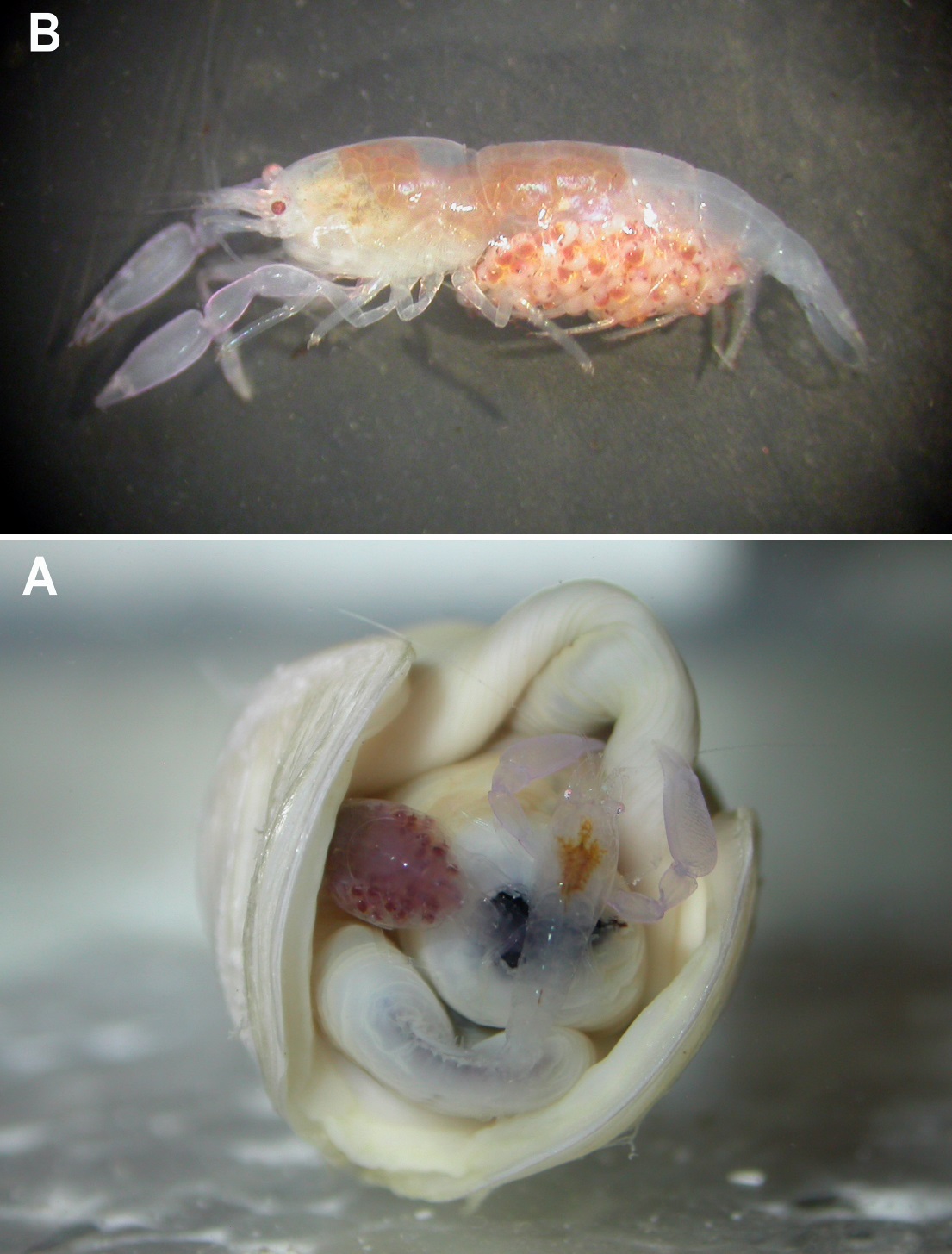
[Crustacea • 2024] Platypontonia ngae • A New symbiotic Shrimp (Decapoda: Palaemonidae) living inside a boring gastrochaenid bivalve mollusk from the Philippines


Platypontonia ngae  Fransen, 2024
ovigerous female holotype & male-female pair in gastrochaenid bivalve

 
Abstract
A new symbiotic palaemonid shrimp Platypontonia ngae sp. nov., is described based on a male-female pair found inside the mantle cavity of a gastrochaenid bivalve mollusk collected on a coral slope on the island Panglao, Philippines. The new species constitutes the third member of the genus Platypontonia Bruce, 1968. The new species is described, figured and compared with its congeners.

Crustacea, Malacostraca, Caridea, Symbiosis, Mollusca, Gastrochaenidae, Philippines


Platypontonia ngae sp. nov.:
A, male-female pair in gastrochaenid bivalve; B, ovigerous female holotype, RMNH.CRUS.D.58061.
Photographs by Stefano Schiaparelli.


Charles H.J.M. Fransen. 2024. Platypontonia ngae sp. nov., A New symbiotic Shrimp (Decapoda: Palaemonidae) living inside a boring gastrochaenid bivalve mollusk from the Philippines.  Zootaxa. 5476(1); 89-98. DOI: 10.11646/zootaxa.5476.1.11

[Paleontology • 2024] Gaiasia jennyae • Giant stem Tetrapod was Apex Predator in Gondwanan late Palaeozoic Ice Age


Gaiasia jennyae
Marsicano, Pardo, Smith, Mancuso, Gaetano & Mocke, 2024


Abstract
Current hypotheses of early tetrapod evolution posit close ecological and biogeographic ties to the extensive coal-producing wetlands of the Carboniferous palaeoequator with rapid replacement of archaic tetrapod groups by relatives of modern amniotes and lissamphibians in the late Carboniferous (about 307 million years ago). These hypotheses draw on a tetrapod fossil record that is almost entirely restricted to palaeoequatorial Pangea (Laurussia). Here we describe a new giant stem tetrapod, Gaiasia jennyae, from high-palaeolatitude (about 55° S) early Permian-aged (about 280 million years ago) deposits in Namibia that challenges this scenario. Gaiasia is represented by several large, semi-articulated skeletons characterized by a weakly ossified skull with a loosely articulated palate dominated by a broad diamond-shaped parasphenoid, a posteriorly projecting occiput, and enlarged, interlocking dentary and coronoid fangs. Phylogenetic analysis resolves Gaiasia within the tetrapod stem group as the sister taxon of the Carboniferous Colosteidae from Euramerica. Gaiasia is larger than all previously described digited stem tetrapods and provides evidence that continental tetrapods were well established in the cold-temperate latitudes of Gondwana during the final phases of the Carboniferous–Permian deglaciation. This points to a more global distribution of continental tetrapods during the Carboniferous–Permian transition and indicates that previous hypotheses of global tetrapod faunal turnover and dispersal at this time must be reconsidered.


Claudia A. Marsicano, Jason D. Pardo, Roger M. H. Smith, Adriana C. Mancuso, Leandro C. Gaetano  and Helke Mocke. 2024. Giant stem Tetrapod was Apex Predator in Gondwanan late Palaeozoic ice age. Nature.  DOI: 10.1038/s41586-024-07572-0


[Botany • 2024] Paraphlomis youyangensis (Lamiaceae) • A New Species from southeastern Chongqing, China


 Paraphlomis youyangensis H.Jiang, R.B.Zhang & Tan Deng, 

in Zhang, Deng, Jiang, Xie, Wei, Dou, Qian et He, 2024. 

Abstract
The newly discovered Paraphlomis youyangensis, native to southeastern Chongqing, China, is introduced to the scientific community. This species exhibits similarities in floral structure to P. kuankuoshuiensis but is distinguishable by several discrete features, such as less pronounced rhizomes (<0.5 vs. 2–4 cm), elongated stolons (present vs. absent), smaller leaf blades (1.8‒5.5 × 1.2–3.1 vs. 10–37 × 3–8 cm), leaf margins (shallowly repand and mucronulate vs. serrulate), and shorter bracteoles (1.2–4 vs. ca. 5 mm). Phylogenetic assessments based on two nuclear genes and three chloroplast genes indicated that P. youyangensis has a closer evolutionary relationship with P. yingdeensis but is differentiated from the latter by long stolons, smaller leaf blades (vs. 6.2–16.5 × 4–11.5 cm), leaf margins (vs. crenate-serrate), and notably shorter bracteoles (vs. 7–8 mm).

Keyword: cpDNA, limestone flora, nrDNA, Paraphlomis jiangyongensis, P. kuankuoshuiensis, P. nana, P. yingdeensis

 Line drawing of  Paraphlomis youyangensis H.Jiang, R.B.Zhang & Tan Deng.
A. Plant; B. Adaxial leaf surface; C. Abaxial leaf surface; D. Opened calyx; E. Opened corolla; F. Flower; G. Stamens; H. Pistil.
Drawn by Tan Deng.


Photographs of Paraphlomis youyangensis H.Jiang, R.B.Zhang & Tan Deng.
A. Habitat; B. One clone, showing long stolons; C. Tufted plants; D. Stem indumentum; E. Adaxial leaf surface; F. Abaxial leaf surface; G. Inflorescence; H. Flower; I. Bracteoles; J. Opened calyx; K. Opened corolla; L. Corolla lips; M. Thecae; N. Ovary; O. Pistil.
Photographed by Hong Jiang & Ren-Bo Zhang, composed by Tan Deng.


Paraphlomis youyangensis H.Jiang, R.B.Zhang & Tan Deng, sp. nov. 

Diagnosis: The height and foliage dimensions of Paraphlomis youyangensis are similar to those of P. jiangyongensis and P. nana; however, its floral characteristics are more similar to those of P. kuankuoshuiensis. Despite these similarities, P. youyangensis is readily distinguishable from P. kuankuoshuiensis by several distinct traits: inconspicuous rhizomes (<0.5 vs. 2–4 cm), long stolons (vs. absent), much smaller sized lamina (1.8–5.5 × 1.2–3.1 cm vs. 10– 37 × 3‒8 cm), shallowly repand and mucronulate lamina margin (vs. serrulate), and shorter bracteoles (1.2–4 mm vs. ca. 5 mm).  


Ren-Bo Zhang, Tan Deng, Hong Jiang, Da-Jun Xie, Ruo-Xun Wei, Quan-Li Dou, Zheng-Min Qian and Lin He. 2024. Paraphlomis youyangensis (Lamiaceae), A New Species from southeastern Chongqing, China. Taiwania. 69(3); 281-287. DOI: 10.6165/tai.2024.69.281

Wednesday, July 3, 2024

[Botany • 2024] Kaempferia calcicola • Cytotaxonomy of Kaempferia subgenus Protanthium (Zingiberaceae) supports A New limestone Species endemic to Thailand


   Kaempferia calcicola Noppornch.

in Nopporncharoenkul, Sukseansri, Nopun, Meewasana, Jenjittikul, Chuenboonngarm, Viboonjun et Umpunjun, 2024. 
ดอกดินเขาหินปูน  ||   DOI: 10.3372/wi.54.54201

Abstract
Thailand is the biodiversity hotspot of genus Kaempferia (Zingiberaceae) and harbours 14 species belonging to K. subgenus Protanthium. To better understand the taxonomic circumscription and verify the taxonomic status, the present characterization of cytogenetic characters included all recognized and one undescribed species of K. subg. Protanthium from Thailand. Overall, 88 accessions of plant materials were analysed cytogenetically: 84 and 42 accessions were subjected to flow cytometry and karyology, respectively. Based on genome size and mitotic chromosome numbers, 74 accessions from all species investigated were putative diploid, whereas the others were putative polyploid: triploid (three accessions) and tetraploid (11 accessions). The cytogenetic evidence indicates that 2n = 2x = 22 is the diploid number and x = 11 is the base chromosome number for K. subg. Protanthium. The genome sizes among the diploid accessions ranged from 3.687 to 6.412 pg while high intraspecific variation in genome size was observed with up to 19.4%. Two species included accessions with different ploidy levels: K. rotunda L. (diploid, triploid and tetraploid) and K. takensis Boonma & Seansouk (diploid and tetraploid). The increase in genome size of tetraploid K. rotunda is nearly in correlation to the increase in ploidy level, whereas the triploid plants represent genome expansion with an approximately 11% larger than expected genome. Interestingly, tetraploid K. takensis displays genome downsizing of 15.3% compared to their diploids. The cytogenetic characteristics, together with morphology, unequivocally clarify the taxonomic status of a new species, named Kaempferia calcicola Noppornch. A revised identification key to species of K. subg. Protanthium is provided.

KEYWORDS: chromosome number, cytogenetics, Cytotaxonomy, genome size, Kaempferia, Kaempferia subg. Protanthium, Khon Kaen province, new species, polyploidy, species circumscription, taxonomy, Thailand, Zingiberaceae

Kaempferia calcicola.
  A: habitat with plants in flowering period; B: plant habit in flowering period; C: inflorescences and flowers in top view; D: habitat with plants in rainy season; E. plant habit in rainy season.
– All photographs taken at type locality: Thailand, Khon Kaen Province, Phu Pha Man District, A: 27 Apr 2023; B, C: 6 Apr 2024; D, E: 29 Aug 2023, by N. Nopporncharoenkul.


Kaempferia calcicola Noppornch., sp. nov.  

Diagnosis — Kaempferia calcicola Noppornch. is similar to K. takensis Boonma & Seansouk in overall habit, inflorescence and floral plane, but differs by anther crest obreniform, broadly ovate, obovate to obdeltoid (vs anther crest oblong to ovate in K. takensis) with irregular undulate to crenate apex (vs bilobed to irregularly tridentate apex, usually with 2–3 small teeth between lobes in K. takensis) and labellum with an incision c. 3/5 of its length (vs labellum with an incision more than 2/3 of its length in K. takensis). It is also similar to K. lopburiensis Picheans. in inflorescence, floral plane and flower colour, but differs by prominent pseudostem upright above ground (vs pseudostem short and completely embedded in soil in K. lopburiensis), leaf blades elliptic, elliptic-oblong to lanceolate-oblong and longer petiole 3–18(–30) cm long (vs leaf blades suborbicular to ovate, adpressed on ground and subsessile petiole in K. lopburiensis).

Floral morphology of Kaempferia subg. Protanthium in Thailand
 A: K. albiflora (NNSB-546); B: K. aurora (NNSB-713); C: K. caespitosa (NNSB-733); D: K. calcicola (NNSB-903);
E: K. graminifolia (NNSB-686); F: K. grandifolia (NNSB-519); G: K. jenjittikuliae (NNSB-760); H: K. lopburiensis (NNSB-541);
I: K. noctiflora var. noctiflora (NNSB-554); J: K. noctiflora var. thepthepae (NNSB-928); K: K. rotunda (NNSB-534); L: K. simaoensis (NNSB-676);
M: K. sipraiana (NNSB-656); N: K. subglobosa (NNSB-749); O: K. takensis (NNSB-697); P: K. udonensis (NNSB-508).
 All photographs by N. Nopporncharoenkul.


Nattapon Nopporncharoenkul, Wiphada Sukseansri, Possathorn Nopun, Jiraporn Meewasana, Thaya Jenjittikul, Ngarmnij Chuenboonngarm, Unchera Viboonjun and Puangpaka Umpunjun. 2024. Cytotaxonomy of Kaempferia subg. Protanthium (Zingiberaceae) supports A New limestone Species endemic to Thailand. Willdenowia. 54(2); 149-121. DOI: 10.3372/wi.54.54201

[Botany • 2024] Saurauia decolorata (Actinidiaceae) • A New Species from Mindanao, the Philippines


Saurauia decolorata  Olimpos & Penneys,

in Olimpos, Penneys, Salas, Coritico, Amoroso et Fritsch. 2024. 

Abstract
Saurauia decolorata from the Mt. Pantaron Range, Bukidnon and Mt. Balatukan Natural Park, Misamis Oriental, Mindanao Island, the Philippines, is illustrated and described as a new species. It closely resembles S. avellana and S. elegans in having branchlets, petioles, and abaxial surfaces of the leaves covered with tomentum and scales, densely clustered flowers, longitudinal anther dehiscence, and 3–4 styles. However, S. decolorata is distinguished from these species by its prominent rusty-colored tomentum and scales on branchlets and abaxial leaf surfaces, cordate leaf bases, crenate margin, 16–21 pairs of lateral veins, fascicled-cymose inflorescences that are both axillary and ramiflorous, and sparsely scaly pinkish green outer sepals. This discovery further emphasizes the unique biodiversity of the forests of the Pantaron Range and Mt. Balatukan which urgently need legislative protection and enhanced protected area management plans, respectively.

Actinidiaceae, Saurauia, Mindanao, biodiversity, Eudicots 


Shiella Mae B. Olimpos, Darin S. Penneys, Daryl S. Salas, Fulgent P. Coritico, Victor B. Amoroso and Peter W. Fritsch. 2024. Saurauia decolorata (Actinidiaceae), A New Species from Mindanao, the Philippines.  Phytotaxa. 658(1); 99-108. DOI: 10.11646/phytotaxa.658.1.4

Tuesday, July 2, 2024

[Botany • 2024] Gentiana betongensis (Gentianaceae) • A New Species from tropical montane sphagnum bog in Peninsular Thailand


Gentiana betongensis  J.Wai,

in Sae Wai, 2024.  
ดอกหรีดเบตง  ||  DOI: 10.11646/phytotaxa.633.1.7
 
Abstract
Gentiana betongensis is described as a new species from Thailand. It was discovered in tropical montane sphagnum bog of the High Plateau in Betong District, Yala Province near the Thai-Malay Border. The new species is morphologically most similar to G. malayana in having erect, simple or few-branched stems, but differs markedly in having smaller flowers, triangular-ovate, acute corolla lobes, and long, recurved and coiled stigma lobes. This paper provides morphological description, illustration, photographs, distribution map, ecological data, reproductive biology, DNA barcode sequence, vernacular name, conservation status, a key to the species of Gentiana in Thailand, Peninsular Malaysia and Borneo, and a special note on conservation perspectives.

Eudicots, Betong, Malesian flora, morphology, new taxon, taxonomy


Jarearnsak Sae Wai. 2024. Gentiana betongensis (Gentianaceae), A New Species from tropical montane sphagnum bog in Peninsular Thailand.  Phytotaxa. 633(1); 60-67. DOI: 10.11646/phytotaxa.633.1.7
  Researchgate.net/publication/377109464_Gentiana_betongensis_a_new_species_from_tropical_montane_sphagnum_bog_in_Peninsular_Thailand

Monday, July 1, 2024

[Herpetology • 2024] Trimeresurus cyanolabris • A New Species of Green Pitviper of the Trimeresurus macrops complex (Serpentes: Viperidae) from South Central Coastal Region of Vietnam


 Trimeresurus cyanolabris 
 Idiiatullina, Nguyen, Bragin, Pawangkhanant, Le, Vogel, David & Poyarkov, 2024 

 ​ Rắn lục mép xanh dương  ||  DOI: 10.11646/zootaxa.5474.4.3
 
Abstract
We describe a new species of green pitviper from southern and central parts of coastal Vietnam based on morphological and molecular (2406 bp from cyt b, ND4, and 16S rRNA mitochondrial DNA genes) lines of evidence. Trimeresurus cyanolabris sp. nov. is distinguished from its congeners by the combination of the following morphological characters: small size, maximum known SVL of 638 mm; dorsal scales in 21 (rarely 23)–21–15 rows, moderately keeled except the outermost rows; ventral scales 166–178; subcaudal scales 52–75, all paired; hemipenis forked, calyculate, reaching the 8th subcaudal; eye bright yellow in both sexes; dorsal surface deep green lacking cross-bands; postocular white stripe missing in both sexes; ventrolateral stripe faintly present on the first few dorsal scale rows in males, absent in females; throat, chin, and lower labials in shades of blue. The new species forms a distinct clade on the phylogenetic tree of the genus Trimeresurus and differs from the morphologically similar T. rubeus by a significant divergence in cytochrome b mitochondrial DNA gene sequences (p = 6.0%). The new species is currently known from low- to mid-elevations (ca. 90–400 m a.s.l.) in tropical forests of central-southern Vietnam. This discovery further underlines the importance of this area as a local center of herpetofaunal diversity and endemism, which is under great threat of deforestation.

Reptilia, Trimeresurus cyanolabris sp. nov., Vietnam, new species, morphology, molecular phylogeny, systematics


 ​ Rắn lục mép xanh dương
Trimeresurus​ cyanolabris​


Sabira S. Idiiatullina, Tan Van Nguyen, Andrey M. Bragin, Parinya Pawangkhanant, Dac Xuan Le, Gernot Vogel, Patrick David and Nikolay A. Poyarkov. 2024. A New Species of Green Pitviper of the Trimeresurus macrops complex (Reptilia: Serpentes: Viperidae) from South Central Coastal Region of Vietnam. Zootaxa. 5474(4); 375-411. DOI: doi.org/10.11646/zootaxa.5474.4.3
  facebook.com/groups/siasr/permalink/793108726288384
  facebook.com/100088301342746/posts/441482432138465

[PaleoMammalogy • 2024] New insights on the Ecology and Behavior of Machairodus aphanistus (Carnivora: Felidae: Machairodontinae) through the Paleopathological Study of the Fossil Sample from the Late Miocene (Vallesian, MN 10) of Cerro de los Batallones (Torrejón de Velasco, Madrid, Spain)


Reconstruction of a hunting scene in the Cerro de los Batallones during the Late Miocene:
 Machairodus aphanistus killed a three-toe horse of the genus Hipparion.

in Salesa, Hernández, Marín, Siliceo, ... et García-Fernández, 2024. 
Artwork by Mauricio Antón

Abstract
The Late Miocene natural traps of Cerro de los Batallones (Madrid, Spain) have yielded thousands of fossils of vertebrates, mostly carnivoran mammals such as hyaenids, amphicyonids, ailurids, mustelids, ursids, and felids, especially Batallones-1 and Batallones-3. Among these carnivorans, the tiger-sized saber-toothed felid Machairodus aphanistus was the top predator of the association, and one of the most abundant taxa, represented by thousands of fossils, including several examples of bone pathologies that have never been studied. In this work, we carry out a paleopathological analysis of some of these pathologies from the Batallones sample of this large early machairodontine, with a description of the pathological changes that occurred in the affected bones, a possible diagnosis, and the ethological and ecological consequences of the presence of these diseases in the living animal. The pathological sample of M. aphanistus studied here included a calcaneus and a Mc III from Batallones-1, and a mandible from Batallones-3. The fossils were X-rayed, and their pathologies were described and compared to non-pathological bones. The calcaneus showed a bone callus indicative of osteitis/osteomyelitis or a tumor; the mandible had evidence of the development of an abscess located in the left mandibular body; and the Mc III shows a marked osteosclerosis. These injuries affected the hunting ability of these individuals and gradually weakened them, very likely contributing to their final entrapment in the Batallones cavities, where they were attracted by the presence of previously trapped animals.

Keywords: Bone pathology, Cenozoic, Felidae, Paleontology

Reconstruction of a hunting scene in the Cerro de los Batallones during the Late Miocene: two adult males of Machairodus aphanistus have subdued and killed a three-toe horse of the genus Hipparion.
Artwork by M. Antón


Manuel J. Salesa, Bárbara Hernández, Pilar Marín, Gema Siliceo, Irene Martínez, Mauricio Antón, María Isabel García-Real, Juan Francisco Pastor and Rosa Ana García-Fernández. 2024. New insights on the Ecology and Behavior of Machairodus aphanistus (Carnivora, Felidae, Machairodontinae) through the Paleopathological Study of the Fossil Sample from the Late Miocene (Vallesian, MN 10) of Cerro de los Batallones (Torrejón de Velasco, Madrid, Spain). Journal of Mammalian Evolution. 31, 21. DOI: 10.1007/s10914-024-09721-8


[PaleoMammalogy • 2024] Temporal Dynamics of Woolly Mammoth Genome Erosion prior to Extinction


woolly mammoth Mammuthus primigenius wanders the frozen shore of Wrangel Island. 

in Dehasque, Morales, et al., 2024. 
    DOI: 10.1016/j.cell.2024.05.033    
 Artwork by Beth Zaiken

Highlights: 
• Analysis of long-term genomic changes using 21 high-coverage woolly mammoth genomes
• Severe bottleneck of the last surviving population when Wrangel Island was isolated
• The population partially recovered within a few generations and then remained stable
• Inbreeding depression and purging persisted for thousands of years after the recovery

Summary:
  A number of species have recently recovered from near-extinction. Although these species have avoided the immediate extinction threat, their long-term viability remains precarious due to the potential genetic consequences of population declines, which are poorly understood on a timescale beyond a few generations. Woolly mammoths (Mammuthus primigenius) became isolated on Wrangel Island around 10,000 years ago and persisted for over 200 generations before becoming extinct around 4,000 years ago. To study the evolutionary processes leading up to the mammoths’ extinction, we analyzed 21 Siberian woolly mammoth genomes. Our results show that the population recovered quickly from a severe bottleneck and remained demographically stable during the ensuing six millennia. We find that mildly deleterious mutations gradually accumulated, whereas highly deleterious mutations were purged, suggesting ongoing inbreeding depression that lasted for hundreds of generations. The time-lag between demographic and genetic recovery has wide-ranging implications for conservation management of recently bottlenecked populations.

Keywords: Mammuthus primigenius, woolly mammoth, extinction, ancient DNA, paleogenomics, mutation load, inbreeding, bottleneck, climate, Wrangel Island

The last woolly mammoth Mammuthus primigenius wanders the frozen shore of Wrangel Island. 
 Artwork by Beth Zaiken

 
M. Dehasque, H. E. Morales, et al. 2024. Temporal Dynamics of Woolly Mammoth Genome Erosion prior to Extinction. Cell.  DOI: 10.1016/j.cell.2024.05.033    

New genetic study reveals the woolly mammoths' journey towards extinction