Tuesday, August 11, 2015

[Herpetology • 2015] Fejervarya gomantaki • Systematic Status of Fejervarya (Anura, Dicroglossidae) from South and SE Asia with the Description of A New Species from the Western Ghats of Peninsular India


 Fejervarya gomantaki
Dinesh, Vijayakumar, Channakeshavamurthy, Torsekar, Kulkarni & Shanker, 2015
DOI: 10.11646/zootaxa.3999.1.5

Abstract
We carried out a large-scale phylogenetic analysis of fejervaryan (dicroglossid frogs with 'Fejervaryan lines' on the ventral side of the body) frogs, distributed in South and SE Asia, using published and newly generated sequences of unidentified individuals from the northern Western Ghats. The results corroborate the presence of a larger fejervaryan clade with a sister relationship to a clade composed of Sphaerotheca. Two sister clades could be discerned within the lager fejervaryan clade. The unidentified individuals formed a monophyletic group and showed a strong support for a sister relationship with Minervarya sahyadris. The species was found to be highly divergent (16S rRNA–4% and tyr–1%) from its sister lineage Minervarya sahyadris, and the clade composed of these two lineages were found to be deeply nested within the larger clade of Fejervarya. Based on this, the genus Minervarya Dubois, Ohler and Biju, 2001 is synonymized under the genus Fejervarya Bolkay, 1915. The unidentified lineage is recognized, based on phylogenetic position, genetic divergence and morphological divergence, as a distinct species and named here as Fejervarya gomantaki sp. nov. The presence of rictal glands was observed to be a synapomorphic character shared by the nested clade members, Fejervarya sahyadris and Fejervarya gomantaki sp. nov. Based on the presence of rictal gland and small size, Minervarya chilapata, a species from a lowland region in the Eastern Himalayas, is synonymized under Fejervarya and evidence for morphological separation from the new species, Fejervarya gomantaki sp. nov. is provided.
For the fejervaryan frogs, currently three generic names (Frost, 2015) are available for the two phylogenetic subclades; the genus Fejervarya Bolkay, 1915 for the species of fejervaryan frogs having distribution in the South East Asia; the genus Zakerana Howlader, 2011 for the species of fejervaryan frogs having distribution in the South Asia and the genus Minervarya Dubois, Ohler and Biju, 2001 nested within the 'Zakerana clade'. In the phylogenetic analysis Minervarya sahyadris, the new species described herein as Fejervarya gomantaki sp. nov. are nested within the 'Zakerana clade', if the 'Zakerana clade' for the fejervaryan frogs having distribution in the South Asia is provided a generic status the nomen 'Minervarya' should be considered as per the principle of priority of the ICZN Code. Taking into consideration the overlapping distribution ranges of members of the sister clades within the larger fejervaryan clade and the absence of distinct morphological characteristics, we also synonymize the genus Zakerana Howlader, 2011, a name assigned to one of the sister clades with members predominantly distributed in South Asia, under the genus Fejervarya Bolkay, 1915. We discuss the need for additional sampling to identify additional taxa and determine the geographical ranges of the members of the sister clades within Fejervarya to resolve taxonomy within this group.

Keywords: Goa, Fejervarya, Minervarya, Western Ghats, Zakerana


Dinesh, K. P., S. P. Vijayakumar, B. h. Channakeshavamurthy, Varun R. Torsekar, Nirmal U. Kulkarni & Kartik Shanker. 2015. Systematic Status of Fejervarya (Amphibia, Anura, Dicroglossidae) from South and SE Asia with the Description of A New Species from the Western Ghats of Peninsular India. Zootaxa. 3999(1): 79–94. DOI: 10.11646/zootaxa.3999.1.5


Monday, August 10, 2015

[Ichthyology • 2015] Aborichthys boutanensis • Repatriating A Lost Name: notes on McClelland and Griffith’s Cobitis boutanensis (Cypriniformes: Nemacheilidae)


FIGURE 1. Comparison of Aborichthys boutanensis holotype to other cobitids.
(a) Aborichthys boutanensis holotype, BMNH1860.3.14.775, 104.7 mm SL; (b) A. boutanensis, CNR (College of Natural Resources, Bhutan) 13551, 101.6 mm SL; (c) drawing of A. boutanensis, labeled Aborichthys kempi in Chaudhuri (1913); (d) Paracobitis atrakensis from Esmaeili et al (2014) with permission of the author;
mouth structures of (e) A. boutanensis, holotype; (f) A. boutanensis, CNR 13551; and (g) A. boutanensis from Chaudhuri (1913).

Abstract

In 1842, a loach was described with great brevity in McClelland’s “On the freshwater fishes collected by William Griffith during his travels from 1835 to 1842” (McClelland 1842). The species was named Cobitis boutanensis McClelland and Griffith 1842, presumably after the country where it was collected. At that time, there was not a consensus on the spelling of ‘Bhutan’, which appeared commonly as ‘Bhotan’, ‘Bootan’, or ‘Boutan’. The locality of Cobitis boutanensis was described simply as “Boutan, on the Mishmee Mountains” (McClelland 1842). Hora (1928) subsequently amended the locality of the specimen to ‘Bolan Pass’ in what was then Afghanistan (now Pakistan). This amendment was based on the assumption that there was likely an error in spelling or interpreting the text in McClelland (1842). As a result, Cobitis boutanensis, now Paracobitis boutanensis in Eschmeyer (2015), has been referred to as a species endemic to Afghanistan for nearly 90 years.

Previous studies involving Paracobitis have indicated that Paracobitis boutanensis is a poorly understood taxon (Mousavi-Sabet et al 2013, Esmaeili et al 2014). This lack of understanding is due to the apparently limited distribution of the species and lack of collections beyond the holotype. However, after morphological examination of the holotype (Fig. 1), analysis of written communications between McClelland and Griffith, and cross referencing the description (McClelland 1842) with dates of Griffith’s travel itinerary and map (Griffith 1847, 1848; Fig. 2), we conclude that the species in question was in fact collected in Bhutan and represents a population of a species recognized as Aborichthys kempi Chaudhuri 1913. Consequently, Aborichthys kempi is a synonym of Aborichthys boutanensis (Griffith and McClelland 1842). 

.........


Keywords: Pisces, Cypriniformes, Nemacheilidae

FIGURE 1. Comparison of Aborichthys boutanensis holotype to other cobitids.
(a) Aborichthys boutanensis holotype, BMNH1860.3.14.775, 104.7 mm SL; (b) A. boutanensis, CNR (College of Natural Resources, Bhutan) 13551, 101.6 mm SL; (c) drawing of A. boutanensis, labeled Aborichthys kempi in Chaudhuri (1913); (d) Paracobitis atrakensis from Esmaeili et al (2014) with permission of the author; mouth structures of (e) A. boutanensis, holotype; (f) A. boutanensis, CNR 13551; and (g) A. boutanensis from Chaudhuri (1913).

Thoni, R. j. & Robbie Hart. 2015. Repatriating A Lost Name: notes on McClelland and Griffith’s Cobitis boutanensis (Cypriniformes: Nemacheilidae). Zootaxa. 3999(2): 291–294. DOI: 10.11646/zootaxa.3999.2.8

Sunday, August 9, 2015

[PaleoMammalogy • 2015] Archaeodobenus akamatsui • A New Late Miocene Odobenid (Mammalia: Carnivora) from Hokkaido, Japan Suggests Rapid Diversification of Basal Miocene Odobenids


Archaeodobenus akamatsui
 Tanaka & Kohno, 2015
Fig 13. The role of eustasy in early late Miocene odobenid diversification in Hokkaido, Japan.DOI: 10.1371/journal.pone.0131856

Abstract
The modern walrus, Odobenus rosmarus, is specialized and only extant member of the family Odobenidae. They were much more diversified in the past, and at least 16 genera and 20 species of fossil walruses have been known. Although their diversity increased in the late Miocene and Pliocene (around 8–2 Million years ago), older records are poorly known. A new genus and species of archaic odobenid, Archaeodobenus akamatsui, gen. et sp. nov. from the late Miocene (ca. 10.0–9.5 Ma) top of the Ichibangawa Formation, Hokkaido, northern Japan, suggests rapid diversification of basal Miocene walruses. Archaeodobenus akamatsui is the contemporaneous Pseudotaria muramotoi from the same formation, but they are distinguishable from each other in size and shape of the occipital condyle, foramen magnum and mastoid process of the cranium, and other postcranial features. Based on our phylogenetic analysis, A. akamatsui might have split from P. muramotoi at the late Miocene in the western North Pacific. This rapid diversification of the archaic odobenids occurred with a combination of marine regression and transgression, which provided geological isolation among the common ancestors of extinct odobenids.


Systematic paleontology

MAMMALIA Linnaeus, 1758
CARNIVORA Bowdich, 1821
ODOBENIDAE Allen, 1880

Archaeodobenus gen. nov.
urn:lsid:zoobank.org:act:F509D05A-CE42-4​72F-9311-83405695F5F6

Type species: Archaeodobenus akamatsui sp. nov. 

Etymology: The generic name, Archaeodobenus, is named in Greek archaios meaning ancient, and the type genus name of the family Odobenidae.

Distribution: Known from the late Miocene (ca. 10.0–9.5 Ma), Japan.

Archaeodobenus akamatsui sp. nov.

Etymology: The species is named in honor of Dr. Morio Akamatsu, a curator emeritus of the Hokkaido Museum, for his longstanding contributions to geology and paleontology of Hokkaido, and in gratitude for his encouragement and assistance to both of us throughout this study.


Archaeodobenus akamatsui
 Tanaka & Kohno, 2015
Fig 13. The role of eustasy in early late Miocene odobenid diversification in Hokkaido, Japan.

Conclusions: 
Archaeodobenus akamatsui gen. et sp. nov. represents the second taxon of the archaic odobenids from the early late Miocene (ca. 10.0–9.5 Ma) Ichibangawa Formation, Hokkaido, northern Japan. The same formation has also produced the archaic odobenid Pseudotaria muramotoi Kohno, 2006. These two odobenids are distinguishable from another in size and shape of the occipital condyle, foramen magnum and mastoid process of the cranium, and some postcranial features. Phylogenetic analysis reveals that A. akamatsui has two synapomorphies that unites the new species with later diverging odobenids (i.e., Imagotaria downsi, Pontolis magnus, the “dusignathines” and the Odobeninae). Therefore, two closely similar odobenids having relatively ancestral characters (P. muramotoi) and relatively derived characters (A. akamatsui) both lived in the same area during the same age. Perhaps the coexistence of two morphologically similar archaic odobenids as represented by A. akamatsui and P. muramotoi in the early late Miocene suggest their rapid speciations by geographical and reproductive isolation during a regressive phase and subsequent transgressions.


Yoshihiro Tanaka and Naoki Kohno. 2015. A New Late Miocene Odobenid (Mammalia: Carnivora) from Hokkaido, Japan Suggests Rapid Diversification of Basal Miocene Odobenids. PLoS ONE.   DOI: 10.1371/journal.pone.0131856


No Tusks: Ancient Walrus Cousin Looked More Like a Sea Lion https://shar.es/1tGEZk via @LiveScience

[Mammalogy • 2015] The Distribution and Taxonomy of Titi Monkeys (Callicebus) in Central and Southern Peru, with the Description of A New Species; Callicebus urubambensis


Figures 33−35. Three Callicebus urubambensis from different localities. Individuals shown on the left and in the center: left bank of the Río Urubamba, near the Colonia Penal del Sepa, Peru (Photographs by Proyecto Mono Tocón); specimen on the right: Amazonia Lodge, on the left bank of the upper Río Madre de Dios, Peru (Photograph by Kevin Schafer).  Figure 37. Hypothetical distributions of Callicebus urubambensis, C. toppini, C. brunneus, and C. aureipalatii. There is little reliable information on the distribution range of C. brunneus; this map is based on Ferrari et al. (2000) and Porter et al. (2013).

Abstract
Here we report on the results of a study on the distribution and taxonomy of titi monkeys, genus Callicebus, in the central part of Peru. We reinstate Callicebus toppini Thomas, a species described in 1914, but since then neglected by science. It evidently has a wide distribution in southern Peru, western Brazil and northern Bolivia. Based on field observations, analysis of museum specimens, and photographs, we also describe a new species of Callicebus from the Río Urubamba basin, endemic to Peru. Reliable identification of titi monkeys observed in the wild is crucial to avoid confusion and to determine conservation strategies.

Key Words: Callicebus, distribution Peru, Platyrrhini, Primates, taxonomy

Figures 33−35. Three Callicebus urubambensis from different localities. Individuals shown on the left and in the center: left bank of the Río Urubamba, near the Colonia Penal del Sepa, Peru (Photographs by Proyecto Mono Tocón); specimen on the right: Amazonia Lodge, on the left bank of the upper Río Madre de Dios, Peru (Photograph by Kevin Schafer).
Figure 37. Hypothetical distributions of Callicebus urubambensis, C. toppini, C. brunneus, and C. aureipalatii. There is little reliable information on the distribution range of C. brunneus; this map is based on Ferrari et al. (2000) and Porter et al. (2013).

Etymology: This species is named after the Río Urubamba, Peru, where it was discovered.

Vernacular name: The species is locally known as “mono tocón.” We propose the name Urubamba Brown Titi Monkey.

Conservation: The Urubamba Brown Titi is hunted for food, especially where all the larger primates have been exterminated. As it lives near villages, it is an easy prey for hunters and young boys with slingshots. However, considering its relatively large range with low human presence, there is no immediate threat for this species. It is protected in Manu National Park, and is common along the Río Urubamba (see also Aquino et al. 2013).


Jan Vermeer and Julio C. Tello-Alvarado. 2015. The Distribution and Taxonomy of Titi Monkeys (Callicebus) in Central and Southern Peru, with the Description of A New Species. Primate Conservation. 2015 (29). 

Tuesday, August 4, 2015

[Herpetology • 2015] Life in the Spray Zone – Overlooked Diversity in West African Torrent-Frogs (Anura, Odontobatrachidae, Odontobatrachus)


 Odontobatrachus arndti 
Barej, Schmitz, Penner, Doumbia, Sandberger-Loua, Emmrich, Adeba & Rödel, 2015
Odontobatrachus arndti sp. n. in life: a) and c) Nimba Mts, Guinea; b) Mt. Sangbé, Côte d’Ivoire. Non vouchered specimens. Note parasitic mites (minuscule red dots) close to the cloaca in (c).

Abstract
West African torrent-frogs of the genus Odontobatrachus currently belong to a single species: Odontobatrachus natator (Boulenger, 1905). Recently, molecular results and biogeographic separation led to the recognition of five Operational Taxonomic Units (OTUs) thus identifying a species-complex. Based on these insights, morphological analyses on more than 150 adult specimens, covering the entire distribution of the family and all OTUs, were carried out. Despite strong morphological congruence, combinations of morphological characters made the differentiation of OTUs successful and allowed the recognition of five distinct species: Odontobatrachus natator, and four species new to science: Odontobatrachus arndti sp. n., O. fouta sp. n., O. smithi sp. n. and O. ziama sp. n. All species occur in parapatry: Odontobatrachus natator is known from western Guinea to eastern Liberia, O. ziama sp. n. from eastern Guinea, O. smithi sp. n. and O. fouta sp. n. from western Guinea, O. arndti sp. n. from the border triangle Guinea-Liberia-Côte d’Ivoire. In addition, for the first time the advertisement call of a West African torrent-frog (O. arndti sp. n.) is described.

Key Words: Upper Guinea, biodiversity hotspot, rainforest, taxonomy, Amphibia, new species


Systematics of the Odontobatrachus natator-complex


Figure 4. Odontobatrachus natator in life: a) female ZMB 78303, Ziama Forest, Guinea; b) male ZMB 78214, N’Zérékoré Region, Guinea; c) Gola Rainforest National Park, Sierra Leone; d) Freetown Area (type locality of Petropedetes natator Boulenger, 1905), Sierra Leone; e) ZMB 80504, Nimba County, Liberia; f) colouration of male femoral glands hardly visible (male shown in d); g) colouration distinctly contrasted against the femur (male shown in e).
Odontobatrachus natator (Boulenger, 1905)

Distribution: Odontobatrachus natator has the widest distribution of all congeners (Fig. 1). The species is known from Sierra Leone, Liberia and Guinea. While the species distribution overlaps with O. ziama and O. arndti in eastern Guinea, westernmost localities reach extensions of the Fouta Djallon area, close to the range of O. fouta. Two distinct molecular clades have been uncovered in O. natator (Barej et al. 2015), one of them being restricted to the Freetown Peninsula in coastal Sierra Leone (FP sensu Barej et al. 2015) and the other covering all remaining localities (IL sensu Barej et al. 2015) of this taxon.

Conservation status: The EOO, combining both subclades of O. natator (Barej et al. 2015; therein natator) sums up to 180,231 km2, resulting in the IUCN Red List category “Least Concern (LC)”. However, due to the habitat requirements of this family the AOO is restricted to 224 km2 and thus classifies the species as “Endangered (EN)”. When considering the genetic subdivision of O. natator (see Barej et al. 2015), the distribution areas further diminish dramatically, especially for the Freetown Peninsula subclade. While IUCN categories remain constant for the widely distributed subclade, the Freetown Peninsula subclade possesses an AOO of only 20 km2 classifying it as EN and an EOO of 34 km2 placing it as “Critically Endangered (CR)” if treated as its own taxonomic unit.


Figure 6. Odontobatrachus ziama sp. n. in life: a) female paratype ZFMK 95465 Ziama Forest, Guinea; b) female paratype MHNG 2731.46, from Ziama Forest, Guinea; c) female ZMB 78267, Kankan Region, Guinea; d) female ZMB 78263, Kankan Region, Guinea; e) ventral view of ZFMK 95465; f) colouration of femoral glands in male ZMB 78269. Mind the variation in shape of snout in lateral view from rounded (b) to pointed (d) and the variation in shape of dorsal ridges ranging from sub-elliptical (a, b), elongated (c) to conic (d).

Odontobatrachus ziama Barej, Schmitz, Penner, Doumbia, Hirschfeld, Brede, Bangoura & Rödel, sp. n.

Distribution: Distribution of Odontobatrachus ziama is restricted to isolated mountains north of the Nimba Mts. in south-eastern Guinea (Fig. 1). Its range apparently overlaps with O. natator as the latter is found in proximity to the Simandou Mountain Range, Massif du Ziama or Mt. Going. However, no syntopic populations are known so far. At present no differing habitat requirements or ecological adaptations are known (Barej et al. 2015), which could explain their spatial separation. Presence of O. natator in lower altitudes (e.g. Liberia, Grand Gedeh 250-500 m a.s.l.) could be a factor but both species co-occur in altitudes of app. 500–1300 m a.s.l. in the distribution range of O. ziama.

Natural history remark: Odontobatrachus ziama is known as a host of the endoparasitic mite Endotrombicula pillersi, otherwise known from members of the family Phrynobatrachidae (Wohltmann et al. 2007).

Etymology: The species epithet ziama is a noun in apposition, therefore invariable, referring to the species' type locality, the Ziama Forest, in eastern Guinea.

Common name: We advise to use the term ‘‘Ziama torrent-frog’’ in English and ‘‘grenouilles des torrents de Ziama’’ in French.

Conservation status: The EOO of O. ziama is 7797 km2, placing the species in the category “Vulnerable (VU)” while the AOO of 104 km2 classifies the species as “Endangered (EN)” (Barej et al. 2015).


Figure 8. Odontobatrachus smithi sp. n. in life: a) male ZMB 78307, Kindia Region, Guinea; b) female paratype MHNG 2731.47, Fouta Djallon: Pita, Hörè Binti, Guinea); c) colouration of femoral glands in ZMB 78307; d) ventral view of female paratype MHNG 2731.47.

Odontobatrachus smithi 
Barej, Schmitz, Penner, Doumbia, Sandberger-Loua, Hirschfeld, Brede, Emmrich, Kouamé, Hillers, Gonwouo, Nopper, Adeba, Bangoura, Gage, Anderson & Rödel, sp. n.


Distribution: Distribution of Odontobatrachus smithi is restricted to localities in western Guinea on the western and southern edge of the Fouta Djallon Highlands and its western extensions to the Kindia region (Fig. 1). Its easternmost localities are in proximity of O. fouta. However, O. smithi seems to occupy lowland to mid-altitudes (app. 100–650 m a.s.l.) while O. fouta occurs in mid-altitudes (app. 650–900 m a.s.l.).

Etymology: The species epithet smithi refers to Major F. Smith of the Royal Army Medical Corps (R.A.M.C.). In addition to his studies on blackwater fever he contributed to our knowledge on West African amphibians and collected the first specimens of Petropedetes natator Boulenger, 1905 in Sierra Leone during his military service in West Africa.

Common name: We advise to use the term ‘‘Smith’s torrent-frog’’ in English and ‘‘grenouilles des torrents de Smith” in French.

Conservation status: The EOO of Odontobatrachus smithi is 12673 km2, placing the species in the category “Vulnerable (VU)” while the AOO of 40 km2 even classifies the species as “Endangered (EN)” (Barej et al. 2015).


Figure 10. Odontobatrachus fouta sp. n. in life: a) female paratype ZMB 78315, Fouta Djallon: Labé, Sala, Guinea; b) male holotype ZMB 78314, Fouta Djallon: Labé, Sala, Guinea; c) male Dalaba\Chute de Ditinn, Guinea; d) colouration of femoral glands in the male holotype ZMB 78314.

Odontobatrachus fouta 
Barej, Schmitz, Penner, Doumbia, Brede, Hillers & Rödel, sp. n.

Distribution: The distribution of Odontobatrachus fouta is restricted to isolated peaks in the central Fouta Djallon Highlands in western Guinea (Fig. 1). Localities of O. natator at the southern edge and of O. smithi close to western-central of the Fouta Djallon Highlands are in close proximity to O. fouta. However, O. fouta occurs in higher altitudes (southern edge: O. natator app. 500 m a.s.l. and O. smithi app. 92 m a.s.l. vs. O. fouta app. 650 m a.s.l.; western-central: O. smithi app. 510–650 m a.s.l. vs. O. fouta app. 750–900 m a.s.l.).

Etymology: The species epithet fouta is a noun in apposition, therefore invariable, referring to the species' type locality, the Fouta Djallon Highlands, in western Guinea.

Common name: We advise to use the term ‘‘Fouta Djallon torrent-frog’’ in English and ‘‘grenouilles des torrents de Fouta Djallon” in French.

Conservation status: Both, the EOO of 1318 km2 and the AOO of 20 km2 classify O. fouta as “Endangered (EN)” (Barej et al. 2015).


Figure 12. Odontobatrachus arndti sp. n. in life: a) and c) Nimba Mts, Guinea; b) Mt. Sangbé, Côte d’Ivoire. Non vouchered specimens. Note parasitic mites (minuscule red dots) close to the cloaca in (c).

Odontobatrachus arndti 
Barej, Schmitz, Penner, Doumbia, Sandberger-Loua, Emmrich, Adeba & Rödel, sp. n.

Distribution: Odontobatrachus arndti is known to occur on the Nimba Mts. in Guinea and Liberia, the adjacent areas at Mt. Gangra (Liberia) and Déré (Guinea), as well as the Mt. Sangbé in western Côte d’Ivoire (Fig. 1). This taxon represents the easternmost representative of the family. Localities at the southern end of the Nimba Mts. and along Mt. Gangra are in very close proximity to O. natator. Both species inhabit similar altitudes at the foot of the Nimba Mts. However, at present no differing habitat requirements or ecological adaptations are known (Barej et al. 2015), which could explain their spatial separation.

Etymology: The species epithet arndti was chosen in order to honour Prof. emerit. Dr. Rudolf G. Arndt, New Jersey USA, for his trust in young academics and his invaluable support of this study.

Common name: We advise to use the term ‘‘Arndt’s torrent-frog’’ in English and ‘‘grenouilles des torrents d’Arndt” in French.

Conservation status: Both, the EOO of 2595 km2 and the AOO of 156 km2 classify O. arndti as “Endangered (EN)” (Barej et al. 2015).


Michael F. Barej, Andreas Schmitz, Johannes Penner, Joseph Doumbia, Laura Sandberger-Loua, Mareike Hirschfeld, Christian Brede, Mike Emmrich, N’Goran Germain Kouamé, Annika Hillers, Nono Legrand Gonwouo, Joachim Nopper, Patrick Joel Adeba, Mohamed Alhassane Bangoura, Ceri Gage, Gail Anderson and Mark-Oliver Rödel. 2015. Life in the Spray Zone – Overlooked Diversity in West African Torrent-Frogs (Anura, Odontobatrachidae, Odontobatrachus). Zoosystematics and Evolution. 91(2): 115-149. DOI: 10.3897/zse.91.5127

Life in the fast spray zone: Four new endemic tooth-frog species in West African forests
http://phy.so/357196640 via @physorg_com

Monday, August 3, 2015

[Botany • 2015] Rhynchanthus bluthianus Wittm. (Zingiberaceae), A New Record for Thailand


Rhynchanthus bluthianus Wittm.:
FIGURE 1. A. plant habit; B. inflorescence; C. inflorescence; D. dissected flower: d1 – bract, d2 – bracteole, d3 – calyx, d4 – dorsal corolla lobe, d5 – lateral corolla lobes, d6 – ovary, corolla tube, staminal tube, filament and anther.
N. Muangyen, et al. 2015. || QSBG.or.th

ABSTRACT

Rhynchanthus bluthianus, from Mae Hong Son Province, is newly recorded for Thailand.

Keywords: Rhynchanthus, Zingiberaceae, Mae Hong Son, Thailand


Thailand.— NORTHERN: Mae Hong Son (Sob Moei).

Distribution.— Myanmar.

Ecology.— Epiphyte on tree trunk, montain forest, ca. 1,200 m alt.

Notes.— Two species of Rhynchanthus in Thailand belong to the few-flowered group. The major difference of both species is colour of flower. Rhynchanthus bluthianus is distinguishable from R. longiflorus by its pinkish white corolla and filament (vs. yellow corolla and filament). Type specimen of R. bluthianus is assumed (from the first publication) to be deposited in the Botanischer Garten und Botanisches Museum BerlinDahlem (B) and may be lost in the fire of the museum in 1943 (Dr. Robert Vogt, curator, pers. comm.).


Nattee Muangyen, Wittaya Pongamornkul and Charun Maknoi. 2015. Rhynchanthus bluthianus (Zingiberaceae), A New Record for Thailand. Thai Journal of Botany. 7(1); 79-81. 

[Botany • 2015] The Genus Gaultheria Kalm ex L. (Ericaceae) in Thailand


FIGURE 1. A.–C. Gaultheria discolor Nutt. ex Hook.;
E.–F. G. leucocarpa Blume var. yunnanensis (Franchet) T.Z. Hsu & R.C. Fang.
S. Watthana. 2015 || QSBG.or.th

ABSTRACT
A taxonomic revision of the genus Gaultheria Kalm ex L. in Thailand is presented. Two species are recognized. A key to the species, descriptions, and data on ecology and geographical distribution are provided.

KEYWORDS: Taxonomy, Ericaceae, Gaultheria, Thailand

FIGURE 1. A.–D. Gaultheria discolor Nutt. ex Hook.;
E.–F. G. leucocarpa Blume var. yunnanensis(Franchet) T.Z. Hsu & R.C. Fang.

Santi Watthana. 2015. The Genus Gaultheria Kalm ex L. (Ericaceae) in Thailand. Thai Journal of Botany. 7(1); 53-58. 

[Paleontology • 2015] The Strawberry Bank Lagerstätte reveals insights into Early Jurassic life


Fig. 6. A reconstruction of the Strawberry Bank scene, by J. Sibbick. Situated near a subtropical island on the northwestern margin of Tethys, the shallow seas of Strawberry Bank provided a habitat for diverse macrofauna, amongst which early teleost fishes were the most abundant component. Here larger Pachycormus hunts shoaling Leptolepis, and opportunistically takes a mayfly that has alighted on the sea surface.

Abstract
The Strawberry Bank Lagerstätte provides a rich insight into Early Jurassic marine vertebrate life, revealing exquisite anatomical detail of marine reptiles and large pachycormid fishes thanks to exceptional preservation, and especially the uncrushed, 3D nature of the fossils. The site documents a fauna of Early Jurassic nektonic marine animals (five species of fishes, one species of marine crocodilian, two species of ichthyosaurs, cephalopods and crustaceans), but also over 20 species of insects. Unlike other fossil sites of similar age, the 3D preservation at Strawberry Bank provides unique evidence on palatal and braincase structures in the fishes and reptiles. The age of the site is important, documenting a marine ecosystem during recovery from the end-Triassic mass extinction, but also exactly coincident with the height of the Toarcian Oceanic Anoxic Event, a further time of turmoil in evolution.

Fig. 5. Reptiles from Strawberry Bank. (a, b) The skull of a juvenile ichthyosaur, Hauffiopteryx typicus (BRLSI M1399), in right lateral view (a), and in dorsal view (b), to show the lack of compression. (c) Articulated juvenile ichthyosaur, Stenopterygius triscissus (BRLSI M1409). (d) Skull of a subadult thalattosuchian crocodile Pelagosaurus typus (BRLSI M1413). (e) Articulated infant thalattosuchian Pelagosaurus typus (BRLSI M1418).

Matt Williams, Michael J. Benton and Andrew Ross. 2015. The Strawberry Bank Lagerstätte reveals insights into Early Jurassic life. Journal of the Geological Society. doi: 10.1144/jgs2014-144

Outstanding Jurassic Fossils Rediscovered After More Than 100 Years

Sunday, August 2, 2015

[Ichthyology • 2015] Aetomylaeus caeruleofasciatus • A New Species of Eagle Ray (Myliobatiformes: Myliobatidae) from northern Australia and New Guinea


Blue-banded Eagle Ray | Aetomylaeus caeruleofasciatus
White, Last & Baje, 2015
Fig. 7 Fresh colouration of adult (CSIRO H 958-01, pregnant female ~592 mm DW) and late-term embryos (CSIRO H 958-02, -03, -04 and -05, 171–188 mm DW) of Aetomylaeus caeruleofasciatus n. sp.

Abstract
A new species of eagle ray, Aetomylaeus caeruleofasciatus sp. nov., is described based on specimens collected in northern Australia and southern Papua New Guinea. The new species is very closely related to Aetomylaeus nichofii and was previously considered to be conspecific with this species. The new species and A. nichofii differ from their congeners in having a dorsal pattern of seven or eight transverse pale blue bands. As with other eagle ray species, morphological characteristics which distinguish the closely related species were largely obscured by intraspecific variation. The clearest morphological differences were apparent when comparing adult males to adult males and adult females to adult females, e.g. disc longer in adult female A. caeruleofasciatus compared to adult female A. nichofii. The two species also differ in the number of pelvic radials in both females and males and show subtle colour differences. A neotype is also allocated for A. nichofii.

Keywords: Aetomylaeus, New species, Australia, Papua New Guinea, Morphology


William T. White, Peter R. Last and Leontine Baje. 2015. Aetomylaeus caeruleofasciatus, A New Species of Eagle Ray (Myliobatiformes: Myliobatidae) from northern Australia and New Guinea. Ichthyological Research. DOI: 10.1007/s10228-015-0480-9

[Ichthyology • 2015] Suculentophichthus nasus • A New Genus and New Species of Snake Eel (Teleostei: Ophichthidae) from the northern Gulf of Aqaba, Red Sea


Red Sea Flappy Snake Eel | Suculentophichthus nasus
R. Fricke, Golani & Appelbaum-Golani, 2015
Figure 4. Presumed specimen of Suculentophichthus nasus n. gen. n. sp., Red Sea, Gulf of Aqaba, Israel, Eilat, North beach. Underwater photograph. Photographer unknown, photograph in HUJ collection.
Figure 1. holotype, HUJ 20382, 374.5 mm TL, Red Sea, Gulf of Aqaba, Israel, Eilat, North beach: Coloration immediately after collection (D. Golani).

Abstract

A new genus and species of snake eel, Suculentophichthus nasus, is described on the basis of a single specimen collected with a beach seine in 0.5–1 m depth at the northern beach of Eilat, Israel, Gulf of Aqaba, Red Sea. The new genus is characterized within the subfamily Ophichthinae by the tail which is much longer than the head and trunk; median fins low; origin of dorsal fin well in advance of pectoral-fin base; lower part of pectoral-fin base arising opposite upper one-fourth of gill opening, and occupying the upper one third of gill opening; gill openings sublateral, elongate, nearly vertical and crescentic, shorter than isthmus; eye moderately developed, its center above posterior third of upper jaw, its posterior margin well in advance of rictus; jaws moderately developed, lower jaw fits into upper jaw; snout conical, tapering evenly, its tip rounded; underside of snout with a median sulcus exposing the teeth in advance of the anterior nostril bases; anterior nostrils within short tubes; a large, succulent-leaf shaped flap behind anterior nostril; posterior nostril a hole above upper lip; teeth conical, erect, numerous, and small, anteriorly biserial and posteriorly uniserial on maxillary and biserial on mandible; a series of 6 vomerine teeth; and two preopercular pores. The new species is compared with other species of the subfamily and a key to the ophichthine eels of the Red Sea is presented.

Key words: reef fishes, taxonomy, systematics, Israel, morphology, identification keys


Suculentophichthus, n. gen.
Type species. Suculentophichthus nasus, new species (by monotypy)
Gender. Masculine.

Etymology. The name of the new genus is derived from the Latin suculentus, meaning succulent. The name refers to the succulent-leaf shaped snout appendages of the new genus, which are characteristic; ophichthus refers to its snake eel identity. The name also alludes to its similarity to Phyllophichthus.

Distribution. The species is only known from the type locality, Eilat, Israel, Gulf of Aqaba, Red Sea. The holotype was seined on shallow sand bottom, at a depth of 0.5–1 m. Another individual, presumably of the same species, was photographed near Eilat, also on sand bottom, at an unknown depth (Fig. 2).

Etymology. The name of the new species, nasus (Latin), means nose. The name refers to the nose-like snout of the new species. In combination with the generic name, it is treated as a noun in apposition, and does not change its ending.


 Fricke, R., Golani, D. and Appelbaum-Golani, B. 2015. Suculentophichthus nasus, A New Genus and New Species of Snake Eel from the northern Gulf of Aqaba, Red Sea (Teleostei: Ophichthidae). Journal of the Ocean Science Foundation. 16: 56–66.


Saturday, August 1, 2015

[Ichthyology • 2011] Heliotrygon gen. nov. • Morphology and Phylogenetic Relationships of A Remarkable New Genus and Two New Species of Neotropical Freshwater Stingrays (Chondrichthyes: Potamotrygonidae) from the Amazon Basin


Rosa’s Round Ray | Heliotrygon rosai
de Carvalho & Lovejoy, 2011

Abstract
The morphology and phylogenetic relationships of a new genus and two new species of Neotropical freshwater stingrays, family Potamotrygonidae, are investigated and described in detail. The new genus, Heliotrygon, n. gen., and its two new species, Heliotrygon gomesi, n. sp. (type-species) and Heliotrygon rosai, n. sp., are compared to all genera and species of potamotrygonids, based on revisions in progress. Some of the derived features of Heliotrygon include its unique disc proportions (disc highly circular, convex anteriorly at snout region, its width and length very similar), extreme subdivision of suborbital canal (forming a complex honeycomb-like pattern anterolaterally on disc), stout and triangular pelvic girdle, extremely reduced caudal sting, basibranchial copula with very slender and acute anterior extension, and precerebral and frontoparietal fontanellae of about equal width, tapering very little posteriorly. Both new species can be distinguished by their unique color patterns: Heliotrygon gomesi is uniform gray to light tan or brownish dorsally, without distinct patterns, whereas Heliotrygon rosai is characterized by numerous white to creamy-white vermiculate markings over a light brown, tan or gray background color. Additional proportional characters that may further distinguish both species are also discussed. Morphological descriptions are provided for dermal denticles, ventral lateral-line canals, skeleton, and cranial, hyoid and mandibular muscles of Heliotrygon, which clearly corroborate it as the sister group of Paratrygon. Both genera share numerous derived features of the ventral lateral-line canals, neurocranium, scapulocoracoid, pectoral basals, clasper morphology, and specific patterns of the adductor mandibulae and spiracularis medialis muscles. Potamotrygon and Plesiotrygon are demonstrated to share derived characters of their ventral lateral-line canals, in addition to the presence of angular cartilages. Our morphological phylogeny is further corroborated by a molecular phylogenetic analysis of cytochrome b based on four sequences (637 base pairs in length), representing two distinct haplotypes for Heliotrygon gomesi. Parsimony analysis produced a single most parsimonious tree revealing Heliotrygon and Paratrygon as sister taxa (bootstrap proportion of 70%), which together are the sister group to a clade including Plesiotrygon and species of Potamotrygon. These unusual stingrays highlight that potamotrygonid diversity, both in terms of species composition and undetected morphological and molecular patterns, is still poorly known.

Key words: Heliotrygon rosai, Heliotrygon gomesi, taxonomy, systematics, Myliobatiformes, South America


Family Potamotrygonidae Garman, 1913

Genus Heliotrygon, n. gen.

Type-species. Heliotrygon gomesi, n. sp., by original designation.

Included species. Currently the new genus is composed of two species, Heliotrygon gomesi, n. sp., and Heliotrygon rosai, n. sp., both described below.

Etymology. From the Greek helios, meaning “sun”, in reference to its distinctively arranged pectoral disc radials that appear to “radiate” outward; and trygon, Greek for stingray. Gender feminine.

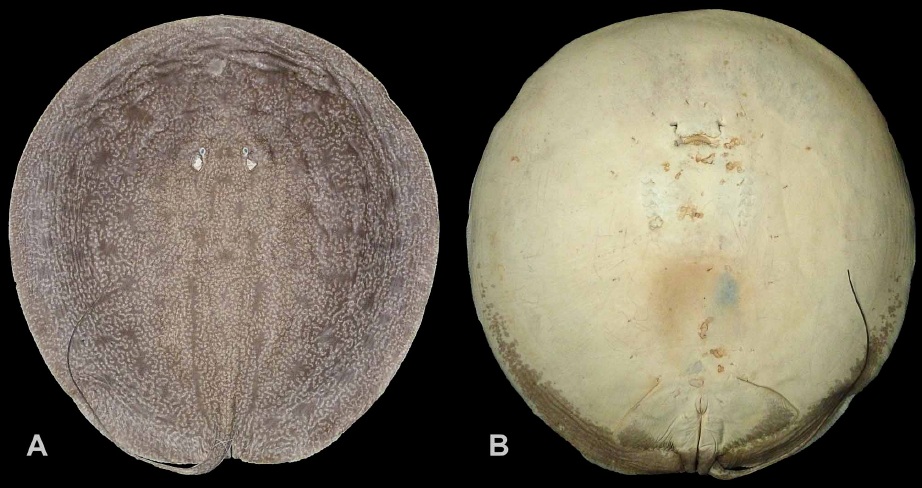
FIGURE 4. Paratype of Heliotrygon gomesi, n. sp., in dorsal (A) and ventral (B) views (ANSP 178017, preadult female, Rio Nanay, Rio Amazonas basin, 4.5 km west of Iquitos, Peru; 425 mm TL, 230 mm DL, and 224 mm DW).

Heliotrygon gomesi, n. sp.

Geographic distribution. Heliotrygon gomesi is distributed in the upper Rio Amazonas basin according to our material (Figure 10), but enters, we suspect, the lower reaches of most major tributaries and the lower Rio Amazonas basin as well. Its distribution is very similar to that of Plesiotrygon iwamae (Rosa et al., 1987; Carvalho et al., 2003).

Etymology. This new species honors Ulisses L. Gomes, a pioneer in the study of elasmobranch morphology and systematics in Brazil, and an esteemed colleague and collaborator of the first author.

Proposed common name. Gomes’s Round Ray (also referred to as "china" ray in the aquarium trade).

FIGURE 11. Holotype of Heliotrygon rosai, n. sp., in dorsal (A) and ventral (B) views (MZUSP 104996, adult male, Baía de Marajó, Pará state, Brazil; 984 mm TL, 604 mm DL, 577 mm DW).


Heliotrygon rosai, n. sp. 

Geographic distribution. Heliotrygon rosai is known from the upper, mid and lower Rio Amazonas basin, and probably also enters, we believe, the lower reaches of its major tributaries (Figure 17). As with H. gomesi, its distribution is similar to that of Plesiotrygon iwamae (Rosa et al., 1987; Carvalho et al., 2003).

Etymology. This new species is named after Ricardo S. Rosa, whose excellent revision of potamotrygonids (Rosa, 1985a) represents a landmark in our understanding of the taxonomy and diversity of this family. 

Proposed common name. Rosa’s Round Ray (also referred to as "coly" ray in the aquarium trade). 


Marcelo R. de Carvalho and Nathan R. Lovejoy. 2011. Morphology and Phylogenetic Relationships of A Remarkable New Genus and Two New Species of Neotropical Freshwater Stingrays from the Amazon Basin (Chondrichthyes: Potamotrygonidae). Zootaxa. 2776: 13–48. 

Pictures: Odd Stingless Stingrays Discovered in Amazon http://on.natgeo.com/1E1lYEw via @NatGeo

[Ichthyology • 2010] Plesiotrygon nana • An Unusual, Dwarf New Species of Neotropical Freshwater Stingray (Chondrichthyes: Potamotrygonidae) from the Upper and Mid Amazon Basin: The Second Species of Plesiotrygon


FIGURE 10: Small, free-living specimen of Plesiotrygon nana sp. nov. MZUSP 57642, juvenile or preadult female 912 mm TL, 124 mm DL, 118 mm DW. Characters that allow it to be identified as P. nana include its dorsal color pattern, dark purplish-brown caudal whip, proportionally smaller spiracles and nasoral region, and ventral lateral-line canals.
Photo: M. Toledo-Piza. | DOI: 10.1590/S0031-10492011000700001

ABSTRACT

A new species of the relatively poorly known Neotropical freshwater stingray genus Plesiotrygon Rosa, Castello & Thorson, 1987 is described from the main channel and smaller tributaries (Ríos Itaya and Pachitea) of the upper Amazon basin in Peru. The first specimen to be collected, however, was from much farther east in Rio Solimões in 1996, just down-river from Rio Purus (specimen unavailable for this study). Plesiotrygon nana sp. nov., is a very distinctive and unusually small species of freshwater stingray (Potamotrygonidae), described here mostly from three specimens representing different size classes and stages of sexual maturity. Plesiotrygon nana sp. nov., is distinguished from its only congener, P. iwamae Rosa, Castello & Thorson, 1987, by numerous unique features, including: dorsal coloration composed of very fine rosettes or a combination of spots and irregular ocelli; very circular disc and snout; very small and less rhomboidal spiracles; short snout and anterior disc region; narrow mouth and nostrils; denticles on dorsal tail small, scattered, not forming row of enlarged spines; adult and preadult specimens with significantly fewer tooth rows; fewer caudal vertebrae; higher total pectoral radials; very small size, probably not surpassing 250 mm disc length or width, males maturing sexually at around 180 mm disc length and 175 mm disc width; distal coloration of tail posterior to caudal stings usually dark purplish-brown; and features of the ventral lateral-line canals (hyomandibular canal very narrow, infraorbital and supraorbital canals not undulated, supraorbital and infraorbital loops small and narrow, supraorbital loop very short, not extending posteriorly to level of mouth, jugular and posterior infraorbital canals short, not extending caudally to first gill slits, subpleural loop very narrow posteriorly; absence of anterior and posterior subpleural tubules). To provide a foundation for the description of P. nana sp. nov., morphological variation in P. iwamae was examined based on all type specimens as well as newly collected and previously unreported material. Two specimens topotypic with the male paratype of P. nana sp. nov., referred to here as Plesiotrygon cf. iwamae, are also reported. Relationships of the new species to P. iwamae are discussed; further characters indicative of Plesiotrygon monophyly are proposed, but the genus may still not be valid. Plesiotrygon nana sp. nov., is commercialized with some regularity in the international aquarium trade from Iquitos (Peru), an alarming circumstance because nothing is known of its biology or conservation requirements.

Key-Words: Plesiotrygon iwamae; Taxonomy; Morphology; Myliobatiformes; Rio Solimões; Río Ucayali; South America.


Etymology: The specific epithet nana is in reference to its dwarf size (from the Latin nanus). Gender feminine.

Common name: Dwarf Antenna Ray (as in aquarium literature; also known as "black-tailed" antenna ray).

Geographic distribution: As far as is known, Plesiotrygon nana occurs in the upper Río Amazonas basin of Peru, both in smaller tributaries and in the main Río Amazonas channel, and in the lower course of Rio Solimões in Brazil, just down-river from the mouth of Rio Purus (MZUSP 57642). The small female paratype is from Río Itaya, a small tributary of Río Nanay (near Iquitos). The male paratype was collected in Río Amazonas slightly farther south, near Tamshiyacu, and the holotype was found in Río Pachitea, a triburay of Río Ucayali near Puerto Inca (Figure 16). This species may be expected to occur in Río Napo and other regions of the upper Río Amazonas inhabited by P. iwamae. Plesiotrygon nana is not restricted to the main Amazonas channel as previously thought (accounts from the aquarium fish trade conflict).


Marcelo R. de Carvalho and Maíra Ragno. 2010. An Unusual, Dwarf New Species of Neotropical Freshwater Stingray, Plesiotrygon nana sp. nov., from the Upper and Mid Amazon Basin: The Second Species of Plesiotrygon (Chondrichthyes: Potamotrygonidae). Papéis Avulsos de Zoologia (São Paulo). 51(7):101-138. DOI: 10.1590/S0031-10492011000700001