Tuesday, January 30, 2024

[Mammalogy • 2024] Ecological Modeling, Biogeography, and Phenotypic Analyses setting the Tiger Cats’ Hyperdimensional Niches reveal A New Species, Leopardus pardinoides


Classic examples of the tiger cat species complex:
 (a) the savanna tiger-cat (Leopardus tigrinus);
(b) the new species, the clouded tiger-cat (Leopardus pardinoides); and
(c) the Atlantic Forest tiger-cat (Leopardus guttulus).

in de Oliveira, Fox-Rosales, Ramírez-Fernández, Cepeda-Duque, Zug, ... et Rodrigues, 2024.   
Drawings by Ricardo Ribeiro; 
photographs: (a & c) authors, (b) Johannes Pfleiderer.

Abstract
Recently, the tiger-cat species complex was split into Leopardus tigrinus and Leopardus guttulus, along with other proposed schemes. We performed a detailed analysis integrating ecological modeling, biogeography, and phenotype of the four originally recognized subspecies—tigrinus, oncilla, pardinoides, guttulus—and presented a new multidimensional niche depiction of the species. Species distribution models used > 1400 records from museums and photographs, all checked for species accuracy. Morphological data were obtained from institutional/personal archives. Spotting patterns were established by integrating museum and photographic/camera-trap records. Principal component analysis showed three clearly distinct groups, with the Central American specimens (oncilla) clustering entirely within those of the Andes, namely the pardinoides group of the cloud forests of the southern Central-American and Andean mountain chains (clouded tiger-cat); the tigrinus group of the savannas of the Guiana Shield and central/northeastern Brazil (savanna tiger-cat); and the guttulus group in the lowland forests of the Atlantic Forest domain (Atlantic Forest tiger-cat). This scheme is supported by recent genetic analyses. All species displayed different spotting patterns, with some significant differences in body measurements/proportions. The new distribution presented alarming reductions from the historic range of − 50.4% to − 68.2%. This multidimensional approach revealed a new species of the elusive and threatened tiger-cat complex.

Classic examples of the tiger cat species complex: (a) the savanna tiger-cat (Leopardus tigrinus); (b) the new species, the clouded tiger-cat (Leopardus pardinoides); and (c) the Atlantic Forest tiger-cat (Leopardus guttulus).
Drawings by Ricardo Ribeiro; photographs: (a) authors, (b) Johannes Pfleiderer, (c) authors.

Leopardus pardinoides (Gray, 1867)


Tadeu G. de Oliveira, Lester A. Fox-Rosales, José D. Ramírez-Fernández, Juan C. Cepeda-Duque, Rebecca Zug, Catalina Sanchez-Lalinde, Marcelo J. R. Oliveira, Paulo H. D. Marinho, Alejandra Bonilla-Sánchez, Mara C. Marques, Katia Cassaro, Ricardo Moreno, Damián Rumiz, Felipe B. Peters, Josué Ortega, Gitana Cavalcanti, Michael S. Mooring, Steven R. Blankenship, Esteban Brenes-Mora, Douglas Dias, Fábio D. Mazim, Eduardo Eizirik, Jaime L. Diehl, Rosane V. Marques, …Flávio H. G. Rodrigues. 2024. Ecological Modeling, Biogeography, and Phenotypic Analyses setting the Tiger Cats’ Hyperdimensional Niches reveal A New Species. Scientific Reports. 14: 2395. DOI: 10.1038/s41598-024-52379-8
  twitter.com/ruzzibarbara/status/1752111872285835713

[Invertebrate • 2024] Alloscopus arborealis • A New canopy-dwelling Species of the Genus Alloscopus Börner (Collembola: Orchesellidae: Heteromurinae) from Mt. Makiling, Philippines


Alloscopus arborealis
Alviola, Lucañas, Lit,  Soto-Adames & Jantarit, 2024


Abstract
A new species of Alloscopus Börner, 1906 (Orchesellidae: Heteromurinae), A. arborealis sp. nov., is herein described from Mt. Makiling, Laguna, Philippines. The new species is distinct from its blind congeners by the combination of: 7+7 macrochaetae on head ‘An’ series and 1+1 on ‘M’ series; 13+13 macrochaetae on thorax II (vs. 9–12) and 7+7 central on thorax III (vs. 6+6); absence of the microsensilla on abdomen I; abdomen IV with four sensilla (vs. three); and ventral tube with a small number of chaetae on its posterior face (4–5 vs. 11–23) and lateral flap (7 vs. 9–16). The complete body chaetotaxic pattern of the new species and a revised key to the world fauna of Alloscopus are also provided.

Collembola, chaetotaxy, Luzon Island, springtails, taxonomy


Alloscopus arborealis sp. nov.


Marnelli S. Alviola, Cristian C. Lucañas, Ireneo L. Lit Jr.,  Felipe N. Soto-Adames and Sopark Jantarit. 2024. A New canopy-dwelling Species of the Genus Alloscopus Börner (Collembola: Orchesellidae: Heteromurinae) from Mt. Makiling, Philippines.  Zootaxa. 5405(2); 281-295. DOI: 10.11646/zootaxa.5405.2.8 
 facebook.com/AimeeLynn1804/posts/10233343588070095


[Botany • 2024] Indigofera abbottii, I. ngwenyana, etc. (Fabaceae: Papilionoideae: Indigofereae) • New and poorly known Taxa of Indigofera from the Pondoland Centre of Endemism, South Africa: Part 2


Indigofera abbottii Schrire & K.W.Grieve,

in K. W. Grieve, G. R.H. Grieve et Schrire, 2024.

 Highlights: 
• Taxonomic description of new and little known Indigofera species from South Africa.
• Four new Indigofera species, one new variety and two little known species are described.
• One established taxon is raised to specific status and described with a new name.
• An earlier name is found which has priority over an established species name.
• All taxa are associated with the Pondoland Centre of Endemism, ranging to surrounding floristic areas.

Abstract
This second paper describes and clarifies new and poorly known Indigofera species, belonging to sect. Pinnatae (E.Mey.) Harv., from the Pondoland Centre of Endemism and associated neighbouring areas in the Eastern Cape and KwaZulu-Natal provinces, South Africa. Five new species (one with two infraspecific taxa) are recognized: Indigofera abbottii Schrire and K.W.Grieve, I. hillburttii Schrire and K.W.Grieve, I. tysonii Schrire and K.W.Grieve, I. herrstreyi Schrire and K.W.Grieve var. herrstreyi and I. herrstreyi var. helodes K.W.Grieve and Schrire, and I. ngwenyana Schrire and K.W.Grieve. Descriptions are provided for the poorly known I. corniculata E.Mey. and I. gerrardiana Harv., taxa rarely taken up in the literature and both having been mostly synonymised under I. dregeana E.Mey. that occurs outside the area of the present study. The name I. tenuissima E.Mey. was found to be the earliest, correct, name for the widespread species I. longipes N.E.Br. ex Baker f., leaving the coastal Zululand taxon – currently named I. tenuissima E.Mey. – requiring further evaluation.


 Kate W. Grieve, Graham R.H. Grieve and Brian D. Schrire. 2024. New and poorly known Taxa of Indigofera (Fabaceae, Papilionoideae, Indigofereae) from the Pondoland Centre of Endemism, South Africa: Part 2. South African Journal of Botany. 164; 297-321. DOI: 10.1016/j.sajb.2023.11.027
 
Kew’s top 10 new species of 2023
Kew’s scientists and international partners share their 10 favourite new species named to science in 2023.

[Botany • 2020] Primulina titan (Gesneriaceae) • A New Species from Limestone Areas in Guangxi, China


Primulina titan Z.B. Xin, W.C. Chou & F. Wen,

in Xin, Fu, Huang, Chou, Huang et Wen, 2020. 

Abstract
A new species of Gesneriaceae, Primulina titan, is described and photographed from northern Guangxi, China. It resembles P. hunanensis, but can be distinguished by combined morphological characters of leaf, bract, corolla, stamen and pistil. We found only one population with approx. 800 mature individuals at the type locality. This species is provisionally assessed as vulnerable [VU D1] using IUCN criteria.

Keywords: Flora of Guangxi, Limestone flora, Lithophytic, New taxon, Taxonomy

 Primulina titan Z.B. Xin, W.C. Chou & F. Wen,
A: Habitat. B: Habit with flowers. C: Leaf and the axillary cyme. D: Cyme. E: Bracts. F: Lateral view of the corolla. G: Top view of the corolla. H: Front view of the corolla. I: Pistil and Calyx. J: Calyx lobes. K: Opened corolla
(Photographed by Z.B. Xin) 
 
Primulina titan Z.B. Xin, W.C. Chou & F. Wen, sp. nov.

Diagnosis: Primulina titan differs from P. hunanensis by its leaf blade glabrous (vs. covered with straight, pointed, white trichomes), petiole 1.2-2.5 cm in diam. (vs. 0.4-1.0 cm); bract pale green inside, margin obviously numerous serrate, sparsely pubescent outside, glabrous inside (vs. pink or purple-red inside, margin entire or repand, densely trichomes and pubescent outside, sparsely trichomes and pubescent inside); corolla white outside, with red-purple and brown stripes and spots inside ( vs. purple, with white stripes at corolla mouth); filament yellow, 1.5-1.7 cm long(vs. white, 0.8-1.2 cm); anther 7-8 mm long (vs. 3.5-4.5mm); pistil pale green, 4.2-5.0 cm long (vs. pale pink, 2.6-3.8 cm). 


Zibing Xin, Longfei Fu, Zhangjie Huang, Wei-Chuen Chou, Yi Huang and Fang Wen. 2020. Primulina titan (Gesneriaceae), A New Species from Limestone Areas in Guangxi, China. Journal of Botanical Research. 2(3); 1–5. DOI: 10.30564/jrb.v2i3.1994  

Monday, January 29, 2024

[Ornithology • 2023] Catharus arcanus, C. fuscater, C. mirabilis, etc. • Integrative Taxonomy reveals Hidden Diversity in the Catharus fuscater (Passeriformes: Turdidae) complex in Central and South America


 Darién Nightingale-thrush Catharus arcanus
 Halley, Catanach, Klicka & Weckstein, 2023
 

Abstract
We assembled datasets of genetic (genomic ultraconserved elements [UCEs], mtDNA) and phenotypic (morphology, voice) characters to address species limits and taxonomy in the slaty-backed nightingale-thrush Catharus fuscater (Passeriformes: Turdidae), a polytypic complex of songbirds with a broad montane distribution in Central and South America. We identified 10 allopatric populations that have been evolving independently for multiple glacial cycles. Genetic structure is broadly correlated with divergence in phenotypic characters, including plumage colour, iris colour, maxilla (bill) colour, and the acoustic structure of vocalizations (calls and songs). We propose an integrative taxonomic revision that recognizes seven species in the complex, including a newly described species from eastern Panama, and four subspecies, of which two are newly described.

phylogenetics, Neotropics, nightingale-thrush, systematics


 ... taxonomic revision splits the C. [fuscater] complex into 7 species, of which 1 is newly described, and 4 subspecies, of which 2 are newly described. We also proposed new English names for each species. They are …

1. Talamanca Nightingale-thrush (Catharus hellmayri) 
– monotypic – 
Northern mountains of Costa Rica (Rincón de la Vieja, Miravalles, Tenorio) to west-central Panama (Parque Nacional Santa Fé, Veraguas). 


2. Darién Nightingale-thrush (Catharus arcanus, sp. nov.) 
– monotypic –
 E Panama, endemic to Serranía de Majé and Serranía del Darién, from Cerro Azul in the west, to Cerro Tacarcuna in the east 


3. Pirre Nightingale-thrush (Catharus mirabilis) 
– monotypic –
 Endemic to Cerro Pirre, Darién province, E Panama 
(Photo: ML 242929041) 


4. Cordilleran Nightingale-thrush (Catharus fuscater) 
– polytypic –
 (1) C. f. sanctaemartae, endemic to Sierra Nevada de Santa Marta, NE Colombia; 
(2) C. f. fuscater, Sierra de Perijá of Venezuela, N and E Andes of Colombia and Venezuela. 
(Photo: ML 206115721) 

5. Trans-Andean Nightingale-thrush (Catharus berlepschi) 
– polytypic –
 (1) C. b. berlepschi, W Andes in Ecuador; 
(2) C. b. caniceps, W Andes in Ecuador, S to NW Peru; 
(3) C. b. nebulus, ssp. nov., E Peruvian Andes. 
(Photo: ML 38468741)


6. Antioquia Nightingale-thrush (Catharus opertaneus) 
– polytypic – 
(1) C. o. opertaneus, NW and Central Andes in Colombia, S to Napo, Ecuador; 
(2) C. o. tenebris, ssp. nov., Río Chinchipe watershed of N Peru and SE Ecuador 


7. Cochabamba Nightingale-thrush (Catharus mentalis) 
– monotypic –
 S Peru, east of the Río Apurímac, E to Santa Cruz, Bolivia


Matthew R. Halley, Therese A. Catanach, John Klicka and Jason D. Weckstein. 2023. Integrative Taxonomy reveals Hidden Diversity in the Catharus fuscater (Passeriformes: Turdidae) complex in Central and South America. Zoological Journal of the Linnean Society. 199(1); 228–262. DOI: 10.1093/zoolinnean/zlad031


[Herpetology • 2024] Pareas guanyinshanensis • A New Species of the Pareas hamptoni Complex (Serpentes: Pareidae) from Yunnan, China, with Confirmation of P. hamptoni sensu stricto in China


 Pareas guanyinshanensis

Liu, Mo, M. Li, B. Li, Luo, Rao & S. Li, 2024.

Abstract
We describe a new species of the genus Pareas, based on three specimens collected from Guanyinshan Provincial Nature Reserve in Yuanyang County, Honghe Prefecture, Yunnan Province, China. The new species is distinguished from its congeners by one preocular, one postocular or postocular fused with subocular, loreal not bordering the orbit, one row enlarged vertebral scales, five rows keeled mid-dorsal scales at the middle of the body, 189–192 ventral scales and 72–89 subcaudal scales. The dorsal surfaces of the head and body are yellowish red or yellowish brown, and the belly and ventral surfaces of the head and tail are pinkish yellow or yellow with more or less small black spots. Phylogenetic analyses of mitochondrial DNA recovered the new species being the sister taxon to P. hamptoni sensu stricto. The genetic divergences between the new species and P. hamptoni sensu stricto were 4.2% in the Cyt b sequences and 5.0% in the ND4 sequences. In addition, based on specimens collected from Honghe and Wenshan prefectures, we confirmed that P. hamptoni sensu stricto is distributed in China.

Keywords: Cyt b; morphology; ND4; Pareas guanyinshanensis sp. nov.; taxonomy

Class Reptilia Laurenti, 1768
Order Squamata Oppel, 1811
Suborder Serpentes Linnaeus, 1758
Infraorder Caenophidia Hoffstetter, 1939

Family Pareidae Romer, 1956
Subfamily Pareinae Romer, 1956

Genus Pareas Wagler, 1830
Subgenus Eberhardtia Angel, 1920

Pareas guanyinshanensis sp. nov.

 Pareas guanyinshanensis sp. nov. in life.
(A) The holotype (KIZ 2023038); (B) the paratype (KIZ 2023040).

 
Diagnosis. SVL 482–540 mm, TL/SVL 0.26–0.30; prefrontal bordering orbit; loreal not bordering orbit; 1 preocular; 1 postocular or postocular fused with subocular; 7–8 supralabials; 6–8 infralabials; infralabial not fused with chin-shield; 3 chin-shield pairs; dorsal scales in 15 rows throughout; 1 row of vertebral scales enlarged; scales not keeled at anterior part of body, 5 rows of mid-dorsal scales keeled at middle part of body, 5–7 rows of mid-dorsal scales keeled at posterior part of body; ventral scales 189–192; subcaudals 72–89, paired; precloacal plate undivided; maxillary teeth 4–5. Dorsal surface of head dark yellowish red or yellowish brown, with dense small black spots; dorsal surface of body yellowish red or yellowish brown; belly and ventral surfaces of head and tail pinkish yellow or yellow, with more or less small black spots; iris reddish yellow or yellow.

Etymology. The specific epithet guanyinshanensis refers to Guanyinshan Provincial Nature Reserve [Yuanyang County, Honghe Prefecture, Yunnan Prov.], where the new species was found. 


Shuo Liu, Mingzhong Mo, Mei Li, Biao Li, Xiong Luo, Dingqi Rao and Song Li. 2024. Description of A New Species of the Pareas hamptoni Complex from Yunnan, China, with Confirmation of P. hamptoni Sensu Stricto in China (Squamata, Pareidae). Animals. 2024, 14(3), 421. DOI: 10.3390/ani14030421  

Simple Summary: In this paper, a new Pareas species of the P. hamptoni complex is described from southern Yunnan Province, China, based on morphological and molecular evidence. Genetically, the new species is most closely related to P. hamptoni sensu stricto, for which we confirm the distribution in China. Morphologically, the new species can be distinguished from P. hamptoni sensu stricto and all other congeners by a combination of morphological characteristics. The discovery of the new species brings the total number of recognized species of the genus Pareas to 31, of which 25 occur in China.

[Crustacea • 2024] Booralana nickorum • A New Species of Deep-sea Booralana Bruce, 1986 (Isopoda: Cirolanidae) from The Bahamas, Western North Atlantic


Booralana nickorum
in Shipley, Bruce, Higgs, Rawlins, Irschick, Gutierrez, ... et Brooks, 2024. 

 
Abstract
Booralana nickorum sp. nov. is described from the deep-water slope of the Exuma Sound, The Bahamas, from depths of 540 to 560 metres. It is the fourth species to be assigned to the genus and the second species described from the Western North Atlantic. The species can be distinguished from Booralana tricarinata Camp and Heard, 1988 and the other species by the sub-triangular pleotelson and the uropodal exopod of mature males being far longer than endopod, with both rami extending well beyond the posterior margin of the pleotelson. Additionally, pleopods 3 and 4 lack a prominent angle at midpoint of ramus.

Northeast Exuma Sound, Crustacea, Isopoda, Booralana, Atlantic Ocean


Booralana nickorum sp. nov. 


Oliver N. Shipley, Niel L. Bruce, Nicholas D. Higgs, Scott Rawlins, Duncan J. Irschick, Robert Gutierrez, Joshua K. Moyer, Mackellar Violich, Brendan S. Talwar, Eric V.C. Schneider, Nathan J. Robinson and Edward J. Brooks. 2024. A New Species of Deep-sea Booralana Bruce, 1986 (Crustacea: Isopoda: Cirolanidae) from The Bahamas, Western North Atlantic. Zootaxa. 5399(3); 254-264. DOI: 10.11646/zootaxa.5399.3.4

New Crustacean Discovered in Deep Waters of Bahamas
The finding may help scientists better understand the vast biodiversity of the sea
news.stonybrook.edu/university/new-crustacean-discovered-in-deep-waters-of-bahamas/

Sunday, January 28, 2024

[Entomology • 2024] Lasioglossum iridescens, L. dilisena & L. silveirai • A Problematic Species Complex of Lasioglossum Subgeneric Diagnostics in North America (Hymenoptera: Halictidae)


Lasioglossum (Sphecodogastra) dilisena
 Hettiarachchi & Gibbs, 2024

 
Abstract
A problematic species complex within Lasioglossum subgenus Sphecodogastra with unusual metallic reflections on the mesosoma is described from North America. Three new species in this complex are described and illustrated: Lasioglossum (Sphecodogastra) iridescens sp. nov., Lasioglossum (Sphecodogastra) dilisena sp. nov., and Lasioglossum (Sphecodogastra) silveirai sp. nov. Our study addresses the challenge of diagnosing Lasioglossum subgenera within North America. We present an updated key for the North American Lasioglossum subgenera.

Key words: Apoidea, classification, cryptic species, new species, taxonomy


Lasioglossum (Sphecodogastra) iridescens sp. nov. 

Etymology. The specific epithet refers to the iridescent colouration of the new species.


Lasioglossum (Sphecodogastra) dilisena sp. nov. , ♀, holotype.
A. Dorsal habitus. b. Face. C. Lateral habitus. D.Metasoma.
Scale bars = 1 mm.

Lasioglossum (Sphecodogastra) dilisena sp. nov. 

Etymology. The specific epithet ‘dilisena’ is derived from the Sinhala word ‘dilisena’ දිලිසෙන, which means ‘shining’, but is used here as a noun in apposition. This name was chosen because all three species described in this paper have an unusual metallic reflection on the mesosoma that is not seen in other known North American species in the subgenus Sphecodogastra. The first author is also a native speaker of Sinhala from Sri Lanka. Sinhala language is one of the official and national languages of Sri Lanka and the mother tongue of the majority people of Sri Lanka. Through this naming choice, we hope to honour all the linguistic and cultural diversity of the world.

 
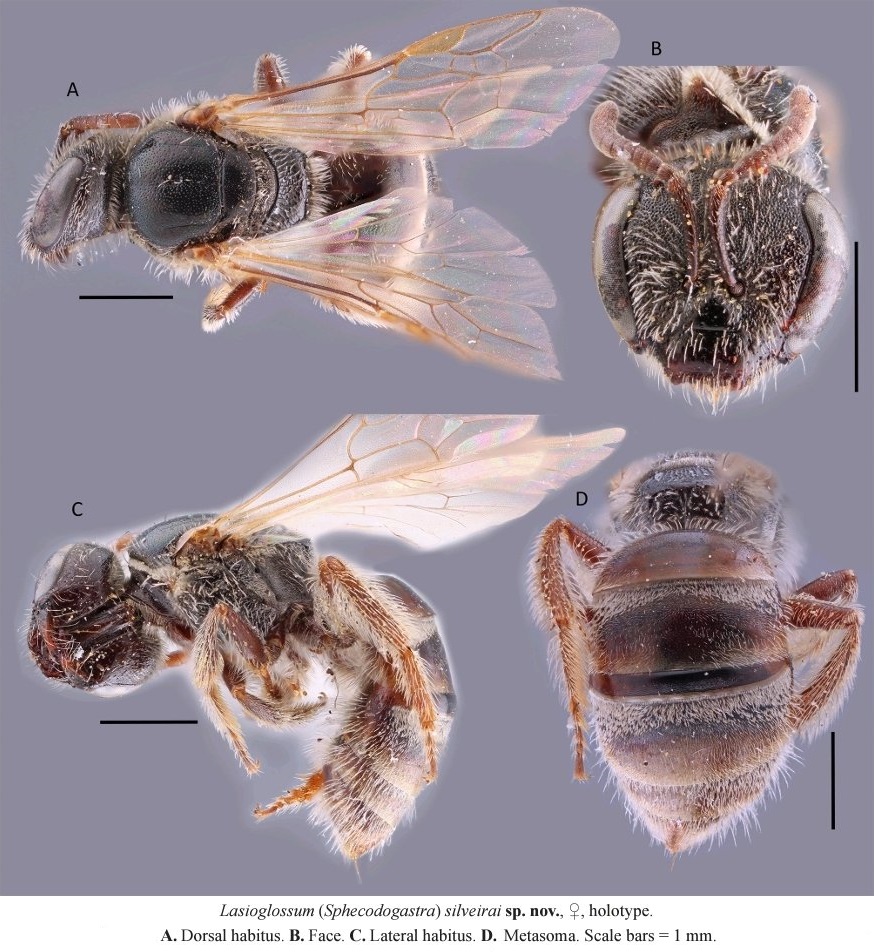
Lasioglossum (Sphecodogastra) silveirai sp. nov., ♀, holotype.
A. Dorsal habitus. b. Face. C. Lateral habitus. D. Metasoma.
Scale bars = 1 mm.

Lasioglossum (Sphecodogastra) silveirai sp. nov.

Etymology. This species is named in honour of the late Fernando Silveira (Universidade Federal de Minas Gerais) for his contributions to bee taxonomy and his warm, jovial spirit, which made it a delight to attend international conferences on pollinators.

  
Thilina Hettiarachchi and Jason Gibbs. 2024. A Problematic Species Complex of Lasioglossum Subgeneric Diagnostics in North America (Hymenoptera: Halictidae). Zootaxa. 5404(1); 206-235. DOI: 10.11646/zootaxa.5404.1.13

[Diplopoda • 2023] Acanthophorella aurita, A. devi & A. valerii • Review of the Genus Acanthophorella Antić & Makarov, 2016 (Chordeumatida: Anthroleucosomatidae), with descriptions of three New Species from the Caucasus


Troglobiotic members of the genus Acanthophorella Antić & Makarov, 2016 in situ.
A–B. Acanthophorella barjadzei Antić & Makarov, 2016, ♂ from Nikortsminda Sakinule Cave. C–D. Acanthophorella barjadzei Antić & Makarov, 2016, ♂ from Muradi Cave.
E–F. Acanthophorella devi Antić sp. nov., types, ♂. G–H. Acanthophorella valerii Antić sp. nov., holotype, ♂ (NHMW MY10366).

in Antić, Šević, Barjadze & Makarov, 2023. 
Photos by Dragan Antić.

ABSTRACT
The present paper is devoted to the description of three new species of the genus Acanthophorella Antić & Makarov, 2016 from Georgia, western Caucasus: A. devi Antić sp. nov. and A. valerii Antić sp. nov., both presumed troglobionts and each from a single cave, and the epigean A. aurita Antić sp. nov. The troglobiotic Acanthophorella barjadzei Antić & Makarov, 2016 is reported from two additional caves, with further descriptive notes given. Notes on the ecology and localities, and a distribution map for all six species of the genus are presented. A key is given to all members of the Flagellophorella complex. The relationships within the complex and the distribution and troglomorphism in the genus Acanthophorella are briefly discussed.

Keywords: caves, Georgia, Flagellophorella complex, millipedes, taxonomy

Troglobiotic members of the genus Acanthophorella Antić & Makarov, 2016 in situ.
 A–B. Acanthophorella barjadzei Antić & Makarov, 2016, ♂ from Nikortsminda Sakinule Cave. C–D. Acanthophorella barjadzei Antić & Makarov, 2016, ♂ from Muradi Cave.
E–F. Acanthophorella devi Antić sp. nov., types, ♂♂.
G–H. Acanthophorella valerii Antić sp. nov., holotype, ♂ (NHMW MY10366).
Photos by Dragan Antić.


Dragan Antić, Mirko Šević, Shalva Barjadze and Slobodan Makarov. 2023. Review of the Genus Acanthophorella Antić & Makarov, 2016 (Diplopoda, Chordeumatida, Anthroleucosomatidae), with descriptions of three New Species from the Caucasus. European Journal of Taxonomy. 908(1), 39–76. DOI: 10.5852/ejt.2023.908.2337


[Arachnida • 2024] Taczanowskia yasuni • A New enigmatic Species of Spider (Araneae: Araneidae) from the Ecuadorian Amazon Canopy


Taczanowskia yasuni
Díaz-Guevara, Macías-Tulcán & Galvis, 2024 


David R. Díaz-Guevara, Mauricio Macías-Tulcán, William Galvis. 2024. Taczanowskia yasuni new species: A New enigmatic Species of Spider (Araneidae) from the Ecuadorian Amazon canopy.  Zootaxa. 5397(2); 295-300. DOI: 10.11646/zootaxa.5397.2.11

[Arachnida • 2024] Spinirta liuae, S. simianshan, etc. • Six Species of the Spider Genus Spinirta Jin & Zhang, 2020 (Araneae: Corinnidae) from southern China


A–B. Spinirta aviforma Jin & Zhang, 2020 (A, male; B, female).
C–D. S. liuae Wang, Lu & Z.S. Zhang sp. nov. (C, male; D, female).
E–F. S. quadrata Jin & Zhang, 2020 (E, male; F, female).

in Wang, Irfan, Lu, F. Zhang et Z.-S. Zhang, 2024. 
(A–C, E–F photo by Qian-Le Lu, D photo by Jia Liu).

ABSTRACT
In the current study, six species of the genus Spinirta from southern China are recognized, four new species are described: S. hongyui Wang, Lu & Z.S. Zhang sp. nov. (♂♀), S. liuae Wang, Lu & Z.S. Zhang sp. nov. (♂♀), S. simianshan Wang, Lu & Z.S. Zhang sp. nov. (♂♀) and S. yintiaoling Wang, Lu & Z.S. Zhang sp. nov. (♂). Females of S. aviforma Jin & Zhang, 2020 (♂♀) and S. quadrata Jin & Zhang, 2020 (♂♀) are described for the first time. Photos of the body and copulatory organs, as well as the locality map are provided.

Keywords: description, morphology, new species, re-descripction, taxonomy

Photos of living specimens of Spinirta Jin & Zhang, 2020.
A–B. Spinirta aviforma Jin & Zhang, 2020 (A, male; B, female).
C–D. S. liuae Wang, Lu & Z.S. Zhang sp. nov. (C, male; D, female).
E–F. S. quadrata Jin & Zhang, 2020 (E, male; F, female).
(A–C, E–F photo by Qian-Le Lu, D photo by Jia Liu).


Lu-Yu Wang, Muhammad Irfan, Qian-Le Lu, Feng Zhang and Zhi-Sheng Zhang. 2024. Six Species of the Spider Genus Spinirta Jin & Zhang, 2020 from southern China (Araneae: Corinnidae). European Journal of Taxonomy. 917(1); 74–93. DOI: 10.5852/ejt.2024.917.2389
 

[Botany • 2024] Helicteres ubonensis (Malvaceae) • A New Species from Thailand


Helicteres ubonensis Chantar. & Kantachot, 

in Kantachot et Chantaranothai, 2024. 
  
Abstract 
A new species, Helicteres ubonensis from Thailand, is described and illustrated. The new key to 12 species of Thai Helicteres is provided.

Keywords: Helicteroideae; Ubon Ratchathani; identification key; new species

Helicteres ubonensis Chantar. & Kantachot.
a. Leaves and capsules; b. lower surface of leaf with stellate hairs (black dots); c. flower; d. seeds (a, b, d: P. Chantaranothai et al. 2021-150, c: C. Kantachot 2020-32, all KKU).
— Drawing by Puntiwa Krachai, 2023

 Helicteres ubonensis Chantar. & Kantachot.
a. Habitat; b. twigs and leaves; c, d. capsule.
 — Photos: Chortip Kantachot

Helicteres ubonensis Chantar. & Kantachot, sp. nov. 

Typical of this species are narrowly elliptic-oblong leaves. Corolla purplish white or pinkish. Capsule pointed as beak at the apex and surface covering with stellate hairs.
 
Etymology. The specific epithet refers to the collections from Ubon Ratchathani province where the species was discovered. 


Chortip Kantachot and Pranom Chantaranothai. 2024. Helicteres ubonensis (Malvaceae), A New Species from Thailand. Blumea - Biodiversity, Evolution and Biogeography of Plants. DOI: 10.3767/blumea.2024.69.01.02


Saturday, January 27, 2024

[PaleoEntomology • 2024] Eunotalia emeryi, Cretotettigarcta shcherbakovi & Pranwanna xiai • Mesozoic Evolution of Cicadas and their Origins of Vocalization and Root Feeding


Life reconstruction of cicadas in a Mesozoic Forest. 
Eunotalia emeryi gen. et sp. nov.
Cretotettigarcta shcherbakovi 
sp. nov.
Pranwanna xiai gen. et sp. nov.

 Jiang, Szwedo, Labandeira, Chen, Moulds, Mähler, Muscente, Zhuo, Nyunt, Zhang, Wei, Rust & Wang, 2024
 Reconstructed by Mr. Dinghua Yang

Abstract
Extant cicada (Hemiptera: Cicadoidea) includes widely distributed Cicadidae and relictual Tettigarctidae, with fossils ascribed to these two groups based on several distinct, minimally varying morphological differences that define their extant counterparts. However, directly assigning Mesozoic fossils to modern taxa may overlook the role of unique and transitional features provided by fossils in tracking their early evolutionary paths. Here, based on adult and nymphal fossils from mid-Cretaceous Kachin amber of Myanmar, we explore the phylogenetic relationships and morphological disparities of fossil and extant cicadoids. Our results suggest that Cicadidae and Tettigarctidae might have diverged at or by the Middle Jurassic, with morphological evolution possibly shaped by host plant changes. The discovery of tymbal structures and anatomical analysis of adult fossils indicate that mid-Cretaceous cicadas were silent as modern Tettigarctidae or could have produced faint tymbal-related sounds. The discovery of final-instar nymphal and exuviae cicadoid fossils with fossorial forelegs and piercing-sucking mouthparts indicates that they had most likely adopted a subterranean lifestyle by the mid-Cretaceous, occupying the ecological niche of underground feeding on root. Our study traces the morphological, behavioral, and ecological evolution of Cicadoidea from the Mesozoic, emphasizing their adaptive traits and interactions with their living environments.

Adults, final instar nymph, and exuviae of Cicadoidea fossils in Kachin amber of northern Myanmar.
 a Eunotalia emeryi gen. et sp. nov. (MGM2016–014). This image was published in the study by ref. 41 (Fig. 3a). b Cretotettigarcta problematica comb. nov. (new material: NIGP201895). c Cretotettigarcta shcherbakovi sp. nov. (NIGP201896). d Vetuprosbole parallelica (new material: NIGP201897).
e–i Pranwanna xiai gen. et sp. nov. (LYU–BC2001, male; LYU–BC2002, female). e Dorsal view of male. f Dorsal view of female. g Ventral view of male. h Ventral view of female. i Left view of final-instar nymph, Cicadoidea species 1 (NIGP2018985).
j–m Final- nymphal exuviae. j Nymphal sp. 2 (MGM2016–017), left view. k Nymphal sp. 3 (LYU–BC2004), right view. l Nymphal sp. 4 (NIGP201900), ventral view. m Nymphal sp. 5 (NIGP201901), left view.

Stem cicadoids
Eunotalia gen. nov.
  Eunotalia emeryi sp. nov.  

Etymology: The generic name is a compound form, from Classical Greek prefix: eu-, meaning ‘true’ or ‘good’, and notos, meaning ‘back’ or ‘dorsum’.

Stem cicadids
Cretotettigarcta

Cretotettigarcta problematica comb. nov.
Cretotettigarcta shcherbakovi sp. nov.

Pranwanna gen. nov 
 Pranwanna xiai sp. nov.

Etymology: The generic name, pranwanna, is from the Jingpho language spoken in Kachin State of Myanmar, meaning ‘primitive’.


Hui Jiang, Jacek Szwedo, Conrad C. Labandeira, Jun Chen, Maxwell S. Moulds, Bastian Mähler, A. Drew Muscente, De Zhuo, Thet Tin Nyunt, Haichun Zhang, Cong Wei, Jes Rust and Bo Wang. 2024. Mesozoic Evolution of Cicadas and their Origins of Vocalization and Root Feeding. Nature Communications. 15, 376.  DOI: 10.1038/s41467-023-44446-x