Sunday, September 23, 2012

[Paleontology • 2012] Habitat tracking, range dynamics and palaeoclimatic significance of Eurasian giant salamanders (Cryptobranchidae: Zaissanurus, Andrias) — indications for elevated Central Asian humidity during Cenozoic global warm periods


Abstract
Environmental fluctuations are a driving force in vertebrate evolution, but cryptobranchids (giant salamanders) show little morphologic change since the Jurassic. Here we analyze their fossil distribution in the Cenozoic of Eurasia and show that morphologic stasis is also maintained by stable environments, making giant salamanders an ideal proxy-group for environmental and palaeoclimatic studies. The climate space of recent and fossil cryptobranchids is best characterized by high humidity with mean annual precipitation values over 900 mm. The recorded patchiness of their fossil record can be explained by habitat tracking and/or range expansion from higher altitudes into lowland settings during humid periods with increased basinal relief. In Central Asia cryptobranchids are recorded from five intervals, four of them are global warm periods: Paleocene–Eocene Thermal Maximum, Late Oligocene warming, Miocene Climate Optimum, and Mio-Pliocene transition. This distribution suggests that during global warmth the Asian cold high pressure zone during winter months may be weak or absent, thus moist westerly winds penetrate far into the continent. The presence of cryptobranchids also indicates that the aridification across the Eocene–Oligocene boundary as reported from Mongolia and northwestern China, does not occur in the Zaysan Basin, probably due to increased upslope precipitation in the rising Altai Mountains

Highlights: 
► Giant Salamanders as proxy-organisms for reconstructing past humidity 
► Their climate space is characterized by high humidity with MAP values over 900 mm. 
► Cenozoic distribution suggests high Central Asian humidity during global warm periods.

Keywords: Giant salamanders, Environmental stasis, Palaeoprecipitation, Central Asia, Global warm periods


2010. The palaeoclimatic significance of Eurasian Giant Salamanders (Cryptobranchidae: Zaissanurus, Andrias) – indications for elevated humidity in Central Asia during global warm periods (Eocene, late Oligocene warming, Miocene Climate Optimum)

Böhme, M., et al. 2012. Habitat tracking, range dynamics and palaeoclimatic significance of Eurasian giant salamanders (Cryptobranchidae) — indications for elevated Central Asian humidity during Cenozoic global warm periods. Palaeogeogr. Palaeoclimatol. Palaeoecol. doi: 10.1016/j.palaeo.2012.04.032

Saturday, September 22, 2012

[Paleomammalogy • 2011] Coelodonta thibetana • Out of Tibet: Pliocene Woolly Rhino Suggests High-Plateau Origin of Ice Age Megaherbivores


Ice Age megafauna have long been known to be associated with global cooling during the Pleistocene, and their adaptations to cold environments, such as large body size, long hair, and snow-sweeping structures, are best exemplified by the woolly mammoths and woolly rhinos. These traits were assumed to have evolved as a response to the ice sheet expansion. We report a new Pliocene mammal assemblage from a high-altitude basin in the western Himalayas, including a primitive woolly rhino. These new Tibetan fossils suggest that some megaherbivores first evolved in Tibet before the beginning of the Ice Age. The cold winters in high Tibet served as a habituation ground for the megaherbivores, which became preadapted for the Ice Age, successfully expanding to the Eurasian mammoth steppe.

A, Skull and cheek teeth of Coelodonta thibetana. 
B, Origin, distribution, and dispersal of woolly rhinos in Eurasia.
(Image by DENG Tao)

 
Skull and lower jaw of the extinct Tibetan woolly rhino, Coelodonta thibetana. 
Credit: DENG Tao


A paper in Science reveals the discovery of a primitive woolly rhino fossil in the Himalayas, which suggests some giant mammals first evolved in present-day Tibet before the beginning of the Ice Age. The extinction of Ice Age giants such as woolly mammoths and rhinos, giant sloths, and saber-tooth cats has been widely studied, but much less is known about where these giants came from, and how they acquired their adaptations for living in a cold environment.

A team of geologists and paleontologists led by Xiaoming Wang from the Natural History Museum of Los Angeles County (NHM) and Qiang Li of Institute of Vertebrate Paleontology and Paleoanthropology, Chinese Academy of Sciences, uncovered a complete skull and lower jaw of a new species of woolly rhino (Coelodonta thibetana) in 2007, at the foothills of the Himalayas in southwestern Tibetan Plateau.

"Cold places, such as Tibet, Arctic, and Antarctic, are where the most unexpected discoveries will be made in the future — these are the remaining frontiers that are still largely unexplored," said the NHM's Dr. Wang.


Reconstruction of Coelodonta thibetana (Illustrated by Julie Naylor)


The new rhino is 3.6 million years old (middle Pliocene), much older and more primitive than its Ice Age (Pleistocene) descendants in the mammoth steppes across much of Europe and Asia. The extinct animal had developed special adaptations for sweeping snow using its flattened horn to reveal vegetation, a useful behavior for survival in the harsh Tibetan climate. These rhinos lived at a time when global climate was much warmer and the northern continents were free of the massive ice sheets seen in the Ice Age later.

The rhino accustomed itself to cold conditions in high elevations and became pre-adapted for the future Ice Age climate. When the Ice Age eventually arrived around 2.6 million years ago, the new paper posits, the cold-loving rhinos simply descended from the high mountains and began to expand throughout northern Asia and Europe.

In addition to the new woolly rhino, the paleontologist team also uncovered extinct species of three-toed horse (Hipparion), Tibetan bharal (Pseudois, also known as blue sheep), chiru (Pantholops, also known as Tibetan antelope), snow leopard (Uncia), badger (Meles), as well as 23 other kinds of mammals.

The team's new fossil assemblage from Tibet offers new insights into the origin of the cold-adapted Pleistocene megafauna, which has usually been sought either in the arctic tundra or in the cold steppes elsewhere. This new evidence offers an alternative scenario: the harsh winters of the rising Tibetan Plateau may have provided the initial step towards cold-adaptation for several subsequently successful members of the late Pleistocene mammoth fauna in Europe, Asia, and to a lesser extent, North America. The Tibetan Plateau may have been another cradle of the Ice Age giants.

"This discovery clarifies the origin of the woolly rhinoceros — and perhaps much of the now extinct, cold-adapted, Pleistocene Eurasian megafauna — as the high-altitude environments of the Zanda Basin of the primordial Pliocene Himalayas," said H. Richard Lane of the National Science Foundation (NSF)'s Division of Earth Sciences.


A, Phylogenetic position of Coelodonta thibetana.  


Deng, T., Wang, X., Fortelius, M., Li, Q., Wang, Y., Tseng, Z.J., Takeuchi, G.T., Saylor, J.E., Säilä, L.K. & Xie, G. 2011. Out of Tibet: Pliocene Woolly Rhino Suggests High-Plateau Origin of Ice Age Megaherbivores. Science. 6047: 1285–1288. doi:10.1126/science.1206594

Discovery: new woolly rhino species Coelodonta thibetana | Science Codex 
Out of Tibet: Ancestral Woolly Rhino Suggests Origin of Ice Age Megaherbivores in High Plateau

Wednesday, September 19, 2012

[Herpetology • 2012] “no a la mina!” Snail-eating Snake | Sibon noalamina • A new species of Sibon (Colubroidea: Dipsadidae) from the Cordillera Central of western Panama


Sibon noalamina 
Lotzkat, Hertz & Kohler 2012

Abstract

We describe Sibon noalamina sp. nov. from the Caribbean versant of the Cordillera Central, in the Comarca Ngöbe-Buglé and the province of Veraguas of western Panama. Due to its coral snake-like, bicolored pattern, the new species superficially resembles Sibon anthracops, Dipsas articulata, D. bicolor, D. temporalis, and D. viguieri. It differs from these species, and from all its congeners, by having only five supralabials, by the unique shape of the posterior supralabial, and by a slight keeling on some dorsal rows in adults. We discuss its conservation perspectives, and provide new distributional records for S. annulatus and S. longifrenis, as well as an updated key to the Lower Central American species of Sibon.

Key words: snail-eater, Dipsas, Chiriquí, Comarca Ngöbe-Buglé, Bocas del Toro, Veraguas, conservation, distribution extension, morphology

Male Sibon noalamina. 
Photo © Sebastian Lotzkat

New snail-eating snake from Panama: Sibon noalamina. Non-venomous snail-eating snakes sport bright colors to mimic poisonous snakes as a defense. 
Photo © Sebastian Lotzkat

Geographic distribution.  Sibon noalamina is hitherto only known from the highlands of western Panama (Fig. 4). The two known localities lie some 125 airline km apart, roughly at either end of the easternmost uninterrupted portion of the Cordillera Central, known as Serranía de Tabasará, which is approximately delimited to the west by the Fortuna depression and has its eastern limit in the region around Santa Fé. This indicates, as a minimum, a continuous distribution of the new taxon along the Caribbean versant of the Serranía de Tabasará, at premontane elevations between 1050 and 1260 m, most of it located in the Comarca Ngöbe-Buglé.


Juvenile Sibon noalamina. 
Photo © Sebastian Lotzkat

Etymology. The specific epithet is a contraction of the exclamation “no a la mina!”, Spanish for “no to the mine”, in the sense of “no mining”. This affirmation was and is used by members of the indigenous Ngöbe communities living in the Serranía de Tabasará in the course of their protests against mining interests aiming to exploit their territory, especially around Cerro Colorado. The specific name is given in recognition and support of the Ngöbe’s struggle to protect their territory and environment, which is home to the new species described herein and many others, from profit-driven destructive interventions.


Sebastian Lotzkat, Andreas Hertz, Gunther Kohler. 2012. A new species of Sibon (Squamata: Colubroidea: Dipsadidae) from the Cordillera Central of western Panama, with comments on other species of the genus in he area. Zootaxa. 3485: 26–40. http://www.mapress.com/zootaxa/list/2012/3485.html

Scientists name new snake species to criticize mine plans in Panama (photos) http://po.st/MIXOX9 
17.09.2012 - NEU ENTDECKTE SCHLANGE SAGT „NEIN ZUM RAUBBAU!“ http://www.senckenberg.de/root/index.php?page_id=5819

Monday, September 17, 2012

[Crustacea • 2011] Gopkittisak angustus • A New Species of the Varunid Crab Genus Gopkittisak (Crustacea: Decapoda: Brachyura: Grapsoidea) from the Ryukyu Islands, Japan


Gopkittisak angustus Komai 2011

A new species of the varunid crab genus Gopkittisak Naruse and Clark, 2009, G. angustum sp. nov., is described on the basis of seven specimens from intertidal sand flats at Iriomote Island, Ryukyu Islands, Japan. It is close to its sole congener G. gallardoi (Serène and Soh, 1976), but the different shapes of the carapace and male abdomen, as well as the setal pattern of the propodus of the fourth pereopod and the coloration in life, distinguish the new taxon from G. gallardoi.

Key Words: Crustacea, Decapoda, Brachyura, Varunidae, Gopkittisak, new species, Japan.


Etymology. From the Latin angustus ( narrow), in reference to the relatively narrow carapace compared with the sole congeneric species, G. gallardoi.

Coloration in life. Carapace generally gray or beige, with scattered brown dots; chelipeds and ambulatory legs generally gray (Naruse and Clark 2009, fig. 3b).
Distribution. Known only from Iriomote Island, Yaeyama Islands, Ryukyus, and Panglao Island, Philippines; intertidal sand flats.


A New Species of the Varunid Crab Genus Gopkittisak (Crustacea: Decapoda: Brachyura: Grapsoidea) from the Ryukyu Islands

[Crustacea • 2009] Gopkittisak gallardoi new Genus • Establishment of a new genus for Asthenognathus gallardoi Serène & Soh, 1976 within Gaeticinae Davie & Ng, 2007 (Crustacea: Decapoda: Brachyura: Varunidae)


Gopkittisak n. gen. Naruse & Clark 2009

Gopkittisak gallardoi (Serène & Soh, 1976) new combination


Abstract
Recently collected Asthenognathus gallardoi Serène & Soh, 1976 from Thailand and the Philippines are examined. Asthenognathus gallardoi possesses long setae of the palp of the third maxilliped and the fused male abdominal segments that are diagnostic characters of Gaeticinae Davie & N.K. Ng, 2007. Although the species lacks the longitudinal sulcus on the anterior segments of the sternum, which is another diagnostic character of Gaeticinae, the anterior part of the sternum is gently concave. The presences of these features indicate that Asthenognathus gallardoi belongs to Gaeticinae, not Asthenognathinae Stimpson, 1858. A new genus is established for Asthenognathus gallardoi to accommodate it in Gaeticinae. 

Key words: Asthenognathus gallardoi, Varunidae, Gaeticinae, new genus, Thailand, Philippines


Family Varunidae H. Milne Edwards, 1853
Subfamily Gaeticinae Davie & N.K. Ng, 2007

Gopkittisak n. gen.
Asthenognathus — Serène & Soh, 1976: 27 (part); Jiang et al., 2007: 77 (part).

Type species: Asthenognathus gallardoi Serène & Soh, 1976, by present designation.

Etymology. The genus is named in memory of Mrs Pharadee (Gop) Uchuphab and Mr Kittisak Raksasri who perished when the Tsunami swept through the Ranong Coastal Research Station, Ranong Province, Thailand on 26 December 2004. They are both missed, but still remembered. The name is an arbitrary combination of two first names and the gender is neuter.

Coloration. The specimens from Thailand are mottled brown with two anterior white spots on the carapace (Fig. 3a), while the Philippines specimens are beige in background and brown dots (Fig. 3b).

Distribution.  Gopkittisak gallardoi was originally described from Andaman Sea, Thailand (Serène & Soh, 1976). They also recoded it from Nhatrang Bay, Vietnam. Subsequently the species has been recorded from Pakistan (Ghani & Tirmizi, 1991) and Weizhou Island, Gungxi, China (Jiang et al. 2007). The present study newly records this species from central Philippines.


Naruse, T. and Clark, P. F. 2009. Establishment of a new genus for Asthenognathus gallardoi Serène & Soh, 1976 within Gaeticinae Davie & Ng, 2007 (Crustacea: Decapoda: Brachyura: Varunidae). Zootaxa. 1987: 61–68. <<Fulltext>>

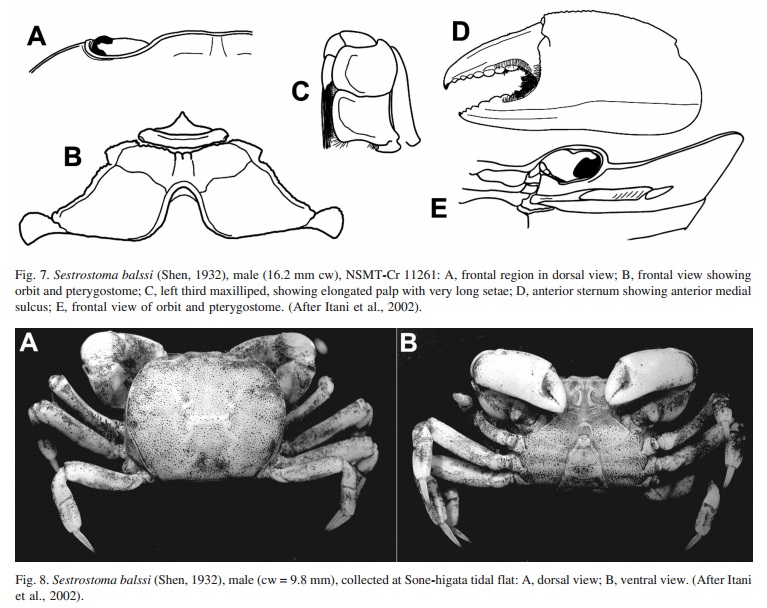
[Crustacea • 2007] Sestrostoma new Genus of Varunidae Crab from Japan • Two new subfamilies of Varunidae (Crustacea: Brachyura), with description of two new genera


Sestrostoma balssi (Shen, 1932) (Varunidae: Gaeticinae) 
inhabiting Russian waters of the Sea of Japan

Subfamily: Gaeticinae Davie & N. K. Ng, 2007

Sestrostoma Davie & N. K. Ng, 2007

Davie, P.J.F.; Ng, N.K. 2007. Two new subfamilies of Varunidae (Crustacea: Brachyura), with description of two new genera. Raffles. Bull. Zool. supplement (16): 257-272.

Kornienko, E.S.; Korn, O.M. 2011. Morphology of the complete larval development of the symbiotic crab Sestrostoma balssi (Shen, 1932) (Varunidae: Gaeticinae). Zootaxa, 2990: 45–58. 

[Crustacea • 1991] Rediscovery of Asthenognathus gallardoi Serène & Soh, 1976, from Pakistan (northern Arabian Sea) with description of the male


Fig. 1. Asthenognathus  gallardoi Serene  &  Soh.  A, animal  in  dorsal view;  B,  carapace;  C, third maxilliped;  D,  cheliped;  E,  chela, in  lateral view;  F,  male abdomen;  G, first  male gonopod;  G', G"',  tip of  same. 


A  few years back (1986) when  Dr.  R.  B.  Manning visited  Pakistan, one  of us (NG)  accompanied him  on  field trips,  collecting with  the help of  a yabby pump,  which  was  available  at  that  time.  Several specimens of Asthenognathus gallardoi were obtained  from deep burrows.  This species is  of  small  size  and  in all probability nocturnal  in  habit. 

The only  description of  the species is  that by Serene  & Soh (1976), based  on an ovigerous female  collected  from  the Andaman  Sea. According to  Serene  & Soh  a  female  in  the  collection  of  the  Institute  of Oceanography at Nhatrang, collected  ten years earlier by Dr.  Gallardo  from Nhatrang  Bay,  Vietnam, also belongs to  this species. As  such  the present  specimens afford  the  first  subsequent record  of  the species and  also  extend  its  known range  considerably. Further, the males  collected  from  Pakistan  are  the  first  known  males  of  the species. 

The  berried  female  was kept in  a glass  aquarium  where  the  larvae  hatched the  next day but  could  not  survive  due  to  unfavourable  conditions. 


Ghani, N. and Tirmizi, N. M. 1991. Rediscovery of Asthenognathus gallardoi Serène & Soh, 1976, from Pakistan (northern Arabian Sea) with description of the male. Crustaceana. 61: 100–102.


Thursday, September 13, 2012

[Mammalogy • 2012] Lesula | Cercopithecus lomamiensis • A New Species of Cercopithecus Monkey (Cercopithecoidea, Cercopithecinae) Endemic to the Democratic Republic of Congo and Implications for Conservation of Congo’s Central Basin


Lesula | Cercopithecus lomamiensis

Lesula | Cercopithecus lomamiensis
Hart, Detwiler, Gilbert, Burrell, Fuller, Emetshu, Hart, Vosper, Sargis & Tosi, 2012

Lesula 
illustration: Kimio Honda | http://flic.kr/p/d9PiZt

Camera trap captures Lesula
: On the Losekola study area, just west of the Lomami River

In June 2007, a previously undescribed monkey known locally as “lesula” was found in the forests of the middle Lomami Basin in central Democratic Republic of Congo (DRC). We describe this new species as Cercopithecus lomamiensis sp. nov., and provide data on its distribution, morphology, genetics, ecology and behavior. C. lomamiensis is restricted to the lowland rain forests of central DRC between the middle Lomami and the upper Tshuapa Rivers. Morphological and molecular data confirm that C. lomamiensis is distinct from its nearest congener, C. hamlyni, from which it is separated geographically by both the Congo (Lualaba) and the Lomami Rivers. C. lomamiensis, like C. hamlyni, is semi-terrestrial with a diet containing terrestrial herbaceous vegetation. The discovery of C. lomamiensis highlights the biogeographic significance and importance for conservation of central Congo’s interfluvial TL2 region, defined from the upper Tshuapa River through the Lomami Basin to the Congo (Lualaba) River. The TL2 region has been found to contain a high diversity of anthropoid primates including three forms, in addition to C. lomamiensis, that are endemic to the area. We recommend the common name, lesula, for this new species, as it is the vernacular name used over most of its known range.


Adult male Cercopithecus lomamiensis, Yawende, DRC, photo by Maurice Emetshu

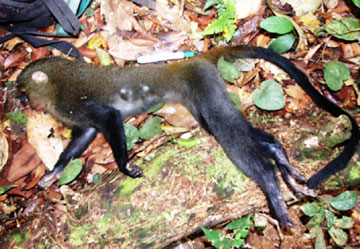
eagle-killed subadult female Cercopithecus lomamiensis, photo by Gilbert Paluku.

Juvenile coloration: Cercopithecus lomamiensis, captured near Obenge, DRC .


Adult pelage coloration. Portraits are of a captive adult male Cercopithecus hamlyni (upper left), photo by Noel Rowe, with permission; and captive adult male Cercopithecus lomamiensis (upper right). 

John A. Hart, Kate M. Detwiler, Christopher C. Gilbert, Andrew S. Burrell, James L. Fuller, Maurice Emetshu, Terese B. Hart, Ashley Vosper, Eric J. Sargis, Anthony J. Tosi. 2012. Lesula: A New Species of Cercopithecus Monkey Endemic to the Democratic Republic of Congo and Implications for Conservation of Congo’s Central Basin. PLoS ONE. 7 (9): e44271.


In Congo, a rare find — a new species of monkey

New African monkey species identified http://phys.org/news/2012-09-african-monkey-species.html
photos: New Species of Monkey Discovered http://on.fox8.com/ShWyzSX

[Mammalogy • 2006] Kipunji | Rungwecebus kipunji • A New Genus of African Monkey, Rungwecebus (Cercopithecoidea, Cercopithecinae): Morphology, Ecology, and Molecular Phylogenetics


Rungwecebus kipunji
(Jones, Ehardt, Butynski, Davenport, Mpunga, Machaga, De Luca. 2005)

Rungwecebus new Genus 
Davenport, Stanley, Sargis, De Luca, Mpunga, Machaga and Olsen, 2006
synonym: Lophocebus kipunji
Jones, Ehardt, Butynski, Davenport, Mpunga, Machaga, De Luca. 2005


A new species of African monkey, Lophocebus kipunji, was described in 2005 based on observations from two sites in Tanzania. We have since obtained a specimen killed by a farmer on Mount Rungwe, the type locality. Detailed molecular phylogenetic analyses of this specimen demonstrate that the genus Lophocebus is diphyletic. We provide a description of a new genus of African monkey and of the only preserved specimen of this primate. We also present information on the animal's ecology and conservation.

Mammals of Tanzania | Rungwecebus kipunji 


Mammals of Tanzania
Rungwecebus kipunji
Davenport, Stanley, Sargis, De Luca, Mpunga, Machaga and Olsen, 2006


Davenport, Tim R. B.; William T. Stanley, Eric J. Sargis, Daniela W. De Luca, Noah E. Mpunga, Sophy J. Machaga, and Link E. Olson. 2006. A New Genus of African Monkey, Rungwecebus: Morphology, Ecology, and Molecular Phylogenetics. Science. 312 (5778): 1378–81. doi:10.1126/science.1125631.

new Monkey species found in Africa
The secret life of the Kipunji

[Mammalogy • 2006] The Recently Described Highland Mangabey, Lophocebus kipunji (Cercopithecoidea, Cercopithecinae): Current Knowledge and Conservation Assessment


 The Highland Mangabey, Lophocebus kipunji. 
Drawing by Stephen D. Nash.

Abstract
The highland mangabey (Lophocebus kipunji), described and named in 2005, is the first monkey to be discovered in Africa since 1984. This species, endemic to Tanzania, was independently discovered by two research groups, one working in Ndundulu Forest in the Udzungwa Mountains, the other ~350 km to the southwest in the Rungwe-Livingstone Forest in the Southern Highlands. Lophocebus kipunji is an arboreal omnivore with a morphology and vocal repertoire distinct from other mangabeys (Lophocebus spp. and Cercocebus spp.). Although few data are available, studies of its molecular biology, ecology, behavior, and conservation status are underway. Lophocebus kipunji is Critically Endangered as a result of hunting and loss of habitat, which have produced small and fragmented populations. Efforts to improve the conservation status of both Ndundulu Forest and Rungwe-Livingstone Forest are ongoing, as well as augmentation of community-based conservation programs with expanded law enforcement. Research, long-term monitoring, effective law enforcement, and additional conservation projects are all essential to the long-term survival of L. kipunji.

Key Words: Highland mangabey, Lophocebus kipunji, Tanzania, conservation, Udzungwas, Southern Highlands

Carolyn L. Ehardt and Thomas M. Butynski. 2006. The Recently Described Highland Mangabey, Lophocebus kipunji (Cercopithecoidea, Cercopithecinae): Current Knowledge and Conservation Assessment. Primate Conservation. (21): 81 –87


[Mammalogy • 2005] 'Highland Mangabey' | 'Lopocebus' kipunji • A New Species of African Monkey from southern Tanzania


Highland Mangabey | Lophocebus kipunji 
 Jones, Ehardt, Butynski, Davenport, Mpunga, Machaga, De Luca. 2005


A distinct species of mangabey was independently found at two sites 370 kilometers apart in southern Tanzania (Mount Rungwe and Livingstone in the Southern Highlands and Ndundulu in the Udzungwa Mountains). This new species is described here and given the name “highland mangabey” Lophocebus kipunji sp. nov. We place this monkey in Lophocebus, because it possesses noncontrasting black eyelids and is arboreal. L. kipunji is distinguished from other mangabeys by the color of its pelage; long, upright crest; off-white tail and ventrum; and loud call. This find has implications for primate evolution, African biogeography, and forest conservation.


The Highland Mangabey Lophocebus kipunji: A New Species of African Monkey

 Jones, Trevor; Carolyn L. Ehardt, Thomas M. Butynski, Tim R. B. Davenport, Noah E. Mpunga, Sophy J. Machaga, Daniela W. De Luca. 2005. The Highland Mangabey Lopocebus kipunji: A New Species of African Monkey. Science. 308 (5725): 1161–1164. doi:10.1126/science.1109191.  


[Mammalogy • 2007] The Endemic Uganda Mangabey, Lophocebus ugandae, and Other Members of the Lophocebus albigena-Group


Abstract
 Revising the grey-cheeked mangabeys (Lophocebus albigena group) in the light of the Phylogenetic Species Concept reveals more taxonomic diversity than was formerly suspected. The three subspecies recognized by Groves (1978) are diagnosably distinct, and are here upgraded to species rank. Most significantly, the mangabeys of Uganda, not recognized as distinct at all in the 1978 revision, are now shown to constitute a fourth species, Lophocebus ugandae (Matschie, 1912), which is apparently confined to Uganda, and as such probably Uganda’s only endemic primate

Key Words: Mangabey,  Lophocebus albigena, Lophocebus osmani,  Lophocebus johnstoni,  Lophocebus ugandae, Uganda endemicity


 Groves, Colin. 2007. The Endemic Uganda Mangabey, Lophocebus ugandae, and Other Members of the albigena-Group (Lophocebus). Primate Conservation. 22.

Sunday, September 9, 2012

[Paleontology • 2001] 'Sinornithosaurus' Dave NGMC-91 • The distribution of integumentary structures in a feathered dinosaur


Non-avian theropod dinosaurs with preserved integumentary coverings are becoming more common, but apart from the multiple specimens of Caudipteryx, which have true feathers, animals that are reasonably complete and entirely articulated that show these structures in relation to the body have not been reported. Here we report on an enigmatic small theropod dinosaur that is covered with filamentous feather-like structures over its entire body.


unamed specimen NGMC-91. From Ji, Norell et al., 2001.

Qiang, Ji, Norell, Mark A., Gao, Ke-Qin, Ji, Shu-An, Ren, Dong. 2001. The distribution of integumentary structures in a feathered dinosaur. Nature. 410:1084-1087 doi:10.1038/35074079