Monday, March 6, 2023

[Herpetology • 2020] Amolops mahabharatensis • A New Species of Amolops Cope, 1865 (Anura: Ranidae) from Nepal and Nomenclatural Validation of Amolops nepalicus Yang, 1991


Amolops mahabharatensis 
Khatiwada, Shu, Wang, Zhao, Xie & Jiang, 2020

 Asian Herpetological Research. 11(2); 

Abstract 
A new species, Amolops mahabharatensis sp. nov., is described from Mahabharat range (middle mountain) of Nepal. The new species is a member of the A. marmoratus group and is distinguished from its congeners using morphological and molecular data. The new species is diagnosed by having numerous warts on dorsum and flanks, dorsal body greyish olive-brown/light brown, presence of vomerine teeth series, presence of a pair of subgular vocal sacs in males and tadpole with III:5+5/1+1:II – labial tooth row. In addition, evidenced by the phylogenetic and morphological analyses in this study, Amolops nepalicus is shown to be a valid species. A molecular phylogenetic analysis based on 16S ribosomal gene for six members of the A. marmoratus group suggested that the new species is sister to a clade containing A. nepalicus and A. panhai. The uncorrected genetic divergences between the new species and its closest congeners A. nepalicus, A. panhai and A. marmoratus based on 16S rRNA gene were 10.5%, 11.6%, and 8.6% respectively. The new species showed wide distribution in the Mahabharat range of Nepal.
 
Keywords: A. marmoratus group;  mahabharat range;  molecular phylogeny;  taxonomy

Amolops mahabharatensis sp. nov. 
Male holotype in natural habitat A. Dorsolateral view B. Ventral view.
  Female paratype in natural habitat. 
Microhabitat at Siraichuli Hill, Chitwan district, Nepal.

Amolops mahabharatensis sp. nov. 

Suggested common name: Mahabharat Torrent frog
Suggested common name in Nepali: पाहाड ी पि र्रेपाहा (Pahadi Pirre Paha)

Diagnosis: The new species is assigned to genus Amolops based on the molecular and morphological similarity (first finger with circummarginal and transverse grooves on disk and tadpoles with gastromyzophorous) of the specimens to those of other species in the A. marmoratus group. Further, the new species is assigned to the genus Amolops due to the presence of ventral sucker in tadpole (tadpoles were identified with molecular method); a major diagnostic feature (Inger, 1966). Amolops mahabharatensis sp. nov differed from other species of Amolops based on the following morphological characters: (1) male SVL (mean 37.1 mm, n=14), (2) dorsal surface granular, (3) head wider than longer, (4) distinct dorsolateral fold, (5) nuptial pad present on first finger of male (6) circummarginal grooves present on all digit discs, (7) toes fully webbed, (8) males with dual gular poaches, (9) vomerine teeth weakly developed, and (10) tadpoles with gastromyzophorous (ventral abdominal sucker) and distinct mouth parts (III:5+5/1+1:II).

Etymology: The species name is derived from the noun “Mahabharat” which refers to the foothills of Himalaya, from where this species were collected.


Janak Raj Khatiwada, Guocheng Shu, Bin Wang, Tian Zhao, Feng Xie and Jianping Jiang. 2020. Description of A New Species of Amolops Cope, 1865 (Amphibia: Ranidae) from Nepal and Nomenclatural Validation of Amolops nepalicus Yang, 1991. Asian Herpetological Research. 11(2); 71-94. DOI: 10.16373/j.cnki.ahr.190052

[Paleontology • 2023] Chucarosaurus diripienda • A New Giant Titanosaur (Sauropoda: Titanosauria: Colossosauria) from the Upper Cretaceous of Northwestern Patagonia, Argentina


Chucarosaurus diripienda 
 Agnolin, Gonzalez Riga, Aranciaga Rolando, Rozadilla, Motta, Chimento & Novas, 2023


Abstract
Chucarosaurus diripienda gen. et sp. nov. is a new and large titanosaurian sauropod from the Neuquén Basin, Rio Negro Province, Patagonia. The specimen was discovered in the Upper Cretaceous strata of the Huincul Formation (middle Cenomanian–lower Turonian). It includes appendicular and relatively slender elements, with a femoral total length of about 1.9 m long. This taxon shows a unique combination of characters indicating that appendicular bones such as the femur, ischium and tibia, show a remarkable morphological variety, greater than previously described, and are morphologically informative as source of phylogenetic data. A cladistic phylogenetic analysis placed Chucarosaurus well nested within the Colossosauria clade.

 Keywords: Chucarosaurus, Sauropods, Colossosauria, Neuquén Basin, Cenomanian–Turonian, Patagonia, Argentina


Dinosauria Owen 1842
Saurischia Seeley 1887
Sauropoda Marsh, 1878

Titanosauria Bonaparte and Coria, 1993
Colossosauria Gonzalez Riga, Lamanna, Otero, Ortiz David, Kellner, and Ibiricu, 2019 

Chucarosaurus diripienda gen. et sp. nov. 

 Etymology. Chucaro, from the native language Quechua, also used for the gauchos (people who live in the countryside of Argentina), Mapundungum, meaning hard and indomitable animal; saurus, from the Latin, reptile; diripienda, from the Latin, meaning scrambled.


Federico L. Agnolin, Bernardo J. Gonzalez Riga, Alexis M. Aranciaga Rolando, Sebastián Rozadilla, Matías J. Motta, Nicolás R. Chimento and Fernando E. Novas. 2023. A New Giant Titanosaur (Dinosauria, Sauropoda) from the Upper Cretaceous of Northwestern Patagonia, Argentina. Cretaceous Research. 146, 105487. DOI: 10.1016/j.cretres.2023.105487  

[Paleontology • 2019] Patagosphenos watuku • Bridging the Gap: Sphenodont Remains (Lepidosauria: Sphenodontia) from the Turonian (Upper Cretaceous) of Patagonia


 Patagosphenos watuku
Gentil, Agnolin, Marsà, Motta & Novas, 2019


Abstract
Rhynchocephalians are a lepidosaur clade with a single living species. Here we report the first record of an eilenodontine sphenodontian from Turonian beds in South America. The new Turonian basal eilenodontine sphenodontian, Patagosphenos watuku gen. et sp. nov., is described. The specimen is represented by partial cranial and postcranial remains, being very similar to other eilenodontines such as Kaikaifilusaurus and Eilenodon. Moreover, the genus Kaikaifilusaurus is reported for the first time from Turonian beds. Furthermore, this genus is revalidated, being previously considered as a nomen dubium. Paleohistological analysis of Patagosphenos gen. nov reveals a similar bone microstructure to that of the living Sphenodon. We infer that physiological adaptations to survive in cold (freezing conditions) environments may constitute the key pre-adaptation that allowed Sphenodon to survive the Cretaceous-Palaeogene boundary.

Keywords: Rhynchocephalia, Huincul formation, Palaeohistology, Cretaceous-Palaeogene boundary


 Patagosphenos watuku


 Adriel R. Gentil, Federico L. Agnolin, Jordi A. Garcia Marsà, Matias J. Motta and Fernando E.Novas. 2019. Bridging the Gap: Sphenodont Remains from the Turonian (Upper Cretaceous) of Patagonia. Palaeobiological Inferences. Cretaceous Research. 98; 72-83. DOI: 10.1016/j.cretres.2019.01.016
 nationalgeographicla.com/exploradores/2019/02/restos-fosiles-de-una-nueva-especie-de-tuatara-ayudan-comprender-como-esta

[Mollusca • 2020] Camaena funingensis, C. maguanensis, etc. • Four New Dextral Land Snails of the Genus Camaena (Gastropoda: Eupulmonata: Camaenidae) from south China


A Camaena funingensis B Camaena gaolongensis Zhou, Wang & Lin
C Camaena maguanensis D Camaena yulinensis Zhou, Wang & Hu

in Wang, Hu, Lin, Yang, Li et Zhou, 2020. 

Abstract
In this study, four new dextral camaenid from China are reported, based on shell morphology, reproductive system anatomy, and molecular phylogenetic analyses: Camaena funingensis Zhou, Wang & Lin, sp. nov., Camaena gaolongensis Zhou, Wang & Lin, sp. nov., Camaena maguanensis Zhou, Wang & Hu, sp. nov., and Camaena yulinensis Zhou, Wang & Hu, sp. nov. Detailed descriptions of the morphological characteristics including shells and genitalia, DNA sequences, and living environments of the four new species are provided, with further comparisons with congeners.

Keywords: Anatomy, Camaena, molecular biology, shell morphology, terrestrial snail


 Ecological photographs of snails
A Camaena funingensis sp. nov. (Laolida, Funing, Yunnan, China) B Camaena gaolongensis sp. nov. (Dayao, Gaolong, Guangxi, China) 
C Camaena maguanensis sp. nov. (Huazhige, Maguan, Yunnan, China) D Camaena yulinensis sp. nov. (Longquan cave, Yulin, Guangxi, China).

Photographs of the four new species
A Camaena funingensis sp. nov. (holotype, FJIQBC 19340, Laolida, Funing, Yunnan, China)
B Camaena gaolongensis sp. nov. (holotype, FJIQBC 19353, Dayao, Gaolong, Guangxi, China)
C Camaena maguanensis sp. nov. (FJIQBC 19405, Huazhige, Maguan, Yunnan, China)
D Camaena yulinensis sp. nov. (FJIQBC 19460, Longquan cave, Yulin, Guangxi, China).
Scale bars: 10 mm.


Pei Wang, Mei-Ling Hu, Jun-Hong Lin, Hai-Fang Yang, Xiao-Jing Li and Wei-Chuan Zhou. 2020. Descriptions of Four New Dextral Land Snails of the Genus Camaena (Gastropoda, Eupulmonata, Camaenidae) from south China. ZooKeys. 996: 37-58. DOI: 10.3897/zookeys.996.54187

[Entomology • 2022] Rediscovery of Polystoechotes punctata (Fabricius, 1793) (Neuroptera: Ithonidae) in Eastern North America


Polystoechotes punctata (Fabricius, 1793)

in Skvarla et Fisher, 2022.

Abstract
Polystoechotes punctata (Fabricius, 1793) (Neuroptera: Ithonidae) was formerly widespread across North America, but was extirpated from eastern North America by the 1950s. We report a specimen collected from Fayetteville, Arkansas, which represents a new state record and the first specimen recorded in eastern North America in over fifty years. We also reexamine a previously published dataset and discuss the history of P. punctata in eastern North America. The importance of community science efforts are discussed and compared with museum holdings. We propose that P. punctata may have always been uncommon in eastern North America, or at least when insect collecting began in earnest in the late 1800s, and support our case by examining collection effort in other insects. This discovery suggests there may be relictual populations of this large, charismatic insect yet to be discovered.


Michael J. Skvarla and  J. Ray Fisher. 2022. Rediscovery of Polystoechotes punctata (Fabricius, 1793) (Neuroptera: Ithonidae) in Eastern North America. Proceedings of the Entomological Society of Washington. 124(2); 332-345. DOI: 10.4289/0013-8797.124.2.332
https://phys.org/news/2023-02-rare-insect-arkansas-walmart-historic.html

Sunday, March 5, 2023

[Botany • 2023] Oreocharis repenticaulis (Gesneriaceae) • A New Species from western Guangxi, China


Oreocharis repenticaulis  

in Huang, Su, Yang et Liu, 2023. 

Abstract
Oreocharis repenticaulis, a new species of Gesneriaceae from Guangxi, China, is described and illustrated. It is the first described Oreocharis with repent stem. A detailed description, color photographs, distribution and habitat, as well as its morphological relationship with relevant similar species are also provided.

Keywords: Flora of Guangxi, morphology, new taxon


Xue-Kui Huang, Chun-Lan Su, Ping Yang and Yan Liu. 2023. Oreocharis repenticaulis (Gesneriaceae), A New Species from western Guangxi, China. Nordic Journal of Botany. e03636. DOI: 10.1111/njb.03636  

[Botany • 2019] Henckelia collegii-sancti-thomasii (Gesneriaceae) • A New Species from Northeastern India


 Henckelia collegii-sancti-thomasii A.Joe, D.Borah, M.Taram & Sandhya,  

in Borah, Taram, Joe & Neelamkavil, 2019.

Henckelia collegii-sancti-thomasii, a new species of Henckelia is described here from Nirijuli, Papum Pare district of Arunachal Pradesh, northeastern India. Detailed description, its habitat and ecology along with color photographs are provided.

Keywords: Arunachal Pradesh, Gesneriaceae, India, Henckelia, new species


 Henckelia collegii-sancti-thomasii
  A. Habitat. B. Habit.

 Henckelia collegii-sancti-thomasii:
A. Flowering twig. B. Flower-front view. C. Bract. D. single flower -side view. E. Calyx. F. dissected corolla with stamens and staminodes. G. calyx with style and stigma. H. Pistil.

Henckelia collegii-sancti-thomasii A.Joe, D.Borah, M.Taram & Sandhya sp. nov. 

Henckelia collegii-sancti-thomasii is morphologically similar to H. speciosa but can be easily distinguished by a combination of characters such as plants caulescent with 8–20 cm long stem (vs stems absent or sub-acaulis), laminae base cuneate (vs cordate), laminae color green (vs purplish, mainly along the veins), peduncle white pubescent (vs rust-brown pubescent), bracts ovate (vs lanceolate), pedicel glabrous (vs tomentose), calyx divided below the middle or near to middle (vs above the middle), filaments puberulent (vs glabrous), anthers glabrous (vs puberulent), ovary glabrous (vs puberulent) (Table 1.).

Etymology:— This species is named after the prestigious St. Thomas’ College (Autonomous), Thrissur, Kerala,India, which is one of the premier and oldest educational institutions in Kerala.  

 
Dipankar Borah, Momang Taram, Alfred Joe and Sandhya Vincent Neelamkavil. 2019. Henckelia collegii-sancti-thomasii: A New Species of Henckelia (Gesneriaceae) from Northeastern India. Phytotaxa. 415(4); 247–251. DOI: 10.11646/phytotaxa.415.4.10

Saturday, March 4, 2023

[Diplopoda • 2020] Eutrichodesmus cambodiensis • A New Micropolydesmoid Millipede of the Genus Eutrichodesmus Silvestri, 1910 (Polydesmida: Haplodesmidae) from Cambodia, with A Key to Species in mainland Southeast Asia


Eutrichodesmus cambodiensis Srisonchai & Panha, 

in Srisonchai, Likhitrakarn, Sutcharit, Jeratthitikul, Siriwut, Thrach, Chhuoy, Ngor & Panha, 2020

Abstract
The micropolydesmoid millipede family Haplodesmidae is here recorded from Cambodia for the first time through the discovery of the first, new species of the genus Eutrichodesmus Silvestri, 1910: E. cambodiensis sp. nov. This new species is described from two limestone habitats in Kampot Province, based on abundant material. It is easily distinguished from all related congeners by the following combination of characters: body greyish-brown; limbus roundly lobulate; solenomere partially divided from acropodite by a digitiform lobe, but without hairpad. Brief remarks on the previously-proposed “pecularis-group” are provided and a second group, the “demangei-group”, is established and discussed on the basis of morphological evidence, updating the number of recognised species groups of Eutrichodesmus to two. Detailed morphological illustrations, photographs and a distribution map, as well as remarks on its habitat and mating behaviour of the new species are presented. Furthermore, the current distributions of all 55 presently-known species of Eutrichodesmus are provided and a key to all 23 species that occur in mainland Southeast Asia is given.

Keywords: Karst, new species, Southeast Asia, taxonomy

Taxonomy
Order Polydesmida Pocock, 1887
Suborder Polydesmidea Pocock, 1887

Family Haplodesmidae Cook, 1895

Genus Eutrichodesmus Silvestri, 1910
Type species: Eutrichodesmus demangei Silvestri, 1910

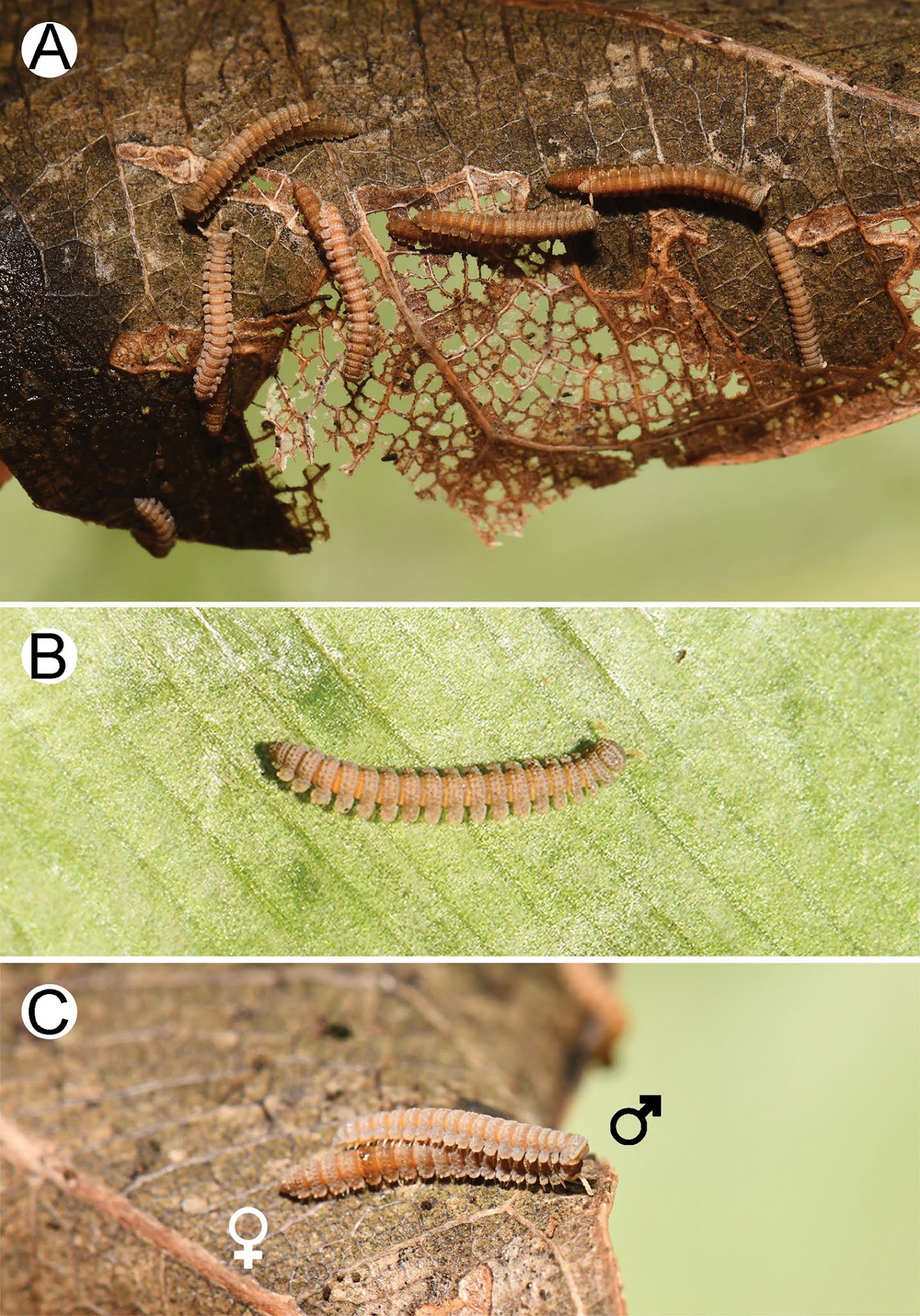
Photographs of live Eutrichodesmus cambodiensis sp. nov., paratypes (CUMZ–hapld00002)
A pairs of mating couples B male and C mating couple. Not to scale.

Eutrichodesmus cambodiensis Srisonchai & Panha, sp. nov.
  
Diagnosis: Body with incomplete volvation; metaterga with three transverse rows of regular and round tubercles, but no mid-dorsal projection (outgrowth) on metaterga; distofemoral process on gonopod telopodite very short, inconspicuous. Similar in all these characters to E. griseus Golovatch et al., 2009, but differs in having (1) live specimens and freshly preserved material pale greyish-brown or pale brown in colour; (2) the limbus crenulate, but not spinulate, crenulations being slightly longer than broad; (3) the acropodite curved and long, unciform, attenuated near tip; with a free solenomere starting from about midway; and (4) the solenomere digitiform, papillate, without hairpad.

Etymology: The specific epithet reflects the name of the country “Cambodia” where all specimens were collected and to which the new species appears to be endemic; adjective.

Habitat at the type locality of Eutrichodesmus cambodiensis sp. nov. 
A limestone outcrop B, C humid rock wall, sinkholes and crevices
D co-occurrence of the new species with microsnail, Hypselostoma cambodjense Benthem Jutting, 1962
and E mating couple (male on top).


Ruttapon Srisonchai, Natdanai Likhitrakarn, Chirasak Sutcharit, Ekgachai Jeratthitikul, Warut Siriwut, Phanara Thrach, Samol Chhuoy, Peng Bun Ngor and Somsak Panha. 2020. A New Micropolydesmoid Millipede of the Genus Eutrichodesmus Silvestri, 1910 from Cambodia, with A Key to Species in mainland Southeast Asia (Diplopoda, Polydesmida, Haplodesmidae). ZooKeys. 996: 59-91. DOI: 10.3897/zookeys.996.57411


[Entomology • 2023] Hea qiuae • A New Species of Hea Distant, 1906 (Hemiptera: Cicadidae: Cicadettinae) from China, with Annotated Catalogue for the Genus


 Color variations of Hea qiuae Wang, 2023 

 
Abstract
A new species of cicada, Hea qiuae Wang, sp. n. (Hemiptera: Cicadidae: Cicadettinae), is described and illustrated from Chongqing and Yunnan, Southwest China. An annotated catalogue and an updated key to the four species of Hea are presented.

Keywords: Hemiptera, cicada, Taphurini, taxonomy, morphology, bibliography, key, Oriental Region


 Color variations of Hea qiuae sp. n., dorsal views:
A paratype (WCBA00102), ♂; B paratype (WCBA00101), ♂; C holotype (WCBA00100), ♂;
D paratype (WCBA00106), ♂; E paratype (WCBA00109), ♂; F paratype (WCBA00104), ♂;
G paratype (WCBA00103), ♀; H paratype (WCBA00112), ♀; I paratype (WCBA00111), ♀.

Hea qiuae Wang, sp. n.


Cheng-Bin Wang. 2023. A New Species of Hea Distant, 1906 from China, with annotated catalogue for the genus (Hemiptera: Cicadidae: Cicadettinae).  Zootaxa. 5231(5); 575-583. DOI: 10.11646/zootaxa.5231.5.6 

[Ichthyology • 2023] Eulophias spinosior • A New Deep-Water Eulophiid Fish (Perciformes: Zoarcoidei: Eulophiidae) from Japan


Eulophias spinosior
Nakayama, Yamakawa, Takami & Endo, 2023


Abstract
The genus Eulophias, which is an enigmatic group of the suborder Zoarcoidei, previously comprised two rare species: Eulophias tanneri Smith, 1902 (type species and a senior synonym of Eulophias owashii Okada and Suzuki, 1954) and Eulophias koreanus Kwun and Kim, 2012. Here we describe a new species, Eulophias spinosior, based on 71 specimens (94.9–182.3 mm in standard length, SL) collected from the upper slope of the northwestern Pacific off southern Japan at depths of 257–555 m. It readily differs from its two congeners in having 133–143 dorsal-fin spines, 109–116 anal-fin soft rays, 5–6 pectoral-fin rays, and 146–156 total vertebrae, and in lacking a dark band posterior to the eye and a series of dark blotches midlaterally on the trunk and tail. Regarding bathymetric distribution, the new species occurs much deeper than E. koreanus and E. tanneri. Eulophias spinosior, new species, is sexually dimorphic, with males having large, stout, modified canines at the tips of the premaxillary and dentary (vs. only slightly enlarged in females). Dentition of males also differs from that of females in that most teeth are uniserially arranged in each jaw (vs. distinct two rows anteriorly).

Fresh specimens of Eulophias spinosior.
(A–E) BSKU 118798, paratype, sex undetermined, 155.0 mm SL, Tosa Bay, 300 m depth, soon after capture;
(F) BSKU 118835, paratype, sex undetermined, 135.3 mm SL, Tosa Bay, 300 m depth, freshly thawed.

(A, F) Lateral views; (B) close-up lateral, (C) dorsal, and (D) ventral views of the head and trunk; (E) close-up lateral view of the posterior part of the tail.

Eulophias spinosior, new species 
 New standard Japanese name: Toge-itoginpo

Diagnosis.—Eulophias spinosior is readily distinguished form its two congeners by having 133–143 dorsal-fin spines (vs. 124–128 and 116–125 in E. koreanus and E. tanneri, respectively), 109–116 anal-fin soft rays (vs. 102–103 and 90–100, respectively), 146–156 total vertebrae (vs. 141–143 and 132–143, respectively), and 5–6 pectoral-fin rays (vs. 7 in both E. koreanus and E. tanneri). In addition, the new species is unique among the genus in lacking prominent dark markings on the sides of the head and body, whereas E. koreanus and E. tanneri have a dark band posterior to the eye and a series of dark blotches midlaterally on the trunk and tail.


Etymology.— The specific epithet spinosior is derived from the comparative of the Latin adjective spinosus, meaning thorny, spiny, or prickly, in alluding to a greater number of dorsal-fin spines of the new species among Eulophias.


Naohide Nakayama, Takeshi Yamakawa, Munehiro Takami and Hiromitsu Endo. 2023. Description of A New Deep-Water Eulophiid Fish (Perciformes: Zoarcoidei) from Japan. Ichthyology & Herpetology. 111(1); 87-97. DOI: 10.1643/i2021047
 

[Arachnida • 2023] Bothriurus mistral • the Highest-dwelling Bothriurus (Scorpiones: Bothriuridae) from the western Andes


Bothriurus mistral
Ojanguren-Affilastro, Benítez, Iuri, Mattoni, Alfaro & Pizarro-Araya, 2023


Abstract
We describe Bothriurus mistral n. sp. (Scorpiones, Bothriuridae) from the Chilean north-central Andes of the Coquimbo Region. This is the highest elevational discovery for Bothriurus in the western slopes of the Andes. This species was collected in the Estero Derecho Private Protected Area and Natural Sanctuary as part of the First National Biodiversity Inventory of Chile of the Integrated System for Monitoring and Evaluation of Native Forest Ecosystems (SIMEF). Bothriurus mistral n. sp. is closely related to Bothriurus coriaceus Pocock, 1893, from the lowlands of central Chile. This integrative research includes a combination of traditional morphometrics and geometric morphometric analyses to support the taxonomic delimitation of the species.

 Living specimens and type locality of Bothriurus mistral n. sp.
 (A) Living specimen (B) Living specimen under UV light.
(C) Type locality in the Estero Derecho Private Protected Area and Natural Sanctuary (Coquimbo Region, Chile). (D) Aerial view of the type locality.

 Bothriurus mistral n. sp., habitus.
(A) Male, dorsal aspect, (B) Male, ventral aspect, (C) Female, dorsal aspect, (D) Female, ventral aspect.
Scale bars: 10 mm.

Bothriurus mistral n. sp. Ojanguren-Affilastro, Mattoni, Alfaro & Pizarro-Araya

Diagnosis and comparisons: Bothriurus mistral n. sp. is most closely related to B. coriaceus, which occurs in neighboring areas but at much lower altitudes. Both species can be easily told apart by their pigment pattern and morphology. Bothriurus mistral n. sp. is more pigmented than B. coriaceus; the pigment pattern of tergites I–VI is usually restricted to the anterior third of the segment in B. coriaceus (Fig 8C), whereas in B. mistral n. sp. it occupies more than the anterior half of each segment (Fig 8D). Additionally, B. coriaceus only has a median wide stripe in the ventral surface of metasomal segments I–IV (Fig 8A), whereas B. mistral n. sp. has three ventral stripes, two VL and a VM (Fig 8B). Bothriurus coriaceus has more developed ventral carinae in metasomal segment I (Fig 6G–6J). Metasomal segment V is more elongated in B. mistral n. sp. males (Fig 6E), and its length/width ratio ranges from 1.80 to 2.01 (N = 10; mean = 1.86), whereas in B. coriaceus males (Fig 6F) it ranges from 1.61 to 1.76 (N = 10; mean = 1.67). The base of the aculeus in B. mistral n. sp. males is slightly thicker and higher than in B. coriaceus males (Fig 6B and 6D), but this character is highly variable. There are also some conspicuous differences in the hemispermatophores of both species; in B. mistral n. sp. the distal lamina is more elongated and more recurved apically than in B. coriaceus (Fig 7A and 7B), being the distal lamina proportionally shorter and wider in B. coriaceus than in B. mistral n. sp. considering the total length of the hemispermatophore. Hemispermatophore total length/distal lamina length ratio ranges from 1.88 to 1.98 (N = 5; Mean = 1.93) in B. mistral n. sp., whereas in B. coriaceus it ranges from 2.04 to 2.08 (N = 5; Mean = 2.06). Hemispermatophore total length/distal lamina width ratio ranges from 7.71 to 8.23 (N = 5; Mean = 8.03) in B. mistral n. sp., whereas in in B. coriaceus it ranges from 6.31 to 7.16 (N = 5; Mean = 6.81).

Etymology: The specific name mistral is a noun in apposition referring to Gabriela Mistral, pseudonym of the Chilean poetess Lucila María Godoy Alcayaga (1889–1957), who was born in Vicuña and raised in Monte Grande, both in the Elqui valley (Coquimbo Region), an area adjacent to the type locality of this species. For her poetry work, she was awarded the Nobel Prize in Literature in 1945 and was the first Ibero-American woman and the second Latin American person to receive the Nobel Prize. Gabriela Mistral worked as a teacher at numerous schools of the Elqui valley and became a leading thinker as to the role of public education. She was also involved in the reformation of the Mexican education system, and since the 1920s, led an itinerant life due to her work as a consul and representative for international organizations in the Americas and Europe.

Distribution: Bothriurus mistral n. sp. is only known from its type locality, the Estero Derecho Private Protected Area and Natural Sanctuary (30°23ʹ3.86ʺS, 70°24ʹ44.97ʺW, 3,034 masl), located in the Paihuano mountain range, an area with a surface of 31,680 ha, placed at high altitudes of the north central Chilean Andes (Coquimbo Region, Chile) (Fig 1).

Ecology: 
The area where Bothriurus mistral n. sp. was collected occupies the sub-Andean floor, which is characterized by the presence of medium-height shrub vegetation and scrublands, with the dominant species Stipa chrysophylla E. Desvaux, 1854, Viviana marifolia Cavanilles, 1804, Cristaria andicola Gay, 1846, Adesmia hystrix Philippi, 1860 (Fabaceae), and Ephedra americana Humb. & Bonpl. ex Willd 1806; and the lowermost Andean floor, characterized by a low tropical-Mediterranean shrubland of Adesmia subterranea Clos, Gay, C., 1838, and Adesmia echinus C. Presl, 1791 (Fabaceae) [15, 31].

Bothriurus mistral n. sp. has been found in sympatry with Brachistosternus gayi Ojanguren-Affilastro, Pizarro-Araya & Ochoa, 2018, and with an undetermined, possibly new, species of Brachistosternus.

 
Andrés A. Ojanguren-Affilastro, Hugo A. Benítez, Hernán A. Iuri, Camilo I. Mattoni, Fermín M. Alfaro and Jaime Pizarro-Araya. 2023. Description of Bothriurus mistral n. sp., the Highest-dwelling Bothriurus from the western Andes (Scorpiones, Bothriuridae), using Multiple Morphometric Approaches. PLoS ONE. 18(2): e0281336. DOI: 10.1371/journal.pone.0281336


Friday, March 3, 2023

[Ichthyology • 2023] Phylogenetic Relationships of the North American Catfishes (Siluriformes: Ictaluridae): Investigating the Origins and Parallel Evolution of the Troglodytic Species


Noturus, Prietella, Pylodictis, Satan, Trogloglanis, Ameiurus, Ictalurus 
Phylogeographic sketch of extant Ictaluridae based on relationships supported in this study

in Janzen, Pérez-Rodríguez, Domínguez-Domínguez, Hendrickson, Sabaj & Blouin-Demers, 2023. 
Photos by D.A. Hendrickson, J. Krejca, Zara Environmental LLC., M.H. Sabaj, G.W. Sneegas and M.R. Thomas.
 
Highlights: 
• The known cave species of Ictaluridae currently form a polyphyletic clade.
• A minimum of two cave invasions occurred by surface-dwelling ancestors.
• Two sister cave species likely resulted from subterranean dispersal between caves.
• Transient connectivity of aquifers acted as a sufficient barrier for speciation.
• Prietella species do not form a sister pair, indicating a need for reclassification.

Abstract
Insular habitats have played an important role in developing evolutionary theory, including natural selection and island biogeography. Caves are insular habitats that place extreme selective pressures on organisms due to the absence of light and food scarcity. Therefore, cave organisms present an excellent opportunity for studying colonization and speciation in response to the unique abiotic conditions that require extreme adaptations. One vertebrate family, the North American catfishes (Ictaluridae), includes four troglodytic species that inhabit the karst region bordering the western Gulf of Mexico. The phylogenetic relationships of these species have been contentious, and conflicting hypotheses have been proposed to explain their origins. The purpose of our study was to construct a time-calibrated phylogeny of Ictaluridae using first-occurrence fossil data and the largest molecular dataset on the group to date. We test the hypothesis that troglodytic ictalurids have evolved in parallel, thus resulting from repeated cave colonization events. We found that Prietella lundbergi is sister to surface-dwelling Ictalurus and that Prietella phreatophila + Trogloglanis pattersoni are sister to surface-dwelling Ameiurus, suggesting that ictalurids colonized subterranean habitats at least twice in evolutionary history. The sister relationship between Prietella phreatophila and Trogloglanis pattersoni may indicate that these two species diverged from a common ancestor following a subterranean dispersal event between Texas and Coahuila aquifers. We recovered Prietella as a polyphyletic genus and recommend P. lundbergi be removed from this genus. With respect to Ameiurus, we found evidence for a potentially undescribed species sister to A. platycephalus, which warrants further investigation of Atlantic and Gulf slope Ameiurus species. In Ictalurus, we identified shallow divergence between I. dugesii and I. ochoterenai, I. australis and I. mexicanus, and I. furcatus and I. meridionalis, indicating a need to reexamine the validity of each species. Lastly, we propose minor revisions to the intrageneric classification of Noturus including the restriction of subgenus Schilbeodes to N. gyrinus (type species), N. lachneri, N. leptacanthus, and N. nocturnus.
 
Keywords: Aquifer, Biogeography, Hypogean, Insular habitats, Speciation, Time-calibrated phylogeny


Phylogeographic sketch of extant Ictaluridae based on relationships supported in this study (solid lines) or inferred from previous ones (dashed line).
Branch lengths proportional to those in Fig. 2; circles denote common ancestor of respective genus. Distribution maps of epigean genera (gray) and hypogean species (red) derived from Burr et al. (2020).
Photos by D.A. Hendrickson (Prietella lundbergi), J. Krejca, Zara Environmental LLC. (Prietella phreatophila), M.H. Sabaj (Noturus, Pylodictis), G.W. Sneegas (Satan, Trogloglanis) and M.R. Thomas (Ameiurus, Ictalurus).


Francesco H. Janzen, Rodolfo Pérez-Rodríguez, Omar Domínguez-Domínguez, Dean A. Hendrickson, Mark H. Sabaj and Gabriel Blouin-Demers. 2023. Phylogenetic Relationships of the North American Catfishes (Ictaluridae, Siluriformes): Investigating the Origins and Parallel Evolution of the Troglodytic Species. Molecular Phylogenetics and Evolution. 107746. DOI:  10.1016/j.ympev.2023.107746

[Herpetology • 2023] Cophixalus gigiraensis • Another Giant Species of the microhylid Frog Genus Cophixalus Boettger, 1892 (Anura: Microhylidae) from the mountains of Papua New Guinea and First Records of procoracoids in the Genus


Cophixalus gigiraensis  
Günther, Dahl & Richards, 2023 

Mount Gigira Giant Nursery Frog || DOI: 10.3897/zse.99.97006

Abstract
A new arboreal species of the microhylid genus Cophixalus Boettger, 1892 is described from montane rainforest on Papua New Guinea’s central cordillera. With a male SUL exceeding 44.0 mm, the new species is among the largest members of the genus; the only other Papuan species known to reach this size is C. riparius Zweifel, 1962. The new species differs from C. riparius in a small number of mensural characters and by its distinct advertisement call, a single explosive ‘bark’ uttered singly or in rapid series. In contrast, calls of C. riparius recorded near the type locality are a series of drawn out, rasping croaks. Calls of the two species are analysed and compared. The two species also appear to have different ecologies, with the new species found only high in trees, while C. riparius is often encountered in vegetation on or near the forest floor. Examination of osteological features revealed the presence of cartilaginous procoracoids in both species, representing the first records of procoracoids in the speciose genus Cophixalus. Lack of procoracoids is traditionally considered an important diagnostic character for defining Cophixalus but both species also lack clavicles, a character considered diagnostic for Cophixalus and a key feature distinguishing the genus from the closely related Oreophryne Boettger, 1895. Because preliminary published genetic data indicate that they are nested within Cophixalus, we retain both species in that genus until a comprehensive molecular phylogeny of Cophixalus and related genera, particularly Oreophryne, is completed.

Key Words: Amphibia, bioacoustics, central cordillera, montane rainforest, morphology, New Guinea, taxonomy

Holotype of Cophixalus gigiraensis sp. nov. in life
a. Dorsolateral view; b. Ventral view; c. Palmar view of right hand; d. Plantar view of right foot.

a–c. Juvenile paratype of Cophixalus gigiraensis sp. nov. in life.

 Cophixalus gigiraensis sp. nov.
Mount Gigira Giant Nursery Frog
Oreophryne ? sp. 5 ‘loud grunter’ (Richards & Armstrong, 2017).
Cophixalus sp. 5 ‘loud grunter’ (Richards & Armstrong, 2018).
Cophixalus sp. 4 ‘loud grunter’ (Richards et al., 2021).
  
Diagnosis: With a snout-urostyle length of 44.4 mm in an adult male the new species is among the largest species of the genus; in New Guinea only Cophixalus riparius reaches a similar size. It is distinguished from C. riparius and all other congeners by the following unique combination of characters: body robust, head short (HL/SUL 0.31); legs moderately short (TL/SUL 0.42), third toe longer than fifth; fingers and toes with greatly expanded triangular terminal discs, all with circum-marginal grooves; discs of fingers much larger than those of toes (T4D/F3D 0.76); dorsal surfaces including rear of tarsus with scattered low tubercles, ventral surfaces smooth; most of dorsal surfaces brown-olive (RAL 8008) with irregular beige (most similar to RAL 1001) flecking; ventral surfaces whitish overlain with moderately dense reddish-brown pigmentation; advertisement call a loud explosive ‘bark’ produced singly or in groups of up to eight, each containing 13–19 pulses lasting 60–80 ms, dominant frequency 1.5 kHz.

Emergent Nothofagus trees in montane forest on Gigira Ridge. Male Cophixalus gigiraensis sp. nov. called from the upper canopy of these large emergent trees making collection difficult.

Etymology: The specific epithet gigiraensis refers to the type locality of this species, Gigira Ridge, otherwise known as Hides Ridge. Gigira is the local Huli Community’s name for this mountain.


Rainer Günther, Chris Dahl and Stephen J. Richards. 2023. Another Giant Species of the microhylid Frog Genus Cophixalus Boettger, 1892 from the mountains of Papua New Guinea and First Records of procoracoids in the Genus. Zoosystematics and Evolution. 99(1): 173-183. DOI: 10.3897/zse.99.97006