Wednesday, November 3, 2021

[Herpetology • 2021] Oligodon churahensis • A New Species of Snake of the Genus Oligodon Boie in Fitzinger, 1826 (Serpentes: Colubridae) from the Western Himalayas


Oligodon churahensis  
Mirza, Bhardwaj & Patel, 2021


Abstract
A new species of Oligodon Fitzinger, 1826 is described based on specimens collected from Churah Valley of Himachal Pradesh. The new species is related to O. arnensis based on molecular as well as morphological data, however differs from it in several aspects. The new species shows a pairwise sequence divergence of 6–20% from congeners for mitochondrial cytochrome b gene. Lack of pterygoid and palatine teeth of the new species suggests that the diet may largely comprise of eggs. Discovery of the new species is not surprising, as the Western Himalayas has been poorly explored in terms of its herpetofaunal diversity. Considerable genetic divergence in the sampled sequence suggests Oligodon arnensis is a species complex, likely represents multiple species and a revision of the group would be desirable.

Key Words: Colubridae, cytochrome b, Himachal Pradesh, Kukri snake, taxonomy
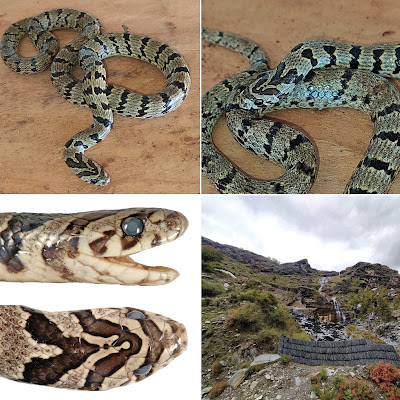


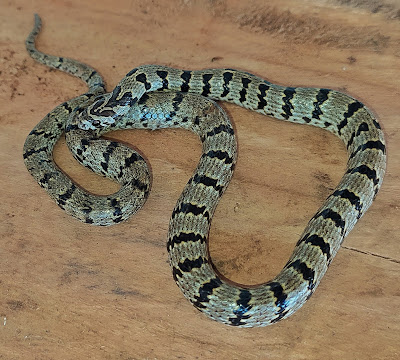
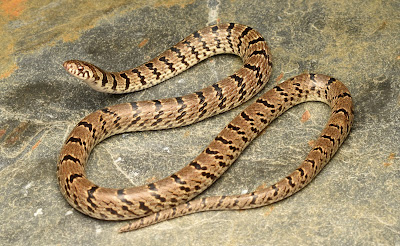
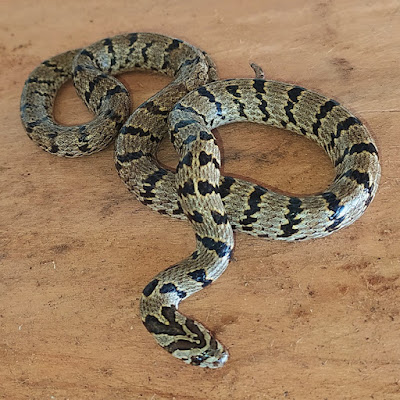
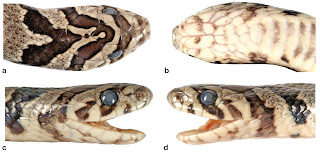
Oligodon churahensis sp. nov. holotype female NCBS NRC-AA-019,
view of the head, (a) dorsal, (b) ventral, (c) lateral right, (d) lateral left.

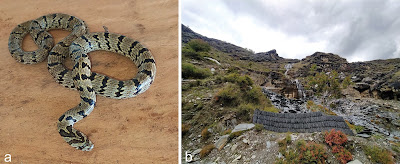
Oligodon churahensis sp. nov.
holotype female NCBS NRC-AA-019 in life(a);
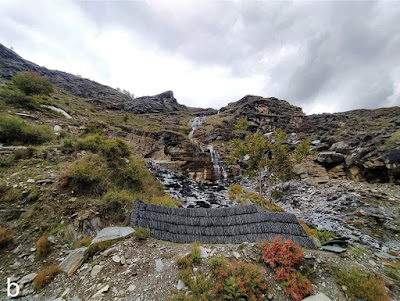
a general view of the habitat at the type locality (b)
 Photos by Virender Kumar.

Oligodon churahensis sp. nov.
 
Diagnosis: A medium sized Oligodon (SVL 275 mm) with 17 dorsal scale rows at midbody. Seven supralabials, 3rd and 4th in contact with the eye. Loreal present. 170–175 ventrals, 46–47 subcaudals. Palatine and pterygoid teeth absent. Dorsal patterns consist of 1–2 dorsal scales wide black bands edged with yellow. Ventral scales white with brown smear along the width of each scale, the smear is darker on the lateral edges forming a blotch on each side. 48 to 54 bands in total on the body. Hemipenis forked and spinose throughout.

Etymology: The specific epithet refers to the Churah Valley where the new species was collected.

Suggested common name: Churah Valley Kukri

Natural history notes: 
The holotype and the paratype were found actively moving along a mud road around 20:00 hours (Fig. 6b). Additionally, five more individuals (uncollected) of the species were encountered at the same locality between the last weeks of May to late June 2020. All the individuals were found near the village after dusk. Sympatric reptile species recorded at the locality include Cyrtodactylus chamba Agarwal, Khandekar & Bauer, 2018, Asymblepharus sp., Lycodon mackinnoni Wall, 1906, Gloydius himalayanus (Günther, 1864), Orthriophis hodgsonii (Günther, 1864), Laudakia sp. and Liopeltis sp. None of the observed individuals showed any sign of aggression nor did they try to bite except for the male paratype, which bit one of us upon capture.
 

 Zeeshan A. Mirza, Virender Kumar Bhardwaj and Harshil Patel. 2021. A New Species of Snake of the Genus Oligodon Boie in Fitzinger, 1826 (Reptilia, Serpentes) from the Western Himalayas. Evolutionary Systematics. 5(2): 335-345. DOI: 10.3897/evolsyst.5.72564

[Botany • 2021] Asplenium pahli (Polypodiales, Aspleniaceae) • A New Species from Leyte, Philippines — [Taxonomic and Nomenclatural Notes on Philippine Ferns. IV]


Asplenium pahli Salgado,

in Salgado, 2021. 

 
Abstract
Asplenium pahli, a new species from Leyte, Philippines, is described. Morphological and distribution range differences between A. pahli, A. anisodontum, A. caudatum, A. falcatum, A. gueinzianum, and A. planicaule are discussed. The habitat and climate of Eastern Leyte is described.

Keywords: Philippine pteridophyte taxonomy, Philippine new species, Pteridophytes 


Asplenium pahli Salgado, Wenzel 572, holotype (P).
Note the plantlets near the apex of two fronds. Muséum national d’histoire naturelle, Paris, France. Collection: Vascular plants P00370339.
License CC Attribution 4.0 International. Available at: science.MNHN.fr/institution/mnhn/collection/p/item/p00370339

Asplenium pahli Salgado, sp. nov.  

Diagnosis:—Asplenium pahli and A. anisodontum have a proliferous rachis but differ in the pinna shape and serration. A. pahli differs from A. caudatum, A. falcatum, A. gueinzianum, A. planicaule and A. polyodon in the proliferous rachis, the pinna margins being irregularly serrate, sinuses of different depth and width, fewer sori distant from the costa, not contiguous, and straight or slightly falcate.

Distribution and ecology:— Island of Leyte, Central-Eastern Philippines. A terrestrial species growing on the eastern slopes of the Leyte Cordillera, at 500 m elevation, in lowland tropical evergreen rainforest. Climate warm and humid; rainfall evenly distributed throughout the year (Pagasa 2020). 

 Etymology:— The species epithet honors Brother George Pahl, FSC, Ph.D., an American biologist and university professor who taught, mentored, and inspired thousands of students in the United States and the Philippines during his teaching career spanning more than 50 years.


Arthur Edward Salgado. 2021. Taxonomic and Nomenclatural Notes on Philippine Ferns. IV. Asplenium pahli (Polypodiales, Aspleniineae, Aspleniaceae), A New Species from Leyte, Philippines. Phytotaxa. 524(2); 71-84. DOI: 10.11646/phytotaxa.524.2.1

[Crustacea • 2021] Geothelphusa boreas • A New Montane Freshwater Crab (Decapoda: Potamidae: Potamiscinae) from northeastern Taiwan, and the Identity of G. hirsuta Tan & Liu, 1998


Geothelphusa boreas  
 Shy, Shih & Mao, 2021

 
Abstract
A new freshwater crab is described from the montane area in northeastern Taiwan based on morphological and molecular evidence. Geothelphusa boreas sp. nov., from the Fushan Botanical Garden situated around New Taipei City and Yilan County, is distinct from similar congeners by the structure of the male first gonopod and the proportions of the male thoracic sternites. In addition, after comparing the holotypes of G. takuan and G. hirsuta Tan & Liu, 1998, no substantial difference could be found. Molecular evidence from mitochondrial cytochrome oxidase subunit I also supports the recognition of the new species and the conspecificity of G. hirsuta with G. takuan.
 
Key words: Crustacea, Potamidae, freshwater crab, new species, Geothelphusa boreasGeothelphusa hirsutaGeothelphusa takuan, Taiwan, mitochondrial. DNA, cytochrome oxidase subunit


Figure 2. Geothelphusa boreas sp. nov.
A, B, C, dorsal, frontal and ventral views of the holotype (NCHUZOOL 13615);
D, habitat in Dakeng Bridge, Suao, Yilan;
E, F, habitat in Shenmihu, Nan-ao, Yilan;
G, H, habitat in Tongshan, Nan-ao, Yilan.
 The arrows in E and G indicated the localities with crabs observed. The two rulers in H were used for a separate ecological study of the habitat.

Family Potamidae Ortmann, 1896
Subfamily Potamiscinae Ortmann, 1896 (sensu Yeo & Ng 2003)

Genus Geothelphusa Stimpson, 1858

Geothelphusa boreas sp. nov.

Diagnosis. Carapace length, width 1.7-, 2.3-times carapace height, respectively. Anterolateral margins distinct, lined with inconspicuous granules, without epibranchial tooth. Subterminal segment of G1 (Fig. 3A–C) curving inwards, outer proximal margin without tooth; terminal segment slightly curving outwards to almost straight; total length of G1 5.8 times terminal segment.  

Etymology. The species is derived from the Greek “boreas” (for north), alluding to the northernmost distribution of this species in the Central Range.


Jhy-Yun Shy, Hsi-Te Shih and Jean-Jay Mao. 2021. Geothelphusa boreas, A New Montane Freshwater Crab (Crustacea: Potamidae: Geothelphusa) from northeastern Taiwan, and the Identity of G. hirsuta Tan & Liu, 1998. Zootaxa. 5060(1); 93-104. DOI: 10.11646/zootaxa.5060.1.4 

Tuesday, November 2, 2021

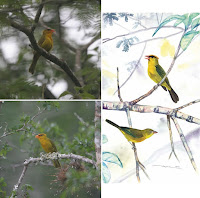
[Ornithology • 2021] Heliothraupis oneilli • A New Genus and Species of Tanager (Passeriformes, Thraupidae) from the lower Yungas of western Bolivia and southern Peru


Heliothraupis oneilli
Lane, Justiniano, Terrill, Rheindt, Klicka, Rosenberg, Schmitt & Burns, 2021

Inti Tanager ||  DOI: 10.1093/ornithology/ukab059
 
Abstract
We describe a colorful and distinctive new species of tanager from the lower slopes of the Andes of southeastern Peru and western Bolivia. The species was first noted from southeastern Peru in 2000, but little of its natural history was uncovered until the 2011 discovery of a breeding population in deciduous forest in an intermontane valley, the Machariapo valley, in Bolivia. This species appears to be an intratropical migrant, breeding in deciduous forest during the rainy season (November–March) and spending the dry season dispersed along the lower slopes of the Andes, apparently favoring Guadua bamboo-dominated habitats in both seasons. Phylogenetic evidence suggests this tanager is embedded within a clade of thraupids that includes Ramphocelus, Coryphospingus, Loriotus, Tachyphonus, and related genera in the subfamily Tachyphoninae. Within this subfamily, the new species falls in a clade with two monotypic genera, Eucometis penicillata (Gray-headed Tanager) and Trichothraupis melanops (Black-goggled Tanager). There is strong support for a sister relationship between the new tanager and T. melanops, but because all three species in this clade are highly distinctive phenotypically, we propose erecting a new genus and species name for the new tanager.


Daniel F. Lane, Miguel Angel Aponte Justiniano, Ryan S. Terrill, Frank E. Rheindt, Luke B. Klicka, Gary H. Rosenberg, C. Jonathan Schmitt and Kevin J. Burns. 2021. A New Genus and Species of Tanager (Passeriformes, Thraupidae) from the lower Yungas of western Bolivia and southern Peru. Ornithology. ukab059. DOI: 10.1093/ornithology/ukab059


RESUMEN: Describimos una nueva especie de tangara, colorida y distintiva, de las colinas bajas de los Andes del sureste de Perú y del oeste de Bolivia. La especie fue registrada por primera vez en el sureste peruano en el año 2000, pero poco de su historia natural fue develada hasta el año 2011, cuando se descubrió de una población reproductiva en bosques caducifolios en un valle intermontano (valle del Machariapo) en Bolivia. Parece que esta especie es un migrante intratropical, que se reproduce en bosques caducifolios durante la temporada de lluvias (noviembre-marzo) y pasa la temporada seca, dispersa a lo largo de las colinas bajas de los Andes, aparentemente prefiriendo los hábitats dominados por el bambú Guadua, en ambas estaciones. La evidencia filogenética sugiere que esta tangara está dentro de un clado de tráupidos que incluye a Ramphocelus, Coryphospingus, Loriotus, Tachyphonus y géneros relacionados en la subfamilia Tachyphoninae. Dentro de esta subfamilia, la nueva especie pertenece a un clado con dos géneros monotípicos, Eucometis penicillata y Trichothraupis melanops. Existe un fuerte soporte para una relación hermana entre esta nueva tangara y T. melanops, pero debido a que las tres especies dentro de este clado son fenotípicamente muy diferentes, proponemos erigir un nuevo género y nombre de especie para la nueva tangara.


[Mammalogy • 2021] Mesoplodon eueu Speciation in the Deep: Genomics and Morphology reveal A New Species of Beaked Whale (Odontoceti: Ziphiidae)


Mesoplodon eueu
Carroll, McGowen, McCarthy, Marx, Aguilar, Dalebout, Dreyer, Gaggiotti, Hansen, ... et Olsen, 2021

Ramari's Beaked Whale || DOI: 10.1098/rspb.2021.1213 

Abstract
The deep sea has been described as the last major ecological frontier, as much of its biodiversity is yet to be discovered and described. Beaked whales (ziphiids) are among the most visible inhabitants of the deep sea, due to their large size and worldwide distribution, and their taxonomic diversity and much about their natural history remain poorly understood. We combine genomic and morphometric analyses to reveal a new Southern Hemisphere ziphiid species, Ramari's beaked whale, Mesoplodon eueu, whose name is linked to the Indigenous peoples of the lands from which the species holotype and paratypes were recovered. Mitogenome and ddRAD-derived phylogenies demonstrate reciprocally monophyletic divergence between M. eueu and True's beaked whale (M. mirus) from the North Atlantic, with which it was previously subsumed. Morphometric analyses of skulls also distinguish the two species. A time-calibrated mitogenome phylogeny and analysis of two nuclear genomes indicate divergence began circa 2 million years ago (Ma), with geneflow ceasing 0.35–0.55 Ma. This is an example of how deep sea biodiversity can be unravelled through increasing international collaboration and genome sequencing of archival specimens. Our consultation and involvement with Indigenous peoples offers a model for broadening the cultural scope of the scientific naming process.

Keywords: True's beaked whale, Mesoplodon mirus, Ramari's beaked whale, Mesoplodon eueu, taxonomy, biodiversity


Figure 1. Sampling locations in the NA (black circles) and SH (yellow circle). Global map viewed as a Spilhaus projection that shows the connectedness of the ocean, with sampling locations and distribution of Mesoplodon mirus and proposed species Mesoplodon eueu shown by the key, with the artist's impression of the species in top right.
Credit: Vivian Ward, University of Auckland.

Figure 4. Skull and morphological distinctiveness of Mesoplodon eueu shown by holotype (NMNZ MM003000). (a) Skull in dorsal (left), ventral (centre) and left lateral (right) view (b) periotic in dorsal (left) and ventral (right) view; (c) tympanic bulla in dorsal (left) and ventral (right) view; (d) mandible in dorsal (top) and lateral (bottom) view; (e) mandibular tusks in medial (left) and lateral (right) view. (f) PCA of cranial and mandibular measurements showing clear separation between M. eueu from the SH and M. mirus from the NA. Percentages next to principal components (PCs) denote the total variance explained. Filled stars are holotypes and hollow stars paratypes.  

Skull of Mesoplodon eueu shown by holotype (NMNZ MM003000),
 in dorsal, ventral and left lateral view.


Systematic biology
Cetacea Brisson 1762
Ziphiidae Gray 1865

Mesoplodon Gervais 1850

Mesoplodon eueu sp. nov.

Holotype: NMNZ MM003000, a pregnant, 5.06 m long adult female named Nihongore by Te Rūnanga o Makaawhio. Collected by Ramari Stewart, Nathaniel Scott and Don Neale after beachcast on 27 November 2011. The complete skeletons of the female and fetus are held by Museum of New Zealand Te Papa Tongarewa (NMNZ, Wellington, Aotearoa New Zealand; specimen MM003000), and a tissue sample is held in the New Zealand Cetacean Tissue Archive (NZCeTA, University of Auckland, Auckland, Aotearoa New Zealand; all institutional abbreviations in electronic supplementary material, S1).

Type locality: Waiatoto Spit, South Westland, Aotearoa New Zealand.

Diagnosis: 
Molecular characteristics
M. eueu differs from M. mirus based on nuclear DNA markers, and from M. mirus and its closest relatives M. europaeus, M. ginkgodens and M. bidens using mtDNA markers (figure 2). M. mirus is distinct from all other mesoplodont species based on previous mitochondrial and nuclear DNA trees [7,20,24].

Mitochondrial DNA: analysis of mitochondrial data includes sequences from the holotypes of both M. mirus and M. eueu at all sequence lengths. Over the 304 bp mitochondrial control region segment, M. eueu is distinguished by seven fixed differences from M. mirus, with FST = 0.85 (p < 0.01), dA = 0.04 between the two species. At the full mitochondrial genome lengths, M. eueu is distinguished by 579 fixed differences from M. mirus with FST = 0.96 (p < 0.01) and dA = 0.04 (electronic supplementary material, table S2).

Nuclear DNA: reduced representation sequencing with ddRAD showed M. eueu had a distinct admixture pattern to M. mirus (figure 2), and an FST = 0.64 (p < 0.0001) was estimated between the two species. M. mirus and M. eueu were distinguished by 1909 fixed differences (12%, per SNP allele error rate = 0.002), across a dataset of 15 671 SNPs found between or within both species. Comparison of one whole nuclear genome each from M. mirus and M. eueu showed a level of nucleotide divergence of 0.28%.

Morphological characters: 
M. eueu is a larger (5.3 m) species of Mesoplodon differing from all other members of the genus except M. mirus, M. hectori and M. perrini in having tusks positioned at the tip of the mandible. It also differs from M. hectori and M. perrini in having smaller, less triangular tusks and from M. mirus in having a relatively shorter rostrum with a wider base, a shorter mandibular symphysis, wider premaxillary sac fossae and crests, and a taller cranium.

Etymology: The scientific and common names acknowledge links with Indigenous communities in South Africa and Aotearoa New Zealand, respectively, and were chosen in consultation with these peoples. Most of the South African strandings come from territory inhabited by the Khoisan peoples. Guided by the Khoisan Council, we chose the name //eu//’eu (simplified to eueu to fit nomenclature standards; correct pronunciation available in associated audio clip a1 in the electronic supplementary material), which means ‘big fish’ in Khwedam (from the Khoe language family). In Aotearoa New Zealand, Māori cultural expert Brad Haami developed a shortlist of potential names meaningful in the Māori language, which was then sent for comment to Te Rūnanga o Ngāi Tahu. The selected common name, Ramari's beaked whale, pays homage to Māori tohunga (expert) Ramari Stewart, who has kept traditional knowledge alive, contributed extensively to scientific research on marine mammals, and helped prepare the skeleton of the holotype. The word ‘Ramari’ means a rare event in the Māori language, reflecting the elusive nature of most beaked whales.


Emma L. Carroll, Michael R. McGowen, Morgan L. McCarthy, Felix G. Marx, Natacha Aguilar, Merel L. Dalebout, Sascha Dreyer, Oscar E. Gaggiotti, Sabine S. Hansen, Anton van Helden, Aubrie B. Onoufriou, Robin W. Baird, C. Scott Baker, Simon Berrow, Danielle Cholewiak, Diane Claridge, Rochelle Constantine, Nicholas J. Davison, Catarina Eira, R. Ewan Fordyce, John Gatesy, G. J. Greg Hofmeyr, Vidal Martín, James G. Mead, Antonio A. Mignucci-Giannoni, Phillip A. Morin, Cristel Reyes, Emer Rogan, Massimiliano Rosso, Mónica A. Silva, Mark S. Springer, Debbie Steel and Morten Tange Olsen. 2021. Speciation in the Deep: Genomics and Morphology reveal A New Species of Beaked Whale Mesoplodon eueuProc. R. Soc. B. 288. 20211213: 20211213. DOI: 10.1098/rspb.2021.1213


[Ichthyology • 2021] Profundulus adani • A New Species of Killifish of the Genus Profundulus (Atherinomorpha: Profundulidae) from the Upper Reaches of the Papaloapan River in the Mexican State of Oaxaca


Profundulus adani
 Dominguez-Cisneros, Velázquez-Velázquez, McMahan & Matamoros, 2021


Abstract
Profundulus adani, new species, is described from the upper reaches of the Papaloapan River in the Mexican state of Oaxaca. The uniqueness of this new species is supported by morphological and molecular evidence. A combination of color patterns and counts separate P. adani, new species, from its congeners. Profundulus adani, new species, is distinguished from all congeners by the absence of a humeral spot in individuals larger than 45 mm SL. It can further be distinguished from P. balsanus, P. chimalapensis, P. kreiseri, P. oaxacae, P. parentiae, and P. punctatus based on the absence of series of dark dots on the sides of the body. Profundulus adani, new species, shows a faded dark band that extends from the tip of the operculum to the end of the caudal peduncle; this band is absent in P. balsanus and P. parentiae. The new species is described using specimens collected in the upper reaches of the Papaloapan River in the Mexican state of Oaxaca; geographically this represents a significant range expansion and extends the Atlantic slope northernmost limit of the Profundulidae.

Known geographic distributions of species in the genus Profundulus. Localities of Profundulus adani depicted by yellow stars. Distributional data from UNICACH-MZ-P and complemented with data from global aggregators such as FishNet2 (accessed through the Fishnet2 Portal, www. fishnet2.net, 2020-12-10) and the Global Biodiversity Information Facility (GBIF, 2020).

 Profundulus adani, new species
 Papaloapan Killifish

Distribution and habitat.—The known distribution of P. adani is limited to the three localities reported here in the upper reaches of the Papaloapan River in the Mexican state of Oaxaca (Fig. 1). These three localities are small creeks of high order at altitudes above 1500 masl, characterized by shallow streams with boulders, rocks, and gravel dominating the substrate (Fig. 5). 

Etymology.—In recognition of his contributions to the study and conservation of freshwater fishes in southern Mexico, this species is named after our friend, colleague, and Mexican ichthyologist Adán E. Gómez González who tragically passed away in January 2018.

 
Sara E. Dominguez-Cisneros, Ernesto Velázquez-Velázquez, Caleb D. McMahan, and Wilfredo A. Matamoros. 2021. A New Species of Killifish of the Genus Profundulus (Atherinomorpha: Profundulidae) from the Upper Reaches of the Papaloapan River in the Mexican State of Oaxaca.  Ichthyology & Herpetology. 109(4), 949-957. DOI: 10.1643/i2020156

Profundulus adani especie nueva se describe de la cuenca alta del r´ıo Papaloapan en el estado mexicano de Oaxaca. La distintividad de esta nueva especie esta´ respaldada por evidencia morfologica y molecular. Una combinaci ´ on de ´ patrones de coloracion y conteos separan a ´ P. adani especie nueva de sus congeneres. ´ Profundulus adani especie nueva se distingue de todos sus congeneres por la ausencia de una mancha humeral en individuos mayores de 45 mm SL. Adema ´ ´s, se puede distinguir de P. balsanus, P. chimalapensis, P. kreiseri, P. oaxacae, P. parentiae y P. punctatus por la ausencia de l´ıneas de puntos oscuros en los lados del cuerpo. Profundulus adani especie nueva muestra una banda oscura descolorida que se extiende desde la punta del operculo hasta el final del ped ´ unculo caudal; esta franja esta ´ ´ ausente en P. balsanus y P. parentiae. La nueva especie se describe con espec´ımenes recolectados la cuenca alta del r´ıo Papaloapan en el estado mexicano de Oaxaca; geogra´ficamente esto representa una expansion de rango significativa en la vertiente del ´ Atla´ntico para Profundulus.

Monday, November 1, 2021

[PaleoMammalogy • 2021] Eusmilus adelos • The Largest Hoplophonine (Carnivora: Nimravidae) and A Complex New Hypothesis of Nimravid Evolution


Eusmilus adelos
 Barrett, 2021

skeletal reconstruction by Dhruv Franklin  twitter.com/DhruvFranklin

Abstract
Nimravids were the first carnivorans to evolve saberteeth, but previously portrayed as having a narrow evolutionary trajectory of increasing degrees of sabertooth specialization. Here I present a novel hypothesis about the evolution of this group, including a description of Eusmilus adelos, the largest known hoplophonine, which forces a re-evaluation of not only their relationships, but perceived paleoecology. Using a tip-dated Bayesian analysis with sophisticated evolutionary models, nimravids can now be viewed as following two paths of evolution: one led to numerous early dirk-tooth forms, including E. adelos, while the other converged on living feline morphology, tens of millions of years before its appearance in felids.


Partial skeleton of USNM 12820, Eusmilus adelos with shaded known elements. Cranial abbreviations: fr frontal, na nasal, mp mastoid process, (A) cn carnassial notch, mc main cusp of P3, pa paracone, pcc posterior cingular cusp of P3, ps parastyle; (B–D) bis brachialis insertion site, lg lateral groove of ulna, rn radial notch, sln semilunar notch, (E–G) ce capitular eminence of radius, rt radial tuberosity, (H–J) dpc delto-pectoral crest, of olecranon fossa, sc supinator crest (brachial flange), *remnants of bridge enclosing epicondylar foramen. Eusmilus adelos skeletal reconstruction by Dhruv Franklin.

Tip-dated Bayesian phylogeny of the Nimravidae, outgroups (save Tapocyon) removed. Two main clades were recovered, the Hopliphoninae and Nimravinae, the latter of which includes all barbourofelin taxa. Color gradient reflects maximum-likelihood estimation of ancestral body mass. Additional nodal values (e.g., posterior probability, divergence dates) can be found in Supplementary.

Systematic palaeontology

Carnivora 
Nimravidae 

Eusmilus 

Eusmilus adelos sp. nov.

Holotype: Smithsonian National Museum of Natural History, Washington D.C., USA (USNM) 12820: partially crushed cranium, parts of both dentaries, atlas, axis, 3rd, 5th and 7th cervical vertebrae, three lumbar vertebrae, left: scapula, distal humerus, proximal and distal ends of radius, proximal ulna (Figs. 1, 2, 3, Supplementary Figs. S1–S3).

Etymology: From the Greek adelos, for unseenunknown, or secret. The specific epithet refers to the unclear taxonomic affiliations these specimens have had in their more than 85 year history of publication. 


Paul Zachary Barrett. 2021. The Largest Hoplophonine and A Complex New Hypothesis of Nimravid Evolution. Scientific Reports. 11, 21078. DOI: 10.1038/s41598-021-00521-1

[Herpetology • 2021] Leptobrachella murphyi • Integrative Taxonomy reveals A New Species of Leptobrachella (Anura: Megophryidae) from the mountains of northern Thailand


Leptobrachella murphyi
Chen, Suwannapoom, Wu, Poyarkov, Xu, Pawangkhanant & Che, 2021

Chiang Mai Leaf Litter Toad || DOI: 10.11646/zootaxa.5052.2.2

Abstract
The genus Leptobrachella is one of the most speciose and taxonomically troubling groups of Asian anurans. Herein, we describe a new species of Leptobrachella from Doi Inthanon, Chiang Mai Province, Thailand based on the integration of morphological, acoustic and molecular data. The new species, Leptobrachella murphyi sp. nov., is morphologically distinguished from its congeners on the basis of body size, dorsal skin texture and coloration, ventral coloration and pattern, degree of webbing and fringing on the fingers and toes, iris coloration in life, pattern of markings on flanks and pattern of body macroglands. It also differs from its phylogenetically close congeners by an uncorrected p-distance of >9.6% for a fragment of 16S rRNA. The advertisement call of the new species consists of 4.5–4.7 kHz (at 15 °C) and without a distinct introductory note. Leptobrachella murphyi sp. nov. likely occurs across the Thanon Thong Chai Range and analyses provide evidence of unknown biodiversity and species composition on Doi (mountain) Inthanon. In addition, the congeneric species L. minima was also confirmed in Doi Inthanon. The coexistence pattern of Leptobrachella in Doi Inthanon deserves further study. As Thailand’s highest mountain and biodiversity reservoir, the need for further biological exploration is urgent given ongoing habitat loss and degradation.

Keywords: Amphibia, Biodiversity hotspot, Cryptic diversity, Integrative taxonomy, Leptobrachella murphyi sp. nov., Southeast Asia, Thailand


FIGURE 4. Holotype of Leptobrachella murphyi sp. nov. (KIZ034039) in life.
 (A) General dorso-lateral view, (B) dorsal view, (C) ventral view, (D) thenar view of the right hand, (E) plantar view of the right foot, (F) close-up of the iris.
 Photos by Chatmongkon Suwannapoom.

Leptobrachella murphyi sp. nov.
Chresonymy: Leptolalax sp. — Ohler et al. 2011: 9; 
Leptolalax sp. 3 — Chen et al. 2018: 165; 
Leptolalax pelodytoides — Taylor 1962.

Etymology. The specific epithet “ murphyi ” is a patronymic noun in the genitive singular; derived from the name of Prof. Robert W. Murphy from the Royal Ontario Museum, Canada, the co-founder of ColdCode, the international effort to DNA barcode species of amphibians and reptiles. We acknowledge his continuous support and inspiration of our study across the country border from China to Southeast Asia. For the common name, we recommend “Chiang Mai Leaf Litter Toad”.


FIGURE 6. Paratypes of Leptobrachella murphyi sp. nov. in life
in dorso-lateral (upper row) and ventral (lower row) aspects.
A: KIZ034038; B: KIZ034158.
Photos by Chatmongkon Suwannapoom.


Jin-Min Chen, Chatmongkon Suwannapoom, Yun-He Wu, Nikolay A. Poyarkov, Kai Xu, Parinya Pawangkhanant and Jing Che. 2021. Integrative Taxonomy reveals A New Species of Leptobrachella (Anura: Megophryidae) from the mountains of northern Thailand. Zootaxa. 5052(2); 41-64. DOI: 10.11646/zootaxa.5052.2.2 

[Botany • 2018] Monstera limitaris (Araceae) • A New Species from the border between Costa Rica and Panama


Monstera limitaris M. Cedeño,  

in Cedeño-Fonseca, Karremans & Ortiz, 2018. 

Abstract
Species of genus Monstera are among the most representative hemi-epiphytic Araceae in the Neotropics. They are widely distributed and abundant in the tropical forests of Costa Rica and Panama. During recent exploration in the border region between the two countries, an undescribed species belonging to the genus has been identified. The new species, Mostera limitaris, is described and illustrated here, using a color plate based on photographs of the vegetative and reproductive structures of live material.

Keywords: Central America, fieldwork, Monstera, Monsteroideae, taxonomy, Monocots


FIGURE 1. Lankester Composite Dissection Plate (LCDP) of Monstera limitaris sp. nov.
A. Inflorescence development: B. Frontal and back part-opened inflorescence: C. Infructescence (detachment styling cape): D. Seeds: E. Complete flower (left); cross-section flower (right): F. style and stigma (left); Anther (right): G. Sterile flowers: H. Adult plant: I. seedling.

FIGURE 2. Comparison between Monstera limitaris (A-D), and M. dissecta (E-H).
A. Adult plant. B. Brown stem. C. Flower (left); flower in cross section (right). D. Geniculum with crenate margins (upper arrow) and petiole with semi-persistent sheath (lower arrow).
E. Adult plant. F. Green stem. G. Geniculum with entire margins (upper arrow) and petiole with persistent sheath (lower arrow). H. Flower (left); flower in cross section (right).

Monstera limitaris M. Cedeño, sp. nov.  
Monstera limitaris is characterized by having leaves with verruculose petioles at base, semi-persistent and convolute sheaths, crenate geniculum margins, blades with pinnatifid margins and fenestrations along the midrib as well as by the white-yellowish acuminate spathe, a creamy-white spadix and flowers with lateral-flattened stigmatophore and linear stigma which have a colorless stigmatic secretion.

Eponymy:—The name limitaris, from the Latin “limitis”, refers to a border or boundary, alluding to the type locality, which is on the Costa Rica and Panama border.


Marco Cedeño-Fonseca, Adam P. Karremans and Orlando O. Ortiz. 2018. Monstera limitaris (Araceae), A New Species from the border between Costa Rica and Panama. Phytotaxa. 376(1); 37–42. DOI: 10.11646/phytotaxa.376.1.4