Sunday, October 29, 2023

[Cnidaria • 2023] Bellactis lux • A New Sea Anemone (Anthozoa: Actiniaria: Aiptasiidae) from the Gulf of Mexico


Bellactis lux 
Delgado, Larson, Sheridan & Daly, 2023

 
Abstract
Here we describe a new species of sea anemone from the family Aiptasiidae based on specimens collected from the Gulf of Mexico (USA: Florida & Alabama). Accounts of this species have been known since the early 1990’s, primarily from an underwater field guide and hobbyist aquarium literature under the name “Lightbulb Anemone.” We describe it as a new species from the genus Bellactis based on anatomy, histology, and cnidom. Members of this species are small in size, with a smooth, typically contracted column divided into regions based on color and bearing rows of two or three elevated cinclides in the mid column. Their tentacles are distinctive, translucent, distally inflated and can be bulbous in shape, with sub annular rings. This description synthesizes information about Bellactis and contextualizes what is known about its diversity in light of other members of the Aiptasiidae.

Keywords: Coelenterata, Cnidaria, Anthozoa, Actiniaria, Aiptasiidae 


 Bellactis lux n. sp. 


Alonso Delgado, Paul Larson, Nancy Sheridan and Marymegan Daly. 2023. Bellactis lux n. sp. (Cnidaria: Anthozoa: Actiniaria: Aiptasiidae), A New Sea Anemone from the Gulf of Mexico.  Zootaxa. 5353(4); 379-392. DOI: 10.11646/zootaxa.5353.4.5


[Botany • 2021] Stemona namkhunensis (Stemonaceae) • A New Species from Eastern Thailand


Stemona namkhunensis Chatan & Promprom, 

in Promprom et Chatan, 2021.

Abstract
Stemona namkhunensis Chatan & Promprom, a new species from the East of Thailand, is described and illustrated. It is morphologically similar to S. collinsiae Craib but clearly differs in the characteristic of the petiole, lamina, tepal, stamen, pistil, simple and pedunculated flower, and lacking bract. A morphological description, distribution, ecology, etymology, vernacular name, preliminary conservation status, and photographs are provided. A key to species of the erect species in Thailand is presented.

Keyword: Erect species, new species, Stemona collinsiae, taxonomy, Ubon Ratchathani Province


Stemona namkhunensis Chatan & Promprom.
 A. & B. Flowers, C. & D. tepals (adaxial and abaxial sides, respectively), E. Androeciym, F. and G. stamens (adaxial and abaxial sides, respectively), H. Gynoecium, I. Young fruit.
Photos by: Wilawan Promprom.

Stemona namkhunensis Chatan & Promprom sp. nov.
A. Habits and Habit in the field, B. Habit in the author‘s home garden, C. Roots.
Photos by: Wilawan Promprom.


Stemona namkhunensis
Chatan & Promprom, sp. nov. 
 
Diagnosis: The most similar species of Stemona namkhunensis Chatan & Promprom is S. collinsiae Craib because they share similar morphological characters, including erect and glabrous herb, alternate leaves, long tepal (more than 15 mm long), inner tepals larger than outer tepals, and the absence of thecal appendage. 
It differs from S. collinsiae Craib in having distinctly pulvinate petiole (vs. indistinct one), wider lamina with slightly fewer in a number of the vein (vs. smaller one with somewhat greater in number), Simple flower with no bract, and always with long peduncle (vs. inflorescence with bracts and peduncle, sometimes sessile inflorescence present near stem base), slightly narrower tepal, i.e., width and length ratio 1: 3.33–4.25 (vs. slightly wider one, i.e., width and length ratio 1: 2.0–3.6). Narrowly lanceolate to slightly linear stamen, ovate-cylindrical ovary, conspicuous stigma with retuse apex with two groups of hair ((vs. narrowly lanceolate stamen and ovate ovary with inconspicuous and glabrous stigma).

Etymology: The epithet refers to Nam Khun District, Ubon Ratchathani Province, where the type was collected. 
Vernacular name: Non Tai Yak Phum - หนอนตายหยากพุ่ม


Wilawan Promprom and Wannachai Chatan. 2021. Stemona namkhunensis (Stemonaceae), A New Species from Eastern Thailand. Taiwania. 66(3); 332 - 336. DOI: 10.6165/tai.2021.66.332


[Ichthyology • 2023] Rhinotridens chromocaudatus • A New Genus and Species of miniature tridentine Catfish (Siluriformes: Trichomycteridae) from the Amazon Basin


Rhinotridens chromocaudatus
 Datovo, Ochoa, Vita, Presti, Ohara & de Pinna, 2023


Abstract
A new miniature tridentine catfish is described from the rio Purus drainage, Amazon basin, Brazil. It differs from all other tridentines in having several unique autapomorphies: conspicuous anteromedial protuberance in the snout; set of symphyseal premaxillary and dentary teeth inclined posteromedially; distal process of the hyomandibula directed anteriorly; rod-like orbitosphenoid ossified only ventral to the optic nerve; mesethmoid cornua inclined ventrolaterally; opercular and interopercular odontodophores separated by a large interspace; basipterygia fused sagittally; and conspicuous dark brown horizontal stripe in the middle of the caudal fin. The new taxon is hypothesized to be sister to the clade formed by Tridensimilis and Tridens. A detailed osteological description of the new taxon is provided based on X-ray microcomputed tomography (µCT-scans) data and on cleared and stained specimens. Our analysis also reveals that “Tridens” brevis, an enigmatic species that has been indecisively assigned to three different tridentine genera over the past 134 years, belongs to Tridentopsis.Consequently, Tridensimilis is a monotypic genus that currently includes only T. venezuelae.

Keywords: Freshwater; Loricarioidei; Ostariophysi; Systematics; Taxonomy


Rhinotridens, new genus
 
Type-species. Rhinotridens chromocaudatus, new species.

Diagnosis. Rhinotridens is distinguished from all other tridentine genera by the following unique autapomorphies: presence of a conspicuous anteromedial protuberance on the snout, with a length greater than 35% of its width (Fig. 1; vs. protuberance absent or limited to a discreet convexity with a length less than 18% of its width; see Baskin, 1973: fig. 66; Henschel et al., 2023: figs. 2, 8, 12, 13); set of symphyseal premaxillary and dentary teeth inclined posteromedially (Fig. 2; vs. not inclined, see Azpelicueta, 1990: figs. 2, 3; Henschel et al., 2023: fig. 9); rod-like orbitosphenoid ossified only ventral to the optic nerve (Fig. 3; vs. laminar bone ossified around the optic nerve, with a foramen for its exit, see Baskin, 1973: figs. 28, 29; Henschel et al., 2023: fig. 3); mesethmoid cornua inclined ventrolaterally (Fig. 4; vs. cornua horizontally straight); distal process of the hyomandibula directed anteriorly (Fig. 5; vs. posteriorly, see Baskin, 1973: fig. 51; Henschel et al., 2017: fig. 2g; Henschel et al., 2023: fig. 4); opercular and interopercular odontodophores separated by a large interspace, greater than the depth of the opercular patch (Fig. 5; vs. patches nearly juxtaposed, separated by a distance less than the depth of the opercular patch, see Baskin, 1973: fig. 51; Azpelicueta, 1990: fig. 4; Henschel et al., 2017: fig. 2g; Henschel et al., 2023: fig. 4); and basipterygia fused sagittally (Fig. 6; vs. separated).
 
Etymology. From rhino, latinized form of the Greek word rhinos (ῥινός), meaning nose or snout, and Tridens, the type genus of the subfamily. In allusion to the rostral protuberance of the new genus. An adjective.

Rhinotridens chromocaudatus, new species
 
Diagnosis. The new species differs from all other tridentines by having a conspicuous dark brown horizontal stripe in the middle of the caudal fin (Fig. 1). Ongoing studies indicate the existence of additional undescribed species of Rhinotridens that lack this caudal stripe (see Discussion). As a result, this character is preemptively proposed as autapomorphic for R. chromocaudatus rather than as a synapomorphy for the genus as a whole.

Etymology. From chroma, latinized form of the Greek word khrôma (χρῶμα), meaning color, and cauda, a Latin word meaning tail. In reference to the presence of the dark brown pigmentation in the middle of the caudal fin. An adjective.


Alessio Datovo, Luz Ochoa, George Vita, Paulo Presti, William M. Ohara and Mario C. C. de Pinna. 2023. A New Genus and Species of miniature tridentine Catfish from the Amazon Basin (Siluriformes: Trichomycteridae). Neotrop. ichthyol. 21(3); www.ni.bio.br/1982-0224-2023-0076

[Botany • 2023] Gastrodia munasinghae & G. thilakapremae (Orchidaceae: Epidendroideae: Gastrodieae) • Two New Species from Sri Lanka [The Study of the Tribe Gastrodieae in Sri Lanka I]


Gastrodia munasinghae G. thilakapremae 
Atthanagoda, C.Bandara & Kumara, 
 
in Bandara, Atthanagoda, Bandara et Kumar, 2023.
 
Abstract
As the first step in the taxonomic study of the tribe Gastrodieae (Orchidaceae), two new species, Gastrodia munasinghae and G. thilakapremae are described here from Sri Lanka based on the distinct morphological differences and long-term field observations. Detailed taxonomic descriptions along with the line drawings, color plates, notes on habitat and ecology, distribution and conservation status, phenology and pollination ecology as well as morphological comparison to the other Gastrodia species in Sri Lanka are also discussed. Both species are endemic to the Island and are assessed as Critically Endangered according to the IUCN Red List criteria. Furthermore, notes are provided along with a distribution map for field identification of all Gastrodia species in Sri Lanka.

Keywords: Monocots, Central Highlands, mycoheterotrophy, potato orchids, Samanala Nature Reserve


 Gastrodia thilakapremea Atthanagoda, C.Bandara & Kumara 


 Gastrodia munasinghae Atthanagoda, C.Bandara & Kumara 


Champika Bandara, Anusha Gayan Atthanagoda, Nadeesha Lewke Bandara and Pankaj Kumar. 2023. The Study of the Tribe Gastrodieae (Orchidaceae, Epidendroideae) in Sri Lanka I: Two New Species of Gastrodia. Phytotaxa. 622(2); 115-130. DOI: 10.11646/phytotaxa.622.2.2


[Botany • 2022] Nepeta iraqo-iranica (Lamiaceae) • A New Species from the Border of Iraq and Iran


Nepeta iraqo-iranica  

in Bordbar, Haloob, Qader et Mirtadzadini, 2022. 

Abstract
Nepeta iraqo-iranica, a new species is described and illustrated from NE of Iraq, Sulaimaniya Province, and W of Iran, Kurdistan Province, NW of Bâne. A table of morphological comparison and detailed discussion with morphologically close species is given. The species is considered Critically Endangered (CR) according to IUCN criteria.

Keywords: Eudicots, Critically Endangered, Nepeta iraqo-iranica, new species, Kurdistan

 Nepeta iraqo-iranica sp. nov.
A) habitat of plants in Iran, B) habit, C) basal leaves, D) inflorescence, E) close-up of inflorescence in flowering time, F) close-up of inflorescence in fruiting time, G) close-up of corolla, H) nutlets, adaxial (left) and abaxial surface (right).
Photographs: A and E, M. Mirtadzadini; B, C, D, F, G and H, K.O.Qader. 
Scale bar = 1 mm.


Firouzeh Bordbar, Ali Haloob, Karzan Omar Qader and Mansour Mirtadzadini. 2022. Nepeta iraqo-iranica (Lamiaceae), A New Species from the Border of Iraq and Iran. Phytotaxa. 550(2); 195–200. DOI: 10.11646/phytotaxa.550.2.8 

[PaleoEntomology • 2023] At the Dawn of Megadiversity – Protoitidae, A New Family of Chalcidoidea (Hymenoptera) from Lower Cretaceous Lebanese Amber


Protoita noyesi  Ulmer & Krogmann, 

in UImer, Janšta, Azar & Krogmann, 2023. 

Abstract
The earliest representatives of Chalcidoidea are described from Barremian age Early Cretaceous Lebanese amber and classified in Protoitidae Ulmer & Krogmann, fam. nov. (Hymenoptera: Chalcidoidea). Protoitidae exhibits a high morphological diversity of the terminal metasomal tergum which may indicate a broad spectrum of oviposition capabilities and the ability to occupy a diverse range of ecological niches. Protoitidae comprises two genera, Protoita Ulmer & Krogmann, gen. nov., and Cretaxenomerus Nel & Azar, 2005 based on C. jankotejai Nel & Azar, 2005, which is transferred from Scelionidae (Hymenoptera: Platygastroidea) to Protoitidae. Together, 10 new species, all by Ulmer and Krogmann, are described in the two included genera–Protoita bidentata, P. istvani, P. noyesi, P. petersi, Cretaxenomerus brevis, C. curvus, C. deangelis, C. mirari, C. tenuipenna, and C. vitreus. Keys to the genera and species of Protoitidae are provided. In addition, we examine the postulated plesiomorphies and apomorphies within Chalcidoidea with respect to the fossil record, and provide additional hypotheses on their biogeographic origins.

Keywords: Barremian age, Paleoentomology, plesiomorphic, taxonomy


Protoita noyesi, holotype
A lateral habitus B apical part of antenna C fore leg basitarsus D mesosoma, lateral E head, posterior F fore wing G ovipositor complex and terminal metasomal segments.
Scale bars: 500 µm (A); 200 µm (F); 100 µm (D); 50 µm (G). 
3v = 3rd valvulae; axl = axillula; btc = basitarsal comb; cal = calcar; cer = cerci; msc = mesoscutum; msct = mesoscutellum; no1 = pronotum; ov = ovipositor; pl2 = mesopleuron; pre = prepectus; prp = propodeum.

Systematic palaeontology

Order Hymenoptera Linnaeus, 1758

Superfamily Chalcidoidea

Family Protoitidae Ulmer & Krogmann, fam. nov.
 
 Protoita Ulmer & Krogmann, gen. nov.
 
Diagnosis: Small, less than 1 mm in length. Head transverse in dorsal view, wider than mesosoma and with temple narrow. Metasoma sessile, broadly associated with mesosoma, and in dorsal view triangular in shape; syntergum no longer than preceding tergite; cerci digitiform. Female with exerted ovipositor at most ¼ as long as length of metasoma.

 Protoita noyesi Ulmer & Krogmann, sp. nov.
 
Diagnosis: The female of Protoita noyesi differs from those of other species in the genus by the following combination of characters: occiput impressed relative to vertex (Fig. 4E). Flagellomere 8–12 with micropilosity on ventrum. Ovipositor sheaths broadened at midpoint before tapering distally (Fig. 4G).


 Jonah M. UImer, Petr Janšta, Dany Azar and Lars Krogmann. 2023. At the Dawn of Megadiversity – Protoitidae, A New Family of Chalcidoidea (Hymenoptera) from Lower Cretaceous Lebanese Amber. Journal of Hymenoptera Research. 96: 879-924. DOI: 10.3897/jhr.96.105494
 phys.org/news/2023-10-oldest-family-jewel-wasps-cretaceous.html

Saturday, October 28, 2023

[Crustacea • 2023] Songpotamon funingense & S. malipoense • A Taxonomic Revision of the Freshwater Crab Genus Parvuspotamon (Decapoda: Brachyura: Potamidae), with Descriptions of A New Genus and Two New Species


 Songpotamon funingense & S. malipoense 

Shi, Pan & Sun, 2023

Abstract
The taxonomy of the potamid crab genus Parvuspotamon Dai & Bo, 1994, with two species native to Yunnan province of southwest China, is revised based on morphological and molecular data. In order to stabilise the taxonomy of these species (and the genus), two separate genera are hereby designated: Parvuspotamon and Songpotamon gen. nov. While Parvuspotamon is restricted to P. yuxiense Dai & Bo, 1994, as a monotypic genus, P. dixuense Naruse, Chia & Zhou, 2018, is transferred to a new genus, Songpotamon gen. nov. In addition, two new species of Songpotamon gen. nov. are described herein: S. funingense sp. nov. and S. malipoense sp. nov. Songpotamon gen. nov. morphologically most resembles Parvuspotamon and Chinapotamon Dai & Naiyanetr, 1994, but can be distinguished by the combination of characters in the carapace, third maxilliped, thoracic sternites, and male first gonopod. The genetic data derived from the mitochondrial 16S rDNA also supports the monophyly of these new taxa.

Key words: China, Crustacea, new combination, Potamiscinae, taxonomy, Yunnan


Songpotamon malipoense gen. et sp. nov., holotype ♂, 21.7 × 16.8 mm (NNU-167444-01)
A overall dorsal view B overall frontal view C overall ventral view.
Scale bars: 10 mm.

 Songpotamon funingense gen. et sp. nov. , holotype ♂, 27.2 × 21.9 mm (NNU-167462-01)
 A overall dorsal view B frontal view of cephalothorax C overall ventral view.
 Scale bars: 10 mm.


Boyang Shi, Da Pan and Hongying Sun. 2023. A Taxonomic Revision of the Freshwater Crab Genus Parvuspotamon Dai & Bo, 1994 (Decapoda, Brachyura, Potamidae), with Descriptions of A New Genus and Two New Species. ZooKeys. 1183: 13-38.  DOI: 10.3897/zookeys.1183.109948

[Mammalogy • 2023] Talpa hakkariensis & Talpa hakkariensisNotes from the Anatolian Underground: Two New Mole Taxa from Eastern Turkey, together with A revised Phylogeny of the Genus Talpa (Eulipotyphla: Talpidae)


Talpa hakkariensis
 Gündüz, Demirtaş, Silsüpür, Özmen, Polly & Bilton, 2023


Abstract
Subterranean life is associated with strong adaptive constraints, leading to the frequent occurrence of morphologically cryptic lineages. This is true of most small mammals, including moles (Eulipotyphla: Talpidae), where a number of species have been recognized recently, particularly following the application of molecular genetics. Here, we use mitochondrial and nuclear DNA sequence data and geometric morphometrics to explore the systematics and evolution of some of the least-known Western Palaearctic moles: the Talpa davidiana group of Eastern Anatolia/Iran. We show that T. davidiana includes four taxa, two of which we describe herein: T. hakkariensis  sp. nov. T. davidiana davidianaT. davidiana tatvanensis ssp. nov., and T. streetorum valid species. For the first time, we apply molecular species delimitation analyses to Talpa, confirming taxonomic hypotheses and suggesting the existence of further morphologically cryptic lineages. These analyses also support the recognition of T. transcaucasica as a valid species distinct from T. levantis. We present a revised phylogeny for Eurasian Talpa and increase the number of known extant taxa to 18, most of which are found in Anatolia, the global hotspot of diversity in this genus. This probably results from the isolation of suitable habitats by a combination of climatic and topographical heterogeneity.

Keywords: geometric morphometrics, molecular phylogeny, new species, species delimitation analyses, subspecies, subterranean, systematics, Talpinae


Talpa hakkariensis   

  
İslam Gündüz, Sadık Demirtaş, Metin Silsüpür, Medine Özmen, P David Polly and David T Bilton. 2023. Notes from the Anatolian Underground: Two New Mole Taxa from Eastern Turkey, together with A revised Phylogeny of the Genus Talpa (Mammalia: Eulipotyphla: Talpidae). Zoological Journal of the Linnean Society. zlad049. DOI: 10.1093/zoolinnean/zlad049

[Paleontology • 2023] Lauravolsella willemeni • A New Species of possible archipolypodan Millipede from the Carboniferous of the Netherlands with unusually long tergites


Lauravolsella willemeni 
J. Haug, Fraaije & C. Haug, 2023


Millipedes have a long evolutionary history, with the oldest presumed fossils of Diplopoda de Blainville in Gervais, 1844 being from the Silurian and the first definite fossil record originating from Devonian deposits. The phylogeny of Diplopoda is not fully resolved yet, especially not concerning fossil representatives. At the same time, already in the Palaeozoic millipedes showed quite a morphological and presumably also ecological variety. We describe here a new species of a Carboniferous millipede from the Westphalian A of the Netherlands, Lauravolsella willemeni n. gen., n. sp., a possible representative of Archipolypoda (†Archipolypoda Scudder, 1882). The species is based on a single specimen, preserved with part and counterpart, which both show a three-dimensional preservation. The specimen has unusually long tergites, in normal life position covering most of the following segment. These long tergites might have been beneficial when performing defensive enrolling. In extant millipedes, enrolling is usually facilitated by softer areas between the sternites, allowing for a certain degree of ventral compression. In the new fossil, the sclerotic sternites occupy the entire length of the ventral side of the segment, not allowing for any type of compression. The new fossil therefore demonstrates another solution for the mechanical challenges during enrolment and increases the morphological diversity of Carboniferous millipedes.

KEYWORDS: Myriapoda, Diplopoda, Archipolypoda, stereo imaging, new genus, new species.

New millipede Lauravolsella willemeni n. gen., n. sp., MAB13859A/B:
A, B, part B; A, cross-polarised light; B, reflected light under ring illumination; C, part A, reflected light under ring illumination.
 Scale bars: 3 mm.


Joachim T. HAUG, René H. B. FRAAIJE and Carolin HAUG. 2023. A New Species of possible archipolypodan Millipede from the Carboniferous of the Netherlands with unusually long tergites. COMPTES RENDUS PALEVOL. 22(29); 595-604


[Invertebrate • 2023] Syllis belmontensis • Genetic Diversity of Polychaete Annelids from the Saint Peter and Saint Paul Archipelago, Equatorial Atlantic, with Description of A New Species


Syllis belmontensis
 Ribeiro, Freitas, Zanol, de Paiva, Fukuda, Guilment & Ruta. 2023

 
Abstract
The Saint Peter and Saint Paul Archipelago (SPSPA) is located in the mid-equatorial Atlantic and represents a potentially important area for biodiversity research; however, its species diversity remains poorly characterized. Particularly, neglected groups such as invertebrates have not been thoroughly registered or described. For instance, no species inventory is provided for Annelida, the phylum to which segmented worms belong. This study represents the first polychaete species inventory from SPSPA, including genetic and morphological data. We have generated COI mtDNA and 16S rDNA sequences intended as DNA barcode to molecularly identify polychaete species via different methods. First, we used the Barcode of Life Database (BOLD) identification tool; second, we calculated genetic distances and performed maximum likelihood trees with selected sequences from the Genbank database. We found that most species identified from SPSPA are strictly distributed in the Atlantic Ocean. Our methods proved that the accuracy of molecular identification was limited by the shortage of the annelid data available in BOLD and Genbank. Additionally, we describe a new species named Syllis belmontensis sp. nov. Overall, these results can be important resources for comparative studies on the distribution and genetic diversity of polychaetes worldwide.

Keywords: 16S rDNA, Annelida, COI, DNA barcoding, Oceanic island, Marine invertebrates

Syllis belmontensis sp. nov.
 
 
Rannyele P. Ribeiro, Roberta Freitas, Joana Zanol, Paulo Cesar de Paiva, Marcelo V. Fukuda, Thomas Guilment and Christine Ruta. 2023. Genetic Diversity of Polychaete Annelids from the Saint Peter and Saint Paul Archipelago, Equatorial Atlantic, with Description of A New Species. Regional Studies in Marine Science. 68, 103243. DOI: 10.1016/j.rsma.2023.103243

[Crustacea • 2023] Oxyarcturus holoacanthus • Revision of the Genus Oxyarcturus (Isopoda: Valvifera: Antarcturidae), with A Description of A New Deep-sea Species from Argentina


Oxyarcturus holoacanthus 
Pereira, Roccatagliata & Doti, 2023

 
Abstract
A new antarcturid isopod, Oxyarcturus holoacanthus sp. nov., is fully described based on seven specimens collected in the Mar del Plata submarine canyon at 2950 m depth, during the “Talud Continental III” expedition on board the Argentinian RV “Puerto Deseado”. Oxyarcturus holoacanthus sp. nov. is closely related to O. spinosus (Beddard, 1886), from which it can be distinguished by the body spine pattern. The penial plate, a novel character for the genus Oxyarcturus, as well as for the family Antarcturidae, is described in detail. The species O. dubius (Kussakin, 1967) and O. beliaevi (Kussakin, 1967) are considered as incertae sedis until further morphological and molecular data can clarify their taxonomic position. An update of the geographic and bathymetric records of the genus Oxyarcturus is provided.

Key Words: Mar del Plata submarine canyon, Oxyarcturus beliaevi (Kussakin 1967), Oxyarcturus dubius (Kussakin 1967), Oxyarcturus holoacanthus sp. nov., Southwest Atlantic

Oxyarcturus holoacanthus sp. nov. Photographs.
Holotype male (MACN-In 44318). A. Habitus, lateral view. Paratype male (MACN-In 44319-a); B. Pleon, dorsal view.
Paratype female (MACN-In 44319-b); C. Head and pereonites 1–4, dorsal view;
D. Habitus, lateral view. cl – caudolateral spine; m – medial spine; l – lateral spine.

Oxyarcturus holoacanthus sp. nov.

Etymology: The specific epithet combines two Greek words holos = “entire, complete” and akantha = “spine”, referring to the many long and acute spines that cover the body surface of this species.


Emanuel Pereira, Daniel Roccatagliata and Brenda L. Doti. 2023. Revision of the Genus Oxyarcturus (Isopoda, Valvifera, Antarcturidae), with A Description of A New Deep-sea Species from Argentina. Zoosystematics and Evolution. 99(2): 457-472. DOI: 10.3897/zse.99.106667

[Herpetology • 2023] Xenophrys pangdaensis • A New Species of Xenophrys (Anura: Megophryidae) from southern Tibet, China

 
Xenophrys pangdaensis
 Shu, Li, Wu, Liu, He, Li, Zhang & Guo, 2023


Abstract
A new species of Xenophrys is described from Yadong County, Tibet Autonomous Region, China based on morphological and molecular evidence. Phylogenetic analyses based on the mitochondrial genes 16S rRNA and COI indicated that this new species represents an independent lineage and the minimum p-distance based on 16S rRNA between this species and its congeners is 4.4%. Additionally, the new species is distinguished from its congeners by a combination of the following morphological characters: (1) small body size, SVL 17.9–22.2 mm in adult males and SVL 23.4 mm in the single adult female; (2) tympanum indistinct, supratympanic fold distinct; (3) canthus rostralis well-developed, snout tip far beyond the margin of the lower lip; (5) pupil vertical; (6) vomerine teeth present, maxillary teeth present; (7) tongue notched posteriorly; (8) supernumerary tubercles absent, subarticular, metacarpal and metatarsal tubercles indistinct; (9) relative finger lengths I < II < IV < III, finger tips rounded, slightly expanded relative to digit widths; (10) toes with narrow lateral fringes and tarsal folds; (11) a dark triangular marking with light edge between eyes, a dark “)(”-shaped marking, with light edge, present on center of dorsum, pectoral glands on sides of the breast.

Key words: Morphology, phylogenetic analyses, taxonomy, Xenophrys pangdaensis sp. nov., Yadong County

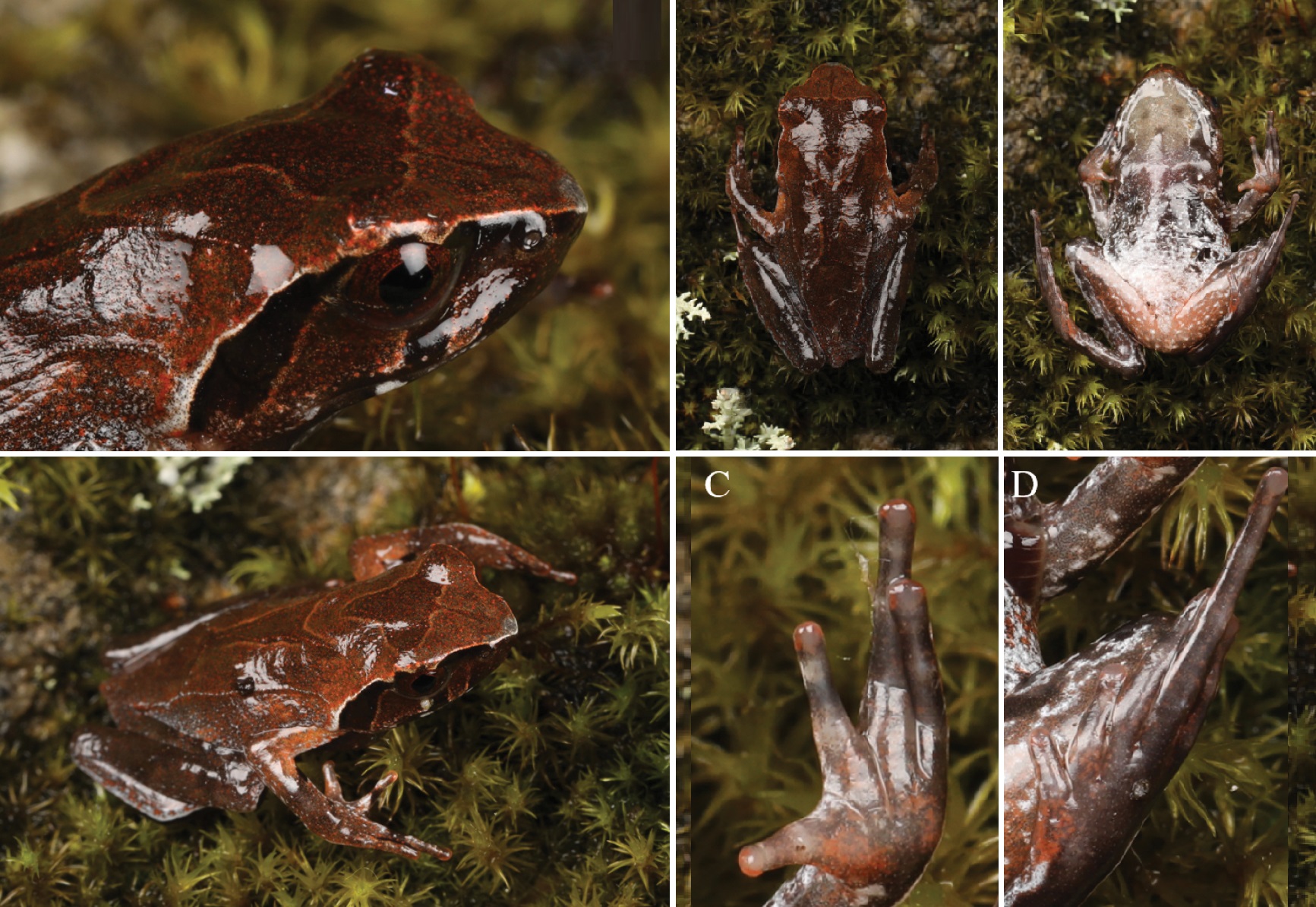
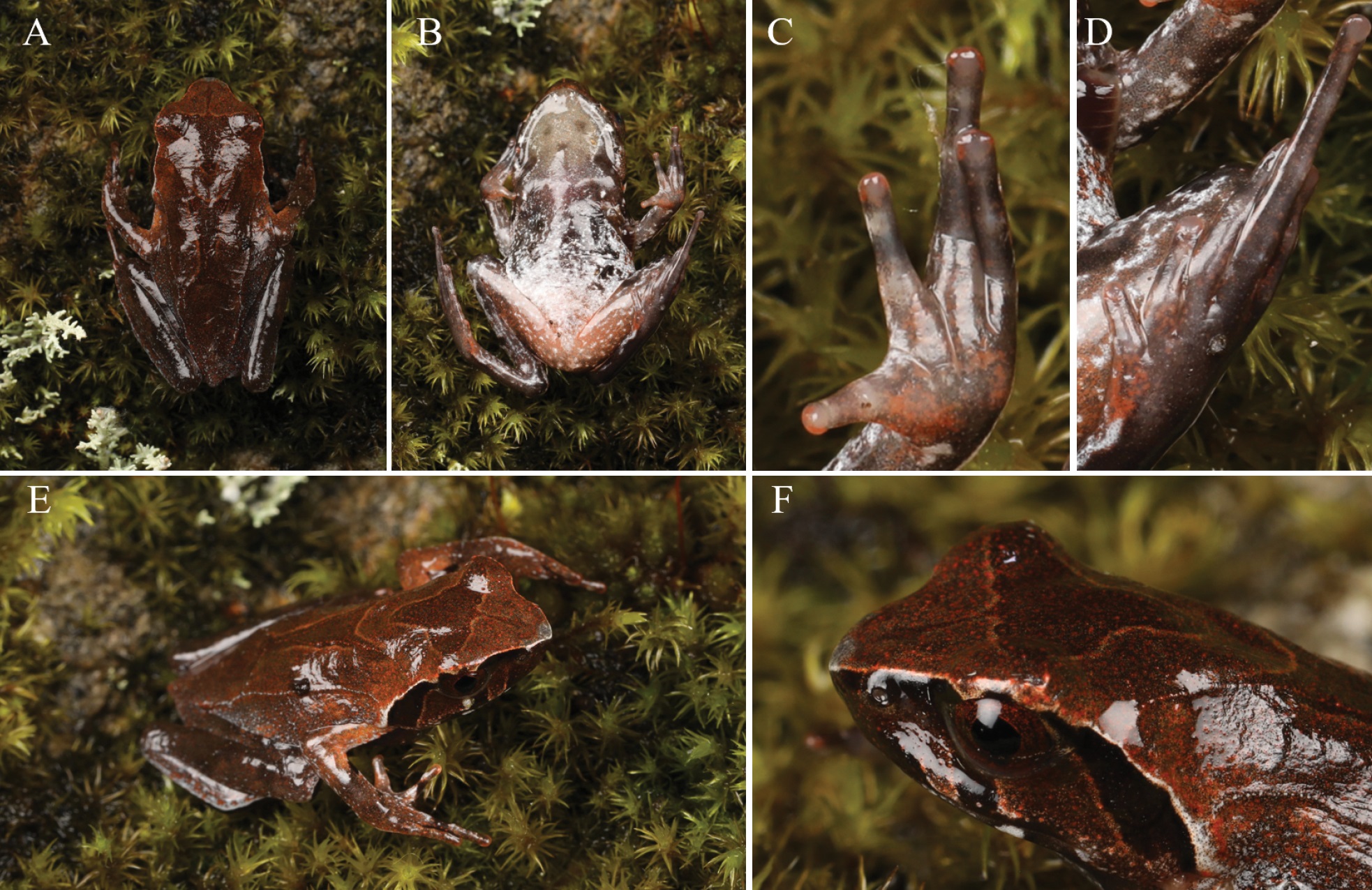
Xenophrys pangdaensis sp. nov. in life.
A dorsal view of body B ventral view of body C ventral view of hand D ventral view of foot E lateral view of body F lateral view of head.

Xenophrys pangdaensis sp. nov.

Diagnoses: (1) Small body size, SVL 17.9–22.2 mm (20.5±1.8, n = 6) in adult males and SVL 23.4 mm (n = 1) in the adult female (Table 3); (2) tympanum indistinct, supratympanic fold distinct; (3) canthus rostralis well-developed, snout tip far beyond the margin of the lower lip; (5) pupil vertical; (6) vomerine teeth present, maxillary teeth present; (7) tongue notched terminally; (8) supernumerary tubercles absent, subarticular, metacarpal and metatarsal tubercles indistinct; (9) relative finger lengths I < II < IV < III, finger tips rounded, slightly expanded relative to digit widths; (10) toes with narrow lateral fringes and tarsal folds; (11) a dark triangular marking with light edge between eyes, a dark)(-shaped marking, with light edge, present on center of dorsum, pectoral glands on sides of the breast.

Etymology: The species name pangdaensis indicates the type locality of Pangda Village, Yadong County, Tibet Autonomous Region, China.

Suggested name: Pangda Horned Toad (English), and 
Pang Da Jiao Chan (庞达角蟾, Chinese).


Guocheng Shu, Ke Li, Yayong Wu, Qin Liu, Zhongping He, Ling Li, He Zhang and Peng Guo. 2023. A New Species of Xenophrys (Amphibia, Anura, Megophryidae) from southern Tibet, China. ZooKeys. 1182: 307-329. DOI: 10.3897/zookeys.1182.106828


[Botany • 2023] Curcuma suraponii (Curcuma subg. Curcuma, Zingiberaceae) • A New Species from Tak Province, Northern Thailand


 Curcuma suraponii 
 Boonma. 2023.

 
Abstract
A new species, Curcuma suraponii Boonma sp. nov. has been collected in Tak Province, Northern Thailand during an exploration of Zingiberaceae diversity. This species belongs to the family Zingiberaceae and the genus Curcuma subgen. Curcuma. The plant materials were collected from their natural habitats and measurements were recorded from both living and preserved specimens. This species bears resemblance to Curcuma rubrobracteata Škorničk., Sabu & Prasanth, but differs in certain morphological characteristics and does not match any existing species. Therefore, the author described it as a new species to science under the name Curcuma suraponii Boonma. The description includes detailed information on its morphological characteristics, supported by illustrations, and provides the vernacular name, ecology, phenology, traditional utilization, conservation status, distribution map, and a comparative table to highlight its differences with allied species. Additionally, a revised key of 29 species within the Curcuma subgen. Curcuma in Thailand is also presented.

Keywords: Curcuma, new species, taxonomy, Thailand, Zingiberaceae


Thawatphong Boonma. 2023. Curcuma suraponii sp. nov. (Zingiberaceae), A  New Species of Curcuma Subgen. Curcuma from Thailand. BIODIVERSITAS24(9);  4885-4895.