Friday, November 3, 2023

[Paleontology • 2023] A megaraptorid (Theropoda: Megaraptora) Frontal from the upper Strzelecki Group (Lower Cretaceous) of Victoria, Australia


in Kotevski, Duncan, Pentland, Rule, Vickers-Rich, ... et Poropat, 2023.

Highlights: 
• First non-mandibular skull element reported for an Australian non-avian theropod.
• Geologically oldest megaraptorid frontal element worldwide.
• Megaraptorid and non-megaraptorid megaraptorans present in upper Strzelecki Group.

Abstract
Cretaceous (non-avian) theropod dinosaurs from Australia are poorly understood, primarily because almost all specimens described thus far comprise isolated postcranial elements. In Australia, only three non-dental cranial elements pertaining to Theropoda have been reported: the left and right dentaries of Australovenator wintonensis from the Winton Formation (Cenomanian–lowermost Turonian) of Queensland, and an isolated surangular from the Eumeralla Formation (lower Albian) of Victoria. Herein, we report the first evidence of non-mandibular cranial material of a non-avian theropod from Australia: a left frontal and fused parietal fragment from the Lower Cretaceous (lower Aptian) upper Strzelecki Group of Victoria. The specimen shares several synapomorphies with the frontals assigned to Megaraptoridae, including an anteroposteriorly elongate postorbital articulation and a truncated nasal articular surface. Accordingly, we regard this frontal as Megaraptoridae gen. et sp. indet. We performed both parsimony-based and Bayesian-based phylogenetic analyses to support our assignment, and both analyses support a placement within Megaraptoridae. However, this specimen appears to possess plesiomorphic characters relative to other megaraptorid frontals, lacking dorsoventrally high walls of bone that emarginate the nasal and prefrontal articular surfaces. The plesiomorphies of this specimen have implications for the evolution of the megaraptoran skull roof, suggesting the acquisition of specialised adaptations for longirostry over time. This specimen improves the limited record of Cretaceous Australian theropod cranial remains, and provides limited support for the hypothesis that Megaraptoridae might have originated in Australia.
 
Keywords: Gondwana, Australia, Dinosauria, Theropoda, Cretaceous, Megaraptoridae


THEROPODA Marsh, 1881.
TETANURAE Gauthier, 1986.

COELUROSAURIA von Huene, 1914.
MEGARAPTORA Benson et al. 2010.

MEGARAPTORIDAE Novas et al. 2013.

Megaraptoridae gen. et sp. indet.

 Referred material: NMV P229038: An isolated, almost complete left frontal, fused to a fragment of the left parietal (Fig. 3).


Graphical abstract depicting major research findings of this report.
Clockwise from top: Geological scale indicating ages of known megaraptoran frontals; Locality map of the upper Strzelecki Group portraying localities yielding Megaraptora and Megaraptoridae fossils (map data cited in Fig. 1);
Life reconstruction of Victorian megaraptorid with approximate life position of NMV P229038 shown in silhouette and in dorsal view (illustration by Ruairidh J. Duncan);
Map of southern hemisphere with modern geographic borders showing approximate location of constituent Gondwanan continents and fossil locality at ∼110Ma.
Southern hemisphere map derived and adapted from Rich et al. (2002). 
Chronostratigraphic data derived from Cohen et al. (2013; updated).

 
Jake Kotevski, Ruairidh J. Duncan, Adele H. Pentland, James P. Rule, Patricia Vickers-Rich, Thomas H. Rich, Erich M.G. Fitzgerald, Alistair R. Evans and Stephen F. Poropat. 2023. A megaraptorid (Dinosauria: Theropoda) Frontal from the upper Strzelecki Group (Lower Cretaceous) of Victoria, Australia. Cretaceous Research. In Press, 105769. DOI: 10.1016/j.cretres.2023.105769
 

[Ichthyology • 2023] Awaous motla • A New Species of the Genus Awaous Valenciennes, 1837 (Gobiiformes: Oxudercidae) from the middle stretch of the Mahanadi River, Odisha, India with Comments on the Awaous Species from India


Awaous motla 
 Seth, Roy, Sura, Puvala, Mishra & Mohapatra, 2023


Abstract
A new species of the genus Awaous (Oxudercidae), Awaous motla sp. nov., is described based on eighteen specimens collected from the Mahanadi River near Sonepur, Subarnapur district, and three specimens from the same river near Boudh bridge, Boudh district of Odisha, India. This species is distinct from its congeners by a combination of characteristics: relatively small eyes, its diameter 6.6–8.4 in head length; robust and long snout, 2.0–2.6 in head length; eye diameter 2.7–4.1 in snout length; cephalic sensory pore system interrupted with eight pores; predorsal scales 13–15; longitudinal scale series 55–58; gill rakers 2 + 1 + (6–7) on first gill arch; teeth small, conical and in a single row on the upper jaw and multiserial (2–3) on the lower jaw. This species is also differentiated from some of its congeners in the nucleotide composition of the Cytochrome C Oxidase I (COI) gene by 8.3–13.8% K2P distance and belongs to a separate cluster in the Maximum Likelihood tree analysis. The above finding is also supported by the species delimitation analysis based on Assemble Species by Automatic Partitioning (ASAP). The new species holds high commercial value in its locality and needs special conservation attention for sustainable utilisation.

Keywords: Mahanadi scribbled goby, Taxonomy, Molecular analysis, Oxudercidae, Odisha
 

Awaous motla sp. nov.


Jaya Kishor Seth, Sanmitra Roy, Sameer Sura, Dilraj Puvala, Subhrendu Sekhar Mishra and Anil Mohapatra. 2023. Description of A New Species of the Genus Awaous Valenciennes, 1837 (Gobiiformes: Oxudercidae) from the middle stretch of the Mahanadi River, Odisha, India with Comments on the Awaous Species from India. Journal of Fish Biology. DOI: 10.1111/jfb.15598

Thursday, November 2, 2023

[Botany • 2019] Sebaea solaris (Gentianaceae) • A New Species from the Western Cape of South Africa


Sebaea solaris Kissling, 

in Kissling et Zeltner, 2019.
 
Highlights
• A new species of Sebaea has been discovered and is here described.

Abstract
Sebaea solaris (Gentianaceae) is here described as a new species from the Overberg region, Western Cape, South Africa. This new species is at first glance very distinct from all others in the genus mainly due to its relative large yellow flowers of c. 2.5 cm diameter with oblanceolate to obdeltoid erose corolla lobes. The petal ornamentation with several orange lines indicating the flower centre (versus two lines per petal for a few other Sebaea species) and a conspicuous undulated calyx wing are also unique in the genus. Furthermore, the position of large secondary stigmas above the middle of the style (versus at the base of the style for its morphologically closest relative: S. exacoides) possibly indicates differences in pollination strategies.

Keywords: Africa, Cape floristic region, Taxonomy

 Sebaea solaris Kissling:
(A) aerial parts; (B) flower from above; (C) calyx with conspicuous undulated wings; (D) pistil; (E) open flower, showing the respective position of the anthers and pistil; (F) anther furnished with apical and basal glands; (G) anther's basal gland enlarged.
 Drawn from Kissling and Zeltner 214. 
Artist: Lena Ihringer.

Sebaea solaris Kissling, species nova 
 
Diagnosis: Sebaea solaris is a pentamerous annual herb 5–20 cm tall, which differs from all other Sebaea species by its oblanceolate to obdeltoid erose corolla lobes; its petal ornamentation with several orange lines per petal indicating the flower centre (versus two lines per petal for a few other Sebaea species) and a conspicuous undulated calyx wing (Fig. 1). The morphologically closest related species to S. solaris is S. exacoides (L.) Schinz. Sebaea solaris, in addition to the above-mentioned characters, differs from S. exacoides by the orangish outer epidermis of the corolla tube and lobes crossed by conspicuous green veins (versus no conspicuous veins); pistil with secondary stigmas situated at the midst of the style – at the anthers level (versus secondary stigmas situated at the base of the style much below the anthers level).


 J. Kissling and L. Zeltner. 2019. Sebaea solaris (Gentianaceae), A New Species from the Western cape of South Africa. South African Journal of Botany. 123; 20-22. DOI: 10.1016/j.sajb.2019.02.002

[PaleoIchthyology • 2023] Yanliaomyzon ingensdentes & Y. occisor • The Rise of Predation in Jurassic Lampreys


Yanliaomyzon occisor Y. ingensdentes 
 Wu, Janvier & Zhang, 2023


Abstract
Lampreys, one of two living lineages of jawless vertebrates, are always intriguing for their feeding behavior via the toothed suctorial disc and life cycle comprising the ammocoete, metamorphic, and adult stages. However, they left a meager fossil record, and their evolutionary history remains elusive. Here we report two superbly preserved large lampreys from the Middle-Late Jurassic Yanliao Biota of North China and update the interpretations of the evolution of the feeding apparatus, the life cycle, and the historic biogeography of the group. These fossil lampreys’ extensively toothed feeding apparatus differs radically from that of their Paleozoic kin but surprisingly resembles the Southern Hemisphere pouched lamprey, which foreshadows an ancestral flesh-eating habit for modern lampreys. Based on the revised petromyzontiform timetree, we argued that modern lampreys’ three-staged life cycle might not be established until the Jurassic when they evolved enhanced feeding structures, increased body size and encountered more penetrable host groups. Our study also places modern lampreys’ origin in the Southern Hemisphere of the Late Cretaceous, followed by an early Cenozoic anti-tropical disjunction in distribution, hence challenging the conventional wisdom of their biogeographical pattern arising from a post-Cretaceous origin in the Northern Hemisphere or the Pangean fragmentation in the Early Mesozoic.

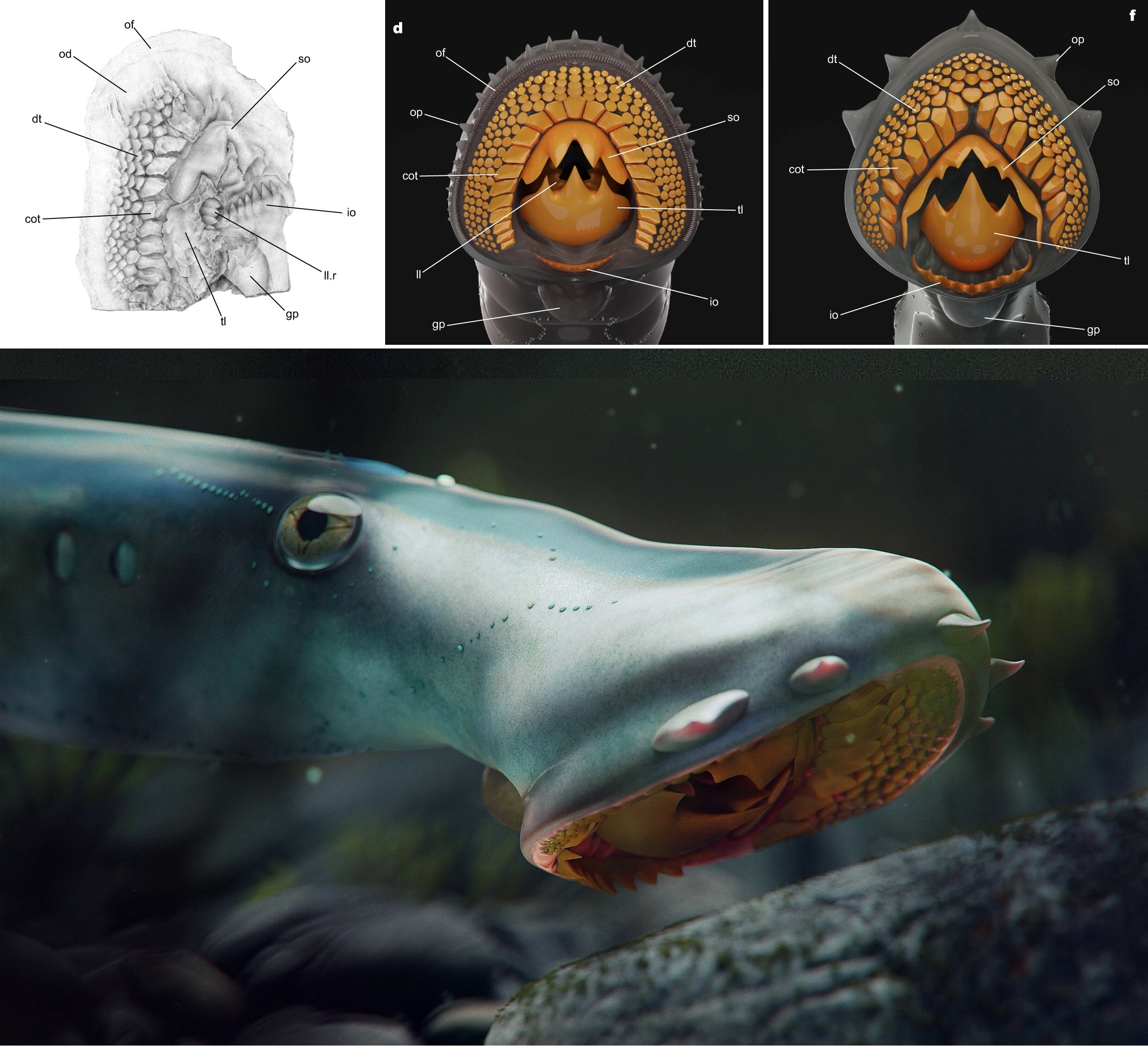
Jurassic lampreys from the Yanliao Biota, China, Yanliaomyzon occisor gen. et sp. nov. and Yanliaomyzon ingensdentes gen. et sp. nov.
a–e Yanliaomyzon occisor gen. et sp. nov., a Photograph of holotype (IVPP V 15830); b Line drawing of the oral disc and dentition of (a), based on Supplementary Fig. 2k and l; c, d Paratype (IVPP V 18956B), photograph (c) and line drawing (d); e Restoration.
 f–h Yanliaomyzon ingensdentes gen. et sp. nov., f Photograph of holotype (IVPP V 16715B), white arrow pointing to the skeletal relics in gut content; g Oral disc and dentition; h Restoration.
Abbreviations: adf, ‘anterior dorsal fin’ (dorsal fin); af, anal fin fold; ba, branchial apparatus; ca, cloaca (anus); cot, circumoral teeth; da, dorsal aorta; dcf, dorsal lobe of caudal fin; dt, oral disc teeth; cf, caudal fin; e, eyes; dt, disc teeth; go, external gill openings; gp, gular pouch; ic, intestine contents; io, infraoral lamina; ll, longitudinal lingual lamina; ll.l, left longitudinal lingual lamina; ll.r, right longitudinal lingual lamina; lv, liver; ns, olfactory organ (nasal sac); oc, otic capsule; od, oral disc; of, oral fimbriae; op, oral papilla(e); paf, precloacal skin fold; pdf, ‘posterior dorsal fin’ (anterior part of caudal fin); pt, piston cartilage; so, supraoral lamina; tl, transverse lingual lamina; vcf, ventral lobe of caudal fin; V1?, ophthalmic ramus of trigeminal nerve?

a–d Oral disc and dentition of Yanliaomyzon ingensdentes gen. et sp. nov., a Photograph (IVPP V 16716B) and b Line drawing; c Photograph (IVPP V 16716A), whitened with ammonium chloride, the white arrow pointing to the imprints of the wrinkles of the gular pouch; d Restoration.
e, f Oral disc and dentition of Yanliaomyzon occisor gen. et sp. nov., e Photograph (IVPP V18956A), whitened with ammonium chloride; f Restoration;
 g Oral disc and dentition of Geotria australis, redrawn from ref. 10.
Abbreviations: cot, circumoral teeth; dt, oral disc teeth; gp, gular pouch; ic, intestine contents; io, infraoral lamina; ll, longitudinal lingual lamina; ll.r, right longitudinal lingual lamina; od, oral disc; of, oral fimbriae; op, oral papilla(e); so, supraoral lamina; tl, transverse lingual lamina.


Systematic paleontology
Order: Petromyzontiformes Berg, 194018

Genus Yanliaomyzon gen. nov.
 
Diagnosis: Stem lampreys with oral discs well-toothed in anterior and lateral fields; anterior and lateral oral disc teeth closely arranged, dorsally truncated, spatulate in shape with the slightly concaved undersurface of the free edge protruding a shallow blade; posterior disc teeth lacking, anterior and lateral circumoral teeth elongate and trihedral in shape; supraoral lamina large and consisting of two stout central cusps flanked by wing-like lateral extensions; transverse lingual lamina very large with the apices of three cusps interlocking with the supraoral lamina in vivo.
 
Etymology: Yanliao’ derives from Yanliao Biota, a Jurassic terrestrial Lagerstätte from North China, where these fossils were discovered; ‘myzon’ (Greek), sucker.

Yanliaomyzon occisor

Diagnosis: The supraoral lamina spanning completely the lateral rims of the oral aperture, with the central cusps flanked immediately by two smaller projections; 16 circumoral teeth; the tail region occupying slightly less than 28% of the total body length.

Etymology: Latin ‘occisor’, meaning ‘killer’, refers to the powerful hunting skill of the species.

Horizon and locality: Tiaojishan Formation, Oxfordian, earliest Late Jurassic, ca. 158.58–160 million years ago (Ma); Daxishan, Linglongta Town, Jianchang County, Liaoning Province (Holotype), and Nanshimen Village, Gangou Town, Qinglong County, Hebei Province (Paratype), China.


Yanliaomyzon ingensdentes gen. et sp. nov.

Diagnosis: The supraoral lamina occupying roughly one-third of the rim of the oral aperture; the transverse lingual lamina almost equaling to the supraoral lamina in width; ca. 23 circumoral teeth; the tail region occupying slightly more than 40% of the total body length.

Etymology: Latin ‘ingens + dentes’, meaning large teeth, refers to the large cuspid laminae on the gouging piston.
 
Horizon and locality: Daohugou beds, Callovian, late Middle Jurassic, ca. 163 Ma in Wubaiding Village, Reshuitang County, Liaoning Province, China.


Feixiang Wu, Philippe Janvier and Chi Zhang. 2023. The Rise of Predation in Jurassic Lampreys. Nature Communications. 14: 6652. DOI: 10.1038/s41467-023-42251-0
https://phys.org/news/2023-11-species-large-ancient-lampreys-china.html


[Botany • 2023] Anoectochilus zhongshanensis (Orchidaceae) • A New Species from Guangxi, China


  Anoectochilus zhongshanensis C.J.Zheng & Y.B.Wu, 

in Wu, Han, He, Chen, Wu, Ye et Zheng, 2023. 
钟山金线兰  ||  DOI: 10.3897/phytokeys.234.111106
Photographs by Yan-Bin Wu.

Abstract
A new species of Anoectochilus (Orchidaceae) from Guangxi, China, A. zhongshanensis, is described here, which was identified based on phylogenetic studies adopting combined plastid markers (rbcL-matK-trnL-F), morphological observation and chemical analysis. Molecular phylogenetic results support the systematic status of A. zhongshanensis as a new species in Anoectochilus genus. Morphologically, this new species is similar to A. zhejiangensis and A. malipoensis, but differs by its characteristic labellum and column, including the hastate or scalpel-shaped lobes of epichile, forward curved and pinnately divided cristate lobes at both sides of the mesochile and inverted triangle column wings. Furthermore, HPLC-ELSD analysis of these three species revealed the interesting chemotaxonomic difference that the principle and characteristic lactone glycoside in this new species was kinsenoside, rather than its diastereoisomer, goodyeroside A, a major glycoside in A. zhejiangensis and A. malipoensis.

Key words: Anoectochilus, new species, phylogeny, taxonomy

 Anoectochilus zhongshanensis 
A habit B leaves C flower (front view and lateral view) D ovary (cross section) E sepals F petals G spur H core column (front view, lateral view and rear view) I anther cap and pollinia.
Drawn by Li-Xiang Zheng.

 Anoectochilus zhongshanensis 
 A1 and A2 habit B flower (front view) C flower (lateral view) D sepals and petals E spur F anther cap G pollinia H column (front view) I column (lateral view) J column (rear view).
Photographs by Yan-Bin Wu.

 Anoectochilus zhongshanensis C.J.Zheng & Y.B.Wu, sp. nov.

Diagnosis: A. zhongshanensis is similar to A. zhejiangensis, but can be distinguished by the hastate or scalpel-shaped lobes of epichile (vs. semiovoid), forward curved and pinnately divided cristate lobes at both sides of the mesochile (vs. backward curved, the same orientation as the spur), unbowed conical spur (vs. bowed) and inverted triangle column wings (vs. squarish) (Fig. 6). A. zhongshanensis is also similar to A. malipoensis, but can be distinguished by the hastate or scalpel-shaped lobes of epichile (vs. obovate lobes with acuminate apex and crenulate margins), pinnately divided cristate lobes at both sides of the mesochile (vs. obliquely subquadrate and serrate lobes) and inverted triangle column wings (vs. elliptic) (Chen and Shui 2010).
 
Etymology: Referring to the locality (Zhongshan County) where this new species was found.

Vernacular name: 钟山金线兰 (Chinese pinyin: zhong shan jin xian lan).

Anoectochilus zhejiangensis
A habit B flower (front view) without petals and sepals C flower (lateral view) without petals and sepals D sepals and petals E spur F anther cap G pollinia H column (front view) I column (lateral view) J core column (rear view).
Photographs by Yan-Bin Wu.


Yan-Bin Wu, Yu Han, Xu-Hui He, Hui-Ling Chen, Jin-Zhong Wu, Qi Ye and Cheng-Jian Zheng. 2023. Anoectochilus zhongshanensis (Orchidaceae), A New Species from Guangxi, China.  PhytoKeys. 234: 203-218. DOI: 10.3897/phytokeys.234.111106


[Paleontology • 2023] Amanasaurus nesbitti • A New silesaurid (Archosauria: Silesauridae) from Carnian Beds of Brazil fills A Gap in the Radiation of Avian line Archosaurs


Amanasaurus nesbitti 
 Müller & Garcia, 2023


Abstract
Comprising the oldest unequivocal dinosauromorphs in the fossil record, silesaurs play an important role in the Triassic radiation of dinosaurs. These reptiles provide the main source of information regarding the ancestral body plan of dinosaurs, as well as the basis for biogeographic models. Nevertheless, the co-occurrence of silesaurs and the oldest unequivocal dinosaurs is rare, which hampers reliable ecological inferences. Here we present the first species of silesaur from the oldest unequivocal dinosaur-bearing beds from Brazil. Amanasaurus nesbitti gen. et sp. nov. possesses a unique set of femoral traits among silesaurs, including the oldest occurrence of an anterior trochanter separated by the femoral shaft by a marked cleft. Its femoral length indicates that the new species rivals in size with most coeval dinosaurs. This find challenges the assumption that in faunas where silesaurs and unambiguous dinosaurs co-occurred, silesaurs were relatively smaller. Moreover, the presence of dinosaur-sized silesaurs within ecosystems with lagerpetids, sauropodomorphs and herrerasaurids reinforces the complex scenario regarding the early radiation of Pan-Aves. Silesaurs—independent of their phylogenetic position—persisted during most of the Triassic Period, with its plesiomorphic body size advancing through the dawn of dinosaurs, instead of silesaur lineages decrease in body size through time.


Systematic paleontology
Archosauria Cope, 1869
Pan-Aves Gauthier & de Queiroz, 2001

Dinosauromorpha Benton, 1985
Silesauridae Nesbitt et al., 2010

Amanasaurus nesbitti gen. et sp. nov. 

Diagnosis: Amanasaurus nesbitti differs from all other known silesaurs with comparable material in (*local autapomorphies): posteromedial tuber of the femoral head reduced to absent; ventral margin of the anteromedial tuber exceeding the femoral head margin; presence of a fossa trochanterica; absence of a raised anterolateral scar; presence of a semi-circular scar on the posterodorsal surface of the femoral head*; cleft between the proximal tip of the anterior trochanter and the femoral shaft ...

Etymology: The genus combines the Tupi word “amana” (= rain) and the Greek “saurus” (= lizard), referring to the Carnian pluvial episode. The specific epithet honors Dr. Sterling J. Nesbitt, a prominent North American paleontologist, for his contribution and studies on silesaurs and Triassic archosaurs.


Rodrigo T. Müller and Maurício S. Garcia. 2023. A New silesaurid from Carnian Beds of Brazil fills A Gap in the Radiation of Avian line Archosaurs. Scientific Reports.  13: 4981. DOI: 10.1038/s41598-023-32057-x
 www.ufsm.br/2023/04/14/paleontologos-descobrem-nova-especie-pre-historica 


[Botany • 2023] Henckelia arupii (Gesneriaceae) • A New Species from Arunachal Pradesh, India


Henckelia arupii Taram & Tag,

in Taram et Tag, 2023. 
 
Abstract
Henckelia arupii, a new species discovered from Arunachal Pradesh, India, is described and illustrated. The new species is superficially similar to Henckelia adenocalyx and three other Northeast Indian species in habit, in the broadly ovate foliaceous bracts covering the flower buds, in the parallel-convergent venation of the bracts and in the infundibuliform corolla. However, it differs in having cymes reduced to solitary flowers, a campanulate, narrowly pleated calyx and lanceolate to elliptic revolute calyx segments. A detailed description and photographic illustration of the morphological characters is presented. So far, Henckelia arupii is only known from the type locality.

Keywords: Arunachal Pradesh, Gesneriad, Henckelia, India, new species

Henckelia arupii
(a) habit. (b) Flowering buds. (c) Flowering plant. (d) Leaf. (e) Bracts. (f) Flower in frontal view. (g) Flower in side view. (h) Corolla in side view. (i) Calyx. (j) Corolla seen from above. (k) Dissected corolla. (l) Stamens and staminodes. (m) Pistil and disk.
 (photographs by Momang Taram).

Henckelia arupii Taram & Tag, sp. nov.

Etymology: The species is named in the honor of Prof. Arup Kumar Das, Retired Professor of Botany, Rajiv Gandhi University, Rono Hills, Doimukh, Arunachal Pradesh, India, for his pioneering and invaluable contribution made toward understanding the flora and ethnobotanical knowledge of the Eastern Himalayan region of India.

(a–e) Henckelia umbellata (f–g) Henckelia pathakii
(h–j) Henckelia dasii (k–o) Henckelia adenocalyx.

 
Momang Taram and Hui Tag. 2023. Henckelia arupii (Gesneriaceae): A New Species from Arunachal Pradesh, India. Feddes Repertorium. DOI: 10.1002/fedr.202100055
  arunachalobserver.org/2023/01/12/new-flowering-plant-species-henckelia-arupii-found-in-arunachal/

[Botany • 2023] Pedicularis revealiana (Orobanchaceae) • A New hemiparasitic Species of Pedicularis from North Sikkim


Pedicularis revealiana Arti Garg,

in Garg et Shukla, 2023. 
 
Abstract
The new species Pedicularis revealiana, is described from Katao in Sikkim Himalaya, India. The new species is hemiparasitic and possesses a combination of characters which makes it unique among all Pedicularis species as it has a perennial caespitose habit, stout and woody stems with decumbent branches and congested internodes, evanescent radical leaves and smaller and fewer cauline leaves with linear pinnae, 3–5 flowered and subcapitate or fascicled inflorescence, pedicillate bracts, minute flowers, hairy calyx with crestate-dentate and recurved lobes, stipitate and arcuate galea with truncate apex and papillose surface, gland-dotted labium with very large lateral lobes, unequal filament pairs inserted near top of the corolla tube, stipitate stigma which is bilobed and woolly and monocolpate pollen grains which are large and fusiform in shape with rugulose-punctate surface. With these combination of characters, it is differentiated from the only allied species Pedicularis gracilis.

Keywords: caespitose, Katao, North Sikkim district, novelty, Orobanchaceae, Pedicularis revealiana, rocky soil


Pedicularis revealiana Arti Garg sp. nov. 


Arti Garg and Achuta Nand Shukla. 2023. A New hemiparasitic Species of Pedicularis (Orobanchaceae) from North Sikkim, India. Nordic Journal of Botany. DOI: 10.1111/njb.03966

[Ichthyology • 2023] Trichomycterus puna • A New Species of Trichomycterus (Siluriformes: Trichomycteridae) from Wetlands of High Elevation of Argentina, with Notes on the T. alterus Species-Complex


Trichomycterus puna
Fernández, Contrera & Bize, 2023

 
Abstract
Trichomycterus puna, new species, is described from a small tributary of the Corral Blanco in Catamarca Province, Argentina, as part of an ongoing systematic study of the genus Trichomycterus from the High Andean Plateau or Altiplano-Puna drainages of the southern Central Andes. The new species is distinguished from congeners by the following characters: the odontodes embedded in thick integument that covers interopercle, the premaxillary bone smaller than maxilla, the presence of sesamoid supraorbital with lateral process, the supraorbital sensory pore s3 present, the discontinuous supraorbital sensory canal, 2–3 premaxillary tooth rows, the uniformly dark pigmentation on the trunk, 15 precaudal vertebrae, the skin of trunk with minute thread-like papillae, 7–8 pectoral-fin rays, 9–12 dorsal procurrent caudal-fin rays, 10–11 ventral procurrent caudal-fin rays, the distally unbranched barbels, the wider interorbital distance, 16 pairs of ribs, the first dorsal-fin pterygiophore inserting on vertebra 18, and the first anal-fin pterygiophore inserting on vertebra 21. It closely resembles T. alterus, T. belensis, T. boylei, and T. ramosus from the Puna region. Trichomycterus belensis and T. catamarcensis are recorded from new localities over 3,400 m elevation.

Trichomycterus puna, holotype, FACEN 151, 74.1 mm SL, Argentina, Provincia Catamarca, Departamento Bele´n, El Angosto creek.

Trichomycterus puna, new species

Etymology.—The specific epithet puna is a noun in apposition and is attributable to the geological province known as the Puna. The origin of the word is Quechuan and is attributable to the indigenous people known as the Kollas who lived in this area.

 
 Luis Fernández, Guadalupe Contrera and Julieta Andreoli Bize. 2023. New Species of Trichomycterus (Siluriformes: Trichomycteridae) from Wetlands of High Elevation of Argentina, with Notes on the T. alterus Species-Complex. Ichthyology & Herpetology. 111(3); 456-466. DOI: 10.1643/i2022074

Wednesday, November 1, 2023

[Paleontology • 2023] Inawentu oslatus • A Rebbachisaurid-mimicking Titanosaur and Evidence of A Late Cretaceous Faunal Disturbance Event in South-West Gondwana


Inawentu oslatus
Filippi, Valieri, Gallina, Méndez, Gianechini & Garrido, 2023

Artwork: Gabriel Lio  facebook.com/GabrielLio3

Abstract
The evolution of ecosystems during the late Mesozoic on the southern landmasses is complex and still poorly known. Starting from a single vicariant Laurasian-Gondwanan scenario, the paleobiogeographic and biostratigraphic models have become more complex, including vicariant, dispersal, and local extinctions as major drivers of changes in the Cretaceous ecosystems during the isolation and posterior fragmentation of Gondwana. However, the direct effects of replacement and the adaptive evolution of terrestrial vertebrates to fill vacant ecological niches after disruptive ecological events have been poorly discussed. Here, we provide a preliminary description of a nearly complete new titanosaurian sauropod from the Upper Cretaceous of Patagonia, Inawentu oslatus gen. et sp. nov., that shows remarkable convergent anatomical traits with rebbachisaurid sauropods. A phylogenetic analysis recovers it within a not previously recovered titanosaurian subclade, named Clade A, which would be endemic to the Upper Cretaceous of South America. The convergent evolution between rebbachisaurids and Clade A members is interpreted as the result of the same ecological niche exploitation. The biostratigraphic scenario during the Late Cretaceous of South America leads to interpret rapid speciation of the titanosaurs because of filling the empty ecological niche left by the extinction of the rebbachisaurids, an idea concordant with a regional disturbance event of the ecosystems in this continent between 90 and 85 Ma....


Inawentu oslatus gen. et sp. nov.


Leonardo S. Filippi, Rubén D. Juárez Valieri, Pablo A. Gallina, Ariel H. Méndez, Federico A. Gianechini and Alberto C. Garrido. 2023. A Rebbachisaurid-mimicking Titanosaur and Evidence of A Late Cretaceous Faunal Disturbance Event in South-West Gondwana. Cretaceous Research. In Press, 105754. DOI: 10.1016/j.cretres.2023.105754

[Paleontology • 2023] Jormungandr walhallaensis • A New mosasaurine (Mosasauroidea: Mosasauridae) from the Pierre Shale Formation (Pembina Member: Middle Campanian) of North Dakota


Jormungandr walhallaensis
Zietlow, Boyd & Van Vranken, 2023. 

Artwork: Henry Sharpe
 
Abstract
Mosasaurs are large, carnivorous aquatic lizards with a global distribution that lived during the Late Cretaceous. After 200 years of scientific study, new mosasaur species are still being discovered as new localities are explored and specimens collected long ago are reevaluated using modern standards of species delimitation. Even so, the phylogenetic positions of many key taxa are unresolved and therefore our understanding of mosasaur macroevolution is muddled. Here, we describe a new genus and species of mosasaurine mosasaur comprising a partial skull and skeleton from the Pembina Member of the Pierre Shale Formation in Cavalier County, North Dakota. The lower bound on the age of the specimen is 80.04 ±0.11 Ma, provided by the underlying bentonite bed. Its skull and jaws are nearly complete, and the postcranial skeleton preserves seven cervical vertebrae with three hypapophyseal peduncles, 11 ribs, and five anterior dorsal vertebrae. The new specimen was scored into a modified version of an existing phylogenetic matrix of Mosasauroidea and was recovered in a polytomy with Clidastes; however, given that its morphology is significantly different from that of Clidastes, we refer it to a new genus and species, Jormungandr walhallaensis. Notably, this new taxon shares a mosaic of features seen in both basal (e.g., Clidastes; high dental counts) and derived (e.g., Mosasaurus; subrectangular quadrate) mosasaurines, in addition to possessing its own unique suite of autapomorphies. Given that it possesses morphology intermediate between Clidastes and Plotosaurini, we suspect that future analyses of mosasaur phylogeny, following the addition of new characters and taxa, will recover Jormungandr as transitional between them. Its occurrence increases the known diversity of mosasaurs from the Pembina Member and is the earliest mosasaur to possess autapomorphies of Plotosaurini. Finally, we also analyzed the matrix using different outgroups to test their effect on tree topology and resolution, and found that including multiple nonmosasauroid anguimorphs increased resolution, but not support, of mosasaurid ingroup relationships.
 
Keywords: Jormungandr walhallaensis, Mosasauridae, North Dakota, Classification, Squamata, Paleontology, Cretaceous, Pierre Shale


A reconstruction of two Jormungandr walhallaensis mosasaurs fighting.
Artwork: Henry Sharpe


Zietlow, Amelia R., Boyd, Clint A. and Van Vranken, Nathan E. 2023. Jormungandr walhallaensis: A New mosasaurine (Squamata: Mosasauroidea) from the Pierre Shale Formation (Pembina Member: Middle Campanian) of North Dakota. Bulletin of the American Museum of Natural History. 464.  hdl.handle.net/2246/7332
  digitallibrary.amnh.org/items/13b0485f-c73f-47f9-8d1d-0d4ab6aaedfb


Tuesday, October 31, 2023

[Herpetology • 2020] Hemidactylus flavicaudus & H. xericolus • Two New Species of Yellow-tailed Hemidactylus Goldfuss, 1820 (Squamata: Gekkonidae) from Rocky Outcrops on the Telangana Plateau, India


Hemidactylus flavicaudus Hxericolus 
Lajmi, Giri, Singh & Agarwal, 2020


Abstract

Two distinct species of the gekkonid genus Hemidactylus are described from the dry zone of peninsular India from the state of Telangana. The two sister species, Hemidactylus flavicaudus sp. nov. and Hxericolus sp. nov., are nested within the morphologically cryptic H. brookii group, but are clearly distinguishable from all known species in having a bright yellow tail and yellow markings on the head, besides unique combinations of meristic characters and small body size (< 45 mm snout to vent length). The two new species are also deeply divergent from each other and other members of the H. brookii group in mitochondrial NADH dehydrogenase 2 and cytochrome b sequences. Hemidactylus flavicaudus sp. nov. can be diagnosed from H. xericolus sp. nov. based on the number of dorsal tubercle rows at midbody (11–14 versus 6–8). These descriptions of evolutionarily and morphologically distinct species highlight the dearth of studies carried out in the dry zone of peninsular India and the urgent need to assess biodiversity in the face of rapid land-use changes in this landscape.

Keywords: Reptilia, Dry zone, granite, Hemidactylus brookii, peninsular India, rocky outcrops, rupicolous


Hemidactylus flavicaudus sp. nov. 
 Hxericolus sp. nov.


Aparna Lajmi, Varad B. Giri, Taneraw Singh and Ishan Agarwal. 2020. Two New Species of Yellow-tailed Hemidactylus Goldfuss, 1820 (Squamata: Gekkonidae) from Rocky Outcrops on the Telangana Plateau, India. Zootaxa. 4895(4); 483–504. DOI: 10.11646/zootaxa.4895.4.2