Friday, March 3, 2023

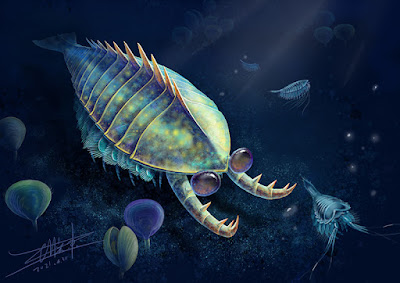
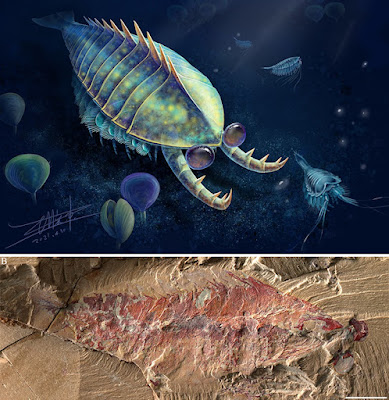
[Paleontology • 2022] Fengzhengia mamingae • A New Euarthropod with Large frontal Appendages from the early Cambrian Chengjiang Biota, Chengjiang Lagerstätte, Southwest China


Fengzhengia mamingae 
O’Flynn, Williams, Yu, Harvey & Liu, 2022. 


ABSTRACT
We describe Fengzhengia mamingae gen. et sp. nov., a new euarthropod from the lower Cambrian (Series 2, Stage 3) Chengjiang Lagerstätte, Southwest China. Fengzhengia mamingae possesses prominent frontal appendages, stalked, circular eyes, a simple, sub-triangular head shield, and a trunk with 15 tergites, the anterior nine each bearing a single medial axial spine. Limited evidence suggests biramous trunk appendages with paddle-shaped exopods. At the posterior end is a sub-triangular region, possibly a pygidium, articulated with a tail fan. The frontal appendage of F. mamingae resembles those of certain ‘great appendage’ arthropods and Isoxys. We test the affinities of F. mamingae by parsimony and Bayesian analyses and tentatively suggest that it is an early branch of Deuteropoda. We suggest that F. mamingae may have been a nektobenthic scavenger or predator, and its dorsal exoskeleton is notable for exhibiting defensive spines.
 
Keywords: lower Cambrian; Chengjiang; Euarthropoda; new genus; new species


SYSTEMATIC PALAEONTOLOGY
Phylum Euarthropoda Lankester, 1904

Class, Order, and Family incertae sedis

Genus Fengzhengia new genus
  
  Fengzhengia mamingae gen. et sp. nov. 

Diagnosis. Euarthropod possessing pair of upward-orientated frontal-most appendages, each consisting of stout shaft and distal articulated region composed of at least six podomeres, five of which clearly bear elongate triangular endites. Two anterior and no posterior stalked compound eyes. Head shield with rounded genal angles. Trunk consisting of 15 tergites—anterior-most nine bearing medial axial spines. Biramous trunk appendages with paddle-shaped exopods fringed with setae. Posterior shield-like structure merged from ≥ three somites articulated with tail fan.

Etymology. Genus name from 风筝 fēngzhēng, Mandarin, kite, i.e., a quadrilateral whose four sides can be grouped into two pairs of equal-length sides that are adjacent to each other, with reference to the overall shape of the fossil. Species from 马明 Mă Míng, the wife of 杨志鑫 Yáng Zhìxīn of Kunming, the man who recovered and prepared the fossil.


Fengzhengia mamingae gen. et sp. nov. (YKLP 11431a).
A-B, lateral view (stereo pair) of the part (stereo images have a tilt of 20˚ to emphasise topographic differences); C, composite line drawing of the same.
All scale bars are 5 mm. 
Abbreviations: ist, indeterminate soft tissue; cw, compression wrinkle(s); en?, putative endopod podomere(s); es, eye stalk(s); ex?, putative exopod(s); gr, groove; hs, head shield; lae, left eye; ps?, putative pygidial segment; pyg?, putative pygidium; rae, right eye; tf, tail fan; tfm?, perceived margin of tail fan; t1-15, tergites 1 through 15. 


CONCLUSION: 
Fengzhengia mamingae possesses a fully arthrodised body and limbs and consequently rests comfortably within Euarthropoda (Aria, 2019). It has large frontal appendages which are otherwise typical of, e.g., radiodonts, megacheirans, and isoxyids, and biramous trunk appendages with short paddle-shaped exopods. It possesses a subtriangular head shield and a trunk bearing 15 tergites, the first nine with a medial spine not unlike those found on some trilobites (Fortey and Owens, 1999) and fuxianhuiids (Chen et al., 2020). Fengzhengia mamingae also has a possible pygidium articulated with a tail fan that resembles the posterior anatomy of Kylinxia zhangi. This structure in F. mamingae adds further evidence that pygidia were not uncommon in early branching euarthropods (see Izquierdo-López and Caron, 2021 who corroborate this).

Although the phylogenetic position of Fengzhengia mamingae is unstable with the available preserved morphology, our analysis suggests it is an early branch of the Deuteropoda, assuming a deutocerebral identity for the frontal appendage.

The results of phylogenetic analyses where the frontal appendage of Fengzhengia mamingae is coded as protocerebral, ipso facto placing it outside Deuteropoda, provides two scenarios: in parsimony analysis F. mamingae occupies a lower branch relative to Kylinxia zhangi and all other deuteropods, as would be expected. However, in Bayesian analysis is it resolved as a later branch to K. zhangi within Deuteropoda. It is beyond the scope of this article to attempt to solve the discrepancies stemming from different analytic tools, but the difficulties here stem from how ancestral state reconstructions vary. New datasets in combination with better material will form key tools in helping us to further understand the phylogenetic relationships within the euarthropod stem.

The dorsoventrally flattened exoskeleton, tail fan, and paddle-shaped exopods may be indicative of a nektobenthic mode of life for Fengzhengia mamingae. It likely used its stalked eyes and frontal appendages, by analogy with other Cambrian euarthropods, either to scavenge or find prey, and its spines may have performed a defensive role.

 
Robert J. O’Flynn, Mark Williams, Mengxiao Yu, Thomas H.P. Harvey and Yu Liu. 2022. A New Euarthropod with Large frontal Appendages from the early Cambrian Chengjiang Biota. Palaeontologia Electronica. 25(1):a6. DOI: 10.26879/1167

Plain Language Abstract: We describe a new fossil arthropod (an invertebrate animal with an exoskeleton and jointed limbs), Fengzhengia mamingae, which lived in the seas of South China about 518 million years ago. At the front of its body, Fengzhengia mamingae possesses long, stout appendages and two stalked, circular eyes. Its head is covered by a sub-triangular shield and its trunk has 15 subdivisions, the first nine with spines. At the back is a possible tail. Fengzhengia mamingae is important for identifying the range of morphologies in early Cambrian arthropods. It may have lived as a scavenger or predator and the spines on the trunk subdivisions may have functioned to protect it from attack.

[Herpetology • 2023] Vitreorana assuh • An Elusive Giant: A New Species of Vitreorana Guayasamin et al., 2009 (Anura: Centrolenidae) from the northern Atlantic Forest with An Osteological Description and Comments on Integumentary Spicules


Vitreorana assuh  
Zucchetti, Rojas-Padilla, Dias, Solé, Orrico & Castroviejo-Fisher, 2023

 
Abstract
We describe a new species of Vitreorana from the Atlantic Forest of southern Bahia state, in north-eastern Brazil. Vitreorana assuh sp. nov. is by far the largest species of the genus (snout-to-vent length [SVL] = 30.9 mm and 34.1 mm in one male and female, respectively; maximum SVL recorded for all other species = 28.0 mm). The new species is morphologically most similar to V. franciscana, from the Cerrado biome in Brazil. Besides its large size, the new species has, among other diagnostic characters, the presence of vomerine teeth and the occurrence of enameled iridophores in the pericardium, hepatic and urinary bladder peritonea. Furthermore, we describe and compare the complete mineralized skeleton of the new species and V. uranoscopa, and describe and discuss the variation of integumentary spicules in all species of the genus and their relevance to Vitreorana systematics.

Key words: Brazil, Centroleninae, glassfrogs, morphology, osteology, taxonomy

Vitreorana assuh sp. nov.
Dorsolateral view of the holotype (upper photo; MZUESC 18530, adult male) in life.
Dorsolateral and ventral view (middle and lower photos, respectively) of the paratopotype (MZUESC 21044, adult female) in life.
Photo of holotype by I.R. Dias and of paratopotype by O. Rojas-Padilla.

Vitreorana assuh sp. nov. 

Etymology. The specific epithet assuh comes from the word açu of the Tupi linguistic trunk, which is an adjective, meaning “large” or “elongated”. Tupi was the main language used by native people on the Atlantic Forest coast before European contact. By naming this species using a Tupi word, we want to pay homage to these residents of the Atlantic Forest and their contribution to shaping current Brazilian culture.


Victor M. Zucchetti, Omar Rojas-Padilla, Iuri R. Dias, Mirco Solé, Victor G. D. Orrico and Santiago Castroviejo-Fisher. 2023. An Elusive Giant: A New Species of Vitreorana Guayasamin et al., 2009 (Anura: Centrolenidae) from the northern Atlantic Forest with An Osteological Description and Comments on Integumentary Spicules. Zootaxa. 5249(3); 301-334. DOI: 10.11646/zootaxa.5249.3.1


[PaleoIchthyology • 2023] Hyneria udlezinye • A high Latitude Gondwanan Species of the Late Devonian tristichopterid Hyneria (Osteichthyes: Sarcopterygii) from South Africa

 
 Hyneria udlezinye
Gess & Ahlberg, 2023

Painting by Maggie Newman

Abstract
We describe the largest bony fish in the Late Devonian (late Famennian) fossil assemblage from Waterloo Farm near Makhanda/Grahamstown, South Africa. It is a giant member of the extinct clade Tristichopteridae (Sarcopterygii: Tetrapodomorpha) and most closely resembles Hyneria lindae from the late Famennian Catskill Formation of Pennsylvania, USA. Notwithstanding the overall similarity, it can be distinguished from H. lindae on a number of morphological points and is accordingly described as a new species, Hyneria udlezinye sp. nov. The preserved material comprises most of the dermal skull, lower jaw, gill cover and shoulder girdle. The cranial endoskeleton appears to have been unossified and is not preserved, apart from a fragment of the hyoid arch adhering to a subopercular, but the postcranial endoskeleton is represented by an ulnare, some semi-articulated neural spines, and the basal plate of a median fin. The discovery of H. udlezinye shows that Hyneria is a cosmopolitan genus extending into the high latitudes of Gondwana, not a Euramerican endemic. It supports the contention that the derived clade of giant tristichopterids, which alongside Hyneria includes such genera as Eusthenodon, Edenopteron and Mandageria, originated in Gondwana.

Systematic palaeontology
OSTEICHTHYES Huxley, 1880
SARCOPTERYGII Romer, 1955

TETRAPODOMORPHA Ahlberg, 1989
TRISTICHOPTERIDAE Cope, 1889

Diagnosis— Tetrapodomorph sarcopterygians with postspiracular bone present, vomers with long caudal process clasping the parasphenoid, circular scales with a median boss, and an elongate body with a trifurcate or rhombic caudal fin (modified from [3]).

HYNERIA Thomson, 1968

Type species— Hyneria lindae Thomson, 1968; Hyner, Pennsylvania, USA.


AM6540b and AM6528a, the two main blocks of the holotype of Hyneria udlezinye.
Each block also has a counterpart (not illustrated). A, AM6540b. Unlabelled bones all belong to a single large individual of the arthrodire placoderm Groenlandaspis riniensis [Long, et al. 1997]. B, AM6528a. This block also carries a jugal of the tetrapod Umzantsia amazana [Gess & Ahlberg, 2018] and a paranuchal of a small individual of Groenlandaspis riniensis.

Skull reconstruction of Hyneria udlezinye.
Dorsal (A) and lateral (B) views, drawn from photographs of a three-dimensional model, scaled to the size of the holotype.
Abbreviations: An, anocleithrum; Ang, angular; Cl, clavicle; Cle, cleithrum; De, dentary; It, intertemporal; Ju, jugal; La, lacrimal; M.Pr, median postrostral; Mx, maxilla; Op, opercular; Pa, parietal; Pi, pineal; Po, postorbital; Pop, preopercular; Pospl, postsplenial; Pp-St-Ta, postparietal, supratemporal and tabular (sutures not visible); Qj, qudratojugal; Sop, subopercular; Sq, squamosal; Sur, surangular.

Hyneria udlezinye sp. nov.  
"Probable eusthenopterid" [Gess & Hiller, 1995]
"Close to Eusthenodon" [Anderson, et al., 1999]
"Similar to Hyneria" [Gess & Coates, 2008]
"cf Hyneria" [Gess, 2011]
"Hyneria-like" [Gess & Whitfield, 2020]

Diagnosis—A very large tristichopterid, closely resembling Hyneria lindae but differing from it in the following respects: postparietal shield widening more strongly from anterior to posterior; lateral corner of tabular weakly developed; preopercular and lacrimal proportionally deeper; denticulated field on parasphenoid extends further anteriorly; subopercular more shallow; dentary fangs proportionately larger.

Etymology— an apposition, from isiXhosa ‘udlezinye’, meaning ‘one who eats others’, referring to the inferred predatory lifestyle of the species. IsiXhosa is the widely spoken indigenous language of south-eastern South Africa where the fossil locality is located.


Life reconstruction of the non-marine component of the Waterloo Farm biota. Hyneria udlezinye is shown together with the tetrapods Umzantsia amazana and Tutusius umlambo [Gess & Ahlberg, 2018], the placoderms Groenlandaspis riniensis and Bothriolepis africana [Long, et al., 1997], the coelacanth Serenichthys kowiensis [Gess & Coates, 2015], the lungfish Isityumzi mlomomde [Gess & Clemen, 2019], and a cyrtoctenid eurypterid.
Painting by Maggie Newman, copyright R. W. Gess.

Conclusion: 
The largest osteichthyan member of the Waterloo Farm vertebrate assemblage, a predatory sarcopterygian with a probable maximum length of nearly three metres, proves to be a new species of the genus Hyneria. This genus is otherwise only recorded from the late Famennian Catskill Formation of Pennsylvania. The new species, Hyneria udlezinye, differs from the type species Hyneria lindae in a number of minor but securely attested proportional characters relating to the skull roof, cheek, lower jaw and operculum. Hyneria now joins Eusthenodon and Langlieria as one of the derived, late, giant tristichopterids known from both Euramerica and Gondwana. The other confirmed members of this clade (Mandageria, Cabonnichthys and Edenopteron) are exclusively known from Gondwana. This strongly supports the contention that this clade represents a Gondwanan radiation [Olive, et al. 2020].

Hyneria udlezinye is the first tristichopterid to be recorded from a high palaeolatitude, all other members of the group coming from palaeoequatorial to mid-palaeolatitude localities. All previously recorded Gondwanan members of the derived tristichopterid clade come from Australia, leading Olive et al. [2020] to argue for an Australian origin for this clade. The new evidence from Waterloo Farm, however, suggests that a more general Gondwanan origin for this clade is highly likely. This once again demonstrates how inferences about biogeographical patterns have historically been skewed by a paucity of data from high-palaeolatitude localities. Such data can only come from Gondwana, as no continents extended into northern high latitudes during the Devonian. The Waterloo Farm lagerstätte provides a unique window into an almost unknown part of the Late Devonian world.


Robert W. Gess and Per E. Ahlberg. 2023. A high Latitude Gondwanan Species of the Late Devonian tristichopterid Hyneria (Osteichthyes: Sarcopterygii). PLoS ONE. 18(2): e0281333. DOI: 10.1371/journal.pone.0281333


Thursday, March 2, 2023

[PaleoEntomology • 2023] The Earliest Pollen-loaded Insects from the Lower Permian of Russia


an Permian insect (Tillyardembia antennaeplana) feeding on a pollen cone of ruflorian cordaites

in Khramov, Foraponova et Węgierek, 2023.
reconstruction by Andrey Atuchin. 
 
Abstract
Recent fossil discoveries suggest that the coevolution of insect pollinators and gymnosperms started long before the appearance of flowering plants. One of the keys to understanding the origins of pollination relationships is fossil insects with gymnosperm pollen attached to the body surface. Such fossils are exceedingly rare to find, especially from the Palaeozoic, a time when ambers with insect inclusions were absent. Here, we report compression fossils of Early Permian tillyardembiid insects (Polyneoptera) preserved with pollen on their heads, thoraces, legs and abdomens. This is the earliest finding of pollen-bearing insects, predating the previous oldest record from the Middle Jurassic by ca 120 Ma. Judging by the pollen composition, tillyardembiids visited a narrow range of host plants, including Rufloriaceae (Cordaitales). While it is impossible to say for certain whether tillyardembiids as pollen consumers contributed to pollination, a trophic specialization of this kind could be considered an evolutionary precursor of pollination mutualism.

 Keywords: Palaeozoic, plant-insect interactions, pollination 


An artistic reconstruction of an Early Permian insect (Tillyardembia antennaeplana) feeding on a pollen cone of ruflorian cordaites. 
Artwork: Andrey Atuchin. 


Alexander V. Khramov, Tatiana Foraponova and Piotr Węgierek. 2023. The Earliest Pollen-loaded Insects from the Lower Permian of Russia. Biol. Lett. 1920220523. DOI: 10.1098/rsbl.2022.0523

[PaleoEntomology • 2023] Hadraulacus perrarus • A New praeaulacid Genus with A New Species in Praeaulacidae (Hymenoptera: Evanioidea) from mid-Cretaceous Myanmar Amber


Hadraulacus perrarus Li, Shih & Ren, 

in Li, Shih, Yang & Ren, 2023. 

Abstract
A new fossil praeaulacid wasp, Hadraulacus perrarus Li, Shih and Ren gen. et sp. nov., is described and figured from mid-Cretaceous Myanmar amber. The new genus is established based on the following characters: antenna with more than 25 antennomeres; metasoma distinctly longer than mesosoma with the first metasomal segment forming a long petiole; legs long and thin, with tibia spurs 1-1-2, claw with one small subbasal tooth; forewing with 1cu-a postfurcal, 1m-cu shorter than 1-M and 2m-cu, 2r-m absent, 3r-m present, 2 + 3rm nearly trapezoidal, and 1m-cu in contact with 2 + 3rm by a short section of M. In addition, this mid-Cretaceous praeaulacid wasp was preserved together with a cicada nymph, likely the result of an accidental assemblage.

 Keywords: Taxonomy, New taxa, Apocrita


Longfeng Li, Chungkun Shih, Jingtao Yang and Dong Ren. 2023. A New praeaulacid Genus with A New Species in Praeaulacidae (Hymenoptera: Evanioidea) from mid-Cretaceous Myanmar Amber. Cretaceous Research. 146, 105483. DOI: 10.1016/j.cretres.2023.105483 
 

[Botany • 2023] Rediscovery of the presumably Extinct Fairy Lantern Thismia kobensis (Thismiaceae)in Hyogo Prefecture, Japan, with Discussions on its Taxonomy, Evolutionary History, and Conservation


Thismia kobensis  Suetsugu 
 
in Suetsugu, Yamana & Okada, 2023. 
 
Abstract
Thismia (commonly known as fairy lanterns) is a genus of strange-looking, elusive, and non-photosynthetic plants. Thismia kobensis was first discovered in Kobe City, Hyogo Prefecture, Japan in 1992, but it was believed to be extinct, given that its type locality was destroyed during the construction of an industrial complex. Here, we have reported the rediscovery of T. kobensis in Sanda City, Hyogo Prefecture, which is located approximately 30 km from the type locality. The new locality of T. kobensis is the northernmost distributional limit of Asian Thismiaceae species. As the original description of the species was based on a single museum specimen that lacked two of the three inner perianth lobes, we have provided an amended description of T. kobensis, highlighting its differences from the morphologically similar species T. huangii. Specifically, our morphological re-examination has revealed that T. kobensis is distinguishable from T. huangii by its short but expanded annulus and many short hairs on each stigma lobe. We have also demonstrated that the genetic distance between these taxa is comparable to that between other closely related species pairs. Finally, we have provided brief notes on the taxonomy, biogeography, evolutionary history, and conservation of T. kobensis and its closely related species, including an enigmatic species T. americana.

Keywords: conservation, emended description, extinct species, fairy lanterns, mycoheterotrophy, phylogenetic relationship, rediscovery, taxonomic revision


Thismia kobensis at the new locality. (A–C) Flower, lateral view. (D–F) Flower, upper view. (G) Flower without perianth lobes. (H) Flower with broken perianth tube and exposed stigma.
 Scale bars: 5 mm. 
Photographed by Kenji Suetsugu.


Thismia kobensis (from the holotype).
A–B. Flowering plant. C. Flower, upper view. D. Flattened perianth tube. E. Stamens, inner view. F. Stamens, outer view. G. Style and stigma. Two broken inner perianth lobes are indicated by the dotted lines in A, B and D.
Drawn by Kumi Hamasaki. Bar = 1 mm.


Thismia kobensis Suetsugu emend. Suetsugu  


Kenji Suetsugu, Kohei Yamana and Hidehito Okada. 2023. Rediscovery of the presumably Extinct Fairy Lantern Thismia kobensis (Thismiaceae) in Hyogo Prefecture, Japan, with Discussions on its Taxonomy, Evolutionary History, and Conservation. Phytotaxa. 585(2); 102–112. DOI: 10.11646/phytotaxa.585.2.2
Kenji Suetsugu, Osamu Nakanishi, Tomiki Kobayashi and Nobuhira Kurosaki. 2018. Thismia kobensis (Burmanniaceae), A New and Presumably Extinct Species from Hyogo Prefecture, Japan.  Phytotaxa.  369(2); 121–125.
 DOI: 10.11646/phytotaxa.369.2.6


[Herpetology • 2023] Leptobrachella korifi & L. sinorensis • Two New Species of Leptobrachella (Anura: Megophryidae) from Northern Thailand


Leptobrachella sinorensis
 Matsui, Panha & Eto, 2023


Abstract  
Phylogenetic analyses using mtDNA gene sequences revealed the presence of two genetic clades in the genus Leptobrachella (former Leptolalax) from northern Thailand. One formed a clade including L. ventripunctata and L. aerea, while another included L. bourrreti and L. laoi. The first clade contained L. cf. minima from Doi Suthep, while the second clade contained L. murphyi and two undescribed species, one from Doi Inthanon, at a high altitude of 2,300 m asl, and another from Mae Hong Son, at Myanmar border. These form a clade, that is sister to L. murphyi. Morphologically, the first species is generally similar to L. murphyi, while the second species resembles L. cf. minima. However, they are clearly distinguished from those described species by great genetic differences, and we describe them as L. korifi sp. nov. and L. sinorensis sp. nov., respectively.

KEYWORDS: Lalos, Leptobrachella korifi sp. nov, Leptobrachella sinorensis sp. nov, Leptolalax, MtDNA phylogeny, Thailand


Leptobrachella korifi sp. nov.

 Diagnosis: A small-sized form of the genus Leptobrachella; adult female 22.7 mm in SVL (n=1); ventral side dusty; tibiotarsal articulation reaching anterior corner of eye; pectoral gland very large; lateral fringe on toes weak.

Etymology: The specific epithet, korifi, is from the Greek “koreefee,” meaning summit, in reference to the high elevation of the habitat [Doi Inthanon, Chiang Mai Province] of the new species.
อึ่งกรายอ่างกา อึ่งกรายยอดดอย(อ่างกา)
เป็นชนิดที่เดิมเคยถูกจำแนกไว้เป็น Leptobrachella bourreti


Dorsolateral view of a male paratype of Leptobrachella sinorensis sp. nov. (KUHE 19809).

Leptobrachella sinorensis sp. nov.
 
Diagnosis: A medium-sized form, adult males 26.6–27.1 mm in SVL (n=3); tibiotarsal articulation reaching center of eye; pectoral gland indistinct; ventral side of head and body creamy white.

Etymology: The specific epithet, sinorensis, is from the Greek “seenoro,” meaning border, in reference to the type locality [Mae Hong Son Province], which lies near the Myanmar border of Thailand.
อึ่งกรายหนังปุ่มแม่ฮ่องสอน อึ่งกรายชายขอบ
มีลักษณะคล้ายกับ อึ่งกรายหนังปุ่มพม่า L. pelodytoides ที่พบในพม่า และ อึ่งกรายหนังปุ่มอินทนนท์ L. murphyi


Masafumi Matsui, Somsak Panha and Koshiro Eto. 2023. Two New Species of Leptobrachella from Northern Thailand (Amphibia, Anura, Megophryidae). Current Herpetology. 42(1); 83-97. DOI: 10.5358/hsj.42.83 
 facebook.com/100088301342746/posts/142909801995731

Wednesday, March 1, 2023

[Herpetology • 2023] Raorchestes malipoensis • A New Species of Bush Frog (Anura: Rhacophoridae) from southeastern Yunnan, China


Raorchestes malipoensis 
 Huang, Liu, Du, Bernstein, Liu, Yang, Yu & Wu, 2023


Abstract
In this study, based on morphological and molecular data, a new bush frog species is described from Yunnan, China. Eleven samples of Raorchestes malipoensis sp. nov. were collected from Malipo County, southeastern Yunnan. This species can be distinguished from other congeners by a combination of 13 morphological characters. Phylogenetic analyses based on the 16S rRNA gene indicate that these individuals form a monophyletic group, and genetic divergence between this clade and its closest relatives is higher than 3.1%, which is comparable to the divergence between recognized Raorchestes species. The discovery of this new species suggests that additional extensive surveys in the southeastern Yunnan would yield more amphibian lineages yet unknown to science.

Keywords: Kurixalus gryllus, Raorchestes gryllus, Raorchestes malipoensis sp. nov., taxonomy

Habitat at the type locality of Raorchestes malipoensis sp. nov., Malipo County, Yunnan Province, elevation 1496 m, China.

Holotype (GXNU 000339) of Raorchestes malipoensis sp. nov. in life.


 Raorchestes malipoensis sp. nov. 
“Pseudophilautus gryllus” (Li et al. 2009).
“Raorchestes gryllus” (Biju et al. 2010).
 
Diagnosis: The genus Raorchestes is a group of small frogs, diagnosed primarily on the basis of an adult snout-vent length between 15 and 45 mm; vomerine teeth absent; large gular pouch transparent while calling; nocturnally active; direct development without free-swimming tadpoles in all species for which the development is known (Biju et al. 2010). Although the mode of development in the new species remains unknown, R. malipoensis sp. nov. is placed in the genus Raorchestes due to the combination of following characters: small body size, vomerine teeth absent, single translucent external subgular vocal sac present, and tips of all fingers and toes expanded into discs with circum-marginal grooves. The new species is distinguished from geographically and molecularly relevant congeners by the following combination of characters: (1) very small body size (males SVL 14.6–17.7 mm, n = 7; females SVL 18.3–19.3 mm, n = 4); (2) head wider than long; (3) tympanum small, supratympanic fold distinct; (4) tips of all fingers and toes yellow; (5) webbing formula (I 2 – 2 II 2 – 2 III 2 – 3 IV 3 – 2 V); (6) inner and outer metacarpal tubercle indistinct; (7) heels not meeting when limbs held at right angles to body; (8) tibiotarsal articulation reaching anterior border of eye when hindlimb is stretched alongside of body; (9) iris golden brown; (10) nuptial pad small and milky white; (11) inner metatarsal tubercle rounded, outer metatarsal tubercle absent; (12) fingers and toes having lateral dermal fringe; and (13) interorbital distance larger than eye horizontal diameter.

Etymology: The specific epithet is named for the type locality, Malipo County, Yunnan Province, China.
 We suggest “Malipo Bush Frog” as its English common name, 
and “Ma Li Po Guan Shu Wa (麻栗坡灌树蛙)” as its Chinese common name.

Distribution: Currently known from the type locality, Malipo County (Fig. 1), Yunnan Province, China and Pac Ban, Tuyen Quang, in north of Vietnam.
 

 Junkai Huang, Xiao Long Liu, Lingyun Du, Justin M. Bernstein, Shuo Liu, Yun Yang, Guohua Yu and Zhengjun Wu. 2023. A New Species of Bush Frog (Anura, Rhacophoridae, Raorchestes) from southeastern Yunnan, China. ZooKeys. 1151: 47-65. DOI: 10.3897/zookeys.1151.95616


[Herpetology • 2022] Tantilla carolina • Out of the Past: A New Species of Tantilla of the calamarina Group (Squamata: Colubridae) from southeastern coastal Guerrero, Mexico, with Comments on Relationships among Members of the Group


Tantilla carolina 
 Palacios-Aguilar, Fucsko, Jiménez-Arcos, Wilson & Mata-Silva, 2022


Abstract
A new species of Tantilla in the calamarina group from southeastern coastal Guerrero, Mexico is described. This new species is part of a clade that contains T. calamarina, T. cascadae, T. ceboruca, T. coronadoi, T. deppei, T. sertula, and T. vermiformis. All of these species are endemic to Mexico, except for T. vermiformis, which is found along the Pacific coastal plain from El Salvador to northwestern Costa Rica. Members of this group of Tantilla show varying adaptations to fossoriality, which might reflect their phylogenetic relationships. 

Keywords. calamarina group, centipede snake, fossoriality, phylogenetics, Reptilia, taxonomy 

Dorsal (A), lateral (B), and ventral (C) views of the head of the holotype of Tantilla carolina sp. nov.(BMNH 1906.6.1.241).

  Dorsal view of the holotype of Tantilla carolina sp. nov. (BMNH 1906.6.1.241).

Tantilla carolina, new species 
Suggested common name. Carolina’s Little Snake. 

 Diagnosis. Tantilla carolina is a member of the T. calamarina group (Table 1). This species differs from Tantilla calamarina by the presence of more ventrals in females (156 versus [hereinafter = vs.] 118–140), more total segmental scales (194 vs. 146–179), a normallysized preocular scale in contact with the postnasal scale (vs. a preocular with a tendency toward a decrease in size to complete the loss of the scale), two postocular scales (vs. one), seven supralabials (vs. usually six), a uniform dorsal head color followed by two pale postparietal spots (vs. a head pattern consisting of a spatulate dark anterior extension of the middorsal dark stripe flanked by prominent pale narrow longitudinal markings confluent with the pale postparietal spots), and a body pattern involving a dark lateral stripe that does not extend to the end of the body (vs. a dark brown lateral stripe on rows 3 and 4 extending the length of the body).
...

Etymology. We are privileged to name this small snake in honor of the Hungarian Freedom Fighter Karolina Laszló (Fig. 4), in recognition of her dedication to the maintenance of human rights for all peoples in the face of totalitarianism, beginning with the Hungarian Revolution in 1956. As a young woman, Karolina was forced to join the exodus of her country people, in the company of her new husband, a soldier, Ede Károly Fucskó, who bravely defied the Hungarian dictatorship, communism, and the invading Soviet army. Ede Károly Udvarhelyi was adopted at an early age, when his mother remarried and thus kept the surname Fucskó. As the couple roamed through several European countries, in search of a refuge from the terror of oppressive political regimes, they escaped to England before seeking asylum in Australia. Due to unforeseen circumstances, however, the family of five later travelled back to Hungary, residing there for several years before escaping again to Vienna, Austria, then travelling to Italy, and from there they journeyed to South Africa. There, they dared to oppose the policy of apartheid but eventually, under duress, had to flee as interracial tensions escalated into further hostilities and reprisals. Finally, the family found relative solace in the democratic land of Australia, where life remained challenging in such a strangely beautiful land. During this long trek to find a life of freedom, Karolina and Ede were accompanied by their three children, John Edward, Stephen Charles, and a coauthor of this paper, Lydia Allison Fucsko. Therefore, in Karolina’s honor, we named this snake Tantilla carolina sp. nov., with a reference to the meaning of the name Carolina in Spanish as “the prettiest woman of the town,” an apt descriptor for this truly lovely, indomitable, and spirited lady whose humanitarian efforts continue to inspire future generations. 


 Ricardo Palacios-Aguilar, Lydia Allison Fucsko, Víctor H. Jiménez-Arcos, Larry David Wilson and Vicente Mata-Silva. 2022. Out of the Past: A New Species of Tantilla of the calamarina Group (Squamata: Colubridae) from southeastern coastal Guerrero, Mexico, with Comments on Relationships among Members of the Group. Amphibian and Reptile Conservation. 16(2); 120-132. 


Resumen.— Describimos una nueva especie de Tantilla del grupo calamarina de la costa sureste de Guerrero, México. Esta nueva especie forma parte de un clado que contiene a T. calamarina, T. cascadae, T. ceboruca, T. coronadoi, T. deppei, T. sertula y T. vermiformis. Todas estas especies son endémicas de México, excepto T. vermiformis, que se encuentra a lo largo de la planicie costera del Pacífico desde El Salvador hasta el noroeste de Costa Rica. Los miembros de este grupo de Tantilla muestran diversas adaptaciones a la fosorialidad, lo que podría reflejar sus relaciones filogenéticas. 
Palabras claves. Culebra ciempiés, fosorialidad, grupo calamarina, relaciones filogenéticas, Reptilia, taxonomía

[Botany • 2022] Paraphlomis nana (Lamiaceae) • A New Species from Chongqing, China


Paraphlomis nana  Y.P. Chen, C. Xiong & C.L. Xiang 

in Chen, Xiong, Zhou, Chen & Xiang, 2022. 
矮生假糙苏  ||  DOI:  10.55730/1300-008X.2680

Abstract
Most species of Paraphlomis are distributed in the south of the Yangtze River in China. In this study, a new species, Paraphlomis nana, from northeast Chongqing in the north of the Yangtze River is described and illustrated. Bayesian inference and maximum likelihood analyses based on two nuclear ribosomal DNA regions (ITS and ETS) and three plastid DNA markers (rpl32-trnL, rps16, and trnL-trnF) were carried out to explore the phylogenetic position of the new species within Paraphlomis. Though the nuclear and plastid trees reveal incongruent placements of P. nana in Paraphlomis, which may be caused by chloroplast capture, a close relationship between the new species and P. albiflora is supported by molecular phylogenetic, morphological, and geographic evidence. However, the two species can be clearly distinguished from each other by the plant height and lamina and calyx morphology.

Keywords: Chloroplast capture, Matsumurella, Paraphlomideae, the Yangtze River


Line drawing of Paraphlomis nana.
 (A) habit (B) lateral view of flower (C) dissected calyx (D) frontal view of corolla (E) dissected corolla (F) pistil.
 Drawn by J. Tian.

Morphology of Paraphlomis nana from the type locality.
 (A) habitat (B, C) leaves (D, E) plants (F) frontal view of flower (G) lateral view of flower (H) calyx and corolla.
Photographed by C. Xiong.

 
Paraphlomis nana Y.P. Chen, C. Xiong & C.L. Xiang sp. nov. 

Diagnosis: Paraphlomis nana is morphologically most similar to P. albiflora, but differs by its 1–5 cm tall (vs. 30–60 cm tall) plants, ovate laminae (vs. ovate to broadly ovate) with obtuse apices (vs. acute), and ca. 3 mm long calyx teeth (vs. ca. 1 mm long) with bristle-like-acuminate apices (vs. acute).

Etymology: The specific epithet refers to the dwarf plants of the new species compared with that of most species of Paraphlomis.

Common name (assigned here): Ai Sheng Jia Cao Su (矮生假糙苏; Chinese name). 

Distribution and habitat: The new species has only been found in two localities in northeast Chongqing, China (Figure 5). It usually grows on moist cliffs or at streamsides in valleys of evergreen broad-leaved forests at altitudes of 1000–1300 m.


 Yaping Chen, Chi Xiong, Houlin Zhou, Feng Chen and Chunlei Xiang. 2022. Paraphlomis nana (Lamiaceae), A New Species from Chongqing, China. Turkish Journal of Botany. 46(2); 7. DOI:  10.55730/1300-008X.2680