Thursday, August 18, 2011

[Botany • 2011] Impatiens kunyitensis • new Impatiens (Balsaminaceae) from West Sumatra, Indonesia


Impatiens kunyitensis showing short violet spur.


Summary
A new species of Impatiens, I. kunyitensis from Kerinci Seblat National Park,West Sumatra, Indonesia is described and illustrated. It has a unique combination of characters, including red and green stems and white flowers in which the lower sepal is bucciniform and abruptly constricted into a curved, short, violet spur. This combination of characters makes determining the relationships of I. kunyitensis difficult.

Key Words. Balsaminaceae, Impatiens, national park, taxonomy.


Impatiens kunyitensis Utami sp. nov. Caulis erectus, rubri et viridi coloris. Folia alternata, breviter petiolata, ovata-elliptica, 20 – 90 mm longa, 20 – 30 mm lata, petiolata 10 – 30 mm longa. Flos albus cum violaceus in basis et calcaris, terminalis. Pedicellus c. 40 mm longa, bracteae c. 10 mm longa, viridia. Sepala lateralia 2, ovata c. 13 mm longa, albus et subroseus in apex. Labellum c. 8 mm in diametro. Calcar curvatum abreviatus, c. 3 mm longa, violaceus. Vexillum obovata, c. 5 × 10 mm. Capsula fusiforma, c. 7 × 2 mm, glabra, distinguenda. Typus: Indonesia, Sumatra, Taman Dewa, Mt Kunyit, Kerinci Seblat National Park, 18 Aug. 2009,Wiguna Rahman 341 (holotypus BO!).

Fig. 2. Impatiens kunyitensis showing: A red and green stem; B short violet spur. PHOTOGRAPHS BY WIGUNA RAHMAN.

Fig. 1. Impatiens kunyitensis. A habit; B two lateral sepals; C lateral united petals; D dorsal petal; E lower spur and spur; F peduncle and ovary. All from Wiguna Rahman 341. DRAWN BY SUBARI.

CONSERVATION STATUS. Near threatened (NT) following the IUCN (2001) categories. With a limited area of distribution.

PHENOLOGY. Flowering June – August.

ETYMOLOGY. The specific epithet refers to the collecting locality, Mt Kunyit, where this species was first recognised.

NOTES. Impatiens kunyitensis is easily distinguished from all other Sumatran Impatiensspecies. It has a unique combination of characters, including red and green stems and white flowers in which the lower sepal is bucciniform and abruptly constricted into a curved,
short, violet spur. This combination of characters makes it difficult to determine the relationships of I. kunyitensis to other taxa. At first glance it even looks like a species ofPaphiopedilum Pfitzer.
Grey-Wilson (1989) noted that, within Malesia, Sumatra seems to correspond to a centre of species diversity and its evolutionary complexity is unparalleled amongst the islands of South East Asia. Therefore, it is not surprising that many new taxa of Impatiens have been, and are likely to be, found on Sumatra.
The specimen collected from the field did not have good flowers. Therefore flowers were taken from cultivated material in Cibodas Botanical Garden, Java, to supplement the type.

Impatiens kunyitensis showing red and green stem

Map 1. Distribution of Impatiens kunyitensis (orange dot)

UTAMI, N. 2011. Impatiens kunyitensis (Balsaminaceae), a new species from Sumatra, Indonesia. Kew Bull. 66 (1): 187-190, DOI: 10.1007/s12225-011-9273-0 : http://www.springerlink.com/content/l01835h7747v6k60/

[Botany • 2009] Impatiens rubricaulis • new Impatiens (Balsaminaceae) from West Sumatra, Indonesia


ABSTRACT

Impatiens rubricaulis Utami (Balsaminaceae) is described as a new species.

Key words: Impatiens rubricaulis, Balsaminaceae, new species, West Sumatra

Impatiens delectans Ridl. affinis, sed alae, vexillum, sepalum inferior forma and colore caulis differt –Typus: Rani & Nanda Utami 487 (BO), Indonesia, West Sumatra, Solok, Air Sirah, 1000 m asl.


Distribution. Endemic in West Sumatra

Habitat. Along the road on the moist places at 1000 m asl.

Note. This plant is similar to I. delectans Ridl., but differs from it in having a reddish stem, a different shape of the dorsal petal, lateral united petals and lower sepal. In I. delectans the stems are green, the dorsal petal cuculate with a “keel like” crest above, lower sepal shallowly navicular and abruptly constricted into a straight spur. The lateral united petal have a ± ovate upper part and an ± elliptic lower part.

Fig.1. Habit of Impatiens rubricaulis Utami spec. nov.
Figs.2. Flora organs of Impatiens rubricaulis Utami
a. Lateral united petals, b. Dorsal petal,
c. Lower sepal and spur, d. Two lateral sepals


UTAMI, N. 2009. Impatiens rubricaulis (Balsaminaceae), a new species of Impatiens from West Sumatra. Reinwardtia 13(1): 93–94. :

[Botany • 2005] Impatiens sorikensis & I. batanggadisensis • 2 new Impatiens endemic to North Sumatra, Indonesia


Fig. 2. Impatiens sorikensis Utami. a. Habit; b. spurred, lower sepal; c. one pair of lateral united petals; d. dorsal petal; e. two lateral sepals (all: T. Tokuoka et al. 617).

I. pilosivitata Grey-Wilson arcte affinis, sed petalo laterali forma differt, foliis forma distinguibilis. — Typus: T. Tokuoka et al. 617 (holo BO), Indonesia, North Sumatra, Mt Sorikmerapi, Batang Gadis National Park, Panyabungan, 1235 m alt.


SUMMARY
Two species of Impatiens (Balsaminaceae), I. sorikensis Utami and I. batanggadisensis Utami are described as new species. They are endemic for Batang Gadis National Park, North Sumatra.

Key words: Balsaminaceae, Impatiens, Batang Gadis National Park, new species.


Fig. 1. Impatiens batanggadisensis Utami. a. Habit; b. spurred, lower sepal; c. one pair of lateral united petals; d. dorsal petal; e. two lateral sepals (all: T. Tokuoka et al. 680)

I. sidikalangensis Grey-Wilson affinis, sed petalo laterali forma et colore differt, calcari uncato distinguenda. — Typus: T. Tokuoka et al. T-680 (holo BO), Indonesia, North Sumatra, Mt Sorikmerapi, Batang Gadis National Park, Panyabungan, 1235 m alt.


UTAMI, N. 2005. Two new species of Impatiens (Balsaminaceae) from Batang gadis National Park, North Sumatra, Indonesia. Blumea 50: 443-446.: http://ingentaconnect.com/blumea/2005/art00003

[Botany • 1997] Impatiens laumonieri, I. sarawakensis & I. tujuhensis • Three new Impatiens (Balsaminaceae) in Malesiana region


[Botany • 1997] Impatiens laumonieri, I. sarawakensis & I. tujuhensis • Three new Impatiens (Balsaminaceae) in Malesiana region
Summary
Two new species, Impatiens laumonieri T. Shimizu and I. tujuhensis Utami & T. Shimizu, and a new species, I. sarawakensis T. Shimizu, are described from Sumatra and Sarawak, respectively


SHIMIZU, T. & N. UTAMI 1997. Three new species of Impatiens (Balsaminaceae) added to Flora Malesiana. Kew Bull. 52: 435-442.: http://www.jstor.org/stable/4110390

[Botany • 1989] A revision of Sumatran Impatiens • 20 new taxa described: 15 new species, 2 new subspecies and 3 new varieties


FIG 3. Impatiens beccarii


Summary:
20 new taxa are described: 15 new species, 2 new subspecies and 3 new varieties;


FIG. 1. Impatiens vitellina

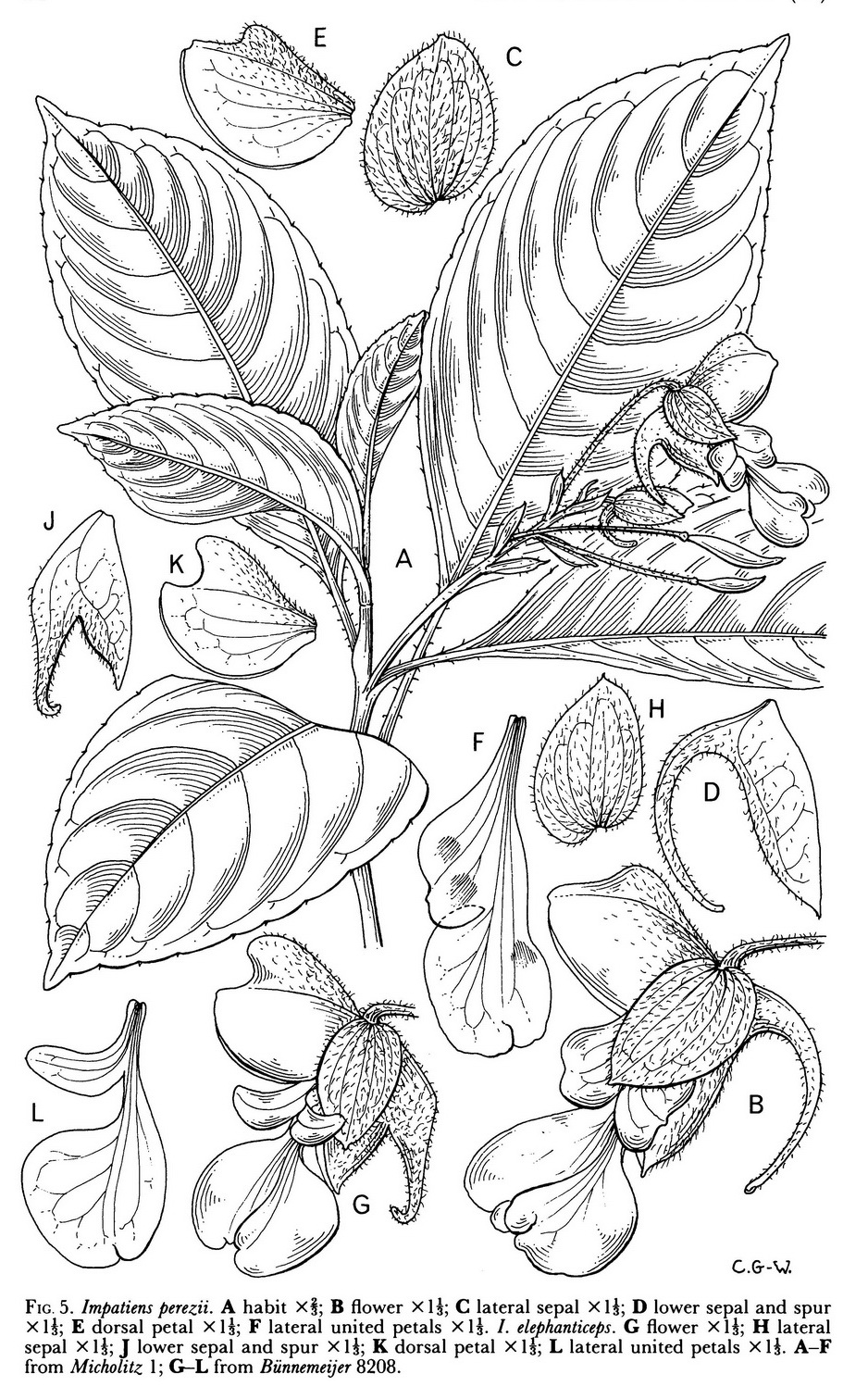
FIG. 5. Impatiens perezii

GREY-WILSON, C. 1989. A revision of Sumatran Impatiens. Studies on Balsaminaceae VII. Kew Bull. 44: 67-106.: http://www.jstor.org/stable/4114646

[Ichthyology • 2011] Protoanguilla palau • A 'living fossil' eel (Anguilliformes: Protoanguillidae, fam. nov.) from an undersea cave in Palau


Protoanguilla palau
Johnson, Ida, Sakaue, Sado, Asahida & Miya, 2011

Abstract
We report the discovery of an enigmatic, small eel-like fish from a 35 m-deep fringing-reef cave in the western Pacific Ocean Republic of Palau that exhibits an unusual suite of morphological characters. Many of these uniquely characterize the Recent members of the 19 families comprising the elopomorph order Anguilliformes, the true eels. Others are found among anguilliforms only in the Cretaceous fossils, and still others are primitive with respect to both Recent and fossil eels. Thus, morphological evidence explicitly places it as the most basal lineage (i.e. the sister group of extant anguilliforms). Phylogenetic analysis and divergence time estimation based on whole mitogenome sequences from various actinopterygians, including representatives of all eel families, demonstrate that this fish represents one of the most basal, independent lineages of the true eels, with a long evolutionary history comparable to that of the entire Anguilliformes (approx. 200 Myr). Such a long, independent evolutionary history dating back to the early Mesozoic and a retention of primitive morphological features (e.g. the presence of a premaxilla, metapterygoid, free symplectic, gill rakers, pseudobranch and distinct caudal fin rays) warrant recognition of this species as a ‘living fossil’ of the true eels, herein described as Protoanguilla palau genus et species nov. in the new family Protoanguillidae.

Keywords: eel; morphology; phylogeny; new species, genus and family; divergence time


Figure 1. Protoanguilla palau. (a) Holotype, NSMT-P 98249 female, 176 mm SL. (b–g) Paratype USNM 396016 juvenile, 65 mm SL: (b) whole specimen; (c,d) head in lateral and ventral view, respectively; (e) close-up of tubular gill opening, left side in ventral view; (f) alizarin red-stained body scales along lateral midline (lateral-line scales are forming in alcian blue-stained areas); (g) USNM 396051, 150 mm SL, alizarin red-stained, close-up of lace-like, tubular lateral-line scale.


Protoanguilla palau

• A primitive-looking eel from an undersea cave in Palau retains ancient Dinosaur-Era features.
• Since the eel's history goes back 200 million years, with few bodily changes occurring over that time, scientists refer to it as a "living fossil."
• The eel's only known habitat is the Palau cave, so it could be highly endangered.


Johnson, G. D.; Ida H., Sakaue J., Sado T., Asahida T. & Miya M. (2011). "A 'living fossil' eel (Anguilliformes: Protoanguillidae, fam nov) from an undersea cave in Palau". Proceedings of the Royal Society B (in press). doi: http://dx.doi.org/10.1098/rspb.2011.1289 Retrieved 17 August 2011.

Media:
• 'Living Fossil' Retains Dinosaur-Era Look : Discovery News http://news.discovery.com/animals/eel-living-fossil-110816.html
• 'Fossil eel' squirms into the record books http://www.physorg.com/news/2011-08-fossil-eel-squirms.html
• New species of dinosaur-era eel wriggles into history books as a 'living fossil': http://www.dailymail.co.uk/sciencetech/article-2026935/New-Pacific-eel-living-fossil-Protoanguilla-Palau-200m-years-old.html

Wednesday, August 17, 2011

[Ichthyology • 1980] Revision of the Asian Mastacembelid Fish Genus Macrognathus


3 species of Macrognathus
• Macrognathus aculeatus — the southern Malay peninsula, Sumatra, Borneo and Java
• Macrognathus aral — the Indian subcontinent, including Sri Lanka and Burma
• Macrognathu siamensis — the Chao Phrya and Mekong basins of Thailand and Kampuchea (Cambodia)

Abstract
The highly specialized Asian mastacembelid genus Macrognathus, hitherto considered monotypic, comprises three morphologically distinct species with nearly contiguous ranges: M. aral, from the Indian subcontinent, including Sri Lanka and Burma; M. siamensis, from the Chao Phrya and Mekong basins of Thailand and Kampuchea, and the northernmost part of the Malay peninsula; and M. aculeatus, from the southern Malay peninsula, Sumatra, Borneo and Java. The species differ sharply in number of rostral toothplates and other meristic characters as well as in coloration. The specific status of M. aculeatus from Java, and that of M. dhanashorii from Assam (placed here as a synonym of M. aral), should be reconsidered when adequate study material becomes available. Mastacembelidae form two groups, possibly phyletic, based on structure of the rim of the anterior nostril. All or almost all African Mastacembelus and several Asian species (usually the larger species, including M. mastacembelus) have the nostril rim with two flaps and two fimbriae, whereas Macrognathus and several smaller species of Asian Mastacembelus (including M. pancalus and M. circumcinctus) have the nostril rim with six fimbriae.


Roberts, Tyson R. (1980). "A Revision of the Asian Mastacembelid Fish Genus Macrognathus". Copeia (American Society of Ichthyologists and Herpetologists) 1980 (3): 385–391. doi:10.2307/1444512. JSTOR http://jstor.org/stable/1444512.

[Ichthyology • 2005] ปลาหลดพรุ | Macrognathus tapirus • Kalimantan Barat (Borneo), Indonesia


ปลาหลดพรุ | Macrognathus tapirus
Kottelat & Widjanarti, 2005

Occurs in rivers among leaf litter or dense vegetation, over muddy substrate.
Feeds on insects and crustaceans

Kottelat, M. and E. Widjanarti. 2005. The fishes of Danau Sentarum National Park and the Kapuas Lakes area, Kalimantan Barat, Indonesia. Raffles Bull. Zool. Supplement (13):139-173.


[Ichthyology • 2008] Macrognathus pentophthalmos Gronow | Sri Lankan spiny eel (Teleostei: Mastacembelidae), and its enigmatic decline


Macrognathus pentophthalmos


Abstract
The Sri Lankan population of the spiny eel previously assigned to Macrognathus aral Schneider (Teleostei: Mastacembelidae) is shown to be a distinct species, for which the name M. pentophthalmos Gronow is available. Macrognathus pentophthalmos is distinguished from its closest congener, M. aral, by having 14–16 dorsal spines and a pre-dorsal length of 43.3–46.8% of standard length (SL) (vs. dorsal spines 18–22 and pre-dorsal length 35.5–40.8% SL in M. aral). Macrognathus pentophthalmos differs from its only other Indian congener, M. guentheri Day, among other characters, by having 24 pairs of rostral tooth plates (vs. rostral tooth plates absent). With the present designation of a neotype, Rhynchobdella orientalis Bloch & Schneider (type locality East Indies to Sri Lanka) becomes an objective junior synonym of M. aculeatus Bloch. Although assessed as ‘common’ in 1980, the population of M. pentophthalmos suffered a precipitous decline in the following decade, the causes of which are unknown. The species may now be extinct.

Key words: Macrognathus aral, Macrognathus guentheri, Macrognathus malabaricus, Macrognathus ocellatus, Macrognathus orientalis, neotype

Pethiyagoda, R. Silva, A. Maduwage, K & Kariyawasam, l. 2008. The Sri Lankan spiny eel, Macrognathus pentophthalmos (Teleostei: Mastacembelidae), and its enigmatic decline. Zootaxa, 1931: 37-48.: http://mapress.com/zootaxa/2008/f/z01931p048f.pdf


[Ichthyology • 2009] Macrognathus pavo • from Rakhine Yoma mountain range in western Myanmar


Macrognathus pavo differs from all other Asian mastacembelids by the presence of only 4-6 dorsal-fin spines (vs 11-42).

A characteristic feature of spiny eels is their long snouts or trunks which are highly sensitive and are used to probe around for insects and worms. © Ralf Britz


Macrognathus pavo make alert and attractive aquarium subjects. © Ralf Britz

Macrognathus pavo is only known from this mountain stream, Kyeintali Chaung in the Rakhine Yoma mountain range in western Myanmar. © Ralf Britz


ปลาหลดลายนกยูง: Macrognathus pavo
Macrognathus pavo : nhm.ac.uk Species of the day


The first images of live individuals of 4 new spiny eels from Myanmar and India identified by Museum scientist Dr Ralf Britz. From the top they are Macrognathus pavo, M. dorsiocellatus, M. obscurus and M. lineatomaculatus. © Photo of M. obscurus courtesy of Ye Hein Htet

First images of 4 new spiny eels | http://t.co/uQoIAY6 via Natural History Museum


Abstract

The species of the Macrognathus aculeatus group from Myanmar are reviewed and three new species are described. Macrognathus dorsiocellatus, new species, previously identified as M. aral, is distinguished by rostral tooth plates 19-23, dorsal fin spines 14-22, 7-11 small ocelli along soft dorsal fin, with ventrally open, incomplete white rim; M. obscurus, new species, is distinguished by rostral tooth plates 8-10, dorsal fin spines 20-22, ocelli along dorsal fin developed as small irregularly arranged dark spots or absent, M. pavo, new species, is distinguished by the presence of only 4-6 dorsal-fin spines, only 6-8 rostral tooth plates and details of the colour pattern. In addition, M. lineatomaculatus, new species, is described from India and Nepal and it is distinguished by rostral tooth plates 15-17, dorsal fin spines 19-22, and large black blotches along dorsal fin. The systematic position of M. caudiocellatus is reviewed and the species is retransferred to Mastacembelus.

Britz, R. 2009. Species of the Macrognathus aculeatus group in Myanmar with remarks on M.caudiocellatus (Teleostei: Synbranchiformes: Mastacembelidae). Ichthyological Exploration of Freshwaters. 20: 295-308.


Tuesday, August 16, 2011

[Ichthyology • 2009] Macrognathus lineatomaculatus • Ayeyarwaddy, Myanmar


Macrognathus lineatomaculatus Britz, 2009


ปลาหลด: Macrognathus lineatomaculatus


The first images of live individuals of 4 new spiny eels from Myanmar and India identified by Museum scientist Dr Ralf Britz. From the top they are Macrognathus pavo, M. dorsiocellatus, M. obscurus and M. lineatomaculatus. © Photo of M. obscurus courtesy of Ye Hein Htet

First images of 4 new spiny eels | http://t.co/uQoIAY6 via Natural History Museum


Abstract

The species of the Macrognathus aculeatus group from Myanmar are reviewed and three new species are described. Macrognathus dorsiocellatus, new species, previously identified as M. aral, is distinguished by rostral tooth plates 19-23, dorsal fin spines 14-22, 7-11 small ocelli along soft dorsal fin, with ventrally open, incomplete white rim; M. obscurus, new species, is distinguished by rostral tooth plates 8-10, dorsal fin spines 20-22, ocelli along dorsal fin developed as small irregularly arranged dark spots or absent, M. pavo, new species, is distinguished by the presence of only 4-6 dorsal-fin spines, only 6-8 rostral tooth plates and details of the colour pattern. In addition, M. lineatomaculatus, new species, is described from India and Nepal and it is distinguished by rostral tooth plates 15-17, dorsal fin spines 19-22, and large black blotches along dorsal fin. The systematic position of M. caudiocellatus is reviewed and the species is retransferred to Mastacembelus.

Britz, R. 2009. Species of the Macrognathus aculeatus group in Myanmar with remarks on M.caudiocellatus (Teleostei: Synbranchiformes: Mastacembelidae). Ichthyological Exploration of Freshwaters. 20: 295-308.


[Ichthyology • 2009] Macrognathus dorsiocellatus from Upper Ayeyarwaddy Drainage, Myanmar • Species of the Macrognathus aculeatus group (Synbranchiformes: Mastacembelidae) in Myanmar


Macrognathus dorsiocellatus Britz, 2009


Abstract
The species of the Macrognathus aculeatus group from Myanmar are reviewed and three new species are described. Macrognathus dorsiocellatus, new species, previously identified as M. aral, is distinguished by rostral tooth plates 19-23, dorsal fin spines 14-22, 7-11 small ocelli along soft dorsal fin, with ventrally open, incomplete white rim; M. obscurus, new species, is distinguished by rostral tooth plates 8-10, dorsal fin spines 20-22, ocelli along dorsal fin developed as small irregularly arranged dark spots or absent, M. pavo, new species, is distinguished by the presence of only 4-6 dorsal-fin spines, only 6-8 rostral tooth plates and details of the colour pattern. In addition, M. lineatomaculatus, new species, is described from India and Nepal and it is distinguished by rostral tooth plates 15-17, dorsal fin spines 19-22, and large black blotches along dorsal fin. The systematic position of M. caudiocellatus is reviewed and the species is retransferred to Mastacembelus.


Macrognathus dorsiocellatus
Paratype: NRM 58205
MYANMAR: Barlar Chaung, approximately 40 km (25 miles)
on the way from Yangon northeast to Bago
Date collected: 15 Mar 2008
Artist: Kajrup, B


The first images of live individuals of 4 new spiny eels from Myanmar and India identified by Museum scientist Dr Ralf Britz. From the top they are Macrognathus pavo, M. dorsiocellatus, M. obscurus and M. lineatomaculatus. © Photo of M. obscurus courtesy of Ye Hein Htet

First images of 4 new spiny eels | http://t.co/uQoIAY6 via Natural History Museum


Britz, R. 2009. Species of the Macrognathus aculeatus group in Myanmar with remarks on M.caudiocellatus (Teleostei: Synbranchiformes: Mastacembelidae). Ichthyological Exploration of Freshwaters. 20: 295-308.

[Ichthyology • 2009] Macrognathus obscurus • from Upper Ayeyarwaddy Drainage, Myanmar


Macrognathus obscurus Britz, 2009


Macrognathus obscurus

HOLOTYPE: NRM 36330
MYANMAR: Ayeyarwaddy River drainage: Hpa Lap Chaung just S of Yuzana Myaing village (8 km left from Myitkyina-Myitzon rd km 11)
Date collected: 1 Apr 1997
Artist: Kajrup, B


ปลาหลด Macrognathus lineatomaculatus


The first images of live individuals of 4 new spiny eels from Myanmar and India identified by Museum scientist Dr Ralf Britz. From the top they are Macrognathus pavo, M. dorsiocellatus, M. obscurus and M. lineatomaculatus. © Photo of M. obscurus courtesy of Ye Hein Htet

First images of 4 new spiny eels | http://t.co/uQoIAY6 via Natural History Museum


Abstract

The species of the Macrognathus aculeatus group from Myanmar are reviewed and three new species are described. Macrognathus dorsiocellatus, new species, previously identified as M. aral, is distinguished by rostral tooth plates 19-23, dorsal fin spines 14-22, 7-11 small ocelli along soft dorsal fin, with ventrally open, incomplete white rim; M. obscurus, new species, is distinguished by rostral tooth plates 8-10, dorsal fin spines 20-22, ocelli along dorsal fin developed as small irregularly arranged dark spots or absent, M. pavo, new species, is distinguished by the presence of only 4-6 dorsal-fin spines, only 6-8 rostral tooth plates and details of the colour pattern. In addition, M. lineatomaculatus, new species, is described from India and Nepal and it is distinguished by rostral tooth plates 15-17, dorsal fin spines 19-22, and large black blotches along dorsal fin. The systematic position of M. caudiocellatus is reviewed and the species is retransferred to Mastacembelus.

Britz, R. 2010. Species of the Macrognathus aculeatus group in Myanmar with remarks on M.caudiocellatus (Teleostei: Synbranchiformes: Mastacembelidae). Ichthyological Exploration of Freshwaters. 20: 295-308.